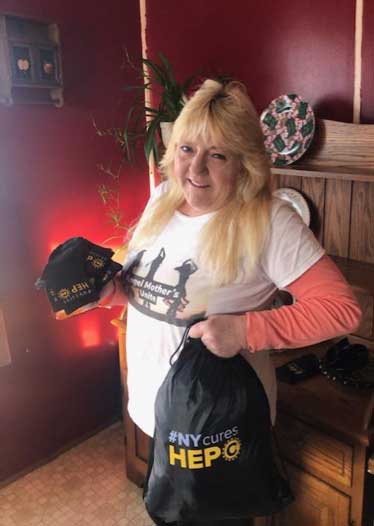
Provided photo: Tammi Bale of Clarendon has collected socks the past four years in memory of her son, Robert Bale. She donates them to the Open Door Mission in Rochester.
There is currently no vaccine available to prevent Hepatitis C, but early diagnosis of Hepatitis C is important as it can prevent serious liver problems.
Approximately 3.2 million people in the U.S. have chronic Hepatitis C, but most do not know that they are infected. This is exactly why testing is so important!
Hepatitis C is primarily spread through contact with blood from an infected person, even in amounts too small to see. People with Hepatitis C often have no symptoms. If symptoms do occur, they can be a sign of advanced liver disease (such as cirrhosis or scarring of the liver).
“Hepatitis C is a leading cause of liver cancer and the leading cause of liver transplants,” stated Brenden Bedard, deputy director of Genesee and Orleans County Health Departments.
New treatments for Hepatitis C are available and more are in development. Today, chronic Hepatitis C Virus (HCV) is usually curable with oral medications taken every day for two to six months. According to the Department of Health and Human Services, “The homeless population is disproportionately impacted by HCV infection, with an estimated prevalence of 22% to 53% percent.” (Dan, 2018).
Hepatitis C testing is recommended if you,
• Were born from 1945 through 1965
• Injected drugs
• Received donated blood or organs before 1992
• Have been exposed to blood on the job through a needle stick injury with a sharp object
• Have medical conditions, such as chronic liver disease or HIV/AIDS
To increase awareness about Hepatitis C, the Genesee and Orleans County Health Departments are donating socks to Tammi Bale who operates the “Just Socks, Ma” Campaign, collecting socks to donate to those in need in memory of her son Robert Bale who passed away of a drug overdose in 2016.
“These socks read #NYCuresHepC and is a reminder to get tested and that a cure is available to those who need it,” Bedard said. “It’s a small way to give back to the community this holiday season and increase a valuable message.”
Bale has done an annual sock drive the past four years. Last year she donated 1,583 pairs to the Open Door Mission in Rochester. She does the sock drive in memory of her son, who was 28 when he died.
“I wasn’t able to help him because I didn’t know anything was wrong (substance use disorder),” she said. “He had a good job, was working 50 hours a week and had just gotten a raise. No one knew his secret, not even his roommate. It’s good to try to find out what is happening in your child’s life so this doesn’t happen. This campaign makes me happy and will hopefully make Robert proud.”
Tammi is also giving back by operating a Facebook group named “Angel Mothers Unite” providing uplifting messages to those who need it.
‘Vaping is a public health crisis, claiming too many lives and making countless others sick in a short period of time.’ – Gov. Cuomo said.
Press Release, Gov. Andrew Cuomo’s Office
Governor Andrew M. Cuomo today announced the 15th proposal of his 2020 State of the State agenda: legislation banning all flavored nicotine vaping products including menthol flavors and vaping advertisements aimed at youth.
The legislation would also authorize the State Department of Health to regulate the sale of chemicals used in vaping-related products and ban the sale of vaping product carrier oils deemed to be a public health risk.
Finally, the legislation would prohibit the online, phone and mail order sale of e-cigarettes; only registered retailers would be allowed to purchase e-cigarettes using those methods.
“Vaping is a public health crisis, claiming too many lives and making countless others sick in a short period of time,” Governor Cuomo said. “The problem is made worse by unscrupulous vaping companies who are targeting young people with candy flavored products like Cotton Candy and Bubble-gum and other marketing ploys. While the federal administration continues its empty rhetoric on an issue impacting more than a quarter of all high school students, in New York we’re using every tool at our disposal to keep help children safe and stop them from forming an unhealthy and potentially deadly lifelong addiction.”
Ban the Sale of Flavored Nicotine Vaping Products
The Governor will introduce legislation banning the sale of all flavored nicotine vaping products, including menthol — an extension of the State’s ongoing efforts to reduce youth use of both tobacco and vaping products. Nearly 40 percent of 12th grade students and 27 percent of all high school students are now using e-cigarettes, with this increase largely driven by flavored e-liquids used in vaping devices. With this ban New York continues to lead the charge on limiting the use of flavorings in all vaping products and provide critical support to local communities who are fighting this growing epidemic.
Restrict Vaping Ads Targeted to Youth
In addition to restricting the sale of flavors that appeal to kids, the Governor’s legislation will ban all vaping-related ads targeted to youth, including those in more traditional forms of advertising such as newspapers and magazines, as well as in digital formats in periodicals, social media and on websites with significant youth viewership. Advertisers will also not be allowed to make vaping product safety claims or pitch vaping products as smoking cessation options without FDA-approval.
Ban Harmful Unregulated Carrier Oils
Following the alarming number of hospitalizations and deaths involving patients who had reported a history of using e-cigarettes or vaping products, Vitamin E acetate — which is sometimes used as an e-liquid diluent — has been identified as a chemical of concern. In order to quickly respond to the proliferation of these dangerous, untested and unregulated chemicals used in vaping related products, the Governor will also advance legislation to empower the Department of Health to ban the sale of vaping carrier oils that include chemicals or ingredients that when inhaled through a vaping device are deemed to be dangerous and a significant public health risk.
Limit Online Sale of Vaping Products
The current sale of e-liquids and e-cigarettes through online, phone and mail order allows underage youth to purchase products unlawfully and circumvent sales taxes. Therefore, the Governor will advance legislation restricting the online, phone and mail order sale of e-liquids and e-cigarettes only to licensed vaping product retailers. Only registered retailers would be allowed to purchase e-cigarettes using those methods. This restriction, which already applies to the sale of conventional tobacco products, will help stop the illegal sale of dangerous vaping products to underage purchasers.
Governor Cuomo has taken unprecedented steps to ensure the health and safety of all New Yorkers by combatting the use of harmful tobacco and nicotine products. In 2017, Governor Cuomo expanded the Clean Indoor Air Act to prohibit e-cigarette use in nearly every workplace to protect workers and the public from harmful secondhand tobacco smoke and vaping aerosols.
In 2019, e-liquid retailers were required to register with the Department of Taxation and Finance and a 20 percent sales tax on e-liquids will be imposed. In November of 2019, the legal age for purchasing tobacco and e-cigarette products was raised to 21, further discouraging youth from accessing the products. Moreover, at the Governor’s direction, DTF will triple the number of regulatory inspections of retailers authorized to sell tobacco products from 2018.
By Tom Rivers, Editor Posted 29 December 2019 at 9:11 am
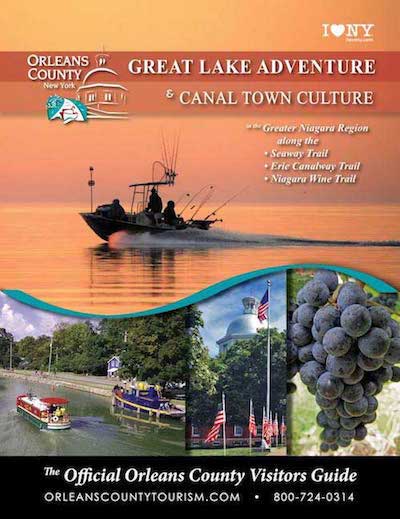
Courtesy of Orleans County Tourism Department: The visitor’s guide for Orleans County promotes “Great Lake Adventure & Canal Town Culture.” The guide also touts the county’s presence on the Seaway Trail, Erie Canalway Trail and Niagara Wine Trail.
ALBION – The Orleans County Tourism Department will be promoting county attractions at several upcoming out-of-state travel shows.
Dawn Borchert, the county’s tourism director, will be attending the shows on behalf of the county.
The County Legislature authorized attendance at the following travel and trade shows:
• Fly Fishing Show, Edison, NJ, January 25-28 with total cost to be paid by Lake Ontario Sportfishing Promotion Council.
• Great American Outdoor Show, Harrisburg Pa., January 30 to Feb. 4 with cost to be paid by Lake Ontario Sportfishing Promotional Council.
• AAA Great Vacation Travel Expo, Columbus, OH, February 6-11 with cost to be paid by New York State Tourism Industry Association.
• Pittsburgh Car Show, Pittsburgh, Pa., February 12-18 with cost to be paid by New York State Tourism Industry Association.
• The Outdoor Adventure Show, Mississauga, ONT Canada, February 20-25 with cost to be paid by New York State Tourism Industry Association.
• AAA Vacation Expo, Cleveland, OH, Oct. 16-20 to be paid by New York State Tourism Industry Association.
The County Legislature also has renewed contracts with Lynne Menz Designs for tourism work in 2020. Menz will be paid $18,720 for tourism coordination services in 2020 and up to $22,000 for design services in 2020.
This agreement includes costs associated with advertising design, publication design, social media, photography and video production to be paid on a project basis from I Love New York tourism funding.
AAA wants to remind everyone to be extra vigilant this holiday season and to enjoy New Year’s Eve festivities responsibly.
Drunk and drug-impaired driving are serious issues impacting traffic safety year-round, yet, it worsens over the holidays. According to the National Highway Traffic Safety Administration, “during the New Year’s and Christmas periods in 2018, there were 285 drunk-driving-related fatalities.”
AAA Western and Central New York recognizes the impact that more than 50 years of public education efforts against alcohol-impaired driving have had across the country. “AAA has made traffic safety a priority since 1921, working to make roads, vehicles and drivers safer,” said Tony Spada, AAA WCNY president and CEO. Those campaigns helped to achieve changes to alcohol-impaired driving laws, increased enforcement, and, critically, a shift in public attitudes and behaviors toward drinking and driving.
Although much more still needs to be done, anti-drunk driving campaigns and related efforts have helped cut the number of alcohol-impaired crash fatalities in half since the 1980s, according to the National Institutes of Health.
AAA is reminding motorists to be aware of the dangers of drunk driving, especially before they get caught up in holiday excitement and to plan ahead to avoid getting behind the wheel while intoxicated.
Being prepared is essential. Abstaining from alcohol and substances or having a safe ride home are two options that allow you to enjoy the holidays while being responsible. It’s imperative that drivers take steps to stay off the road if they are impaired. Follow these tips to keep roads safer for drivers, passengers and pedestrians:
For drivers
Choose a designated driver before you go out.
Use a ridesharing service.
Use a local taxi service.
Stay with a friend or book a nearby hotel room if you are impaired.
Visit Roadwise Rx to see how your medications affect safe driving.
For hosts
Offer non-alcoholic drink options and never serve minors.
Stop serving alcohol well before the party ends.
Remind guests to plan ahead and designate a sober driver.
Don’t be afraid to take car keys away from guests who are too impaired to drive.
Help arrange alternate transportation or accommodations for guests who need it.
For everyone
Always wear your seat belt. The NHSTA estimates that almost 15,000 lives were saved in 2017, and out of the 37,000 people fatally harmed in crashes, 47 percent were not wearing seat belts.
If you spot someone who appears to be an impaired driver when you are on the road, keep a safe distance and call 9-1-1 if it is safe to do so. Do not attempt to stop the vehicle yourself.
I preface this post by putting it out there that New Year’s Eve is my favorite night of the year! All kinds of rituals are performed from reflecting to toasting. But once The Ball starts to drop on December 31 at 11:59 p.m. … 10,9,8 … and the countdown begins, we all start to scramble looking for someone to pucker up with.
Why is it that we want to kiss someone at midnight on December 31st? If you are lucky you won’t have to search too far. As you near midnight make sure you are surrounded by a lot of fun and familiar people to better your odds of sneaking in a smooch.
If you do not have a special someone and are unsure of how to snag a kiss, I did some research to help you and discovered the “Hug Technique.” Give someone a big hug and then perhaps it might build a bridge to a kiss! Now I have not read, with 100 percent certainty, that a kiss has to be on lips. Although that would be ideal, I think a kiss on the cheek is just as sweet! This tradition has been traced back to Europe.
The New Year’s Kiss is meant to bring good luck for the future, especially with the one we kiss. This left me wondering what other nationalities are doing at midnight on New Year’s Eve. I read in Spain that it is common to eat 12 grapes at midnight. Each grape is meant to bring good luck for the following 12 months. Or in Brazil they wear special-colored underwear on New Year’s Eve. Red undees desire love and yellow undees desire money.
Another fun one from Denmark is that they jump off chairs at midnight as a way to leap into the New Year with good luck. All these traditions have one common thread. They are hoping fate will bring them good luck and happiness in the upcoming year. Being a somewhat superstitious person I want to cover all my bases.
This New Year’s Eve I feel it might be prudent at midnight to jump off a chair in red and yellow striped undees while eating 12 grapes quickly, only to land into the arms of My True Love and share a New Year’s Kiss. Of course this is all silliness which I hope brings you a smile to start year 2020.
The end of 2019 leaves us reflecting on what we did well in 2019 and what more we want to accomplish in 2020. However you celebrate New Year’s this year, I resolve that it is the beginning of the best year for all of us – full of good vibes, grand adventures and much gratitude for what we have. Happy New Year’s to everyone!!
Happy Perks to everyone! To view my blog live online and share any of your New Year’s resolutions just go to https://www.positiveperksposts.com were you can also join in, like and share your comments.
Truly,
Debbie Burgoon London
Your Sassy Small Town Missus from Albion
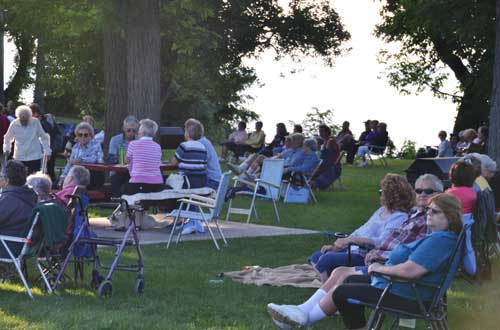
File photo: About 200 people attended a concert at the Yates Town Park by Lake Ontario in July 2014. The park is at the end of Morrison Road. The town was awarded a $2.5 million state grant for the park.
YATES – The Town of Yates is exploring how best to take advantage of the $2.531 million grant awarded for the Yates Town Park by the NY State Resiliency and Economic Development Initiative (REDI) Commission.
The REDI grant authorizes the Town of Yates to develop shoreline resiliency upgrades such as jetties, a kayak launch, and a safe harbor for watercraft, and to add park amenities such as a handicap-accessible playground, additional parking for cars and horse-drawn carriages, safety and security measures, a nature walkway, restrooms and a pavilion.
The Town of Yates was in the process of expending a $414,500 state grant for shoreline remediation caused by the 2017 flooding when the REDI Commission called for proposals in June for enhancing resiliency and economic development initiatives along the Lake Ontario shoreline due to additional flooding in 2019.
“This grant provides a much-needed shoreline resiliency upgrade and comes at a time when the Town of Yates is poised to take advantage of the fruits of multiple community-wide planning efforts to enhance the park experience for future generations,” said Jim Simon, Town Supervisor.
“The Town’s REDI grant application was based on ideas generated from the recently revised and adopted Yates-Lyndonville-Ridgeway-Medina-Shelby Western Orleans Comprehensive Plan, the ongoing Yates-Carlton-Kendall-Lyndonville Local Waterfront Revitalization Program revision efforts, and the work of the Yates Town Park Task Force,” Supervisor Simon said.
The Yates Town Park Task Force has met several times since June 2019 to help develop and refine the park proposal. Members include Russ Martino, Georgette Stockman, Paul Lauricella, Anne Marie Holland, Linda Fisk, Highway Superintendent Roger Wolfe, Town Engineer Jon Hinman (MRB Group), Councilman John Riggi, and Supervisor Jim Simon.
The goal of the task force is to make recommendations to the Town Board for final design and related suggestions. The final meeting of the Task Force is January 6 from 5 to 7 p.m. at the Yates Town Hall at 8 South Main St. The meeting is open to the public but only Task Force members will participate, with an option for the public to ask questions once the meeting adjourns.
The Town of Yates is tentatively planning on a public forum followed by a public hearing on Feb. 10 at 7 p.m., at the Town Hall. Yates residents can get the latest updates about the park proposal on the town website (townofyates.org) and may submit ideas about the town park via email to jamesjsimon11@gmail.com.
The Yates Town Board will vote on the final design of the project no later than its March 12 board meeting in order to meet the REDI Commission grant acceptance deadline of March 16.
Governor Andrew M. Cuomo unveiled the 14th proposal of his 2020 State of the State agenda – increasing transparency in healthcare costs.
Under this proposal, Governor Cuomo will direct the Department of Health, the Department of Financial Services and the New York State Digital and Media Services Center – a joint enterprise of the Office of Information Technology Services and Office of General Services – to create a consumer-friendly website, called NYHealthcareCompare, where New Yorkers can easily compare the cost and quality of healthcare procedures at hospitals around the state.
The platform will also provide consumers with educational resources designed to help consumers know their rights including financial assistance options, what to do about a surprise bill and more.
“New York has made tremendous progress protecting consumers from unreasonably expensive medical care,” Governor Cuomo said. “But the cost of many healthcare procedures has risen in recent years in part because consumers don’t have an easy way to compare prices at different hospitals in their area. This new website will give New Yorkers the facts they need to make informed decisions about the cost and quality of healthcare procedures – helping increase competition in the marketplace and driving down prices.”
Governor Cuomo has taken nation-leading steps to protect consumers from high medical costs. In 2014, the Governor signed first-in-the-nation legislation to protect consumers from surprise bills for out-of-network costs, and in 2019 the Governor signed legislation further extending these protections. Governor Cuomo has also supported making information about healthcare services available to the public. With the development of the All Payer Database system, New York is entering a new era of cutting-edge healthcare research and transparency in healthcare costs and delivery.
However, the burden of healthcare costs is increasingly falling to consumers, and there are increasing demands for reliable information for decisions, especially for planned services where there is a choice. The cost of planned services can vary widely within a region.
For consumers to be empowered to shop for healthcare services, consumers first need to be aware that there is a trusted source of information that is presented in a user-friendly and accessible way. Existing information is scattered across websites. Consumers cannot easily find what they are looking for, leading them to give up on finding the information they need.
This new website will allow consumers to easily shop for healthcare services and understand their rights all in one site, empowering New Yorkers to become educated consumers of healthcare services and choose the healthcare facility that fits their needs. The website would also enable consumers to:
• See cost, quality and volume data by specific hospital;
• Search by medical procedure costs;
• Search affordability questions; and
• Search laws and programs to help New Yorkers with medical bills, health insurance complaints, hospital complaints and practitioner/provider complaints.
By Matthew Ballard, Orleans County Historian Posted 28 December 2019 at 8:49 am
“Overlooked Orleans” – Vol. 5, No. 48
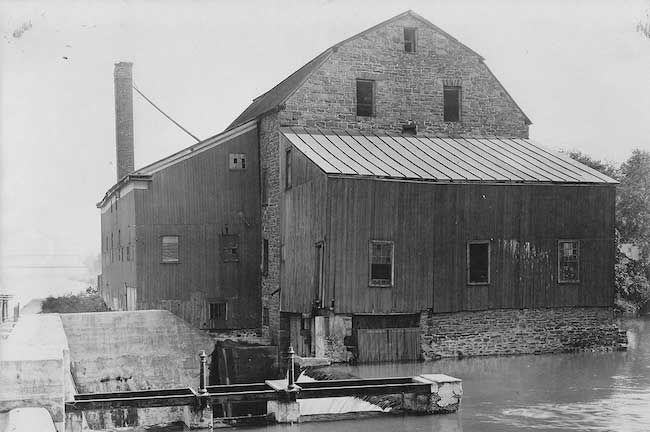
ALBION – This image, taken in the early 1920s, shows the Woods & Sprague Mill located on East State Street in Albion. The mill relied largely on water from the West Branch of Sandy Creek, which passes under the Erie Canal at this location. Looking east, the Brown Street Canal Bridge is visible in the distance and the image is part of a series that shows leakage from the Canal into the foundation of the mill.
The history of this mill dates back 1819 when William Bradner purchased 266.5 acres of land from the Holland Land Company for the sum of $1,159.00. According to Arad Thomas, Bradner relocated from Palmyra and purchased several lots of land including Lot 35 from William McAllister. Aside from the construction of an early sawmill, Bradner’s grist mill included mill stones which he personally cut by hand in Palmyra.
Grist mills provided an essential service to local farmers, particularly in the years preceding the construction of the Erie Canal. According to Gaines pioneer John Proctor, the closest grist mill to his property was Black Creek, nearly 25 miles away. However, the path to that mill was so difficult to traverse that the 30-mile trek to Rochester was much faster.
Arad Thomas noted in the Pioneer History of Orleans County that “the people of Kendall took their grain to Rochester, or to Farwell’s mill in Clarendon, to be ground. Farwell’s mill was much nearest, but the road to it was almost impassable with a load, and the little mill had not capacity to do all the work in that part of the country.” In response, residents constructed grist mills within their community; Ose Webster constructed a mill at Kendall Mills around 1819 which resolved the travel constraints highlighted by Thomas.
In colonial New England, the grist mill provided its owner with a symbol of status in the community. Millwrights possessed skills that bridged across the talents of carpenters, smiths, and masons, making their work far more valuable and desirable than blacksmiths. As bread represented a dietary staple, millwrights and millers were often viewed as life-givers in their communities.
The same held true for early mill owners in Orleans County. Needing flour to sustain their families, local grist mills provided farmers with the ability to grind wheat into flour and corn into meal. With little means of transporting surplus crops to market, many mills operated in conjunction with distilleries until the Erie Canal opened in 1825.
A land deed from 1834 shows a transfer of ownership from Freeman Clarke to Joshua Rathbun for the sum of $10,000 – quite the increase in value from Bradner’s 1819 purchase price. Rathbun would eventually share “mill privilege” with Roswell Clark in an 1844 deed transfer for the sum of $10.00 at which point the records reference Bradner’s “old grist mill.” That same year, the property was sold at public auction to Alexis Ward for the sum of $2,000.
An 1849 advertisement in the Rochester Daily Democrat advertised the sale of the building, noting the mill was “propelled by water and steam, or either…it has four runs of 4.5 ft stone. Custom and Merchant Bolts mostly new and everything in good running order. A large and commodious warehouse has been recently added, and a storehouse for barrels.”
The mill lot was sold to Orson Tousley from Wilson & Ward in 1853 for $12,200 and John B. Lee was brought in as a partner in 1855 when he purchased half-interest for $6,000. Tousley & Lee sold out to Jerome Lee, John Lee’s nephew, in 1858 and the property once again sold to Hannah Smith in 1879. George Sprague purchased the lot from Smith in 1886, thus starting the line of ownership that would lead to the Woods & Sprague partnership.
Once located behind the present-day Community Action building on East State Street, an August 23, 1934 article in the Medina Tribune highlights the last legs of this historic structure. “A modern structure having supplanted it, the more than century-old Woods and Sprague grist mill in Clarendon Street between the Barge Canal and East State Street, which marks the birthplace of milling in Albion, is being torn down.”
By Tom Rivers, Editor Posted 27 December 2019 at 8:35 pm
Photos by Tom Rivers: Heather Drew is co-owner of The Snack Shack at 50 North Main St. in Albion. She and Donald Buchanan started The Snack Shack this past summer at Hamlin Beach State Park. They decided to keep the business going in Albion.
ALBION – This summer, Heather Drew and her boyfriend Donald Buchanan ran the restaurant at Hamlin Beach State Park. Their business, The Snack Shack, proved popular at the state park.
“We got the best feedback in the world,” Drew said today.
When the season ended, the Albion couple looked for a spot for The Snack Shack in their hometown, and found that 50 North Main St., the Hazy Jade Gift Shop’s location for several years, was available. Drew and Buchanan opened in October.
Donald Buchanan and Heather Drew have a food trailer behind the Main Street building where the food is cooked. They plan to take the food trailer to special events in 2020.
In November, they added a food trailer behind the Main Street building. That is where the food is cooked. They do a lot of the food prep at Brightly’s Farm Market in Hamlin, where ther eis a commercial kitchen. Drew’s mother, Elizabeth Brightly, runs the farm market in Hamlin.
The Snack Shack is open Wednesdays through Saturdays from 11 a.m. to 2 p.m., and then from 5 to 8 p.m. Most of the orders are takeouts, but there is dining available. The Snack Shack offers free delivery within the Village of Albion.
Heather Drew peeks through the window of the food trailer. She has worked in the food business half of her life, beginning when she was 17.
Drew and Buchanan each have many years working in the food service business. Buchanan, 30, spent a decade at Uncle Sal’s in Albion. Drew, 33, started as a hostess at a restaurant when she was 17. She would later work as a bar manager at the former Crooked Door Tavern.
The couple was going at a brisk pace today with fish fry orders, and others from their menu. Some of their more popular dishes are crab rangoons, coconut shrimp, garbage plates and salads. They wanted to offer more than burgers and fries, but they have those as well.
They said 2019 was a great start for the business and they are looking forward to 2020. They want to take the food trailer to special events, including the concerts by the canal. They also will offer catering.
Drew and Buchanan both said they enjoy the fast-paced food service business.
“We want to offer something different,” Buchanan said. “We like satisfying everybody.”
They expect to be back at Hamlin Beach State Park this upcoming summer, but will be available for other events in Albion. During the park’s offseason, they plan to run The Snack Shack at the Main Street location.
For more information on The Snack Shack, click here.
Press Release, State Department of Environmental Conservation
New York State Department of Environmental Conservation (DEC) Commissioner Basil Seggos today announced the adoption of a regulation to reduce problems caused by wildlife feeding and establish strict procedures for the use of tick-control devices designed to treat deer.
Prohibiting the feeding of wild deer and moose is a best management approach to reduce risks associated with communicable wildlife diseases like chronic wasting disease, minimize conflicts with deer, and protect wildlife habitat.
“Feeding deer and moose can artificially increase populations and change behavior, causing harm to people, wildlife, and the environment,” Commissioner Seggos said. “These new requirements strike a necessary balance between preventing the negative effects of deer feeding while recognizing the increased public health threat posed by tick-borne diseases and make an exception to allow the use of certain devices designed to kill ticks on deer.”
DEC first prohibited deer feeding in 2002 in response to the threat of Chronic Wasting Disease (CWD) because concentrating deer or moose at feeding sites increases the risk of disease transmission. However, there are many other negative impacts associated with deer feeding that necessitate a broader regulation.
Following a public comment period earlier this year, DEC adopted the new regulation to provide a clearer definition of what does and does not constitute illegal feeding of deer or moose. For example, the requirements provide exemptions for wildlife plantings, bona fide agricultural practices, livestock husbandry, and research and nuisance abatement actions permitted by DEC.
It clarifies that incidental feeding such as the attraction of deer or moose to a birdfeeder will only be considered a violation if DEC has previously issued a written warning to the person responsible for the incidental feeding. This will allow nuisance situations to be appropriately addressed without limiting bird feeding in general.
To reduce the sale and marketing of products that are illegal to use and to protect consumers from being misled, the new regulation requires retail products packaged for sale as food or edible attractants for wild deer or moose to carry a label clearly stating that such use is illegal in New York.
The regulation also establishes procedures for the legal use of 4-PosterTM Tickicide and devices used to dispense it. 4-PosterTM Tickicide is a pesticide registered by the U.S. Environmental Protection Agency and DEC to kill ticks on deer. It is dispensed via four rollers, or “posts,” attached to bait stations filled with corn. As deer eat the corn, the rollers deposit pesticide on their heads and necks.
In parts of New York with high tick-borne disease rates, there is considerable public interest in using these devices. The application procedures and permit issuance conditions specified in the new regulation are designed to allow such use while limiting negative impacts of deer feeding on the surrounding community and environment.
To see the full text of the new regulation, click here.
By Tom Rivers, Editor Posted 27 December 2019 at 3:32 pm
Photo by Tom Rivers: Downtown Medina, which includes about 100 businesses, welcomed several thousand people for fireworks and the Parade of Lights on Nov. 30.
ALBION – The sales tax apportionment for towns and villages for 2019 again shifts more money to the towns, at the expense of the villages in Orleans County.
The county receives about $17 million in sales tax annually, and shares $1,366,671 with the four villages and 10 towns. They have been frozen at that level since 2001.
Once a decade the town and village amounts are set based on local population. However, each year after that the share is modified based on the assessed values of towns with villages.
If a town with a village grows its tax base faster than the rate in a village, that town will get more sales tax – by getting more of the village’s. That is what has been happening almost every year since 2001. Most of the new development is just outside the village borders, or reassessments give the towns bigger increases than in the villages.
The villages saw their share take a hit by nearly $30,000 from 2013 to 2020, falling from $404,661 in 2013 to $375,620 in 2020.
Medina, after a taking a $4,998 hit in 2019, will get $825 more in 2020. Medina is the only village to get a little more in sales tax in 2020.
Here is the sales tax apportionment for 2020, a distribution approved by the County Legislature last week:
Villages – $375,620 in 2020 ($377,019 in 2019, and $382,240 in 2018)
Albion – $165,688 in 2020 ($167,181 in 2019, and $167,203 in 2018)
Holley – $45,051 in 2020 ($45,751 in 2019, and $45,878 in 2018)
Lyndonville – $15,243 in 2020 ($15,275 in 2019, $15,349 in 2018)
Medina – $149,638 in 2020 ($148,813 in 2019, and $153,811 in 2018)
Towns – $991,051 in 2020 ($989,651 in 2019, and $984,431 in 2018)
Albion – $123,143 in 2020 ($122,414 in 2019, and $122,468 in 2018)
Barre – $64,536 (no change because no village)
Carlton – $95,418 (no change because no village)
Clarendon – $116,261 (no change because no village)
Gaines – $88,698 in 2020 ($87,933 in 2019, and $87,858 in 2018)
Kendall – $86,813 (no change because no village)
Murray – $113,915 in 2020 ($113,215 in 2019, and $113,089 in 2018)
Ridgeway – $130,143 in 2020 ($130,272 in 2019, and $128,868 in 2018)
Shelby – $105,811 in 2020 ($106,506 in 2019, and $102,913 in 2018)
Yates – $66,312 in 2020 ($66,279 in 2019, and $66,206 in 2018)
The villages received more back in 2001, when the amount was frozen collectively to the 10 towns and four villages. The village share peaked at $211,669 for Albion in 2004 (down $45,981 to $165,688 in 2020). Medina dropped $23,954 from $173,592 in 2002 to $149,638 in 2020.
Holley hit a high of $62,549 in 2002 – 18 years later it’s down by $17,498 to $45,051. Lyndonville was at $18,592 in 2002 and has slid to $15,243 in 2020.
By Tom Rivers, Editor Posted 27 December 2019 at 10:26 am
ALBION — Adam Kirby of Albion has the top corn yield in New York in the 2019 Corn Yield Contest, which is organized by the National Corn Growers Association.
Kirby had a 277.0 bushel yield in the strip till, non-irrigated category. That topped Jason Swede of Pavilion with a 259.8 yield and Gary Swede of Pavilion at 255.4 bushels.
Kirby’s yield also topped the other category leaders from New York. Jeremy Silsby of Gasport won the conventional non-irrigated category with a yield of 254.6 bushels. John Macauley of Mount Morris won the no-till non-irrigated category with 229.3 bushels and Paul Campbell of Nichols won the conventional irrigated division with 258.5 bushels.
Kirby used a Pioneer seed, P0843AM, to grow the winning corn.
The National Corn Growers reported the results of the contest, including a new all-time record yield of 616.2 bushels by David Hula of Charles City, Va.
Corn growers were able to achieve impressive yields despite adverse growing conditions that impacted most farmers, the National Corn Growers said.
This is the 55th year of the annual contest. The organization said improved seed varieties, advanced production techniques and innovative growing practices allowed corn growers to boost their yields.
“Yield contest participants create and share information that shapes the future of the industry while participating in friendly competition,” said Roger Zylstra, chairman of the Corn Growers’ Stewardship Action Team. “At both the state and national levels, contest winners find new ways to excel in a variety of situations. In turn, these innovations can help their fellow farmers face challenges as well. Our contest emphasizes invention and improvement, both from growers and technology providers, that enables U.S. farmers to meet the growing demand for food, feed, fuel and fiber.”
You’re here checking the site, so you know: Orleans Hub is a vital resource for our community. Day in and day out, we share information and insights that matter to those who live and work in the towns, villages and hamlets of our county. Local advertisers help make the Hub possible, and so can you.
Donate today to keep Orleans Hub healthy and accessible to all. Thank you!
By Tom Rivers, Editor Posted 27 December 2019 at 9:19 am
Chris Bourke
ALBION — Chris Bourke will take the ceremonial oath of office at 4 p.m. on Jan. 6 in the new legislative chambers at the County Administration Building at 14016 Route 31.
Bourke and other leaders at the Sheriff’s Office will take the oath, including Michael Mele, the new undersheriff; Jeff Gifaldi, who will be the new chief deputy; and Scott Wilson, who is continuing as the jail superintendent.
Bourke starts as Orleans County’s new sheriff on Jan. 1. He is succeeding Randy Bower, who is retiring.
Bourke has been the undersheriff the past four years. He was elected in November.
He has worked with the Orleans County Sheriff’s Office for 35 years, starting his career as a correction officer and then was a deputy sheriff before working 18 years as a lieutenant. He was supervisor of the Marine Patrol, and also was a K9 officer for 20 years.
By Tom Rivers, Editor Posted 26 December 2019 at 6:00 pm
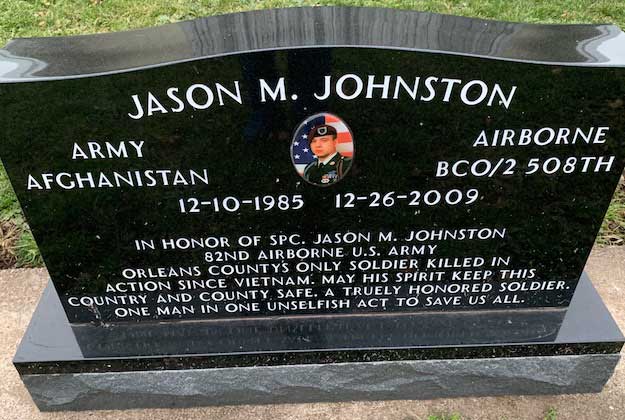
Photo by Tom Rivers: The Elks Lodge dedicated this memorial for Jason Johnston on Aug. 17. The Albion Elks Riders do an annual dice run and fundraiser for a memorial scholarship given each year for an Albion senior who is pursuing a helping profession.
ALBION – It was 10 years ago today when Jason Johnston of Albion was killed by a roadside bomb in Arghandab, Afghanistan.
Johnston, a specialist and paratrooper in the Army, was 24. He is the only soldier from Orleans County to be killed in combat during the Afghanistan War.
He was on his second tour in Afghanistan. He completed a 13-month-deployment in 2008 and left again for the war-torn country in October 2009.
I think about his family every year around Christmas. Today is the 10th anniversary of his death. I thank his parents, Brad and Jenny Johnston, for his sacrifice. And for his sisters – Carrie, Heather and Holly – and several nieces and nephews, too.
The Johnston family has stayed active in the community. Jennie and her daughter Heather are members of the Albion Fire Department and they proudly march with the Fire Department in parades, especially on Memorial Day.
Brad joins the Albion Elks Riders are their dice runs to help raise money for his son’s memorial scholarship. He led the explorers post in the Fire Department when he son was a teen-ager.
I remember when Jason was brought home on Jan. 3. Word got out in the community and many people stood for an hour in snowbanks along Route 31 to welcome his body home. It was 10 degrees outside and many of the people who lined the snow-filled sidewalks were elderly.
I’ve told people about that day many times since. It made me proud to live in Orleans County, to see a big homecoming in such frigid conditions.
The community would do it for Trevor Cook when he was brought home at 2 in the morning on July 15, 2011. Cook was 25 when he was killed in a helicopter crash during a training exercise on July 6, 2011. More than 1,000 people crowded into downtown Medina to 2 a.m. to show support for Cook’s family and respect for the young Marine.
Another large group of several hundred people was in Medina on June 9, 2014 and saluted as a motorcade passed by carrying the body of Sgt. Shaina Schmigel, 21. Schmigel, a Medina native, was killed May 30, 2014 during a night-time training drill. She was a paratrooper at Fort Bragg with the 82nd Airborne Division. She was in the Army for four years, and was promoted to sergeant that January.
File photo from Albion Central School: Albion students stood in the cold to show respect for Jason Johnston and his family during a motorcade processional on Jan. 5, 2010.
Two days after Johnston’s homecoming, it was his funeral at St. Joseph’s Catholic Church. It was a full church with 450 mourners at his funeral.
Dan Allyn, a major general with the U.S. Army at Fort Bragg, was among the speakers at the funeral.
“He always fought to be out front on the mission,” Allyn said about Johnston. “He was an extra-courageous man.”
Johnston was an “elite soldier,” the top 1 percent of Americans, Allyn said at the funeral service for the first Albion soldier to die in combat in 42 years.
Johnston, 24, felt such a devotion to his fellow soldiers that he insisted on joining them for a second deployment to Afghanistan.
“He volunteered not just once, but twice to join his teammates in Afghanistan,” Allyn said at the funeral. “He was an extraordinary teammate and brother.”
After that funeral service, the motorcade then headed to Mount Albion Cemetery. About 2,400 Albion students were out in front of the school to show support for the Johnston family and pay their respects. The students held 1,000 American flags. That is a sight I won’t forget.
Later in June during high school graduation, Michael Bonafede, president of the Board of Education, presented a high school diploma for Johnston to both of his parents. Johnston earned a GED before joining the Army. Bonafede spoke with each parent at length, and the crowd in the gym gave a standing ovation.
The community has continued to remember Johnston, giving towards a $1,000 annual memorial scholarship that goes to a student pursuing a career in a helping profession, such as a nurse, doctor, firefighter, counselor or other social services.
“The recipient of the award should be of good character, show dedication, effort and potential while working to the best of their,” according to a description of the scholarship provided by the Elks.
“Specialist Johnston believed in the Golden Rule – ‘Do unto others as you would have them do unto you.’”
The Albion Elks Lodge in August unveiled a new memorial by the lodge on East State Street in Johnston’s honor.
The monument at the Elks Lodge states: “In honor of Spc. Jason M. Johnston, 82nd Airborne U.S. Army. Orleans County’s only soldier killed in action since Vietnam. May his spirit keep this country and county safe. A truly honored soldier. One man in one unselfish act to save us all.”