By Tom Rivers, Editor Posted 25 May 2020 at 4:11 pm
There are two more deaths due to Covid-19 at The Villages of Orleans Health and Rehabilitation Center in Albion, bringing the total deaths at the nursing home in Albion to 26, the Genesee and Orleans County Health Departments is reporting this afternoon.
Orleans County has now suffered 31 deaths from Covid-19 with four at the Orchard Rehabilitation & Nursing Center in Medina and one from another community member.
The Health Department also is reporting two more confirmed cases of Covid-19 in the county, bringing the total confirmed cases to 202 in the county. The two new cases were contracted by community members.
Genesee County also has one new case, bringing the Genesee total to 180 cases.
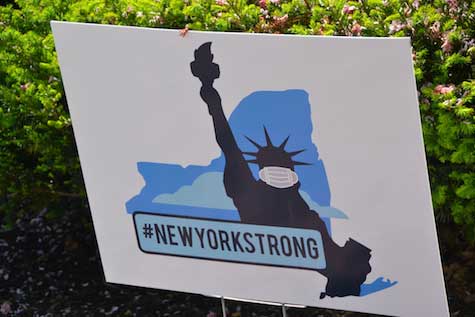
Photo by Tom Rivers: This sign, showing the Statue of Liberty with a mask, is on display outside the Village Clerk’s Office in Medina.
Governor Andrew Cuomo today announced that state and local governments will provide death benefits for frontline workers who died from COVID-19 during this emergency pandemic.
Cuomo also renewed his call for the federal government to provide hazard pay for essential public workers on the front lines.
“During these troubling times there have been so many New Yorkers who have really risen to the challenge and done more than anyone could ask for or expect, and we want to make sure that we remember them and we thank those heroes for all that they’ve done,” Cuomo said. “I personally feel a grave responsibility to our frontline and essential workers who understood the dangers of this virus, but went to work anyway because we needed them to. And we’re going to make sure that every government in the State of New York provides death benefits to those public heroes who died from COVID-19 during this emergency.”
Cuomo noted today on Memorial Day that more than 100,000 Americans will lose their lives to the coronavirus.
“I know that I feel a grave responsibility to our frontline workers, our essential workers, who understood the dangers of this COVID virus, but went to work anyway because we needed them to,” Cuomo said. “We needed the nurses and the doctors to perform phenomenal service in the hospitals. We needed the police, the fire department, the EMS, to show up. We needed the frontline workers in grocery stores to show up so others could stay home and be safe.
“And I bear heavy the responsibility of explaining to the people of this state and beyond what we were dealing with when we were dealing with the COVID virus and how dangerous it was, and then in the same breath asking people to please show up tomorrow – having just explained how dangerous it was. And many of those people who showed up and did their duty and served with honor lost their lives to keep others of us safe. In many ways that is a microcosm of what we’re here talking about today on Memorial Day.”
By Tom Rivers, Editor Posted 25 May 2020 at 10:05 am
Photos by Tom Rivers
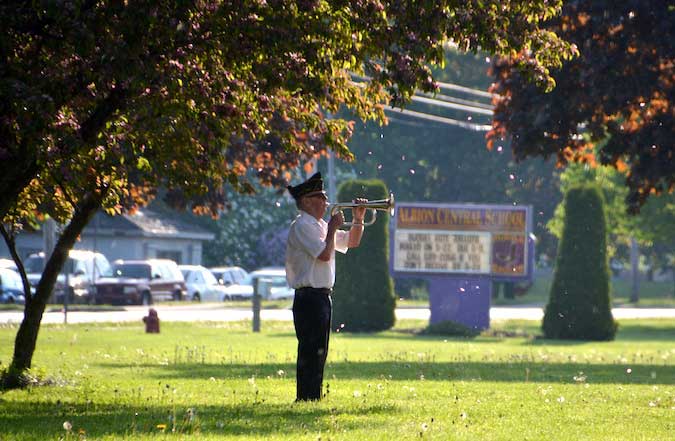
ALBION – Wally Skrypnik, commander of the American Legion in Albion, plays Taps during an observance on Memorial Day in front of the Albion Middle School. There is usually a large crowd for the Memorial Day service each year at the school.
There is no Memorial Day service or parade today with social gatherings still limited to no more than 10 people due to the Covid-19 pandemic.
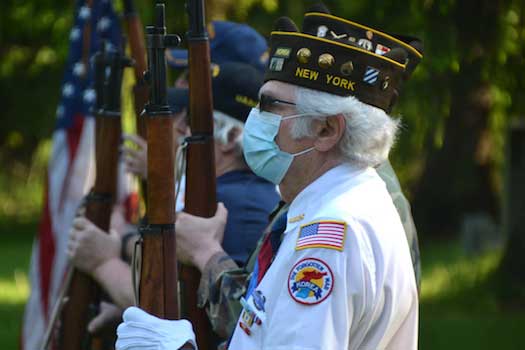
Today, there were eight veterans in the Honor Guard.
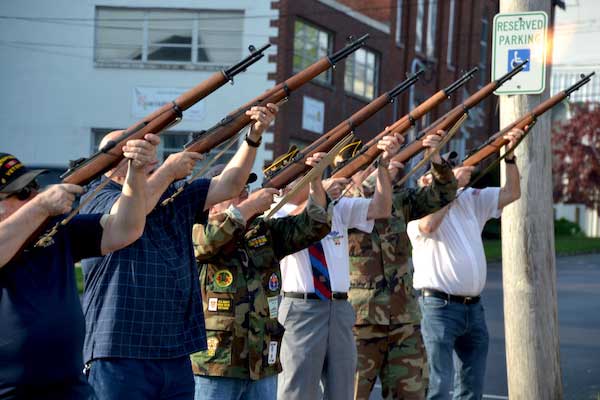
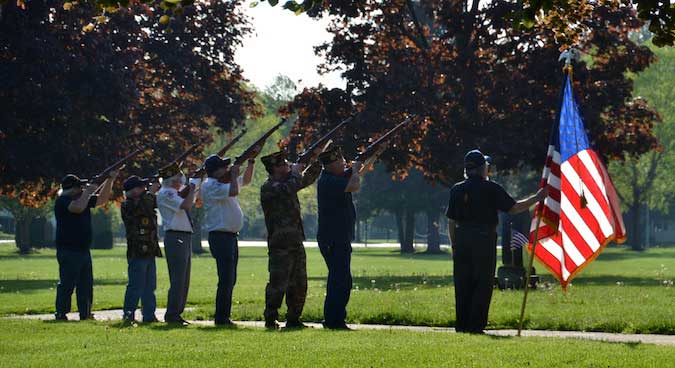
The Honor Guard, however, did a gun salute and played Taps at eight sites in Albion – cemeteries and memorials for veterans.
Joe Gehl of Kent is part of the Honor Guard in Albion that went to many local cemeteries and memorials this morning to honor soldiers who were killed in action.
Gehl is shown with the Honor Guard at the older St. Joseph’s Catholic Cemetery on Brown Road.
Gehl served in the Korean War, where he said two of his classmates from Corning were killed. Another friend from basic training also was killed in Korea.
“I always remember them during this time,” Gehl said.
The Honor Guard met at 7 this morning at the Orleans County Vets’ Club on Platt Street. They did a gun salute and then Taps was played by Wally Skrypnik, commander of the American Legion in Albion.
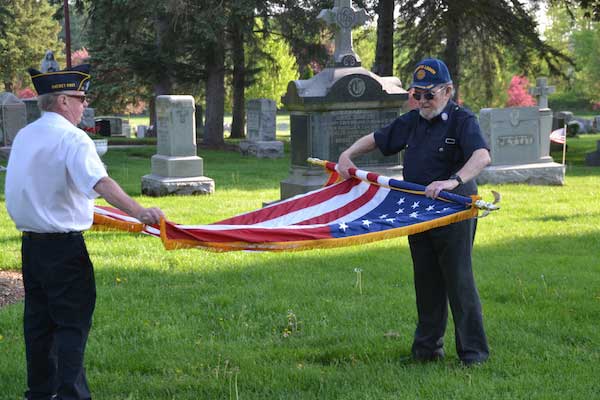
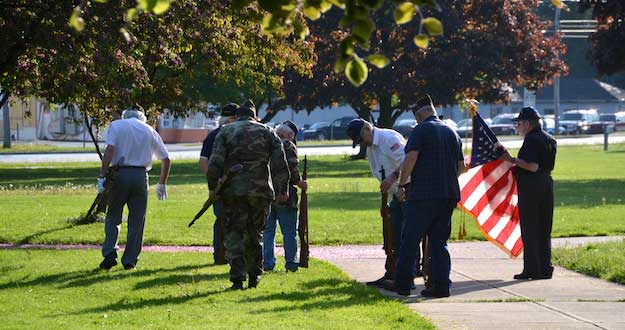
Wally Skrypnik, left, assists Gary Befus with the American flag after the gun salute and Taps at St. Joseph’s Catholic Cemetery on Route 31.
Befus asked the Honor Guard members if they would be willing to honor veterans at the local memorials and cemeteries as they usual do on Memorial Day, even though there wasn’t a parade today.
The group was willing and would visit eight sites to honor veterans this morning.
Befus said the Honor Guard usually gets together frequently during the year, often at funerals of veterans.
“This is the first time we’ve seen each other in months because there haven’t been any funerals,” Befus said.
Mike Donahue looks for an empty shell after the gun salute at Mount Albion Cemetery.
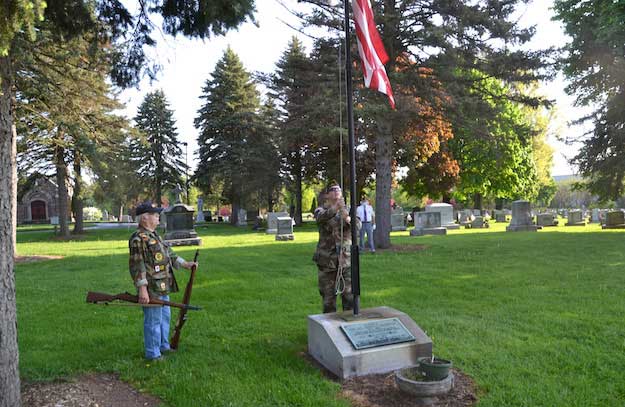
Matt Passarell lowers the flag at St. Joseph’s Cemetery on Route 31 in Albion. Kevin Christy is at left.
St. Joseph’s Catholic Cemetery on Route 31 includes a memorial for two World War II soldiers –Tech Sgt. Joseph F. Christopher who was killed in North Africa on April 28, 1943 and Cpl. John A. Christopher who was killed in North Africa on Nov. 26, 1943.
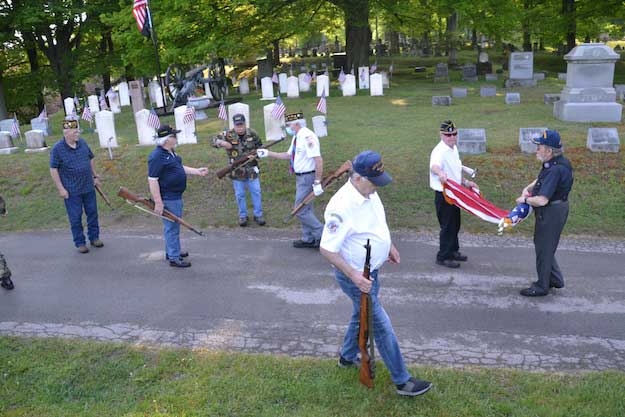
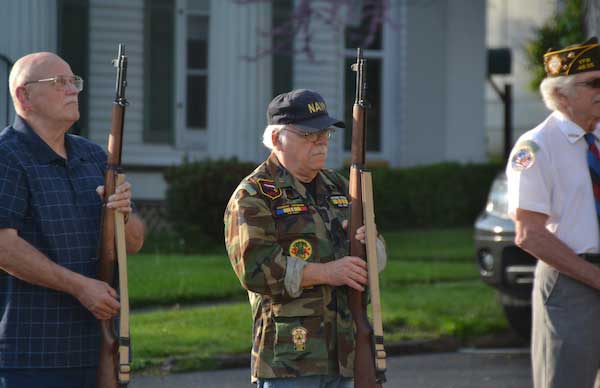
The Honor Guard includes, from left: Phil Warne, Kevin Christy, Joe Gehl, Mike Donahue, Matt Passarell, Orville Preston and Gary Befus.
These veterans look for their empty shells after an observance in front of the Vietnam War memorial in front of the Albion Middle School, where there is usually a large Memorial Day event each year.
Orville Preston, left, Kevin Christy, center, and Joe Gehl stand at attention while Taps is played at the Orleans County Vets’ Club this morning.
To see two videos from this morning’s observances, click here at St. Joseph’s Cemetery on Route 31 and click here to see the Honor Guard at Mount Albion.
By Tom Rivers, Editor Posted 24 May 2020 at 10:35 pm
New online database lists memorials dedicated to soldiers from Orleans County
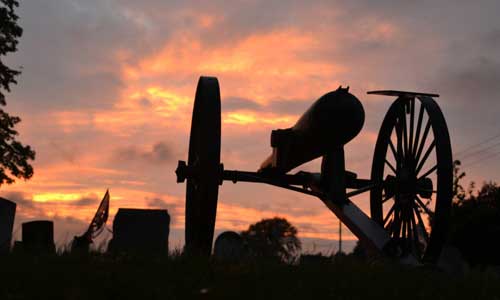
Photos by Tom Rivers: The Civil War cannon at Greenwood Cemetery on Route 18 is a memorial for the community’s Civil War veterans.
There won’t be any big parades or official public gatherings in Orleans County on Memorial Day.
Residents can still have a meaningful Memorial Day without a crowd. The Orleans County Tourism Department has created a database of military memorials.
There is a war memorial in all 10 towns in the county. The most remarkable by size and for the number of dead it honors may be the tower at Mount Albion Cemetery, a 68-foot-high sandstone structure that includes the names of 463 county residents killed in the war. The names are in marble slabs inside the tower. That memorial was dedicated in 1876, on the country’s 100th anniversary.
The most recent new memorial is a bronze statue of a soldier that was dedicated on Sept. 7, 2019. That statue honors the soldiers who trained at the former Medina Armory, which is now the Orleans County YMCA.
All of the memorials throughout the county pay homage to sacrifice of soldiers.
“Orleans County’s deepest respect and patriotism is demonstrated in the memorials and monuments scattered throughout the county,” the County Tourism Departments states in a message about the memorials. “Dedicated organizations and individuals have led the efforts to create these monuments in honor of those who served in the Armed Forces and several who paid the ultimate sacrifice.”
Click here to see the online site about the local memorials dedicated to soldiers from Orleans County.
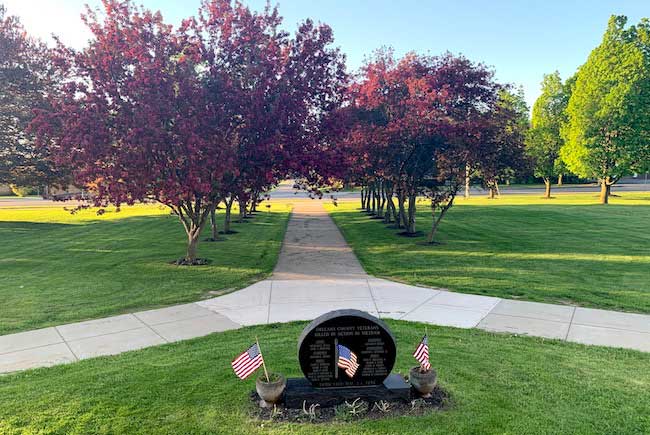
This memorial in front of the Albion Middle School is a memorial to Orleans County residents who were killed in action during the Vietnam War. The memorial was dedicated on May 24, 1996.
By Tom Rivers, Editor Posted 24 May 2020 at 4:19 pm
Health Department reports another resident of The Villages dies from Covid-19
Orleans County has six more confirmed cases of Covid-19, which brings the county’s total to 200, the Genesee and Orleans County Health Departments reported this afternoon.
The six new cases in Orleans include one community member and five residents of the Orchard Rehabilitation and Nursing Center in Medina. Orchard now has 30 confirmed cases.
The Health Department also is reporting the death of a resident at The Villages of Orleans Health and Rehabilitation Center in Albion. That nursing home has now suffered 24 deaths due to Covid-19. The local health department said that the New York State Department of Health did swab all residents and employees of The Villages to test if they are positive for Covid-19.
Orleans County now has 29 total deaths from Covid-19.
Of the county’s 200 Covid-19 cases, 117 of them are residents of either The Villages (87 cases) or Orchard Rehabilitation and Nursing Center.
Genesee County also has one more confirmed case of Covid-19, bringing the Genesee total to 179. The new case is a community member and not a resident of a facility.
By Tom Rivers, Editor Posted 24 May 2020 at 1:15 pm
The weekly number of deaths in New York State from Covid-19 continued to decline last week, dropping from 1,107 deaths the week of May 10-16 to 730 this past week. That represents a 34 percent decrease.
The weekly number of deaths have continued to decline since a peak of 5,226 deaths the week of April 5-11.
The state has begun to reopen the economy in most regions of the state. Orleans County is in the Finger Lakes Region and phase 2 should reopen on Friday, as long as hospitalizations and infections don’t spike.
The state on Friday reopened beaches to 50 percent capacity (determined by parking spaces at the parks) and on Monday will reopen campgrounds and RV parks.
Gov. Andrew Cuomo also announced today that veterinarians can reopen statewide on Tuesday and NY professional sports leagues can begin spring training.
The 730 deaths last week is an average of 104 a day. That compares to the daily average of 158 the previous week.
Week of May 17-23: (730 deaths)
• May 17, 106; May 18, 105; May 19, 112; May 20; 105; May 21, 109; May 22, 84; and May 23, 109.
Week of May 10-16: (1,107 deaths)
• May 10, 161; May 11, 195; May 12, 166; May 13; 157; May 14, 132; May 15, 157; and May 16, 139.
Week of May 3-9: (1,568 deaths)
• May 3, 226; May 4, 230; May 5, 232; May 6, 231: May 7, 216; May 8, 226; May 9, 207.
Week of April 26-May 2: (2,176 deaths)
• April 26, 337; April 27, 335; April 28, 330; April 29, 306; April 30, 289; May 1, 299; May 2, 280.
Week of April 19-25: (3,097 deaths)
• April 19, 478; April 20, 481; April 21, 474; April 22, 438; April 23, 422; April 24, 437; April 25, 367.
Week of April 12-18: (4,484 deaths)
• April 12 (Easter), 671; April 13, 778; April 14, 752; April 15, 606; April 16, 630; April 17, 540; April 18, 507.
Week of April 5-11: (5,226 deaths)
• April 5, 599; April 6, 731; April 7, 779; April 8, 799; April 9, 777; April 10, 783; April 11, 758.
File photo by Tom Rivers – St. Mary’s Catholic Church in Medina is part of Holy Trinity Parish which includes St. Stephen’s Catholic Church in Middleport.
Bishop Edward B. Scharfenberger, Apostolic Administrator of the Diocese of Buffalo, has launched a broad-based initiative focused on re-envisioning the mission of the Catholic Church of Western New York and bringing about Diocesan-wide renewal.
The Buffalo Diocese is home to approximately 571,000 Catholics, spanning almost 6,500 square miles and encompasses eight counties: Allegany, Cattaraugus, Chautauqua, Erie, Genesee, Niagara, Orleans and Wyoming.
The emergence and continuing threat of the Covid-19 pandemic has exacerbated financial challenges confronting parishes as well as Diocesan operations. In light of a sharp decrease in parish revenues, as well as an anticipated decrease in donations to the annual “Fund for the Faith” appeal, the Diocese will be identifying options for potential mergers of parishes and schools, as well as identifying partnerships with other organizations and donors committed to Catholic education and the ministries determined to be vital. The Diocese has communicated that it will not be in a position to continue the subsidy provided to Catholic schools given the current environment.
This will necessitate an immediate process among school leaders, working with School Superintendent Michael C. LaFever, to assess the implications of this development and to work collaboratively in developing options that will enable the continuation of Catholic education across Western New York. Currently, there are 34 Catholic elementary schools throughout the Diocese.
“The responsibility for Catholic education must be seen as an equal one, which begins in the home and which is then supported in our parishes, and promoted by our dedicated teachers, priests, religious and other mentors throughout early childhood and into adulthood,” said Bishop Scharfenberger. “Although we recognize the obligation to live within our means, we are not relinquishing our greater obligation to promote a culture that truly reflects Christ’s Gospel of love, caring and relentless service to young and old alike.”
The purpose of the initiative is to strengthen the impact of the Church’s many ministries, support the healing of victim survivors of abuse, and to promote a culture of co-responsibility among laity, clergy and religious members in carrying out the work of evangelization and service.
“We have no more urgent priority than to reassert the vital relevance, role and tremendous impact of our Catholic faith in serving so many needs across Western New York,” said Bishop Scharfenberger. “The very harsh realities that have caused so much hurt and disappointment and damaged credibility in recent years must in no way obscure the vitality of our parish communities. It is in these vibrant parish families that we see such remarkable determination to live the Gospel of Jesus Christ in conspicuous ways that lift and empower others, while creating hope and opportunity among those most in need. This initiative to bring about renewal across our Diocese is all about creating greater reliance on one another, and creating even greater impact by combining our resources and harnessing the abundant expertise, talent and zeal of our people to bring about immense good.”
The scope of the initiative will entail working closely with pastors and parish leaders to create a structured, decision-making process to ensure Diocesan resources are focused on the Church’s essential mission which is carried out primarily at the parish level and supported by Diocesan ministries and programs, as well as the extensive ministries of Catholic Charities of Buffalo.
The process will involve conducting a thorough assessment of all aspects of Catholic ministries and operations, looking closely at the current construct of parishes and schools; identifying resources that are able to be shared and leveraged more broadly; identifying underlying financial and operational strengths and weaknesses; and making decisions about the long-term viability of parishes and schools, as well as other programs carried out at the Diocesan level.
May. Mental Health Awareness Month and Memorial Day.
Statistic say 1 in 5 people “experience” mental health issues. I have no doubt that number is low. Most of us have experienced a mental health crisis at least one time in our lives because we are emotional beings.
Mental illness can be fostered by internal chemicals or circumstances. Imagine if those occurrences did not end and you had to face that realization daily. Would you have the strength and courage to carry on?
If you or someone you love struggles with mental health, this subject is close to your heart, as it is mine. I am about “Positive Perks” and in that spirit this post will be a story about overcoming. It is primarily inspired by someone who is college educated, very smart and can speak on any subject. They would give the shirt of their back for you if you needed it because they harbor a sensitive heart. Their peers look up to them because they give of themself often when they see someone in need.
This may not seem so unusual, but if you witness someone who rises up to the challenges of anxiety, depression, obsessive compulsive or other mental health challenges you know that they are exceptionally strong.
Why you may wonder? Because society has a way of passing judgement because they do not understand the state of mind of a person who rises above the challenges of mental health on a daily basis. But you know what, that does not dissuade those who suffer from fighting everyday, to be the best they can be. Wanting and deserving respect and courtesy. Against the downward pull from side effects of medications, they survive.
It is hard to grasp the difficulties of someone who suffers from mental health challenges since their pain is not visible on the outside. They wear their pain on the inside. Still, it physically hurts as much as any illnesses that can be seen.
If you ever are in need of a compassionate heart find someone who is an overcomer and therefore, wiser. The knowledge they hold to offer insight on issues of the heart are priceless, because only they know what it takes to forge on each day..even when it seems impossible. Never succumbing when life gets to be too much, but overcoming.
The stigma surrounding mental health is one of fear. People fear what they don’t understand. So restrict judgement and choose to be inspired instead. We are all people trying to navigate life, each with our own challenges whether mental, physical or both. No one goes unscathed.
Honor Memorial Day by memorializing those service men whose mental illness was created by combat, like that of a quiet farm boy from Nebraska who went to war and returned with emotional barriers that lasted until he took his last breathe, but still overcame in life. Honor them by soldiering out a life boat for those who need emotional support, leave no man behind.❤
To share your inspiring story, visit my blog live online at https://www.positiveperksposts.com and catch up on weekly photo perks and past posts. Like and share your comments. Happy perks to everyone!
By Tom Rivers, Editor Posted 23 May 2020 at 5:01 pm
There are no new confirmed cases of Covid-19 to report today in Orleans and Genesee counties, the local health department reported this afternoon.
That follows a day when there were 23 new cases in Orleans, including 22 at Orchard Rehabilitation and Nursing Center in Medina.
Orleans County has had 194 test positive for the virus, while Genesee has had 178.
The health department reminds people to wear masks or facial coverings when they are in public and when social distancing isn’t possible. People should also wash their hands frequently and shouldn’t have social gatherings of more than 10 people.
By Tom Rivers, Editor Posted 23 May 2020 at 4:04 pm
Project would add new transmission line from Albion water plant to Ridgeway, 2 new water tanks in western Orleans, and interconnection between Albion and Lyndonville plants
File photo by Tom Rivers: The Albion Department of Public Works worked on Jan. 1, 2019 to repair a leak to its main transmission line on Main Street (Route 98). A consultant is suggested a second transmission main be constructed from the Albion water plant, with the new one providing service for Shelby and Ridgeway.
A firm that looked at ways to improve the water system in Orleans County is suggesting an $12 million upgrade in phase 1.
A second phase at $6 million would bring the total costs to $18 million.
The projects would increase water capacity in the county, improve water pressure and fire flows, and keep more water revenue in the county, instead of to outside suppliers.
That added revenue for more in-county water revenue, as well as expected grant funding for the project, would cover the cost for the project, the Wendel engineering firm told municipal officials.
That project would also would have the added benefit of a lower bulk water rate for many of the towns.
“I think you will find the opportunity here is extraordinary and even historic for the county,” said Chuck Nesbitt, a regional manager for Wendel. “It’s a winner for this community.”
Nesbitt is also the former chief administrative officer for Orleans County before leaving that job after 14 years in December to join Wendel.
The firm presented the results of the study on Thursday evening during a Zoom meeting with local elected officials, and highway and water department leaders.
Gerald Summe, executive vice president of Wendel, and Brian Sibiga, an engineer with Wendel, joined Nesbitt in going over the study.
Sibiga said the current system is plagued by numerous dead ends in waterlines, low fire flows, weak water pressure in spots and a lack of redundancy in the main water transmission line for Albion. If that line on Route 98 went down there is another main line to feed the system.
The study included an inventory of water infrastructure in the county, as well as the personnel devoted to maintaining water lines and running water plants.
The study also looked at how new transmission lines could move water to spots in the county that would be ideal for economic development.
Wendel also looked for potential cost savings and efficiencies that will reduce costs and increase capacity.
The current water rates are not consistent among the towns, and “problematically high in some areas.” For example, Ridgeway and Shelby pay a $5.98 rate 1,000 gallons, which is more than double what most of the towns are paying.
Water suppliers
The Village of Albion is currently the main water provider in central Orleans with its water plant on Wilson Road by Lake Ontario in Carlton. Albion provides about 1.47 million gallons of water daily for 15,000 customers. Albion’s water plant is designed for 3 million gallons. Albion is utilizing about 49 percent of its capacity.
Lyndonville produces about 200,000 gallons of water a day at a plant with a 400,000-gallon peak capacity, or a 50 percent utilization. That plant serves about 2,200 customers.
The also use about 460,000 gallons a day from other users — the Niagara County Water District for western Orleans and Monroe County Water Authority in eastern Orleans.
The study focused on how to better utilize and safeguard two water suppliers in the county – Albion and Lyndonville.
Wendel is suggesting an $18 million project with three main capital initiatives for phase 1 that would increase water pressure and fire flows, and also provide more revenue for in-county water suppliers. That revenue would help reduce the overall per-gallon water cost for the towns, and also pay for the capital projects (which would be eligible for state and federal grants).
The project also would give Albion another main transmission line to feed the water districts, instead of relying solely on the Route 98 main.
Phase I: $12 million
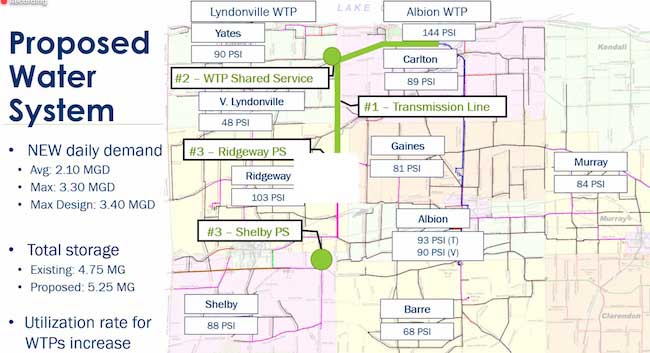
These slides are screen shots from a presentation on Thursday by the Wendel engineering firm. This slide shows a map of the county include an outline for a 10-mile tranmsission line in phase 1. It also shows the water pressure in the towns if the project proceeds.
Project 1: 10-mile transmission line from Carlton, down Route 18, south on Townline Road to Route 104 near Kenyonville Road.
Project cost: $8.4 million
Proposed benefits:
Supplies water to western/southern side of Orleans County
Improves the water flow
Gives secondary route to feed water to Barre and Village of Albion, by coming through Shelby
Provides and improves service to towns of Yates, Shelby and Ridgeway
Reduces water costs in supplied communities
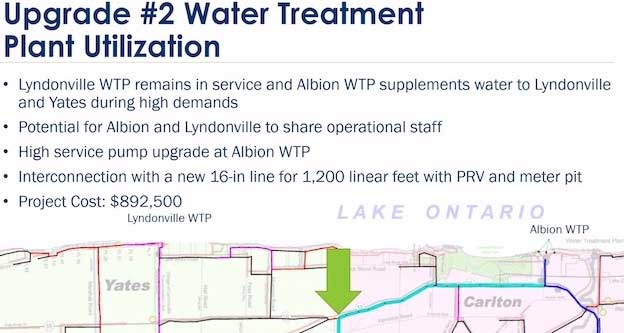
Project 2: Interconnection line at 1,200 feet that would allow Albion to supplement water to Lyndonville and Yates.
Besides the waterline, project would include high-service pump upgrade at Albion water plant, and pressure-reducing valve and meter pit.
Project cost: $892,500
Proposed benefits:
Lyndonville’s water treatment plant would remain in service and Albion’s plant would supplement water to Lyndonville and Yates during high demands. Often farmers could use more water for irrigation and would pay for it, but Lyndonville’s system is maxed out at about 200,000 gallons per day. The interconnection would allow for more water to be sold locally and would help farmers boost the quality of their crops.
The project would increase water sales for Albion, reduce overall water-per-gallon costs, and improve water quality through interconnections. The regional approach would likely lead to more grants for the water projects.
Albion and Lyndonville should also consider sharing operational staff. Albion already has some of its sewer plant employees helping to run the sewer plants in Holley and Elba. Albion could also provide some personnel to help with Lyndonville’s system.
Project 3: Water storage tanks and pump stations in Ridgeway and Shelby
Ridgeway and Shelby each would have a new 250,000 gallon water storage tank, and a new pump station with two booster pumps discharging at 85 PSI (pound-force per square inch).
This project would increase water pressure in Ridgeway from 80 to 103 PSI, to 88 PSI in Shelby and from 55 to 68 PSI in Barre. The pressure would also improve in parts of central Orleans, going from 60 to 89 PSI in Carlton and 70 to 90 PSI in Albion.
The projects would increase the demand for water produced by Albion and Lyndonville to 2.1 million gallons a day, with capacity remaining for another 1.2 million gallons. The two new 250,000-gallon storage tanks would boost storage capacity from 4.75 million gallons to 5.25 million.
Project cost: $3,000,000
Proposed benefits:
Increase in regional revenue
Increase in water supply by average 344,000 gallons a day. Albion water plant utilization would increase from current 49 percent of capacity to 61 percent.
Improve regional water infrastructure
Communities would see increase in water pressure, increase in available fire flow and additional storage for Shelby, Ridgeway and Barre.
Outside of Phase 1, the Village of Albion is already working to upgrade its water plant. The village is undertaking a $3,250,000 improvement project.
The project scope includes chemical and ventilation system improvements, clarifier system rehabilitation, filtration system rehabilitation, bolster pump station No. 1 improvements, miscellaneous building repairs and transmission main improvements along Route 98.
Phase 2 project to expand capacity of Albion water plant, $6 million
After phase 1 is complete, Wendel said Albion and the partner municipalities should consider a phase 2 project that would increase the capacity at the Albion water plant from 3 million gallons and 4.5 million.
That $6 million project would involve a high-service pump station upgrade, filtration upgrade, sedimentation improvements, main building expansion, and associated electrical, mechanical and structural upgrades as well as a new SCADA system (supervisory control and data acquisition) to help monitor and operate the water plant.
The consultants say the town water districts in Albion, Barre, Carlton, Gaines, Murray, Shelby and Ridgeway all currently pay $1.2 million annually for water. (This doesn’t count Murray’s water from the Monroe County Water Authority.)
The Village of Albion provides 621,975 of those gallons per day and the Village of Lyndonville’s water plant provides 112,000 gallons per day to customers in Yates.
The Village of Albion sells the water in a bulk rate to the towns for $2.96 per 1,000 gallons. Lyndonville bills Yates a $2.45 rate. Shelby and Ridgeway are charged $5.98 for water they buy from the Village of Medina, which gets its water from the Niagara County Water District.
Wendel said the project would allow Albion to lower its bulk rate to the towns by 30 cents to $2.66 per 1,00 gallons. That would be less than half of what Ridgeway and Shelby are currently paying. Yates could continue with its $2.45 rate paid to Lyndonville.
That reduced rate would save water customers about $240,000 a year in what they are currently paying, Wendel said.
‘Our water system is old. It’s aging. We’re band-aiding when we need to. We’re spending a lot of money operating the way we are now.’ – John Papponetti, Orleans County DPW superintendent
Sibiga, the Wendel engineer, said the municipal leaders should also look to loop districts to remove dead-ends. That would also improve water pressure and quality, and reduce the need for frequent flushing.
He said the additional transmission line from the Albion plant should be considered a high priority.
“A failure could really be catastrophic,” he said a break in the main transmission line. “There is some room for improvement with investment.”
With the plan proposed by Wendel, Albion and Lyndonville would continue to own their water plants, but the towns would each get a vote in a regional water system administrative board that would guide investments and water supply contracts. Each community would get a vote on how the system operates.
That could include having designated personnel for the water system, rather than having each municipality’s highway or DPW workers also have to run the water systems.
The regional approach would significantly increase the chances for federal and state grants, which would help Albion and Lyndonville with funding to upgrade the water systems.
“This would increase capacity for future developments, whether residential of business development,” Sibiga said about the proposed project. “Having large quantities of potable water is critical for our region to compete, and there would be an anticipated decrease in cost to users.”
The Wendel officials asked the municipal leaders to consider the suggestions of the study and work towards an agreement or memorandum of understanding on how to proceed.
Nesbitt said the regional approach would be a big benefit to the local municipalities.
“It would create future opportunities for increased sales and service,” he said.
John Papponetti, the county’s DPW superintendent, said the proposed projects would address many deficiencies in the water system. Papponetti also is an Albion firefighter. His father, Harry, is the Albion fire chief.
“Many of new districts going in that are dead ends and barely meet fire flow standards,” John Papponetti said.
The new transmission line “would be a major, major benefit for the entire area,” he said.
“Our water system is old,” Papponetti said. “It’s aging. We’re band-aiding when we need to. We’re spending a lot of money operating the way we are now.”
By Kim Pritt, Contributor Posted 23 May 2020 at 3:00 pm
Let’s go on an adventure together … to South Dakota!
Tunnel in Custer State Park – when you leave the tunnel, you see a perfectly framed view of Mount Rushmore 15 miles away
I’ve said many times…it is really hard to pick a “favorite” state or trip! I find beauty, adventure, and interesting things to see and do wherever I go. But, I have to say that South Dakota does hold a special place in my heart. I have been to South Dakota twice and I’d go back in a heartbeat. My first visit to the state was on a cross country motorhome trip with my brother and sister-in-law and her sister in 2016 – we called it our Most Excellent Adventure (MEA). We enjoyed 21 states in 34 days with two states that we spent a great deal of extra time in – South Dakota and Louisiana. We were in S.D. a little over a week, stayed in two different campgrounds, and got a rental car while we were there, so we had the flexibility to get around to a lot of places on day trips and see a lot of what the state has to offer. My second trip was with a friend on a Caravan bus tour that covered five states and included an overnight in the Rapid City, S.D. area.
When most people think of South Dakota, their first thoughts tend to be Mount Rushmore and Crazy Horse Memorial. We did see both of these incredible sights – actually, I saw them on both trips and it was a thrill both times – not to be missed. But, South Dakota has so much more to offer. There are fun, touristy things to do, as well as beauty beyond measure and wildlife to amaze and entertain you. Here are some of the wonderful things I highly recommend you do if you should ever get the chance to visit South Dakota:
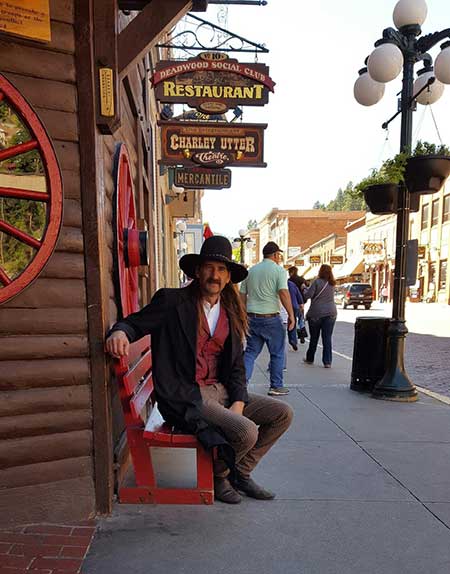
Deadwood, S.D. – “Wild Bill Hickok” waiting outside the saloon between shows of the reenactment of his murder in 1876
Rapid City – on our MEA, we camped for about five days in a Rapid City KOA, but didn’t actually go into downtown Rapid City on that trip. The Caravan trip, though, began with an overnight right in the heart of downtown. If you find yourself near Rapid City, don’t pass up the chance to just wander around downtown. They call themselves the “City of Presidents” and have the most wonderful life size statues of every US President – one on every corner throughout downtown. It is incredible! When I was reviewing the Caravan itinerary, I thought S.D. would be of least interest to me because I had been there and seen the two major attractions on the list of stops. But, getting free time to wander around downtown Rapid City was a real treat and ended up being one of the most memorable points of that trip.
Sioux Falls – another really cool city in S.D. is Sioux Falls. They have a Sculpture Walk that features a variety of art over several blocks downtown – everything from the quirky to spiritual to fun to stunning to interactive. We were driving through and took the opportunity to get for the road for a bit by stopping for a couple hours so we could take the walk. We were really glad we did.
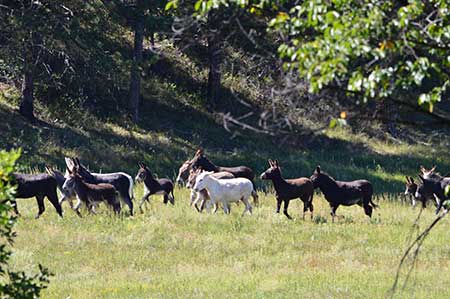
Custer State Park – plan to spend the better part of a day driving through Custer State Park in the Black Hills. It is really beautiful. We actually went there twice while we were in the area – once to just drive through and explore a little and then spent most of the next day doing a deeper dive. They have wild donkeys that come right up to your car for treats, wild turkeys everywhere, and, of course, bison and prairie dogs and lots more. It also has the BEST view of Mount Rushmore – one of the tunnels is perfectly placed (by design) so that when you go through it you get an amazing framed view of the famous presidential tribute and another view from an overlook. These views are 15 miles from Mount Rushmore and I thought they were much more impressive than seeing it up close. Another of the fascinating features in the park were the Pigtail Bridges. Considered an engineering marvel of their day, these bridges circle around the elevations of the park – much like a spiral staircase for cars. They are made of log timbers and are simply stunning! If you’re traveling in a large RV, you might want to rent a car for the day – there are lots of low tunnels and places a large motorhome may have limited or no access to and you don’t want to miss any part of this beautiful park.
The Needles – the Needles is a 637 acre area within Custer State Park in the Black Hills. They consist of eroded granite pillars, towers, and spires also known as Cathedral Spires. The Needles Highway weaves in and out, around, and through the rock formations. It is incredible enough to just see them in the distance as you drive up the narrow, winding road (another reason to get a rental car, if driving a large RV), but, once you get there and start to drive through them…..well, let’s just say it took my breath away and brought tears to my eyes. It is absolutely overwhelming and reminded me just how insignificant we are in the big, beautiful world that our God has made for us to live in and enjoy. This was one of the most memorable parts of the entire Most Excellent Adventure trip and a place I would dearly love to go back to, one day.
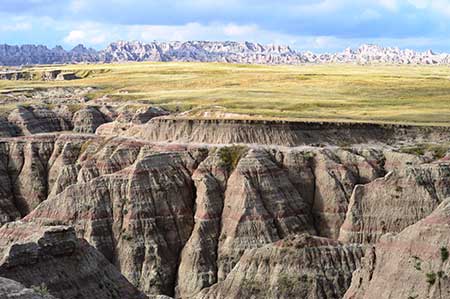
The Badlands – No photo can do the views in the Badlands justice.
The Badlands – another favorite spot in S.D. – one I will absolutely return to at some point – is The Badlands. Extreme temperatures, lack of water, and the exposed rugged terrain caused Native Americans to call it “Badlands”. Very little vegetation grows in the Badlands, which were formed when soft sedimentary rock was extensively eroded in a dry climate over hundreds of years. Sounds awful, but the result is one of the most beautiful places on earth. It is miles and miles of the most majestic scenery I’ve ever seen. The drive through is full of awesome overlooks and tons of wildlife roaming free – including “Prairie Dog Town” which is a clearing that is home to hundreds of prairie dogs and their holes. I could have spent an entire day just watching those funny critters playing around. The Badlands is located in Interior, S.D. and was a stop as we drove through the state, so we didn’t have the luxury of spending more than one day. The website says it takes a good two days to see most of what the 244,000 acre park has to offer and it takes about two hours to just drive through it and stop at a couple overlooks. We spent most of our day there driving through the bulk of the park and driving the Sage Creek Rim Road (The Badlands Wilderness Area) where most of the wildlife can be found. I’d love to explore it more thoroughly.
Deadwood – another mostly touristy stop, but really cool place is historic Deadwood. Deadwood was considered a major “boom” town in the 1876 Black Hills Gold Rush Era. It was the epitome of what became known as the “Wild West” with legends like Wild Bill Hickok and Calamity Jane and others. It is also the town where Wild Bill Hickok was murdered by Jack McCall. Wild Bill and Calamity Jane are buried in Mount Moriah Cemetery located on a hill overlooking the town – definitely worth the time to see. There are a lot of wild west characters roaming the streets and one of the saloons stages a reenactment of Wild Bill’s murder several times a day – we saw it – it was pretty good and a good way to get inside out of the heat for a little bit.
Herds of wild donkeys roam free and come right up to your car for treats in Custer State Park
Fun Tourist Stops – when in S.D., you must make a stop at the Corn Palace in Mitchell. It is a HUGE building with the façade and much of the interior decorated with corn – husks, stalks, cobs, corn nuggets, etc., creating elaborate murals. The theme and all the murals change every year – the year we were there, the theme was Rock of Ages. There are also several other little museums and shops along the street to entertain you. Another must see is Wall Drug in the town of Wall. This is a store that goes on forever with room after room after room of the coolest things to see and do. They boast “free water”, but be sure to also enjoy an ice cream or eat at the lunch counter. And, Keystone is a fun stop, as well. Keystone is an old gold rush town that was built in a gulch and is now mostly tourist shops, but it is pretty cool to spend a little time there.
Wildlife – I have to say….I’ve been to a lot of places where there was potential to see a ton of wildlife and sometimes I did and sometimes I didn’t. But, S.D. didn’t disappoint! I saw many herds of bison, antelope, pronghorn, big horn sheep, donkeys, prairie dogs, deer, bear, turkeys, bald eagles, and more all roaming free and being amazing. We also made an impromptu stop at a place called “Bear Country, USA” just outside Rapid City after seeing their billboard. It is a drive through animal park where the animals were mostly wandering around free that was totally awesome. They also had some walk through areas to view the smaller animals up close that included a natural enclosure with baby bear playing and having fun.
Put South Dakota on your bucket list – it is truly a must visit state! And, you can always visit my blog for tons of photos and lots more about South Dakota, my Most Excellent Adventure, and the Caravan trips mentioned in this post: https://thoughtsbykim.com – when you get there, search “Most Excellent Adventure”, “MEA” and “Caravan” to find multiple posts dedicated to these trips.
Amid the ongoing COVID-19 pandemic, Governor Andrew M. Cuomo announced the launch of the $100 million New York Forward Loan Fund to provide flexible and affordable loans to help small businesses, focusing on minority- and women-owned small businesses, that did not receive federal COVID-19 assistance.
The state will take a smart, targeted approach for distributing these loans, focusing on businesses with 20 or fewer employees and less than $3 million in gross revenues. Businesses interested in receiving a loan should visit esd.ny.gov/nyforwardloans.
“Small businesses are the engine of the New York economy, but they are now facing some of the toughest challenges in this pandemic,” Governor Cuomo said. “Helping our small businesses is a top priority, and we are starting the New York Forward Loan Fund and making more than $100 million available to provide loans to small businesses, focusing particularly on minority and women owned businesses that have faced even greater risks and received less in federal relief throughout this pandemic.”
The Governor also announced the launch of a new pilot program with 52 independent pharmacies to conduct 7,000 tests per week. New York State now has more than 750 testing sites across the state. The Governor also encouraged eligible New Yorkers to visit coronavirus.health.ny.gov to find a nearby testing site and get tested.
The Governor also announced that the state is making its contact tracing training curriculum available at no cost to all states through the National Governors Association to speed the process of creating contact tracing programs.
The state partnered with Bloomberg Philanthropies and the Bloomberg School of Public Health at Johns Hopkins University to develop this comprehensive online curriculum to train potential contact tracers. Contact tracing is currently underway in seven regions of the state – the Capital Region, Central New York, Finger Lakes, the Mohawk Valley, the North Country, the Southern Tier and Western New York.
The Governor also reminded New Yorkers to vote in the state’s Wear a Mask New York Ad Contest, which was launched by the Governor on May 5th and is being overseen by his daughter Mariah Kennedy Cuomo. New Yorkers can vote for the winning ad until Monday May 25th at WearAMask.ny.gov, and 92,000 people have voted to date. The winning ad will be announced on Tuesday, May 26th, and that ad will be used as a public service announcement.
By Tom Rivers, Editor Posted 23 May 2020 at 9:56 am
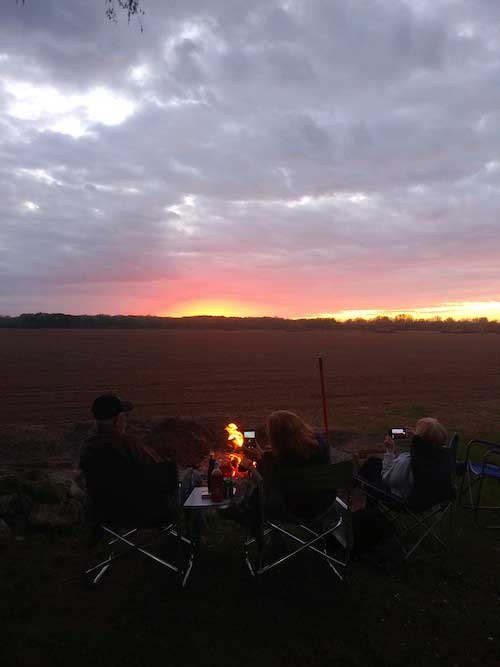
Mike Zeliff sent in this photo last evening while the sun was setting in his backyard on Route 63 in Lyndonville. He was joined at the sunset by his friends, Dave and Debbie Palone, and Zeliff’s wife Darlene.
It’s going to feel like summer very soon in Orleans County with temperatures forecast in the 80s from Monday through Thursday.
Today will be partly sunny with a high of 72 followed by a high of 78 on Sunday, according to the National Weather Service in Buffalo.
On Memorial Day there is a chance of showers, with thunderstorms also possible after noon. The high is forecast for 81.
On Tuesday it will be mostly sunny with a high of 85, followed by a mostly sunny Wednesday with a high near 87. Thursday is forecast for partly sunny with a high near 82.
On Friday, Orleans County should be out of the 80s with a high near 73.
By Matthew Ballard, Orleans County Historian Posted 23 May 2020 at 8:15 am
“Overlooked Orleans” – Vol. 6, No. 19
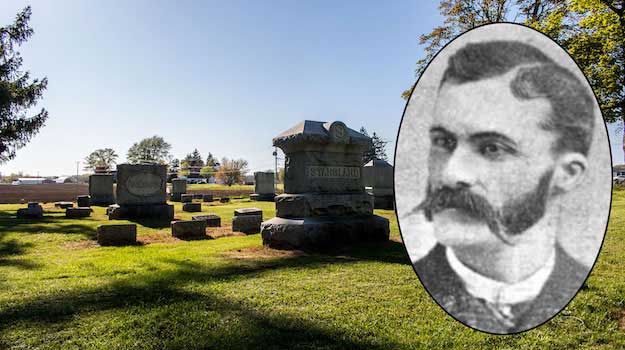
KENDALL – This photograph shows the Stangland family burial plot at Greenwood Cemetery in Kendall. The cemetery is the final resting place for Benjamin Franklin and Emily Bridgeman Stangland. Born on January 20, 1848 in Noble County, Indiana, “Frank” was the son of Andreas Stangland, a Norwegian immigrant, and Susan Cary of Kendall.
Frank’s father arrived in the United States in early 1825 to prepare land in Kendall for the arrival of 52 immigrants from Stavangar, Norway. Docking at the Port of New York on October 25, 1825, the “Sloopers” as they were called travelled along the Erie Canal to Holley, where they embarked for the shore of Lake Ontario. Andreas was a bachelor and settled on a small parcel of land situated north of the Lakeshore and Norway Road intersection. Family lore says that while exploring his property, Andreas stumbled upon the home of John Cary where he met his future wife. Unable to speak English, he received lessons from Susan who was a teaching in a nearby schoolhouse.
Andreas and Susan had five children in Kendall including Eleazer, Lydia, Tallock, Bela, and Rosetta. Around 1839, a wealthy farmer from Indiana named Ole Orsland visited Andreas and offered to trade 600 acres of land in Indiana and $200 for Stangland’s 48 acres in Kendall. Believing Orsland to be a trustworthy man and presented with an unbelievable opportunity, Stangland accepted the offer much to the disapproval of his wife. When the Stanglands arrived in Indiana, they found that less than 25% of the land was tillable and the majority of the acreage was a swampy mess. The young couple welcomed four more children to the family while in Indiana; Maria, Andrew Jackson “Jack,” Mary Elizabeth “Libbie,” and Benjamin Franklin “Frank.”
The swampland would take its toll on the Stangland family, as Rosetta (my 5th great grandmother) developed “swamp fever” every year and was forced to spend time with her grandparents in Kendall to recuperate. While Andreas spent most of his time trying to drain his farm, he contracted pneumonia and died August 31, 1847, nearly five months before the birth of Frank. Susan suffered immensely following the passing of her husband and was said to have died of a broken heart on November 4, 1848. Frank was sent to the home of a Mrs. Squire Young to be nursed over the winter while the children awaited the arrival of their grandfather from Kendall.
At the Cary Farm in Kendall, Frank’s uncle Richard Cary offered to adopt his young nephew. Instead, his uncle Alex Cary picked him up and said, “Mother, I think we will keep Frank,” and left the room. From that point forward, Frank remained on the farm, becoming a full-fledged farm hand by the age of fourteen. After his grandfather died, he would take wheat to Kendall Mills so it could be ground into flour.
Frank attended the one-room schoolhouse at the corner of Norway and Lakeshore Road, where his mother taught his father how to read and speak English. Wishing to continue his scholarly pursuits, Frank attended the Brockport Normal School at the age of sixteen before moving to Indiana to live with his brother, Tallock. It became apparent rather quickly that Frank was not cut out for the farm life. He returned to the Cary Farm in Kendall before traveling to Rochester to commence studies in business at Bryant & Stratton & Co.
Fresh out of business school, Frank applied to work as a shipping clerk at Forsyth Scales in Rochester. Preferring sales to clerking, the firm sent him on the road which led him to Chicago in 1870. On October 9, 1870, that city suffered the massive conflagration known as the Great Chicago Fire. Asleep in his bed, two neighborhood boys alerted Frank to a massive fire on the city’s southside. He sprung out of bed and rushed to the store where he “watered” the store’s wooden back platform.
As the fire spread and nearby clerks fled, Frank rushed into the store, opened the safe, and loaded the company’s financial ledgers into a trunk. He tied to the trunk to a handcart and spent the better part of the night pulling the cart across the city. Having located his boss, Mr. Forsyth said, “You needn’t have taken the trouble to take the books out Frank, for you know we made that safe and it is perfectly safe.” Six weeks later, they dug the safe out from the ruins only to find that the remaining documents within the safe were turned to dust.
During his time in Chicago, Frank kept in touch with his sweetheart back home, Emily Sedgwick Bridgeman. Her parents were quite skeptical of a “prosperous looking young man who traveled,” so the couple settled on a ten-year “understanding” rather than a traditional engagement. They wed on October 25, 1876.
During his time with Forsyth, Frank developed a process of counting small watch parts by weighing them on delicate scales. Shortly after his marriage, Frank and Emily relocated to New York City where Frank commenced work as a mechanical engineer with Howard & Morse. He quickly became an expert on ventilation and drying ovens, installing ventilator systems in some of the largest buildings in the United States.
The Stanglands owned a summer home on Rt. 18 near Kendall and upon Frank’s retirement in 1932, he and Emily made the house their permanent residence. He died July 31, 1941 at the age of 92 and was interred in this lot in Kendall.
Of the many interesting anecdotes relating to Frank Stangland, perhaps none is as interesting as his participation in a major New York City murder trial. In 1890, Carlyle Harris, a medical school student at the New York College of Physicians and Surgeons gave his wife Helen Potts a lethal dose of morphine placed in capsules. Frank was one of twelve “well-educated” jurors that sat for the trial. Carlyle was found guilty and sentenced to death, which was carried out in 1893 in Sing Sing’s electric chair.
By Tom Rivers, Editor Posted 22 May 2020 at 10:27 pm
Photos by Tom Rivers
ALBION — The Thurston family in Albion doubled in size today with the adoption finalization of three siblings.
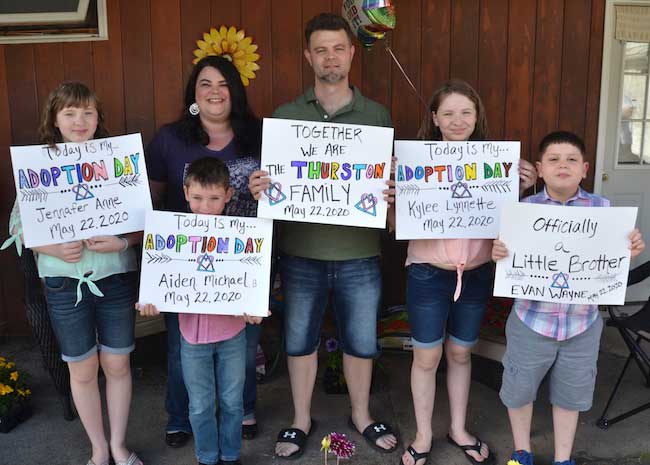
Stephanie and Jeff Thurston adopted twin sisters, Jennifer and Kylee, both 12, and their brother Aiden, 9. They join little brother, Evan Wayne, 8. The adoption was finalized in a hearing this afternoon through Skype. (Pictured from left include Jennafer, Aiden, Stephanie. Jeff, Kylee and Evan Wayne.)
Orleans County Family Court Judge Sanford Church presided over the hearing. The Thurstons originally were scheduled to adopt Jennafer, Kylee and Aiden on March 17. But a day before at 5 p.m. that hearing was called off because the courthouse was closed to the public due to the Covid-19 pandemic.
“We’ve been waiting a long time,” Stephanie Thurston said at the family’s home on West Bank Street. “We feel
There was a celebration outside their house after the hearing. Many of their friends and neighbors drove by, honking horns.
Stephanie Thurston inquired with the court last week about doing an adoption over Skype. She read about other courts doing them through videoconferencing.
Judge Church was willing to do the hearing through Skype. He presided over his first adoption through Skype on May 14.
The Thurstons served as foster parents for the three siblings for 409 days. They met the three at Our Light of Victory Church o Brown Street in Albion, where the Thurstons are youth ministers. The three were staying with a different foster family at the time.
“We got to know the kids and they were on my heart,” Mr. Thurston said. “We grew to love them.”
Mrs. Thurston works as the executive secretary at the church. Mr. Thurston is a hair stylist in Lockport, working at Full Circle Salon.
The couple said they had been praying for about two years about being adoptive parents. They connected with Hillside Children’s Service in Batavia and took classes for six months. They became certified to serve as foster parents in April 2019. The three siblings joined them that month and right away were a good fit with the Thurstons.
This group stopped by the Thurstons’ driveway to congratulate them on the adoption finalization.
Mrs. Thurston said the family needs to be well organized to stay on stop of schoolwork and appointments. That has been one of the bigger challenges, just being busier.
The Covid-19 pandemic has actually slowed down the pace, and the family has enjoyed spending more time together at home.
“It has definitely been an adventure and it will only get better as we make memories and get stronger together,” Mrs. Thurston said. “I feel totally blessed.”
The Thurstons would like the three children to stay in touch with their biological parents.
“We’re very thankful for the blessing their birth parents gave us,” Mrs. Thurston said.



















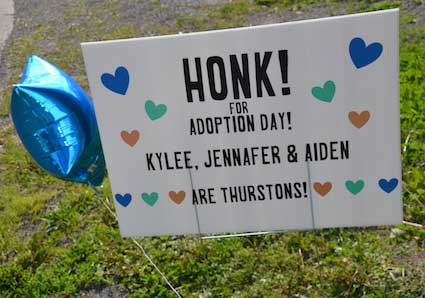 “We’ve been waiting a long time,” Stephanie Thurston said at the family’s home on West Bank Street. “We feel