By Tom Rivers, Editor Posted 9 February 2017 at 4:21 pm
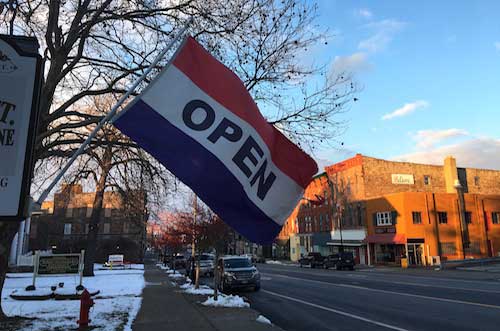
Photo by Tom Rivers: A business on Main Street in Albion has an “Open” flag, encouraging people to stop in.
Sales tax revenue in Orleans County dropped for the second straight year in 2016, according to the State Comptroller Thomas P. DiNapoli.
Sales tax collections were down 1.2 percent or $182,421 in 2016, a drop from $15,469,950 in 2015 to $15,287,529.
That decline followed a drop of 1.5 percent or $233,412, from $15,703,362 in 2014 to $15,469,950 in 2015.
The sales tax is a key source of revenue for the county government. It also is a measure of the local economy.
“Sales tax collections are a crucial, yet unstable source of revenue for local governments,” DiNapoli said in a report. “The impact of little to no growth is felt in several regions across the state, especially in counties and municipalities that may already be struggling financially. As the year progresses, local officials will need to closely monitor their budgets should these collections slip.”
Other counties in Western New York saw decreases including Niagara County, down 0.9 percent; Cattaraugus, down 3.9 percent; Erie, down 0.2 percent; Genesee, a drop of 2.4 percent; and Livingston, down 0.8 percent.
Most counties experienced growth in sales tax. The comptroller’s report showed 39 out of 57 counties had gains.
DiNapoli’s report showed the strongest sales tax growth in 2016 was in the Mid-Hudson Valley with a 2.9 percent increase and Long Island with a 1.9 percent increase.
Central New York was the only region in the state to suffer a decline in collections, while growth in the Mohawk Valley, Southern Tier and Western New York was below one percent, according to the comptroller.
Orleans Hub wrote an editorial on Oct. 31, 2016 with ideas about growing the sales tax. Click here to see “Editorial: To lower taxes and strengthen economy in Orleans, local officials should grow sales tax.”
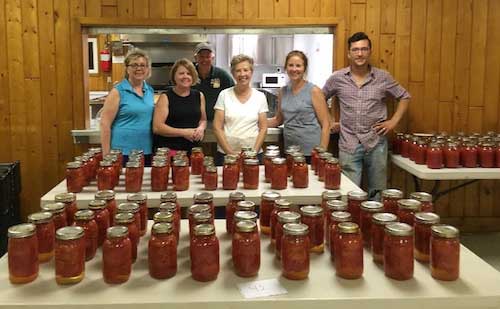
Provided photo: Tim Kirby (in back), board member for the Cornell Cooperative Extension in Orleans County, led a group in canning tomatoes.
Press Release, Cornell Cooperative Extension in Orleans County
KNOWLESVILLE – As the Orleans County Cornell Cooperative Extension rings in a new year and its 100th year anniversary celebration, another important task is at hand – finding the next leader of their organization.
The Board of Directors is actively seeking an Executive Director to lead them into the second century of extending research-based knowledge into local communities.
“It’s an exciting time to be part of Cornell Cooperative Extension, as some of the core programs of our mission have seen a resurgence in popularity, as people recognize and value the relevance of agriculture, local foods, nutrition, youth development, and other strong programs traditionally offered by our organization,” said Deborah Roberts, interim executive director.
Roberts is in a unique position to see the changes. As former executive director, she has seen the changes over the years.
“Our traditional programs, such as support to the agriculture community remains, but we have become more innovative in the ways we deliver education and reach the whole population.”
One recent successful innovation has been the addition of a commercial kitchen on the fairgrounds that can be used to support large events as well as serve as a venue for teaching.
This fall, board member Tim Kirby taught a group how to can tomatoes, a skill that younger generations have not previously had a chance to hone.
In addition the Master Food Preservers, Master Gardeners, the 4-H Cooking Club, Expanded Food and Nutrition Program, and other clubs and community groups all utilize the kitchen for preservation, cooking, and other programming in new ways.
Part of the celebration of the centennial will happen during the Orleans County 4-H Fair. The occasion will be marked with two nights of fireworks, strolling acts, and special live animal performances.
This year will also introduce new contests and events for youth and adults, including a quilt show. These new elements and traditions like livestock shows, delicious foods, and connecting with friends and family will make the week a true celebration of the 100 years of successful programming and the beginning of the next 100 years.
While the community recognizes the strong alignment between CCE and the county fair, numerous other elements are needed for an executive director to be successful.
“Our leader needs to connect us to campus, continue to grow our programs, manage the facilities, and focusing on revenue generation,” states Ed Neal, chairman of the board of directors. “The next executive director will be inheriting a terrific team of staff members, an informed and dedicated board of directors, and an opportunity to facilitate community conversation about the future of Cooperative Extension in Orleans County.”
Filling the position is the agency’s top priority this year, Neal said, and several local residents have already expressed interest in the job, which carries a $58,000 salary and requires a Master’s Degree.
For more information on the Executive Director position, please visit jobs.cce.cornell.edu.
By Tom Rivers, Editor Posted 3 February 2017 at 1:54 pm
Wayne Litchfield
ALBION – A Medina resident has an ambitious goal: to make sure every school-aged child in Orleans County doesn’t go hungry over the weekend.
Wayne Litchfield, a retired county dispatcher who now heads the VALOR Medical Reserve Corps for the county, wants to start a backpack program, where children would have six meals in backpacks to take home for the weekend.
He is in the early stages of trying to put together a program with VALOR partnering with Foodlink, and local churches, organizations and school districts.
“We are looking for stakeholders,’ Litchfield told the Albion Rotary Club on Thursday. “It will need to be community driven.”
Litchfield is also a volunteer with the Hands 4 Hope ministry, which distributes some food on Saturday mornings, visiting Albion twice, and Medina and Holley once each month. Hands 4 Hope also takes prayer requests from people who stop by.
The experience has been an eye-opener for Litchfield, who sees a lot of desperate families with very little food to eat. Hands 4 Hope gives away a “share” which is about $20 worth of food for each family.
Litchfield would like to start “Pack 4 Hope” for kids in school to bring home meals for the weekend. Foodlink could provide six meals per child at $2.50 per kid, Litchfield said.
His ultimate goal would be to have food for each child eligible for free or reduced lunch. The breakdown per school district for children eligible for free or reduced lunch includes 777 in Albion, 402 in Holley, 348 in Kendall, 302 in Lyndonville, and 548 in Medina. The total is 2,377 in the county, Litchfield said.
Medina’s PTSA already runs a backpack program serving 60 children. That is what the group can financially afford, he said.
To feed all of the kids on free and reduced lunch over the weekends would cost over $475,000, Litchfield said.
Foundations locally and regionally, businesses, USDA programs and other funding sources will likely be pursued, he said.
He wants to try a less daunting beginning. He is looking at a pilot project with Lyndonville, the district with the fewest number of kids eligible for free or reduced lunches with 302. Lyndonville also is considered by the federal government to be a “food desert” because there isn’t a grocery store in the village.
Jason Smith, the Lyndonville Central School superintendent, said the district would like to partner with Litchfield and VALOR.
“We support an opportunity to provide meals for some of our neediest families,” Smith said today.
The number of children eligible for free and reduced lunches may need to be a starting point for looking who could be served by such a program, Smith said. If the funding isn’t there for all children on free and reduced lunch, Smith said a backpack program serving fewer children could be a possibility.
Litchfield said a backpack program could be run through VALOR, which is a non-profit with a 501c3.
He wants to pack nutritious meals for kids – fruits, vegetables, dairy, grains and protein.
With better meals over the weekend, students would see improved attendance at school, and a better ability to concentrate, especially earlier in the school week, leading to higher grades, Litchfield said.
Provided photo: New York State Association of Counties congratulate recent graduates of the County Government Institute. They were recognized on Jan. 31 in Albany. From left, include: NYSAC President William Cherry, Oswego County Legislator Terry Wilbur, Orleans County Legislator Ken DeRoller, Monroe County Legislator George Hebert, Chemung County Legislator Paul Collins, Genesee County Assistant Manager Matthew Landers, and NYSAC Executive Director Stephen Acquario.
Posted 2 February 2017 at 3:17 pm
Press Release, NYSAC
ALBANY – Orleans County Legislator Ken DeRoller, R-Kendall, was honored on Tuesday by the New York State Association of Counties for graduating from the NYSAC County Government Institute. The ceremony was held at the NYSAC Legislative Conference in Albany.
The NYSAC County Government Institute is an educational program established in conjunction with Cornell University. The Institute provides an educational program for county elected and appointed officials, to enhance the knowledge, skills and abilities of county officials. For more information, visit www.nysac.org.
DeRoller is an Orleans County Legislator for District #4, the Towns of Carlton, Kendall, Murray, and the Village of Holley. He is committed to serving the residents of the community and Orleans County in the most efficient and effective ways possible.
“The Institute’s vigorous curriculum prepares county leaders with the skills and knowledge necessary to meet the increasing demands of local government leadership in now and in the future,” said NYSAC Executive Director Stephen J. Acquario.
William E. Cherry, NYSAC President and Schoharie County Treasurer agrees. “The County Government Institute equips county officials with the knowledge, skills, and tools necessary to address the challenges and opportunities of leadership, and to engage in civil dialogue with constituents as well as fellow leaders.”
The County Government Institute’s comprehensive curriculum includes extensive course work on government ethics, building consensus in a political environment, principles of county budget and finance, and public sector labor/management relations. The courses are supplemented with electives, training sessions, and continuing education courses designed to support county leaders in serving their constituents.
“My experience with the NYSAC County Government Institute has been very positive in furthering my knowledge through meaningful courses to reach or exceed my learning expectations,” DeRoller said.
DeRoller also serves on the board of directors for the Orleans Economic Development Agency and is active with the Kendall Lions Club.
By Tom Rivers, Editor Posted 2 February 2017 at 10:23 am
Photo by Tom Rivers: Genesee Valley Transportation parked a train on the tracks in Holley next to the Holley Cold Storage in this photo from Aug. 26, 2014.
BATAVIA – The Falls Road Railroad, which runs from Lockport through Orleans County to Brockport, has been approved for $1.1 million in state funding.
The railroad, which is owned Genesee Valley Transportation in Batavia, plans to use the funds to upgrade a multi-modal facility in Lockport and replace railroad ties along the system.
Governor Andrew M. Cuomo announced the funds for GVT on Wednesday, part of $25 million in rail and port improvement projects across New York.
The grants, awarded through the Governor’s Passenger and Freight Rail Assistance Program, will support projects that strengthen infrastructure and economic development vital to the movement of goods throughout the state, Cuomo said.
“These grants will help strengthen New York’s infrastructure, attract new investments, and foster economic growth in communities in every corner of the state,” Cuomo said. “A strong, reliable transportation system is critical to supporting safe, efficient travel for both New Yorkers and visitors, and our investments are key to ensuring the long-term resiliency of infrastructure across the state to support economic growth for generations to come.”
The $25 million will support track rehabilitation, capacity expansion, railroad bridge repairs, and economic development opportunities. An additional $5.4 million in private and local funding is being leveraged through this state initiative, Cuomo said.
By Tom Rivers, Editor Posted 2 February 2017 at 9:17 am
File photo by Tom Rivers: Paul Gray, a motor equipment operator for the Orleans County Highway Department, moves a pallet of computer units and other electronic waste at the County Highway Department at 225 West Academy St. This photo was taken on Sept. 18, 2015.
ALBION – Orleans County has collected nearly 400,000 pounds of “e-waste” since it started offering disposal sites for residents in September 2015.
Many of the older TVs with cathode-ray technology were ending up in ditches along rural roads. Garbage trucks didn’t pick them up beginning on Jan. 1, 2015 and local can redemption centers didn’t take them.
About 500 TVs were picked up by highway crews the first eight months of 2015 before the county opened waste collections sites at the County Highway Department today at 225 West Academy St., Albion; Murray Town Hall at 3840 Fancher Rd (Route31); and the Shelby Town Hall, 4062 Salt Works Rd.
“It’s been a very successful program with quality of life issues,” said County Legislator Ken DeRoller. “It makes the county look better.”
The county pays Sunnking Incorporated of Brockport to pick up and dispose of cathode ray tube televisions and other e-waste – monitors, computers, peripheral devices and other household electronics.
The Sunnking contract is based on quantity or weight of the items. It’s about a $28,000 to $30,000 per year cost.
The state last summer announced it would help municipalities with some of the cost of properly disposing of e-waste. James Bensley, the County Planning Department director, said the state is offering to cover half of the costs. Orleans has submitted an application for state funding, which would be $14,000 to $15,000.
The collected waste at the three sites totals 368,987 pounds since the county started the service, including 208,665 pounds in Albion, 115,510 at Shelby and 44,812 at Murray, according to data from the County Planning Department.
The county also runs household hazardous waste collection events, with residents disposing of 22,291 gallons of liquid waste and 41,205 pounds of solid waste during five events since 2009.
Photos by Tom Rivers: Members of the Honor Guard in Orleans County are pictured with their certificates after being named the 2016 ‘Person of the Year” by the Orleans Hub. Pictured, include, from left in front row: Dave Kusmierczak, Adam Johnson, Earl Schmidt and Eric Delano. Second row: Ken Schaal, Fred Heschke, Steve Johnson, Tony Vicknair, Frank Berger, Dave Higgins and Ron Ayrault. Back row: Gary Befus, Bryan Splangler, George Bakeman, Mike Donahue, Steven Goodrich, Bob Blosenhauer, Charles Eberhardt, Al Pulcino and Glenn Whitmore.
By Tom Rivers, Editor Posted 1 February 2017 at 8:40 am
Orleans Hub recognized nine outstanding citizens on Tuesday during an awards program at Hoag Library in Albion. Pictured, front row, include: Bill Menz, Nicole Tuohey and Carol D’Agostino. Back row: Jack Burris, Linda Redfield, Wes Bradley and Holley Ricci-Canham. Missing: Chris Busch and Erik Olsen.
ALBION – Orleans Hub held its annual awards program on Tuesday evening and presented certificates to our annual list of “Outstanding Citizens” and also the “Person of the Year.” About 75 people attended the program at the Hoag Library.
Orleans Hub Editor Tom Rivers and Publisher Karen Sawicz pick the annual winners, looking for people who make extraordinary contributions to the community.
We named the “Honor Guard” as Person of the Year in appreciation for veterans who volunteer at about 100 military funerals each year. The Honor Guard provides a solemn and dignified sendoff, sometimes standing for hours in the freezing cold or blistering heat.
The Honor Guard marches in parades, and attends numerous local community services – Memorial Day, the opening ceremonies for the County Fair, Sept. 11 and Pearl Harbor memorial services, and many other events.
There are Honor Guards in Medina (with members from Lyndonville) and a combined group from Albion and Holley. Each group has about a dozen regular volunteers and they usually range in age from 60 to their early 90s.
The Albion-Holley and Medina groups will often work together for a funeral. They want a good turnout to pay their respects.
Many communities struggle to have enough volunteers for the Honor Guard and veterans may come in from outside the community. Orleans County still has a dedicated corps, but the Honor Guard members worry about that, especially as many of the veterans get older.
Several Honor Guard leaders spoke at Tuesday’s awards program, saying they are grateful for the chance to show respect for the veterans at their funerals.
Orleans Hub presented our fourth annual list of Outstanding Citizens. We picked people who have been volunteering or serving in community causes for many years. They do their good deeds for little to no pay, driven by a love for their community and neighbors.
Here are our picks for Outstanding Citizens for 2016:
Nicole Tuohey: The Medina woman is a prolific fundraiser in the fight against Alzheimer’s. She typically raises about $1,000 each year for the “Walk to End Alzheimer’s.” Tuohey, 26, each year sells about 1,000 paper “elephant links” and creates a chain that is used to kick off the annual “Walk to End Alzheimer’s.” Nicole has Triple X Syndrome. She hasn’t let that disability prevent her from being a tireless advocate against a disease that took the lives of her grandparents, Don and Jane Bradley.
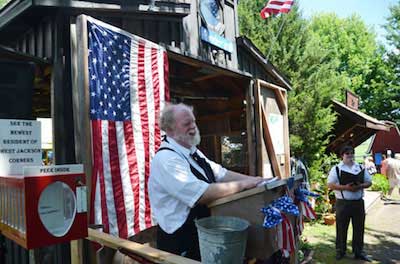
Erik Olsen leads a town meeting during a recent “Old Tyme Day,” an annual celebration at East Shelby Community Bible Church.
Erik Olsen: The leader of East Shelby Community Bible Church has the church dedicated outreach. Every July for the church hosts an “Old Tyme Day” celebration in east Shleby, serving pie, lemonade and hot dogs for a penny. There are horse-drawn rides, candle-making, and other activities with an emphasis on fun – and old-fashioned technology. About 2,000 to 3,000 people attend Old Tyme Day, a huge crowd for the tiny hamlet in East Shelby once known as West Jackson Corners. Church members have created a mini-village across from the church. That village also draws about 500 to 1,000 people for an old-time Christmas celebration.
The church has been growing ever since Olsen and an initial group of 40 people started the church at a former Methodist Episcopal building in 1989. That church building had been empty for 30 years. The East Shelby Community Bible Church has grown so much – about 275 members – it has put an addition on the building.
Carol D’Agostino: The Kendall Junior-Senior High School principal makes numerous community connections as leader of her hometown school. She serves on the boards for the Orleans Economic Development Agency, the Orleans County United Way and the Human Services Council of Orleans County, often bringing back ideas for Kendall to improve opportunities for students and the community. D’Agostino helped start the Kendall Innovations Committee, which brings together leaders from the school district, town government and county to brainstorm ways to promote Kendall. She is a member of the Lawnchair Ladies and led the school through a major capital construction project.
Linda Redfield: The long-time ESL teacher helps students build a better life. In the past 20-plus years, Redfield has helped about 400 farmworkers learn English. Redfield started going to labor camps in 1994, before a school built by the World Life Institute became the base for classes in 1999. The school on Stillwater Road offers evening courses in English, as well as computer literacy, pottery and other programs through a partnership with the Orleans-Niagara BOCES. Several of the students attended the awards program on Tuesday.
Wes Bradley: The Lyndonville resident leads the fund-raising effort that makes Lyndonvilel the place to be each Fourth of July in Orleans County. Bradley works throughout the year raising money on the big show, which tops $20,000. Bradley, a retired teacher, is active in the community in many ways, from serving on the Yates Town Board, to 37 years with the Fire Department and serving as finance chairman for the Lyndonville United Methodist Church. He also serves on the Lyndonville Area Foundation Board of Directors, which distributes more than $100,000 a year to community causes. Bradley also helped start Lyndonville’s annual Christmas celebration in 2013, where residents, businesses or organizations decorate Christmas trees in Veterans’ Park. That has now grown to 61 trees with the community welcoming Santa and singing Christmas carols.
Jack Burris: The Albion resident started a new ministry last year where he and a team of volunteers take a former red delivery truck to stops in Albion, Medina and Holley, alternating sites each week. Hands 4 Hope distributes bags of food and takes prayer requests. “Unfortunately in Orleans County there is a lot more heartache out there than I thought there was,” Burris said. “There are a lot of people in tough circumstances.”
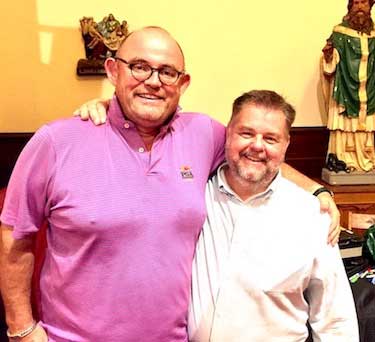
Provided photo: Chris Busch, right, is pictured with Ronan Tynan on Sept. 17. Tynan, one of the biggest names to perform in Orleans County in many years, sang to a capacity crowd at St. Mary’s Catholic Church.
Chris Busch: The chairman of the Orleans Renaissance Group isn’t afraid to aim high and reach for the stars. Last year he and the ORG welcomed famed Irish tenor Ronan Tynan to Medina for a concert at St. Mary’s Catholic Church.
Busch has been an active Medina community member for many years, leading the Tree Board that has helped Medina plant about 1,000 trees in recent years. Busch is chairman of the Medina Planning Board, insisting on design standards in the historic district that have preserved Main Street’s look as if it was a Norman Rockwell painting. Those standards have attracted investment in the downtown from numerous businesses.
Busch last year also helped spearhead the first-time Farm-to-Table Dinner event in Medina on Aug. 4 that attracted 137 people for a fine dining experience on a closed off section of Main Street.
Holly Ricci-Canham: The Carlton woman compiled a book on local farmers, a two-year effort that culminated in 300 pages after interviewing 150 farmers. “Mom & Pop Farming in Orleans County, New York – The past brought to life” is one of the most ambitious local history books in many years. The book includes about 400 photographs and includes reminisces about simple days with lots of hard work. The farms featured in the book were part of a close-knit community with neighborhood schools and churches. Ricci-Canham grew up on a “mom and pop” farm in Kenyonville run by her parents, Pete and “Mike” Ricci. The book covers farm operations throughout county with sections about muck farmers, dairies, fruit and vegetable farms, canning companies, migrant labor camps, “ladies accounts,” technology changes as well as country schools, “kids play” and fairs and celebrations.
Bill Menz: The Medina resident has spent more than a decade working on a monument and memorial outside the former Medina Armory, which has been a YMCA the past 35 years.Menz doesn’t want the original purpose of the building to be forgotten, as a training site for soldiers who served in many wars. Menz helped build the monument that was unveiled in 2008 by the Armory. In recent years he has been raising money for a bronze statue to go on top of the monument. Menz and the Company F Memorial Committee met its $65,000 goal at the end of 2016, with Menz sending out letters, knocking on doors and making numerous phone calls. The 7-foot-high statue could be ready in 2018.
By Tom Rivers, Editor Posted 30 January 2017 at 12:23 pm
ALBION – Otto, the new K9 dog for the Orleans County Sheriff’s Office, will be getting a new vehicle.
The County Legislature last week approved spending $50,192 for a new 2017 Chevrolet Tahoe from Joe Basil Chevrolet in Depew. The Legislature also approved buying two Tahoes for patrol vehicles for $101,824.
The Sheriff’s Office on Oct. 13 welcomed Otto, a German Shepherd from Holland. Otto works with Deputy Jeff Cole. The K9 is trained in tracking and will receive more training with Cole.
The dog will be useful for solving crimes, finding suspects and also for public relations. Otto will join Cole for patrols and for narcotics detection.
In other resolutions, the Legislature last week:
• Named Jerry Bentley, the Barre fire chief, a new deputy fire coordinator, replacing Marty Zwifka of Albion who is retiring after 20 years. Bentley will be paid $2,178 for the year.
• Authorized the Highway Superintendent to purchase four new pickup trucks – 2017 Chevrolet Silverados – from Joe Basil Chevrolet in Depew for $123,832.
• Approved spending $12,369 for a new road planer from Clark Equipment in West Fargo, ND, and $45,877 for a Ford F-550 utility truck from Van Bortel Ford in East Rochester. Both will be used by the Highway Department.
• Approved a five-year agreement between Sheriff’s Office and Taser International of Scottsdale, Arizona to buy and support 25 Premium X26P Tasers, at a total cost of $44,510.
• Authorized the Health Department to spend up to $100,000 for the human rabies vaccine for post-exposure treatment.
• Appointed Bruce Baker to the Orleans County Board of Health.
• Appointed Elaine Berg of Murray to the Orleans County Planning Board, term effective until Dec. 31, 2019, with Charles Felice of Murray to serve as the alternate.
• Approved allowing the Strawberry Festival Committee to use the Courthouse grounds for the annual Strawberry Festival on June 9-10.
By Tom Rivers, Editor Posted 30 January 2017 at 10:10 am
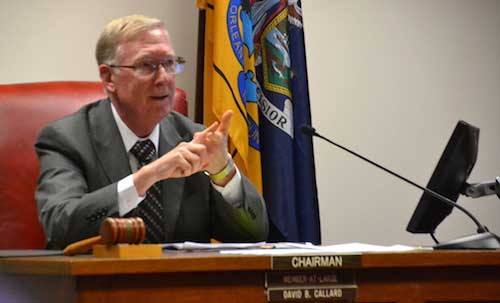
Photo by Tom Rivers: Orleans County Legislature Chairman David Callard said giving towns and villages more of the local sales tax would result in higher county property taxes.
ALBION – Orleans County legislators were asked last week to modify the sales tax sharing formula locally so towns and villages would receive a boost in funding.
Paul Lauricella of Lyndonville said the towns and villages have high tax rates and directing more local sales tax to them would help to bring down those tax rates.
“Every town and village is cash-strapped,” Lauricella told legislators during last week’s meeting. “You guys seem to have money for everything you want to do.”
The county receives about $16 million annually in sales tax and shares $1,366,671 collectively with the four villages and 10 towns. The town and village total has been frozen since 2001.
The village amount, however, has been decreasing because the local share is based partly on assessments. The town assessments have been increasing while villages have been going down.
The share for the four villages – Albion, Holley, Lyndonville and Medina – in 2013 was $404,661 of the sales tax. But it dropped by about $25,000 to 2017. The village share fell to $400,681 in 2014, to $398,111 in 2015, to $391,230 in 2016 and the biggest decrease yet, $379,265 for 2017.
“There is a limited pot of money. To take it from the county doesn’t serve any practical purposes. There is no extra sales tax money to share.” – David Callard
Legislature Chairman David Callard said he doesn’t support taking sales tax funds from the county and giving more to the towns and villages. The towns, however, could consider modifying the formula for the $1,366,671, so villages wouldn’t lose money as the assessments change.
“There is a limited pot of money,” Callard said. “To take it from the county doesn’t serve any practical purposes. There is no extra sales tax money to share.”
Village leaders periodically request the county to look at how it shares sales tax with the local municipalities, noting that in some counties, it’s more of a 50-50 split with the county getting half of the funds and cities, towns and villages sharing the other half.
Orleans, even though it keeps about 92 percent of the sales tax, is actually being generous, Callard said, because most of the 14 counties under 50,000 population don’t share any of the sales tax.
Orleans picks up some expenses that other counties push onto towns, such as community colleges. That cost has jumped for Orleans County from $694,823 in 2005 to over $1.85 million in 2017.
Callard said the county continues to be strained by mandated programs from the state, with Medicaid the biggest budget burden. If the state pulled back some of the benefits in that program, it would ease costs for the counties and state.
Lauricella said the taxes are too high locally.
Callard said the taxes would come down if the state scaled back some of benefits with Medicaid and if the state paid for more of its mandated programs.
“The best way to cut taxes would be with mandate relief,” Callard said.
By Tom Rivers, Editor Posted 29 January 2017 at 10:12 am
ALBION – The Orleans County Planning Board approved a zoning change for East Center Street that will allow three properties to go from single-family residential to general commercial.
The zoning change accommodates growth for Medina Transport, a taxi service owned by David Stalker. Planners said the zoning change blends in with the area, which includes a Mexican grocery store and other businesses. The former Towne Primary School also is in back of the property and has been zoned for business.
The zoning change includes 501 East Center, 493 East Center, and 491 East Center.
“The village feels it makes a lot of sense to do this,” said Marty Busch, the village’s code enforcement officer and also a member of the County Planning Board.
Stalker’s business was called a “great success story for Medina,” according to a letter from his attorney, Nathan Pace.
“The success of this business is stretching the limits of what is possible in the Residential district,” Pace wrote to Medina Mayor Michael Sidari and the Village Board. “The change in zone would be in line with the general plan for Medina and the area, as there is already a light industrial zone across the street and the section in question is immediately contiguous to a presently existing general business zone.”
Stalker said one of the houses with the rezoning is lived in by employees. He is looking to add additional parking space. He also acquired land across the street that could be used for parking vehicles.
The Planning Board on Thursday recommended the village approve the zoning change. Planners said the business draws few, if any, customers to the site.
Other decisions by the board include:
• Approval for the site plan and special use permit request for construction of a ground-mounted solar system (11.725 kW) at 10506 Telegraph Rd. That property, owned by Graydon and Eileen Owen, is located in a Agricultural/Residential District in Shelby. The site is along the Erie Canal and the solar system won’t be visible from the road, planners said. The system will be constructed by CIR Electrical Construction Corp.
• Recommended Medina and Ridgeway both approve amendments to their zoning ordinances for regulating solar energy systems, including requiring building permits, setting up systems to minimize visual impact, limiting ground-mounted systems to side or back yards and no more than 2,000 square feet or up to 50 percent of lot coverage in the village. Larger systems will limit the maximum height of solar panels at 15 feet in Medina (20 feet in Ridgeway), establish minimum setbacks from property lines at 25 feet in Medina (100 to 500 feet in Ridgeway), and require landscape buffer around solar collectors and equipment.
A decommissioning plan also will be required with solar systems to be removed within 180 days of cessation of use.
• The board also re-elected Brian Napoli of Ridgeway as board chairman and Tibbs Ahlberg of Gaines as vice chairman.
Photo by Tom Rivers: Michael Van Durme, a retired chief conservation officer for Region 8 of the DEC, said rifles are safer than shotguns for deer hunting.
By Tom Rivers, Editor Posted 26 January 2017 at 10:44 am
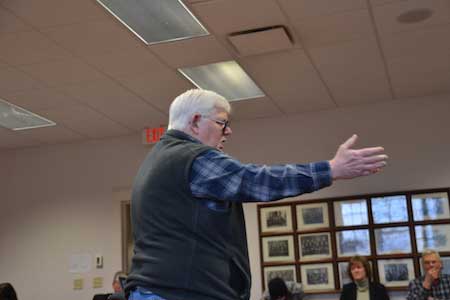
Emerson “Tinker” Young, past president of SCOPE (Shooters Committee on Political Education) in Orleans County, told the Orleans County Legislature on Wednesday that not all hunters favor allowing rifles for big game hunting in the county.
ALBION – Orleans County legislators continue to be pressed to allow rifles for hunting deer and bears.
Several speakers urged the Legislature to support rifles for big game hunting. On Dec. 21, several leaders of the sportsmen’s groups in Orleans stated their support for the measure.
On Wednesday, the former president of SCOPE (Shooters Committee on Political Education) said not all hunters favor allowing rifles for shooting deer and bears.
“I’m not 100 percent in favor of it,” said Emerson “Tinker” Young, the past president of SCOPE. “There’s not enough guys out there with common sense.”
Young said high-powered rifles can send ammunition 1,000 yards. He worries some hunters would empty their rifle shooting at a deer, and those bullets could hit houses.
“There’s a lot of people out for this and I understand what they’re saying,” Young said. “I just wish we could sit down and figure out a way so guys don’t misuse it.”
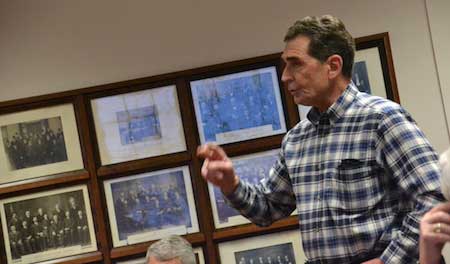
Doug Piedemonte of Holley said his house has been hit by slugs from shotguns, including one that tore through his home, breaking a mirror inside.
Doug Piedemonte of Holley said he would support allowing rifles. His house has been hit by slugs fired from shotguns.
Michael Van Durme, a retired chief conservation officer for Region 8 of the DEC, told legislators that rifles are much safer for hunting.
He said there hasn’t been any accidental deaths by hunters using rifles in the past 40 years while they were deer hunting.
Legislator Lynne Johnson asked Van Durme if he misspoke, and he said his statement was true.
Johnson said she heard of a man in Parma hit in the stomach from a long-range rifle round.
Van Durme said that was from someone who was target shooting, not hunting.
Van Durme’s career as a conservation officer included seven years in Orleans. He now manages a consulting company that specializes in hunter and firearms safety.
“I can tell you rifles rounds for white-tailed deer are safer than shotguns,” he said. “As far as a rifle round going long range and hitting people, it just doesn’t happen.”
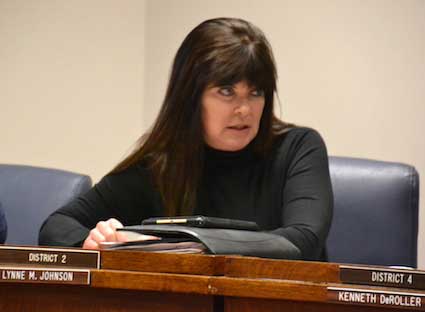
Legislator Lynne Johnson asks a question during Wednesday’s meeting.
Sportsmen Club leaders told county legislators that 41 out of 62 counties, including counties with more residents than Orleans, allow rifles for hunting.
The Orleans County Sportsmen Federation last month presented the Legislature with a petition signed by about 500 people, supporting center-fire rifles for deer hunting.
The county allows rifles for small game hunting – woodchucks, foxes, crows and coyotes. Other counties also allow rifles for smaller animals and Van Durme said there hasn’t been any accidental deaths.
“Hunters use rifles for woodchucks and no one has been shot long range,” he said.
Sportsmen insisted the rifles are safer, because hunters tend to take only one shot with a rifle because they use scope and have better accuracy.
Legislators said they will continue to discuss the issue.
By Tom Rivers, Editor Posted 26 January 2017 at 9:07 am
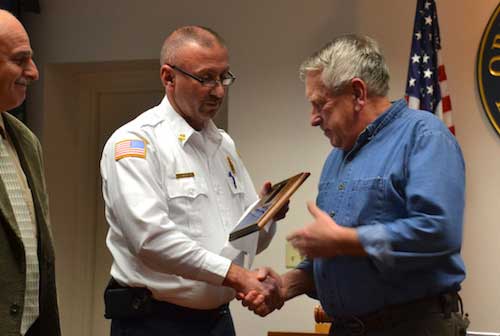
Photo by Tom Rivers: David Thom, a volunteer for 27 years with the Auxiliary Police, receives a plaque for his service to the group that was disbanding last month by the county. Thom accepts the plaque from Dale Banker, the county’s emergency management director. County Legislator John DeFillipps is at left.
ALBION – Orleans County officials on Wednesday praised an all-volunteer group for its many years of dedicated service.
However, liability concerns and the demands of training to meet the standards of peace officers, prompted the county to dissolve the Auxiliary Police last month.
The group was started in Orleans County in 1952 and was to be activated at times of civil defense. The county was never attacked, and the group’s duties strayed from that original mission. The Auxiliary Police provided crowd control at the 4-H Fair, football games, festivals and other community events.
The group had shrunk to seven members.
“They always did a great job,” said Dale Banker, the county’s emergency management director who oversaw the group. “I have nothing but praise for them.”
The Legislature on Wednesday presented a plaque to Lt. David Thom, who volunteered 27 years with the group.
Capt. Jack Monell has 47 years with the Auxiliary Police and has been its leader. He also will be getting a plaque, and so will Joe Riley, who served 43 years with the group.
Banker also has certificates of appreciation for Lawrence Bale, 11 years; Dixie Woodworth, 7 years; Ray Keffer, 7 years; and Craig Wilston, 7 years.
Ray Hertel also served with the group for 22 years before retiring last year.
Banker said the Auxiliary Police donated about 1,000 to 1,200 hours a year.
The county may fill some of the void without the group by having seasonal deputies work at some more community events.
By Tom Rivers, Editor Posted 25 January 2017 at 11:55 am
‘It wasn’t a decision made lightly. We agonized over this discussion for months.’
ALBION – Orleans County officials last month decided to disband an all-volunteer auxiliary police force, citing concerns over liability.
The auxiliary police was formed in 1952 with a mission to provide civil defense if the community was under attack. The actual work, however, changed to helping manage crowds at large community events, such as the Orleans County 4-H Fair, fireworks displays, festivals and football games. The auxiliary police also directed traffic at events.
“They served the community well and did many wonderful things,” said County Attorney David Schubel, who recommended the group be disbanded.
The group was down to six members, and would have needed more training and equipment to meet standards of peace officers.
“If you’re going to do it and do it well it would have required enormous training,” Schubel said today. “If we continued, we would have needed more people.”
The auxiliary police operated under the Emergency Management Office. Schubel said many people in the public likely assumed they were deputies with the Sheriff’s Office.
Many of the auxiliary police carried their own firearms with holsters and equipment that weren’t up to police standards.
“They certainly had the best interests of the community at heart,” Schubel said.
During the Orleans County Association of Municipalities meeting on Tuesday, County Legislator Bill Eick told the group the auxiliary police had been dissolved.
“Liability is No. 1,” Eick told the village, town and county officials. “There was declining interest from younger people.”
The county may fill void of the auxiliary police with seasonal deputies, who currently work on the marine patrol. Those deputies all have law enforcement training with the proper equipment. They would operate under the Sheriff’s Office.
“It wasn’t a decision made lightly,” said Chuck Nesbitt, chief administrative officer. “We agonized over this discussion for months.”
By Tom Rivers, Editor Posted 24 January 2017 at 9:13 am
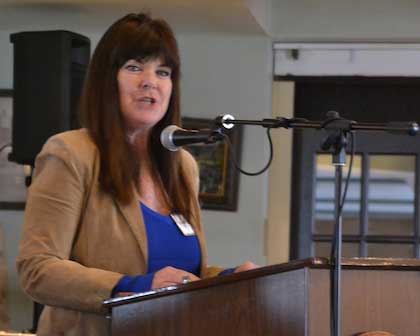
Lynne Johnson, vice chairwoman of the Orleans County Legislature, speaks during Friday’s Legislative Luncheon for the Orleans County Chamber of Commerce.
GAINES – Orleans County has made progress on many fronts by tackling neglected infrastructure – roads, bridges, culverts, building roofs – while also getting closer to bringing high-speed Internet to underserved pockets of the county.
That was the message from Lynne Johnson, vice chairwoman of the County Legislature. She addressed nearly 100 people on Friday at the annual Legislative Luncheon put on by the Orleans County Chamber of Commerce at the Village Inn.
“2016 was a great year for Orleans County,” Johnson said at the luncheon.
She sees many positive developments for 2017.
Pride Pak’s construction of a 68,000-squarefoot vegetable and processing facility in Medina topped the economic development efforts last year, Johnson said. She praised the Orleans Economic Development Agency, led by Jim Whipple and Gabrielle Barone, for working with Pride Pak to make the company’s $12.5 million investment a reality.
Pride Pak also is considering two expansions in the future in Medina, with 200 workers eventually on the payroll. It opened in Medina in November with 40 employees.
Orleans County’s unemployment rate has also fallen to its lowest level in a decade, Johnson said.
Orleans took on an $8 million bond to tackle a series of infrastructure projects from 2015 to 2017, including six bridges, six culverts, and new roofs on some of the county buildings. The county also built two new pole barns for the Highway Department.
The county also purchased a paver for the Highway Department that is available for other municipalities. The Highway Department last year paved 29 miles of roads, more than doubling the previous high.
Orleans officials have been pressing the state for several years about the weight restrictions or closures with many of the canal bridges in the county, as well as the deterioration of the Lake Ontario State Parkway.
The state has about $20 million-plus approved to work on canal bridges and the Parkway, Johnson said on Friday.
The state has set aside $14 million to improve the Parkway in 2017-18 with most of the work upgrading the Parkway in Monroe County near Orleans. The Parkway paving includes $8.97 million to pave the road from Route 19 east to Payne Beach in 2017, and then $5.2 million to pave the Parkway from Route 19 in Hamlin to Route 237 in Kendall in 2018.
The Department of Transportation’s 5-year plan, which runs until 2020, doesn’t include paving for the Parkway west of 237 in Kendall.
A five-year capital by the State Department of Transportation, however, includes repairs to the lift bridge on Main Street in Albion, and $13 million to rehab six other canal bridges in Orleans County.
Gov. Cuomo last week also announced $2,989,000 for four other bridges in the county, including $1.045 for the Portage Road bridge over Fish Creek; $1.140 million for the Monroe-Orleans County Line Road bridge over East Branch Sandy Creek, $630,000 to Orleans County for South Holley Road over a branch of Sandy Creek, and $174,000 to the town of Albion for a small bridge on Clarendon Road over West Branch Sandy Creek.
Johnson has been the county’s point person for efforts to extend broadband Internet into Orleans. The county has teamed with Niagara County in the Niagara-Orleans Regional Alliance to press the state for more high-speed Internet coverage.
The effort received good news late last year when Charter Communications announced it would serve most of the remaining gaps for coverage in Orleans as part of its merger with Time Warner. The state is requiring Charter to extend service to an additional 145,000 homes and businesses in New York over four years as part of the merger.
Niagara County Legislator David Godfrey said a two-county alliance has advanced projects in Orleans and Niagara counties.
In Orleans County, there are about 3,600 households without access to high-speed Internet, but that number would shrink to 77 as part of the merger.
Charter would also make significant improvements in Niagara County, reaching all but 943, with most of those gaps in rural eastern Niagara County.
“The broadband has been a long struggle and we’re not done,” said David Godfrey, a Niagara County legislator who has been teaming with Johnson on the broadband push through NORA.
The high-speed Internet is critical for attracting and keeping residents, who need the service for homework, job searches and a desired quality of life, Godfrey said. Businesses need the service to file many reports and to be competitive in the marketplace.
Godfrey said the extended service will fill a need, “so we are no longer deprived and discriminated against because we are rural counties.”
NORA also has been working together to oppose a new lake level plan for Lake Ontario. A plan approved by the bi-national International Joint Commission has been approved, despite concerns that it would lead to more erosion and bigger fluctuations in water levels on the southshore. Johnson said she is optimistic the Trump Administration will overturn the plan.
NORA also has been pushing for a dredging plan and federal funds to ensure harbors, including Oak Orchard, are dredged on a regularly basis to prevent a buildup of sediment that could make the harbors impassable for boaters.
“We are working on a long-term mechanism to dredge our harbors,” Johnson said.
By Tom Rivers, Editor Posted 18 January 2017 at 1:43 pm
The state has announced funding for bridges and culverts today and four of the projects are in Orleans County.
The funding – $2,989,000 total for Orleans – includes:
• $1.045 million to Orleans County for Portage Road over Fish Creek
• $1.140 million to Orleans County for Monroe-Orleans County Line Road over East Branch Sandy Creek
• $630,000 to Orleans County for South Holley Road over a branch of Sandy Creek
• $174,000 to the town of Albion (Orleans County) for Clarendon Road over West Branch Sandy Creek
The county applied for five projects and received funding for three, Chief Administrative Officer Chuck Nesbitt said.
“We were hopeful we would get something,” he said. “But we weren’t counting on it until it was announced.”
The state will pay 100 percent of the cost for culverts, and 80 percent of the work for bridges. Nesbitt said there may be other funds available besides county dollars to cover the remaining 20 percent for the bridges.
He expects the three projects for the county to be in design phase this year, with the construction to be in 2018.
The Albion bridge is actually a culvert on Clarendon Road, near the Holley Road intersection. Michael Neidert, the highway superintendent, said he expects that culvert to be replaced this summer after school is out.
Orleans County fared better than most other counties in the Finger Lakes with the bridge and culvert projects announced today.
Gov. Andrew Cuomo announced $19.7 million for 23 projects in the Finger Lakes, which includes 1 in Seneca, 2 in Genesee, 5 in Livingston, 3 in Monroe, 4 in Orleans, 5 in Wayne, 1 in Wyoming, 1 in Ontario and 1 in Yates.
Nesbitt said a 10-year capital plan had the county prepared to apply for the funding.
“We can continue to move the ball forward with our capital plan,” he said.
The funds announced today are part of a $21.1 billion multi-year capital plan – BRIDGE NY – to upgrade roads, bridges, and other vital transportation infrastructure across New York State.
“Infrastructure is the key to our prosperity and through this program, we are providing funding to local governments in every corner of this state to help ensure their bridges remain reliable, resilient, and able to meet the demands of current and future generations of New Yorkers,” Cuomo said in a statement. “This is another step toward a safer, stronger and more secure New York for all.”