By Tom Rivers, Editor Posted 2 November 2019 at 2:58 pm
Photos by Tom Rivers
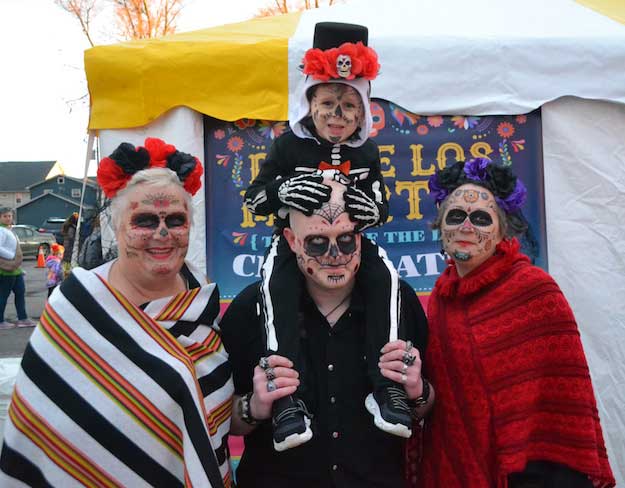
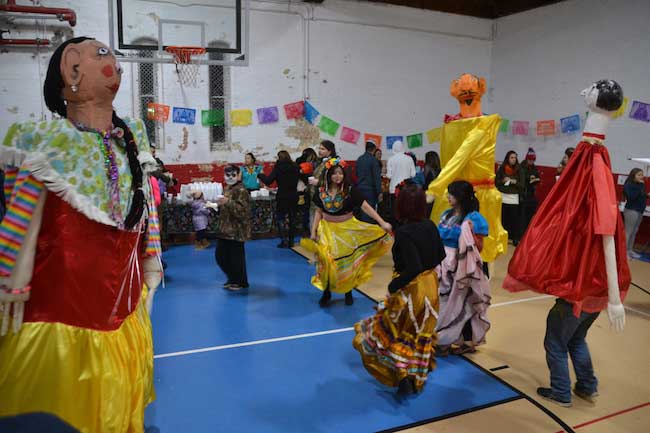
MEDINA – Crevan Ulrich, 4, of Medina is on his father Jeremy’s shoulders during the Day of the Dead Celebration in Medina on Friday evening. Crevan is joined by his grandmother, Cindy Tracey of Sanborn, and mother, Kate Tracey.
The Genesee-Orleans Regional Arts Council, Medina Business Association, Orleans County YMCA and Mariachi De Oro worked together on the big event which was in medina’s downtown in the afternoon before a parade to the YMCA at 6 p.m.
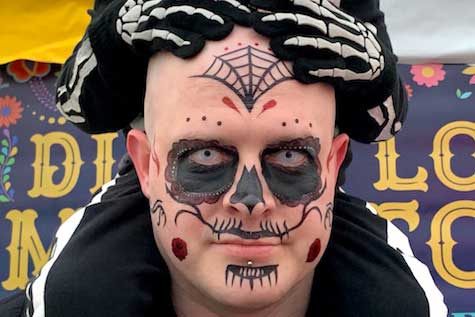
Jeremy Ulrich dressed up for the occasion, including with temporary tattoos and specialty contact lenses.
The Day of the Dead Celebration is a time of joyful remembrance of deceased loved ones, filled with an array of colors, scents, sounds and stories. Centered around the Christian observance of All Saints and All Souls Days on November 1 and 2, the celebration includes images and ideas about the roles of ancestors in our lives, that trace back to Mexico’s indigenous peoples.
Traditionally, people believe that this is the one time of the year when souls can return to earth for a day and commune with their families and friends.
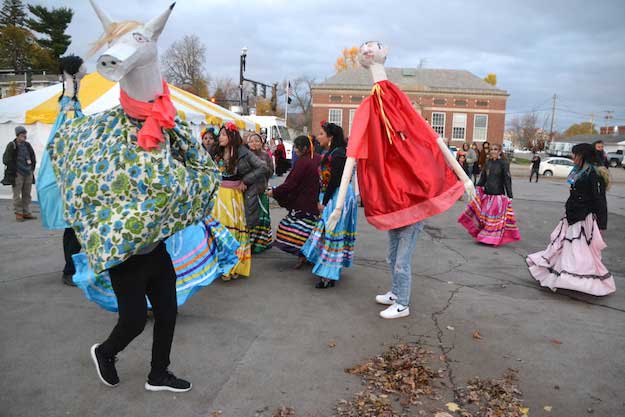
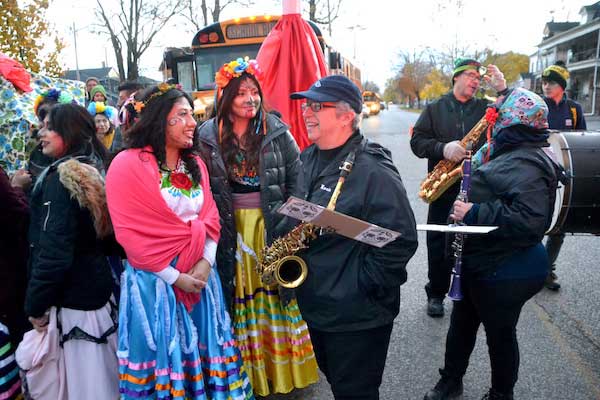
Musicians from March Time Marchers joined dancers from Mariachi Del Oro at the start of the parade on West Avenue. Then headed to Pearl Street and then to the YMCA.
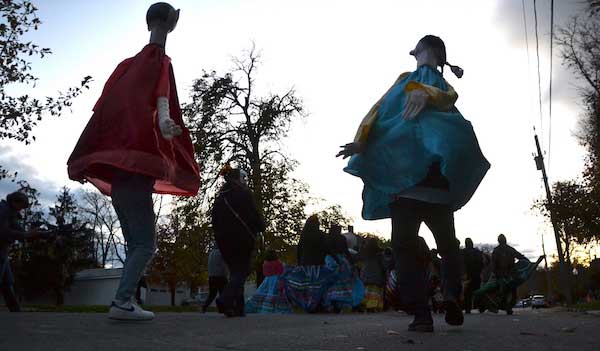
The two puppets towered more than 10 feet. They were nimble on their feet during the parade.
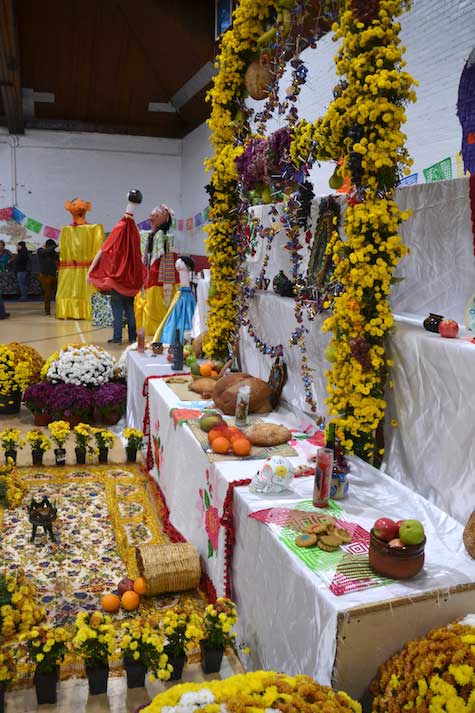
At the YMCA there was an ofrenda or home altar, which included bright aromatic marigolds, with petals forming a path to lead the souls home. Candles give welcoming lights and incense gives additional guidance and guards against unfriendly spirits. Photos, mementos and favorite foods of loved ones are placed on the altar.
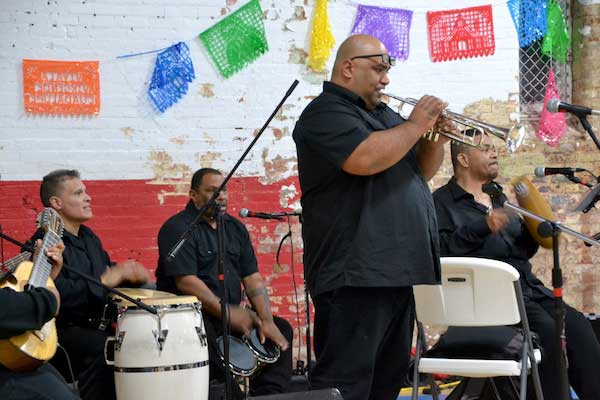
The band Conjunto Clásico performed traditional Mexican music, which had the crowd dancing.
This group dances at the Y where Mexican food and beverages were available.
To see a video of the parade on West Avenue, click here.
By Tom Rivers, Editor Posted 28 October 2019 at 10:52 pm
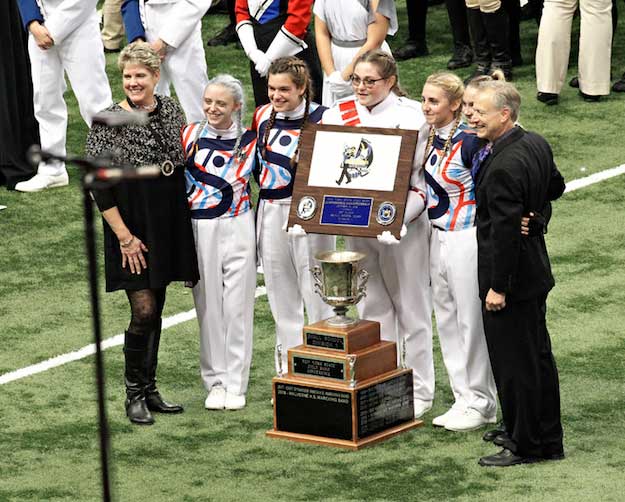
Provided photos from Wendi Pencille: Some of the Medina Marching Band leaders accept the first place Governor’s Cup on Sunday night during the New York State Field Band Conference Championship at the Carrier Dome in Syracuse. The two adults are Chris and Beth Calhoun, NYSFBC 2019 inductees into the NYSFBC Hall of Fame. The students from left are Margaret Klotzbach, Miranda Zelazny, Jada Draper, Lacey Kenward and McKenna Callard.
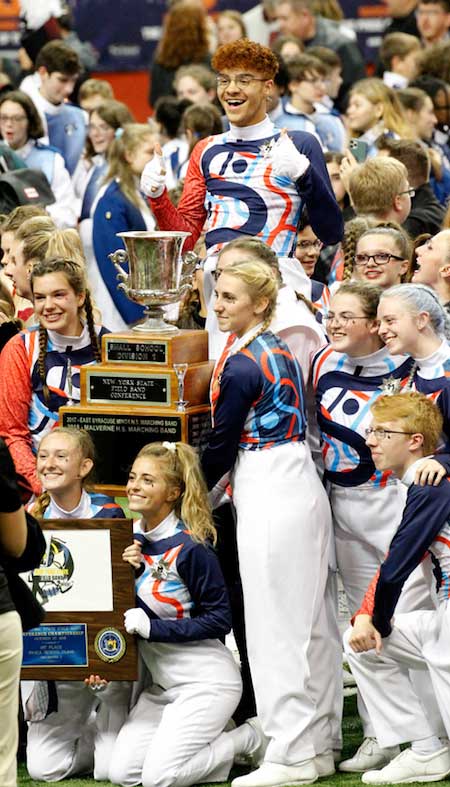
Trenton Crews, top, is thrilled with the band’s victory on Sunday.
SYRACUSE – The Medina Marching Band is the state champion for the first time since 2013. Medina had the top score in the Small School 1 Division on Sunday at the Carrier Dome in Syracuse. Medina’s 91.6 score was higher than seven other bands in SS1.
The Mustangs won all six captions or categories that make up the score – “That’s unheard of,” said Jim Steele, the band director.
The band this season performed to a program titled, “Walk the Path.” Medina had top marks in the competition for Ensemble Music Performance, Ensemble Visual Performance, General Effect Music, General Effect Visual, Individual Field Music Performance and Individual Field Visual Performance.
The band was second or third from 2014 to 2018, before bringing home the sliver-plated Governor’s Cup on Sunday.
Steele praised the 115 students who are in the marching band. Of those band members, 40 percent are in the band for the first time.
Some of the band members started reading through music for the fall show back in June. Some band members, the drumline and those who play the wind instruments, started practicing in early July, and then there was band camp during the third week in July.
After that, the full band and colorguard practiced three days a week – Tuesday, Thursday and Saturday – through the summer and the first two months of the school year.
“There is a tradition here, there is no doubt about it,” Steele said. “The kids like to be part of something bigger than themselves.”
Medina puts up some of the highest scores, even those from much larger schools. Medina is actually the fifth smallest school district out of the 53 schools at the New York State Field Band Conference Championship.
Sunday’s victory was Medina’s 14thstate championship. Medina won five straight years, from 2009 to 2013, before taking the title on Sunday.
“Our emphasis is not winning at all costs,” Steele said. “It’s building better young adults and still be entertaining.”
The band is fortunate to have such a supportive booster program and school administration, he said.
This season was Medina’s 53rd time competing as a marching band and Sunday was the Mustangs’ 43rd appearance in the New York State Field Band Conference Championship.
These Mustang band members include Margaret Klotzbach, Lily Kiebala, Mirana Zelazny, Mary Flores, Jada Draper, Grace Cook, Lacey Kenward, Trenton Crews and Reagan Wilkins.
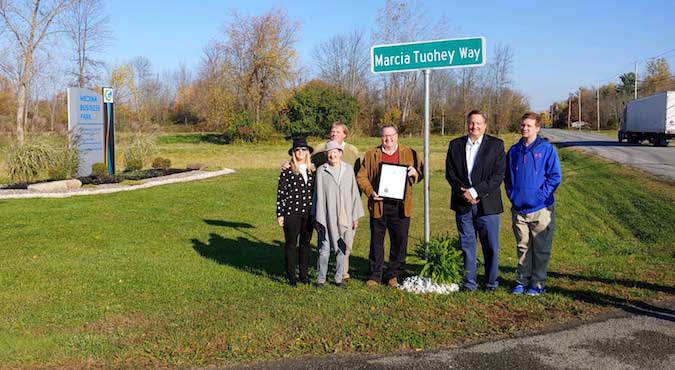
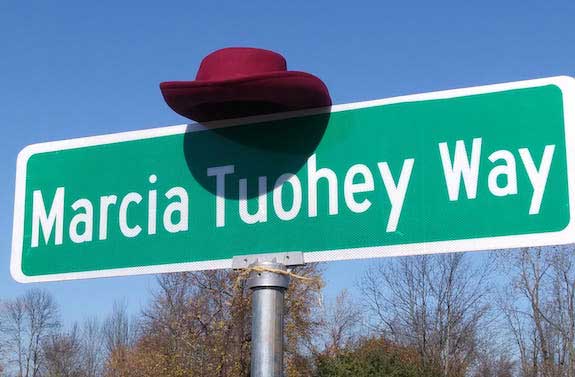
Provided photos: Marcia Tuohey’s family gathers by the sign for Marcia Tuohey Way. From left include Kim Tuohey, Barbara Waters, Charles Touhey, Craig Tuohey, Cal Tuohey and Jackson Tuohey. Craig, Charles and Cal are Marcia’s sons. Kim is married to Charles, and Barbara is Marcia’s twin sister. Marcia Tuohey Way leads into the Medina Business Park off Bates Road, across from Western New York Energy.
By Tom Rivers, Editor Posted 28 October 2019 at 6:34 pm
Marcia Tuohey
MEDINA – Village officials joined Marcia Tuohey’s family and friends in dedicating “Marcia Tuohey Way” at the Medina Business Park this morning.
Tuohey served as a village trustee, mayor and then Orleans County legislator. She was instrumental in developing the Medina Business Park off Bates Road in the 1980s. Tuohey pushed to bring infrastructure to the Business Park and also welcomed its first tenants.
The site continues to grow, with Takeform doing a recent expansion, Pride Pak building a new vegetable processing and packaging facility, and a new hotel currently under construction alog Maple Ridge Road.
“Today we recognize Marcia’s contributions not only to the Village of Medina but also to the Medina Business Park and the Orleans Economic Development Agency,” said Mayor Mike Sidari. “We recognize that this street is the gateway to the Business Park and with it comes out hopes for new development and more prosperity for the area. It is fitting to honor Marcia in this way.”
After Tuohey retired as an elected official, she served on the Village Planning Board and was the county’s representative on the Board of Directors for the Western Regional Off-Track Betting Corp. She passed away on Aug. 7, 2014.
“My mother would be very proud to receive this recognition,” Cal Tuohey said about the road naming “This is a great tribute for her and our family. Mom loved Medina and did her best to make it a better place. If she were here today she would be both humbled and delighted by this honor.”
Jim Whipple, chief executive officer of the Orleans Economic Development Agency, said the Medina Business Park has been a great asset for attracting and retaining companies in the county.
“We are standing at ground zero where it all started, where her vision of an industrial park began,” Whipple said at today’s dedication. “As Marcia’s vision becomes a reality I want her family to know what an inspiration and driving force she was both to me personally and to our agency.”
Marcia Tuohey’s friends and family briefly placed one her hats on top of the sign of the roadway bearing her name during a dedication ceremony this morning. Tuohey was known for being an impeccable dresser capped with her fancy hats.
By Tom Rivers, Editor Posted 27 October 2019 at 11:06 pm
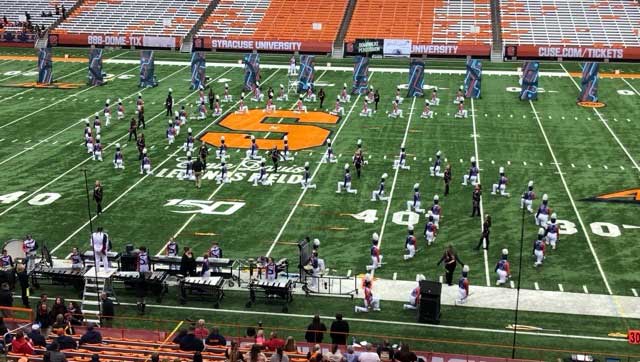
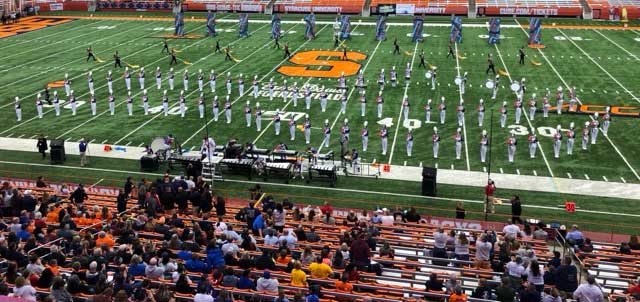
Photos courtesy of Kelly Kiebala: The Medina Marching Band is shown performing at the Carrier Dome in Syracuse this evening. The Mustang band was crowned state champion in the Small Schools I Division.
SYRACUSE – The Medina Marching Band is a 2019 state champion. The Mustang band won the Small Schools 1 Division in today’s New York State Field Band Conference Championship at the Carrier Dome in Syracuse.
Medina scored 91.6, which topped the others bands in the division, including last year’s champ Malverne from Long Island (85.2), East Syracuse-Minoa (88.7), New Hartford (87.2), Central Square (87.0), Mohonasen (85.4), East Irondequoit (83.9), and Oswego (83.2).
Medina finished second in 2018. The band this season performed to a program titled, “Walk the Path.” This is Medina’s 53rd season competing as a marching band and today was the Mustangs’ 43rd appearance in the New York State Field Band Conference Championship.
Orleans Hub will have more on the state champions on Monday.
Click here to see photos of the band from its home show on Sept. 21 during the Fall Festival of Bands.
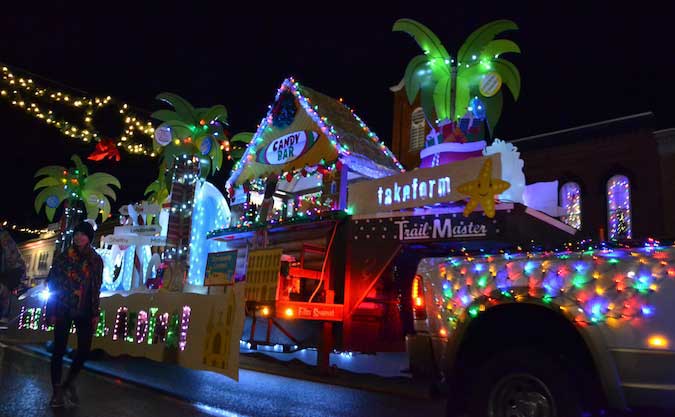
Photos by Tom Rivers: Takeform repeated as the grand champion in the 10th annual Parade of Lights in the 2018 parade. The Medina business created a float with a Tropical Christmas theme. There were 45 entries in last year’s 10th anniversary parade.
By Tom Rivers, Editor Posted 27 October 2019 at 6:02 pm
MEDINA – The Committee for the Parade of Lights urges local businesses and organizations to enter a float in the Parade of Lights on Nov. 30. This will be the 11thyear for the parade, which follows on the Saturday after Thanksgiving.
Participants are encouraged to send in an entry form to ensure a position in the parade, which starts at 6 p.m. at the Olde Pickle Factory on Park Avenue and continues through the downtown. The deadline to enter is Nov. 25. (Parade entry forms are available at www.christmasinmedina.com.)
The parade is the culmination of a daylong celebration in downtown Medina, sponsored by the Medina Business Association and the Village’s Tourism Committee. Some of the activities include a noon-time parade on Main Street with Santa, a 5K race in the morning and numerous other events.
This year’s edition of the parade includes music at Rotary Park by Prime Time Brass from Churchville at 5 p.m. and the Community Tree Lighting ceremony at 5:30, followed by a fireworks display by Young Explosives.
“This year there are a few surprises that we’re sure will delight the crowd,” said Jim Hancock, the parade chairman.
The parade is adding DownBeat Percussion, which is a regular performer at the Buffalo Bills home games.
The parade route also has been lengthened. Instead of ending at NAPA Parts, the parade will extend to Hartway Motors. This will give additional viewing for the crowds on Main Street. There also will be a spot for handicapped parking and viewing in the Five Star Bank parking lot. Space is limited, but will the additions allow an opportunity for better parking and viewing of the parade.
Organizers are also looking for volunteers to be parade marshals. Anyone interested in helping can call Hancock at (585) 798-2118.
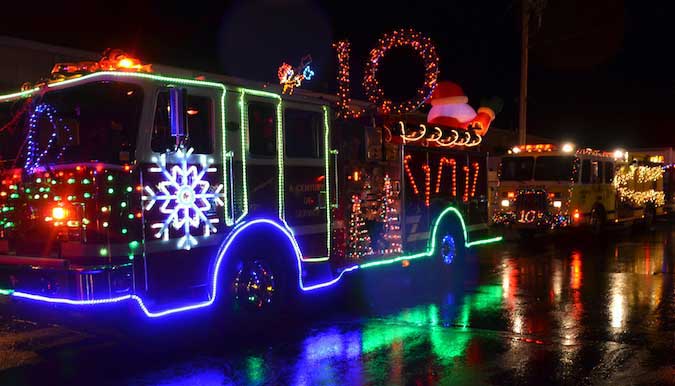
The Lyndonville Fire Department won Best in Class for the fourth consecutive year in 2018.
By Tom Rivers, Editor Posted 26 October 2019 at 9:01 am
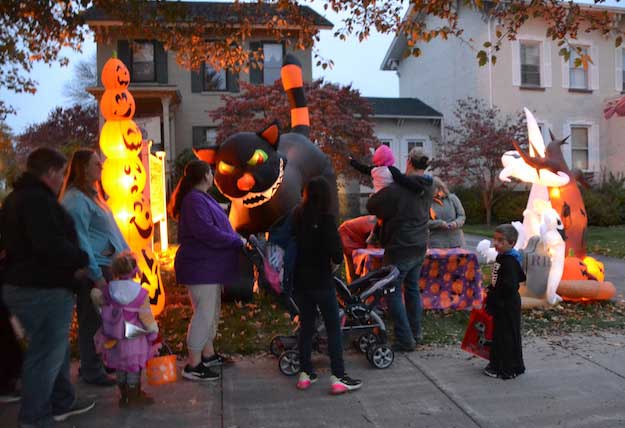
Beggar’s Night draws several hundred in 2 villages
Photos by Tom Rivers
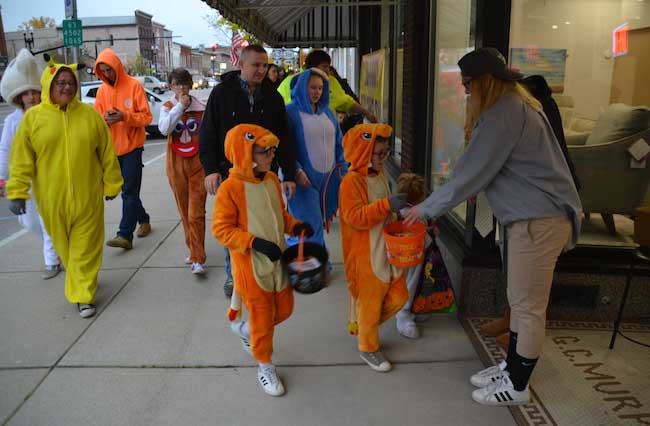
Twin brothers Logan (right) and Landon Scribner, 8, of Medina are dressed as Pokemon characters while headed for treats at Main Street TV & Appliance in Medina on Friday evening during the annual Beggar’s Night put on by the Medina Business Association.
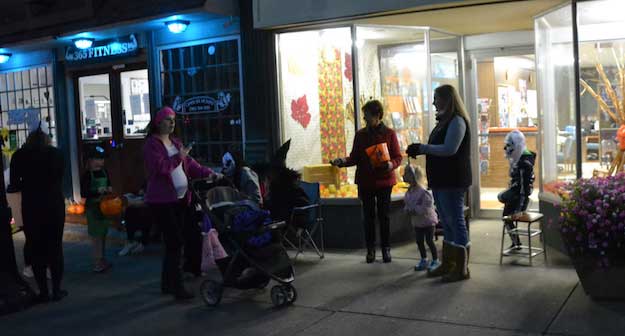
Nearly 1,000 kids come out for the event, where downtown merchants hand out candy and treats.
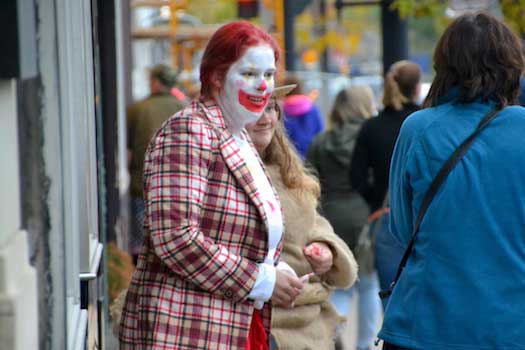
Abbygal Fuller is dressed as a clown and her sister Grace Fuller is a scarecrow. They were passing out candy at Della’s Chocolates, which is run by their mother, Susan Fuller.
“I get to see all the children in their costumes and I get to dress up myself,” Grace said.
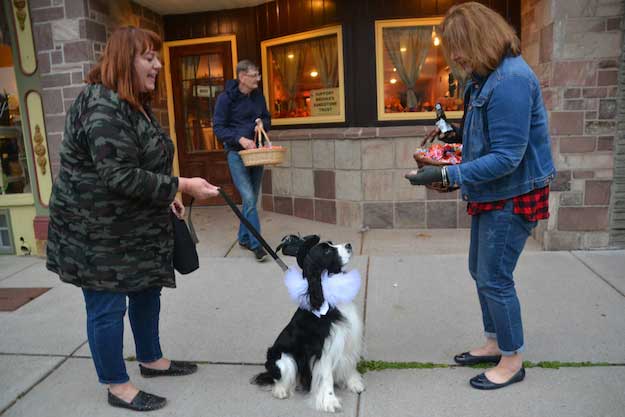
Fitz William “Mr. Fitz” dressed up for the occasion. Mr. Fitz is a 5-year-old English springer spaniel. He is owned by Kelly Herbert, left. Bonnie Heck, right, is the owner of Herbalty Cottage. Her husband Tom Heck is in back.
Herbert recently moved to Medina from New Jersey. She said she enjoys the quaint little town, and the many fun activities in the downtown.
“I love that the town and the businesses support the events,” she said.
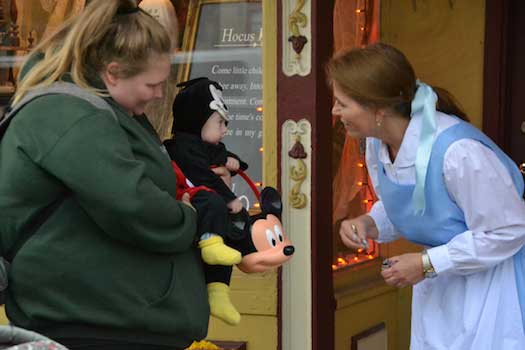
Kasey Sprester, left, of Middleport holds her 6-month-old son, Mathew, while being greeted by Cindy Robinson, owner of the English Rose Tea Shoppe.
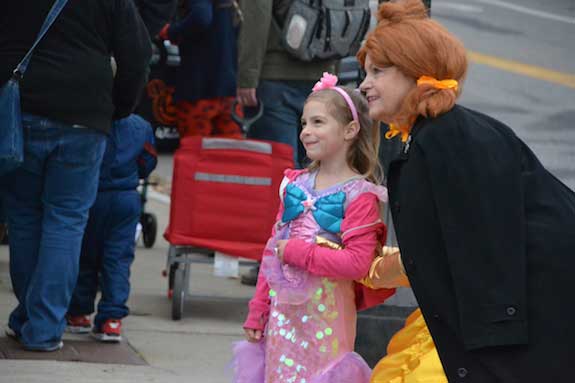
Kathy Blackburn dressed as Belle from Beauty and the Beast and greeted children and their families at the start of the Beggar’s Night route. Blackburn always dresses up as a character to kick off Beggar’s Night.
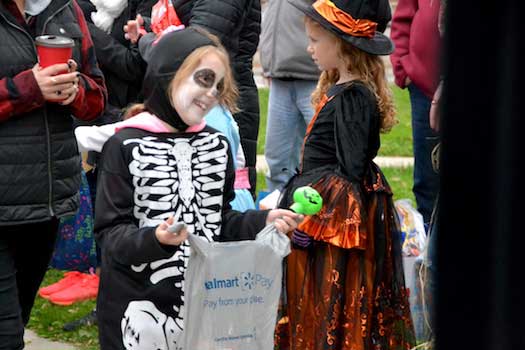
Madelyn Hill of Medina is delighted to get so much candy before Halloween. She dressed up as a skeleton.
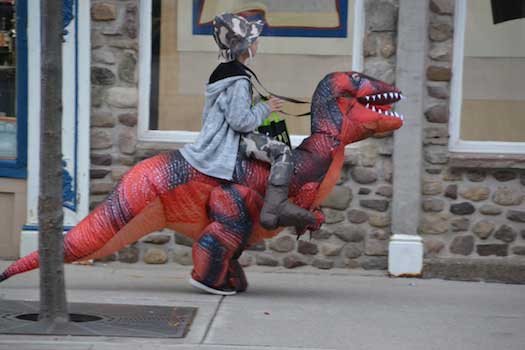
There were a variety of costumes on display, with a dinosaur inflatable very popular.
The Albion Merchants Association and Village of Albion also put on their Beggar’s Night celebration on Friday. Albion Agencies was among the many businesses and organizations to decorate their store and hand out treats.
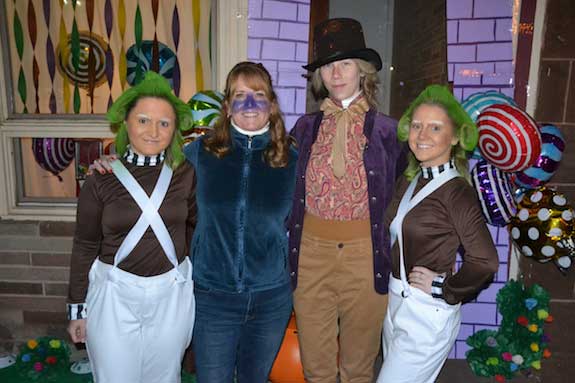
The staff at Roots always wears costumes for Beggar’s Night. This year they went with a Willy Wonka theme. Pictured from left are Jenna O’Connor, Lisa Heidemann, owner Amber Mogle, and Gretta Smith.
Mitzi Peglow, owner of Orleans Travel, and her daughter Stephanie Spencer hand out candy.
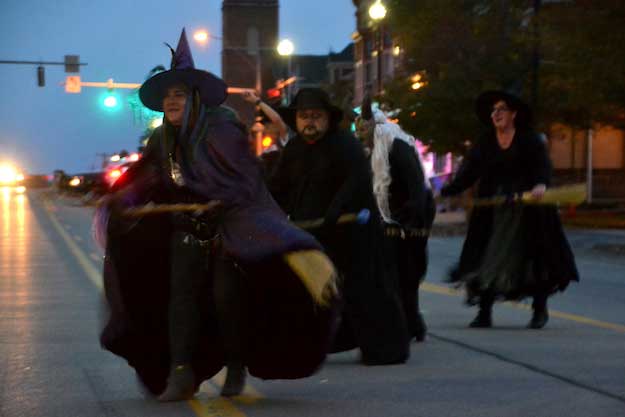
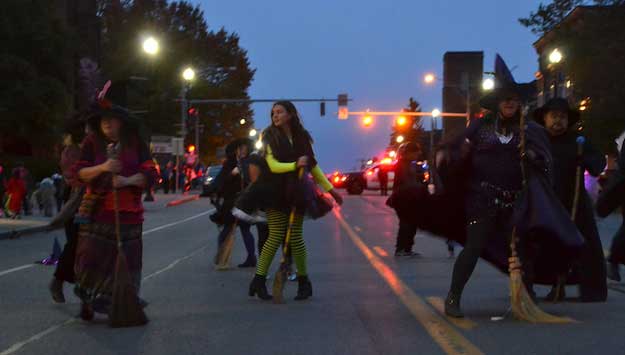
There was also a witches dance on Main Street in Albion.
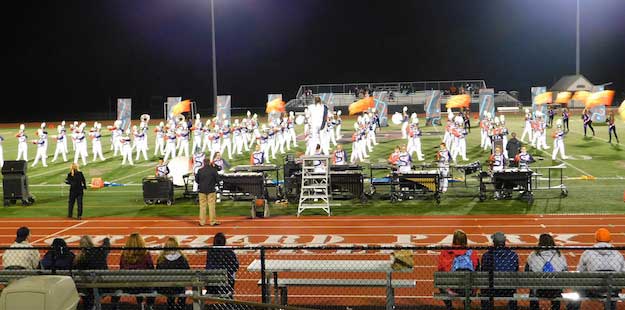
The Medina Mustang Marching Band traveled to Orchard Park on Saturday for the last competition before the championships. There were 14 bands from across Western New York and Pennsylvania that competed in six different classifications.
In SS1, Medina earned first place with a score of 87.85 followed by East Irondequoit in 2nd with 83.80 and Oswego in 3rd with 82.35.
Other 1st place winners were Leroy in SS3 with 71.3; Greece in LS3 with 79.60; Northwestern in SS2 with 79.55; Orchard Park in LS2 with 83.75 and Jamestown in National with 89.0.
This week coming up before the Dome is busy with practices and a special Senior Recognition Night on Wednesday at 7 p.m. at the Medina High School. You can see a performance of the show. Each senior will be given recognition for their years of dedication to the band.
Championships at the Carrier Dome are Sunday, Oct. 27. A total of 53 bands will perform in competition starting at 8 a.m. and finishing at 10 p.m.
The event is broken down into 3 shows with LS3 and LS2 classes performing from 8 a.m. to noon followed by a retreat and awards for that group. The SS2 and SS3 classes perform from 12:45 p.m. to 5 p.m. followed by retreat and awards for that group.
The SS1 and National classes perform from 6 p.m. to 10 p.m. followed by retreat and awards. Medina will perform at 7:15 p.m.
There is a new Dome policy for security purposes which prohibits backpacks and purses. Only clear plastic vinyl or PVC not exceeding 12″x6″x12″ are allowed. A gallon size plastic bag is acceptable.
There is still room on the spectator bus to the Dome on Sunday. For more information, contact Jim Steele, band director, at 585-317-9389.
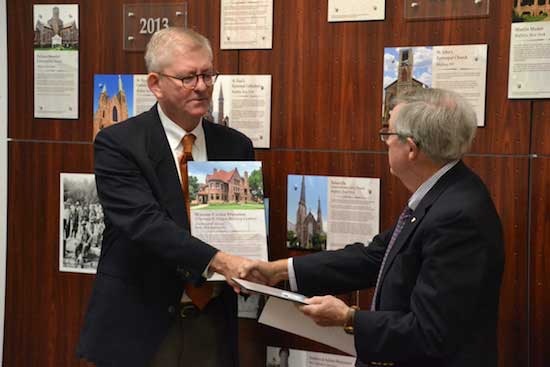
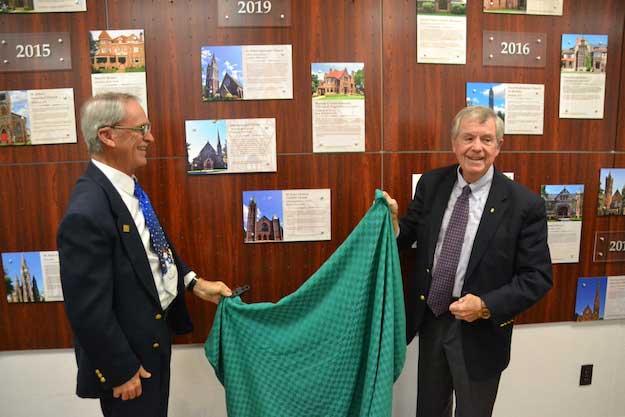
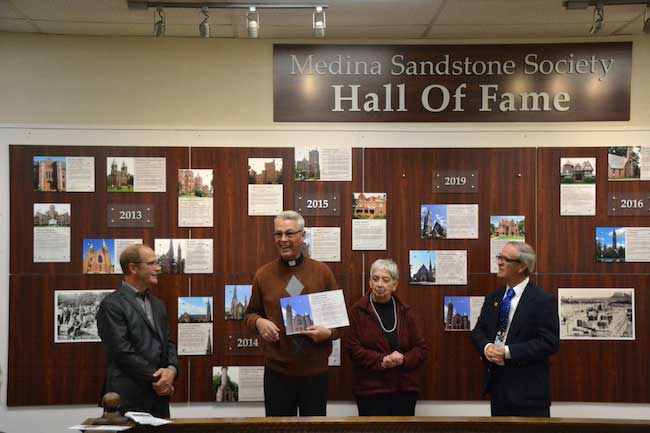
Photos by Tom Rivers: Medina Sandstone Hall of Fame Committee members Jim Hancock, left, and Don Colquhoun unveil the four new inductees into the Medina Sandstone Hall of Fame on Thursday afternoon. The Hall of Fame now has 29 inductees. It was established in 2013 and is located inside Medina City Hall. The plaques are made courtesy of Takeform in Medina.
By Tom Rivers, Editor Posted 19 October 2019 at 10:09 am
Mansion in Erie, churches in Palmyra, Geneva and Rome, NY added to distinguished list
MEDINA – The Medina Sandstone Hall of Fame inducted a mansion in Erie, Pa. and three upstate churches into the shrine for spectacular sandstone structures.
Since the hall of Fame was established in 2013, the inductees now include 29 sites and 59 nominations.
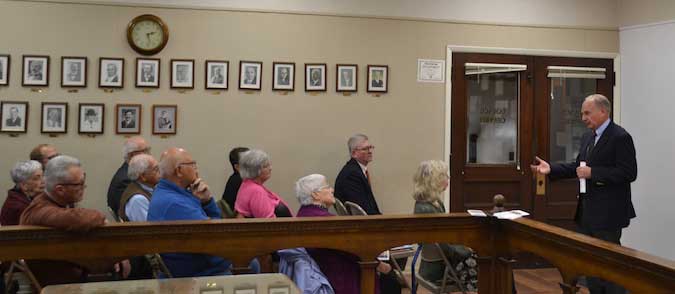
Representatives from the four new Hall of Fame sites attended an induction program on Thursday afternoon at Medina City Hall, where the Hall of Fame is located in the main meeting room.
David Miller, president of the Sandstone Society, thanked the buildings’ owners for their care of the structures, which were all built before 1900. The group is sitting by a wall with photos of past Medina mayors.
Jim Hancock, David Miller and Don Colquhoun are all members of the Hall of Fame Committee. They travelled 700-800 miles to visit the sites.
“You have all lovingly taken care of these wonderful sandstone buildings,” Hancock said. “I can guarantee none of you were there when they were built.”
The new inductees have tackled ambitious restoration projects to keep the buildings going for years to come.
“We’re very proud of you for maintaining your buildings,” Hancock told them honorees.
The 2019 Hall of Fame Class includes (with the writeups from the Sandstone Society):
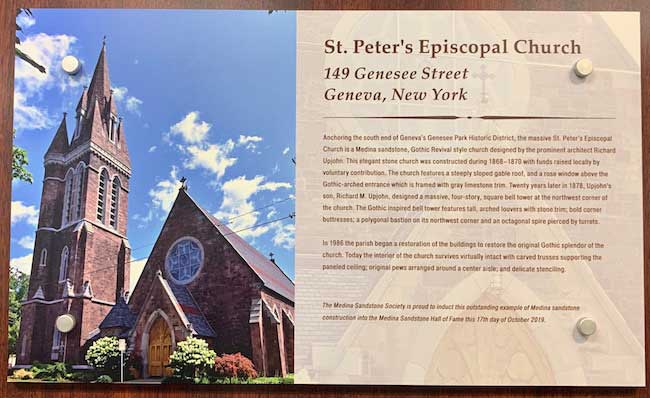
St. Peter’s Episcopal Church, 149 Genesee St., Geneva, NY
Anchoring the south end of Geneva’s Genesee Park Historic District, the massive St. Peter’s Episcopal Church is a Medina sandstone, Gothic Revival style church designed by the prominent architect Richard Upjohn. This elegant stone church was constructed during 1868-1870 with funds raised locally by voluntary contribution.
The church features a steeply sloped gable roof, and a rose window above the Gothic-arched entrance which is framed with gray limestone trim. Twenty years later in 1878, Upjohn’s son, Richard M. Upjohn, designed a massive, four-story, square bell tower at the northwest corner of the church. The Gothic inspired bell tower features tall, arched louvers with stone trim; bold corner buttresses; a polygonal bastion on its northwest corner and an octagonal spire pierced by turrets.
In 1986, the parish began a restoration of the buildings to restore the original Gothic splendor of the church. Today the interior of the church survives virtually intact with carved trusses supporting the paneled ceiling; original pews arranged around a center aisle; and delicate stenciling.
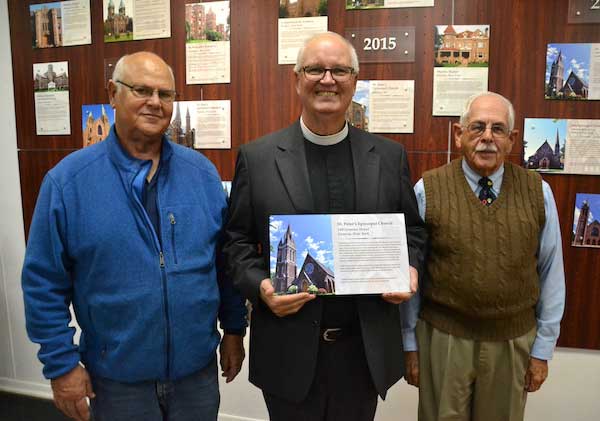
Representatives from St. Peter’s Episcopal Church in Geneva include Joseph Marino, the Rev. Jim Adams and Charles Bauder. Marino and Bauder are long-time members of the church.
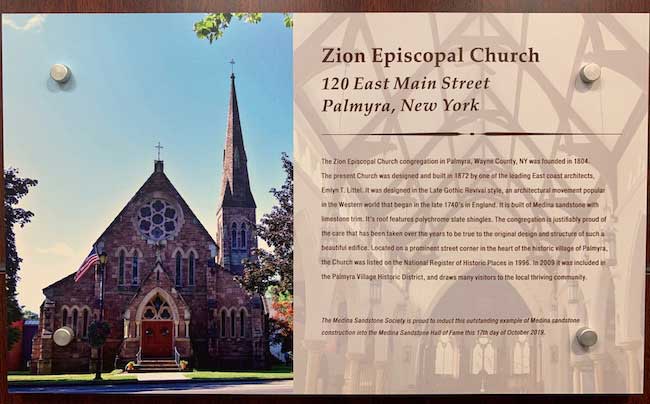
Zion Episcopal Church, 120 East Main St., Palmyra
The Zion Episcopal Church congregation in Palmyra, Wayne County, was founded in 1804. The present church was built in 1872 by one of the leading East coast architects, Emyln T. Little. It was designed in the Late Gothic Revival style, an architectural movement popular in the Western world that began in the late 1740s in England.
It is built of Medina sandstone with limestone trim. It’s roof features polychrome slate shingles. The congregation is justifiably proud of the care that has been taken over the years to be true to the original design and structure of such a beautiful edifice.
Located on a prominent street corner in the heart of the historic village of Palmyra, the church was listed on the National Register of Historic Places in 1996. In 2009, it was included in the Palmyra Village Historic District, and draws many visitors to the local thriving community.
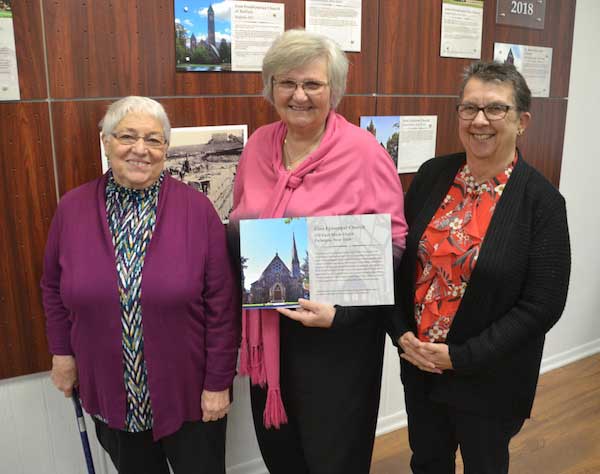
The Zion Episcopal Church in Palmyra was represented at the induction ceremony by church members, from left: Cindy Lehmkuhl, Elaine Bonafede and Diane Peters. Bonafede and Peters are members of the vestry. Lehmkuhl serves in the church’s archives committee with Bonafede.
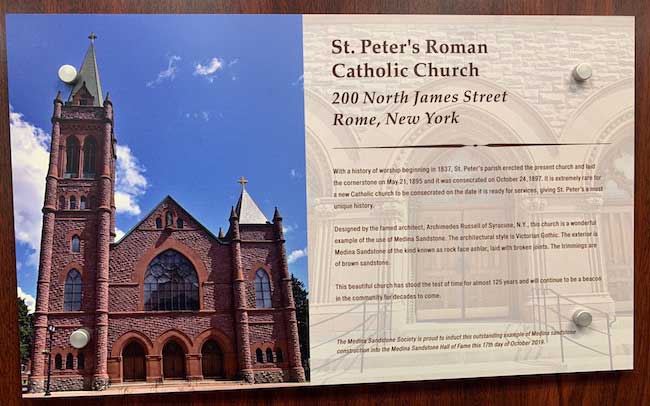
St. Peter’s Roman Catholic Church, 200 North James St., Rome
With a history of worship beginning in 1837, St. Peter’s Parish erected the present church and laid the cornerstone on May 21, 1895 and it was consecrated on Oct. 24, 1897. It is extremely rare for a new Catholic church to be consecrated on the date it is ready for services, giving St. Peter’s a most unique history.
Designed by the famed architect, Archimedes Russell of Syracuse, this church is a wonderful example of the use of Medina sandstone. The architectural style is Victorian Gothic. The exterior is Medina sandstone of the kind known as rock-face ashlar, laid with broken joints. The trimmings are of brown sandstone.
This beautiful church has stood the test of time for almost 125 years and will continue to be a beacon in the community for decades to come.
Representatives of St. Peter’s Roman Catholic Church in Rome thanked the Hall of Fame Committee for the recognition. Father Sean O’Brien praised the church’s parishioners and a previous priest for a big restoration project at the church in 2005. Father O’Brien is joined by the church’s maintenance director, Mark LaGasse, and office manager, Sharon Hansen. Jim Hancock is at right.
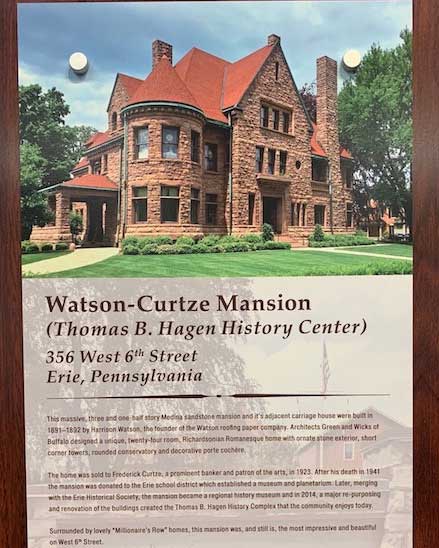
Watson-Curtze Mansion (Thomas B. Hagen History Center), 356 West 6th St., Erie, Pa.
This massive, three and one-half story Medina sandstone mansion and it’s adjacent carriage house were built in 1891-1892 by Harrison Watson, the founder of the Watson roofing paper company.
Architects Green and Wicks of Buffalo designed a unique, 24-room, Richardsonian Romanesque home with ornate stone exterior, short corner towers, rounded conservatory and decorative porte cochere.
The home was sold to Frederick Curtze, a prominent banker and patron of the arts, in 1923. After his death in 1941, the mansion was donated to the Erie school district which established a museum and planetarium.
Later, merging with the Erie Historical Society, the mansion became a regional history museum and in 2014, a major repurposing and renovation of the buildings created the Thomas B. Hagen History Complex that the community enjoys today.
Surrounded by lovely “Millionaire’s Row” homes, the mansion was, and still is, the most impressive and beautiful on West 6th Street.
Since the Hall of Fame was established in 2013, 29 sites have been inducted and 59 have been nominated.
Other sites nominated in 2019, but not yet inducted, include: Eberhardt Mansion in Buffalo, Blessed Sacrament Roman Catholic Church in Buffalo, Trinity Episcopal Church in Buffalo, Old Stone Warehouse/Skalny Building in Rochester, St. Ann Catholic Church in Erie, Pa.; and St. Paul Catholic Church in Erie, Pa.
Jeff Sherry, museum educator at the Historical Society of Erie County, accepts the award for the Thomas B. Hagen History Center, a new member of the Medina Sandstone Hall of Fame. He is congratulated by Don Colquhoun of the Sandstone Society.
By Ginny Kropf, correspondent Posted 16 October 2019 at 10:57 am
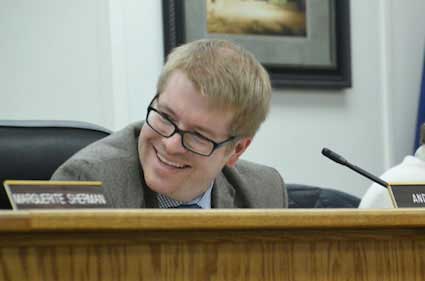
Photo by Tom Rivers: Andrew Meier is pictured on March 28, 2016, while leading his last meeting as Medina’s mayor.
MEDINA – A Medina attorney is stepping out of his normal realm to become the honorary chair of Orleans Community Health’s Treasure Island.
Treasure Island will celebrate its 26th year on Nov. 2 at Sacred Heart Club as the annual fundraiser for Medina Memorial Hospital (Orleans Community Health).
“Our hospital is essential to not just the physical and emotional health of the community, but also to its economy and sustainability in the long term,” said Andrew Meier, a partner in the law firm of Webster, Schubel and Meier. “It’s a partner to our Medina Ambulance Service. It’s a critical community amenity that can help attract new residents and businesses.”
Meier continued to say Medina Memorial Hospital has made great strides in the last few years, and Treasure Island will help the hospital grow even further into its essential role.
This growth is already being noticed with the announcement by the Orleans Community Health Foundation that three new doctors have joined the hospital and proceeds from Treasure Island will go toward the purchase of equipment for these doctors, all of whom are able to perform surgical procedures.
The first new doctor is Anees Fazili, a urologist from Rochester who also has an office in Batavia.
The other two doctors are twin podiatrists, Peter and Paul Stasko, who are affiliated with Rochester Regional Health.
“I’m honored to be just one concerned citizen among many others who support this event and the work of healthcare workers in our home town,” Meier said.
Community support is vital to the success of this event, said Heather Smith, executive director of Orleans Community Health Foundation.
“This event cannot be successful without community support,” Smith said. “Treasure Island provides a unique marketing opportunity, touching several hundred individuals, while allowing the community to see donors’ investment back into their hometown healthcare system. Orleans Community Health exists to be your community-focused medical center, providing you and your loved ones with quality services here at home.”
The public can donate to Treasure Island in a variety of ways – by offering an auction item, gift certificate or raffle basket; by purchasing an ad in the program; by making a cash donation; or by purchasing tickets.
Individuals can purchase tickets online or pre-register for the event by clicking here.
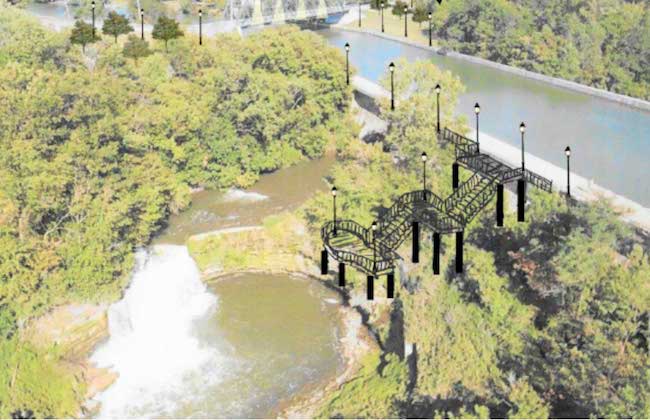
Courtesy of Village of Medina, DRI application: The Village of Medina wants to improve public access to the Medina Waterfalls by constructing an elevated platform from the towpath.
By Tom Rivers, Editor Posted 15 October 2019 at 1:43 pm
Funding would target economic development, housing, and waterfront
MEDINA – Village officials have been anxiously awaiting word from the Governor’s Office whether Medina will be awarded a $10 million grant through the Downtown Revitalization Initiative.
Ten of those grants will be announced around the state. Gov. Cuomo has already announced five: Fulton in Central New York, Baldwin in Long Island, Peekskill in the Mid-Hudson, Hornell in the Southern Tier and the Niagara Falls Bridge District in WNY.
Medina is in the Finger Lakes region. This is the fourth round of the DRI, where communities submit applications and the state decides the winner. Previous $10 million grant winners in the Finger Lakes region include the City of Geneva in 2016, the City of Batavia in 2017 and the Village of Penn Yan last year.
‘Within the past few years, it has become increasingly evident that this historic and vibrant village has become a destination for young entrepreneurs, hastening a multifaceted commercial and cultural renaissance driven by considerable private investment.” – Chris Busch, Medina Planning Board chairman
Medina faces stiff competition for the $10 million. Some of the applicants include the Village of Waterloo, City of Canandaigua, Town of Seneca Falls and the Village of Newark.
Medina Mayor Michael Sidari said the community has put together a strong application. It benefitted from the work of committee that completed a Local Waterfront Revitalization Plan to better utilize the Erie Canal, Oak Orchard Creek and Glenwood Lake.
The DRI program is intended to transform vulnerable, vacant or forgotten areas of the state into livable, walkable, dynamic neighborhoods.
Communities should show existing momentum with public and private investment in the neighborhood and surrounding areas.
Medina was able to count $375 million in recent investment, led by Baxter which acquired the Medina operation of Sigma International for about $250 million and has spent another $10 million upgrading its facility in the Olde Pickle Factory.
“Medina has experienced outsized capital investment and job creation in recent years for a community of its size,” the village states in its application. “Companies like Fortune 500 Baxter have invested an estimated $10 million in local infrastructure and added 400 jobs since 2012, many of which pay more than $100,000 per year.
“Canadian firms like Brunner, Pride Pak, and Hinspergers leverage Medina to access US markets, while local investors have contributed more than $10 million to grow their own businesses and to restore some of the most historically significant properties in New York State. Funding from the DRI will allow Downtown Medina to build off these recent economic successes and will likely encourage additional private investment into our growing and diversifying economy.”
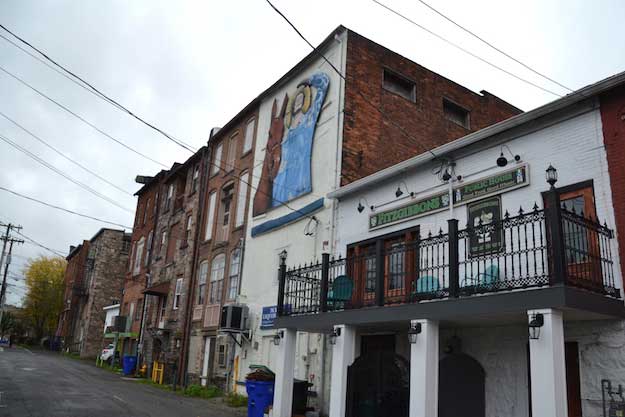
Photos by Tom Rivers: Medina officials believe the Canal Basin could be a bigger asset with more amenities for boaters and better entrances and seating areas on the rear sides of Main Street businesses.
Some of the recent investments in Medina include:
• $6 million at Bent’s Opera House, for restaurant, hotel and performing art space;
• $10 million by Brunner on a 48,000-square-foot expansion in 2014;
• $6.75 by Cobblestone Hotel for a new 10,567 square-foot building will include 58 hotel rooms, a 50-plus person conference room, and a bar.
• Hinspergers Poly Industries, multi-million investment, doubling the complex to its current 83,000 square-foot footprint.
• Newell Shirt Factory Building – $1.5 million historic restoration project converted an 1876 shirt factory into a trendy, upscale coffee shop and craft cocktail bar with law offices and extended-stay lofts on the upper floors.
• The Olde Pickle Factory (Fisher Price) – Nearly $8 million has been invested in this 430,000 square-foot facility to create a state-of-the-art facility that can house a diverse array of tenants.
• Pride Pak – $30 million in 2016 to construct a 68,000-square foot state-of-the-art facility for vegetable processing and packaging.
• Takeform has invested more than $10 million in the last 5 years in infrastructure, equipment, software technology, and human capital, and recently completed a 15,000 square-foot expansion to accommodate growth.
• BMP spent $1.8 million to double manufacturing space in 2004.
• Western New York Energy spent $90 million in 2006-07 to build the first ethanol plant in the Northeast United States.
• 414/416 Main Street – $750,000 investment to transform 9,000 square feet into a single-family home, co-working space and a restaurant (Mile 303).
• Village of Medina water and sewer upgrades at $8 million. The village has recently begun a $7.3 million upgrade to its wastewater treatment plant and completed a $800,000 upgrade to its water system. These investments will facilitate the expansion of the Medina Business Park and the growth of the village.
Medina wants to build off those successes and investments. Medina lists $29 million in projects. If the community’s $10 million application is approved, Medina will need to work with the state to determine how to divvy up the $10 million.
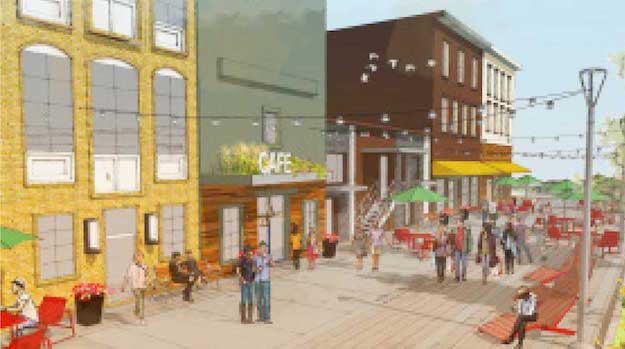
Medina wants to add pedestrian amenities to the pathway behind the buildings facing the Canal Basin.
Medina’s application lists the following projects to be considered for DRI funding:
• Streetscape Improvements at an estimated $1 million in DRI funding
Medina wants to improve the downtown pedestrian experience through street furniture, landscaping, and crosswalk enhancements on Main Street and Pearl Street.
The village wants to enhance crosswalks; add more benches, bike racks, trash receptacles and pedestrian lighting; and plant more street trees and shrubs.
• Rail with Trail, a multi-use trail along the Medina Railroad from the museum to Main Street, at an estimated DRI funding request of $200,000
The village wants to improve a gap within the pedestrian network and improve the connectivity from the Railroad Museum to the downtown. A “rail-with-trail” would create a multi-use path alongside the rail line.
• The Canal Village Farmer’s Market would become a year-round market with a community kitchen, distillery and event space as part of a $3 million project, with $2.8 million in DRI funding
The market is in its fifth year at the northeast corner of West Center Street and West Avenue. The market, which is run by Orleans Renaissance Group, currently operates on select weekends throughout the year out of a small building and temporary stands in the parking lot.
The ORG is seeking to construct a large, enclosed structure to allow for continuous, year-round operation of the market. The structure will be anchored by three tenants: the farmer’s market with a community kitchen and exhibit space; a distillery or microbrewery on the second floor; and a rooftop event space.
• Canal Basin Park – Improved waterfront access and amenities at the Canal Basin Park for $2 million, to be funded with the DRI.
The village in its application says the spot is hampered by an “overabundance of paved parking space and limited recreational access to the Erie Canal.” Medina wants to increase public access to the waterfront area and encourage recreational and passive use at this prime waterfront location.
Recommended improvements include:
• Installation of a pedestrian boardwalk along the rear facades of Main Street buildings;
• Conversion of the existing parking space into public greenspace with access to the Erie Canal;
• Construction of a promenade along the Erie Canal;
• Installation of boating docks on the Erie Canal;
• Comfort amenities, such as restrooms and showers;
• Crosswalk enhancements to improve pedestrian connection across East Center Street.
The village anticipates the changes would prompt building owners to “activate the rear facades of the buildings on Main Street, creating commercial opportunities on both sides of these structures and allowing for the development of new businesses.”
• State Street Park – enhanced programming to make the park a year-round recreational destination, with an ice skating rink, enhanced lighting, boat tie-ups, benches and bicycle racks, and a construction of a nature trail at a $600,000 cost, with the DRI funding $500,000.
The installation of motor boat tie-ups will allow boaters on the canal to join in on the enjoyment of local musicians’ performances at the bandstand during the summer months while the ice skating rink will allow for winter activities and encourage continued use of the park even during the off-season, the village stated in its application.
• Lions Park Boater Access – The village seeks $250,000 for the DRI to install boat tie-ups and docking facilities at the Lions Park near the Route 63 lift bridge.
The village, in its application, says boater amenities and docking infrastructure are limited within Medina. Throughout the community engagement process, the public consistently expressed a need for additional boater amenities along the waterfront.
This project also includes the creation of a fitness trail through Lions Park, with various pieces of fitness equipment located along the trail.
• Medina Falls Overlook – The village wants to better utilize the Medina waterfalls by adding a viewing platform and overlook off the Erie Canalway Trail, near the Horan Road Bridge. The project would cost an estimated $1.9 million with the DRI funding $1.5 million.
“Medina Falls is one of the Village’s stunning natural wonders,” according to the village’s application. “Its 40-foot drop dazzles onlookers and makes a great challenge for any kayakers willing to brave it. The scenic Falls, however, lacks an easily accessible viewing point and is obscured by brush, foliage, and a significant grade change that can be dangerous for interested onlookers to traverse.”
• Wayfinding Signage – Install a cohesive and well-branded system of wayfinding and directional signs at a cost of $200,000 with the DRI funding $150,000.
The signs would direct visitors to the Erie Canal, Waterfalls, public parking and other resources. Medina wants to add gateway signs, directional signs, kiosks and interpretive signs, light pole banners and identification signs for destinations and parking areas.
• Small Grant Fund – This fund will support economic-development related activities through the distribution of small grants to local businesses and investors. Medina would like a $900,000 fund with the DRI paying $600,000.
The fund is intended to support projects that retain jobs, generate increased economic activity, and improve the economic viability and livability of Downtown Medina. Eligible projects could include historic rehabilitation and repair, facade improvements, land acquisition, new construction, and event programming.
• Mustang City: Adaptive Reuse of the old Medina High School – A $9 million project with the DRI request at $3 million.
A developer, Talis Equity, seeks to transform 90,000 square feet into 40 loft apartments. Mustang City will fulfill Medina’s need for additional housing options and will allow for a new kind of “maintenance-free” living, with amenities and services including grocery delivery, cleaning, and laundry pickup. Just steps from the Erie Canal and downtown’s restaurants, shops and nightlife, Mustang City will provide attractive living options for anyone from young entrepreneurs to retirees, according to the village’s DRI application.
• Snappy’s Mixed-Use Development: This project at $1.8 million includes a $1 million DRI request. It would redevelop the Snappy facility on Commercial Street by the Erie Canal into a mixed-use commercial and residential space. The property could be redeveloped with the first floor for commercial uses and the second floor for residential.
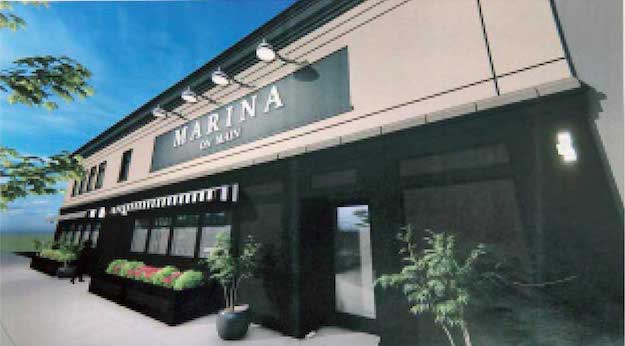
The Marina on Main would transform four storefronts on Main Street.
• Marina On Main – This project at 333-339 Main St. would create a canal-side indoor and outdoor event space at an estimated cost of $1.65 million. The DRI request is for $1 million.
Marina on Main is envisioned as an upscale, multi-use event center with both indoor and outdoor seating to cater to a variety of events and special occasions including weddings, reunions, and other large gatherings for 200-plus guests. The ground floor is envisioned as a mixed-use space with connectivity to the canal.
This project proposed by the Zambito family will revitalize and repurpose four underutilized storefronts along Main Street. It will also improve the rear facades along the canal, which presently detract from the pedestrian experience along the trail.
• Walsh Hotel Mixed-Use Redevelopment – The building at 525 West Ave. would be rehabilitated and redeveloped, creating a mix of apartments and hotel rooms. The project is an estimated $1 million with the DRI request at $600,000.
Tim Cooper is working to turn the 9,400-square-foot building to include either 8 apartments, 6 to 8 hotel rooms, or a combination of both on the 2 upper floors. The ground floor will house The O’Brien & Ceallaigh Bar and Lounge.
• Medina Railroad Museum Campus – The $1.5 million project seeks $1.2 million in DRI to create a welcome center on Main Street and courtyard space.
The Medina Railroad Museum is one of the largest tourism drivers in the village, drawing approximately 40,000 people annually. The museum wants to expand its footprint and to create more of a campus-like complex. The campus will extend east from the existing museum building to the old train station near Main Street, creating a visible and intriguing presence along the main thoroughfare.
The train station building, which is owned by the village, will act as a welcome center and small exhibit space, attracting people off Main Street and to the museum (while the senior citizen’s center that presently occupies this space will be relocated to City Hall).
A landscaped pedestrian plaza will connect the train station to the existing museum building.
On the southern side of the tracks, the campus plan calls for the creation of a park-like courtyard space adjacent to the library. This courtyard will include the installation of two, permanent dining cars – to be rented out for weddings and other events – as well as an enclosed pole barn building, which will be used to store and repair cars.
The campus is intended to strengthen the museum’s position in the village, to enhance its status as a regional tourism generator, and to bring visitors into downtown.
• Medina Hotel and Conference Center – This $4 million project includes $2 million in the DRI. It would repurpose the former Dipson Diana Theater (currently Medina Theater) into a conference center at 601-611 Main St.
The theater sits underutilized in a prime location on Main Street. This project by the Cardone family proposes to stabilize and restore the theater and to transform it and the adjacent former warehouse into a conference center and hotel complex.
The former 7,900 square-foot theater will be converted into a large event space with capacity for more than 350 people and will also feature a restaurant in the ground floor. The adjacent 20,000 square-foot former warehouse will be converted into a hotel to accommodate conference-goers and other visitors.
“Within the past few years, it has become increasingly evident that this historic and vibrant village has become a destination for young entrepreneurs, hastening a multifaceted commercial and cultural renaissance driven by considerable private investment,” wrote Chris Busch, Medina Planning Board chairman, in a letter of support for the application.
The rear side of businesses on Main Street, facing the Erie Canal, would benefit with better facades, seating areas and a path for pedestrians.
“Medina’s ‘renaissance’ and revitalization has and will continue to attract young families, tourists, culture seekers, trail, cyclist and history enthusiasts, recreational boaters and entrepreneurs seeking to invest and grow in a thriving community.”
Busch said a $10 million DRI grant would be “a transformative breakthrough event in the economy of Medina and the region.”
He praised the Medina officials and community leaders for putting together the application and presenting a vision for the community.
“Medina’s successful application for DRI funding will without a doubt, lead to dramatic improvement in the regions’ key economic indicators of job creation, continued private investment, expansion of tourism, and increase of tax revenues, as well as the preservation of vital cultural and historic assets,” Busch said in his letter of support.




















 This massive, three and one-half story Medina sandstone mansion and it’s adjacent carriage house were built in 1891-1892 by Harrison Watson, the founder of the Watson roofing paper company.