By Tom Rivers, Editor Posted 13 January 2022 at 1:17 pm
ALBION – The Covid testing at GCC’s Albion campus has added rapid tests today, with results expected in about an hour.
The state is paying BioReference Laboratories to run the testing site, which is free to the community, including people outside Orleans County. The site opened on Dec. 29 and is expected to continue for about four more weeks.
It is open at 456 West Ave. on Monday through Saturday from 10 a.m. to 7 p.m.
So far before today, the tests at the site have been PCR only with the results sometimes not coming back for several days.
The site offers tests by appointment, as well as walk-ins. Click here for more information about making an appointment.
Paul Pettit, the public health director for Genesee and Orleans counties, urged the community to use the site in Albion, which came from a push from local officials.
He said he is hopeful there will also be a state testing site soon in Genesee County. Genesee officials have made a formal request to the state for a testing site, Pettit said.
The state also opened a mass testing site today at Brockport State College. The Brockport community testing site is at Mortimer Hall on Holley Street. It runs until Jan. 25, Monday through Friday. It will be open from 8:30 a.m. to 4 p.m. Appointments can be scheduled online – click here.
By Tom Rivers, Editor Posted 13 January 2022 at 12:38 pm
4 simple steps: get vaccinated, take a Covid test, stay home if test positive or if feel sick
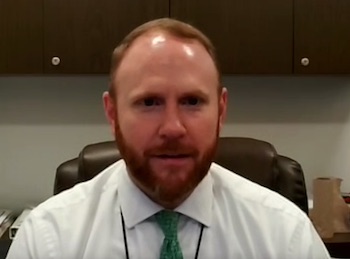
Screenshot: Paul Pettit, public health director in Orleans and Genesee counties, speaks to media during a Zoom online meeting today.
Covid cases are surging dramatically locally, following the indoor gatherings over the holidays and spread of the highly contagious Omicron variant.
Genesee had 1,509 new cases in December, which was by far the most it had during the pandemic – until this month. The county already reported 2,118 cases during the first 10 days of January.
Orleans had 1,045 cases in November, the most during the pandemic for Orleans, and followed that with 938 in December. The county already has 1,125 in the first 10 days of January.
Paul Pettit, public health director in the two counties, spoke about the “unprecedented spike in cases” today during a monthly update with local media.
The number of cases, nearly 3,000 in the two counties in the past week, has overwhelmed the local health department, forcing staff to limit contact tracing to those 18 and younger, and senior citizens (65 and older) who are more vulnerable to the virus.
Those who aren’t contacted by the health department for case investigations and contact tracing should continue to quarantine and stay home for at least five days. If they don’t have symptoms they can go out of the house but should wear a well-fitting mask in public, Pettit said.
If symptoms persist, people should continue to isolate for 10 days, Pettit said.
Both counties have done mass Covid test kit distributions and Matt Landers, Genesee County manager, said Genesee will be doing more at a drive-through distribution and by getting the kits out to town and village halls around the county.
The local schools are seeing “recond number of abseetism” with students and staff due to the Covid spread, Pettit said.
He meets with school superintendents weekly and he joins them in being committed to keeping schools open. The increased Covid testing has identified more cases and help to isolate those with the virus.
He urged parents not to send kids to school if they are symptomatic and not feeling well.
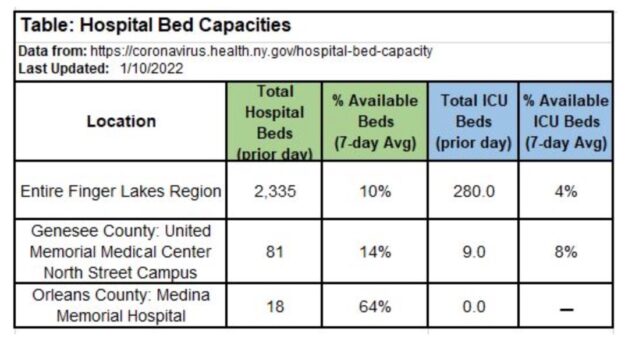
Dan Ireland, president of the United Memorial Medical Center in Batavia, said the hospital is near capacity with 86 percent of beds filled.
The hospital can still do emergency surgeries and respond to the community if there are broken bones, an appendicitis and other healthcare needs. He said 36 percent of the people currently hospitalized at UMMC have Covid. That shows the hospital is tending to other healthcare needs in the community besides Covid, Ireland said.
The “strong majority” of those in the hospital with Covid weren’t vaccinated. And none of those on ventilators with Covid took the vaccine, Ireland said.
“Those who are vaccinated are faring much better than those who aren’t,” he said.
By Ginny Kropf, correspondent Posted 13 January 2022 at 7:45 am
MEDINA – For anyone who has ever considered giving blood – the time is now.
According to Orleans Community Health, for the first time in its history, the American Red Cross on Tuesday declared the current situation is a national blood crisis.
Since March 2020, the American Red Cross has reported a 10% decline in overall donations, Orleans Community Health said in a press release. If donation levels do not return to normal soon, many patients in need of transfusions will not receive them, the hospital reports.
Orleans Community Health is calling on the larger community to do its part to become a blood donor. On Feb. 4, from 2 to 6 p.m., Orleans Community Health is partnering with the Orleans County YMCA to hold a community blood drive. Appointments can be made by calling 1-800-Red-Cross or visiting www.RedCrossBlood.org.
“We have continued to host blood drives throughout the pandemic, as we want to be a space where the community is welcome to help one another, when they are able to,” said Greg Reed, executive director of the Orleans County YMCA. “Bringing the YMCA, American Red Cross and Orleans Community Health together in an effort to save lives through blood donations is what social responsibility is all about.”
“Not everyone can donate blood, said Marc Shurtz, CEO/CIO of Orleans Community Health. “But if you can, we’re calling on you. Let’s pull together as a community and provide this life saving service.”
Anne Kawski is the laboratory director at Orleans Community Health. She regularly highlights the need to donate blood. Every two seconds blood is needed by someone in the United States, and just one donation can save up to three lives, she said.
The following facts are shared by the American Red Cross:
More than 4.5 million patients need blood transfusion each year in the United States and Canada.
Roughly 43,000 pints are used in the United States and Canada each day.
Only 37% of Americans are eligible to donate blood, and only about 10% of those actually donate.
Anyone who has received a Covid-19 vaccine is eligible to donate. They simply need to bring the name of the manufacturer with them at the time of donation.
Patients could be forced to pass up a lifesaving organ if compatible blood is not available at the time of the transplant.
Donating blood saves lives.
Anyone who donates blood during the month of February will receive a $10 Amazon e-gift card.
Orleans Community Health and the Orleans County YMCA ask everyone to join them in doing their part to save lives. Those eligible are urged to donate on Feb. 4 and then create a plan to donate again.
By Tom Rivers, Editor Posted 12 January 2022 at 6:36 pm
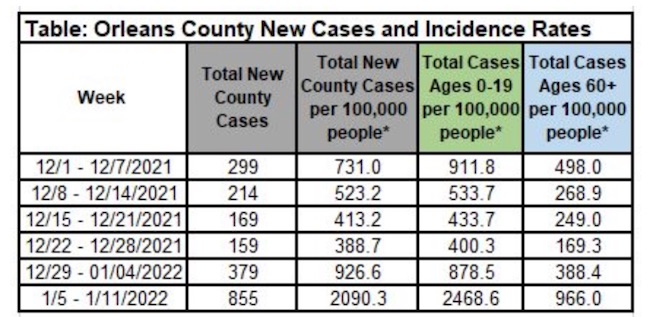
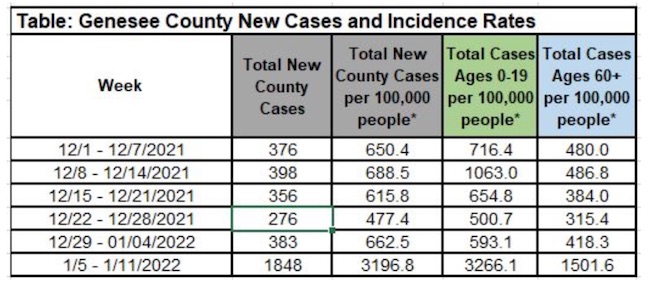
Charts compiled by Genesee & Orleans County Health Departments
Both Orleans and Genesee counties are reporting a major increase in Covid cases in the past week with nearly 3,000 in the two counties.
Orleans County has 855 new confirmed cases from Jan. 5 to Jan. 11, with 622 from lab-based tests and 233 home tests, the Genesee and Orleans County Health Departments reported today.
The 855 is up from 379 the previous week, Dec. 29 to Jan. 4, and 159 the week earlier, from Dec. 22 to Dec. 28.
The 855 cases in Orleans represents 2.1 percent of the total population of 40,343. Orleans has now had 7,654 positive Covid cases since the pandemic started nearly two years ago in March 2020.
Genesee is reporting 1,848 during the week from Jan. 5 to Jan. 11 with 1,523 from lab-based tests and 325 from home tests. That’s up from 383 the previous week, Dec. 29 to Jan. 4, and from 276 on Dec. 22 to Dec. 28.
“Due to the Omicron variant, the post-holiday Covid-19 surge, the delay in case investigations, and the recent change in case investigation protocol, the Genesee and Orleans County Covid-19 data reflects a dramatic increase in our cases for this week’s report,” the G-O Health Departments stated.
The 1,848 new cases in one week represents 3.2 percent of Genesee’s total population of 58,388. Genesee has now had 12,105 confirmed cases of Covid since the pandemic started in March 2020.
Genesee also is reporting another Covid-related death of a person over 65. Genesee has had 164 Covid-related deaths during the pandemic and Orleans has had 104, but none in the past week.
The local health departments today are shifting to providing weekly Covid updates on Wednesdays, instead of twice a week on Mondays and Thursdays.
By Tom Rivers, Editor Posted 11 January 2022 at 9:16 am
A Covid testing site opens Thursday at Brockport State College. It’s one of 11 new testing sites opening at SUNY campuses around the state, joining 10 other SUNY locations.
The SUNY Brockport community testing site will be at Mortimer Hall on Holley Street. It runs for as long as it is needed, Monday through Friday. It will be open from 8:30 a.m. to 4 p.m. Appointments can be scheduled online – click here.
Each site will maintain capacity for approximately 225 appointments per day and up to 50 walk-ins.
“We are not defenseless as we fight the winter surge: vaccines, boosters and testing can help us slow the spread and protect our loved ones,” Governor Kathy Hochul said. “These new SUNY sites build on our ongoing efforts to make testing more available as part of our Winter Surge Plan, and will be part of more than 2,000 locations statewide where New Yorkers can easily get tested for Covid-19. We are utilizing every possible state resource to keep New Yorkers safe and protect our fragile health care system.”
By Tom Rivers, Editor Posted 8 January 2022 at 4:52 pm
Genesee has 171 new cases, while Orleans reports 113
New York set a new pandemic high for most new Covid cases in one day on Friday with 90,132, Gov. Kathy Hochul said today.
Those cases include 113 in Orleans County and 171 in Genesee.
The 90,132 cases in one day tops the previous high of 85,476 on Dec. 31.
The percentage of positive tests reported on Friday was 21.17, and the seven-day average of positivity is 22.15 percent state-wide.
The number of patients hospitalized with Covid is 11,843, which is up 295 from the previous day.
“There is an answer to this winter surge and it’s simple: the vaccine and the booster,” Hochul said. “Our vaccination rate among children is still too low. Parents and guardians don’t delay in getting your children vaccinated and boosted, if eligible. It’s safe and widely available. This is the one of the best ways to keep our numbers down, as well as wearing a mask and staying home if sick.”
Boosters also recommended for 12-15 year olds; Nursing home visitors need negative Covid tests, surgical masks
Press Release, Gov. Kathy Hochul’s Office
Governor Kathy Hochul on Friday announced new guidance recommending booster doses for all New Yorkers ages 12 and older.
The guidance, following action by the CDC, recommends that people, including the newly authorized 12-15 year-old age group, who received the Pfizer-BioNTech vaccine should receive a booster dose at least five months after their second dose; the previous recommended interval was at least six months.
In addition, moderately to severely immunocompromised 5-11-year-olds can receive an additional primary dose of the Pfizer-BioNTech vaccine 28 days after their second dose. At this time, only the Pfizer-BioNTech Covid-19 vaccine is authorized and recommended for children ages 5-11.
Additionally, the CDC on Friday recommended the same change to a five month booster interval for the Moderna vaccine, which is only authorized for people 18 years and older.
“As we continue to battle this winter surge, I strongly recommend that all New Yorkers ages 12 and older get boosted as soon they are eligible,” Governor Hochul said. “With boosters now available for all adolescents, I especially urge parents and guardians to get their children in this age group a booster dose as soon as eligible. A booster dose will provide greater protection against severe outcomes from Covid-19 and help keep our kids healthy, protected, and safe.”
Governor Hochul additionally announced her plan to require that all covered health care workers previously required to receive a Covid-19 vaccination under the Department’s August 26th Emergency regulation must also now receive a Covid-19 booster dose within two weeks of becoming eligible, absent a valid medical exemption.
Consistent with the August 26th Emergency Regulation, there is no test-out option. Following review and approval by the Public Health and Health Planning Council at their emergency meeting on Tuesday, the emergency regulation will be filed with the Department of State (DOS). Regulations are effective upon the filing with DOS.
The Governor also announced new rules for nursing home visitations. Starting Wednesday, all visitors must wear “surgical”-type masks and must present upon entry a Covid negative test taken within 24 hours of their visit. Governor Hochul further noted that 952,000 tests and 1.2 million masks are being delivered to nursing homes late this week into next.
On Jan. 5, the CDC endorsed the Advisory Committee on Immunization Practice’s (ACIP) recommended expansion of booster dose eligibility for the Pfizer-BioNTech Covid-19 to individuals ages 12 through 15.
CDC now recommends that all adolescents ages 12 through 17 should receive a booster dose five months after their initial Pfizer-BioNTech vaccination series. This followed the CDC’s updated recommendations that severely immunocompromised 5-11 year-olds receive an additional primary dose of vaccine 28 days after their second dose, and that people who received the Pfizer-BioNTech vaccine series should get a booster dose at least five month after the second dose, instead of six months.
“Booster doses are a critical tool in our continued response to the Covid-19 pandemic, and I am grateful that they are now available for all New Yorkers 12 years of age and older,” said Dr. Mary T. Bassett said, the state’s acting health commissioner. “Data show that people who are vaccinated and boosted are more protected against serious illness from Covid-19, and we continue to urge all those eligible to act now. Do what you can to stay healthy and out of the hospital by getting vaccinated and boosted and wear a mask. If you have questions, talk to your health care provider or vaccine administrator.”
By Tom Rivers, Editor Posted 7 January 2022 at 9:14 pm
Genesee, Orleans and state won’t be doing contact tracing for people 19 to 64 but will for those 18 and younger, 65 and older
The big increase in Covid cases locally is resulting in a change in the contact tracing, especially for people ages 19 to 64.
The Genesee and Orleans County Health Departments and State Health Department won’t be doing contact tracing for people 19 to 64 in the two counties but will continue for people 18 and younger and those 65 and older.
The G-O Health Departments needs to prioritize its resources, and will focus on the younger and older age groups “due to the higher risk of spread and severity,” said Paul Pettit, public health director for the two counties.
Orleans County hit a pandemic high for active Covid cases with 561 on Thursday. The county has 75 more cases reported today by the State Health Department. Genesee County has 180 more cases today, according to state data.
The State Department of Health also announced that beginning next week changes will be implemented to case investigation and contact tracing. This guidance may change, G-O Health said this evening in a news release.
Effective Monday, Jan. 10, residents who test positive for Covid-19 or who have had close contact with someone who tested positive for Covid-19 will be able to visit www.GOHealthNY.org and choose the red “Covid-19 Isolation & Quarantine Information” button to be directed to the isolation and quarantine documents.
Those who have tested positive for Covid-19 will be contacted by NYS by e-mail or text. Once notified of the positive result by the lab or NYS, immediately self-isolate and notify close contacts of their potential exposure, G-O health officials said.
Those in the 19-64 age group who test positive should no longer expect to receive a call from the local health department – and a call isn’t required to the local health department.
Those people in that age group who test positive for Covid should follow the general directions from the state for isolation and quarantine, and contact their healthcare provider for medical advice.
For those in need of isolation, quarantine or release documents, they are available on the G-O Health website. Complete the form(s) and print out for employer or school.
Isolation (for those who test positive for COVID-19) G-O Health says the following apply:
Isolate for 5 days, where day 0 is the day of symptom onset or (if asymptomatic) the day of collection of the first positive specimen.
If asymptomatic at the end of 5 days or if symptoms are resolving, isolation ends and the individual should wear a well-fitting mask while around others for an additional 5 days.
Individuals who are moderately-severely immunocompromised should continue to follow standard (i.e., not shortened) Isolation Guidance.
Individuals who are unable to wear a well-fitting mask for 5 days after a 5-day isolation should also follow standard isolation guidance (i.e., 10 days, not shortened)
Quarantine (for those who have had close contact with a person who tested positive for Covid-19), G-O Health issued these protocols:
Quarantine as follows, where day 0 is the last date of exposure:
If not fully vaccinated or fully vaccinated and eligible for a booster but not yet boosted, quarantine for 5 days and wear a well-fitting mask while around others for an additional 5 days.
If fully vaccinated and boosted (with the booster at least 2 weeks before the first date of exposure) or not yet eligible for a booster, no quarantine is required but these individuals should wear a well-fitting mask while around others for 10 days after the last date of exposure.
If possible, test at day 5 with either a nucleic acid amplification test (NAAT, e.g., PCR) or antigen test.
If symptoms appear, quarantine and seek testing. In this situation, quarantine would end when the test is negative. If testing is not done, isolate according to the guidance above.
Quarantine orders and release are also included on the GOHealthNY.org website to complete and provide to employer/school.
Given the changes announced for case investigation and contact tracing the Orleans and Genesee data collection/reporting will be adjusted. Starting next week, GO Health will be releasing limited data on Wednesdays.
By Tom Rivers, Editor Posted 6 January 2022 at 8:53 pm
561 active cases goes past previous high of 334
Orleans County is reporting 381 new cases of Covid-19 since Monday, and has a new pandemic high for active cases – 561. That is well above the previous high of 334 on Dec. 9.
The new confirmed cases include 105 from home testing kits.
The county also has passed over 7,000 cases since the pandemic started in March 2020.
While the number of cases is way up, the number of people hospitalized due to Covid remains at six, the same as on Monday.
Orleans also is reporting 89 more recoveries of people who completed their 10-day isolation and have been removed from mandatory isolation.
In Genesee County the number of active cases is down from 265 on Monday to 241 today.
The county is reporting 242 new cases and 260 more recoveries. Genesee also has two more deaths from Covid, both under age 65.
Genesee’s new cases include 54 from home testing kits. The county has 22 hospitalized due to Covid, the same as on Monday.
New York State is reporting 84,202 new positive cases, which is the second highest during the pandemic. The record high is 85,476 on Dec. 31.
The state’s positivity rate over the past 7 days is 22.5 percent. In Orleans it’s 16.3 percent and in Genesee it’s at 19.9 percent.
By Ginny Kropf, correspondent Posted 6 January 2022 at 9:36 am
MEDINA – Marc Shurtz, CEO of Orleans Community Health, has issued five health conscious goals which he deems achievable for 2022.
Marc Shurtz
“It’s that time of year again,” Shurtz said. “We’re all thinking about the personal goals we want to achieve over the next 12 months, and in many cases trying to become more successful than the year before. Determining how these New Year’s resolutions can be sustainable beyond January is a challenging goal, and making sure they reflect a healthy lifestyle must be a priority. Simply say you plan to lose weight by going on a diet might not be the healthiest path forward.”
The focus on the community’s collective health has never been greater, Shurtz added. The team at Orleans Community Health has put together five health conscious goals for 2022 – which are achievable.
1. Be a blood donor: A suggestion from Anne Kawski, laboratory director, is to become a blood donor. It’s no secret we’re faced with a blood shortage. To make things worse, only around 37% of Americans can donate. So for those who are in that 37%, here’s an opportunity to make a difference. Plain and simple, blood donors save lives.
2. Rethink approach to dieting: Aleigha Decker, RDN, CDN and Anna O’Keefe, RD, CDN in Clinical Dietetics suggest rethinking the annual goal of dieting. By now, we all know a diet that drastically changes one’s habits is likely not sustainable and isn’t healthy. Instead, they suggest increasing activity and trying to plan healthier meals.
3. Go to doctor for annual checkup: Nicole Helsdon, practice manager at the Albion Clinic, offers the suggestion to schedule a doctor’s visit. A yearly visit is important for many reasons, she said, and allows you to spot potential problems before they are too far along.
4. Eat more fruits and veggies: From Fredderica Fuentes, director of Nutritional Services and Clinical Dietetics, comes the suggestion to add more fresh produce to your diets. Western New York is home to a vibrant agricultural community, which includes wonderful produce. Identify local farm markets and stores that allow you to eat healthy and support local growers.
5. Get enough sleep: Leighann VanAuker, RN, MSN, ANP, FNE, director of Emergency Services and Infection Control, stresses the importance of getting some rest. There is a lot of noise around us at all times, whether it’s from the television, social media, worldly affairs, our careers or even activities in which we participate. No matter what the cause of time diminishing, it’s important to focus on getting rest and much needed sleep. Sleep deprivation can have an effect on one’s weight, immune system and cardiovascular system, among other things, VanAuker said.
“As we’re gearing up for positive things to come, it’s always important to focus on our personal well- being,” Shurtz added. “These five health-conscious goals are achievable and will help position you for a positive 2022.”
ALBION – Supportive Care of Orleans, formerly Hospice of Orleans, is pleased to welcome Julie Kumiega as its new chief executive officer.
Kumiega’s first day was Jan. 1 and she hit the ground running, meeting with former director Elisa Chambery. Having taken on the position as CEO in June 2021, Chambery has announced her retirement from healthcare; her last day will be Jan. 20.
Working in the health care industry all her adult life, Kumiega was the director of patient services at the Alzheimer’s Association-WNY before serving as an administrator at both Heathwood Assisted Living & Memory Care and Elderwood in Williamsville.
“I always wanted to help people,” Kumiega said. “I started out with my undergrad in psychology and from there my passion grew.”
Kumiega graduated from the University of Phoenix in 2008 with her master’s in health administration and currently plans to have her doctorate in health administration by the end of 2023.
Born and raised in Corfu, Kumiega says this small rural county and hospice hold a special place in her heart.
“It has been a huge passion of mine to make healthcare more accessible for patients, families, and staff,” Kumiega said. “Supportive Care of Orleans is one way I can help.”
Dedicated to supporting the community, the staff, our patients, and their families during a difficult end of life journey, Kumiega said it is her goal to assist in providing supportive care opportunities to all.
Test kits also can be picked up at County Office Building
Press Release, Genesee and Orleans County Health Departments
ALBION – New York State has provided Orleans County Emergency Management Office with free at-home Covid test kits to distribute to residents.
Starting Thursday, Jan. 6, each town hall and the Orleans County Office Building will have a limited supply of Covid test kits to distribute to their residents during normal business hours until the kits are gone.
Please note all the school districts have received kits for their students and will distribute according to their respective plans. A maximum of two kits per family will be distributed at the following locations:
Orleans County Office Building: Monday-Friday from 9 a.m. to 4:30 p.m.
Albion Town Hall: Monday, Tuesday, Thursday and Friday from 8:30 to 11 a.m. and noon to 3 p.m.
Albion Village Hall: Monday-Friday from 8 a.m. to 4 p.m.
Barre Town Hall: Monday, Tuesday, Thursday, Friday from 10 a.m. to 3:30 p.m.
Carlton Town Hall: Tuesday-Friday from 8:30 a.m. to 2:30 p.m.; Saturday from 9 a.m. to noon
Clarendon Town Hall: Monday, Wednesday, Thursday from 9 a.m. to 4 p.m.; Tuesday from noon to 6 p.m.; Friday from 9 a.m. to 2 p.m.; and Saturday from 10 a.m. to noon
Gaines Town Hall: Monday-Thursday from 10 a.m. to 3:30 p.m.; Monday from 5 to 7 p.m.
Holley Village Hall: Monday-Friday from 8 a.m. to 4 p.m.
Kendall Town Hall: Monday-Friday from 9 a.m. to 3:30 p.m. (closed from noon to 12:45 p.m.)
Lyndonville Village Hall: Monday-Friday from 7:30 a.m. to 4 p.m. (closed daily from 12:30 to 1 p.m.)
Medina Village Hall: Monday-Friday from 8:30 a.m. to 4:30 p.m.
Murray Town Hall: Monday, Tuesday, Thursday, Friday from 9 a.m. to 4 p.m.; Saturday from 9 a.m. to noon
Ridgeway Town Hall: Monday-Friday from 9 a.m. to 4:30 p.m.
Shelby: Monday-Friday from 8:30 a.m. to 4 p.m.
Yates Town Hall: Monday, Tuesday, Thursday, Friday from 9 a.m. to 4:30 p.m.
To report a positive at-home test:
Individuals can visit the GO Health website Covid-19 Testing page under Emerging Issues (GOHealthNY.org) and choose the appropriate Home Test button for their respective county.
Individuals should complete the at-home tests according to the directions provided. When the test is completed, individuals should take a picture with the individual’s name, the date and the time they took the test legibly written in permanent marker within 15 minutes of reading the test.
Towards the end of the online form, the individual will be required to upload the picture on the website and attest to the authenticity and truth of the form. If there are any missing sections that are required, the form is invalid. At this time, individuals do not need to report negative at-home test results.
Anyone who tests positive for Covid-19 is to self-isolate immediately. A case investigator will contact the individual to determine any potential contacts, check on the individual’s health and provide guidance on their isolation.
Please answer the phone and be able to provide information regarding potential contacts when called. Also note, depending on our caseload, it may be one to three days before you are called. It is important to continue with self-isolation from household members as much as you are able. If you must share space, make sure all in contact with you are wearing masks covering their nose and mouth and frequently shared items/surfaces are sanitized often.
By Tom Rivers, Editor Posted 3 January 2022 at 5:28 pm
5 Covid-related deaths reported since Dec. 30 in Genesee-Orleans
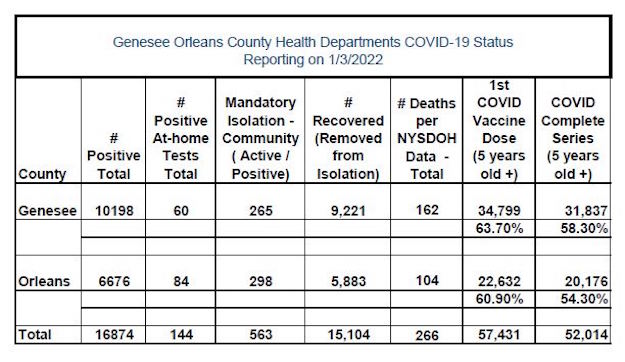
The active Covid cases is up in Orleans and Genesee counties, and the two counties also have five more Covid-related deaths since the last update on Dec. 30 from the Genesee and Orleans County Health Departments.
Genesee has four deaths – one under age 65 and three over 65, and now has 162 Covid-related deaths since the pandemic started in March 2020.
Orleans has one more Covid-related death, a person over age 65, and now has had 104 residents pass away from Covid during the pandemic.
The number of active cases in the two counties also has increased from 130 in Orleans a week ago to 298 today. Genesee is up from 218 to 272 in the past seven days.
In Orleans County there are 158 new positive cases (with 51 from home tests) since Thursday. There are also 73 more recoveries or people who completed their 10-day isolation and have been removed from mandatory isolation.
In Genesee County, there are 211 new cases and 207 more recoveries since Thursday. Genesee also passed a milestone with its 10,000 case of Covid during the pandemic. The county has now had 10,198 confirmed cases.
The number of hospitalizations since last Thursday (Dec. 30) have increased from four to six in Orleans, while Genesee has dropped from 28 to 22, according to the Genesee and Orleans County Health Departments.
By Tom Rivers, Editor Posted 1 January 2022 at 7:15 pm
New York State made it four straight days of setting a new record for Covid cases. There were 85,476 new cases on Friday, which followed 76,555 on Thursday, 74,207 on Wednesday and 67,090 on Tuesday.
The 85,476 positive cases on Friday are out of 384,365 reported tests for a positivity rate of 22.24 percent.
Those positive tests include 46 in Orleans – out of 427 tests for a positivity rate of 10.8 percent. Genesee has 91 more positives out of 506 tests for a rate of 18.0 percent.
The state’s 7-day positivity rate is at 19.79 percent. Locally the positivity rate over the past 7 days is 14.1 percent in Genesee and 11.9 percent in Orleans.
Only two of the 62 counties in the state under 10 percent: Chenango at 9.6 percent and Tompkins at 8.6 percent.
Long Island has the highest positivity rate at 22.69 percent followed by New York City at 20.56 percent. The nine-county Finger Lakes region, which includes Genesee and Orleans, is at 15.68 percent.
“As we fight the winter surge, we need to keep the most vulnerable among us in mind – do what you can to keep others in your community safe from Covid-19,” Governor Hochul said in a Covid update. “Wear a mask, wash your hands, and take advantage of the best tool we have at our disposal – the vaccine. If you haven’t gotten your second dose, do so as soon as possible and get your booster if you’re eligible. We will continue to make vaccines, boosters and testing more widely available as part of our Winter Surge Plan so we can continue to keep each other safe.”
The state also reported today that hospitalizations from Covid increased by 532 to 8,451. The hospitalizations five days earlier on Sunday were at 5,526. On Dec. 17 there were 3,909 hospitalized from Covid.
SUNY students will need booster; mask or vax mandate extended to Feb. 1
Press Release, Gov. Kathy Hochul’s Office
Governor Kathy Hochul today announced Winter Surge Plan 2.0, a new targeted effort to bolster New York’s fight against the winter surge.
Hochul’s comprehensive plan focuses on five core areas: keeping students in school, doubling down on masks and testing, preventing severe illness and death, increasing access to vaccines and boosters, and working together with local leaders. Hours before the New Year begins, Governor Hochul also urged New Yorkers to celebrate New Year’s Eve in a safe, responsible way.
“As we head into the holiday weekend, New York State is mobilizing every resource at our disposal to fight the winter surge and keep New Yorkers safe,” Governor Hochul said. “We can get through this surge through targeted actions, partnerships with local leaders, and by taking common sense steps to keep us all safe: get vaccinated, get boosted, and wear a mask indoors.”
1. Keep Schools Open: After two years of remote learning and school closures, Governor Hochul is focused on keeping students in school in the upcoming year. The first plank of Governor Hochul’s 5-part plan includes:
Providing tests to students and school districts: 5.56 million tests arrived for schools this week and between six and seven million more are expected to arrive in the coming days. New York has mobilized 40 trucks and 86 state personnel to distribute tests. Overall, New York State has secured 37 million tests for distribution.
Working with counties to implement Test-to-Stay: Test-to-Stay policies have proven successful at keeping our kids safe and schools open. If a student tests positive, classmates can take a test kit back home with them and return to the classroom upon receiving a negative result instead of mandatory quarantining.
Keeping college students and faculty safe: SUNY and CUNY will be introducing a new requirement for all students to get boosters, campuses will require mandatory mask wearing in public indoor spaces, and will require all faculty to be vaccinated. Students will also be required to submit negative tests upon returning to campus.
2. Keep Masking, Keep Testing: Governor Hochul recognizes that to stop the spread of the virus, New Yorkers must continue wearing masks and getting tested for Covid. Governor Hochul will:
Extend the mask-or-vax requirement: the Department of Health will extend the mask-or-vaccine requirement for an additional two weeks to Feb. 1, protecting workers and allowing businesses to remain open.
Make masks more widely available: New York State has already distributed 5 million KN-95 masks, and more will be distributed through state legislators. Hundreds of thousands of masks will also be distributed for nursing home visitors.
Launch new testing sites: Governor Hochul will open six new testing sites on January 4, totaling 19 state-run sites statewide. Additionally, Governor Hochul announced the launch of two new testing sites at MTA stations, in addition to previously announced MTA pop-ups.
3. Preventing Severe Illness and Death: With case counts rising, Governor Hochul is making it a priority to prevent severe illness and death by supporting our hospital system. The Winter Surge Plan 2.0 will:
Distribute antiviral treatments: New York is working with the Biden Administration to secure doses of the antiviral drug Pavloxid and make this treatment more widely available.
Boost hospital capacity: Governor Hochul will continue enforcing the November 26 Executive • Order to boost hospital capacity. Since it took effect, the number of hospitals with limited capacity needing to pause non-essential surgeries has declined from 32 to 21.
Launch National Guard EMT training: to ramp up our long-term health care workforce capacity needs, the Department of Health and the Division of Military and Naval Affairs will be launching two pilot EMT training classes on January 5th. This will cover two classes of 40 service members (80 service members in total) who will be able to be deployed by February.
Secure additional help from Federal partners: in the coming days, we will receive federal Department of Defense (DoD) Medical Response and Disaster Medical Assistance Teams (DMATs). This will include a 35-member DMAT to SUNY Upstate in Syracuse, 23-member DoD Medical Response Team to Erie County Medical Center in Buffalo, and 50 new ambulance teams deployed to NYC.
Protect nursing home residents and workers: the Hochul Administration is in constant contact with all 606 nursing homes in New York and will be providing them with additional PPE to ensure the safety of all patients and staff. Additionally, the Administration is coordinating with hospitals and will be deploying durable medical equipment in continued support of the care for all New Yorkers.
4. Expand Access to Vaccines and Boosters: Vaccines continue to be the best defense against Covid hospitalization and death. While 95% of adult New Yorkers have received at least one shot, there’s more to do to increase vaccination and booster rates, especially among children:
Provide boosters to nursing homes: New York will begin requiring each nursing home to demonstrate their plan to increase vaccination and booster rates among their residents.
Increase pediatric vaccination: the most unvaccinated eligible cohort is New Yorkers aged 5-11. New York will increase our focus on pediatric vaccination.
Get booster shots to teenagers: we anticipate approval of Pfizer’s booster shot for children aged 12-15 and will immediately begin outreach to that population once ready.
5. Work With Local Partners: From the beginning, Governor Hochul has emphasized that the fight against COVID must take a collaborative approach. Fighting the winter surge requires close collaboration with local partners:
Let local leaders lead: from New York City to Erie County, local leaders are making smart choices. We will continue this surgical, targeted approach.
Provide resources to local partners: Governor Hochul will continue to lead a whole-of-government approach to fight Covid, making sure county emergency managers and local school boards have the tests and masks they need.
“We have every tool to keep our families and communities safe,” Acting State Health Commissioner Dr. Mary T. Bassett said. “We must ensure we use them all. Governor Hochul’s targeted plan to expand vaccination and booster access, mask and test, and increase measures to protect our health care workers is the comprehensive strategy needed to combat the fast-spreading Omicron variant. Leveraging these layered mitigation tactics is how we will protect the health of New Yorkers and effectively manage the winter surge.”




















 The big increase in Covid cases locally is resulting in a change in the contact tracing, especially for people ages 19 to 64.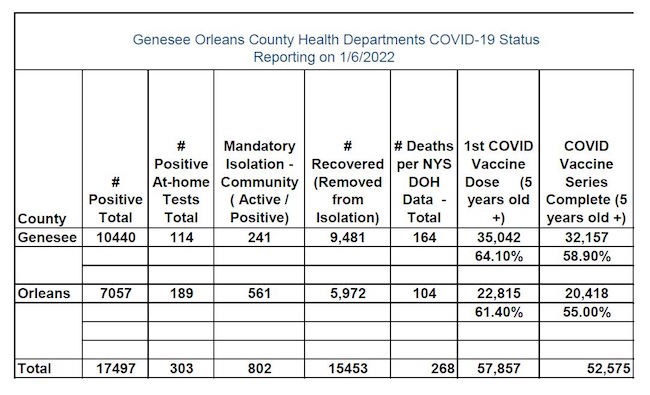


 ALBION – New York State has provided Orleans County Emergency Management Office with free at-home Covid test kits to distribute to residents.