By Tom Rivers, Editor Posted 9 September 2020 at 8:59 am
Jason Smith and Lyndonville district welcome back students today
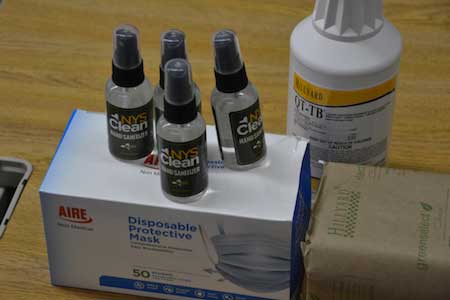
Classrooms are stocked with hand sanitizer, masks and cleaning products.
LYNDONVILLE – Jason Smith has served as Lyndonville’s superintendent of schools since December 2011. The superintendent and district will begin welcoming back students today for a new school year. Lyndonville is staggering the grade levels this week before all grades come back next week for in-person classroom learning each school day.
Lyndonville is able to offer all students the option for in-person learning each day, rather than a hybrid approach like many districts where students come in to school for classes two or three days a week with the other days remotely at home.
Lyndonville, which has 630 students in grades PreK to 12, can accommodate all students with social distancing guidelines in place. The district has three grade levels at the elementary school, which is being used again after closing after the 2011-12 school year.
This year the district will have PreK and grades 5 and 6 in the elementary school.
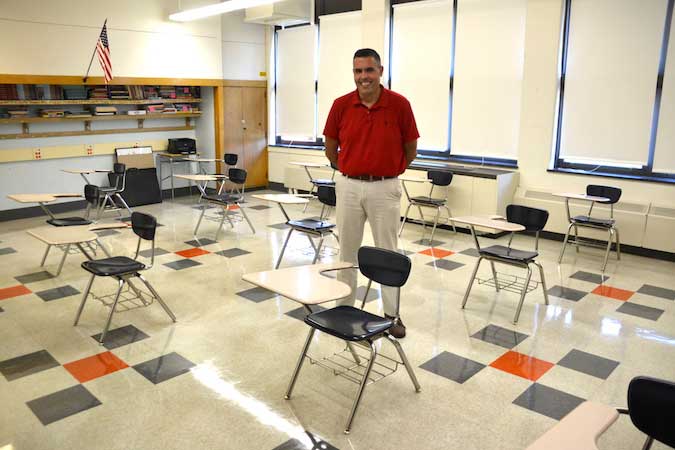
The district has many new protocols in place to reopen during the Covid-19 pandemic, including taking students’ temperatures, spreading out desks, having students wear masks when social distancing isn’t possible, and making hand sanitizer available.
Jason Smith was interviewed last week in his office at Lyndonville Central School on Housel Avenue.
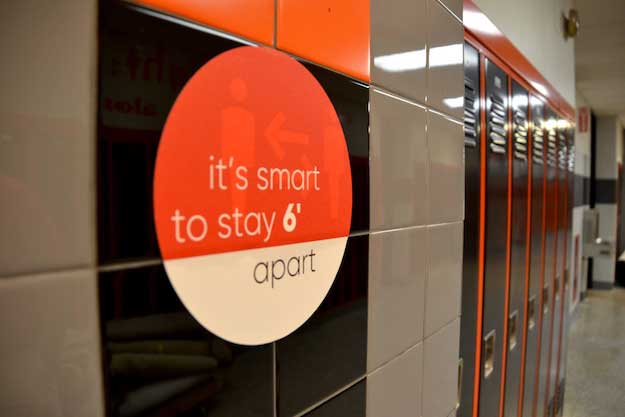
The district has signs and decals throughout the hallways, classrooms and campus, urging people to maintain social distancing and wear masks.
Question: This is your 26th year in education. (Smith started his career in 1994 as a social studies teacher in Albion.) How radically different is this start of the school year?
Answer: It has been a radical start, going back to March. I was telling the families when I did the reopening meetings, I began tongue in cheek by saying I’m a history teacher by trade. We’re learning this as we go.
I’m basically saying I am committed to learning about this and making changes, but understand I was brought up as a history teacher.
March 13 was the last day we had students here. It was unreal because on March 14th I started talking with the superintendents in the county and Paul Pettit (the public health director in Orleans County) and we all closed that day. It was a Saturday.
It was almost like when I was at Albion (as a social studies teacher) and we watched the towers come down in New York City (on Sept. 11, 2001). I watched with eighth-graders in the cafeteria hallway. Standing next to me was Joe Martillotta (another social studies teacher).
March 14th was another surreal moment. It took about four hours from 1 to 5 to get everything done that I needed to get done. Then my wife and I went out to dinner for the last time for a while. Then I went back to work that night and had a call with my administrators. It was very much like I can’t believe this is happening.
It’s been six months. It’s definitely been out of the ordinary. I’ve had many calls with superintendents in Orleans County and also in the Niagara-Orleans BOCES.
There has been a lot of communication, a lot of problem solving and working to meet the new challenges. There has been a lot of pieces to put together.
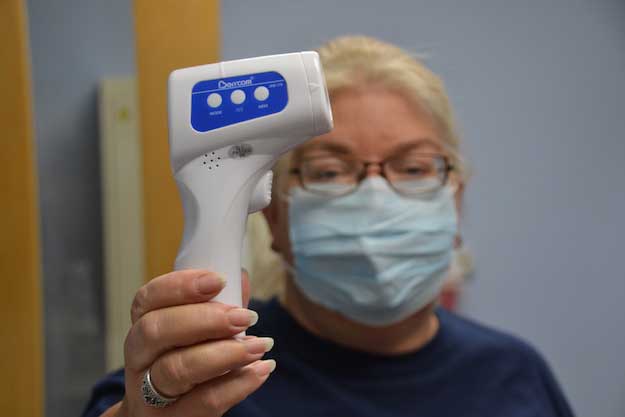
The district has two thermal scanners that doing rapid screens as students enter the hallways in the main building. That scanner will identify students who may have temperatures at 100 degrees or more. Those students will then be checked individually with infrared touchless thermometers. If they have a temp of 100 degrees or more, they will have to go home.
Question: Last year there was such abruptness with the schools closing and the switch to remote learning. This year I know Lyndonville is starting with the option of in-person learning all five days of the school week. At least you know what you’re getting into at the start of the school year.
Answer: We do have about 15 percent or about 80 students who have opted to do remote only, even though we are offering full person instruction. We are offering the remote instruction to our families.
But the other piece is if we get switched to remote by force or by choice, we wanted to make sure we had a better plan in place. As we developed our plan for reopening, we wanted to make sure we had plans for full in-person which we’re doing, hybrid or full remote.
If we have to go full remote, we wanted to make sure we have enough devices and that there are expectations for teachers, students and families for what it looks like.
For example, last year from March, April, May and June, we were on pass-fail. There wasn’t traditional grading because of the challenges we had. But this year, anyone who is on remote, whether they chose it or were on it by force, it’s going to be regular grading and feedback with tests.
We’ve upped our game and everybody needs to up their game and understand it’s going to be graded, whether you are here or not. That is one of the lessons we learned.
We learned to do mobile hotspots. We actually started planning on March 12th in anticipation of what could happen. We had started that inner game plan a couple days before not knowing it would go on for the rest of the year.
Question: Do you have a sense of the percentage of kids that need the mobile hotspots?
Answer: We purchased 40 of them. The ones that we purchased work very well with a Verizon signal.
When Aaron Slack (high school principal) and I drove around the whole district during the graduation parade, oftentimes our phones died because there wasn’t a Verizon signal out on this road or that road.
So there is a strong need (for mobile hotspots). Our school board is committed to having better high-speed internet. We want to engage in the political process to open up broadband.
We opened up the campus here in the library and later on we placed two hotspots at the White Birch and the Oak Orchard Assembly of God.
So obviously the need is strong. It is definitely a handicap for us.
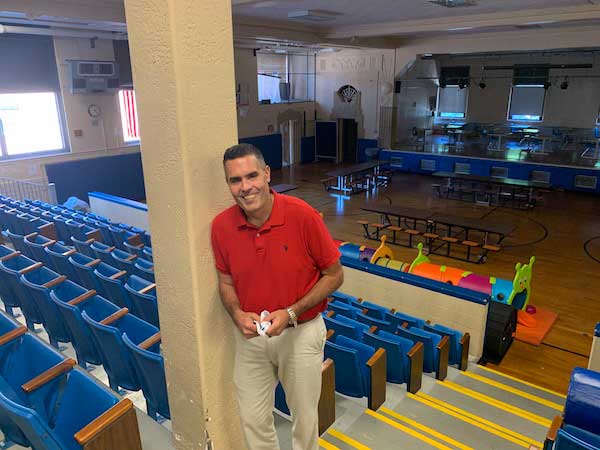
Jason Smith is shown in the cafeteria at the elementary school, where there will be clear dividers in place at the lunch tables. The school building gave the district the option to shift two grade levels, fifth and sixth, from Housel Avenue to free up more space and reduce the number of people in the main school building.
Question: Are the two hotspots still there at the White Birch and the church?
Answer: They won’t be there right to start. We’re going to monitor it and see how it goes. They didn’t get a lot of use last year. It was a cost for us to have them. We will monitor it. People can still use this campus. They can use the Yates library. The students will have access to Chromebooks, too.
Question: People might wonder what has been the hardest part of being a superintendent during the pandemic?
Answer: Just the changing rules. The changing regulations. The communication from the state and making sure I get that communication out to the staff and the parents.
I think one of the new normals for us is we’ve all had to up our communication game. I’ve used all of our systems. I’ve become much more proficient with it. I’ve got the calls out, the texts out, links, all kinds of stuff and getting the website updated.
Those have been some of the challenges, getting as much information out as much as we can.
Question: You function as the chief communication person?
Answer: I do a lot of it or I have someone else do it but I have my hands on the button all the time. We have our website set up with all the alerts on there. I have a great staff, too, and we have BOCES service that helps us out. But if it’s an immediate need I’ll get it up there.
Certainly we miss our students. While we weren’t open since March, I saw one of our students at the EZ Shop. We just kind of smiled at each other and had a prolonged hello because we just missed seeing each other. You miss the hustle the bustle of students and staff in school. So that’s been hard.
And just the unknown and not knowing, and all the planning.
Mary Kurz, the school nurse, holds one of the infrared touchless thermometers.
Question: The fall sports starting on Sept. 21 is confusing with some sports able to go and others not.
Answer: The practices can start on the 21st. The frustrating part for all of us has been we’ve been able to have youth sports with contact but now there seems to be conflicting guidance. Our infection rate in our state is lower than other states, yet those states with higher (infection) rates are able to play football. Why can’t we do that or something similar here?
That’s been a frustrating part.
But we are excited to get the athletics back and again do that in a smart manner. The guidance says maybe two spectators per child and we’ll have to decide how we’ll manage that and keep the density down.
Question: Two spectators per kid that will be a hard deal.
Answer: That will be tough. Some of what is being tossed around is do we give each child two passes? We’re also going to try to livestream some of the events. If people can’t come in person they could watch it on YouTube. We’re going to look at a service for that.
The elementary school last year was used for an expanded PreK program after being closed since 2012. This year it will have PreK, fifth and sixth grades.
Question: If you didn’t have the elementary school option, would you have been forced to do the hybrid without in-person each day for everyone?
Answer: It would have been tight. By having classes there we’ve opened up space here so we can have spillover rooms. So it was definitely to our advantage to have that building. We’re even able to feed students over there.
It definitely made the process easier knowing that we had that space over there.
Question: In terms of a silver lining, I have to think the kids will be really happy to see each other and they will value in-person friendships.
Answer: Yes, we saw how quickly it all ended last March.
Another challenge we had going back to June was graduation. It was one big task at a time. In March and April it was getting the meals out and the technology out.
In May and June we started having talks about graduation, which is a huge event.
We kind of took a breath and waited for guidance from the state about reopening the schools. We formed a committee, and had that going on the last two weeks in July. Ultimately I did nine presentations, one to the board, six to parents and two to teachers.
It’s easy to be overwhelmed, trying to keep up with the federal laws and the state laws. You want to balance parent needs, student needs and staff needs.
Question: I’m guessing you haven’t had much of a break personally since March?
Answer: Me, no. I had a vacation I was going to take over Memorial Day weekend but it was cancelled.
I will say this, I try to give myself so downtime because the job can be so demanding. During the shutdown I was looking at emails 24-7 trying to keep up with what parents and staff needed, what students needed. I was in constant contact with the administrators. It wasn’t until July when I took every other Friday off. That’s what I was able to do. The idea of taking a week off, for one, where are you going to go? Every place I wanted to go was quarantined.
So you try to balance it out and keep your Sundays free. The job is challenging enough and you add (Covid) to it, it’s another 25 layers.
Question: What else would you like to say?
Answer: It’s been a good process, we’ve learned and we’ve grown as administrators, as staff, as teachers. We’ve all learned.
There are some things we will keep on doing when this (Covid) is done. For example I used to have to drive to Sanborn once a month for a meeting (with the Niagara-Orleans superintendents). Do I have to do that anymore when we can do the same thing online? It saves money. It saves time. It saves gas to do things here. Why do I have to drive there when every Tuesday I’ve been doing Zoom meetings with the superintendents, although there is value to meeting in person, but maybe we’ll do it once every three months in person.
By Ginny Kropf, correspondent Posted 9 September 2020 at 7:58 am
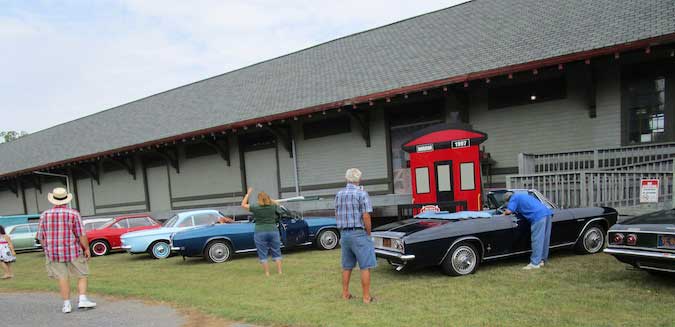
MEDINA – The Medina Railroad Museum will welcome up to a dozen members of the Niagara Frontier Corvair Club on Sunday. Cars will arrive at the museum about 11 a.m., where they will spend 1 1/2 to two hours touring the museum. During that time, the community is invited to stop and look at the cars, as long as they wear a mask and maintain social distancing.
The club, founded in the early 1970s, takes one field trip a year and lastly visited the museum several years ago, according to club secretary John Dawley of Tonawanda.
Club membership numbered 40 three years ago, but has dwindled to 30 now. In 2006, the club hosted the National Corvair Convention in Buffalo, which 600 people attended, Dawley said.
“Corvair is not the most popular classic car,” he said. “Ralph Nader called it the car which is not safe at any speed.”
When the Mustang and Corvette came out, that killed the Corvair, Dawley added.
The Corvair was only made from 1960 to 1969. Early models are considered those made from 1960 to 1964, while late models, made from 1965 to 1969, had a second body style. Only 6,000 were made in the last year.
The club’s newsletter editor Gary Swiatowy of Gasport has six Corvairs. He said the Corvair engine was cast in Massena and put together at the Chevrolet Tonawanda Engine Plant. He added that Corvairs have rear engines and are air-cooled.
Dawley said when his uncle turned 85, he gave him his 1969 Corvair, a Monza with a 140 motor.
This 1961 Corvair Lakewood station wagon owned by Patrick Murphy, president of the Niagara Frontier Corvair Club, is one of several from the Niagara Frontier Corvair Club who will be making a field trip to the Medina Railroad Museum Sept. 13. The community is welcome to come and see the cars parked there from 11 a.m. to 12:30 or 1 p.m.
The trip to Medina on Sunday will begin in Lockport. Dawley has planned the route for their trip, and any club member who can guess the closest to the number of miles they will drive will win a free lunch. Dawley is familiar with Medina, having served in the National Guard at the Medina Armory from 1965 through 1968.
The club meets once a month at the guest center on Grand Island. Prior to the pandemic they met at Lutheran Church in Tonawanda, which has been closed.
By Tom Rivers, Editor Posted 8 September 2020 at 8:30 pm
KENDALL – Stacey Jurs sent in this photo of her 5-year-old daughter, Gracelynn, waiting for her brother to come home on the school bus. Gracelynn is dressed as Lego Batgirl.
Her brother Connor Jurs, 8, had his first day of third grade today at Kendall. The district welcomed back students in grades 1 through 12.
Gracelynn has her first day of kindergarten on Wednesday at Kendall, which also has the first day for prekindergartners.
“The first day went smooth,” Jurs said. “The teachers were prepared, students too! It was a great first day!”
ALBION – Orleans County smokers are encouraged to contact the New York State Smokers’ Quitline to receive up to three months of free nicotine gum while supplies last.
The Quitline asks everyone to spread the word to family and friends about this time-limited offer, made possible thanks to a generous donation from Ro, a U.S. telehealth company headquartered in Manhattan.
Nicotine gum is one of seven FDA-approved nicotine replacement therapy products to treat nicotine dependence and increases the chance for success in quitting. Those odds further increase when combined with coaching support from a trained tobacco treatment specialist, such as one of the Quitline’s Quit Coaches.
“We strongly encourage anyone who’s interested in the nicotine gum to spread the word to family and friends,” said Paul Pettit, Public Health Director in Orleans County. “Nicotine gum is an effective and proven medication to treat addiction and supplement the quit-process. It eliminates short-term cravings of cigarettes and can double the odds of successfully quitting when combined with a nicotine patch.”
Each piece of nicotine gum typically lasts 20 to 30 minutes. Unlike traditional chewing gum, nicotine gum works when chewed only a few times and then parked along the inside of the mouth by the cheek.
Interested smokers can receive the nicotine gum by contacting one of the Quitline’s Quit Coaches at 1-866-NY-QUITS (1-866-697-8487), who are available seven days a week beginning at 9 a.m. Nearly all Quitline participants are eligible to receive nicotine replacement therapy (NRT), coaching and self-help materials.
The Quitline’s Quit Coaches work with all types of traditional tobacco and vape-product users by developing personalized quit-plans to navigate the behavioral and psychological aspects of nicotine dependence. Healthcare professionals can also connect to the Quitline’s Patient Referral Program as a supplement to visits and follow-ups with their nicotine-dependent patients.
About the New York State Smokers’ Quitline
The New York State Smokers’ Quitline is a service of the New York State Department of Health and based at Roswell Park Comprehensive Cancer Center in Buffalo, N.Y. It is one of the first and busiest state quitlines in the nation and has responded to nearly 3 million calls since it began operating in 2000. The Quitline encourages nicotine users to talk with their healthcare professionals and access available Medicaid or health insurance benefits for stop-smoking medications. All New York State residents can call 1-866-NY-QUITS (1-866-697-8487) for coaching and resources, free of charge, seven days a week beginning at 9 a.m. Visit www.nysmokefree.com for more information.
About Tobacco-FREE GOW
The New York State Department of Health, Bureau of Tobacco Control funds Tobacco-Free GOW to increase support for New York State’s tobacco-free norm through youth action and community engagement in Genesee, Livingston, Orleans and Wyoming counties. Efforts are evidence-based, policy-driven, and cost-effective approaches that decrease youth tobacco use, motivate adult smokers to quit, and eliminate exposure to secondhand smoke.
By Tom Rivers, Editor Posted 8 September 2020 at 4:17 pm
County reaches 300 confirmed cases since March
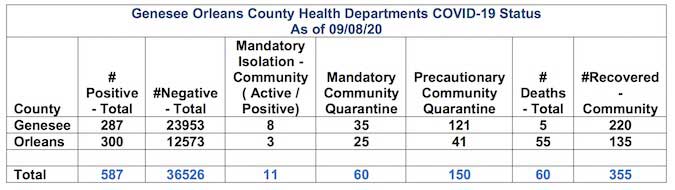
Orleans County has 10 new confirmed cases of Covid-19, the Genesee and Orleans County Health Departments said today in their first update since Friday.
Orleans has now had 300 people test positive for Covid-19 since March. It only had 12 new confirmed cases in the month of August.
Seven of the new cases since Friday are inmates at the Albion Correctional Facility. That women’s prison also had two confirmed cases reported on Friday and has now had nine people test positive.
The three new cases in the community, outside of the prison, are residents of Albion, Clarendon and Kendall. Those three people were not on quarantine prior to testing positive, the Health Departments said this afternoon.
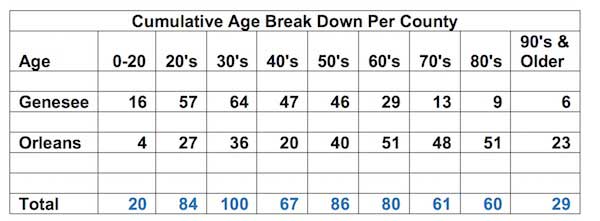
The age breakdown of the new cases includes one person less than 20, two individuals in their 20s, three people in their 30s, one person in the 40s, and three people in their 50s.
There are also 19 new individuals on precautionary quarantine in Orleans due to travel from restricted states.
Genesee County received four new positive cases of Covid-19 and now has had 287 positive cases.
The new positive cases reside in Batavia, Byron, Elba and Pembroke.
One of the positive individuals is less than 20, two individuals are in their 40s, and one person is in the 50s. Three of the individuals were not on quarantine prior to testing positive, according to the Health Departments.
Two people in Genesee also have recovered from Covid-19, bringing the total recoveries in the community to 220 who have been released from mandatory isolation.
Genesee also has 25 new individuals on precautionary quarantine due to travel from restricted states. The county also has one resident hospitalized with Covid-19.
Increasing the sales tax by a penny per dollar for the next three years and legalizing (and taxing) marijuana are among recommended 80 actions presented by the New York State Association of Counties to help the state and local governments close budget gaps during the Covid-19 pandemic.
The counties want permission to collect an extra penny in sales per dollar the next three years, with the state and county splitting that additional revenue. In Orleans, that would mean increasing the sales tax from 8 to 9 cents per dollar. In Orleans, the county receives 4 cents and the state the other 4 cents of the sales. Each penny generates about $4.25 million in sales tax in Orleans County.
NYSAC also said legalizing adult-use cannabis would provide the state and counties with resources for public health education and technical assistance. Counties should be allowed to apply their local sales tax rate on these transactions, NYSAC said. In addition, the cannabis cultivation tax should be shared with the county in which the product is grown.
NYSAC officials today announced the group representing 62 counties in the state has submitted to the New York State Division of Budget a series of county recommendations for overcoming the budget crises.
“When Covid-19 arrived in our communities, counties mobilized and led the response efforts that were essential to stopping the spread of the virus,” said NYSAC President John F. Marren, the chairman of the Ontario County Board of Supervisors. “Now, as the economic aftershocks from the pandemic rock our local economies and the federal government stands idly by, counties are once again mobilizing to provide creative solutions that will place local governments on improved fiscal footing and protect essential services.”
The NYSAC proposals would allow counties to preserve local services in the face of massive declines in local revenues and the withholding of state aid.
The recommendations include programmatic reforms to lower costs both the state and local level, the creation of a Blue Ribbon Commission to Redesign State-Local Service Delivery, short term revenue options, temporary bonding authority, and property tax cap flexibility.
The report was submitted to the Division of Budget for consideration as Administration officials explore mid-year cuts to localities and begin the process of developing the budget recommendations for the 2022 State Fiscal Year.
It will also serve as a tool for state legislative leaders should they return to Albany to consider additional relief legislation to aid counties and other entities in Covid-19 response efforts.
“With this report we’re sending a message to the state that we’re ready, willing and able to be constructive partners in the economic recovery from the coronavirus pandemic,” said Dan McCoy, Albany County Executive and President of the New York State County Executives Association. “While these recommendations are a positive step in the right direction, they are no substitute for the federal action that is needed to provide states and local governments with the resources we need to fully recover from this pandemic and get our economy moving again.”
As the state adopted social distancing measures to stop the spread of the virus, counties and New York City saw massive declines in sales tax revenues which comprise a significant portion of their annual budgets.
Currently, counties and New York City are facing a $14.5 billion revenue deficit over the next two years—and towns, cities and villages are also facing shortfalls.
Compounding the impact of local revenue shortfalls, New York State is facing a current year revenue decline of $14.5 billion, and a four-year shortfall of $62 billion. In the absence of federal funding, the state has reduced spending through June by nearly $4 billion by holding back 20% of payments to localities, among other actions.
“When this pandemic first swept across the state, local governments stepped up with innovative solutions to manage a crisis that none of us were prepared for,” said NYSAC Executive Director Stephen J. Acquario. “Now counties are providing the essential services that New Yorkers depend on during this recession, and we need the state to consider these recommendations to help us address the lack of revenue and their budget cuts. ”
Among the recommended actions to help counties includes no more diverting local sales tax revenue for what was an entirely state-funded Aid and Incentives for Municipalities (AIM) and a new distressed hospital fund.
These diversions take more than $484 million annually in locally raised revenues from counties and New York City. Local sales taxes are intended to provide the least burdensome way of financing local government operations, support state required spending and keep property taxes lower, NYSAC said.
To see the report and all the recommendations from NYSAC, click here.
Delaware, Maryland, Ohio and West Virginia are on the list
Press Release, Gov. Andrew Cuomo’s Office
Governor Andrew M. Cuomo today announced four additional states – Delaware, Maryland, Ohio and West Virginia – meet the metrics to qualify for New York State’s Covid-19 travel advisory.
Puerto Rico and the United States Virgin Islands have been removed.
The advisory requires individuals who have traveled to New York from areas with significant community spread to quarantine for 14 days. The quarantine applies to any person arriving from an area with a positive test rate higher than 10 per 100,000 residents over a 7-day rolling average or an area with a 10 percent or higher positivity rate over a 7-day rolling average.
“Individuals coming from other states continue to be a problem, and today we’re adding four more states to New York’s travel advisory. We now have 35 high-risk states in this country, which is incredible,” Governor Cuomo said. “We’re entering a new, different post-Labor Day phase. After Labor Day, people start to get back to work, schools are opening, activity is increasing, colleges are opening, you see traffic starting to increase. So we have to keep that in mind as we move forward and we need to remain vigilant and smart so that we don’t backslide.”
The full, updated travel advisory list includes: Alaska, Alabama, Arkansas, California, Delaware, Florida, Georgia, Guam, Hawaii, Iowa, Idaho, Illinois, Indiana, Kansas, Kentucky, Louisiana, Maryland, Minnesota, Missouri, Mississippi, Montana, North Carolina, North Dakota, Nebraska, Nevada, Ohio, Oklahoma, South Carolina, South Dakota, Tennessee, Texas, Utah, Virginia, Wisconsin and West Virginia.
New York State’s Covid-19 infection rate has been below 1 percent for 32 straight days. Of the 57,826 test results reported to New York State yesterday, 557, or 0.96 percent, were positive.
By Tom Rivers, Editor Posted 8 September 2020 at 1:29 pm
Chet Fery, ‘The Bread Man,’ says students need love more than ever
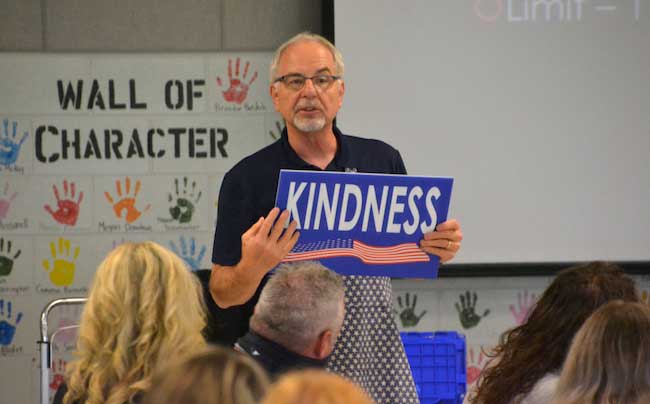
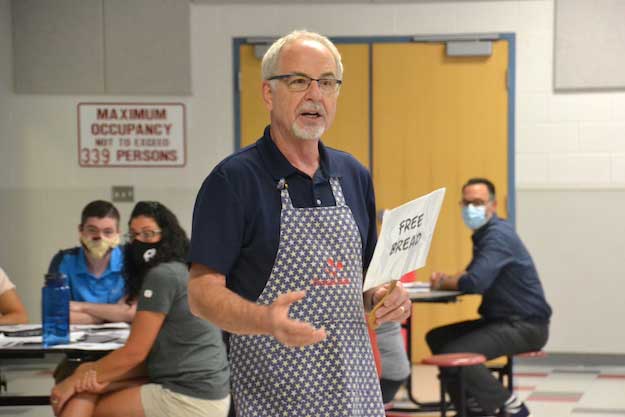
Photos by Tom Rivers: Chet Fery of Brockport addressed Holley faculty and staff this morning, urging them to embrace kindness in respond to others, as well as themselves. Fery, who is known as “The Bread Man,” also baked a loaf of bread for each Holley school employee.
HOLLEY – The school district, which will be utilizing more technology to educate students during the pandemic, isn’t neglecting an elementary principle of treating others with kindness and love.
Kindness – a show of respect and care for others – is the district’s main theme for this school year.
“The message of kindness is especially important this year,” said Brian Bartalo, the district superintendent.
This is Bartalo’s third year as Holley superintendent. In 2018-19, the district theme was “Holley Together.” Last school year, the district embraced the theme, “Holley Cares.”
Bartalo believes the message of kindness is critical during a polarizing election cycle and a time of uncertainty and stress with the economy and a public health pandemic.
The superintendent joined staff development and orientation sessions today and welcomed one of his neighbors, Chet Fery of Brockport, as a keynote speaker. Fery is well known in the region as “The Bread Man.” He has given away more than 100,000 loaves of bread for free in the past 20 years.
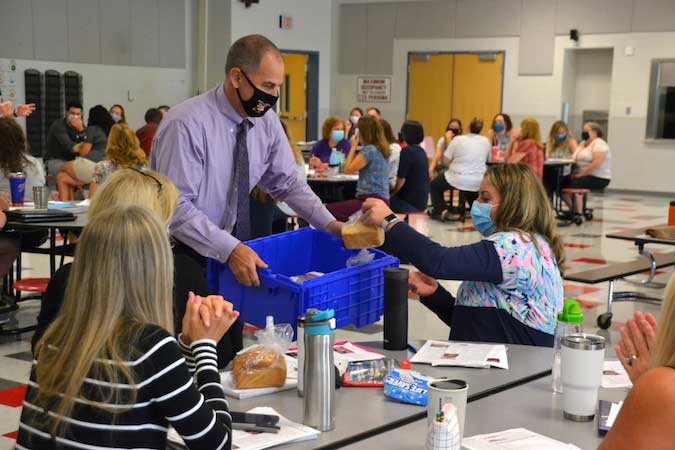
Brian Bartalo, the Holley school superintendent, passes out loaves of bread baked by Chet Fery. The two live in the same neighborhood in Brockport. Bartalo noticed Fery was giving out bread from a red wagon in Fery’s driveway during the pandemic and had “Kindness” signs in the neighborhood. Very gave away free bread from the wagon for 161 consecutive days.
Fery brought 267 loaves to the Holley school district today. He gave away bread to every staff member during presentations at the high school, elementary school and the bus garage.
Fery is a retired teacher and administrator from the Gate-Chili school district. He told teachers he knows they are feeling more anxiety this school year, returning to classrooms during the Covid-19 pandemic. He said students also are feeling nervous and excitement as they come back to school.
“People are seeking kindness now more than ever, aren’t they?” Fery asked the elementary school staff and teachers.
Fery spoke recently in Dansville to the Class of 1955, which was celebrating its 65th reunion. He listened as they reminisced about teachers. The ones the best remembered were the teachers who showed they cared about their students.
“What you do makes a big, big difference,” Fery said. “Kids listen. Kids always remember how we make them feel more than the content we’re teaching them.”
He said students, even those with tough exteriors, crave love and attention.
“Their hearts are open,” he said. “Kindness has a way of changing lives.”
Chet Fery said teachers top priority this year should be connecting with students, remotely or in class, and show them they are valued.
Before the pandemic, Fery normally had three or four presentations a week, where he gave away bread and shared his message of being kind to others. When he was sidelined from speaking to groups in Western New York, he put his home-made bread in a red wagon at the end of his driveway. He did that for 161 straight days.
He also made 100 “Kindness” signs and gave them away. Bartalo noticed and asked Fery to address the staff just before the start of the school year.
Holley students will be back on Thursday and Friday for orientations. Holley will be doing a hybrid model to start the year, with students doing in-person classes two days a week and remote learning three days. Bartalo said 18 percent of the students have opted for remote only for the first 10 weeks of the school year.
Fery said educators, bus drivers and other staff need to follow 5 principles to equip themselves in spreading kindness:
1. Be Kind to You. Fery urged them to smile, eat well and exercise – be fit in the body, mind and spirit. “You’re going to need it this year.”
2. Be Kind to Others. Be sure to put that kindness in words, when communicating with others. Make it clear to others that you value them.
3. Keep Order. “We can manage the chaos or rather than the chaos managing us,” Fery said.
4. Be Together. Work as a team and reach out to others, especially if you’re feeling down. “There isn’t a circumstance that can’t be improved,” Fery said. “We need each other to get through difficult times.”
5. Find Your Happy Place. Do something you enjoy to put your mind at ease. For Fery, that is baking bread, lots and lots of loaves.
By Tom Rivers, Editor Posted 8 September 2020 at 11:09 am
Photos by Tom Rivers
HOLLEY – Mark Cerrone, Inc., a contractor from Niagara Falls, installs a 12-inch waterline this morning in front of St. Mary’s Catholic Church on South Main Street (Route 237).
Construction workers lay the new waterline below ground in front of St. Mary’s this morning.
The company has put in new 12-inch watermains on Route 237, starting near the water tank by Hillside Cemetery. It will go to the intersections of routes 237 and 31.
Then it will put 8-inch waterlines on Geddes Street.
Cerrone also will be putting in new sidewalks along Rt. 237 – both north and south of Rt. 31 to the village limits (from the water tower to the elementary school), as well as both sides of Geddes Street from Van Buren to Route 31, both sides of Perry Street, both sides of Morgan Street and the west side of East Avenue.
Cerrone submitted the low bid for the project at $2,556,000. Grants will cover the majority of the costs. Holley is responsible for 20 percent of the sidewalk work and 40 percent of the waterlines.
As part of the village share of a $4.5 million overall project, Holley will put in sidewalks and waterlines on East Albion Street, Park Place and East Union Street.
The village was approved for a $1,780,000 federal TAP grant (Transportation Alternatives Program) to construct curbs and sidewalks that are compliant with the Americans with Disabilities Act. The grant will allow the village to replace about one-third of the sidewalks in the village.
Holley also was awarded nearly $1.3 million from the state for upgrades to the water system through the Water Infrastructure Improvement Act, as well as the Intermunicipal Water Infrastructure Grants Program.
The waterline project includes 5,800 linear feet, just over a mile, and involves replacing 4- to 8-inch water mains with 8- to 12-inch water mains.
By Tom Rivers, Editor Posted 8 September 2020 at 8:37 am
LYNDONVILLE – H.H. Dobbins hosted a tour for state legislators and a member of Congress on Friday, and the company shared concerns about filling job openings and the prospect of having the overtime threshold drop from the current 60 hours a week.
The state on Jan. 1, 2020 instituted an overtime threshold for agriculture for the first time, with workers getting time-and-a-half after 60 hours in a week as part of the Farm Laborers Fair Labor Practices Act.
That 60-hour cap before overtime could be reduced. A Wage Board is holding public hearings about the issue.
Assemblyman Steve Hawley of Batavia was on the tour on Friday at Dobbins, an apple packing and storage company. Dobbins is looking to hire 20 people.
“The dilemma for many businesses, including agriculture, is finding enough people who want to work even regular hours,” Hawley posted on Facebook after the tour.
Other farmers were at the tour to tell the elected officials the reduced overtime threshold would hurt their businesses, making them less competitive with agricultural operations in other states and countries.
“We were joined by other area farmers who all expressed grave concern about the lowering of hours/week requiring OT pay,” Hawley said.
State Sen. Robert Ortt said many farmworkers are bypassing New York so they can be in other states where they can work as many hours as they want. New York’s farm labor law is actually resulting in smaller paychecks for workers, Ortt said.
Farmers worry the Wage Board could lower the overtime threshold to 40 hours.
“The Wage Board will increase costs for farmers and agriculture,” Ortt said. “They will drive businesses and workers out of New York State.”
The Wage Board includes the following members: David Fisher, President of the New York Farm Bureau; Denis Hughes, former President of the New York State AFL-CIO; and Brenda McDuffie, President of the Buffalo Urban League.
Congressman Chris Jacobs also toured Dobbins on Friday. He is a member of the House Agriculture Committee
“H.H. Dobbins has an extremely impressive operation packaging and distributing fruit that harnesses the power of local labor and innovative technology,” Jacobs said in a statement. “However, they are also a testament to USDA programs’ success and the ability for local businesses to adapt. They took advantage of the Farmers to Families Food Box USDA program developed to aid growers and processors affected by COVID-19. This allowed them to keep their staff employed and supply families in need with nutritious food all around the country. These programs are vital to the restoration of our agriculture industry and seeing the benefits first-hand will make me that much stronger of an advocate for their continuation as we defeat COVID-19.”
By Tom Rivers, Editor Posted 7 September 2020 at 3:12 pm
AJ’s Play Date expects to be a draw in the region
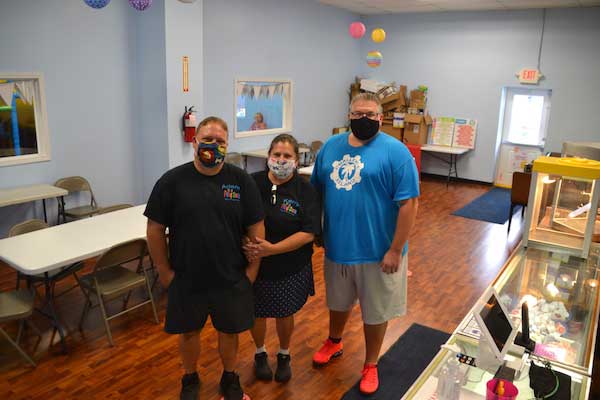
Photos by Tom Rivers: Adam and Kerry Papaj are pictured with their sons, Aiden (11) and Arik (7). The family opened AJ’s Play Date on Aug. 24 at 627 West Ave., at a former women’s gym across from Lee-Whedon Memorial Library.
MEDINA – A Medina family has opened a new business that caters to children who love to play.
AJ’s Play Date opens at time when many youth programs have been shut down or curtailed due to the Covid-19 pandemic.
Adam and Kerry Papaj have transformed a site for a former women’s gym into a one-of-kind playground with other activities that get kids ages 2 to 12 jumping, climbing, building and exploring.
There is lots to do at AJ’s Play Date, which opened Aug. 24 in Medina.
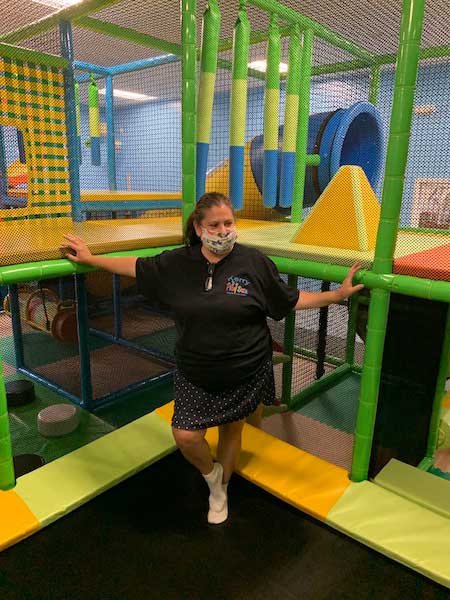
Kerry Papaj, a speech pathologist the past 26 years at Lyndonville Central School, designed the playground and the space at AJ’s. There is a trampoline in the center of the playground, and swings, stairs, a spiky spinner, a webbed bridge, tunnels and other obstacles for gross and sensory motor play.
The Papajs also set up a double train table, two doll houses and pretend play center with a kitchen, laundry, grocery store and ice cream/bake shop.
Arik Papaj climbs up the enclosed stairs that are part of the playground.
Mrs. Papaj said the playground has been well received by all children in the past two weeks. The family created the space to be friendly with children on the autism spectrum who have sensory processing issues. AJ’s has activities for gross motor play, such as jumping and running.
There are also many activities for sensory motor play – touch, smell, taste, movement, balance, sight and hearing – and fine motor play for skills such as writing, pushing Lego blocks together and opening and closing latches.
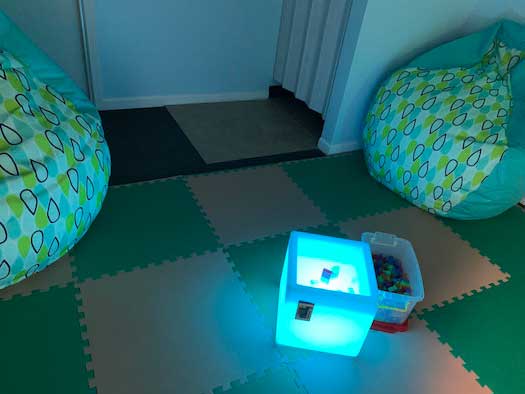
If kids need a break from the main play room, they can try the calming room with a lighted cube and translucent Legos.
Kerry Papaj, a speech pathologist at Lyndonville Central School, designed the playground to help children on the autism spectrum who may have sensory processing issues. She is shown on the trampoline.
AJ’s is named for Adam and sons Aiden and Arik, whose first and middle initials are all AJ. The family had been considering the indoor playground center for the past three years. They were aiming to open on March 1, but Covid-19 delayed the project. They weren’t able to receive the playground equipment until July.
AJ’s is currently limiting the site to less than 25 percent of its capacity or no more than 25 children at a time.
The Papajs offer the space for two hours and preregistration is required. Then AJ’s closes for an hour to allow for a deep cleaning.
It is open seven days a week, Monday through Saturday from 9 a.m. to 8 p.m., for four two-hour sessions, and Sunday from 11 a.m. to 5 p.m. for two two-hour play times.
A boy ventures down the web walk in the playground.
Kerry and Adam are both very involved in youth sports programs in the Medina area. Mrs. Papaj was a volleyball and softball coach at Lyndonville. She is president of the LOYAL youth soccer organization in Medina, Lyndonville and Roy-Hart.
Mr. Papaj is a Medina school bus driver. He will open the business at 9 a.m. after doing his morning bus runs. He coaches his son’s U12 baseball team.
The family wanted an indoor play area in Medina. They said there are few options for indoor playgrounds in the region, especially those that are sensitive to children with sensory processing issues.
They see AJ’s as complimenting a growing business scene in Medina that is drawing visitors from outside the community.
Adam and Kerry Papaj teamed with Hank Brummer to offer Challenge Island.
The Papajs also teamed with Hank Brummer of Newfane to offer Challenge Island, a STEAM program with activities for Science, Technology, Engineering, Arts and Math.
Challenge Island uses space in a room next to the playground. That room will also have a concessions stand. Challenge Island uses many household products or supplies that are used to solve engineering problems.
Brummer also offers the Challenge Island at the Niagara Shores Campground in Olcott. The program offers hands-on learning using household items such as paper toll rolls to demonstrate momentum, energy and other scientific principles.
“It’s getting kids active,” Brummer said. “It’s getting them away from computers and getting them socializing.”
Aidan Papaj rides the bolster swing. The playground is sanitized after every group uses it. It takes a solid hour to wipe down and spray all the equipment.
AJ’s hopes to give home-schooling families or kids doing schoolwork remotely a chance to get out and play and do other educational activities.
By Tom Rivers, Editor Posted 7 September 2020 at 10:28 am
Party pushes to stay on the ballot in NY
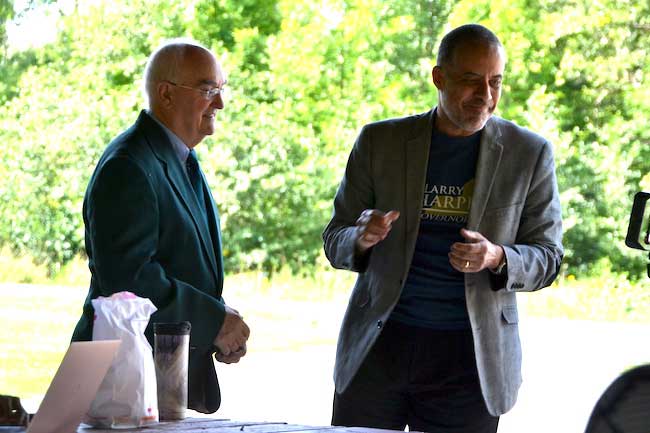
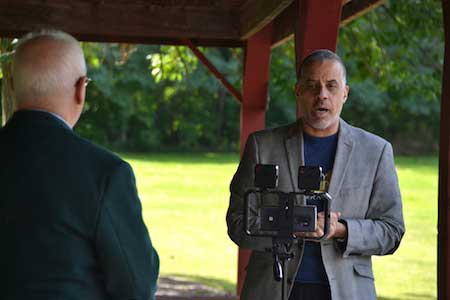
Photos by Tom Rivers: Larry Sharpe, right, was the Libertarian Party’s candidate for governor in 2018. He was back in Albion on Sunday. He is shown introducing Mark Glogowski, a candidate for the 139th State Assembly District. Sharpe has popular social media feeds and he is trying to build up Libertarian Party candidates and county organizations in the state.
ALBION – The Libertarian Party, which is seeing growth in registered enrollment and organized county committees in the state, is in danger of being knocked off the ballot.
The state has allowed ballot positions for political parties if they get at least 50,000 votes for their candidates in gubernatorial or presidential elections.
Duane Whitmer, an accountant from Hamburg, is running for the NY-27th Congressional seat. He said it is critical Libertarians keep their ballot line so people can have more options than the two major parties.
But the rules have been changed and parties now need at least 130,000 votes or 2 percent of the vote in gubernatorial or presidential elections. In New York, if 8 million vote in the upcoming presidential election, political parties would need at least 160,000 votes to stay on the ballot, according to the 2 percent threshold.
“In theory you could only have two options to vote – Republican or Democrat,” said Duane Whitmer, a candidate for the NY-27th Congressional seat. “They’re trying to take away the minority voice in New York.”
Whitmer, an accountant with offices in Hamburg and Franklinville, joined Libertarian candidate for governor Larry Sharpe during at event in Albion on Sunday. Sharpe received about 103,000 votes for governor in 2018, doubling the threshold to keep the Libertarians on the ballot under the old rules.
But 103,000 votes wouldn’t be enough to reach the new standard, which faces a court fight.
Sharpe said he is confident Libertarians can meet the higher threshold, whether it’s 130,000 or more votes. He sees a growing party around the state.
The number of enrolled Libertarians is up from about 7,000 to 20,000 in two years, said Tony D’Orazio, Libertarian Party chairman. The number of organized county committees has also doubled in those two years to about 32 to 34 county organizations. The Orleans County Libertarian Party is led by Chase Tkach, who ran for county legislator in 2019.
Dr. Jo Jorgensen, a senior lecturer in Psychology at Clemson University, is the Libertarain presidential candidate. The state’s travel advisory would require her to self quarantine once she reached NY from South Carolina. That makes it impossible for her to effectively campaign in NY. That’s why Sharpe, a resident of Astoria in New York City, is crisscrossing the state, spreading the Libertarian message.
Tony D’Orazio is the chairman of the Libertarian Party in New York. The Monroe County resident worries new voter thresholds in the state could knock Libertarians off the ballot.
Sharpe said the Libertarian principles are needed in the state and country. The party values personal freedom, without pushing those beliefs on others.
“We have to unite in this country because right now each side is focused on how they can dominate the others,” Sharpe said.
The US has shifted from a nothing of personal freedom to making maintaining order a top priority, he said.
“The Libertarian Party creates a better opportunity for everyone to grow,” Sharpe said. “I want us to be about life, liberty and the pursuit of happiness.”
Sharpe and Whitmore are critical of Gov. Andrew Cuomo leading the state’s response to Covid-19 through a series of executive orders the past six months.
“You cannot allow one man to rule unchecked,” Whitmer said. “That’s not what this country was founded on.”
The governor is closing down bars and restaurants in New York City at establishments that violate social distancing, crowd size restrictions and wearing of masks. Sharpe said the Covid-19 crackdown is decimating many small businesses.
He believes it would be better to let consumers decide who stays open. Businesses that adhere to all the guidelines should be given a stamp from the government that they are in compliance. Those that don’t follow the rules shouldn’t get a stamp but consumers should be allowed to enter those sites on their own volition.
“Consumers would have decided which businesses survive and who fails – not government,” Sharpe said.
Larry Sharpe has stopped at every county in the state the past two years, trying to build up the Libertarian Party. He is speaking at the Albion Sportsmen’s Association on Keitel Road. After Albion, Sharpe had events in Lewiston and Mayville.
Whitmer, in his job as an accountant for small businesses, sees how many of the stimulus checks and government programs have gone to bigger companies “with scraps to people.”
He also was critical of the extended backlog in the state’s unemployment system with the pandemic, when many people waited two months of more to get their first unemployment check.
“Let’s put real adults in the room to solve problems,” Whitmer said.
He sees a trail of politicians knocked out of office for wrongdoing. Chris Collins, who held the seat until resigning on Sept. 30, 2019, is awaiting sentencing to prison on insider trading charges.
“The people we are putting in power are unable to run their own lives and we’re electing them to run our lives,” he said.
Whitmer urged people to open their minds beyond the major parties of Republican and Democrat. Many of those voters have kept party loyalty for decades, regardless of the candidates.
“Don’t be a zombie vote,” he said those voters who won’t buck the party line.
Whitmore said too many voters also “idolize” the candidates, who he said are just people who should be focused on serving others.
He sees increasingly polarization in the country.
“People want to vote of Biden because they hate Trump supporters,” he said. “People want to vote for Trump because they hate Biden supporters.”
Mark Glogowski of Hamlin is running for the 139th State Assembly District against Steve Hawley. Glogowski said the state government favors “elite businesses” over most small family-owned operations. He cited a $10 million downtown revitalization program in Batavia and the STAMP site in Genesee County as catering to bigger businesses while producing little or no results for the community.
Sharpe said the third parties are critical to demanding a better government that works for all residents.
“I’m asking you to look at a third party,” Sharpe said. “The Libertarian Party is for people who actually work hard and want accountability in government. The Republicans and Democrats aren’t doing it.”
Whitmer said he has spent $40,000 of his own money to run for Congress. He doesn’t have donors to pay for television advertising and to spread a message around the 8-county district with glossy mailers.
“I am trying to grow this party and build a movement I believe in,” he said.
By Tom Rivers, Editor Posted 7 September 2020 at 8:19 am
465 National Grid customers without power
It’s windy with heavy rain this morning in Orleans County, and that has taken down at least two trees.
A tree has fallen on Marsh Creek Road in Carlton, between Point Breeze Road and Sawyer Road, and the tree is blocking the roadway as of 8:10 a.m. Another tree fell on Kenyonville Road in Gaines just before 8 a.m.
National Grid is reporting that 465 of its customers in Orleans County are without power with scattered outages. The biggest outage with about 150 Grid customers affected is the area near Route 18 in Carlton and Kendall, extending into Murray. National Grid estimates the power will be restored at 10:15 for those customers.
The National Weather Service in Buffalo has issued a special weather statement for Orleans, Niagara, Genesee, Chautauqua and Erie counties this morning due to the strong winds.
“As the steadier rain comes to an end this morning, southerly winds will dramatically pick up across the region,” the Weather Service said. “Winds started gusting over 40 mph across Niagara County before 8 a.m. and as we push towards 9 a.m., winds will pick up for much of the remainder of the Niagara Frontier and portions of the Southern Tier.”
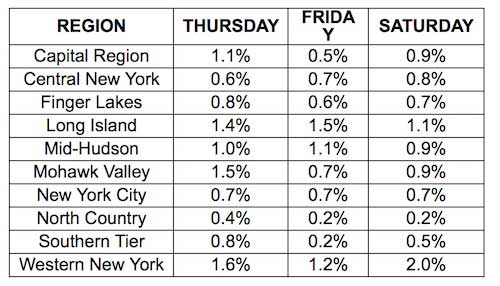
This is each region’s percentage of positive test results over the last three days. Orleans County is in the Finger Lakes Region.
Governor Andrew M. Cuomo today announced that New York State’s Covid-19 hospitalizations have dropped to 410—a new low since March 16. The state’s COVID-19 infection rate has been less than 1 percent for 30 straight days.
“We know based on experience that an incremental, data-driven reopening is the best way to protect the health and safety of all New Yorkers,” Cuomo said. “As this virus continues to be a national crisis, it’s clear that caution is a virtue, not a vice. Our infection rate has been below 1 percent for 30 days, and New Yorkers can help us keep that streak going by wearing masks, socially distancing and washing their hands.
Of the 85,630 test results reported to New York State yesterday, 729, or 0.85 percent, were positive.
“Our actions today determine the rate of infection tomorrow, so as the Labor Day weekend continues, I urge everyone to be smart so we don’t see a spike in the weeks ahead,” Cuomo said.
• Oneonta SWAT Team Testing Effort
The Governor also announced the results of the state’s testing SWAT Team’s focused testing effort in the City of Oneonta in Otsego County over the past five days. A total of 1,965 tests were performed at the 3 sites with results delivered in 15 minutes.
A total of 91 positive cases were identified, for a positivity rate of 4.6 percent. Contact tracing efforts in partnership with local health departments are ongoing. However, test results show that the cases continue to be connected to ongoing spread among college students with 85 of the 91 positives cases being individuals aged 18-24. Of the 738 tests for individuals in this age bracket, 11.5 percent tested positive. For the 1,227 individuals tested who were not in the 18-24 age bracket, the positivity rate was 0.48 percent.
By Tom Rivers, Editor Posted 6 September 2020 at 11:07 am
GAINES – Leaders of the Cobblestone Museum met with Congressman Chris Jacobs for an hour on Friday and asked him to pursue federal assistance for a visitor’s center in the historic Childs hamlet and also to help make the area safer for pedestrians.
Jacobs, who was sworn into office on July 21, made his first visit to the museum, which is a National Historic Landmark, the top historic recognition given by the U.S. Department of the Interior.
Congressman Chris Jacobs said he has experience with historic properties in Buffalo’s Theater District. He said federal tax incentives are critical for projects at historic sites.
“History is the best thing Orleans County has to sell to visitors,” Erin Anheier, the museum president, told Jacobs.
She thinks the county has many historic sites that could be promoted as part of heritage tourism. The museum could be the center of those efforts, working with other partners in the county, Anheier said.
The museum has expanded its programming, drawing more visitors and members in recent years. (The Covid-19 pandemic has limited the museum to tours by appointment in 2020, but the museum has a full calendar of activities planned for next year, said Doug Farley, the executive director.)
The museum will soon acquire the home next to the blacksmith shop at the southwest corner of routes 98 and 104. It will be decorated in a 1920s style and offers more space for exhibits, Anheier said.
The museum would like to work with other local agencies – perhaps the Orleans County Chamber of Commerce and Orleans County Tourism Department – to develop a visitors’ center in the historic Childs hamlet. The site could be used promote many attractions in the county, including sportsfishing, Farley told Jacobs.
The hamlet in October 2019 was named one of “Five to Revive” by the Western New York Landmark Society. That designation brings awareness to important sites in the region that are in need of protection and investment.
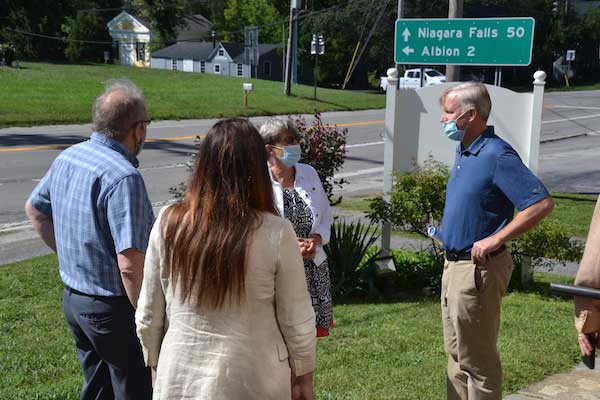
Congressman Chris Jacobs, right, hears from Cobblestone Museum President Erin Anheier about concerns over traffic and available parking near the museum on Route 104.
The hamlet is unusual in WNY, with so many cobblestone buildings and other historic sites on a busy road that is largely devoid of chain store commercialism, said Larry Francer, associate director of preservation for the Landmark Society of WNY.
She praised the museum and other Gaines residents for their work to preserve so many sites from the 1800s.
“This is great example for the rest of our region,” Francer said about the Childs hamlet.
The hamlet would benefit from sidewalks along the stretch of cobblestone buildings that are part of the museum (from the Cobblestone Universalist Church to the former one-room schoolhouse), and historic-looking street lights, said Richard Remley, the museum’s vice president.
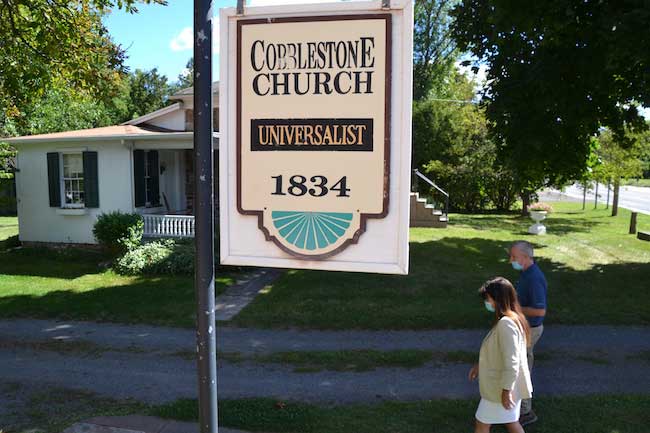
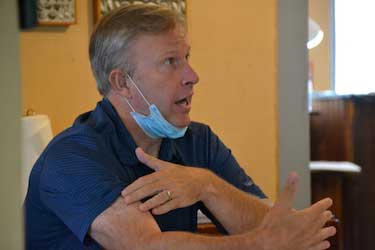
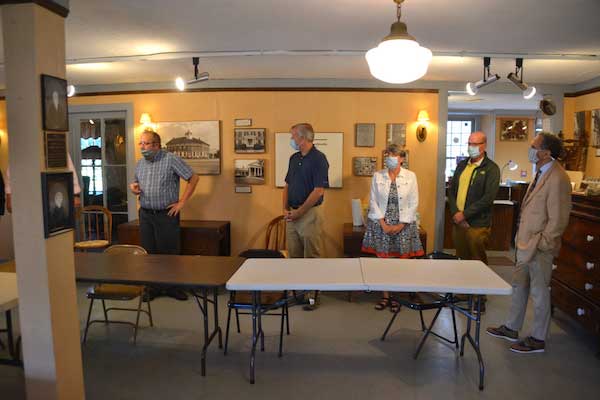
Cobblestone Museum Executive Director Doug Farley, left, speaks in the lower level of the Cobblestone Universalist Church, a building constructed in 1834. Farley said the museum maintains three important cobblestone structures, as well as other important buildings near the routes 104 and 98 intersection. Others in the photo include, U.S. Rep. Chris Jacobs, Cobblestone Museum President Erin Anheier, Cobblestone Museum VP Richard Remley and Larry Francer, associate director of preservation for the Landmark Society of WNY.
Farley said the museum needs more parking. It would like to upgrade its bathrooms for the public, and have meeting space for up to 100 people with a kitchen facility.
It could pursue a new structure for a visitor’s center, but Farley and museum leaders believe a brick house from 1834 across the street from the church offers a lot of potential as a visitor’s center. The 3,000-square-foot site is owned by Ray and Linda Burke and is for sale.
Museum leaders asked Jacobs to help pursue funding for the visitor’s center and the pedestrian improvements in the district.
Lynne Johnson, chairwoman of the Orleans County Legislature, said the county would benefit from a welcome center. She said the Legislature values the museum and has recently contributed $3,000 in annual funding for the organization.
The Legislature also ended a hiring freeze on Aug. 27 and appointed a new county historian, Catherine Cooper of Medina. She recently retired as the director of the Lee-Whedon Memorial Library in Medina.
Jacobs said he knows the value of well-maintained historic sites. As a real estate developer, he worked on several historic rehabs in Buffalo’s Theater District. He said maintaining state and federal tax incentives for those projects is critical for developers.