Press Release, Tops Market and Price Chopper/Market 32
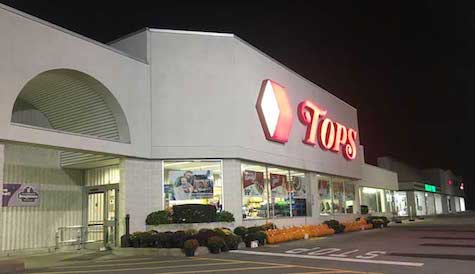
Photo by Tom Rivers: The Tops store on Maple Ridge Road in Medina is pictured in September 2018. Tops also operates a store in Orleans County in Albion.
WILLIAMSVILLE/SCHENECTADY — Price Chopper/Market 32 and Tops Markets today announced that they have entered into a definitive merger agreement that creates a powerful alliance between the two storied independent grocery chains, as it nearly doubles their collective footprint in the Northeast.
This transaction unites two iconic New York-based grocery chains with deep ties to their local communities and shared commitments to service, savings, and convenience. With increased scale across their almost perfectly contiguous footprints, the merged companies are expected to be better positioned to compete and offer even more value and outstanding services to their customers across the Northeast.
Scott Grimmett, Price Chopper/Market 32’s President and CEO, will be CEO of and serve on the Board of Directors of the new parent company which will oversee the operations of nearly 300 Price Chopper, Market 32, Market Bistro and Tops Markets stores and collectively employ more than 30,000 teammates.
Frank Curci, Tops Markets Chairman and CEO, will serve on the Board of Directors of the new parent company and as a consultant to assist in the transition. Blaine Bringhurst, Price Chopper/Market 32’s Executive Vice President of Merchandising, Marketing and Store Operations, will lead the Price Chopper/Market 32 business. John Persons, Tops Markets President and Chief Operating Officer, will lead the Tops Markets business.
The new parent company will be headquartered in Schenectady. The Price Chopper/Market 32 and Tops Markets businesses will retain main offices in Schenectady and Williamsville and will continue to be managed locally by their respective leaders.
“This merger marks a major step forward and collectively elevates our ability to compete on every level,” said Grimmett. “It leverages increased value for our customers; advances shared opportunities for innovation; fortifies the depth of our workforce, community and trade partnerships; and ultimately accelerates our capacity to deliver a distinctively modern and convenient shopping experience. Given the vital role that supermarkets and their workforces play in our communities, particularly this past year, I am excited to lead the parent company of these two historic grocery retailers.”
“We have long believed that this merger makes sense both strategically and based on the similar ways in which we each put customers first, go to market and treat our people,” said Curci. “We look forward to working closely with the Price Chopper/Market 32 team and together becoming an even stronger competitor with more scale, as we continue serving our customers and communities.”
“I’ve seen tremendous change in our industry across my 65-year career and have long been an advocate for the promise of innovation and partnership, like that which has driven this merger forward,” said Neil Golub, Price Chopper/Market 32’s Executive Chairman of the Board. “I can assure you that our commitment to sustaining and improving the communities in which we operate remains steadfast.”
“Tops has always put serving customers and providing an exceptional shopping experience at the center of everything we do, and this merger is no different,” said Persons. “Our associates, who take pride in their work and recognize the importance of the role they play in taking care of customers and communities, will continue to be the backbone of our company.”
With formative roots dating back to the 1920s, both Tops Markets and Price Chopper/Market 32 have grown exponentially over the last century, building and acquiring stores across Upstate New York and throughout the Northeast. The merged companies are committed to serving their markets across the Northeast.
The transaction is expected to close in the coming months, subject to regulatory approval and customary closing conditions. Financial terms of the transaction were not disclosed.
PJ SOLOMON is acting as exclusive financial advisor to Price Chopper. Harter Secrest & Emery LLP and Wilson Sonsini are serving as legal advisors to Price Chopper. Deutsche Bank Securities Inc. is acting as exclusive financial advisor to Tops Markets. Paul Weiss LLP and Hogan Lovells US LLP are serving as legal advisors to Tops Markets.
About Price Chopper/Market 32
Based in Schenectady, Price Chopper/Market 32 operates 130 Price Chopper and Market 32 grocery stores and one Market Bistro, employing 18,000 teammates in New York, Vermont, Connecticut, Pennsylvania, Massachusetts, and New Hampshire. The American-owned company, founded by the Golub family in 1932, prides itself on longstanding traditions of innovative food merchandising, cutting edge brand development and store design, leadership in community service, and cooperative employee relations. For additional information, please visit www.pricechopper.com
About Tops Markets
Based in Williamsville, Tops Markets operates 162 grocery stores in New York, Pennsylvania, and Vermont, including five that are run by franchisees. As the largest private, for-profit employer in Western New York, with more than 14,000 associates, the company is dedicated to providing sustainably sourced, high quality products, while helping its communities flourish via support for programs that eradicate hunger and disease, educate youth and reduce environmental waste and energy consumption.
By Tom Rivers, Editor Posted 8 February 2021 at 11:20 am
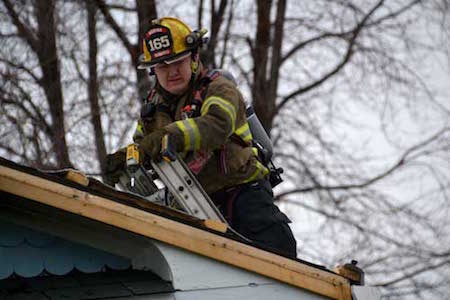
Photos by Tom Rivers: In this photo from April 9, 2020, Donato Rosario of the Medina Fire Department removes some of the metal roofing from a cottage in Yates, which was damaged in a chimney fire.
MEDINA – The Fire Department responded to fewer calls in 2020, mainly due to the impact of Covid-19, especially early in the pandemic in March, April and May.
Medina firefighters responded to 2,437 total calls in 2020, which was down by 10.3 percent from 2019. The restrictions early in the pandemic closed schools and many businesses, and many people avoided non-essential travel. People were also nervous to seek medical treatment out of fear of being exposed to the coronavirus.
Medina firefighters handled 87 calls last year involving people who contracted Covid, according to the annual report compiled by Fire Chief Matt Jackson.
He said 2020 brought many personnel and operational changes. Former Chief Tom Lupo retired and Jackson was appointed to lead the department on Jan. 13. There were three promotions in the department and other new firefighters were hired to fill vacancies.
The Medina FD also needed to respond to the Covid-19 pandemic with added cleaning and safeguards to protect staff and the public.
“Our department has willingly accepted the ever-changing demands that this pandemic sprang on us,” Jackson said in his annual report. “I continue to be impressed by the passion that the personnel of the Medina Fire Department bring to the job and their ability to adapt and overcome in this dynamic environment.”
Medina had six of its 22 full-time staff test positive for Covid in December.
The calls by month include: January, 248; February, 179; March, 161; April, 138; May, 178; June, 217; July, 312; August, 196; September, 217; October, 204; November, 208; and December, 179.
July was the busiest month with 312 calls, partly due to rain storm on July 27 when 7 inches of rain fell in one day and many basements needed to be pumped.
The department averaged 203 calls a month, but the first three months of the pandemic were well below that, with April the slowest month with 138 calls.
The fire chief’s report shows that 5 p.m. is the busiest hour of the day while 4 a.m. is the slowest. Mondays are also the busiest day of the week with Sundays the fewest calls.
The average response time was less than 2 minutes throughout the year, Jackson said.
He also reported that firefighters completed 2,638 total training hours, including 2,409 training hours for fire service and 229 hours for EMS training. Firefighters also taught CPR training to 75 students.
Some other highlights of the report include there were 2,140 emergency medical calls, 572 non-emergency medical transfers from Medina Memorial Hospital, and 297 fire calls, including three house fires in the village.
The calls were nearly split between day and night shifts: 1,268 (52%) for night shift and 1,169 (48%) for day shift.
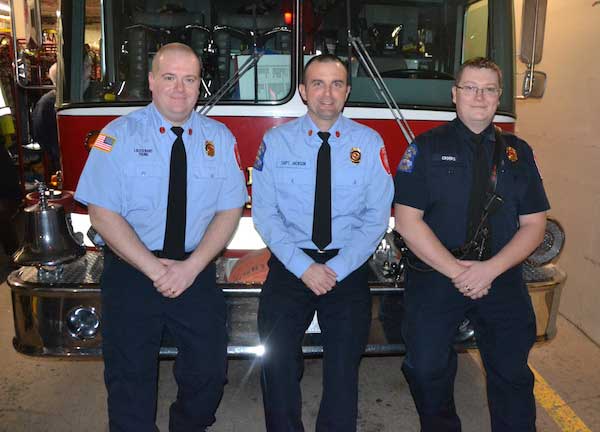
Medina promoted leaders in the Fire Department. This trio is pictured on Jan. 13, 2020 inside the fire hall after taking their oaths of office. From left include Captain Michael Young, Fire Chief Matt Jackson and Lt. Jacob Crooks.
By Tom Rivers, Editor Posted 8 February 2021 at 9:52 am
U.S. Senate Majority Leader Charles Schumer is pressing the Biden administration to forgive up to $50,000 in federal student loan debt per borrower, saying it would help to jump-start the economy.
Biden is open to cancelling $10,000 to student loan debt per borrower. Schumer and other members of Congress want to see Biden do more. The senator from New York was joined at a news conference last week at the U.S. Capitol with Sen. Elizabeth Warren of Massachusetts, U.S. Rep. Ayanna Pressley of Massachusetts, U.S. Rep. Ilhan Omar of Minnesota and U.S. Rep. Mondaire Jones of New York. They called on Biden to take action on student loan debt.
“This debt holds people back from buying cars, going on vacations, from starting families,” Schumer said during the news conference. “It’s a huge anchor on the entire economy.”
Schumer said the debt is a “Civil Rights issue” with people of color bearing far more debt. He said the federal government charges people an “outrageous rate of 7 percent” on student loans.
Warren said wiping out $50,000 in student loan debt would result in more people starting businesses, buying homes, and spending more to stimulate the economy.
Pressley said the mounting student loan debt, more likely for people of color, is a form of “policy violence.” Biden could cancel student debt by executive action, providing relief to millions of families, Pressley said.
Schumer and Warren said more than 43 million people in the United States are weighed down by $1.6 trillion in federal student loan debt.
“The Covid-19 crisis is worsening the massive inequities in our economy and society, but even before the pandemic the student loan debt crisis was already crushing millions of Americans,” Warren said. “By cancelling up to $50,000 in federal student loan debt for borrowers, President Biden can take the single most effective executive action available to provide a massive stimulus to our economy, help narrow the racial wealth gap, and lift this impossible burden off of tens of millions of families.”
More than 300 civil rights, climate, health, labor, consumer rights, and student organizations have called on President Biden to cancel federal student debt using executive action, including American Federation of Teachers, National Education Association, The Education Trust, Hispanic Federation, NAACP, National Urban League, UnidosUS, League of United Latin American Citizens, Minority Veterans of America, National Women’s Law Center, SEIU, the American Psychological Association, Sunrise Movement, the United States Student Association, and Young Invincibles, Warren said in a news release.
“During a time of historic and overlapping crises, which are disproportionately impacting communities of color, we must do everything in our power to deliver real relief to the American people, lift up our struggling economy and close the racial wealth gap,” Schumer said. “Democrats are committed to big, bold action, and this resolution to cancel up to $50,000 in federal student loan debt is one of the strongest steps the president can take to achieve these goals.”
By Tom Rivers, Editor Posted 8 February 2021 at 8:03 am
In WNY, only Chautauqua County tops high prices in Orleans
Gas prices are an average price of $2.56 a gallon in the state today, which is up from $2.37 a month ago, AAA Western and Central New York reported this morning.
The price is up about 5 cents from a week ago. Compared to a year ago, when the price was an average of $2.635 a gallon, the price is down about 7 cents.
The average price per gallon in Orleans County at $2.515 is among the highest in Western New York. Only Chautauqua County, at $2.544 is higher. Gas is more expensive in northern New York. The average price in Essex County, for example, is at $2.740.
Here are the average prices in WNY counties:
Allegany, $2.452
Cattaraugus, $2.439
Chautauqua, $2.544
Erie, $2.482
Genesee, $2.438
Livingston, $2.497
Monroe, $2.497
Niagara, $2.463
Orleans, $2.515
Wyoming, $2.489
AAA said this morning reported that the price of crude increased by more than $57, which is the highest settlement price of the year. Crude prices rose last week after the Organization of the Petroleum Exporting Countries (OPEC) agreed to collectively reduce their crude production by 7.2 million barrels per day.
The group decided to hold the cuts steady and expects output to remain low this year, since demand is forecasted to be lower than expected throughout 2021 due to ongoing crude demand concerns as the pandemic continues to keep travel restrictions in place, AAA said.
By Tom Rivers, Editor Posted 7 February 2021 at 3:20 pm
Orleans County saw an increase in its unemployment rate and the number of people unemployed in the county in December, after the rate and unemployed had been on the decline.
The state Department of Labor reported the unemployed rate was 6.4 percent in December, with 1,100 people unemployed in Orleans. That 6.4 percent rate was up from the 5.4 percent in December 2019.
The DOL reported there were 15,600 people working in Orleans County December 2020, which was down from 15,800 in November and 16,700 December 2019.
Here are the unemployment rates and number of unemployed in the Orleans County during the Covid-19 pandemic:
March: 5.4 percent, 900 unemployed
April: 15.9 percent, 2,700 unemployed
May: 11.5 percent, 1,900 unemployed
June: 10.8 percent, 1,900 unemployed
July: 12.7 percent, 2,300 unemployed
August: 9.8 percent, 1,700 unemployed
September: 5.5 percent, 900 unemployed
October: 6.0 percent, 1,000 unemployed
November: 5.4 percent, 900 unemployed
December: 6.4 percent, 1,100 unemployed
Orleans County, with the 6.4 percent unemployment rate for December, is about in the middle of the pack among WNY counties.
Here are the rates for the other counties in the region: Allegany, 6.2%; Cattaraugus, 6.4%; Chautauqua, 7.8%; Erie, 7.6%; Genesee, 5.4%; Livingston, 5.5%; Monroe, 6.9%; Niagara, 7.3%; Orleans, 6.4%; and Wyoming, 6.1%.
Statewide, Tompkins had the lowest unemployment rate at 4.3% while the New York City metro has the highest rate at 11.0%, with Bronx, 15.1%; Kings, 11.3%; and Queens, 10.7%, all above 10%.
In New York State, the unemployment rate is up from 3.7% in December 2019 to 8.1 percent in December 2020. The number of people working in state dropped by 812,100 from 9,116,400 to 8,304,200. The number of unemployed more than doubled from 351,900 to 733,200 during that time.
By Tom Rivers, Editor Posted 7 February 2021 at 10:08 am
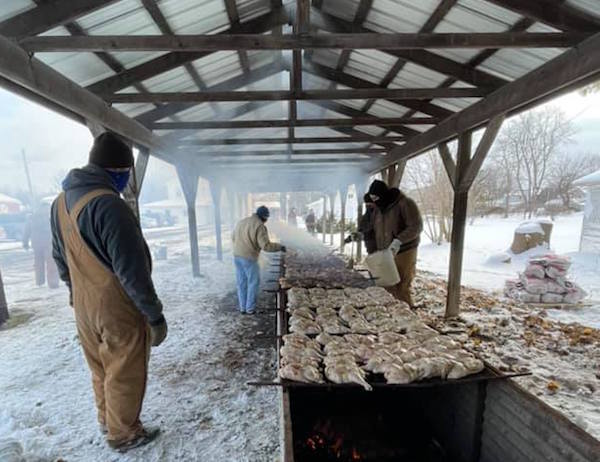
Photos courtesy of Kendall Lions Club
KENDALL – The Kendall Lions Club cooks chicken halves on Saturday during the club’s annual winter chicken barbecue.
The club served about 1,250 dinners. The event was take-out and drive-through only at the Kendall United Methodist Church.
Proceeds from the dinner will go to Stacy Lynaugh, a local resident battling cancer. The Lions Club does that every year with the dinner, using the funds to help a local resident with medical bills or another unexpected crisis.
Kendall Lions and members of the Leos Club at the high school package the meals, which were delivered to vehicles who lined up at the church entrance off Crandall Avenue.
The Lions Club also prepped food for the big meal on Friday.
Kendall Leos assisted with the big effort on Saturday.
Have you ever seen wild horses in the wild? Not on TV, but truly running wild in a pack in the vastness of the meadows and mountains. On a trip out West, we headed to The Pryor Mountains in Montana. It was an exploration trip that stays with you. It was quite a drive out to the Pryor’s, but it was magical and awe-inspiring.
Being from Western NY the only horses I have seen are ones that have been broken. Kind of a defining term “broken”. Broken horses have shelter, warmth, guaranteed food, and hopefully love. But the life of a broken horse does not hold the freedom or spirit of a horse that is free to run. The unbroken horse controls its own path. It is tough and needs to self sustain, which is all empowering.
When a horse is broken it becomes dependent on another to care for it, keep it safe, make sure it survives. Those that feel secure in being dependent and crave being cared for will feel secure in the situation of the broken horse. But for those who crave freedom, self reliance and self control, the containment of the broken horse is not coveted. Freedom is at their core.
Breaking a horse and its wild spirit is a long process. Curious how one actually breaks a horse, I went to Google. First you must build trust because animals have an innate ability to sense when they are being threatened. If an animal senses their freedom is being taken away, it will resist. The person breaking the horse needs to show great patience. Interact with the horse daily, perhaps offer rewards for non resistance like giving the horse a carrot for submitting. Once the submission starts, the person breaking the horse will introduce the horse to the bridle, the bit, the ear piece, the saddle.
After much resistance the horse will begin to submit, even to the bit, which is most uncomfortable to a species that wants to run free. Once the breaking is underway the horse will need to be accustomed to the tightening of the girth and accept mounting of its trainer and finally give into the reins. It is quite a process to break a horse and broken horses have served wonderful purposes to those that utilize horses since the beginning of time. For war, for labor, for companionship. The broken horse is loved, no doubt. However the broken horse serves those who broke it and will never run away or be free.
Watching the horses in the Pryor’s and seeing how they run free and cautiously watch us with their soulful eyes as we drive in their “yard”, it is clear that freedom of any species is a beautiful thing to witness. If you ever have the opportunity to witness a wild and free horse, go to the Pryor’s. It is a vast space holding the unbroken spirit. It demonstrates the power and grit of survival by caring for oneself and protecting the herd. I aspire to be free like the unbridled horse and keep my spirit unbroken.
To see a Free Spirit Flying, visit My Blog live online (click here) and catch up on Weekly Photo Perks and past Sunday Posts. Like and share your comments.
By Tom Rivers, Editor Posted 6 February 2021 at 6:11 pm
Orleans County, however, has highest rate in Region
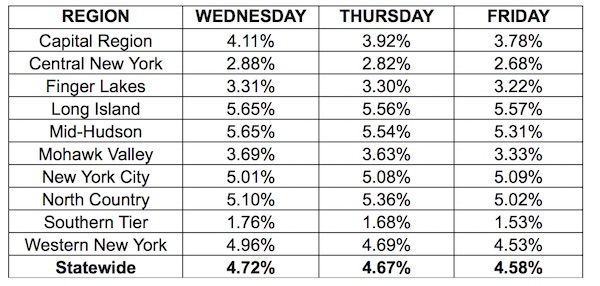
Information from Governor’s Office on seven-day positivity rate for the 10 regions of the state.
The Finger Lakes Region, which was a Covid hotspot in the state about a month ago, now has one of the lowest positivity rates in the state and has reduced the numbered of people hospitalized with Covid by more than half.
The Finger Lakes, which includes Orleans County, had a positivity rate for Covid-19 at 10.29 percent on Jan. 5. That was the seven-day average for percentage of tests that were positive for Covid.
The 7-day average was down to 3.22 percent on Friday, the third lowest of 10 regions in the state. The Southern Tier at 1.53 percent is the lowest and Long Island, at 5.57 percent, is the highest.
Statewide the 7-day positivity average ending Friday was at 4.58 percent, according to data from Gov. Andrew Cuomo’s Office.
Although the positivity rate in the Finger Lakes Region is at 3.2 percent over the last 7 days, in Orleans County it’s at 7.2 percent the past week, the highest of the nine counties in the region.
The rates for the other counties include Genesee, 2.9 percent; Livingston, 5.8 percent; Monroe, 2.8 percent; Ontario, 3.3 percent; Seneca, 3.0 percent; Wayne, 3.2 percent; Wyoming, 6.1 percent; and Yates, 4.4 percent.
The Finger Lakes also led the state on Jan. 5 with the highest percentage of its population hospitalized due to Covid at 0.08 percent, which was double the state average. The Finger Lakes had 934 residents hospitalized with Covid on Jan. 5. A month later the region had 448 hospitalized with Covid or 0.04 percent of its population.
New York on Friday had 7,804 patients hospitalized statewide with Covid, the lowest since Dec. 27, Cuomo said.
There were 11,252 new Covid cases out of 261,285 tests, for a positivity rate of 4.31 percent. The state has now had 1,460,747 individuals test positive for Covid during the pandemic.
Cuomo also reported there were 158 more deaths from Covid, including one each in Orleans and Genesee counties. The state is now reporting 36,079 total deaths from Covid during the pandemic.
“New York’s positivity and hospitalization numbers continue to decline from the holiday surge, a reflection of the discipline New Yorkers have shown to defeat the virus,” Cuomo said in a statement. “The ultimate weapon to win the war is the vaccine and we are getting needles into arms every day, but we need more supply because we have the operational capacity to do much more. Super Bowl weekend is here and while the instinct may be to celebrate together, we cannot get cocky – we must continue doing the things we know are effective at taming the virus: wear a mask, adhere to social distancing, and avoid gatherings. We can beat this thing, but we must stay smart.”
LEWISTON – A 16-year-old girl was killed after striking a tree at the bottom of a hill while sledding at a park in Lewiston, the Niagara County Sheriff’s Office reported.
The Niagara County Sheriff’s Office Dispatch Center was called at 10:14 a.m. with a 911 reporting the accident on the sledding hill at the Clyde L. Burmaster Park in the Town of Lewiston.
Responding members of the Town of Lewiston Police Department and Niagara County Sheriff’s Office located and confirmed two injured parties, the 16-year-old girl and a 3-year-old boy. They were riding a sledding tube.
Members of the Pekin Fire Company and Tri Community Ambulance responded to the scene to render aid. The two were then transported by ambulance to the John R. Oishei Children’s Hospital in Buffalo for treatment.
Subsequent to arrival at the hospital, the girl was pronounced deceased due to her injuries. The boy was treated and released, the Sheriff’s Office stated in a news release.
The incident is under investigation by the Town of Lewiston Police Department and the Niagara County Sheriff’s Office. The sledding hill at the Clyde L. Burmaster Park is closed at this time.
By Tom Rivers, Editor Posted 6 February 2021 at 3:13 pm
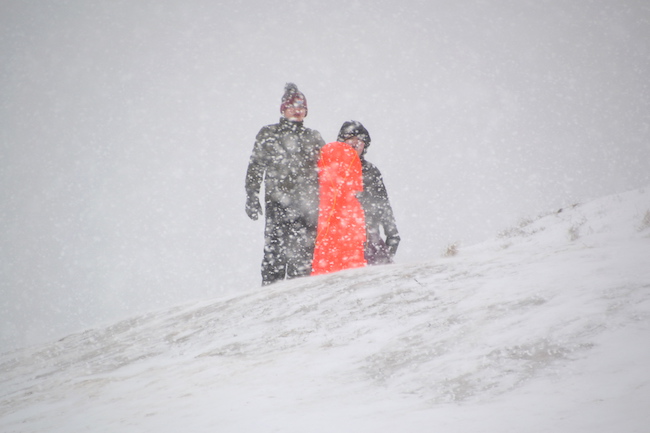
Photos by Tom Rivers: Two friends make it to the top of the Bullard Park sledding hill in Albion at about 2 p.m. today. The hill was icy and fast.
After a fairly easy winter locally through mid-January, the cold and snow have been steady in recent weeks. Today was one of the harshest winter days this year.
It’s in the low 20s, with blowing snow and gusty wind. Orleans County is forecast for several inches of snow today, particularly south of Route 104.
It could be worse. Parts of Genesee County, including Batavia and Le Roy, already had a foot of fresh snow by early afternoon.
In Orleans County, a winter weather advisory is in effect until 10 tonight. The National Weather Service in Buffalo at about 1 p.m. said 3 to 5 more inches of snow could fall today “in the most persistent lake snows.”
The winds gusting as high as 40 miles per hour will produce blowing and drifting snow, the Weather Service said.
Sunday is forecast for a high of 26 degrees in Orleans County with another inch of snow possible. Monday is forecast for a high of 22. It will partly sunny with snow showers possible in the afternoon.
A basketball hoop at Bullard Park manages to stand out in the snow early this afternoon. Part of the splash park is visible in the background.
New record highs for Northern Saw-whet Owl, Common Raven, Brown Creeper, Carolina Wren, Winter Wren and European Starling
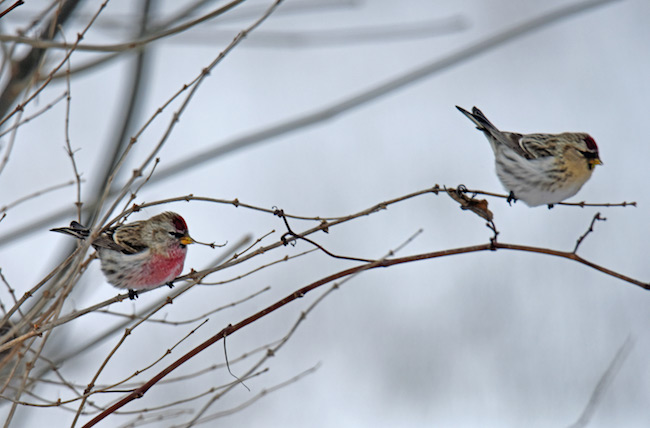
Photo by Celeste Morien: This photo of a Common Redpolls was not taken on count day of Dec. 28, which was very windy.
By Celeste Morien, Count Compiler for Oak Orchard Swamp Christmas Bird Count
SHELBY – The numbers are in and it was another successful Oak Orchard Swamp Christmas Bird Count.
On Dec. 28, 31 volunteers participated in the 53rd annual Oak Orchard Swamp Christmas Bird Count. The National Audubon Society, in collaboration with the U.S. Fish and Wildlife Service, sponsor Christmas Bird Counts annually throughout the country and beyond in the Americas. Each count consists of a tally of all birds seen within a 15-mile diameter circle on one day during a 15-day period at the end of December and the beginning of January. Audubon Christmas Counts provide valuable information on the range expansion or narrowing of wintering bird populations and have been taking place for 120 years.
The Oak Orchard Swamp Count Circle
The circle center for the Oak Orchard count is the point at which the Genesee-Orleans County line crosses Route 63. The 15-mile diameter circle includes the Iroquois National Wildlife Refuge, Oak Orchard and Tonawanda State Wildlife Management Areas, the Tonawanda/Seneca Native American Reservation, the Townships of Alabama and Shelby, the villages of Indian Falls, Medina and Wolcottsville and portions of Middleport and Oakfield.
Weather Factors
Weather can make or break the day for our observers, but we forge ahead! Count hours were cold and wet, with a low of 27F and high of 39F. The early morning began with rain and winds from the south at 11 MPH, which then began gusting throughout the afternoon from the WSW at 16 -21 MPH, making the temperatures essentially feel 10 degrees colder. By afternoon, birding was essentially precipitation free. Late morning and afternoon visibility was good.
Observers
Our 31 intrepid observers went afield in 23 parties from 6:15 a.m. until 6:45 p.m. These folks volunteer to attend from as far away as Rochester and Buffalo, and even with the Covid-19 restrictions in place, persevered in their determination to ensure that the 2020 count would become another accurate contribution in the collection of scientific information about wintering bird populations.
In 106.25 total hours, observers covered 25.75 miles on foot and 535.5 miles by car, which included 37 hours on foot and 69.25 hours by car! Two observers counted birds at home feeders. Participants also clocked 9 nocturnal hours and 39.25 miles searching for owls.
In total, these awesome observers tallied 73 species and 20,843 individual birds! As the compiler, I say thank you all and thank you again to Douglas Beattie, Elaine Dart, Don Bemont, Daniel Rosentreter, Thomas Morien, Garner Light, Judy Light, Rory Kuczek, Paul Hess, Kathryn Brenner, Janie Mellas, Robert Buckert, Jules Wagner, Greg Lawrence, William Wolanske, Denise Appleby, Pat Martin, Kim Hartquist, Bev Seyler, Bob DeLeon, Jennifer Caughel, Donna DeLeon, Emma DeLeon, Mike Vickner, Mike Galas, Gerry Rising, Chuck Mitchell, Heidi Kennedy, Tad Gerace, Christopher Hollister and Iroquois NWR and the NYS DEC.
Winter Diversity
Counters commented on good diversity overall with a few exceptions, such as the lack of waterfowl in the region because of the freeze in early December. Still, we had all three swan species and a smattering of waterfowl. Lack of snow cover on the ground and heavy winds made finding birds at roadside difficult, but there were birds to be found for those who had the opportunity and spent time walking. With a total lack of snow cover, participants reported that birds were difficult to see in fields and were not present at the roadsides. Wished-for irruptive species (those that visit in winter from the boreal forest when cone crops there are low) such as Evening and Pine Grosbeak were not found although they have been seen in other areas of the state, and even in our circle this fall. Irruptive species we did find: a few Pine Siskins, Common Redpolls, which have shown a recent uptick and Red-breasted Nuthatches.
Highs and Lows
Notable highest counts ever: Northern Saw-whet Owl, Common Raven, Brown Creeper, Carolina Wren, Winter Wren and European Starling.
Gerry Rising found the Saw-whet Owls and stated he’d never had an experience quite like this one in his many years of watching birds. Both owls flew out of conifers in response to a recording played in the early morning.
Common Ravens are increasing their presence in the Great Lake plains area, resulting in a total of five of these fascinating and intelligent corvids on count day. Fox Sparrow was the single “new to the count” species this year; Janie Mellas, one of our many sharp-eyed participants, found it lingering on the Iroquois Refuge. A single Red-winged Blackbird was recorded as a new low count. Count week birds seen in the three days before or after the count date, but not on the actual count date, were Sandhill Crane and Northern Pintail.
The Friends of Iroquois, Inc. usually sponsor our evening refreshments at the refuge, but because of the Covid-19 pandemic that was not possible. The INWR Staff was still able to contribute time and effort in covering the refuge areas. The NYS DEC staff also volunteered to report birds while on duty and conducted their winter raptor survey on count afternoon. Many thanks go out to everyone who participated! A list of species follows.
The 2021 Count
We rely on volunteer support every year to continue this important tradition. I might add that for next year, I welcome any homeowner in the circle who wants to count birds at their feeding station to contact me through the NYS Ornithological Association (NYSOA) or Buffalo Ornithological Society websites two weeks before the count. We also welcome permission for counters to access any private property trails or field edges within the circle for walking.
Look for the count date to be announced by mid-November and please put us on your calendar!
A list of species observed at the 2020 count includes (The asterisk represents an all-time high):
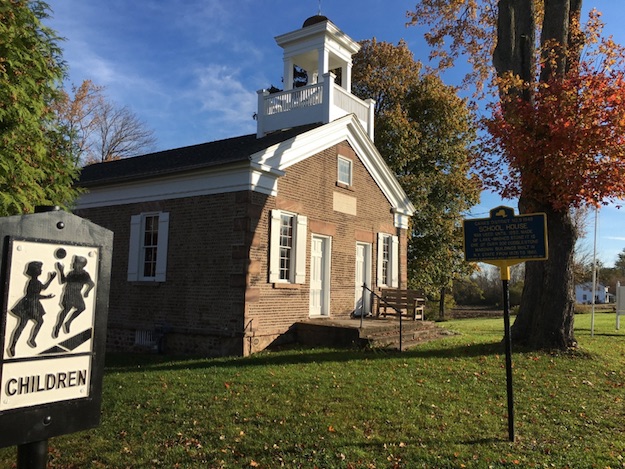
Note from Doug Farley, Cobblestone Museum Director: We are pleased to present this autobiographical essay written by Nancy Jane Wilson Berger (1935-2015). Nancy spent her childhood living in a cobblestone house near and attending the Cobblestone District #5 Schoolhouse in the Hamlet of Childs. We are very grateful to Nancy’s husband, Frank Berger, for sharing this wonderful retelling of Nancy’s childhood memories.
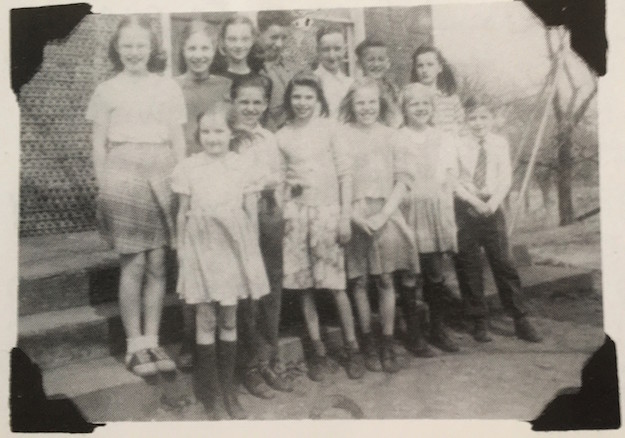
School District #5 in 1946 – Phoebe Beales, Teacher. (Front Row, from left) Nancy Covis, William Covis, Evelyn Becker, Edna Becker, Kathleen Covis and Alan Kidder. (Back Row, from left) Sandra Kidder, Marjorie Becker, Nancy Wilson, Walter Klatt, Edward Janus, Daniel Janus and Laura Klatt.
By Nancy Jane Wilson Berger
I wondered why my mother had tears in her eyes when I left for school for the first time. It was a typical fall day and one that I had been looking forward to for some time. I had reached the ripe old age of six and thought I was pretty well grown up to be able to go to school with the rest of my friends.
It was Gaines District #5, a country school located on Route 104 commonly called the Ridge Road. A one-room country school with grades 1 through 7, one teacher with a visiting music teacher, a religious education teacher, and even a very old retired physician who came once a year to give us a physical exam.
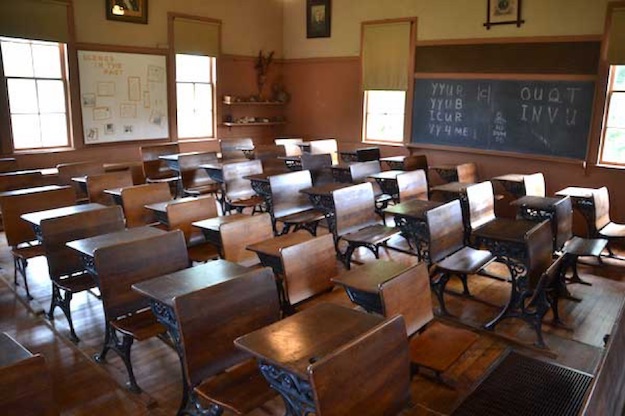
It was a typical one-room schoolhouse with rows of desks running parallel with each other. They grew in size as the children grew – thus the small ones were to the left and they got progressively larger as the rows went to the right. We could hardly wait until we were big enough to sit in the “special” desks. These were separate units with swivel seats and the tops opened up so that you could see what was inside. A student had to earn the right to claim one of these seats as their own.
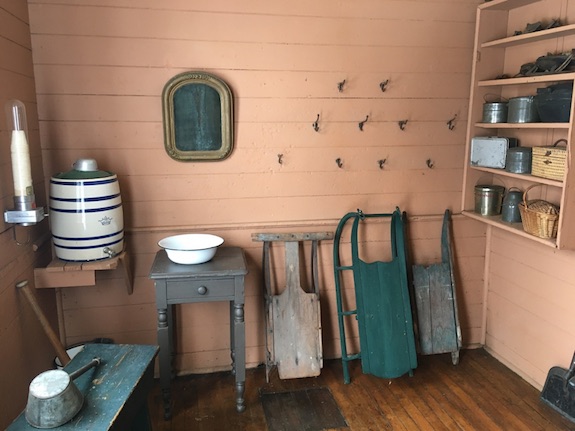
The front door opened into the entry. There was a “U” shaped coat rack supplied with plenty of hangers. To the left of that was a series of shelves which held lunchboxes, etc. On the front wall, next to the door was a shelf with a sink and a clay water-cooler. Perpendicular to that was a bench which helped in the removal of boots and which provided storage space underneath for these. To the right was the door to the basement which housed a mammoth old coal furnace, a huge coal bin and a multitude of other things that we were never brave enough to explore.
The furnace, however, was something of a monster which seemed to have a life of its own. Many a morning throughout the seven years that I attended this house of learning, we were met at the door by our teacher who told us to return home because the coal gas was so strong we surely would have been overcome. No one knew exactly why this happened, but I think that occasionally this mysterious hulk decided that it needed a day of quiet and no children’s footsteps overhead to give it a headache so it spewed forth this nauseous gas like an octopus spitting out its “ink” to scare away predators. At any rate, the opening of windows and some sort of magic performed by the teacher would usually bring this problem to its knees and we would be back to normal by noon.
Occasionally, instead of nauseous gas it decided to try smoke. Sometimes it would be so thick you couldn’t see more than three feet away. Another vacation! However, it did have its good points. Besides keeping us warm and cozy it provided an oven for baking potatoes. Teacher would place whole potatoes just inside the furnace door on a little shelf and by noon we had yummy baked potatoes for lunch. I don’t think baked potatoes have ever tasted that good since.
So, you see, we didn’t have snow-days like they do today. We had smoke and gas days! We did have a snow day sometimes, but they were few and far between. Because we provided our own transportation which was usually by foot, if we could plow through the snow we went to school. If we couldn’t, we stayed home.
At the opposite end of the front of the school was the library, which also served as a whipping room. Yes, back in those days we got a good spanking if we didn’t behave. I was lucky enough to never get one. (I was such a good little girl.) However, I did get reprimanded more than once for talking or laughing. I was usually lucky enough to blame it on my friend Ed Janus who, more than once was taken to the whipping room and got his seat tanned!
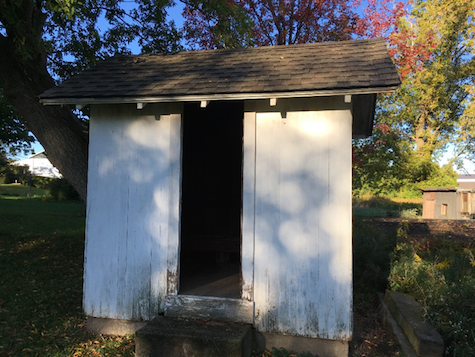
The “bathrooms” were small buildings – one for the girls and one for the boys – behind the school with privacy fences a few feet from the doors. If we needed to go visit the privy (as it was called) we had to raise our hand and when we were given permission to go, we had to put our initials on a small blackboard at the front of the room because only one person could go at a time. I have some stories about the “privies” also.
We had a boy in school whose name was Walter. Walter took it upon himself to teach the boys about the anatomy of the opposite sex. It seems that he had found some magazines called “Sunshine and Health” which was published by the nudists. In it were many pictures (uncensored) of nudists playing volley ball, tennis, and just lounging in the sun. So one day Walter decided to hang some of these pictures on the wall of the boys’ privy providing his own little art show of sorts. There seemed to be a steady stream of boys using the privy that day!
Also attending school was a small boy named Vernon. Now Vernon had a habit of stuttering when he got excited. This particular day Vernon hadn’t heard about the “d’art exhibit” in the boys’ privy and hadn’t had the call to visit it until afternoon. Vernon raised his hand and was given permission to go. He signed his initials and left. In less time than it takes to shake a stick twice, Vernon came running back into the room yelling “T-t-t-teacher! Th-th-th-there’s p-p-p-pictures of b-b-b-bare naked w-w-w-women in the p-p-p-privy!”
Our teacher, Miss McAllister, didn’t have much of a sense of humor. After she calmed Vernon down, she picked up her switch and holding it in her right hand and smacking it lightly against the palm of her left hand, she paced back and forth in silence in front of the students studying the faces of the boys. Sure enough – Walter was looking guilty as sin. She asked him if he knew anything about these pictures. He admitted he did and was taken for a short walk to the whipping room. He and the teacher returned to the classroom, one smiling, one not. Guess which was which!
Now I had another use for the privy. I was a rather timid little girl and when anything was about to transpire that I wasn’t sure about, I would ask permission to go to the privy, sign out and head for home. One such instance was the first time that good old Dr. Burbank came to examine us. He was a round roly-poly elderly man with little round glasses that didn’t quite make it to the correct spot on his nose that would make it easier to see, so he had to tip his head up to see through them or down to see over them. He had very little hair and what he had was white. He was hard of hearing and despite his glasses could not see very well either. He spoke in mumbles with a lot of “hammphs.”
Well, I had never seen a man like him before and I didn’t have a clue what a physical examination was, but I decided not to take any chances. I got permission to go to the privy, signed out and hightailed it for home and as fast as my long skinny legs could go. I arrived home yelling – my mother probably thought I had been beaten! When I explained that I didn’t want a physical ‘zamination, she laughed and assured me that I would live through it and promptly escorted me back to school. The teacher wondered why she was there because this all transpired in no longer a time than it would have taken me in the privy. Dr. Burbank thought the whole affair was quite humorous and Mom stayed while I was being ‘zamined!
Dr. Burbank was a very frugal physician. He did not want to waste tongue depressors, so decided it would not do any harm to use the same one on each child. Miss McAllister, on the other hand, did not agree with him. After a short dissertation between the two of them, they arrived at a solution. The tongue depressors were sawed in half thus satisfying both.
Each student took his\her turn going into the library stripping to the waist and donning a white gown of sorts that tied in the front. Good old Doc Burbank sat in a chair facing the class, therefore, the student being examined would have his/her back to the class – a rather clever arrangement wouldn’t you say?
Well, in our little school room was a girl by the name of Lorraine. Now that I think about her, I’m not quite sure if she was developing early or if she had missed a few grades and was older than most students. Oh well, it really doesn’t matter. Anyway, when Lorraine made her appearance before Doc, he looked at her and said, “Didn’t I examine you?” as he opened the front of her gown – and without a hesitation said “Oh no, I didn’t!” We all wondered why the teacher turned and snickered.
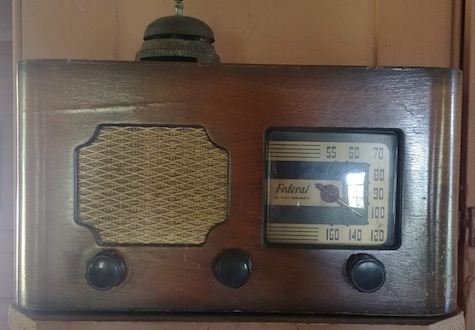
The year I started school was 1941. There was much unrest in the world and there was talk of war. We were too young to really understand what that was all about, but we gathered it was something we didn’t want to happen to our country. When the Japanese bombed Pearl Harbor, I remember having the radio on in school the following day. The teacher turned it too low for us to hear, but she listened to it all day. At one point, she turned to the class with tears in her eyes and said we were at war. No one talked to us very much about it, but we knew it was bad news.
In the weeks and months that followed, we started collecting all kinds of metals and made a huge scrap pile in the school yard. I can’t remember for sure, but I recall that ours was the biggest one around. I also remember running out of the school every time we heard a plane, because this was something quite new to us. I also recall collecting milkweed pods for parachutes. If I remember correctly, we were paid so much a bag for them. I can’t remember what we used the money for, but because there was an ice-cream shop next to the school, I have a feeling we were all treated to ice-cream cones.
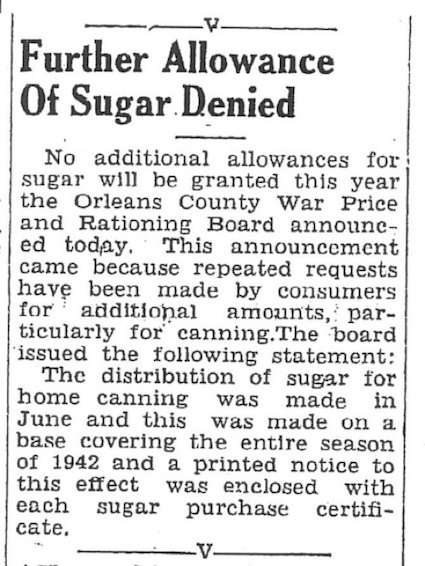
During the war years, I also remember “rationing”. There was a shortage of sugar, meat, flour, gasoline and other things. We had to have a ration book to be able to buy these items. Because of these shortages, it caused there to be shortages of everything that depended on these commodities for their production. No automobiles were manufactured, because all the factories were making planes, bombs, etc. for the war.
We had “blackouts” – this was in case the enemy decided to attack the United States they would not be able to see us at night. We would have to turn out all our lights and leave them out until the whistle blew telling us it was OK to turn them back on. My dad was an air-raid warden. When the whistle blew telling us of the warning my dad and several other volunteers would walk around the neighborhood and make sure no lights were on. As a child of seven, I rather liked the excitement of it and it was sort of an occasion.
The worst part of this whole time was when my Uncle Art was drafted. I recall very vividly the day he left for camp. Everyone was crying and hugging. He was in the Air Force and stationed in California. I wrote letters to him every week, and once he sent me a box of sea shells that he had picked up from a beach in California. These were real treasures. After he left, I was afraid that my dad would have to go to war. I prayed every night that he wouldn’t have to go and luckily he was just over the age limit for being drafted, so he never had to go. We were all very grateful.
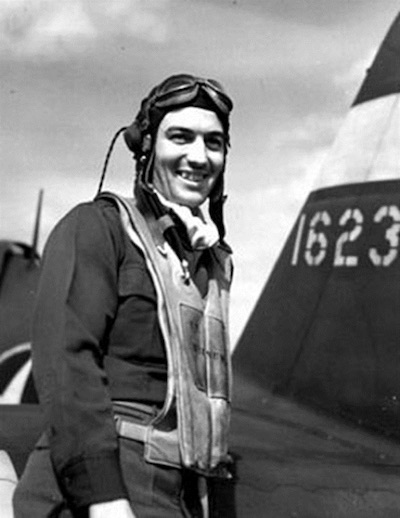
Captain Eugene Everett Barnum, Jr. (1917-1944)
One of my worst memories of this time, was when the word came that Bill Barnum was killed in action. They were neighbors of ours and it hit everyone very hard when this news came. Then, a few weeks later, the news came that his brother Eugene had also been killed in action. We didn’t know how one family could bear the hurt of losing both of their sons. They were both pilots and whenever we heard the song that was popular then, “Coming in on a Wing and a Prayer,” we always thought of them.
By Tom Rivers, Editor Posted 5 February 2021 at 4:26 pm
Active cases in 2 counties drops from 292 a week ago to 222 today
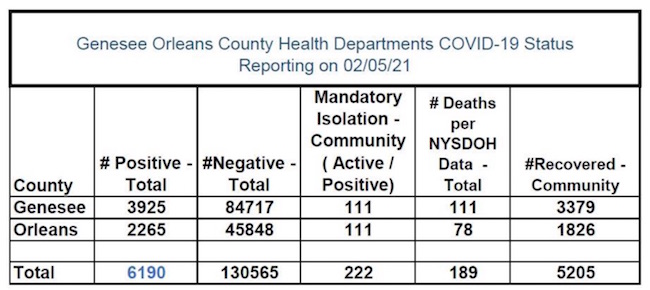
Orleans and Genesee counties combined are reporting 24 new confirmed cases for 6,190 since last March, the Genesee and Orleans County Health Departments reported this afternoon in a news briefing.
The two counties also currently have 222 active cases, which is down from 292 a week ago.
In Orleans County there 13 new positive cases of Covid-19 for a total of 2,265 positive cases since last March.
The positive cases reside in the West Region (Yates, Ridgeway, Shelby), Central Region (Carlton, Gaines, Albion, Barre) and East Region (Kendall, Murray, Clarendon). The individuals are in the age groups of 0-19, 20s, 30s, 40s, 50s, 60s and 70s.
Of the new cases, 5 were on quarantine prior to testing positive. One of the new cases is an inmate at the Orleans Correctional Facility, a men’s prison in Albion.
Orleans also is reporting 26 more of the previous positive individuals have recovered and been removed from the isolation list. The number of active cases in the county has dropped from 127 to 111 in the past week.
Orleans also is reporting 3 of the current positive individuals are hospitalized.
Albion Central School reported a student from the High School has tested positive for Covid-19. The student is a hybrid learner and was last in the building on Jan. 21. Due to the 48-hour look-back period, the Department of Health determined there is no need to quarantine any additional students or staff, the district stated on its website.
Holley Central School is reporting that two students have tested positive for Covid-19. One student attends the Alternative HS program at the Elementary School, whose last day in-person was Jan. 22. The other attends the MS/HS, whose last day in-person was Feb. 4.
The health department has indicated that there is currently no additional quarantining required of other students or staff members due to close contact with these particular cases. These cases are not connected to the report from yesterday, Brian Bartalo, the district superintendent, said in a letter on the district website.
Medina Central School said today a middle school student tested positive. The Department of Health is working with the school district to identify any potential close contacts and is notifying families who may have to quarantine, Mark Kruzynski, the district superintendent, said in letter on the district website.
In Genesee County there are 11 new positive cases for a total of 3,925 positive cases since last March.
The new positive cases reside in the West Region (Alabama, Darien, Pembroke), Central Region (Alexander, Batavia, Bethany, Elba, Oakfield) and East Region (Bergen, Byron, LeRoy, Pavilion, Stafford). The individuals are in the age groups of 0-19, 20s, 30s, 40s, 60s and 80s.
Genesee is reporting 30 more of the previous positive individuals have recovered and been removed from the isolation list. The number of active cases in the county has dropped from 165 to 111 in the past week.
Genesee has 18 residents currently hospitalized due to Covid.
There has also been another Covid-related death reported in the county, bringing that total to 111 since last March.
“The individual was over the age of 65,” the Genesee and Orleans County Health Departments stated. “We will not be reporting any further information to protect the privacy of the individual and their family. We extend our deepest condolences to the family and friends of this individual at this very sad time.”


















 The Unbridled Spirit