By Tom Rivers, Editor Posted 18 August 2021 at 8:53 am
ALBION – Orleans County is calling on the state to pay $1.6 million that Orleans says it is owed in Medicaid reimbursements from April 2016 to April 2020.
The county contends it is due the money, which are federal funds passed down to the state, as part of a provision in the Affordable Care Act with the federal government upping the Medicaid matching share. That has saved the state billions of dollars, the Orleans County Legislature stated in a resolution.
Those savings should then be shared with counties, which pay a local share towards Medicaid, county legislators said.
The state has a methodology where 80 percent of the increased federal funds should go to counties. However, the state has last reconciled with the counties in the state’s 2015-16 fiscal year.
The New York State Association of Counties estimates the state owes $800 million to all of the counties and New York City through withheld Medicaid reimbursements.
“By not providing these federal funds it requires counties and New York City to reserve funds locally to make up for the loss, meaning local taxes have been kept higher than they need to be over multiple years, or local services had to be scaled back or eliminated,” county legislators stated in a resolution.
Legislators called on the state to take immediate steps to release the funds, and to provide timely notice to counties of the coming year’s Medicaid costs. The resolution from the County Legislature was sent to the Governor’s Office and the State Legislature.
‘Every outhouse in Gaines had been tipped over at one point or another.’
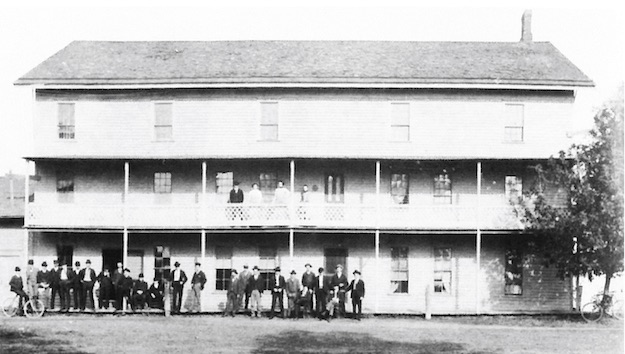
Jim Thurber’s store building, c. 1915, Gaines, attracted many pranksters, especially at the chicken coop.
By Doug Farley, Cobblestone Museum Director – Vol. 2 No. 32
When skimming through the pages of published history material, one can occasionally come across some shenanigans that might best be described as a prank, but I’m sure to the subject of the prank, it probably seemed more like a real nuisance.
Case in point, in 1979, (William) Clure Appleton (1902-1982) reflected on his days growing up in Gaines at the corner of Routes 104 and 279. Clure said, “When I was a kid, the boys and girls weren’t much different than they are today, except they didn’t take drugs and they didn’t drink to excess. However, they were full of mischief and I remember distinctly some of the things that happened on Halloween.”
It seems the cooper shop (barrel maker) was a frequent Halloween target. The boys took great sport in taking apart a barrel rack that was located outside of the cooperage, and removed it to be reassembled on the shop roof. Clure offered, “It was also a common occurrence for the boys to place a buggy or sleigh on top of the schoolhouse roof.”
Outhouses, as essential as they were to everyday life, were another frequent target of pranksters. Clure remarked that he thought “every outhouse in Gaines had been tipped over at one point or another.” It didn’t seem to matter if someone was in the shanty at the time, or not.
Any gathering of a half-dozen or more boys usually became fodder for a prank. Clure remembered that raids on local henhouses were a frequent occurrence, too. Jim Thurber’s chicken coop was a perennial favorite amongst the jokesters. Jim ran the store in the Grange building and kept his prize chickens outside under watchful eye. He had won many awards at the Orleans County Fair for his hens and roosters.
On one night in question, Clure and the Schuler boys were enjoying a card game and realized they had become powerfully hungry. The Schuler boys went over to Jim’s chicken house, one boy going inside and one staying outside as “lookout.” The chickens, of course, started to make a ruckus which aroused the ever alert Jim Thurber from his domestic tranquility. The lookout boy saw Jim coming with a lantern and knocked on the chicken house door to alert the chicken burglar, who quickly crawled down underneath the brooder.
Jim entered the coop, held his lantern up to count his chickens, and seeing all his chickens in place, decided it must have been a rat that aroused his fowl, and went back into the house. Once the coast was clear, the Shuler boy reached up and grabbed the prize rooster and proceeded to wring his neck. The nefarious plan then led the boys to a nearby dryhouse where apples and other fruit were dehydrated over a smoldering fire. The boys then cooked their prized chicken for the enjoyment of the card party. Of course, the next morning, when Jim Thurber discovered the loss of his prize chicken, he offered a few choice words in return, but unfortunately, had no rooster to show at that year’s fair.
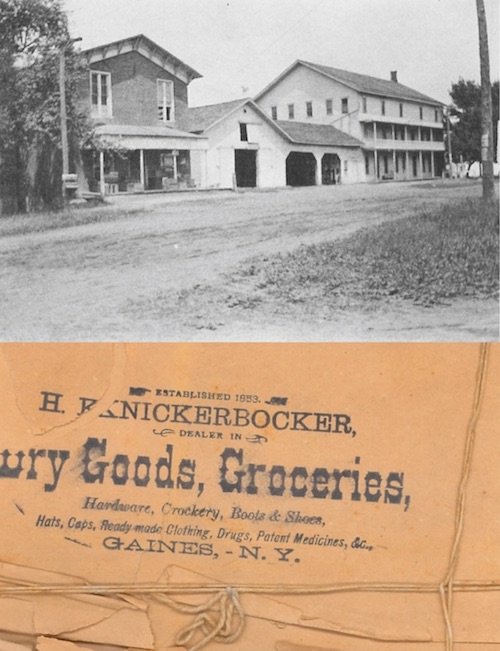
Knickerbocker Dry Goods, Gaines, at left above.
Jim Thurber wasn’t the only merchant that fell victim to frequent pranks. Another local shopkeeper, Harm Knickerbocker ran a store on the northeast corner in Gaines, next to the Grange Hall. The store was a brick building and the Knickerbockers lived up over the store. Harm didn’t run much of a store, though.
Reports are common that a typical day’s trade in the store was a meager ten or fifteen cents. Most of his stock in trade was several years old at best. Well the local boys had a bad habit of taking advantage of Mr. Knickerbocker’s good nature and would enter the store and request a penny’s worth of product from the far end of the building. During his travels, the kids would “help him” get rid of some his stale candy or tobacco by “helping” themselves.
Clure Appleton noted that later in life, he came to his senses and had regrets for his actions, but hindsight is always 20/20. As far as smoking the aforementioned tobacco was concerned, Clure’s father told him that if he was ever going to smoke, it was not going to be behind the barn, and if he did, his father would tan his hide. Any smoking Clure did had to be out in the open, under his father’s watchful eye, which he later reported, started him on a smoking habit that lasted 65 years.
And for intoxicating beverages, Clure said he learned another valuable lesson at an early age. He asked his Sunday school teacher if it was a “sin to drink too much.” She agreed that it was. But, also offered, “Clure, it’s a sin to eat too much, work too much, or play too much.” But her last admonition struck a note with Clure said he remembered it his whole life. “Everything that is carried to excess is a sin.”
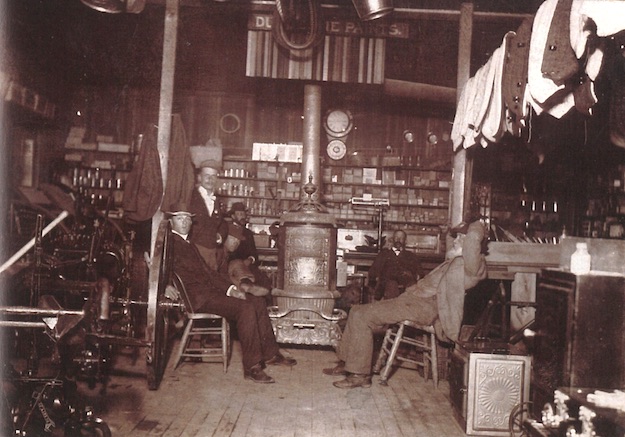
Back in the 19th and late 20th century, every small community had a general store, and the Hamlet of Childs was no exception. The local store of course met the mercantile needs of the local citizens, but also, it served as a center of community engagement and social center. Many a story or yarn had been sewed while sitting around the wood stove in the old country store, and Gaines was no exception.
Locals can tell you about a certain local by the name of Hodie Howes whom the others liked to pick on when he came into the store. Hodie was quoted as saying, “I’m just as smart as any of you, if I could only think of it.” One fall evening Hodie came into the store and sat down in a chair near the stove. The usual bantering began. After a while, Hodie took a huge firecracker out of his pocket. One of the men said, “Where’d you get that firecracker?” Hodie said, “Oh, I found it in a drawer the other day. I think it’s left over from 1876. It probably won’t even work.”
With that disclaimer he got up and went to the stove and opened the door. Another man warned, “Hodie, I wouldn’t throw that in there if I were you.” Hodie said with bravado, “I don’t think it will blow up,” and with that threw it into the stove. Everyone in the store let out a collective gasp and ran towards the door. Hodie went back to his chair and let out a big belly laugh. You see, Hodie had sawn a broomstick down to size and made it look like a firecracker with a string for a fuse. Hodie enjoyed his prank and remarked, “He who laughs last, laughs best.”
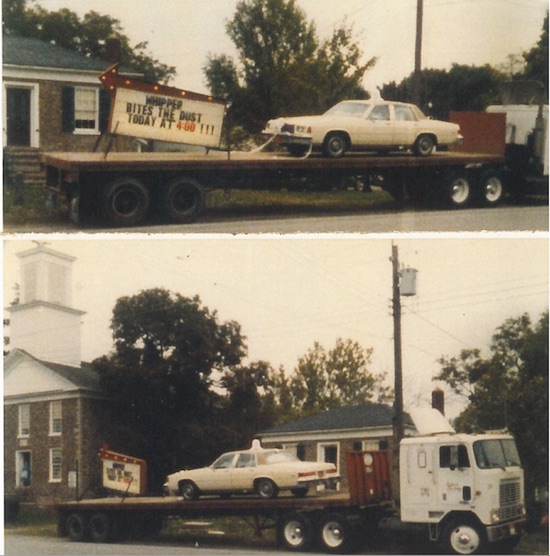
The Cobblestone Church was a more recent setting for a prank, harkening back to October 1985. Those who were pranked were a newlywed couple, Jim and Cheryl Watson. The bridal couple had scheduled their wedding in the Museum’s Cobblestone Church. On the morning of the happy event, a flatbed truck rolled up in front of the church with a new Buick LaSabre loaded on it. There was also a lighted sign on the truck that stated, “Whipper bites the dust today at 4:00.”
Shortly before the wedding, Jim, known as Whipper by his companions, bought his fiancé, Cheryl, the Buick and surprised her by exchanging it with her old clunker in her parking spot at work. Of course, she really loved her new car. On the night of the wedding rehearsal, Jim’s buddies absconded with the car, much to Cheryl’s dismay. Jim assured her it was just a prank and it would be okay. The next morning, Jim and his brother were driving west on Ridge Road when Jim spotted an Orleans Trucking flatbed coming his way with a car on it. He hollered, “Hey, that’s Cheryl’s car!” His brother offered words of comfort, “It’s okay, Roger loaded it.” That made Jim even more nervous because Roger had a reputation for being accident prone.
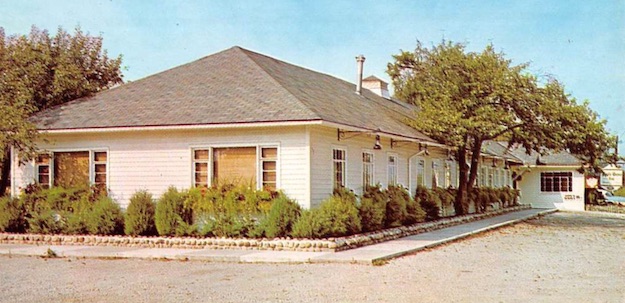
The former Apple Grove Inn, Medina, c. 1970
At any rate Jim and Cheryl got their car back from the pranksters in time for their honeymoon. However, as they left the reception which was held at the Apple Grove in Medina in haste, they neglected to make a thorough check of the car. It wasn’t until later that they discovered they had no luggage at all thanks to Jim’s buddies and their pranks.
Well, as we’ve all been told, “Turn-about is fair play.” I think we all get to chuckle when a prank goes awry and ends up a prank on the pranksters. Such was the case in a story told by Gary Ehrenrich to LeRoy Neeper. The Town of Ridgeway was a great place for young boys to grow up. The area around Oak Orchard was home to a number of obedient, respectful, but adventurous preteen boys. Halloween presented the perfect time to be a bit mischievous.
Clayton Fletcher, around 12 years old, Don Pritchard, Charlie Rorick and Ralph Axtel were great pals. They agreed that their prank would not be pulled on their own families, and settled on their neighbor, Mr. Gazes. The plan involved tipping over the Gazes’ outhouse, after all, neighbor kids had pulled this prank a few years before without much repercussion. The boys planned each movement and swore an oath of secrecy. Mr. Gazes got wind of the plan and decided to out-prank the pranksters.
Before nightfall on Halloween, Mr. Gazes moved his outhouse ahead about four feet, leaving a gaping cesspool exposed. Halloween was a dark night. The boys were full of excitement. They ran quickly in the dark, and in their haste fell full bore into the pit. The lads were a stinking mess and they knew the worst part would be that they were sure to be caught trying to sneak back into their homes later that night. The boys all agreed that the punishment they received from their parents was certainly worse than anything Mr. Gazes could have doled out.
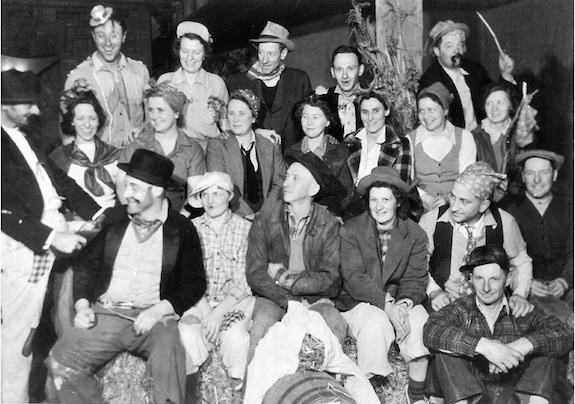
Even most adults enjoy getting into the act for Halloween as seen here in this photo from 1943. This particular party was hosted by Jack and Gerry Larwood and Al and Ruth Mason, and involved a hobo theme. It was held at the Larwood Farm Implement Agency at Five Corners. Infamous Santa School creator, Charles Howard, even played a part in this elaborate Halloween party. Howard was secured to decorate the room for the “hobo” theme.
The amazing planning and execution for this party even involved laying down railroad track along West Bacon Road to add to the mystique. A railroad handcar was used on the track to transport guests into the party. The party ran for two nights with much merriment enjoyed. Bill Lattin tells the story of one prank that came out of this party, too. His father, Cary Lattin, had a devilish wit, and pulling a prank on another unsuspecting “hobo” was just too much fun to pass up. Cary’s costume for the evening involved a “putty” nose, which at the right moment, he slipped off and inserted into Agnes Wilson’s drink. When her libation neared the bottom of the glass she reacted with horror at her discovery. Bill reported that Agnes was still talking about the prank 40 years later.
Those enjoying this 1943 party include: (Front row L-R) Standing – Cary Lattin, Seated – John Larwood, Avis Latin, Robert Brown, Katherine Church, Fred Miller, Bill Phillips and (Seated on Floor) Ward Wilson. (Second row) Jean Jackson, Geraldine Larwood, Doris Phillips, Dorothy Miller, Agnes Wilson, Angie Brown, and Grace Phillips. (Third row) Albert Mason, Ruth Mason, Marcus Phillips, Dr. John Jackson and Sanford B. Church, Esq,
Our last Halloween prank involves the Fletcher clan that lived in a big house on Ridge Road in the Town of Ridgeway, about a half mile east of Oak Orchard River. Beatrice and Harry Fletcher had four children: Clayton, Shirley (Mrs. Brent Manker), Florence (Mrs. Garry Ehrenrich) and Mary (Mrs. Don Hall). Halloween was an exciting time for the kids. The boys liked to play pranks, the girls liked to dress up, and they all liked the Halloween treats.
Mrs. Fletcher insisted that all of her children had to stay together. They could join with other neighborhood children, but had to stay together. The older kids did NOT want to take the younger kids, but that was the rule. They especially did not want to take their youngest sister, Mary, fearing she would tattle on them if they pulled a prank. Knowing that there was no other way, the older siblings took Mary along with them.
Later that night, the older kids decided it was time to pull a prank, so they decided to tie Mary to a mailbox while they went off and performed the dirty deed. Luckily, nothing nefarious happened to Mary during her captivity, but like Joseph of old who was thrown into a pit by his brothers, Mary remembered the ordeal and retold the tale for years whenever Halloween pranks became the topic of conversation.
By Tom Rivers, Editor Posted 17 August 2021 at 5:23 pm
MURRAY – Town Supervisor Joe Sidonio wants to make it an annual observance in Murray, to have the American flag lowered for 10 days beginning on Aug. 14 in recognition of 10 men from the Fancher community who were killed in World War II.
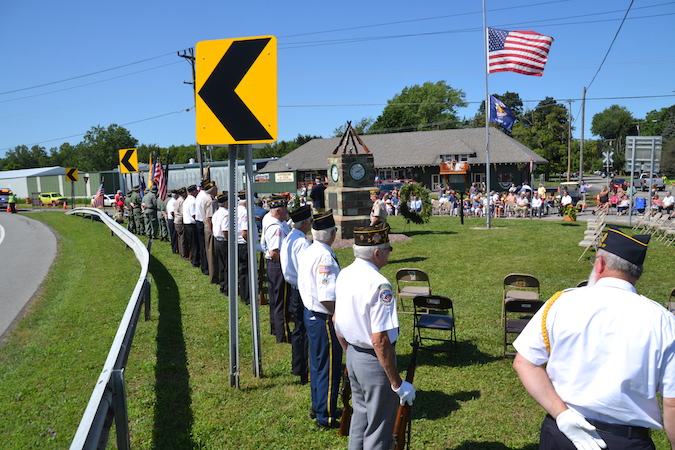
There is a monument for those men in Fancher on the curve at Route 31. The monument is a four-sided clock and includes in plaque in memory of John Christopher, Joseph Christopher, Cosmo Coccitti, John Kettle, Jr., Leonard Licursi, Martin Licursi, Richard Merritt, Camille Nenni, Floyd Valentine and Richard Vendetta.
Sidonio on Monday proposed the flags be lowered at the monument and the Murray town buildings for 10 days every Aug. 14. The Town Board was in favor of declaring Aug. 14 “Fancher Monument Memorial Day.” However, two of the board members believed only the governor and U.S. president have the authority to order the flag to be lowered.
The Town Board on Monday decided to instead have a World War II flag be displayed on Aug. 14 and then for the following 10 days each year.
The flag pole at the monument also will include a POW-MIA flag because the bodies of three of the soldiers were never recovered. Those men include Joseph F. Christopher, Cosmo P. Coccitti and Floyd M. Valentine.
Sidonio, however, reached out to the Association of Towns of New York State and was advised today by general counsel, Lori Mithen-Demasi, that a town can fly a flag “at less than full-staff to commemorate the death of town residents that occurred during a time of war.”
Sidonio said he will seek to amend the resolution passed on Monday to allow Murray to lower the American flag every Aug. 14 for 10 days.
In other action during Monday’s Town Board meeting:
• Louise Passarell told the board she is resigning due a difficult working relationship with Sidonio. Passarell has worked for Murray the past 13 years. She was the town assessor, secretary to the Highway Department and a water billing clerk.
“This has become a very hostile place to work,” she told the board before walking out of the meeting. “I choose not to work here anymore.”
Her resignation was accepted by the five board members – Sidonio, Randy Bower, Michael Mele, Paul Hendel and Lloyd Christ.
Sidonio, who has been town supervisor since Jan. 1, 2020, acknowledged that Passarell has been vocal in backing his opponents in local elections. He said he has a good working relationship with nearly all local community leaders.
Passarell has faulted Sidonio in the past for undermining the morale of highway workers with frequent criticism, especially about water leaks, and for failing to credit the workers when they find and fix the leaks.
• The board appointed Elaine Berg to fill a vacancy on the Planning Board with the term ending Dec. 31, 2021.
• Ron Vendetti, former code enforcement officer, asked the board if there has been any progress on updating a law on renewable energy projects. The board last month approved a 12-month moratorium on solar and wind energy applications in the town.
Vendetti offered to assist in writing an updated law. Sidonio said town officials will be working on the law. Vendetti said the law could be updated without taking 12 months.
• Councilman Hendel recommended the town use some of its American Rescue Plan funds to put in new video conferencing equipment for the town’s main meeting room. That could allow some board members to attend meetings virtually and vote when they are out of town.
The other board members liked the idea of upgrading the videoconferencing capabilities at the Town Hall and want to see cost estimates for the equipment, which should also include a stronger WiFi signal.
By Tom Rivers, Editor Posted 17 August 2021 at 3:03 pm
ALBION – Motorcyclists and all vehicles are encouraged to be a part of 100-mile trek on Saturday to raise money for a scholarship in memory of Jason Johnston, an Albion native who was died in Afghanistan on Dec. 26, 2009.
Johnston was killed by a roadside bomb in Arghandab. Johnston was a specialist and paratrooper in the Army. He was on his second tour in Afghanistan. He completed a 13-month-deployment in 2008 and left again for the war-torn country in October 2009
Participants in the ride should be at the Albion Elks Lodge at 10 a.m. on Saturday to register. The cost is $20 for drivers and $10 for passengers.
The Albion Elks Riders expect to leave the lodge by 11 a.m. for a ride that includes stops at the Alabama Hotel, Duffy’s in Mumford, the Brockport Elks Lodge and then concluding at the Albion Elks Lodge on West State Street.
Motorcyclists need to be back at the Albion Elks by 5 p.m. There will then be food and live music from Bandera, a local country music group. There is a $5 cover charge to attend the concert, with no additional charge to the motorcyclists.
“We believe very strongly in not letting go of Jason’s memory,” said Michael Jenks, sergeant at arms for the Albion Elks Riders.
The Albion Elks give out a $1,000 scholarship in Johnston’s name to a graduating senior pursuing a helping profession.
By Tom Rivers, Editor Posted 17 August 2021 at 1:02 pm
MURRAY – The Town Board wants to hear from residents whether the town should allow marijuana to be sold from a legal dispensary, where people could purchase adult-use cannabis products.
The board set a public hearing for 7 p.m. on Sept. 9 at the Town Hall on Route 31 (3840 Fancher Rd.).
The state is giving municipalities until Dec. 31 to decide whether they will opt out of allowing marijuana dispensaries. The municipalities also need to decide by the end of the year if they will opt out of allowing onsite consumption at businesses such as a smoking lounge.
The state has approved a 13-percent excise tax on marijuana with a breakdown that includes 9 cents for each taxable sale to the state, 3 cents to the municipality that has the dispensary, and 1 cent to the county. Municipalities that opt out wouldn’t be eligible for the 3-cent share of the 13-percent sales tax.
Towns and villages can’t overstep the state and ban recreational use of marijuana. But the towns and villages can prohibit dispensaries and smoking lounges.
If the municipal board for a village or town decides to opt out, residents could still push a permissive referendum, with the matter going on the ballot.
Municipalities could also decide to opt out, and later decide to “opt in” and allow the dispensaries and lounges.
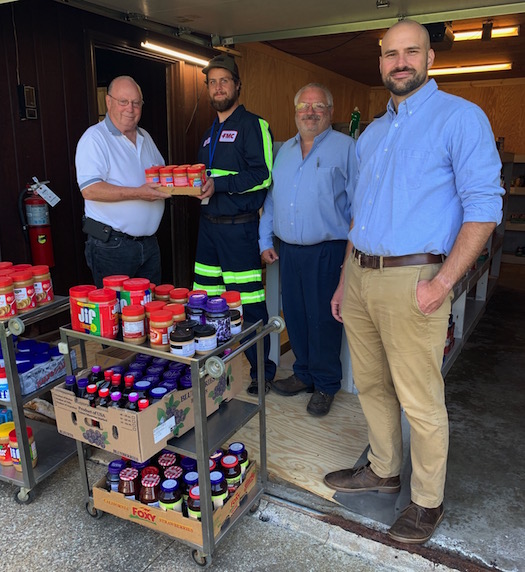
MIDDLEPORT – FMC’s Agricultural Sciences Plant employees in Middleport, working with Local 1180 of the International Association of Machinists and Aerospace Workers and plant management, recently collected and donated more than 200 jars of peanut butter and jellies to the Middleport Royalton Hartland Community Food Pantry.
Dennis McAvoy (left), Food Pantry co-chairman, accepts the donated items from FMC employees and Local 1180 members (from left to right) Austin Jones and Gary Dallmann, and Brent Sensenich, FMC plant manager.
The Food Pantry on S. Vernon St., Middleport, next to St. Stephen’s Church, is open to area residents every Thursday from 10 a.m. to 11:30 a.m.
By Ginny Kropf, correspondent Posted 17 August 2021 at 10:53 am
Medina Railroad Museum looks to upgrade interiors, including making one a dining car
Provided photo: Rick Henn is president of the board of directors for the Medina Railroad Museum.
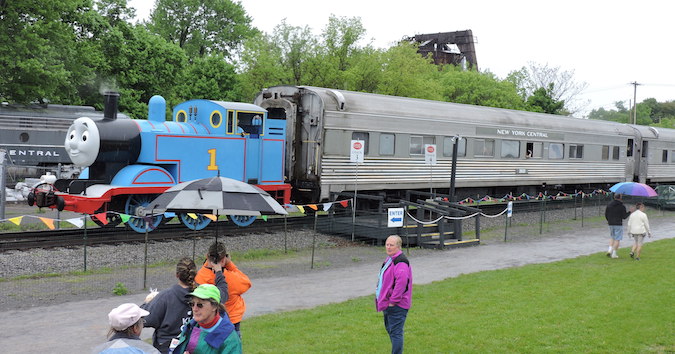
MEDINA – The Medina Railroad Museum has taken a big step forward toward advancing their goals far into the future with the purchase of the five coaches they previously leased from Western New York Railway Historical Society of Buffalo.
The purchase will result in long-reaching savings to the Museum, which has leased the coaches for special excursions for nearly 20 years, according to Museum board president Rick Henn.
The coaches were stored in the Steel Plant in Lackawanna and spent four years in Canada before bring brought to Medina Railroad Museum, where they are kept secure on the siding near the Pickle Factory.
In recent years, Henn said the WNYHRRS has talked periodically about moving the cars to Jamestown, and he knew that could mean doom for the MRRM.
“These coaches are our greatest revenue source, allowing us to keep our doors open throughout the year,” Henn said. “We depend on these cars and it became evident we had to go shopping for our own coaches or buy these.”
Last fall Henn approached WNYRRHS about buying the coaches. He said regulations now require state rail cars to meet Amtrak standards, which costs a minimum of $100,000 per car, meaning WNYRRHS’s ability to use the coaches was compromised. That is not so on the Falls Railroad, which is the line on which the Medina Railroad Museum operates excursions from Lockport to Brockport.
After several months of negotiations, a deal was struck to purchase the five coaches, one spare and a large inventory of parts for $350,000. The Medina Railroad Museum took ownership on July 31.
That didn’t happen without a lot of wheeling and dealing on the part of Museum board members and Museum director Janien Klotzbach, who approached friends, family and railroad buffs asking for loans or donations. That accomplished, now the search is on for grants and donations to repay the loans.
It is the Museum’s goal to upgrade the interiors of the five coaches and eventually add air conditioning. Henn’s dream is to gut the sixth car and turn it into another first-class dining car.
“This will get us closer to our dream of running dinner trains,” Henn said.
The Museum is ready to release its fall schedule of train rides, which will include autumn train rides in October, Santa trains in December and the return of Polar Express in November and December.
Anyone wishing to make a donation to help with the purchase of the coaches may send a check to Medina Railroad Museum, 530 West Ave., Medina. Donations may be made in honor or in memory of a loved one.
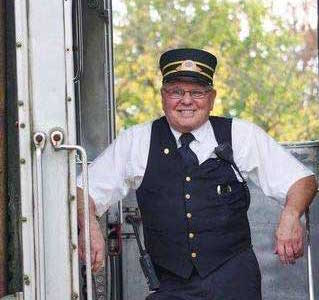
Photo by Tom Rivers: Lynn Heintz, a conductor for the museum, checks on passengers before a ride with Thomas the Train Engine in May 2018. The Railroad Museum now owns the coaches carrying the passengers.
‘The Great Lakes are a massive economic engine, not only for the tourism and recreation industries, but also for the shipping, logistics, agriculture, mining, energy, and finance industries.’ – U.S. Sen. Charles Schumer
Photos by Tom Rivers: These sailboats race last Thursday in Lake Ontario near Point Breeze as part of the racing series organized by the Oak Orchard Yacht Club.
Press Release, U.S. Senate Majority Leader Charles Schumer
Standing on the banks of the Niagara River at Niawanda Park in Tonawanda on Monday, U.S. Senate Majority Leader Charles E. Schumer revealed an historic $1 billion federal investment – the largest ever single investment – in the Great Lakes Restoration Initiative (GLRI).
Specifically, this funding was secured to protect, improve, and preserve the Great Lakes and their related waterways, which Schumer was able to secure in the bipartisan federal infrastructure bill he just led to passage. Schumer detailed the unprecedented amount of funds, explained why he pushed to include them, and detailed how the Great Lakes Restoration Initiative (GLRI) has been helping Western New York since he first pushed for the funding in 2010. Schumer explained that these dollars will continue to improve water quality by reducing pollutants, restoring and protecting wildlife habitats, mitigating climate change impacts, and helping preserve waterways critical to New York State’s environment and economy.
“Today, I am unveiling the ‘catch of the day’ – $1 billion in funds we included in the bipartisan infrastructure package that will do a lot of good for Western and Central New York, and some critical things to protect one of the true gems of New York State – the Great Lakes,” said Senator Schumer. “This funding guarantees a ramp-up in our conservation efforts for the Great Lakes and their waterways, while allowing us to continue to fight for more as part of regular appropriations – so this is really unprecedented support for one of our most critical resources, both natural and economic. The Great Lakes are a massive economic engine, not only for the tourism and recreation industries, but also for the shipping, logistics, agriculture, mining, energy, and finance industries. Because of their huge impact on so many facets of life, investing in the Great Lakes means investing in the future economic health of Western New York.”
In total, the Great Lakes account for 84% of North America’s surface fresh water and contain about 21% of the world’s supply. More than 30 million people in the U.S. and Canada live in the Great Lakes Basin – roughly 10% of the U.S. population and more than 30% of the Canadian population. The Great Lakes themselves span more than 750 miles from west to east. Millions of people flock yearly to the Great Lakes for recreation, and the Lakes provide critical fresh water access. Additionally, the Lakes play host to diverse animal and plant life. The ability of the Great Lakes to support these uses is dependent on the quality of its waters, habitats, and living resources.
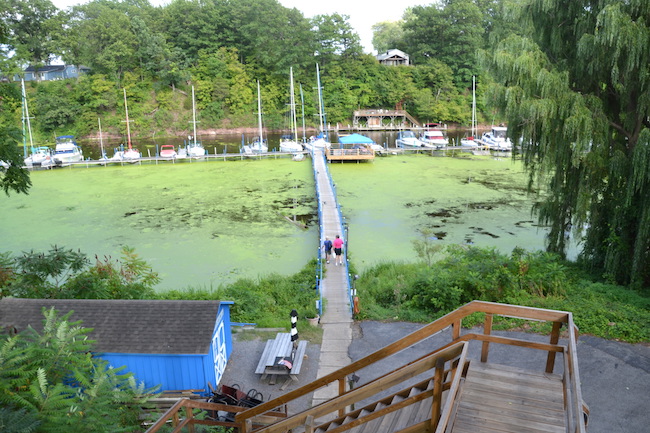
This photo shows the walkway leading to the docks and sailboats at the Oak Orchard Yacht Club along the Oak Orchard River, which is a Lake Ontario tributary.
Schumer also pointed out the massive economic impact of the Great Lakes region and its importance to Western New York. The Great Lakes region includes eight states – Minnesota, Wisconsin, Illinois, Indiana, Michigan, New York, Ohio, and Pennsylvania – and two Canadian provinces.
The Lakes are home to more than 175 species of fish, which contribute to our state’s vibrant commercial and recreational fishing industries. According to the Office of Coastal Management at the National Oceanic and Atmospheric Administration (NOAA), for every dollar invested in Great Lakes protection, the return on investment is $3.35, or 335%. Furthermore, for every $1 million invested in Great Lakes restoration and protection, 16 jobs are created. The Great Lakes Region is directly responsible for $3.1 trillion in Gross Domestic Product (GDP) for the United States and more than $6 trillion overall. It is estimated that 25.8 million jobs worth more than $1.3 trillion in wages spanning countless industries, including 7% of all American farm production, are directly supported by the region.
“We all know that our changing climate poses a threat to our Great Lakes and all the livelihoods that depend on it, so this $1 billion surge will help to accelerate efforts to protect and preserve one of our greatest natural resources,” Schumer added. “Even more, the economic impact of these Lakes is into the trillions. We cannot lose it. We must invest in sustainment, and we have to keep doing it to protect the economic future of Upstate New York and the environment.”
Schumer fought off budget cuts to the GLRI in 2019 and worked to secure a multimillion dollar increase in authorization levels for the program in 2018. Initiated in 2010, the GLRI has received roughly $3.48 billion since its inception, with the funds distributed across 16 different federal agencies including the Environmental Protection Agency (EPA) and the United States Army Corps of Engineers (USACE).
Over the last decade, the GLRI has controlled invasive species on at least 115,000 acres and kept more than 402,000 pounds of phosphorus out of the lakes, a $300,000 investment from GLRI which ended in 2020. GLRI has also played a critical role in fish and wildlife protection, specifically in Western New York. Efforts to improve the population of Lake Sturgeon are currently underway after a $90,000 investment to study their travel patterns, and the trout population is climbing once again thanks to the investment in bloater chub revival, a critical food source for the popular sport fish. Schumer noted that the $1 billion in funding, the largest the program has ever received in a single authorization, will help the agencies and their auxiliary partners prepare for the future.
Schumer was joined in Tonawanda by Erie County Executive Mark Poloncarz, Executive Director of Buffalo Niagara Riverkeeper Jill Jedlicka, Associate Director of the Citizen’s Campaign for the Environment Brian Smith, and other local stakeholders.
“New York is a Great Lakes state, and this $1 billion appropriation reinforces what we have known for a long time- that these freshwater lakes are the nation’s most important living infrastructure system,” said Jill Jedlicka, Executive Director of Buffalo Niagara Riverkeeper. “The health and restoration of the drinking water for 40 million people also supports tens of billions of dollars in economic activity and recreational resources. The Great Lakes Restoration Initiative has been one of the most impactful programs in our nation’s history by helping communities like Buffalo reclaim and restore their waterfronts, protect critical ecosystems, and put us back on a path to a clean water future. We applaud Senate Majority Leader Schumer for guiding this bipartisan infrastructure bill that will ultimately benefit all Americans and our Great Lakes.
The GLRI has also benefited additional sites in New York State. In September 2017, $900,000 worth of GLRI funds were awarded to the Great Lakes Institute at Hobart and William Smith College to fight invasive threats, including an infestation of hydrilla in Cayuga Lake. In 2015, Schumer helped secure $9.5 million in GLRI funding to restore Braddock Bay in the Town of Greece after decades of decline to ecological and recreational activities on the bay. The U.S. Army Corps of Engineers (USACE) used the funding to restore wetlands, habitat and to reconstruct a barrier beach that has been washed away, leaving the bay exposed to Lake Ontario’s damaging waters that destroyed habitat and the bay’s navigation channel needed for boating.
LYNDONVILLE – Kindergarten and Pre-K registration remains open at Lyndonville Central School
There is still time to register your child for kindergarten or pre-kindergarten for the 2021-2022 school year. If you are a resident of the Lyndonville School District and your child will be 3, 4 or 5 by December 1, 2021, they are eligible to enroll. Space is limited but openings are available for all age groups.
The Lyndonville School District will continue to have full day classes for kindergarten with breakfast, lunch and transportation available for those outside the Village. The five-day-a week PreK program engages students in planned educational activities, play and rest time. Breakfast and lunch are provided, and a new PreK playground was recently installed.
Please call or email the school at (585) 765-3122 or esmith@lcsdk12.org. You will need to provide your name, address, child’s name and child’s date of birth. More information can be found by clicking here.
By Ginny Kropf, correspondent Posted 17 August 2021 at 8:32 am
Money from Treasure Island, Mega Drawing will go towards projects at hospital
MEDINA – After a year dampened by the Covid pandemic, Orleans Community Health has embarked on a campaign of fundraising events.
Heather Smith, executive director of Orleans Community Health Foundation, has announced the return of the Mega Drawing, which took the place of the annual Treasure Island last year.
“The cash raffle was such a success that we have decided to do it again,” Smith said.
Tickets are already nearly sold out, and information to purchase a ticket can be found online at www.supportoch.org/events.
The date of the drawing has been moved up to Sept. 14. With hopes that restrictions will stay lifted, the Foundation is considering a small event that evening, in addition to doing the drawing live online.
Proceeds for this year’s drawing will be split between two projects which are part of the hospital’s “Together We are Stronger” campaign to raise $350,000. The money will be used to fund eight small projects in several departments across Orleans Community Health, instead of one big project, Smith said.
First, they plan to purchase a new Hoyer lift system for the patient care unit on the second floor of Medina Memorial Hospital. The second project will be to purchase a new stress test system for the cardiac services department.
“We feel so blessed to be able to keep this vital service available to our community, however, the time has come for an upgrade to the unit we currently own,” Smith said.
In radiology, the successful golf tournament raised funds to purchase two pieces of equipment – an ultrasound probe and a new ceiling mount for the X-ray machine.
The main laboratory and outpatient lab have received new chairs for drawing blood, and countertops have been replaced in the department.
In February, a new coagulation analyzer was purchased with grants from the Lyndonville Area Foundation and Elizabeth Curtis Dye Foundation.
New hospital beds will be purchased for the second floor, at a cost of $10,000 to $25,000 each, depending upon the size and functionality, Smith said.
A grant from the Association of Twigs allowed for the purchase of a new oven in dietary services.
Other improvements include new privacy walls in registration and a separate entrance door to each registration area, thereby increasing patient confidentiality.
The pharmacy will see a new temperature control system to regulate medications, along with new windows, cabinets and counters.
Outside, all new signage is planned at the hospital and two dialysis centers to better inform anyone visiting.
In addition to raising money from the Mega drawing, the Foundation is planning the return of Treasure Island.
They are hoping to reach their fundraising goal with additional monies from grants, individual giving and corporate donations.
Hospital CEO Marc Shurtz announced the campaign at the end of 2020, and the board approved all eight projects, Smith said.
“The Lyndonville Foundation really got the ball rolling with their grant of $40,000 in February,” Smith said.
She added the hospital opened the door for a huge piece of funding by initiating employee giving this year. In early August they already had $8,000 in pledges, and $80,000 in grants was pending.
If Covid restrictions continue to be lifted, Treasure Island will take place Nov. 6 at Shelby Fire Hall.
By Tom Rivers, Editor Posted 16 August 2021 at 6:26 pm
State Sen. Rob. Ortt, R-North Tonawanda, is urging the federal government to fast-track visas to assist Afghan people attempting to evacuate from the country which has been taken over by the Taliban following the U.S. withdrawal from the country.
Ortt issued this statement today:
“The federal government must take immediate action to rapidly approve visas for our Afghan allies, secure the airport in Kabul, and safely evacuate our citizens and allies.
“This is deeply personal to me. In 2008, I served as a combat mentor and advisor to the Afghan National Police in Kandahar City. When Taliban forces took the city just a few days ago, my first thought was of the men and women I served with and those Afghans we so proudly worked with to help protect and build a safer, more stable, and more peaceful Afghanistan. I worried for their lives and the well-being of their families and contemplated the risk they took to help support our mission. Those concerns are amplified today.
“I am asking our Federal representatives to take immediate action to help those who trusted our government and worked to make their home a better place. This is a crisis and all solutions must be considered. I will specifically be working with my partners in the New York State legislature and throughout New York State government to support an increase in the number of Afghan Special Immigrant Visa recipients.
“A failure to live up to our promises to our allies will cost lives and deeply harm America’s capacity to lead and be a force for good throughout the world.”
Jacobs: Biden administration ‘has handed Afghanistan over to the Taliban’
Congressman Chris Jacobs issued this statement about the situation in Afghanistan:
“Five weeks ago, President Biden addressed the nation and vowed it was ‘unlikely’ we would see Afghanistan overrun by the Taliban and that we would not see Americans being evacuated from our embassy. His administration failed to plan for that exact scenario, despite the warning signs, and has now handed Afghanistan over to the Taliban. This negligence has put Americans and our allies in harm’s way, put Afghan women and children at the hands of a regime known for human rights atrocities, and weakened our national security.
“History will remember this as one of the most devastating foreign policy failures in our nation’s history.”
By Tom Rivers, Editor Posted 16 August 2021 at 5:37 pm
Senator touts nearly $8 million in American Rescue Plan funds for project in 2 counties
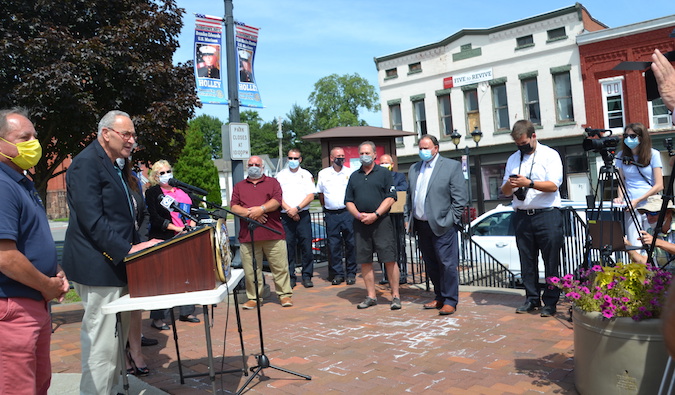
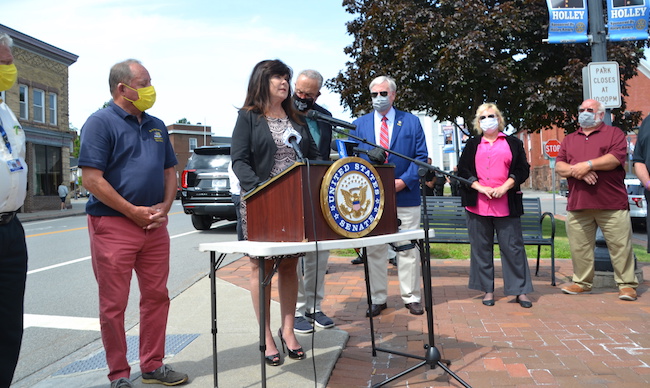
Photos by Tom Rivers: U.S. Senate Majority Leader Charles Schumer speaks during a news conference today in Holley’s Public Square. He is joined by Assemblyman Steve Hawley, left, and other officials from Orleans County, the Village of Holley, Town of Murray and Community Free Library.
HOLLEY – U.S. Senate Majority Leader Charles Schumer met with local officials today to celebrate progress in the effort to close high-speed internets gaps in Orleans and rural Niagara counties.
Both counties recently approved a contract with RTO Wireless of Wellesley, Mass. to co-locate their transmitters on existing communication towers. The counties are using part of their federal American Rescue Plan funds for the build out.
“The Covid pandemic made it all too clear that the digital gap in Orleans County is far too wide,” Schumer said with local officials by the Salisbury Fountain at Public Square.
Schumer was instrumental in the American Rescue Plan being passed in the Senate. The Orleans County Legislature last month voted to spend $3,608,435 to make high-speed internet available county-wide, including for 1,351 addresses that currently don’t internet access, and another 6,700 addresses with only low-speed access. That’s nearly 40 percent of the county’s addresses without access to high-speed internet. That project should be complete in 2022.
“Whether it’s working from home, finding a new job, completing schoolwork, or accessing healthcare options, the rural digital divide has kept many New Yorkers from reaching their full potential,” said Lynne Johnson, chairwoman of the Orleans County Legislature. “Success in the 21st century is dependent on universal, affordable access.”
Orleans County Legislature Chairwoman Lynne Johnson said the federal funds will solve the high-speed internet crisis for thousands of homes in the county. There are 1,351 addresses without access to high-speed internet and another 6,700 out of 22,000 total addresses with only access to low-speed internet.
Orleans and Niagara counties are both working with RTO Wireless of Wellesley, Mass. The Niagara County Legislature earlier this month approved a $4,286,325 bid to make high-speed internet in unserved areas of the county.
In Orleans, RTO will co-locate their technology on existing county-owned communication towers. Those sites include at the Emergency Management Office on West County House Road in Albion, Route 31A in Clarendon, Maple Ridge Road in Medina, Route 31 in Albion next to Public Safety Building, West Avenue in Lyndonville, Route 237 in Kendall, Route 237 in Holley by the water tank.
Orleans and Niagara have been working together for a decade on the project. The Niagara-Orleans Regional Alliance made it a priority but only now has it had the funds to proceed with closing the internet gaps.
“The money is there,” said Niagara County Legislator David Godfrey. “We’re going to make it happen.”
Schumer also said broadband internet access is a key to reversing the population decline in rural areas. The U.S. Census Bureau last week released population counts for each county in the United States.
The data shows a 5.9 percent decline in Orleans County, which was biggest drop among Western New York counties and most in the GLOW region. Orleans shrunk by 2,540 people in the 10 years, according to the U.S. Census Bureau, dropping from 42,883 in 2010 to 40,343 in 2020.
“Broadband is really vital,” Schumer said. “In this new world where broadband connects you, it will bring more businesses here, it will keep businesses here, you will have more people come live here. Lots of people want to live in a beautiful place like this. But if they can’t be connected, they lose out.”
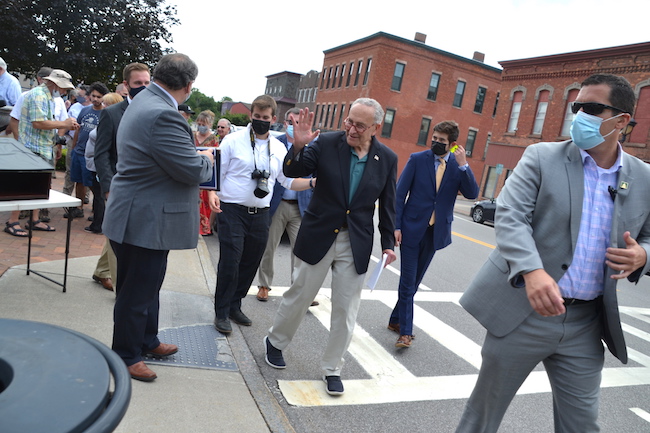
U.S. Senate Majority Leader Charles Schumer waves to people during a stop in Holley today. He was influential in the redevelopment of the former Holley High School as well as the cleanup of the former Diaz Chemical site in Holley.
Schumer said there will also be funding available to help people pay the costs to connect to the internet, and there will be assistance to help pay for the service.
The infrastructure bill that passed in the Senate includes $42.45 billion nationwide for broadband grants in unserved and underserved communities, $14.2 billion for permanent broadband affordability (with eligibility at 200 percent the federal poverty level), and $2.75 billion for “Digital Equity and Inclusion” – providing digital literacy and skills to low-income residents, senior citizens and people with disabilities.
Lynne Johnson also highlighted a new program through the Federal Communications Commission that offers financial assistance for monthly internet. Click here for more information.
By Tom Rivers, Editor Posted 16 August 2021 at 4:32 pm
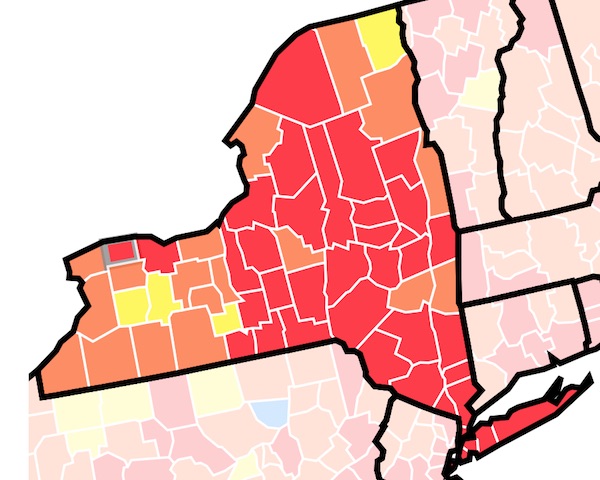
This map from the CDC shows the levels of transmission for each of the counties in the state. Red means there is high transmission, while orange (the next level down) shows substantial transmission and yellow means moderate community spread of Covid-19.
The federal Centers for Disease Control and Prevention now lists Orleans County in the red zone as a community with high transmission.
In Western New York, only Orleans and Monroe counties are in the red zones. Genesee is listed in the orange zone, the next level down, with “substantial” community transmission based on new cases last week.
Wyoming and Livingston counties are at moderate levels or the yellow zone. The CDC map shows nearly the entire state is in either a red or orange zone.
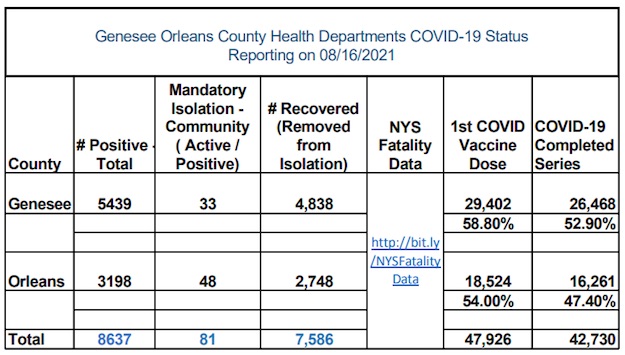
The Genesee and Orleans County Health Departments today are reporting 19 new cases in Orleans since Thursday and 27 more in Genesee County.
The number of active cases in each county has increased 26 a week ago in Orleans to 48 today, and 21 in Genesee a week ago to 33 today.
Of the 19 new cases in Orleans, the individuals are in the age groups of 0-19, 20s, 30s, 40s, 50s, 60s and 70s.
Orleans also is reporting 17 more of the previous positive individuals have completed their 10-day isolation and been removed from mandatory isolation.
There is currently one Orleans County resident hospitalized due to Covid.
In Genesee County there are 27 new positive cases and they are in the age groups of 0-19, 20s, 30s, 40s, 50s, 60s, 70s, 80s and 90s.
Genesee is reporting 16 more of the previous positive individuals have completed their 10-day isolation and have been removed from mandatory isolation.
There are currently two Genesee residents hospitalized due to Covid.
Genesee also reports a death from Covid
The Genesee and Orleans County Health Departments also is reporting a death of a Genesee County resident under age 65 due to Covid.
“No other information will be shared to protect the privacy of this individual,” the Health Departments said. “Our deepest sympathy to the family and friends of this person.”
According to the State Department of Health, there have been 124 Covid-related deaths in Genesee County and 83 in Orleans during the pandemic.
G-O Health Departments urge people to get vaccinated; No mask mandate in either county
The Genesee and Orleans County Health Departments issued a news release this afternoon about the community Covid spread:
“We continue to encourage everyone to follow the public health prevention precautions as noted below. It is important for those who are not currently vaccinated to talk with their primary care provider to determine whether getting vaccinated is right for them.
“There are currently no masking mandates that have been issued by either county, however, per the CDC recommendations for communities with substantial or high spread of Covid-19, we encourage everyone, vaccinated and unvaccinated, to wear masks when indoors in public and when at crowded outdoor settings.
“Everyone should continue practicing the following public health prevention precautions:
Avoid touching your eyes, nose and mouth with unwashed hands.
Wash your hands often with soap and water.
If water is not readily available, use hand sanitizer.
Wash and sanitize frequently shared/touched items.
Stay 6 feet away from others and avoid close contact with people who are sick.
Avoid crowds and poorly ventilated spaces.
Wear a face mask indoors in public and crowded outdoor settings.
Monitor your health daily and stay home if you are experiencing any symptoms.
Get tested if you are experiencing symptoms and self-isolate until you get your results back. If you test positive for Covid, you are to isolate for 10 days.
“The best way to protect yourself from Covid-19 or health complications from Covid-19 is to get vaccinated,” stated Paul Pettit, public health director in the two counties. “Now is the best time to take advantage of getting vaccinated for COVID-19 before the new school term starts and the weather changes and we start moving back indoors.”
Home testing kits: For those who are using home testing kits, please note that the Health Departments are unable to verify the results and will not be able to provide paperwork for your employer/insurance company.
Home tests that need verification will have to complete a follow-up test with an approved provider for documentation and state reporting purposes. If you do either a home test or a test at approved provider, it is important to remember to self-isolate until you receive test results. For home testing, you are to self-isolate for a minimum of 10 days from onset of symptoms or getting your test result. Contact your primary care physician for further instructions.
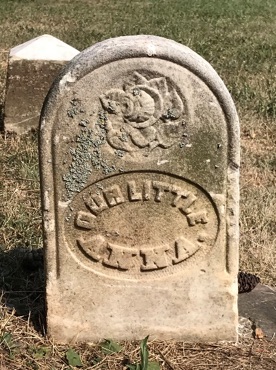
This double-sided stone commemorates Anna Smith who died in 1859. She was 1 year old. The inscription reads ”Our little Anna.”
KNOWLESVILLE – Nestled at the rear of several homes in the hamlet of Knowlesville lies the Knowlesville Cemetery, unobtrusively gliding through time.
It is a small cemetery, about three-quarters of an acre, with some 300 recorded burials. The plot of land originally belonged to the Stevens family, and indeed, the oldest stone is that of Jesse Stevens, dated 1826. The last recorded burials were in 1906, those of Malissa Foote and Caroline Bristol.
Cemeteries honor families, each stone was deliberately purchased and inscribed to record the passing of a family member. The earliest stones at Knowlesville, from the 1820s and 1830s, are simple, upright slabs, with basic information – name, date of death, age.
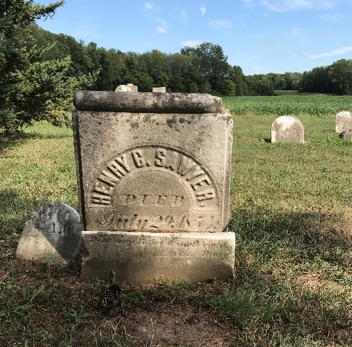
Henry Sawyer died in 1854 at the age of 16. The inscription at the base of the stone reads: “Don’t worry, it’s all right, Henry.” We can imagine the dying boy bravely reassuring his parents, his words etched in their hearts.
They are made of fieldstone and would have been inscribed by a local mason. Later stones are more elaborate, with rounded or curved tops. They generally feature a religious image at the top, a symbol for mourning (willow tree) or the afterlife (finger pointing upwards). Name, birth and death date, or specific age at death are recorded in the center. There is frequently an inscription at the bottom, this was either sentimental or religious.
Of the three hundred souls buried at Knowlesville, almost a quarter are children. There was a noticeable spike in child mortality between 1840 and 1850. Some families lost more than one child: the Banister family lost John, aged 10 months in 1838; Sarah, aged 7 in 1840; Frances, aged 11, also in 1840; and Cynthia, aged 18, in 1841.
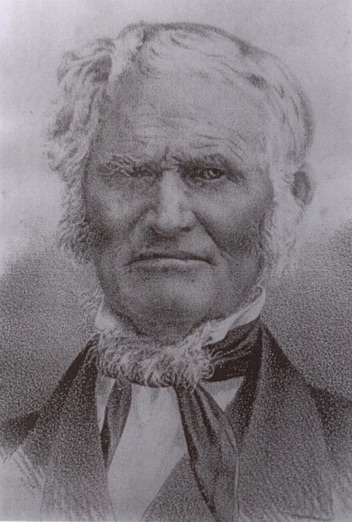
William Knowles (1790-1871, for whom Knowlesville was named in 1826 in recognition of his role in the inception and development of the village, is buried at the Knowlesville Cemetery. He was an early land purchaser, having moved to the area in 1815 from Berkshire County, Mass. in 1815.
William Knowles
He built an ashery in 1816. The Erie Canal went through his land. He organized the first shipment of wheat on the newly opened Canal and built a warehouse. The impact of the Canal on shipping costs and shipping times was obvious from the very beginning. Prior to the Canal, sending wheat to Albany would cost $100 and take a month. A shipment to New York on the Canal would take ten days and cost $5.
With the advent of the Canal, Oak Orchard ceased to be a hub of activity as trade moved to Knowlesville. Soon it was bustling, with stores, blacksmith shops, a cooperage, hotels, taverns and five doctors.
William Knowles funded the construction of the first school in the locality. He was a founding member of the Presbyterian Church. At first, services were held at his home. He funded half the cost for the construction of the first Presbyterian Church and was a Deacon and ruling member for over forty years. He did not have children of his own, but he and his wife took in and educated eight children.
The Orleans County Historical Association hosted a tour of this cemetery on August 8. The Association’s next cemetery tour will be at the Hillside Cemetery, 4065 Holley Byron Rd. in Holley on Sunday, August 22 at 6 p.m. This tour will be preceded by a 15-minute concert on the mortuary chapel’s reed organ, played by Scott Schmidt. There is no charge. A goodwill offering would be appreciated.
Employees at hospitals, long-term care facilities need first dose by Sept. 27
Press Release, Gov. Andrew Cuomo’s Office
Governor Andrew M. Cuomo announced today that all healthcare workers in New York State, including staff at hospitals and long-term care facilities, including nursing homes, adult care, and other congregate care settings, will be required to be vaccinated against Covid-19 by Monday, September 27.
The State Department of Health will issue Section 16 Orders requiring all hospital, long-term care facilities, and nursing homes to develop and implement a policy mandating employee vaccinations, with limited exceptions for those with religious or medical reasons. To date, 75% of the state’s 450,000 hospital workers, 74% of the state’s 30,000 adult care facility workers, and 68% of the state’s 145,500 nursing home workers have completed their vaccine series. Lt. Governor Kathy Hochul’s administration was briefed prior to the announcement.
“The Delta variant is spreading across the nation and across New York – new daily positives are up over 1000% over the last six weeks, and over 80 percent of recent positives in New York State are linked to the Delta variant,” Cuomo said. “We must now act again to stop the spread. Our healthcare heroes led the battle against the virus, and now we need them to lead the battle between the variant and the vaccine.”
Cuomo also announced that the Department of Health has authorized a third Covid-19 vaccine dose for New Yorkers with compromised immune systems, following the Centers for Disease Control and Prevention’s recommendation last week. Eligible New Yorkers can receive their third dose 28 days after the completion of their two-dose vaccine series, effective immediately.
The CDC is currently recommending that moderately to severely immunocompromised people receive an additional dose, including people who have:
Been receiving active cancer treatment for tumors or cancers of the blood;
Received an organ transplant and are taking medications to suppress the immune system;
Received a stem cell transplant within the last 2 years or are taking medicine to suppress the immune system;
Moderate or severe primary immunodeficiency (such as DiGeorge syndrome, Wiskott-Aldrich syndrome);
Advanced or untreated HIV infection;
Active treatment with high-dose corticosteroids, cancer chemotherapy that causes sever immunosuppression, or other medications that may suppress your immune response.
New Yorkers should contact their healthcare provider about whether getting an additional dose is appropriate for them at this time.