


















State legislation stalls that would ban elected officials from IDA boards

Local Orleans EDA says board would lose important connections without elected leaders
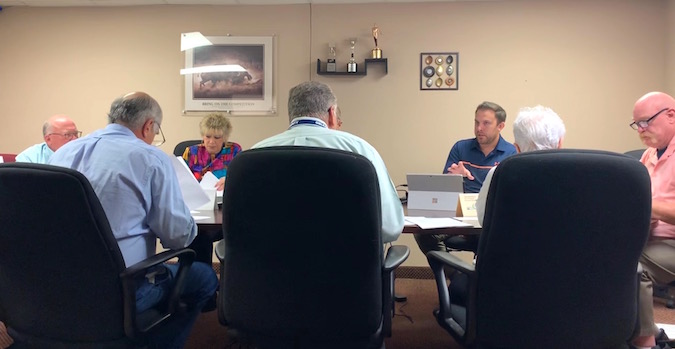
Photo by Tom Rivers: Michael Dobell (second from right in back) is the CEO/CFO of the Orleans Economic Development Agency. He is shown speaking during last Friday’s board meeting. Four of the seven board members are elected officials, including Chairman Paul Hendel, far right, who is a member of the Murray Town Board. Three county legislators – Ken DeRoller, John DeFilipps and Skip Draper – also are on the board.
ALBION – Members of the Orleans Economic Development Agency have been closely watching a bill in Albany that would ban elected officials from serving on boards of the industrial development agencies.
The legislation passed in the State Senate but failed in the State Assembly earlier this month. Proponents of the legislation say the elected officials can give out tax breaks and assistance to businesses through their roles on the IDA, and then may ask those businesses for campaign donations.
State Sen. James Skoufis of the Hudson Valley sponsored the legislation that he said would eliminate conflcits of interest for IDA board members. He wants to prohibit any elected official serving at the county, town, city, or village level from serving as a member of the board of any IDA.
In Orleans County, four of the seven board members on the Orleans EDA are elected officials. Paul Hendel, the board chairman, is a Murray town councilman. Three others are county legislators – Ken DeRoller of Kendall, John DeFilipps of Clarendon and Skip Draper of Shelby.
The three other board members who aren’t elected officials include John Misiti, Ed Urbanik of Farm Credit and Carol D’Agostino, the Kendall High School principal.
The Orleans EDA members aren’t hitting up businesses that work with the EDA for campaign dollars in their low-budget re-election efforts, EDA board members said.
Hendel said the board members, especially the county legislators, have important connections within the county government and community, as well as with state and federal officials. The County Legislature provides $190,000 of the EDA budget and also contributes other important in-kind services with infrastructure work.
The elected officials also are engaged in local issues, and can give insights on potential stumbling blocks with projects and also ways to keep economic development initiatives moving forward.
Kevin Zanner, the EDA attorney, told the board on Friday he doesn’t expect the state legislation, banning elected officials from IDA boards, will gain any momentum in Albany.
If the legislation was approved and the elected couldn’t serve on the board, the EDA could be hard-pressed to find volunteers to serve in the roles that would bring a depth of experience and insight to match the elected officials.
In the past, when the EDA had a vacancy on the board, it has sometimes reached out to a recently retired elected official. Ken Rush, a former county legislator, served on the board after he ended his time on the Legislature.
Two of the current board members – DeRoller and DeFilipps – are retiring from Legislature after this year. The County Legislature, which appoints some of the EDA members, could ask the outgoing legislators to continue to serve with the EDA in 2022.
Return to top
Some leaves are starting to change color for fall foliage season


Press Release, Gov. Kathy Hochul’s Office
Governor Kathy Hochul has announced the start of the 2021 fall foliage season in New York State. Fall is one of the most popular travel times in New York, attracting visitors from around the world to explore the state’s unique communities and support local businesses.
To help travelers and foliage enthusiasts plan a fall getaway, I LOVE NY started issuing its weekly fall foliage reports last Wednesday and will now include a new enhanced interactive progression map. Click here to see the map.
“Every autumn, New York State’s spectacular foliage and natural beauty beckons travelers to our world-class state parks, majestic overlooks, historic sites and unparalleled attractions,” Governor Hochul said. “New Yorkers have long known about the stunning displays of color showcased all across the state, from Niagara Falls to Montauk Point. Now is the perfect time for residents and visitors alike to plan a fall escape and experience this incredibly colorful season in our great state.”
The foliage report is compiled each week using the on-location field observations from I LOVE NY’s team of volunteer leaf peepers. More than 85 spotters extending across the state’s 11 vacation regions are tasked with keeping track of the color change in their area as leaves progress each week. Reports detail the predominant leaf colors, approximate percentage of change, and how much color change has progressed relative to peak conditions.

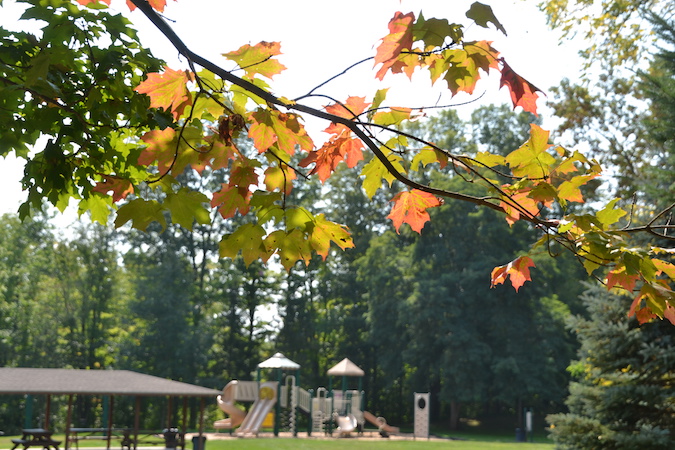
This is a closeup of some of the leaves along Holley’s canal path.
New this year, I LOVE NY is introducing an enhanced, interactive map that tracks weekly foliage change and progression across the state throughout the season. The map, located on the I LOVE NY foliage website, showcases great foliage viewing locations in each of the various regions throughout the state. Visitors can also use the map to see what the foliage is like during peak viewing in a given area, and learn about nearby, must-see attractions.
Thanks in part to its size and location, New York State has one of the longest and most colorful foliage seasons in the country. On any weekend from late September through mid-November, part of the state is likely experiencing peak foliage.
Travelers are also invited to share their photos of New York State’s amazing foliage on social media by using the #NYLovesFall hashtag. Photos submitted to this hashtag have a chance of being featured on the I LOVE NY fall foliage website and official I LOVE NY social media accounts reaching nearly two million followers.
Empire State Development Vice President and Executive Director of Tourism Ross D. Levi said, “The fall foliage season in New York State is always a magical time of year, and the I LOVE NY weekly foliage report is a great tool for visitors looking to plan a seasonal getaway. Our new interactive fall foliage map highlights a variety of attractions and events, from harvest festivals to Halloween celebrations, craft beverage trails, museums and family fun, helping residents and visitors alike to find what they love while exploring the amazing palette of autumn colors on display across the state.”
Return to top
Senior Center in Western Orleans tries new fundraiser, welcomes more members

Site at former railroad depot in Medina shut down for a year of the Covid pandemic
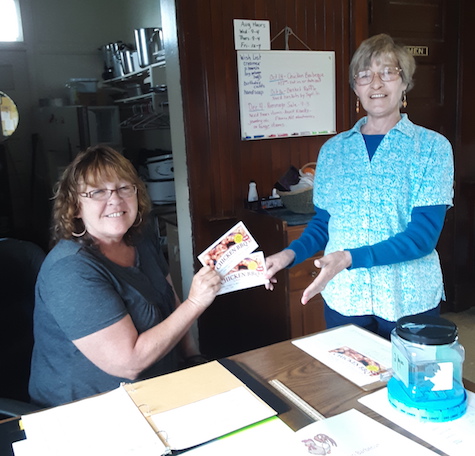
Photo by Ginny Kropf: Kelly Shaw, director of the Senior Center of Western Orleans, sells chicken barbecue tickets to Margaret Kelly. The Senior Center does various fundraisers throughout the year, but this is the first time they have done a chicken barbecue, and it will be provided by the Weidner family from Eden, who have been doing barbecues since 1956. The barbecue will be dine in or take out.
MEDINA – Members of the Senior Center of Western Orleans are happy to have the Center up and running as usual, after being closed for a year due to the pandemic.
Director Kelly Shaw already has two events planned – a chicken barbecue on Oct. 14 and a basket raffle on Oct. 16.
This is the first time the Center has had a chicken barbecue and Shaw contacted a new provider to the area to cook the chicken.
Weidner Barbecue from Eden is a family operation started by Bert Weidner and his two brothers in 1956 when they set up a stand at the Erie County Fair to sell chicken barbecue. Three generations later they are still using the same recipe and cater events all over Western New York.
Tickets are $12 and are available from members or at the Center during opening hours, which are 9 a.m. to noon on Monday and Tuesday, 9 a.m. to 4 on Wednesday and Thursday and noon to 3:30 on Friday. The barbecue comes with salt potatoes, cole slaw, roll and butter and a cookie.
The basket raffle has always been a popular event, with as many as 80 baskets donated by seniors and the community. Shaw is accepting donations of baskets through Thursday. Tickets will go on sale Sept. 17.
Some very unique baskets are already on display at the Senior Center, and include such things as wine baskets, lottery tickets, a designer tote, children’s activities, jigsaw puzzles, gift certificates and holiday decorations. The basket raffle is the Senior Center’s biggest fundraiser, Shaw said.
Shaw stressed how important these fundraisers are to operation of the Senior Center. They are able to operate through memberships, funding from United Way of Orleans County and fundraisers.
Shaw also urges seniors who are not members to join. It provides a wonderful opportunity to meet people, socialize and have a good time. Membership is only $10 a year, and even if a senior doesn’t want to come and participate in activities, the dues help keep the Center going.
When Shaw became director 16 years ago, there were 400 members, and now there are 250. Shaw said the decline is due in part to the fact seniors are working longer and many are taking care of grandchildren. Anyone who is 50 or older is eligible to join.
The Center has a dinner meeting the second Monday of every month, the first of which is pot luck. In October, the meal will be meatloaf. Also on Mondays, baked goods are available from Tops. Seniors may choose a loaf of bread and one sweet treat per person.
Lady Dispatchers meet the last Tuesday of the month for lunch and crafts or games. Lunch is only $5.
The Senior Center also runs a drawing every month for members. Items are donated and include everything from holiday decorations to gift cards. Tickets are only two for $1.
Before Covid, the Senior Center had two rummage sales a year. Items from households or estate sales are welcome, but they cannot accept electronics or large furniture. Shaw is planning to have a cash raffle the beginning the next year.
Shaw reminds seniors that euchre is played at 1 p.m. Wednesday, Thursday and Friday. There is a pinochle game on Wednesdays and Thursdays, and exercise led by Michelle Sargent from the Orleans County Office for the Aging is at 10 a.m. Wednesdays, except for the last Wednesday of the month, which is 11 a.m. The class provides great exercise and a lot of laughs for only $1. There is always a jigsaw puzzle in progress, Shaw added.
The community is also reminded the Senior Center accepts cans and bottles, or they may be taken to Medina Bottles and Cans on East Center Street or JCo Returns on South Main and indicate they are for the Senior Center. The Center also collects canceled stamps and pop can tops.
Return to top
Family donates late daughter’s playground to Partyka Farms

Make-A-Wish originally had playground built for Elaina Dixie Webb
Photos by Tom Rivers
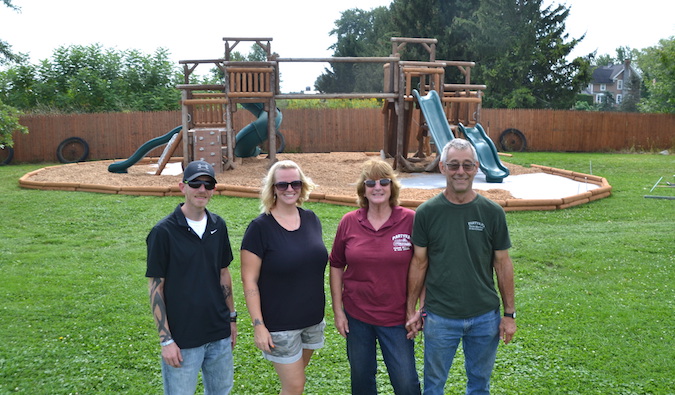
KENDALL – Kyle and Beth Webb are pictured with Lora and Jeff Partyka today at Partyka Farms in Kendall.
A playground built in January 2017 for the Webbs’ daughter, Elaina Dixie Webb, has been relocated to Partyka Farms, 1420 County Line Road (Route 272).
Elaina was 2 ½ when she passed away on Feb. 7, 2017 from cancer – acute myeloid leukemia. The Make-A-Wish Foundation paid for Bears Playgrounds in Lima to construct the playground in January 2017.
The playground was in the family’s backyard on Herrick Street. They no longer live there. The playground had been removed and in storage for nearly two years. Beth Webb said she is very appreciative to Bears Playgrounds for keeping the playground in storage and then reassembling it at Partyka’s, with some changes to meet commercial regulations. Bears also replaced some pieces.
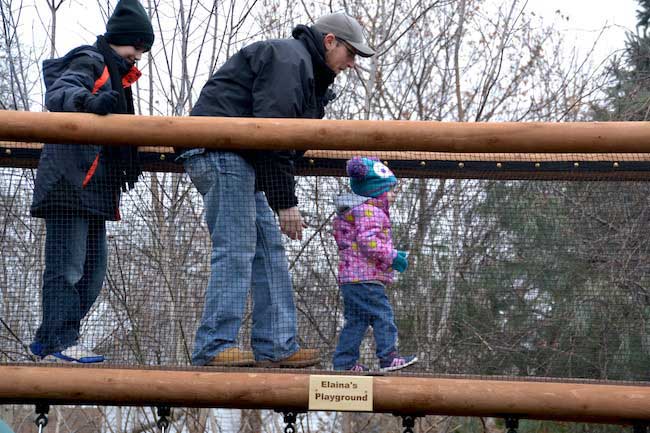
Elaina Dixie Webb, 2 ½, is shown with her father Kyle Webb and older brother Colin after a new playground was opened on Jan. 19, 2017 in the family’s former backyard on Herrick Street in Albion.
The Webb family initially offered the playground to the Village of Albion but that didn’t move forward because the village’s insurance company said the equipment wasn’t up to municipal code. The playground was built to be used in a backyard by a family.
Beth Webb happened to be at Partyka’s in June for ice cream with her 5-year-old twin sons. She thought the playground would fit in well with a play area by the farm market.
Lora and Jeff Partyka had been talking about adding a playground at the site in recent years and even visited Bears Playground. They paid some of the cost to have the playground relocated and modified.

Workers from Bears Playgrounds – Curtis Northrop, left, and Brett Otto – spread mulch at the playground at Partyka Farms in Kendall.
Kyle Webb said the farm market and play area will be a draw for the playground.
“We wanted it to be used,” he said. “We wanted it to be used by as many kids as possible.”
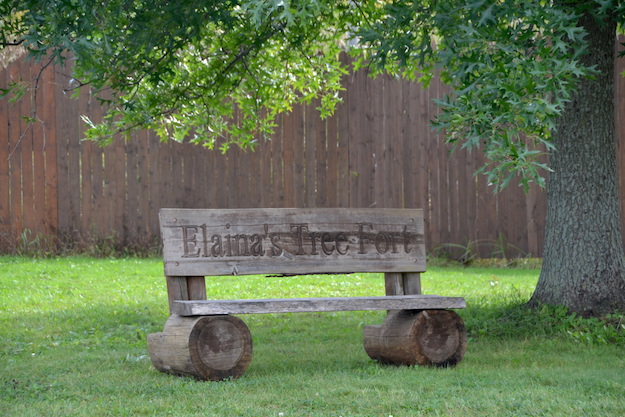
This bench with Elaina’s name is next to a tree by the playground. Her parents said Elaina loved the outdoors.
“She was a nature girl,” Beth said.
The playground has slides, a climbing wall and a bridge.
“It fits perfectly,” Lora Partyka said.
She said the farm will add picnic tables nearby and will stain some of the new wood.
There will also be a plaque noting the playground was given in honor of Elaina Dixie Webb.

Kyle and Beth Webb are pictured with the playground crew from Bears – Lenny Yokes, Curtis Northrop and Brett Otto (with orange head band).
Return to top
Jacobs rebuffed in seeking funds to combat spotted lanternfly, an agriculture pest
Press Release, Congressman Chris Jacobs
WASHINGTON, D.C. – Congressman Chris Jacobs (NY-27) participated in the House Agriculture Committee’s markup of their portion of the $3.5 trillion partisan reconciliation package.
At a hearing, Jacobs offered an amendment to redirect funding to combat an invasive species, the spotted lanternfly, that has become a threat to growers in the Northeast and Midwest. It was rejected.
“The House Agriculture Committee met to once again consider a massive, partisan reconciliation bill crafted in secret by Speaker Pelosi,” Jacobs said. “One would have thought that record inflation and struggling small businesses would have been enough to teach Democrats this style of unilateral legislating is unworkable and damaging, but sadly this is not the case. This package will likely include taxes that will devastate farmers and rural communities but possibly won’t even pay for the whole $3.5 trillion cost of this bill.”
The hearing, started Friday and finished today, was to consider the House Agriculture Committee’s piece of the overall budget reconciliation package. This section will total roughly $90 billion in new spending, though $28 billion of that total was not even considered by the committee because it has not been written yet.
“The Democrats in control of this committee did not hold one single hearing with farmers or agribusinesses to learn the exact needs of rural America,” Jacobs said. “If they had, they would’ve learned that their partisan wish list is unneeded and unwanted. They would have instead directed funding to fix very real problems facing our farmers, such as rural broadband, disaster assistance, and invasive species.
“This process once again shows Democrats are more interested in political power than serving their constituents’ needs – a truly unfortunate change of tune for the Agriculture Committee that has in previous years been lauded as the most bipartisan committee in the House.”
Return to top
Bridge closure for repairs on Allens Bridge Road over canal
Press Release, NYS Department of Transportation
ALBION – The New York State Department of Transportation is advising motorists that the bridge carrying Allens Bridge Road over the Erie Canal in the town of Albion near Eagle Harbor will be closed starting Wednesday, September 15, to facilitate bridge repairs on the structure.
Alternate routes to cross over the Erie Canal can be found at Presbyterian Road and Eagle Harbor Road.
Motorists are urged to slow down and drive responsibly in work zones. Fines are doubled for speeding in a work zone. Convictions of two or more speeding violations in a work zone could result in the suspension of an individual’s driver license.
Return to top
GCC to induct 4 into Alumni Hall of Fame on Sept. 16

Press Release, Genesee Community College
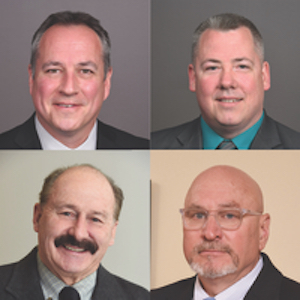
Provided: Top row left – Timothy S. Whitcomb; Top row right – Robert W. Hirsch; Bottom row left – Jim H. Tuttle; Bottom row right – David M. DiMatteo
BATAVIA – The Genesee Community College Foundation will proudly induct both the 2020 and 2021 honorees into its Alumni Hall of Fame in Batavia on Thursday, September 16, at 4 p.m. after missing last year’s ceremony due to the Covid-19 pandemic.
Eager to honor the work done by these four individuals, GCC will induct Timothy S. Whitcomb, Jim H. Tuttle, David M. DiMatteo and Robert W. Hirsch into its Alumni Hall of Fame, forever marking their contributions to their communities and the pride they have brought to Genesee Community College.
Timothy Whitcomb, GCC class of 1989, is the Sheriff for Cattaraugus County in Western New York and has served in this role for 30 years. Sheriff Whitcomb is also a Board Member and PTP Director for Law Enforcement Operations at TTMPT (Talk to Me Post Tour); an independent not-for-profit group of committed and concerned retired police officers and police professionals, and actively speaks nationwide as on posttraumatic stress disorder (PTSD).
Sheriff Whitcomb earned a master’s degree in Counseling Education from St. Bonaventure University and is a certified police instructor in the areas of Interview and Interrogation, the Investigation of Sex Crimes, and the Law Enforcement Response to School Violence. Sheriff Whitcomb is a graduate of the 206th Session of the Federal Bureau Investigation’s National Academy. He has also recently been certified as a SWAT Team fitness specialist.
Sheriff Whitcomb has been an adjunct professor for both St. Bonaventure University and Jamestown Community College. He has served as President for the New York State Sheriffs’ Association and is a past President of the State of New York Police Juvenile Officer Association.
Jim Tuttle, GCC classes of 1971 and 1982 graduated from Genesee Community College with his AAS degree in Criminal Justice and enlisted in the United States Army. Mr. Tuttle re-enlisted in the Army Reserves several times continuing to serve the United States of America for a total of 21 years and eventually returned to earn an Associate degree in Business Administration in 1982 and later to serve on the Alumni Council.
Mr. Tuttle continued his education and earned a bachelor’s degree in Hazardous Studies from SUNY Empire State College. He served as a police officer for the City of Batavia for 30 years, retiring as a Lieutenant.
Mr. Tuttle met his wife while working as an EMT at St. Jerome Hospital in Batavia.
Mr. Tuttle has demonstrated his compassion for others and the community by serving four years as a Town of Pembroke Supervisor, GCC Alumni Council member, GCC Alumni Homecoming Committee, GCC’s Cougar Classic Golf Committee and on the Advisory Board for Genesee County Stop DWI.
David DiMatteo, GCC class of 1984, has been a practicing attorney in the region for over 32 years. A 1982 Notre Dame high school graduate, he began his college education pursuits at Genesee Community College, graduating GCC in 1984, he continued his education at Le Moyne College, graduating Magna Cum Laude with a bachelor’s degree in Sociology then completing his legal studies at the University of Buffalo Law School in 1989. Upon graduating he took a position in Warsaw, where he found his own general law private practice in 1993.
He works with municipalities in Erie, Genesee, Livingston and Wyoming counties addressing siting or prohibiting siting of windmills and a variety of solar projects, writing and adapting local law, and creating and financing water districts. He has worked with the NY State Senate to facilitate legislation for local communities.
Mr. DiMatteo has a farm in Wyoming County where he raises Black Angus cows and horses. He also enjoys hunting locally as well as in Africa, Alaska and the Arctic Circle. Mr. DiMatteo and his wife enjoy their farm with their three children and their new granddaughter.
Robert Hirsch, GCC class of 1997, earned his leadership certification from the Warner School of Education at the University of Rochester, a master’s degree in Education from Buffalo State, a bachelor’s degree in History with a minor in Education from SUNY Brockport, his coaching certification and an associate degree in History and Education from Genesee Community College.
Mr. Hirsch began his career at Warsaw Central School (WCSD) where he taught history and coached the wrestling team for over a decade. The wrestling program he built there included eight LCAA titles, seven Section V championships, over 50 sectional champions, eight individual state champions, and a team NYS title in 2007. Beyond the wrestling mat, Mr. Hirsch encouraged his wrestlers to be involved in community service; he himself served a total of 18 years as the Director of Recreation for the towns of Freedom and Arcade where he organizes the annual Summer Olympics for children.
Mr. Hirsch also coached the NYS Women’s Wrestling National Team which earned Mr. Hirsch the title of 2014 Wrestling Coach of the Year by USA Wrestling. Mr. Hirsch went on to coach the Alfred State wrestling team to win the Northeast Championship and placed second two other times. Coaching four NCWA All-Americans, one National Champion and MVP of the tournament, including an eleventh-place team finish, Mr. Hirsch lead the Alfred State Wrestling team through their NCAA III transition in 2019. During this time Mr. Hirsch was the RTI Director at Alfred Almond Central School. Mr. Hirsch is currently the middle/high school principal at Franklinville Central School.
Mr. Hirsch resides in Arcade with his wife and their two beautiful daughters.
Each year, candidates are nominated by friends, family, colleagues or other associates for their impactful contributions to their profession and distinguished service to the community and/or Genesee Community College. The GCC Alumni Hall of Fame, which is located on the second floor of the Conable Technology Building, boasts honorees from a wide variety of industries and backgrounds.
The complete list of Hall of Fame members is available by clicking here.
Return to top
GCC awarded $2.2 million to assist adult learners over 5 years
EOC grant to help unemployed workers, low-wage workers, and returning high school and college students
Press Release, Genesee Community College
BATAVIA – The U.S. Department of Education announced that Genesee Community College will receive a federal TRIO Educational Opportunities Center (EOC) grant totaling $2.2 million to help unemployed workers, low-wage workers, and returning high school and college students enter or continue a program of postsecondary education.
The grant comes in the form of a five-year cycle providing $430,441 each year to the TRIO Adult Educational Opportunity Center at Genesee Community College. This grant will help support programming and outreach efforts from the 2021-2022 through the 2025-2026 academic years.
“Genesee Community College is extremely grateful for the opportunities this grant funding provides for our students and our community members. Our team of expertly trained AEOC team members work hard to maximize the impact our programs and services have for as many individuals as we can reach,” said Dr. Shelitha Williams, vice president of Student Affairs and Enrollment Services. “It is exciting to see that this work can not only continue, but will now reach even more people in their time of need.”
The TRIO Adult Educational Opportunity Center (AEOC) provides information on college admissions as well as guidance and services to improve participants’ financial and economic literacy. Among comprehensive services are academic and personal counseling, career workshops, information on postsecondary education opportunities, student financial aid and literacy assistance, and help in completing applications for college admissions.
TRIO EOC programs offer services to a broad range of adult learners, including those who are limited English proficient, those who are from groups that are traditionally underrepresented in postsecondary education, individuals with disabilities, homeless individuals, youth aging out of the foster care system, formerly incarcerated individuals, and other disconnected students.
The national Educational Opportunity Center program began in 1972 and is part of a set of federal educational opportunity outreach programs known as “TRIO,” which is authorized by the Higher Education Act to help low-income, first-generation students and students with disabilities succeed in higher education. In FY20 there were 139 Educational Opportunity Centers in America serving more than 192,000 adult learners nationwide.
“As systemic inequality and financial hardship discourage students from succeeding in college, TRIO programs like EOC take on new importance because they continue to help guide un- and underemployed workers and returning high school and college students towards earning a degree,” said Maureen Hoyler, president of the non-profit Council for Opportunity in Education (COE) in Washington, D.C. COE is dedicated to furthering the expansion of college opportunities for low-income, first-generation students and students with disabilities nationwide.
Return to top
Albion district awaiting details on Covid testing mandate for unvaccinated staff
ALBION – The school district is awaiting guidance from the Department of Health about a new state mandate requiring unvaccinated staff to be tested weekly for Covid-19.
Mickey Edwards, the district superintendent, said 83.8 percent of Albion Central School staff are vaccinated and don’t need to be tested weekly.
The other 46 employees will need to be tested for Covid. Edwards said the district is waiting on guidance from the DOH on how the tests should be administered, whether at the district and if employees could get tested on their own and then submit the results.
“It is working out the logistics of it,” Edwards said this morning. “It is determining when and who is doing the testing.”
The unvaccinated staff will need to do the tests weekly “or they can’t come to work,” Edwards told the Board of Education on Monday.
Gov. Kathy Hochul on Aug. 31 announced the testing requirement for school employees statewide.
In other action during the Board of Education meeting,
• The board accepted a $5,000 donation from the Albion Alumni Foundation to be used as the “Superintendent’s Discretionary Fund,” which assists students in need during the school year.
The estate of Kathryn Mahany Kerrigan provides the funding. Kerrigan was a certified primary care nurse practitioner and nurse midwife.
• The board accepted 2,150 masks in adult and youth sizes at a value of $1,309.35 from BMP America in Medina.
Return to top
Albion school district eyes $26.7 million capital project

Synthetic turf at football field, host of security improvements, other projects at 3 school buildings and bus garage

File photo by Tom Rivers: The project would replace the 9-inch wide lockers in the high school with ones that are either 12 or 15 inches wide. The lockers are considered too small by many students to fit in a backpack full of books and often clothes for an after-school practice. The district’s declining enrollment means fewer lockers are now needed and could be replaced with ones that are wider.
ALBION — The school district is looking to put a $26,690,000 million capital project before voters on Dec. 14. The project would be 97 percent funded by state aid, and would include improvements at all three schools, the bus garage and synthetic turf at the football field, varsity soccer and softball fields.
The Board of Education on Oct. 4 expects to vote on the project, and finalize the scope of work and the financing. It expects to put the $26,690,000 project before district voters on Dec. 14.
King & King Architects of Syracuse went over the project with the Board of Education on Monday. Kirk Narburgh, King & King CEO, is an Albion graduate and led the presentation from King & King.
If the project is approved by district voters, King & King would work on the design and construction documents for about eight months, with a four-month approval process then expected by the State Education Department. Bidding would be in January-February 2023, according to a timeline present by Narburgh.
Construction would be April 2023 through December 2024, with two summers of construction phased in. The project’s final punch list and close out would be January through March 2025, according to a timeline presented by Narburgh.
The project includes many improvements, but does not include new air conditioning throughout the school buildings, which Narburgh said would be a $10 million expense per building or $30 million total. (Editor’s Note: The original article said air conditioning would be $10 million throughout the three school buildings, but district officials said this morning it would be $10 million per school or $30 million total.)
“It’s been on the list and it will continue to be on the list, but it fell below the priority list,” Narburgh said about district-wide AC.
The project addresses the most critical and prioritized infrastructure issues identified during the 2020 building condition survey and building tours. It addresses safety and security building systems (such as access controls) identified in the Armored One security assessment of all buildings.
It would provide year-round accessibility through the installation of synthetic turf surfaces for the soccer/softball complex and the football stadium.
Mickey Edwards, the district superintendent, said the synthetic fields could be used by gym classes, and also the baseball team, allowing baseball to get outside earlier in the spring for drills when the grass field is often too wet. The synthetic fields also have much less maintenance costs for the district.
“We don’t have to water, fertilize or cut,” Edwards said.
The synthetic fields last about 15 years, Narburgh said.
The capital project also will modify the drop-off area at the middle school to allow more vehicles on the district’s driving lanes. Right now there is often a long line of vehicles in the morning and afternoon that stretches out on Route 31.
The project also meets a district goal of having no additional tax impact on the community, Narburgh said.
A breakdown of the project includes:
Middle School ($9,990,000)
- Security enhancements to include security films, access controls, exterior/interior door replacements/hardware, communication/notification systems
- Refinish gym floor, replace gym HC lift, new wall pads, ceiling and lighting
- Replace auditorium air conditioning
- Provide parallel pool pump and replace hot water heaters and storage tank
- Miscellaneous mechanical upgrades including original building wing unit ventilators
- Integrate carbon monoxide monitoring, upgrade building system controls to digital (from pneumatic) and miscellaneous panel board and switchgear upgrades
- Miscellaneous site work to include parent drop-off loop, renovate playground at east side, and multi-purpose surface at soccer/softball complex
High School ($9,975,000)
- Security enhancements to include security films, access controls, exterior/interior door replacements/hardware, communication/notification systems
- Replace gym floor, resurface folding partitions, replace bleachers, ceiling/lighting, ventilation system and new wall-mounted scoreboards. The main center scoreboard would be removed.
- Renovate locker rooms and replace recessed corridor locker with wider 12-inch (or possibly 15-inch). The current hallway lockers are 9 inches wide.
- Replace hot water heaters, add redundant boiler, and replace heating line
- Integrate CO monitoring, upgrade building system controls to digital (from pneumatic) and miscellaneous panel board and switchgear upgrades
- Miscellaneous site work to include new accessible sidewalks, tennis court reconstruction, and multi-purpose surface at football stadium complex, etc.
Elementary School ($6,025,000)
- Security enhancements to include security films, access controls, exterior/interior door replacements/hardware, communication/notification systems
- Refinish main gym floor and replace folding partitions and divider curtains
- Reconfigure entry vestibule and finish renovations to district office
- Replace some plumbing fixtures that have aged out and domestic cold water/hot water, sanitary and storm piping in 1955 building
- Miscellaneous mechanical upgrades including original building wing unit ventilators
- Integrate CO monitoring, upgrade building system controls to digital (from pneumatic) and miscellaneous panel board and switchgear upgrades
- Miscellaneous site work to include sidewalk replacement, east side loop drop-off loop
Bus Garage ($700,000)
- Security enhancements to include security films, access controls, exterior/interior door replacements/hardware, communication/notification systems
- Replace large overhead doors at 1997 maintenance bay addition
- Replace roof on 1997 maintenance bay addition
- Integrate CO monitoring and miscellaneous panel board upgrades
- Miscellaneous site work to include extension of paving at bus parking and dumpster pad
The district also plans to use $1,995,000 from the State Smart Schools Bond Act of 2014 for a new public address and visual notification system, which includes $780,000 in elementary school, $645,000 in the middle school and $570,000 in the high school.
Return to top
New Covid cases since Thursday include 63 in Orleans, 56 in Genesee
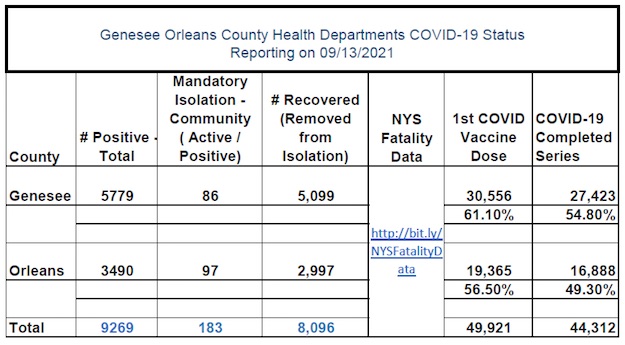
There are 63 new Covid-19 cases in Orleans County since Thursday and 56 more in Genesee County, the Genesee and Orleans County health Departments reported today.
The new cases in Orleans include the age groups of 0-19, 20s, 30s, 40s, 50s, 60s, 70s and 80s.
There are currently five Orleans County residents hospitalized due to Covid, which is up from three on Thursday, according to G-O Health.
Orleans also had 43 more of the previous positive individuals complete their 10-day isolation and they have been removed from mandatory isolation.
Genesee is reporting 56 new positive and the individuals are in the age groups of 0-19, 20s, 30s, 40s, 50s, 60s, 70s and 80s.
There are currently 14 Genesee residents hospitalized due to Covid, which is down from 16 on Thursday, G-O Health said this afternoon.
Genesee is also reporting 37 more of the previous positive individuals have completed their 10-day isolation and been removed from mandatory isolation.
The active Covid cases in the two counties are up from 112 six days ago on Sept. 7 to 183 today. That includes Orleans – from 59 to 97 – and Genesee – from 53 to 86.
Return to top
Public hearing on Oct. 4 for Heritage Wind PILOT
Heritage Wind would pay county, 2 school districts about $400,000 annually; PILOT doesn’t include over $1.2 million to Town of Barre
BARRE – There will be a public hearing at 10 a.m. on Oct. 4 at Barre Town Hall about a proposed PILOT (payment in lieu of taxes) plan from Heritage Wind, where the company will pay over $400,000 annually to Orleans County, Albion Central School and the Oakfield-Alabama school district.
The PILOT doesn’t include the Town of Barre, where 33 proposed turbines would be located. The town negotiated a separate host community agreement with Heritage Wind’s parent company, Apex Clean Energy.
That agreement gives Barre 75 percent of the local municipal revenue for the project or more than $1.2 million annually. Barre also will receive an upfront payment of $250,000 if the project is approved by the state, and the host community agreement would also provide about $75,000 annually to the Barre Fire District.
Apex proposed $9,000 per megawatt annually or $1,663,200 in total municipal revenue in year one of the project to be divvied up among the Town of Barre, Orleans County, Albion school district (where 32 turbines would be located) and Oakfield-Alabama (which would have one turbine).
Barre would receive $6,750 per megawatt or 75 percent of that total of the 184.8 megawatt project or $1,247,400.
The other taxing entities would share $2,250 per megawatt capacity through the PILOT or $415,800 in year one. That increases by 2 percent each year through year 14, and then 2.5 percent annually for years 15 to 25.
The details of the PILOT haven’t been made public yet. But the Albion Board of Education in December 2020 voted to accept the PILOT agreement with Apex.
In December the terms of the PILOT called for to receive $1,091.91 per megawatt annually or $201,600. One of the 33 turbines also is proposed to be in the Oakfield-Alabama school district, which would receive $34.09 per megawatt or $6,300 annually.
Orleans County would receive $1,125 per megawatt for $207,900 in the first year.
Heritage Wind, back in December, also agreed to $50,000 to the Albion school district for a one-time “Heritage Wind Renewables Ecology, Clean Energy, and Sustainability Scholarship and Education Support Fund.” The money is to be spent at the discretion of the district. It could be used for scholarships, science fairs, student research projects, financial support for faculty in renewable energy field, a STEM lab or “however the district deems fit.” The $50,000 is to be paid within 15 days after completion of the project.
The Orleans Economic Development Agency will be leading the Oct. 4 public hearing and administering the PILOT. The agency on Friday agreed to pay $5,750 to the Center for Governmental Research to review Apex’s Job and Economic Development Impact (JEDI) wind model and to provide an estimate of the employment, earnings and output estimate for the project.
CGR also will estimate the difference between tax revenue anticipated under the PILOT agreement and the tax revenue that would be received, were the development fully taxable. The report also is to include the value of lease payments to property owners that would host the Heritage turbines. CGR is to provide the report by Oct. 1.
Heritage is projecting 201 construction jobs paying $14.7 million for the project, another 218 job impacts through the turbine and the supply chain at $16.3 million, 90 other positions affected though “induced impacts” at $6.3 million, and five more jobs for construction-related services at $600,000. The company puts the entire construction impact for jobs at 514 workers earning $37.9 million.
Annual operation and maintenance is forecast by the company to include eight onsite jobs at $800,000, 14 other jobs impacted through “local revenue & supply chain impacts” at $1.1 million, and 10 other jobs through “induced impacts” at $800,000 for an annual reoccurring impact of 31 jobs total at $2.6 million.
The eight local jobs by Apex include two administrative/secretarial at $18.60 per hour, two technicians at $29.06 per hour, and two site management positions at $46.50 per hour, according to an Apex filing with the state.
Return to top
Brockport moves up in rankings among regional universities in the north
Press Release, Brockport State College
BROCKPORT – SUNY Brockport has again been recognized for excellence by U.S. News & World Report. Brockport ranked No. 73 among regional universities in the north in the publication’s 2022 Best Colleges rankings, which were released Sept. 13.
Brockport jumped 10 spots from its ranking a year ago.
“I would like to thank our outstanding faculty and staff for all they do each day to make SUNY Brockport a great place for our students to learn,” said Brockport President Heidi Macpherson. “We will continue to provide our students with an exceptional experience both inside and outside of the classroom.”
SUNY Brockport was also recognized in the following categories:
- Top Public Schools, Regional Universities North: No. 20
- Best Colleges for Veterans, Regional Universities North: No. 29
- Social Mobility (measures the extent schools enrolled and graduated students who received federal Pell Grants), Regional Universities North: No. 35
- Best Undergraduate Nursing: No. 251
- Best Undergraduate Computer Science Programs: No. 274
National Grid warns of scammers seeking account info, Social Security numbers
Press Release, National Grid
National Grid customers and local law enforcement are reporting utility billing and payment scams across upstate New York. The company is asking its customers to beware and know the signs of a scam.
Imposters claiming to be from National Grid may tell customers that they have past due balances on their utility bills, even promising a savings on their next bill. Customers who reported the scams, say they were contacted by telephone and email, and in some cases automated recordings.
The scammers threaten that service will be shut off immediately unless the customer purchases a prepaid debit card in a specific amount, such as a Green Dot card, and provides the caller with the card’s account number, or in the case of business customers, by way of a Western Union money transfer. Imposters also may ask for a Social Security number and a National Grid account number. These calls are not officially from National Grid and instead are from scammers who are looking to obtain personal information and payments.
The scenario can change, but the goal of the scammer remains the same: scare customers into making hasty decisions that often include large payments.
National Grid does contact customers with past due balances by phone to offer payment options, but never demands direct payment through the use of a prepaid debit card and never accepts payment through these cards.
Scammers have become increasingly sophisticated in replicating National Grid’s recorded messaging and directions for phone prompts, even spoofing the phone number on caller ID, making it more difficult to differentiate an actual National Grid call from an imposter’s call. Similar scams have been reported across the U.S. by other utilities.
Customers who believe they have fallen victim to the scam should contact local law enforcement officials immediately. If you are provided a phone number that does not match numbers on the billing statements, it is likely that the call is a scam.
National Grid reminds customers to know the red flags and offers the following tips:
- Be vigilant. If you believe you are current on your National Grid account, it is highly likely a call seeking payment is a scam.
- Protect yourself. Verify you are speaking with a National Grid representative. Ask the caller to provide the last five digits of your National Grid account number. If the caller doesn’t know your account number and phishes for help, take charge and hang up immediately.
- Do not take the bait. Scammers will not have access to your account information, social security number or other personal details and you should never offer that information if asked. National Grid representatives will know your account number.
- Scammers also may contact you by email and attempt to lure customers into clicking on a link, visiting a malicious website, revealing account information, or calling a phone number.
- While National Grid may ask for a payment to be made over the phone, the payment method will be left to the customer’s discretion.
- Do not fall for scare tactics and threats. National Grid will not contact customers demanding immediate payment by wire transfer, Green Dot Money-Pak or any other prepaid card service.
- Do not cave to pressure. Never — under any circumstances — offer personal or financial information to someone who you cannot identify.
- Every National Grid employee carries a photo ID card, and contractors working for the company are also required to carry ID. If someone requesting entry into your home or business does not show an ID card, don’t let that person in, and call National Grid or local law enforcement.