By Ginny Kropf, correspondent Posted 23 May 2022 at 10:43 am
Meals will be served on Thursdays at East Avenue church
ALBION – Mike and Faith Smith are about to embark on a new mission in their goal to help feed the needy in the Albion area.
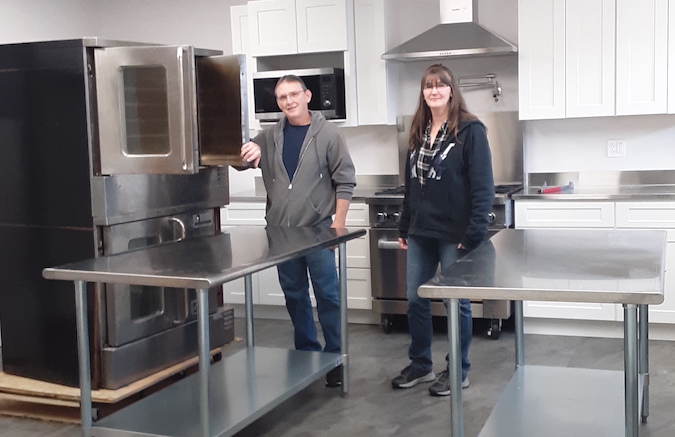
After running the Community Soup Kitchen at Christ Episcopal Church for 13 years, the couple is now planning to open Orleans Koinonia Kitchen (the Orleans OK Kitchen) at Harvest Christian Fellowship, 560 East Ave.
Faith said the name Orleans Koinonia Kitchen was suggested by the Rev. Tim Lindsay, who explained “koinonia” is Greek for fellowship. The Smiths want make sure everyone who comes to the OK Kitchen, as it will be known, knows they are seen as a person, not a number.
They plan to hand out goodie bags each week and will have a birthday box in which they will record the birth month and day of everyone who comes to dinner. The week of their birthday, they will receive a personalized card and a gift. Faith said they are looking for donations to buy gifts for birthday observances.
“It’s the little things like that which count,” Mike said.
The Smiths are concerned getting to Harvest Christian Fellowship on the outskirts of town might present a problem for some individuals looking for a meal. The Smiths are hoping some church might have a bus and be willing to adopt the soup kitchen as a ministry. This would entail parking at a chosen site downtown and taking people to the OK Kitchen at 4 p.m. and returning them at 5:30 p.m. each Thursday night.
While the former Community Soup Kitchen was open on Friday nights, the new OK Kitchen will be open on Thursday nights, as Harvest Christian Fellowship’s kitchen is not available on Fridays.
The first meal on June 2 will be tacos, a favorite of attendees, Faith said.
Lindsay said he offered the use of his church’s kitchen because “giving back to the community is the thing to do.”
“The soup kitchen not only puts food in their belly, but a smile on their face and warms their heart,” Faith said.
Anyone wishing to adopt a Thursday night to prepare a meal, make a donation of food or money or volunteer any night may contact Faith at OKKitchen2022@gmail.com or by calling (585) 319-1578. Donations may be made conveniently through Venmo or Paypal.
The Smiths and Christ Episcopal Church ended their relationship after a difference of opinion.
Jim Theodorakos, warden of the vestry along with Kevin Doherty, said the split was caused by miscommunication between the church and the Smiths.
Faith said she was summoned by the church to bring in receipts for all the transactions she had conducted as head of the soup kitchen, which she did.
Theodorakos said the church found nothing awry with the books.
Faith said she was asked for her keys shortly before Christmas.
In January, Faith reached out to Harvest Christian and shortly after, Pastor Lindsay opened up the new kitchen and dining room for use as a soup kitchen.
“We regularly had five groups who came in every month to cook and serve food,” Faith said. “This time we want the entire county to be involved, whether it’s Boy Scouts, Girl Scouts, churches or friends having a ‘girls’ night out.”
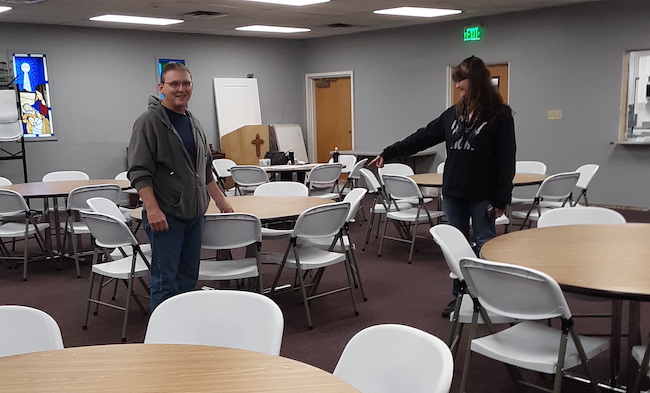
Mike and Faith Smith stand in the new dining room at Harvest Christian Fellowship at 560 East Avenue, which has offered its facility for the site of a new soup kitchen called Orleans Koinonia Kitchen. They will begin serving free meals there from 4 to 5:30 on June 2.
The Smiths are looking for individuals and groups to volunteer to help on a regular basis or whenever they can.
Faith said they were crushed when the soup kitchen at Christ Episcopal Church closed – with no notice to the community.
“For some of these people, it was the only hot meal they got in a week,” she said.
Not only did they receive a hot meal at the soup kitchen, but they would be sent home with a meal.
The Community Soup Kitchen was started in 1994 by former church rector Jeff Haines and Alex Krebs. The Smiths took over in 2009.
“It’s the friendships we made that I’m crushed to lose,” Faith said.
She said the kitchen was supported heavily by the community. Food was donated by Walmart and Community Action.
“We still go and get donated food to give out,” Mike said.
Neil and Kathy Samborski from Lyndonville still drive to Rochester to pick up excess food from Wegmans, Trader Joe’s, BJs, Sam’s Club and the Inner City Mission.
“What I’ve missed these past months is seeing the people who were so appreciative,” Faith said. “If food was short one week, we might have only had grilled cheese and tomato soup, yet no one complained.”
Press Release, NYS Department of Environmental Conservation
File photo by Tom Rivers: This photo from April 3, 2017 shows a painted turtle on Albion-Eagle Harbor Road in Gaines.
New York State Department of Environmental Conservation (DEC) Commissioner Basil Seggos today reminded New Yorkers that turtles are nesting in May and June, and asked motorists to “give turtles a brake.”
In New York, thousands of turtles are killed each year by unsuspecting drivers when turtles cross roads to find nesting areas.
“While a turtle’s shell provides protection from predators, it does not protect against being struck by vehicles while crossing roadways,” Seggos said. “Vehicle strikes are a major cause of mortality among turtles and New York’s native turtles are more susceptible at this time of year as they seek sandy areas or loose soil in which to lay their eggs. Especially in these coming weeks, DEC urges New York drivers to be on the lookout for turtles and slow down, particularly on roads near rivers and marshy areas.”
Drivers who see a turtle on the road are encouraged to slow down to avoid hitting it with their vehicle. If the vehicle can safely stop, motorists should consider moving the turtle to the shoulder on the side of the road in the direction it was facing, if drivers are able to safely do so.
Motorists are advised not to pick turtles up by their tails, which could injure the turtle. Most turtles, other than snapping turtles, can be picked up safely by the sides of their shell.
Snapping turtles have necks that can reach far back and have a strong bite, so if motorists try to help a snapping turtle, they should pick it up by the rear of the shell near the tail using both hands or slide a car mat under the turtle to drag it safely across the road. Do not drag the turtle by the tail as that can dislocate the tail bones.
A licensed wildlife rehabilitator may be able to help if you find an injured turtle.
DEC reminds people not to take turtles home. All native turtles are protected by law and cannot be kept without a DEC permit.
All 11 species of land turtles native to New York are in decline. Turtles are long-lived species and it takes many years for a turtle to reach maturity. Even losing one mature female can have a negative impact on a local population.
ALBION – Orleans County Sheriff Chris Bourke announced that local law enforcement agencies will actively participate in the STOP-DWI Memorial Day Weekend High Visibility Engagement Campaign from May 27 to May 31.
Memorial Day is one of the busiest travel holidays of the year and marks the official start of summer. Law enforcement agencies and local STOP- DWI programs will collaborate across the state and will be out in force in this coordinated effort to reduce the number of impaired driving-related injuries and deaths, said Bourke, the county’s STOP-DWI Coordinator.
The sheriff urges people to plan a safe way to get home. They could call a sober friend, family member, taxi or Uber.
By Tom Rivers, Editor Posted 23 May 2022 at 9:23 am
Photo by Tom Rivers: The Flying J gas station in Pembroke displays gas prices that likely shocked many motorists on Saturday evening.
Gas prices continued to jump in the past week by an average of 17 cents statewide and are now close to $5 for regular unleaded.
AAA reports this morning that the average price for regular unleaded in the state is at $4.933, which is a record high. The diesel price this morning is at $6.515, which is down about 3 cents from the record high of $6.542 on May 19, AAA reported.
The $4.933 price for regular unleaded compares to $4.759 a week ago, $4.233 a month ago and $3.072 a year ago.
The diesel price was $5.306 a month ago and $3.229 a year ago, AAA said.
The average prices in Western New York counties include:
Orleans, $4.879
Niagara, $4.755
Genesee, $4.821
Wyoming, $4.819
Monroe, $4.883
Livingston, $4.879
Erie, $4.841
Chautauqua, $4.731
Cattaraugus, $4.708
Allegany, $4.773
AAA issued this news release this morning:
“Pump prices are inching closer to $5 per gallon across New York as the Memorial Day holiday approaches. AAA research finds that three-quarters (75%) of US adults say they would change their driving habits or lifestyle if the cost of gasoline rises to $5.00 per gallon. Younger and older adults respond to gas price increases the same way.
“According to the latest data from the Energy Information Administration (EIA), total domestic gasoline stocks decreased while gasoline demand increased. Tighter supply and increased demand have pushed pump prices higher. This supply/demand dynamic, combined with volatile crude prices, will likely continue to keep upward pressure on pump prices.
“This morning, oil prices remain over $110 per barrel. Last week, crude prices dropped temporarily over market concerns about the likelihood of a recession. If a recession occurs, crude demand would likely decrease amid slower economic activity. Crude prices then recovered and increased over geopolitical concerns involving Russia and Ukraine.”
By Ginny Kropf, correspondent Posted 23 May 2022 at 7:32 am
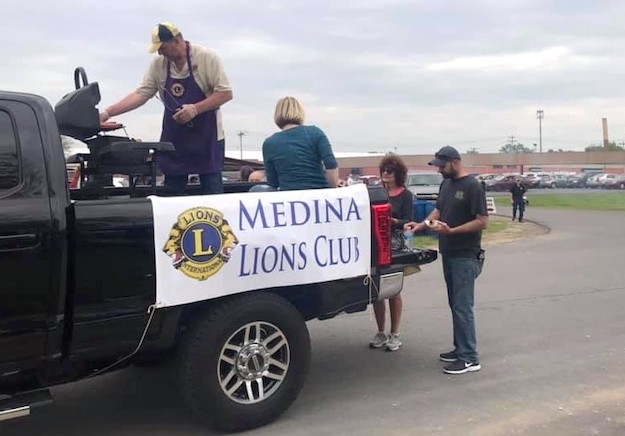
Provided photos: The Medina Lions Club sells hot dogs from their roving “Hotdogmobile” during last year’s Community Yard Sale. This year’s sale is June 4.
MEDINA – Bargain hunters get ready: the annual Community Yard Sale and flea market returns on June 4.
Sherry Wheatley, who started the Community Yard Sale, will again head the 15th annual sale.
This will be the 15th year for the yard sale in the village of Medina. The event is sponsored by Medina Lions Club.
Founded and organized by Sherry Wheatley, the yard sale has become a popular event, featuring community-wide yard sales, and a flea market and chicken barbecue at the Pickle Factory, 711 Park Ave.
A near record 52 vendors have already signed up and spaces are still available by contacting Wheatley at (585) 735-5135. Cost is $15 for a 20’ x 30’ space.
Wheatley recommends buying chicken barbecue tickets in advance, as they usually sell out. Tickets may be reserved by calling Tim Moriarty at (716) 417-0079.
The chicken barbecue will be served from 11 a.m. until sold out. The yard sales and events at the Pickle Factory run from 9 a.m. to 3 p.m.
The Lions will also have a food tent at the Pickle Factory, selling hot dogs and hamburgers.
Another feature of the yard sale is a traveling hot dog wagon, which the Lions call their “Roving Hotdogmobile.”
“This is a convenient way for shoppers to grab a bite to eat and get on to the next good deal,” Wheatley said.
Shoppers can buy a hot dog and drink by waving down the hotdogmobile as it drives through the streets.
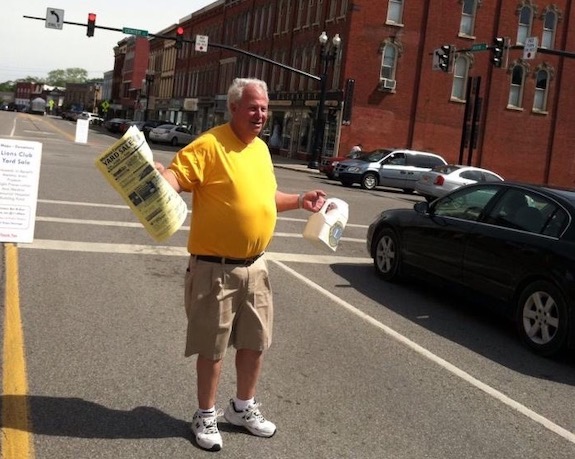
The day begins early, when Lions members will be on the four corners of Main Street by 8:30 a.m., handing out maps of yard sale locations for a donation.
Wheatley reminds everyone that every dollar earned by the Lions goes back for services to help the community.
Lance Mark, a member of Medina Lions, hands out maps with the location of yard sales in the village of Medina at last year’s Community Yard Sale. This year’s sale is June 4. Maps are provided for a donation.
By Ginny Kropf, correspondent Posted 22 May 2022 at 9:05 pm
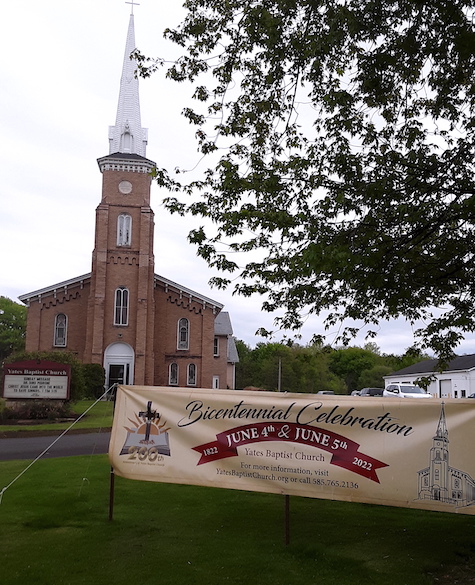
Photos by Ginny Kropf: This banner in front of Yates Baptist Church invites the community to join in their celebration June 4 and 5 to honor the 200th anniversary of the church and the town of Yates.
YATES – This year marks a milestone, not only in the history of the town of Yates, but also the Yates Baptist Church.
Both are observing their 200th anniversary this year, with the church celebrating June 4 and joining with the town’s celebration June 4 and 5.
On Saturday, events will begin at 11 a.m., featuring family activities and games, an eat-in chicken barbecue from noon to 2 p.m., demonstration by Bow Bending Believers, music in the tent, caricature sketches by Diane Martin and church tours from 1 to 3:30 p.m. An evening of music from 6 to 7 p.m. will feature local talent, followed by a free ice cream social.
On Sunday, the celebration continues with a Bicentennial Celebration Service from 9:30 a.m. to noon, with guest speakers and special music by Edward and Kristine Klaussen.
Food truck vendors will be on site beginning at noon, followed by old fashioned games, a bounce house and horse drawn wagon rides from 1 to 3 p.m. Events will conclude with a bicentennial closing program at 4 p.m.
The Yates Baptist Church is the only church ever established in Yates Center. Yates Center was originally known as Northton, but was changed to Yates when Joseph C. Yates was elected governor of New York state in 1822.
Elisha Brown, a physician and member of the Baptist Church of Palmyra who settled in Yates in 1820, was a strong advocate of temperance. He was the first to unite the town to form a strong society to promote that cause, according to a history book compiled by Jon Neal and Lynne Wilson.
In 1822, the Rev. Jeremiah Irons, who was Dr. Brown’s pastor, followed, and through these two men, the church of Yates was founded June 6, 1822. The Rev. Irons served until his death on March 13, 1829.
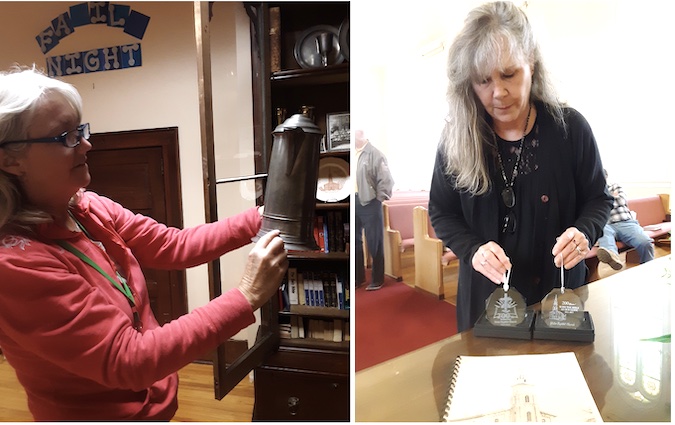
Lynne Wilson (left) holds the original communion cup she found at Yates Baptist Church. Mitzi Fredericks holds two of the ornaments commemorating the 200th anniversary of Yates Baptist Church. The one in Fredericks’ left had was designed by Beth Carpenter and the other by sixth grader Alexa Robinson.
The first meeting of the church was June 6, 1822 in a schoolhouse north of the village. It consisted of eight members, the Rev. Irons, Dr. Bowen, John H. Burroughs, Abigail Irons, Laura Irons, Adaline Bowen, Belinda Burroughs and Rebecca Rawson. On Sept. 22 of that year, nine candidates for membership were immersed in Johnson’s Creek near the grist mill, about two miles below Lyndonville. It is believed to be the first baptism in the town, and the late Jackson Blood was the first person baptized in the group.
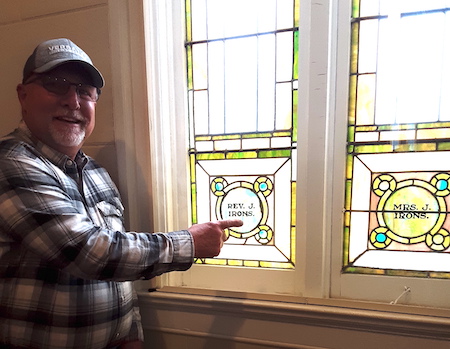
Jon Neal stands next to the stained glass window named for the first pastor of Yates Baptist Church, the Rev. Jeremiah Irons. Neal is an eighth generation descendent of Irons.
Meetings for the first 10 years were held in schools, homes and Dr. Bowen’s office. The first baptismal service of the church was held at Blood’s Bridge.
It is interesting to note the salary the Rev. Irons received was $75 a year – half in cash and the other half in grain. From 1831 to 1834 the pay was increased to $275 and included wood for heating. In 1864, the pay was $350 with a parsonage provided. By 1900, the salary had increased to $400 and the total church budget was $550. The total church budget in 2002 was $99,870, compared to $165,000 for 2022.
A 100th anniversary celebration took place on the weekend of Nov. 19, 1922, with three services on Sunday. They were preached by the Rev. C.F. Knauth and Mrs. J.D. Waterbury, historian, read the history of the church. Addresses in the afternoon were given by Ada Furness, a missionary to Africa and the Rev. J.T. Allen of the Medina First Baptist Church.
A 132-year Founders’ Day Celebration took place June 6, 1954, at which Esther Baker read the church history in the evening. Baker, who has since moved to Canandaigua, will be 100 next January and still supports the church.
Also attending the Founders’ Day services that day were fifth- and sixth-generation members of the Rev. Jeremiah Irons’ family. Virginia Wirth Cooper was a great-great-great-granddaughter of the Rev. Irons. Seventeen of the 22 couples who had been married in the church attended the morning service. On display was a four-piece pewter communion set found tucked away in an upstairs church cupboard. It bears the date 1838 and is believed to be the church’s first communion set.
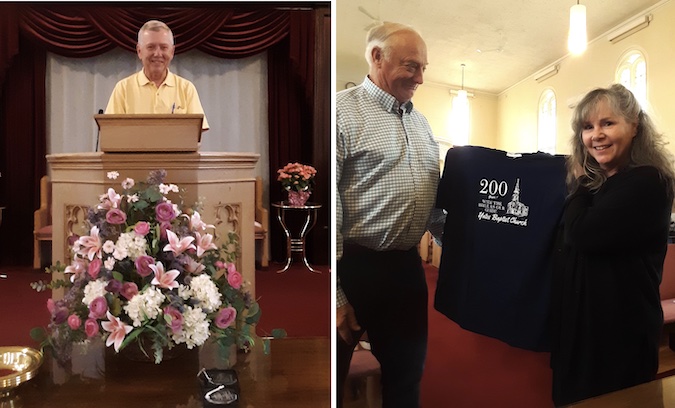
The Rev. Lyle Drake, pastor of Yates Center Baptist Church, talks with members of the congregation who are planning a celebration for the church’s 200th anniversary June 4. Bob Breeze and Mitzi Fredericks look at one of T-shirts commemorating Yates Baptist Church’s 200th anniversary.
The set is also currently on display in a cabinet off the sanctuary, after Lynne Wilson went looking for it and also found it stored away in an old back cupboard. It has been polished and shined and sits in a prominent place where everyone can see it.
Other celebrations were held to observe the 150th and 180th anniversaries of the church. Membership in 1972 had grown from the original 22 souls to 156. In 2002, the 180th celebration spanned three days, featuring a Creation Science Evangelism Seminar on Friday at Lyndonville Central School Auditorium.
In 1989, the church hired its first youth pastor, Steve Thompson, to minister to the large number of children and youth attending church. They are blessed today with a large attendance of children. Twenty to 25 regularly attend and the nursery is full, said Lynne Miller.
Yates Baptist Church has occupied several buildings, the first being completed in 1832. It was enlarged and repaired for $3,500 in 1866, but burned to the ground before work was completed. The church has actually had two fires, according to members of the bicentennial celebration committee.
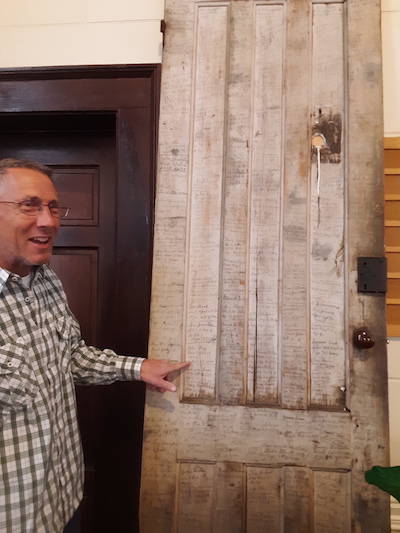
Bill Wilson, a member of Yates Baptist Church since 1985, points out names on the door to the bell tower, on which are written the names and date of death of hundreds of early members of the church. The door was removed to the sanctuary so visitors would be able to see it.
Construction of the current brick structure was completed and the building dedicated Jan. 30, 1868 at a cost of $10,522 for the building and all the furnishings. The brick used was brought from Canada on freighters to the piers at Shadigee.
The second fire occurred in April 1927 and destroyed the rear Sunday School rooms and kitchen. No banks would approve a loan for the rebuilding, so the trustees on the board, including Stanley Breeze and Stanley Baker, signed their farms’ deeds as collateral. By the time of completion of the rebuilding, the debt was paid off.
The Rev. Floyd Childs was pastor from 1943 to 1953, and during his pastorage one Sunday loud snapping noises were heard and plaster began falling from the north end of the sanctuary. The trustees realized the joists in the ceiling were breaking and moved the congregation to the south end of the room while the pastor kept preaching. The ceiling was reinforced by several members under the director of Ken Neal.
From 1951, until the present, many repairs and improvements have been made to the church. These include repairs to the steeple, stained glass windows repaired or replaced, a new furnace, new pews, renovation of the parsonage, a two story addition, purchase of an adjacent property for more parking, a new parsonage kitchen, new handicap bathroom and a picnic pavilion erected, to name a few.
The parsonage is located just past the cemetery, having begun as a log home costing $275. It was replaced by a frame building in 1837 costing $500. The home and barn burned in 1853 when a fire broke out in the nearby planing mill and destroyed a large part of the village. They were rebuilt for $1,000 and since then, upgrades and repairs have resulted in a nicely maintained home.
Music has always been a big part of worship at Yates Baptist Church. The Moeller organ was donated by the late Daniel Ross in memory of his parents Alexander and Ann Ross in 1933. A Baldwin piano was purchased in 1960 and a baby grand piano was donated in 2006 in memory of Sarah Callard by her parents Gary and Dorothy Callard and sister Patricia Callard Corser.
Several members of the church recently met to share their affiliation and dedication to the Yates Baptist Church. Jon Neal boasts being an eighth-generation descendent of the church’s first pastor, the Rev. Jeremiah Iron. He and his wife Carol and their ancestors have attended all their lives, except for a period of 20 years.
Bob and Karen Breeze have been members for 54 years. His great-great-grandfather was married there in 1891 His mom and dad were also married there, around 1918, Bob said.
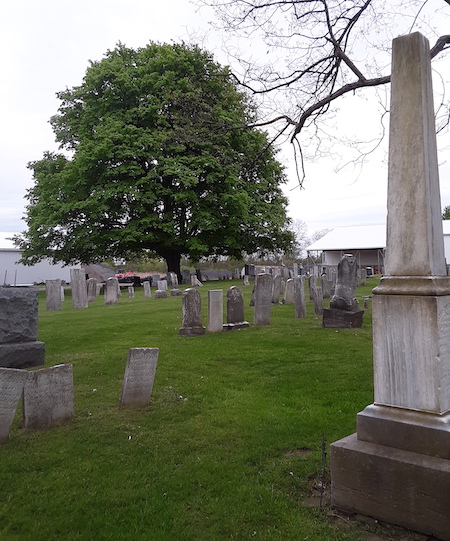
The Yates Center Baptist Church cemetery is located across the parking lot from the church. The tall monument at right is that of the Rev. Jeremiah Irons, first pastor of the church in 1822.
Bill and Lynn Wilson started attending there when they were expecting their oldest daughter in 1985.
Ray and Beckie Feller have been members for 24 years.
Merle and Mitzi Fredericks are new kids on the block, having started attending two years ago.
“They have a men’s breakfast every other Saturday with devotions and prayer,” Mitzi said. “Merle was invited and was so enamored with the pastor, he wanted to come back and hear him preach.”
The Rev. Lyell Drake and his wife Callie came to Yates Center 21 years ago. He had been preaching in Phelps when he said he felt led of the Lord to move. In seeking a new location he applied to Yates in 2000. He accepted the call here in June and came in September that year.
“I felt a sense of welcome,” the Rev. Drake said. “They wanted someone who could stay a while. This is a congregation that is hungry for the Word. It’s a pastor’s paradise.”
Pre-Covid membership exceeded 100. Since Covid, Bill Wilson has been posting the Sunday service online at www.yatesbaptistchurch.org. It is available in YouTube format.
The church boasts a large children’s attendance and family night, with worship and singing, followed by the kids breaking into small groups for Bible lessons, crafts, games, memorizing Scripture and songs.
A Men’s Discipleship meets the first and third Thursdays of each month. They sponsor Vacation Bible School every summer and a Harvest Dinner the first Sunday in November. A free will offering benefits a special church project. A concert by the choir follows.
The choir regularly has 10 to 15 members, led by Lori Boseck.
Janoah Atwater is worship leader/pianist and Jackie Reichard is organist.
The church has supported missionaries since its founding. The First missionary was Vada Furness, who traveled to the Belgian Congo during World War I. During the trip home her ship hit a mine and she lost everything she had, but she survived. The church currently supports 21 missions and/or missionaries.
A highlight of the 200th anniversary celebration will be the opportunity to view a historic door from the bell tower. The door has been removed and placed in the sanctuary so it can easily be viewed. It contains the names and date of death, written in pencil, of the early members of the church, most of whom the committee believes are buried in the church cemetery.
By Mike Wertman, Sports Writer Posted 22 May 2022 at 5:14 pm
Sectional baseball playoff action will swing into high gear on Monday.
In Section VI Class B2, No. 6 seed Medina will open defense of its title by hosting No. 11 JFK at 5 p.m. The winner will advance to a quarterfinal round contest at No. 3 Eden on Tuesday.
Also in Class B2, No. 5 Roy-Hart will host No. 12 Cleveland Hill and No. 8 Akron will entertain No. 9 Newfane at 5 p.m. The Roy-Hart vs. Cleve Hill winner will visit No. 4 Fredonia in the quarterfinals on Tuesday while the Akron vs. Newfane victor will visit top seeded Alden.
In Class B1, No. 8 Albion will host No. 9 Dunkirk at 5 p.m. with the winner advancing to a Tuesday contest at No. 1 City Honors.
In Class C, No. 11 Barker visits No. 6 Salamanca and No. 9 Wilson travels to No. 8 Chautauqua Lake in 5 p.m. contests.
Section VI playoff action also gets underway at 5 p.m. Monday as No. 8 Lyndonville hosts No. 9 Byron-Bergen in Class C3 and No. 10 Holley visits No. 7 Alexander in Class C1.
Two local Section V softball games at 5 p.m. Monday will have No. 1 Lyndonville hosting G-R foe No. 8 Notre Dame in Class C3 and No.3 Kendall entertaining No. 6 Pavilion in Class C2.
By Mike Wertman, Sports Writer Posted 22 May 2022 at 5:01 pm
Seeded No. 8, Lyndonville will face a familiar foe to open the Section V Class C3 baseball playoffs as the Tigers will host Genesee Region League foe No. 9 Byron-Bergen at 5 p.m. Monday.
The Bees just nipped the Tigers 6-4 this past week to close out the G-R season.
The winner will face top seeded Bolivar-Richburg in the quarterfinals later this week.
In Class C2, G-R Division 1 champion No. 3 seed Kendall will host the winner of the No. 11 Pembroke vs. No. 6 Warsaw game later this week.
In Class C3, No. 10 seed Holley visits No. 7 Alexander at 5 p.m. Monday. The winner will face No. 2 Letchworth in the quarterfinals.
By Ginny Kropf, correspondent Posted 22 May 2022 at 8:13 am
Photo by Ginny Kropf: Barrels containing hazardous materials were moved at the site of the former Starlite Cleaners. They were moved away from the sidewalk to the back of the lot on Friday. The DEC is seeking a qualified company to take the barrels away and properly dispose of them.
MEDINA – Business owners on North Main Street will be happy to know the New York State Department of Environmental Conservation is making arrangements to have half a dozen barrels of hazardous waste removed from the former Starlite Cleaners property as soon as possible.
The site was home to Starlight cleaners from 1952 to 2004. The building was badly damaged in a fire in 2004.
The DEC began extensive studies and cleanup two years ago.
It has removed the former building. A $490,000 remediation plan includes removing 8 feet of soil and other work.
The location is a State Superfund Site and is listed as a Class 2 site in the State Registry of Inactive Hazardous Waste Sites. A Class 2 site represents a significant threat to public health or the environment, with action required, the DEC said.
When Mayor Mike Sidari learned area business people were expressing concerns about the barrels containing hazardous waste and left sitting there, he contacted the DEC. Thursday he received a reply from Gail A. Dieter, environmental chemist with the Division of Environmental Remediation.
Dieter’s e-mail stated the drums on the site contain purge water and soil boring wastes from the pre-design investigation conducted several years ago. In order to dispose of the contents properly, waste characterization samples were collected and sent to a laboratory for analysis. According to Dieter, the data has recently been received and DEC is in the process of contracting with a waste removal company to pick up the drums and dispose of them safely and in a timely manner.
She added the drums have been inspected on a monthly basis, and as an added protection, they have been arranged on pallets over plastic sheeting, as well as being covered with plastic sheeting.
At the mayor’s request, consulting engineers who visited the site on Thursday moved the barrels from the fence near the sidewalk to the back of the lot, until they can make final arrangements for their disposal.
By Tom Rivers, Editor Posted 21 May 2022 at 9:38 pm
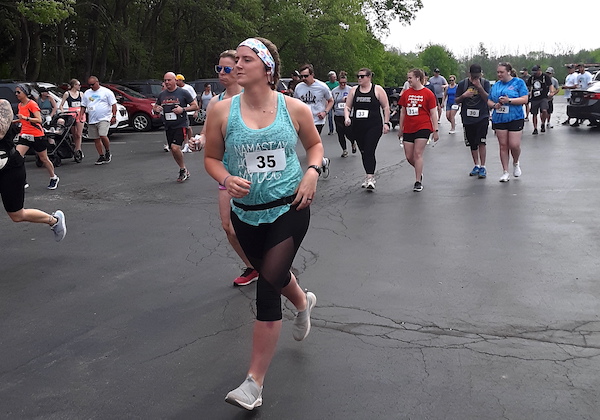
Photos by Ginny Kropf: Runners, walkers and families pushing strollers start off from Junior Wilson Club on the 3.1 mile trek in the Medina 5K Run/Walk.
MEDINA – A 5K run/walk Saturday morning at Junior Wilson Club brought out 50 participants to support the event, which will benefit a Medina family and the Mary Kay Ash Foundation.
Event coordinator Michelle Sidari of Farmington, daughter-in-law of Medina Mayor Mike Sidari, is a senior sales associate with Mary Kay and organizer of several runs/walks to benefit charity.
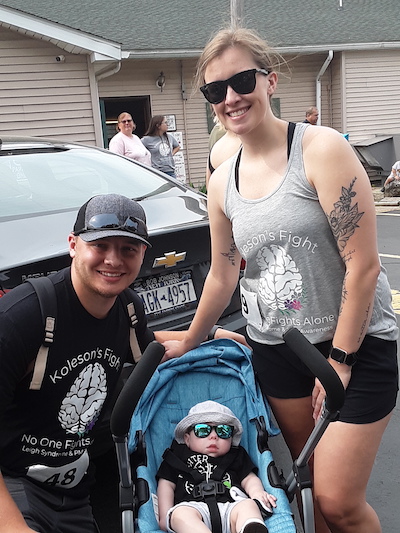
Brady and Dominique Meakin walked with son Koleson in the 5K run/walk held for their benefit this morning.
When she heard about Koleson Meakin, infant son of Brady and Dominique Meakin of Medina who was born with a rare genetic disease called TPK1 Leigh disease, she knew she wanted to help.
In addition to a basket raffle, Lynn Winters Woodruff sold candy bars, with proceeds going toward the benefit. Candy bars will continue to be sold at Genesee Feeds in Batavia, a business owned by Woodruff’s brother.
Saturday’s race started with a prayer of healing for Koleson, now 9 months old, by Pastor Virginia Thomas from the River at Orleans County, NY Church in Knowlesville.
Many families pushed their young children in strollers in support of the Meakin family.
“This is a family event,” Michelle said.
Koleson’s parents also pushed him in his stroller, while he slept. Dominique said this was Koleson’s second walk, as they participated with him in the ARC walk when he was two and one-half weeks old.
The first male runner to complete the race was Henry Rigerman of Medina, with a time of 21.47. The first woman was Rhonda Marciano of Medina, with a time of 23.44.
Proceeds of the event were not available, but Michelle guaranteed every penny will be donated to the Meakin family and Mary Kay Ash Foundation. The Mary Kay Ash Foundation helps fight domestic violence and cancers affecting women.
She thanked all of the business sponsors who made donations. These included Avanti’s Pizza, Bent’s Opera House, Case-Nic Cookies, Della’s Chocolates, Fitzgibbons Pub, Genesee Feeds, Hartway Chevrolet, Herbalty Cottage, Junior Wilson Sportsmen’s Club, Kustom Kreations, Mark’s Pizzeria, Mary Kay, 810 Meadworks, Ontario Shores Federal Credit Union, Rotork Controls, Rudy’s, Sourced Market and Eatery, Specialty Lawn Rx and Zambistro’s.
There is also a Cruisin’ for Koleson car show and basket raffle from 9 a.m. to 4 p.m. on May 28 at the Orleans County 4-H Fairgrounds in Knowlesville. There will be food vendors and live music.
Kathy Jurs of Medina with her 10-month old son Mason is the first walker to be registered for the Medina 5K run/walk for a Medina family.
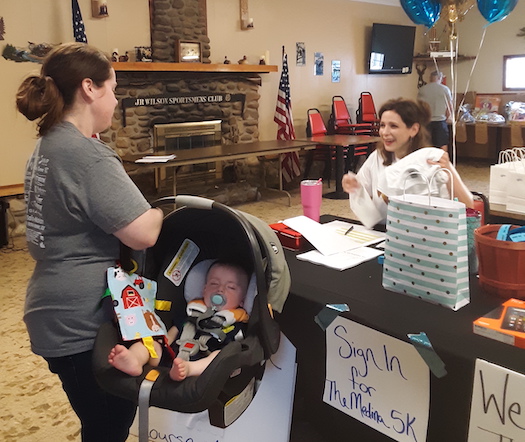
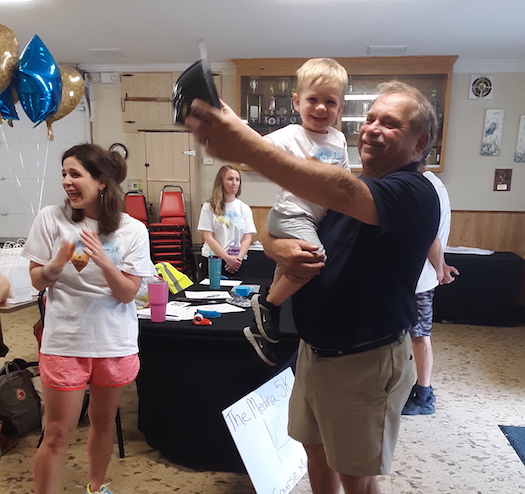
Medina Mayor Mike Sidari holds his grandson Micah, 2, while daughter-in-law Michelle Sidari, left, prepares to register participants in the Medina 5K run/walk Saturday morning at Junior Wilson Club.
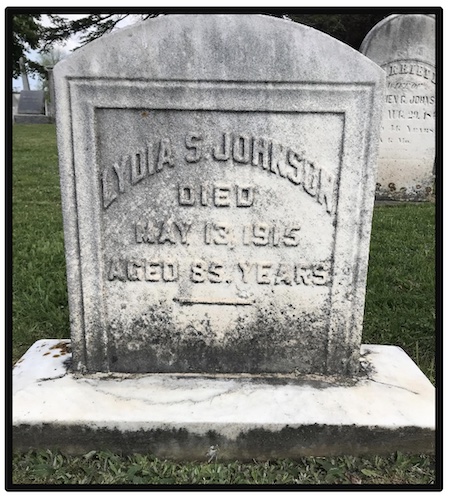
The headstone for “Aunt Selina” as she was known is in Lynhaven Cemetery in Lyndonville.
LYNDONVILLE – Lydia Selina Johnson of Lyndonville was the only nurse from Orleans County to serve in the U.S. Civil War. She was born on April 31, 1830, the daughter of Stephen Burr Johnson and Maria (Gilbert), the youngest of five children.
The following is an excerpt from a reading given by Selina Johnson at the Literary & Historical Society of Lyndonville, Feb. 22, 1898. Full text on file at the Orleans County Historian’s Office.
“Let me relate to you an incident that I witnessed in the Old Warehouse Hotel, in Georgetown, in the Fall of ’62, just after the second Bull Run Battle: there had been a soldier boy who had just passed his eighteenth birthday, by the name of Shepherd from Marble Head, Mass. brought in there after having lain in the battle field eight days.
“The surgeons, upon examining the wound, found that the leg was so badly shattered that it would have to be taken off at the knee. He stood the amputation well, but it was only a short time after, before it was discovered that tetanus had set in, and in about two days, the flesh had drawn back, so that the end of the bone protruded nearly an inch.
“It was decided that his only chance of life was to have the bone cut off so the flesh could be brought up and cover the end of it. They tried it, but it was not of any use…He was a terrible sufferer the last few days he lived. The only way he could get any relief from the fearful pain was for someone to clasp around the leg with both hands, as near where it was cut off as they could and while clasping tight, press the flesh down over the end of the bone. It was very hard work, so we nurses took turns.”
With the advent of the war, reformer Dorothea Dix had been assigned to organize a female volunteer nurse corps. The requirements were strict. Candidates were to be matronly persons of experience, good conduct, or superior education and serious disposition, who displayed habits of neatness, order, sobriety, and industry.
These criteria were designed to minimize potential problems or complaints as female nurses were not welcomed by the male medical establishment at first. Compensation for nurses was 40 cents a day and a three-month minimum period of service was required. As the war progressed, the nurses proved invaluable as caretakers in a sea of carnage, providing nurturing comfort and assurance to injured and dying soldiers, as well as medical care.
Selina had acquired nursing experience working with her brother Dr. Nathan Porter Johnson. She served under Dorothea Dix from September 1862 to July 1865. She contracted typhoid in March 1863 and came home to recuperate but returned to Washington in the fall of 1864. She worked in Georgetown, Washington D.C., Alexandria, Chesapeake, and Old Point Comfort, Virginia.
The disorganization during the early months of the war has been chronicled. Selina’s first experiences of those early months echoes those accounts. She described this to her audience in Lyndonville on that February evening in 1898:
“The Government was not prepared for such manslaughter. Hotels, schoolhouses, churches, and private homes were commandeered for hospital use. The Capitol building was full and there were 500 in the Patent Office Building. In the winter of 62 and 63, there were no less than 12,000 sick and wounded soldiers in the District of Columbia. If you counted those in and around Alexandria, you would have to multiply that number by two. Our Government was without the means to do with and they were ignorant of the needs of so many. They had to learn by experience. We lacked help and almost everything else but bread. Long weary tramps going from one Sanitary Commission house to another, sometimes getting the desired articles and at others, going home empty handed.”
The situation improved as time went by:
“During the winter of ’64 and ’65, I was in the Chesapeake Hospital, Fortress Monroe. At the time, everything was running like clockwork. Order had been brought out of chaos. There was plenty of everything and if we wanted anything, we knew where to get it.”
Selina’s account of her experiences is detailed and forthright. She describes the sufferings of the patients and the privations of the hospital conditions. Simple things made such a difference – wooden stools to sit on, tinware with handles for cooking. A dying soldier expressed a desire for new milk before it got cold with some bread in it, like his mother would give him. A kind lady who kept a cow brought him fresh milk morning and evening for the remaining week that he lived. This is but one of her graphic descriptions.
Following the Civil War, deceased soldiers’ widows, dependent fathers, and brothers were eligible for pensions. The Grand Army of the Republic, a veterans’ organization, waged a long campaign for the Dependents’ Pension Bill, which was approved in 1890. This expanded pension eligibility to include disabled veterans who had served for ninety days, or widows whose husbands had served for ninety days, regardless of whether the disability or death were service connected. Funding for the expanded benefits accounted for roughly 40% of the federal budget at that time.
However, nurses who had served in the Civil War were not automatically entitled to any post war service benefit and had to wage a long campaign until the Army Nurses Pension Act was finally passed in 1892. This entitled women who served as nurses in the Union Army to a pension of $12 per month, provided they had worked at least six months and had been hired by someone authorized by the War Department to engage nurses. This was a departure from previous legislation as it was not tied in with a woman’s marital status, but rather, was a recognition of her contribution. It afforded a welcome degree of financial independence to many women.
Selina returned to Lyndonville after the war. She did not marry, she worked at her brother’s office, lived with her widowed mother until her mother’s death and subsequently lived alone. She was able to enjoy her nurses’ pension for twenty-three years. According to her obituary printed in the Lyndonville Enterprise of May 20, 1915, she was the primary founder of the Literary and Historical Society of Lyndonville and was a member of the Methodist Episcopal Church. She died at the age of 85 at the home of her niece, Mrs. Bessie Johnson, on North Main Street, Lyndonville. The Sons of the Veterans conducted military honors at her graveside in Lynhaven Cemetery.
By Tom Rivers, Editor Posted 21 May 2022 at 8:04 am
KNOWLESVILLE – A conference today at the Orleans County 4-H Fairgrounds will honor the memory of two very active members of the Self-Advocacy All-Stars.
The Jonathan Doherty and Gladys Hopper Self-Advocacy Day will be from 11 a.m. to 3 p.m. at the Orleans County 4-H Fairgrounds in the education building.
The conference will educate about the rights of people with disabilities and teach about what it means to be a self advocate.
Doherty, 38, was the local group’s president. He passed away at age 38 on May 5. He helped organize the conference, which will include speakers from the Self-Advocacy Association of New York State.
Gladys Hopper also was a member of the local Self-Advocacy All Stars. She passed away at age 71 on Jan. 6.
Speakers today during the conference will include Mike Woodward of the local Self Advocacy All Stars, Terry Kingdollar of Arc GLOW, SANYS Western Regional Coordinators Sophia Roberts and Mike Rogers, People Inc. Director of Advocacy and Person-Centered Practice Rick Banner, and Duane Montgomery of Self Advocacy All Stars.
By Mike Wertman, Sports Writer Posted 20 May 2022 at 7:34 pm
Photos by Cheryl Wertman – The Lyndonville community celebrated Mark Hughes’ 50 years as a Tigers baseball coach in ceremonies preceding this afternoon’s Byron-Bergen at Lyndonville game. Here Hughes is flanked by Tigers varsity Coach Shane Price, left, and former long time Lyndonville varsity Coach John Hayes.
Here Coach Mark Hughes leads the Tigers up the field between a crowd of well wishers many of whom were wearing Hughes 50 T-shirts. (Click Here to view a video of the celebration)
Press Release, State Senate Republican Leader Rob Ortt
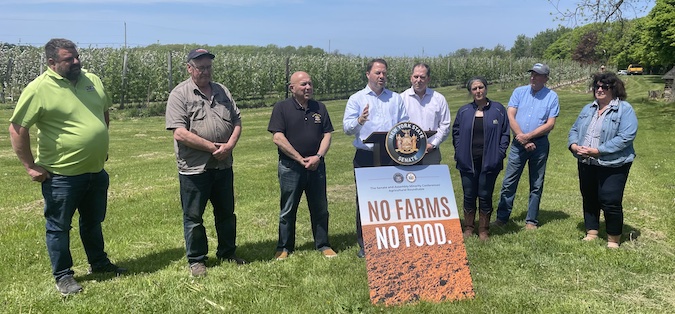
APPLETON – Senate Republican Leader Rob Ortt, Assemblymembers Mike Norris, Angelo Morinello, and industry stakeholders today called on the Governor and NYS Department of Labor to reject the Farm Laborers Wage Board’s recommendation to reduce the overtime threshold for farms from 60 hours per week to 40 hours per week.
“Our family farms and farmworkers play an incredibly important role in our society. The farming industry is a unique system that works much differently than corporate 9-5 jobs,” Ortt said. “This burdensome mandate will cause farms to go under, cut worker’s hours, and jeopardize the future of New York’s agriculture industry — adding to the exodus of people leaving our state. The Governor and NYS Department of Labor MUST reject this proposal for the future of our farms and economy. Bittner Singer Orchards is one of the many farms that fear the effects of lowering the overtime threshold. I’ve traveled across the district and heard the concerns of our farmers. I will continue to be their voice in Albany and advocate for the ones who know what’s best for our farms: our farmers and farm workers.”
In January, the Farm Laborers Wage Board recommended the reduction of the overtime threshold for farm laborers. Ortt called out the disastrous decision by the unelected Albany bureaucrats as “jeopardizing the future of New York’s agriculture industry.”
Several Economic Development and Business Organizations have come out and urged the Governor to maintain the 60-hour overtime threshold, including the Grow NY Farms Coalition, the Business Council of New York State (BCNYS), the National Federation of Independent Businesses of New York (NFIB), and Upstate United.
For years, Ortt and the Senate Republican Conference have listened to and stood with family farmers and local New York farms and have advocated against burdensome Albany mandates, like the lowering of the overtime threshold. Last year, Ortt and the conference sounded the alarm, multiple times, on the negative effects this policy would have on farmers and farmworkers alike.
“Farms across the state have been besieged by rising costs, including energy prices, various taxes, and rising labor costs as well as the addition of costly mandates from the state leading many farms, particularly small, family-run farms to close, consolidate or downsize operations,” said Assemblyman Mike Norris. “As the Consumer Price Index has risen more than 8 percent in the last year, New Yorkers, like all Americans, are struggling to make ends meet in the face of inflation. Families are having to make tough choices and I, for one, think our nation, and this great state, can do better. We have people who want to work, are willing to work and there’s work to be done. This is not the time to limit hard work, entrepreneurial spirit and ingenuity by putting farmers and farm workers alike out of business.”
“The idea that a week’s work on a farm can be completed within just 40 hours is entirely divorced from the weather-dependent reality of farming, where putting in extra hours is needed to either complete a harvest or save crops from the natural threats they face throughout the year,” Hawley said. “If the farm laborer overtime threshold is reduced to 40 hours, it has been projected by Farm Credit East that farmers’ labor costs could rise by as much as 42% over the next several years. Most farms already operate on razor-thin profit margins, so that spike in their expenses is one that could make the difference between maintaining their viability and making the hard decision to shut down their operations,” said Assemblyman Steve Hawley.
“The wage board process has been a frustrating one,” said Jim Bittner, President and General Manager of Operation at Bittner-Singer Orchards. “The farm community had an uphill battle going in, but at the same time we had hoped that the Department of Labor would at least listen to the people who actually farm and our employees. But in the end, all of that testimony fell on deaf ears. The Department of Labor did not even play all the submitted videos from both farmers and farmworkers nor take any time to deliberate or review all of the submitted material before making a recommendation. Most importantly, testimony highlighted how farmworkers are concerned about losing hours and income, said they would have to get a second job or look for jobs on farms out of state. The very people the policy claims to help, will lose in the end.”
“We appreciate the recently enacted overtime tax credit for farmers in this year’s state budget. It is clear, however, from the wage board hearings that farm workers and farmers alike believe the current overtime threshold works. Farmers and farmworkers are key to food security in New York State especially as we continue to see negative impacts from Covid-19 and the economic downturn. Thank you to Senator Ortt and his legislative colleagues for continuing to highlight this critical issue,” said Jeanette Miller, President of Niagara County Farm Bureau.
“We cannot afford these changes. I lost a worker because I had to cut his hours back. I know other farms who have lost workers because they are only allowed to work 60 hours. Lowering the threshold to 40 hours is going to make it harder to find labor in an already tight labor market. The Governor must also remember that farm work is very time sensitive – meaning many of our workers are only here during harvesting time,” said Pat McCormick, a dairy farmer and board member of the New York State Farm Bureau.



















 Selina had acquired nursing experience working with her brother Dr. Nathan Porter Johnson. She served under Dorothea Dix from September 1862 to July 1865. She contracted typhoid in March 1863 and came home to recuperate but returned to Washington in the fall of 1864. She worked in Georgetown, Washington D.C., Alexandria, Chesapeake, and Old Point Comfort, Virginia.