



















Press Release, Town of Barre
BARRE – The Town of Barre is updating its Comprehensive Plan and wants to hear from residents. The Town’s appointed Comprehensive Plan Committee will hold a public open house on Monday, April 29, at the Barre Town Hall, 14317 West Barre Rd.
Residents, landowners, and others interested in the future of the Town of Barre are invited to drop in any time between 4 and 7 p.m. The Town’s planning consultant will give a brief presentation on the Comprehensive Plan and the Community Survey at 4:15, 5:15 and 6:15 p.m.
The Town of Barre launched a Community Survey to help the Comprehensive Plan Committee better understand residents’ issues and priorities. The survey is available online at https://www.surveymonkey.com/r/BarreCommunitySurvey.
Residents may also call the Town Clerk at (585) 589-5100 to request a paper copy of the survey. Barre residents who complete the survey by April 15 will be eligible for a drawing to win $100.
The Comprehensive Plan will set goals and recommend actions to guide town decisions regarding:
For more information, please contact Comprehensive Plan Committee chair George McKenna at (585) 738-4875 or planning consultant Barbara Johnston at (585) 295-6636.
Return to topPress Release, Genesee & Orleans County Health Departments
Have you ever wondered why someone vapes even after learning about the dangers and effects from it?
There are hidden facts behind the range of colors and flavors associated with e-cigarettes. From addictive nicotine to harmful chemicals, the dangers of vaping are real. It is time to clear the air and learn about the risks of vaping.
Electronic cigarettes, or e-cigarettes, heat a liquid to create an aerosol, or mixture of tiny particles in the air. There are many different names for e-cigarettes, including “electronic nicotine delivery systems (ENDS),” “tank systems,” “e-cigs,” “e-hookahs,” “mods,” “vape pens,” and “vapes.”
The Public Health Law’s Article 13-E, sometimes referred to as the Clean Indoor Air Act, has grown in New York State to ban smoking and vaping, and prohibit the sale or distribution of nicotine vapor products with unique flavors, such as e-cigarettes.
However, the use of e-cigarettes by teenagers is on the rise, and sale of these devices to teenagers is illegal. According to the 2021 CLYDE Survey administered in schools in Genesee and Orleans Counties by UConnectCare (formally GCASA), it was reported that 19.7% of 11th graders reported vaping with nicotine in the previous 30 days, and 11.1% reported vaping with marijuana during the same time period.
Vaping is dangerous and can have unknown long-term impacts:
“Unlike cigarettes, vaping is often easy to hide due to its discrete nature,” stated Paul Pettit, Public Health Director for the Genesee and Orleans County Health Departments (GO Health). “The devices used for vaping sometimes look like USB drives or pens. E-cigarettes also do not have a lingering odor, making it easier for individuals to vape without drawing attention. This causes challenges to parents, teachers and other authorities to detect and stop vaping.”
Signs that your child or someone you know might be vaping include:
Get Help Today
If you are interested in quitting, or someone you know needs help quitting, help is available:
For more information about GO Health programs and services, visit GOHealthNY.org or contact your local health department at

Photo by Tom Rivers
ALBION – The dome of the Orleans County Courthouse was illumined in red on Thursday evening for a “Fire Up NY Red” campaign for firefighter recruitment and retention.
The courthouse will be lighted up in red from April 1 to April 14 for “Fire Up NY Red.”
The Firefighters Association of the State of New York said the volunteer firefighter ranks have plunged by 33 percent in the state in the past two decades.
The “Fire Up NY Red” campaign coincides with the start of RecruitNY weekend on Saturday, April 13. Many fire departments around the state will have open houses that day to try to recruit new members.
FASNY President Edward Tase, Jr. urges firehouses statewide to glow red in the week leading up to RecruitNY. He also urged firefighters to light their homes and businesses with red lights.
The red lights symbolize their commitment to a tradition of neighborly help and the need for more volunteers. Additionally, Tase called on residents to join the effort by switching on red porch lights in support of their local fire departments.
Return to top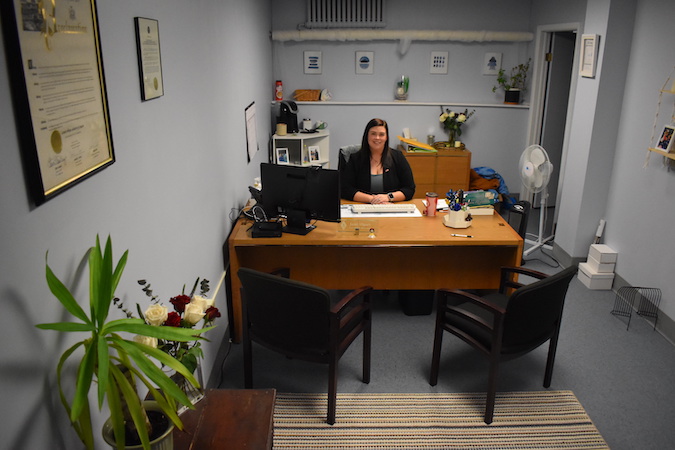
Photos by Tom Rivers: Jami Allport, executive director of the Genesee-Orleans Ministry of Concern, sits at her desk in the agency’s new offices at the First Presbyterian Church. GOMOC moved from the Albion Visitor’s Center to the church with the first day open last Thursday at the church.
ALBION – The Genesee-Orleans Ministry of Concern has moved into its new offices in the First Presbyterian Church of Albion and the agency is thrilled with the welcome from the church.
GOMOC left the Albion Visitor’s Center after 15 years on the third floor at 121 North Main St. The agency moved after the Village Board raised the rent by 35 percent from $1,146.67 to $1,550.96 a month. The board felt GOMOC’s rent was too cheap at 48 cents per square foot. The board raised it to 65 cents per square foot.
Jami Allport, the GOMOC executive director, said that amount was too much for the agency, and would take away funds it needs to assist people in need.
The Presbyterian Church offered space in four rooms at the lower rate that GOMOC was paying before the rent went up. The church painted two of the rooms and added electrical outlets for the new tenants and also put a wall in. The other two rooms also were recently redone following a third floor water leak that caused some damage to the rooms.
“The church worked really hard for us,” Allport said. “They have been great and very welcoming.”
The offices are accessible on the back end of the church at the entrance to the church office. There is a church parking lot on Platt Street and sidewalks leading to the entrance.
There will be an open house for the community to see the new offices on April 25 from 4:30 to 6 p.m.
The Ministry of Concern is known by many as “The Agency of Last Resort.” It provides services to many people in crisis, including working poor who are facing hardship.
The agency last year assisted 2,795 people with 2,192 in Orleans and 603 in Genesee.
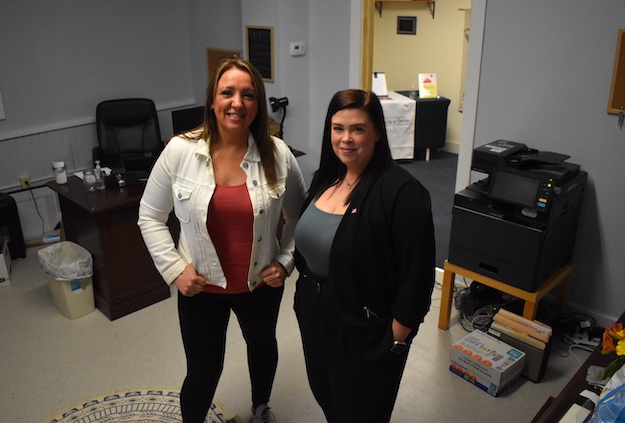
Rose Friedl, left, and Jami Allport show one of the revamped rooms at the church which is now used by the Ministry of Concern. Friedl is the coordinator for the furniture program. Another employee, Nicole Brady, coordinates the Just Friends mentoring program.
The Ministry of Concern has in-house advocates who work on behalf of clients with utility companies, landlords and other entities as necessary. Eligible individuals and families can receive help with personal care items, short-term emergency housing and financial assistance with prescriptions. There is a room stocked with supplies named in honor of long-time board member and volunteer, Mary Grace Demarse.
The Furniture Program also accepts donations of gently used furniture and non-gas appliances which are subsequently delivered without cost to people in need. This in GOMOC’s most used program, assisting 945 people last year. Jayquan Brady and Kyle Woolston pick up furniture and appliances for GOMOC and deliver them to people who need them.
Allport has been working as the agency’s director since September. She said the agency makes a difference for many in the community.
She sees GOMOC doing even more. She has assisted some people with resumes to pursue jobs, and gave other help with health insurance and life skills. The break room also has air hockey and other games where teen-agers can come afterschool and hang out in a safe place.
Rose Friedl said she looks forward to coming to work at GOMOC four days a week. She coordinates the furniture program. She said many people get emotional when GOMOC can locate a bed, couch or even a recliner for them.
“This is a feel-good job,” Friedl said. “I put my whole heart into it.”
Return to topMEDINA – Firefighters put out a basement fire in Medina this afternoon. One firefighter had a medical emergency while working at the scene.
Immediate care was rendered and the firefighter was transported to a hospital. No additional information is being released at this time about the firefighter, said Steve Cooley, lieutenant of Medina Fire Department, fire investigator and the public information officer.
Firefighters were dispatched to 515 North Academy St. at 2:09 p.m. for a reported basement fire. All residents were out of the structure by 2:14 p.m. There were no civilian injuries.
Medina firefighters extinguished a small fire in the basement as other personnel performed searches and ventilation. Damage estimates are $1,000 to the structure and $5,000 in contents, Cooley said.
Both families at the site are being assisted by the Red Cross at this time until repairs can be made.
The fire cause has been ruled accidental. The fire Investigation was handled by the Village of Medina Fire Department’s Fire Investigation Unit with assistance provided by the Orleans County Fire Investigation Unit.
Return to top
Photos by Tom Rivers: The Medina Marching Band enters Vets Park on Sept. 23 for a performance at home during the Fall Festival of Bands. Medina is one of the smaller schools that competes in the field band competition and has won the New York State Field Band Conference Championship several times.
Two school districts in Orleans County has been recognized as a “Best Communities for Music Education,” two of the 975 in the country to receive the designation from the North American Music Merchants.
Medina made the list for the first time. The school district last year started doing its own musical in the junior-senior high school after about a decade of a shared program with Lyndonville. Medina has long had a stellar marching band program.
Albion was recognized for the 17th straight year. Like Medina, Albion offers vocal and instrumental music programs from elementary, middle and high schools, with many performances in the schools and out in the community.
NAMM has been recognized school districts for 25 years. The award recognizes outstanding efforts by teachers, administrators, parents, students and community leaders who have made music education part of a well-rounded education, NAMM said.

Mike Thaine, the Albion High School band director, leads the band during a holiday concert on Dec. 20, 2023.
The NAMM Foundation’s list shows only these school districts in New York have matched or surpassed Albion for longevity on the list: Bayshore, 21 years; Clarence, 19; Fayetteville-Manlius, 19; Great Neck, 18; Jericho Union, 20; Johnson City, 19; Le Roy, 17; Monroe-Woodbury, 18; Monticello, 17; Nanuet Union, 17; North Babylon, 18; Northport Union, 17; Ossining Union, 17; Pittsford, 19; Port Jefferson, 19; Rush-Henrietta, 19; Syosset, 22; Webster, 18; West Genesee, 18; and West Irondequoit, 22.
Other nearby districts also were recognized including Batavia for the first time, Roy-Hart for the second year, Brockport for the seventh year, Pembroke for the fifth year and Lockport for the ninth year.
“Our unwavering commitment is steadfast in embracing and rewarding educators, administrators, parents and community leaders who applaud and support comprehensive music instruction as a fundamental part of core learning opportunities,” said John Mlynczak, NAMM president and CEO. “These leaders offer an extraordinary model of teaching that ignites a foundation of success we can all honor and celebrate.”
For more on the NAMM Foundation, click here.
Return to top
File photo by Tom Rivers: A voter casts a ballot at Hoag Library on June 23, 2020 on one of the voting machines that is expected to be replaced in time for the general election in November.
ALBION – When voters cast ballots in the November election, they will likely be doing them on new voting machines.
The County Legislature has authorized the Board of Election to purchase 28 new machines for $238,972.50 from Clear Ballot Group of Boston, MA.
The county purchased the current optical-scan machines in 2009, replacing the old mechanical lever machines, technology that had been used for about a century.
When the county made the switch to the optical scan machines, they were expected to last about a decade, said election commissioners Mike Mele and Janice Grabowski. The county used them for about 15 years.
The machines have worked well, but the change is necessitated by new computer technology in the Election Management System or the “backbone” of the machines, Mele said.
The new machines will be compatible with the Election Management System used by the county.
The Board of Elections has been setting aside money in its budget towards the replacement cost of the machines, Grabowski said.
The county also is using $5,607 in HAVA (Help America Vote Act) grant monies and $11,878 in TIER (Technology Innovation and Elections Resource) grant funds towards the purchase, leaving the remaining $221,487 as the county cost.
There are 11 voting sites in the county and each site will have a voting machine, plus a backup. The BOE also will have six more in case there are any breakdowns with the 22 at the voting sites.
The new machines will be better able to detect markings on the ballot. Voters will be able to use a ballpoint pen, instead of a marker, Mele said.
The machines will also be equipped with technology for people to vote who are blind or hard of hearing. Click here for more information about the Clear Ballot Group machines.
The state Board of Elections will calibrate the new machines. Mele and Grabowski said they are hopeful the new ones will be ready for early voting in late October and the election on Nov. 5.
Return to topALBION – The PAWS Animal Shelter on Gaines Basin Road has been awarded a $51,249 state grant to replace cat kennels, upgrade dog enclosures, upgrade HVAC systems, and replace a heat pump.
Gov. Kathy Hochul made the announcement this morning. The grant for PAWS is oart of $3.8 million awarded to 10 animal care organizations across the state through the New York State Companion Animal Capital Fund, which is in its sixth round.
“New York State’s Companion Animal Capital Fund continues to make a real difference for our shelters and humane societies across the state,” Governor Hochul said. “This funding will better equip these vital facilities with the tools they need to improve the quality of care for animals as they await a permanent, loving home.”
The Companion Animal Capital Fund program was started in 2017. It is administered by the Department of Agriculture and Markets. The state has dedicated over $33 million to the program.
Competitive grants were awarded to shelters based on a need assessment, detailed project description, and reasonableness of cost.
Governor Hochul’s Executive Budget includes an additional $5 million for the continuation of the program.
“Through six rounds, it has been incredible to see our shelters across the state complete these projects that make life better for the animals in their care,” said Richard A. Ball, the state’s agriculture commissioner. “I’m proud that the funding announced today will continue to build on the great work of this program, helping New York’s animals stay happy and healthy as they await their forever homes.”
Return to top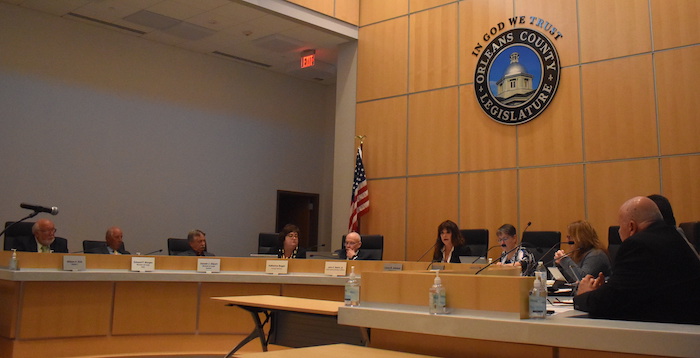
Photo by Tom Rivers: Lynne Johnson, Orleans County Legislature chairwoman, shares her state of the county address last week. From left include County Legislator Bill Eick, Legislator Ed Morgan, Legislator Don Allport, County Attorney Kathy Bogan, Chief Administrative Officer Jack Welch, Lynne Johnson, Clerk of the Legislature Lisa Stenshorn, County Treasurer Kim DeFrank, legislator Skip Draper (not in photo), Legislator John Fitzak, and Legislator Fred Miller.
ALBION – Orleans County government officials have made strides addressing needs in the community, and will continue to that focus in a collaborative effort with local towns and villages, the County Legislature leader said.
Lynne Johnson, chairwoman of the Legislature, gave a “state of the county” address during last week’s Legislature meeting.
She noted the county is nearing completion of bringing broadband internet throughout the county, a project that has been about a decade in the making.
Johnson supports creating a district court that would consolidate town justice courts if residents pass a referendum creating the court, and then if individual towns back the effort.
Johnson said the district is a big change and faces pushback from town justices and court clerks.
“Are we as a community willing to the leave the familiar and the comfortable behind for a new and better way forward?” she said.
The county leader said she remains opposed to a sewer pipe from the STAMP manufacturing site in the Town of Alabama that would go about 10 miles to Oak Orchard Creek. A state Supreme Court judge dismissed the county’s challenge to the project, but Orleans will appeal that decision.
“The Legislature will use every tool available to us to protect Oak Orchard Creek and its importance to us as a resource for water, recreation and tourism,” Johnson said. “And second, it’s never too late for Genesee County to revisit their position on this and to do so in a manner that sees us working together.”
Johnson praised a county workforce of about 400 employees for their service to the 40,000 residents of the county. Johnson said the county will be at the bargaining table with employee unions.
“We need to reach a fair and reasonable deal that recognizes the important work of our employees while understanding the responsibility we have to taxpayers,” she said. “Retaining our current employees and being able to recruit new talent is of the utmost importance.”
Johnson said the Legislature made two building purchases last year, which avoided new construction. Probation and the District Attorney’s office will shift to the former GCC building, and the Treasurer’s Office will move to the former Bank of America site which has a drive-through.
She said building a new public safety building would have cost an estimated $55 million.
The county paid $975,000 for the GCC building at 456 West Ave. and $250,000 for the former bank site at 156 S. Main St. The county also bought 25.7 vacant acres by GCC The for $500,000.
“We invest in our people, but we also need to make wise investments in the places where they work,” Johnson said. “Indeed, meeting the demand for county space is a balancing act. We want to minimize short-term costs at a time when budgets are strained, but we do not want to be short-sighted by forgoing opportunities that better prepare us for the future.”
Highway departments from throughout the state have been concerned about cuts in state funding for road maintenance. Johnson reiterated that call during her speech, saying the state should at least maintain the funding at a time when the cost of construction materials is up about 60 percent.
The county is poised for economic growth, particularly with certified shovel-ready land at the Medina Business Park. Johnson also said the Niagara Orleans Regional Land Improvement Corporation is focused on community development in the two counties by putting blighted or tax delinquent properties back to productive use.

The Orleans County Courthouse stands strong on a stormy day recently.
While the county has made progress on many fronts, Johnson said it faces challenges, including with a surge in homeless residents. A warming shelter opened in December at Christ Episcopal Church for when temperatures fall below 32 degrees at night. That has eased some of the demand to have temporary housing for people who are homeless. That county has been averaging about 100 placements recently.
The county has seen a 273 percent increase in placement of homeless persons since July 2022, with out-of-county placement of emergency homeless persons up 900 percent over that same period, Johnson said.
“The fact is temporary and permanent emergency housing facilities are very scarce in our county,” she said.
The county declared a state of emergency due to the lack of emergency housing.
“Much effort has been made by our generous not-for-profits, but, quite frankly, we have not been able to find a viable solution to this problem and there does not seem to be any good options on the horizon,” Johnson said.
She worries about the fiscal impacts to the county with the state taking some designated Medicaid funds from counties, and the winding down of federal Covid money.
“We are undoubtedly entering some challenging times with a cloudy horizon on the future,” she said.
That is a driving force for why she wants to see more shared services among the local governments, to reduce the overall operating costs of government.
“I think most people are aware that we are part of a shared services initiative to bring towns, villages, schools and fire departments to the table with the county to explore opportunities,” Johnson said. “Anything and everything needs to be viewed with an open mind and an honest conversation. I am hopeful that the towns and villages will really be in the driver’s seat on this effort. They have a different vantage point than the county and can bring some fresh ideas to the table.”
Return to top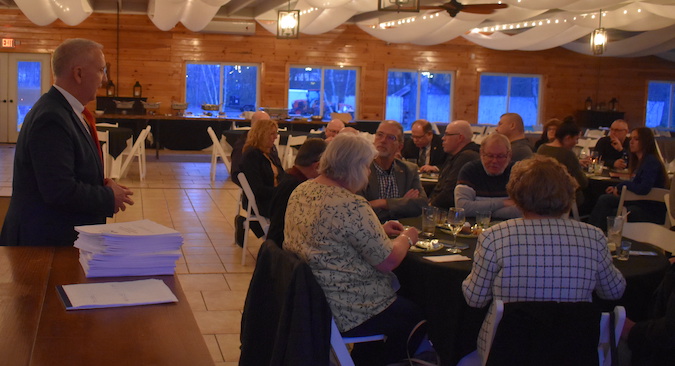
Photos by Tom Rivers: Orleans County District Attorney Joe Cardone meets with officials from the Orleans County Association of Municipalities last week and discusses a possible district court in the county.
ALBION – Orleans County voters will likely be asked this November in a public referendum whether the county should create a district court that would be staffed full-time and could include multiple towns in the county.
Orleans County officials want to put the issue to a public vote. There will be public hearings about the district court at 7 p.m. on May 7 and June 4 at the Orleans County legislative chambers at the County Office Building on Route 31.
The issue almost went to a vote last year, but was withdrawn as a referendum to allow more time to complete a study on the financial implications, and other pros and cons of the court.
County Legislature Chairwoman Lynne Johnson was part of a committee that has been studying the district court. She believes the committee’s report “leaves no doubt this is the best path forward.”
She said the district court would represent collaboration and cooperation among local governments, while bringing down court costs and increasing services.
“Are significant cost savings, better use of resources, streamlined court management and making better use of law enforcement personnel’s time enough to overcome the inertia of ‘things are fine the way they are?’” Johnson said during her state of the county address last week. “We are certainly going to find out.”
She wants residents and local officials to “start the conversation” about the issue.
The Orleans County Magistrates Association has been steadfastly opposed to a district court. The town justices and court clerks at the town level have all signed a resolution last October saying they are opposed to a district court in Orleans County.
“The Magistrate Association of Orleans County is opposed to any efforts to eliminate the local and convenient access to justice by our citizens and find that the Town Courts of Orleans County provide a meaningful and necessary presence within our community for judicial resolution of conflicts, continued public safety of our citizens, and the protection of constitutional guarantees for all of our citizens,” according to the resolution signed by the justices and court clerks.
The resolution was dated Oct. 14 and signed by Albion town justices Gary Moore and Joe Fuller, Barre Town Justice Frederick Root, Carlton Town Justice Kevin Hurley, Clarendon Town Justice Thomas DiFante, Gaines Town Justice Charles Prentice, Kendall Town Justice Debra Kluth, Murray town justices Ted Spada and Gary Passarell, Ridgeway Town Justice Joseph Kujawa, Shelby Town Justice Edward Grabowski and Yates Town Justice Donald Grabowski.
The following town court clerks also signed the resolution: Denise Cornick and Jamie Allport of Albion, Maureen Beach of Barre, Kim Niehaus of Carlton, Joanne Major of Clarendon, Maureen Kline of Gaines, Jessica Maier and Laurie Koelle of Kendall, Jeanne Spada and Lindsay Fredenall of Murray, Stacy Sliker of Ridgeway and Yates, Vicki Allen and Patricia Feltz of Shelby.
District Attorney Joe Cardone and Public Defender Joanne Best are co-leaders of District Court Committee. Other members include Lynne Johnson, Legislature chairwoman; county legislators Skip Draper and John Fitzak; Sheriff Chris Bourke; Rochard DeCarlo, former Barre town justice; Albion Town Justice Joe Fuller; Carlton Town Justice Kevin Hurley; First Assistant DA Susan Howard; Dean Puleo, special counsel for the 8th Judicial District who works with town justices in the eight Western New York counties; Bruce Schmidt, former Gaines town justice and former assistant DA; and Jack Welch, Orleans County chief administrative officer.
DeCarlo, Fuller and Hurley all dissented from the recommendations of the committee, while Bourke and Puleo abstained.
Cardone has been trying to build support for the case of moving away from the town justice courts to a district court that he said would be staffed full-time and offer more consistent justice throughout the county. He sees a district court as far more efficient than 10 town justice courts.
He presented highlights of a committee’s report last week during the Orleans County Association of Municipalities meeting at the White Birch in Lyndonville.
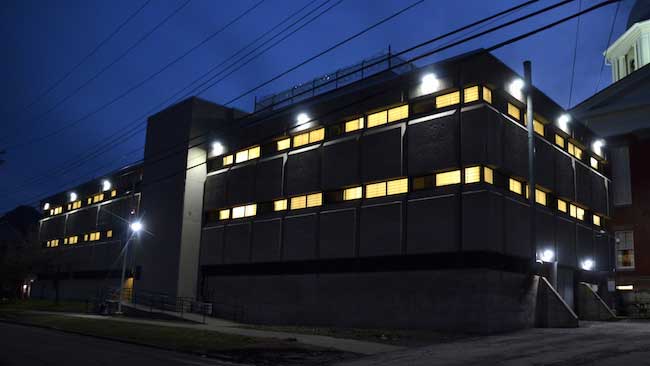
Photo by Tom Rivers: The Orleans County Jail on Platt Street in Albion has been used as a centralized location in the county for arraignments since April 2020. If there was a district court, the jail would no longer be needed for CAP Court for the arraignments when town courts aren’t in session.
The referendum in November would give residents a vote on whether to establish a district court.
Each Town Board could then decide whether to put to a public vote whether to eliminate its town court. Cardone said a district court could exist while some towns decide to keep their own courts. If they keep the town court, the town taxpayers would pay for that cost. The district court would allow a town to remove the court from its budget with the state paying the expense for the district court, Cardone said
“If this gets approved it’s pretty much paid for by the state government,” Cardone said at the Association of Municipalities meeting.
The committee is projecting the costs of the district court at $1.2 million with revenue at $175,000 in fines and forfeitures, and $110,000 through the traffic diversion cases for $285,000 total.
The expenses includes salaries for two judges at $320,000, clerk costs at $150,000, security at $150,000, a stenographer at $50,000, office supplies at $4,000, equipment at $2,500 and interpreter at $2,500.
Employee benefits – Social Security, Medicare, disability, retirement, workers’ comp, unemployment insurance and health insurance – would be an estimated $531,661. Facility costs would cost an estimated $50,000 a year.
The court would operate at a loss of $975,661, with the state picking up the expense, according to the report.
Cardone stressed courts shouldn’t be viewed as a money-maker. Their focus should be to dispense justice fairly.
The 10 towns courts operate at an aggregate deficit of $462,160 (which doesn’t include the costs of employee benefits and facility expense), the report states.
The CAP court that does arraignments in mornings and evenings at the county jail, plus on weekends, is another $113,800. If there was a district court, the CAP court functions would shift to the district court.
Employee benefits and facility costs represent 57 percent of the costs of running a district court. If that same percentage is applied to the 10 town courts, that total “real cost” of those courts would be $1,001,935, plus the CAP court costs of $113,800, the report states.
“The citizens of Orleans County are paying approximately $1.1 million annually for a fragmented system of part-time courts consisting of lay judges,” the report states.
The report states the following as benefits of a District Court system in Orleans County
• Cost savings from consolidation of resources could save municipalities significant costs from having 10 town justice systems in close proximity to one another.
• Improved courtroom facilities and better security. “Courtroom equipment, ranging from technological needs and even basic administrative supplies, are hard to fund with limited budgets.”
• More streamlined court docket management. Some defendants have multiple cases from different neighboring towns, which are handled by different assistant district attorneys and different justices. “This makes adjudication of the cases complicated and often slows down the process as the different parties try to connect and work on a disposition to cover the various cases,” the report states.
• Staggered out appearances and extended hours. The town courts often meet just once or twice monthly, with some meeting more frequently. A district court would have more frequent court hours with some occasional evening hours to accommodate different schedules.
• Modernization of technological needs. “The Covid pandemic shed light on the need for modernization in a way that we have never seen before,” the report says. Courts were permitted to do virtual arraignments if they had the proper video conferencing equipment.
• Better planned transportation of in-custody defendants, who must be transported by law enforcement officers to court. If justice courts were consolidated with fewer locations, that would save substantial time for law enforcement officers and allow them to spend more time on their traditional law enforcement roles.
Cardone noted the towns and villages have gone from 24 local justices about 20 years ago to the current 11. Albion and Medina both have abolished their village courts during that time and most towns are down to one justice.
“Given the evolving complexity of the criminal justice in this state, the concern for the rights of victims and defendants and the involvement of recent technologies, the time for sweeping reforms in the local court system is well overdue,” the report states. “Orleans County stands out as a successful example of consolidation, and other counties should begin to follow suit.”
County Legislator Bill Eick was on the Shelby Town Board when Shelby and Ridgeway decided to share a courts facility at the Shelby Town Hall in 2006. Each town also would go from two justices to one.
“It’s not easy,” he said. “No one likes change. You have to look down the road. I believe the state will shove this down our throats.”
County legislator John Fitzak said many of the details remain to be determined, and they won’t be fully known until after a district court is approved and the office for Court Administration sets the staffing.
“There is still a ton of work to be done,” Fitzak said.
Cardone is retiring as district attorney on Dec. 31 after 32 years in the position. He is trying to bring a district court to the voters before he ends his term as DA.
“We’re keeping an open mind on this,” Cardone said. “We intend to go to the community and make them as informed as possible.”
To see the report from the committee on a district court, click here.
Return to topPress Release, AAA
The upcoming total solar eclipse is getting plenty of attention! Several communities in Western and Central New York are in the direct path of the eclipse that will take place on April 8.
The moon will pass between the sun and the earth and block the sun from view. On April 8, in some key areas, the sky will darken as if it is dawn or dusk, according to NASA.
AAA anticipates that cities along the path of totality will experience high tourist volumes and increased traffic leading up to April 8 just as Easter travelers are making their returns to Western and Central New York. Totality is expected to begin on April 8 at 3:18 p.m. in Niagara Falls and Buffalo, 3:20 p.m. in Rochester, and 3:23 p.m. in Syracuse and Watertown.
The next total solar eclipse that can be seen from the contiguous United States will be on Aug. 23, 2044
Excitement across the state is building over the viewing on Monday, which could lead to distractions for motorists. AAA’s advice:

Andrea Page will discuss her book about the Sioux Code Talkers of World War II during a visit to Yates Community Library on May 14.
LYNDONVILLE – The Lyndonville community has an opportunity to hear from the author of a book about the seven Sioux code talkers of World War II.
Andrea Page of Rochester, an author and educator, will give a talk and sign books during a 7 p.m. presentation on May 14 at the Yates Community Library.
Her program will cap a community reading effort at the library. “Lyndonville Reads” previously featured Marlies Adams DiFante’s “Queen of the Bremen” in 2017.
Many library patrons read “Sioux Code Talkers of World War II” last month. There is still time to check out the book, which is available at the library at 15 North Main St., Lyndonville. Other libraries in the Nioga system also have it.
Page researched seven Sioux soldiers, whose native language ensured secrecy of the strategic messages from the U.S. military as they served in the Pacific Theater under General MacArthur.
Page is the grand-niece of the one of the seven Sioux code talkers, John Bear King.
There will be a book discussion with refreshments at 6:30 pm. on April 29 at the Yates Community Library.
The Elisabeth Dye Curtis Foundation provided funding for the project, including author fee, copies of the book for circulation and for giving one to each 8th grader at Lyndonville Central School.
Return to top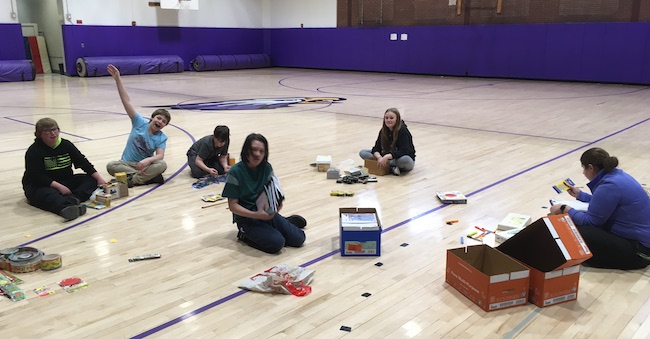
Photos and information from Albion Central School
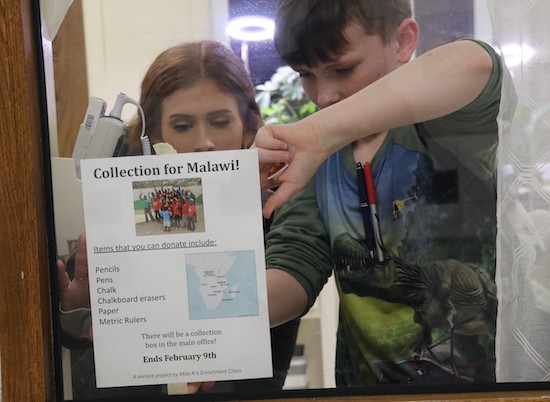
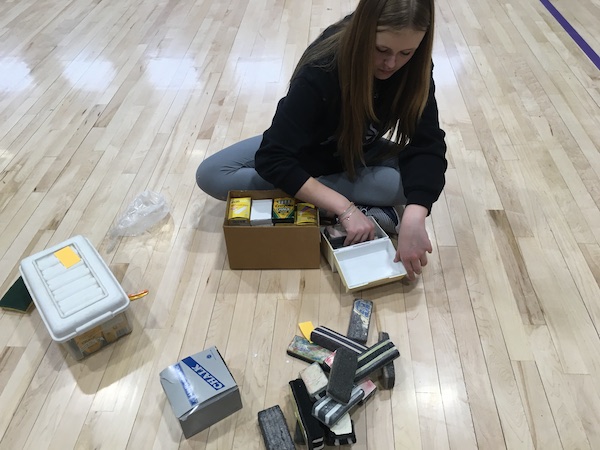
ALBION – Students and staff at Albion Central School have been diligently collecting school supplies for an orphanage in Malawi, Africa.
Tim Archer, Service Learning liaison at Albion, helped to bring the donations to an orphanage of 60 children in Malawi as part of a mission trip this March. Having left for Malawi on March 16, Archer has since been joined by Albion High School junior and Interact Club member, Leo Bolton, over the district’s spring recess this week.
According to Bolton, he’s been preparing for this trip since December and is excited to see what kind of activities they do to keep busy and games they play.
Sara Koppenhaver, a physical education/enrichment teacher at Albion Middle School, said Archer presented to her 8th grade enrichment class, asking for their assistance in promoting the collection school-wide.
“The orphanage has no electricity, has wood planks for desks/chairs, and chalkboards,” Koppenhaver said. “Tim is looking to try and help bring them some needed supplies and my class decided they wanted to help his efforts.”
Inspired, Koppenhaver’s students presented the service project pitch to Albion Middle School Principal Brad Pritchard and Assistant Principal Mariah LaSpina before being approved to promote and collect the items.
“We [the group] are taking 800 pounds of supplies to the orphanage/school located in Mzuzu,” Archer said. “We’ll be helping with educational, health, life skills, and grounds work.”
Mzuzu is a city in located in northern Malawi where Archer will also have the opportunity to meet with the local Rotary Club and work with the school staff.
“Each member of the trip is bringing 100 pounds of things to help the orphanage,” Bolton explained. “My church, Harvest Christian Fellowship, along with Albion Central School, has collected many donations of things that we will be bringing over. Whether it’s clothes, school supplies, or things to help with personal hygiene, they have been very helpful in this way.”
In AHS, the money collected in January and February from staff Dress Down Days – days where staff donates in order to wear more casual attire – also was donated to Archer to benefit the orphanage.
“Trips like this are important because they help us realize how lucky we are to live the way that we live, and how important it is to help others,” Bolton said. “It helps keep us humble and grateful, two things that are very important.”