By Tom Rivers, Editor Posted 2 February 2018 at 10:47 am
Photos by Tom Rivers: Joseph Zaremba, a dentist with Oak Orchard Health, worked out of the mobile dental unit in Albion on Thursday.
ALBION – The mobile dental unit returned to Albion Central School this week and about 200 children are expected to get teeth cleanings and dental exams for about three weeks, until the mobile unit heads to Medina.
Oak Orchard Health has been taking the unit to local school districts since 2005, serving several hundred children each year, cleaning teeth, doing sealants and extractions.
“People know it and they look forward to it,” said Denise Beardsley, coordinator of the mobile dental unit since it started.
Denise Beardsley has been coordinator of the mobile dental unit since it started in 2004.
The mobile unit also spends several months of the year in Albion behind the Oak Orchard office at 301 West Ave. There the mobile unit is open for adults and others in the community.
The unit debuted with Oak Orchard in 2004 and spent its first few moths in Warsaw. Oak Orchard has since opened dental offices in Warsaw and also in Hornell, so the mobile unit doesn’t need to travel to those communities.
Having Oak Orchard dental services in Warsaw and Hornell also has allowed Oak Orchard to keep the unit in Albion when it isn’t visiting school districts.
Oak Orchard has dentists, a hygienist and Beardsley working out of the unit. Beardsley sets up the appointments and walks to the classrooms, leading to children to the mobile unit, which is parked behind the elementary school.
Students get their dental care during the school day and parents don’t have to leave work or try to cram in an appointment after school.
Beardsley said the dental health in the kids has improved since the first few years of the service.
“It’s much better now than it used to be,” she said. “We instill brush and floss.”
About 30 to 40 percent of the kids that get dental exams at the mobile unit don’t have cavities these days. Some need fillings, extractions and restorations. If there is a more serious problem, such as a crown or root canal – which is rare for children – the child will be referred to have the work done at Oak Orchard’s dental offices in Brockport.
Joseph Zaremba, an Oak Orchard dentist, spent his workday on Thursday with the mobile unit. He said the facility is actually roomier than many dental offices.
The site has two dental chairs. It has its own hot water tank, and a sterilization unit to clean equipment and instruments.
Zaremba and Beardsley both said there aren’t very many mobile dental units in the state. They believe it is providing a critical service in Orleans County.
Beardsley has been with the mobile unit since day one. She said she has stayed because she enjoys working with the children.
“It’s stability for them,” she said. “The kids now know it.”
Beardsley said the mobile dental unit plans to go to all five school districts, completing the visits near the end of May.
Oak Orchard accepts Child Health Plus, Medicaid, other insurance and also has a sliding fee for people without insurance.
For more information on the mobile dental unit, call 585-267-9236 or click here.
‘Peak snowmobile season has arrived and New York State is an outstanding destination for riding the trails.’
Press Release, NYS Office of Parks, Recreation and Historic Preservation and the Department of Environmental Conservation
Governor Andrew M. Cuomo has designated February 2-5 as a free snowmobile weekend for riders from outside New York.
Snowmobiling fees will be waived for out-of-state and Canadian snowmobilers during the promotional weekend. Currently, out-of-state and Canadian snowmobilers are required to register their snowmobiles with the state before hitting New York’s trails. Snowmobile registration costs $100, but is decreased to $45 for those that join a local snowmobile club affiliated with the New York State Snowmobile Association.
Participants in free snowmobiling weekend must operate a snowmobile that is validly registered in their home state/Canadian Province and must carry any applicable insurance as required by their home state/province.
The New York State Office of Parks, Recreation and Historic Preservation and the Department of Environmental Conservation remind snowmobilers to ride responsibly and exercise caution while enjoying the state’s abundant snowmobiling opportunities. New York offers more than 10,000 miles of state-designated snowmobile trails.
“Peak snowmobile season has arrived and New York State is an outstanding destination for riding the trails,” State Parks Commissioner Rose Harvey said. “Following the safety recommendations and paying attention to trail conditions will help to ensure you and your friends have a fun and enjoyable day in New York’s great outdoors.”
“New York’s network of snowmobile trails generates more than $800 million each year and offers world-class winter recreation to residents and visitors alike,” DEC Commissioner Basil Seggos said. “DEC works with State Parks, municipalities and volunteers from local snowmobile clubs to maintain and enhance trails during the season, and we encourage those venturing out to engage in a safe and enjoyable snowmobile adventure.”
Top safety recommendations include:
• Check your snowmobile. Make sure it is in good working order and carry emergency supplies.
• Always wear a helmet and make sure you wear the proper snowmobile gear, including bibs, jackets, boots and gloves.
• Always ride with friends or at least one other person.
• Ride responsibly. Ride within your ability, ride to the right, and operate at a safe and prudent speed. Respect landowners, obey posted signs, and stay on the marked trail.
• Frozen bodies of water are not designated trails. If you plan to ride on ice, proceed with caution and be aware of potential hazards under the snow.
MEDINA – Girl Scout Troop 82007 from Albion learned about running a business from Case-Nic Cookies in Medina. The Scouts visited Case-Nic and owner Mary Lou Tuohey as part of their Cookie CEO Badge.
The girls learned that to successfully run a small business, employees must take on multiple roles. They also learned that customer service, knowing your product, and being able to talk to customers about your business is vital to encourage customers to keep coming back.
Governor Andrew M. Cuomo said the influenza epidemic continued to increase across New York State over the past week, with 11,683 laboratory confirmed influenza cases reported to the New York State Department of Health, and 2,221 New Yorkers hospitalized with confirmed influenza.
These numbers are again the highest weekly numbers in both categories since reporting began in 2004 and exceed last week’s record high 7,779 confirmed cases and 1,759 hospitalizations.
“Flu season is in full-swing, and as the number of influenza cases and hospitalizations continue to rise at alarming levels, we must take every action to protect ourselves and our loved ones,” Cuomo said. “I am urging everyone to get vaccinated and take other necessary steps to stop the spread of this virus in New York.”
Last week, the Governor signed an Executive Order allowing pharmacists to administer flu vaccines to children ages 2 to 18, increasing vaccine accessibility for New York children and families as influenza continues to spread across New York.
The Executive Order suspends the section of state education law that limits the authority of pharmacists to administer immunizing agents to anyone under age 18 to allow vaccines to be administered to anyone age 2 and up. Parents and guardians are encouraged to call pharmacies ahead of their visit, to ensure they are ready to receive patients in this age group. Parents and guardians with children between the ages of 6 months and 24 months are still encouraged to see their primary care provider for the vaccination.
In addition to getting a flu shot and staying home when sick, it’s important to practice good hand-hygiene:
• Unlike some viruses, influenza is easily killed by soap and hot water.
• Wash your hands often with soap and hot water for at least 20 seconds to protect yourself from germs and avoid spreading them to others.
• Carry an alcohol-based hand sanitizer to use when soap and water are not available. Choose a product with at least 60 percent alcohol.
• Do not cough or sneeze into your hands. Instead, cover your mouth and nose with a tissue. People with the flu are infectious for up to 7 days after symptoms begin.
By Tom Rivers, Editor Posted 1 February 2018 at 8:36 pm
Will seek to ‘Spark Some Action’ with focus on customer service from village and better relationships with EDA, neighboring municipalities
Kevin Doherty
ALBION – The election for the next Albion mayor will likely include three candidates. Kevin Doherty, the president of the Hoag Library board of trustees, announced today he will run for mayor under the independent “Spark Some Action.”
Doherty operates a communications maintenance business. He lives on West Park Street. He and his wife Linda have six grown children.
Doherty said the Democratic and Republican parties are backing candidates who won’t push the change that is needed in Albion.
“If re-treading candidates were an effective strategy, would the conversations continue to only be about the deterioration of downtown, property taxes and keeping everything the same? Quoting Ronald Reagan, ‘Here we go again!’”
The Republican Party on Tuesday backed Eileen Banker, a village trustee for eight years, as its mayoral candidate while the Democratic Party picked Joyce Riley. The election is March 20.
Doherty needs a petition signed by at least 100 registered voters in the village to be eligible to be on the ballot. He can start circulating petitions Feb. 6 and they are due in the Village Office by Feb. 13.
“The elected officials of our Village have and have had good hearts and great intentions, but their results have been limited,” Doherty states on his campaign website – kevindohertyformayor. “In this year when there is no incumbent mayor, I offer 40 years of experience highlighted by the building the Hoag Library, to lead the Village of Albion into a future of thoughtful progress through collaborations with all the people, not just the few and faithful Democrats or Republicans.”
Photo by Tom Rivers: Kevin Doherty, president of the Hoag Library board of trustees, speaks during a ribbon-cutting celebration for the new library on July 7, 2012.
Albion is the only village in Orleans County that has candidates run under the two major political party lines.
“Although the backing of a major party organization may still be necessary for election to county-wide and higher office, limiting the pool of candidates to party faithful in a village of 6,000 people is self-defeating,” he said.
Doherty, in his role with Hoag Library, was instrumental in the design and 2012 construction of their new facility on South Main Street. Prior to starting his own business, he was superintendent of Buildings and Grounds for the Albion School District, an industrial electrician at the A&P’s soap manufacturing plant in Brockport, and a field service technician, later Operations Manager, for Ronco Communications’ Rochester branch. He was a member of the Albion School Board for 12 years.
He said there needs to be “purposeful direction by the village leadership” to entice more people to invest in the community.
“We need to separate ourselves from our peers – coming to Albion has to be the best experience for homeowners and business locators,” he said. “The library folks may tire of the mantra, but they, and the village, need to be like Wegman’s. Customer service is so consistently high that you like to shop there. Albion needs to be the place where people want to come!”
Doherty said he would “diligently drill down into the numbers” of the village budget. He was chided during a recent forum on law enforcement efficiency when he suggested the village could reduce some costs in the police budget, which accounts for about half of the village tax rate.
Doherty said “whining” about more state aid and local sales tax revenue won’t lead to results. Albion can better attract people, businesses and investment by creating a community where people want to live.
“Anyone who visits the Village MUST be impressed with our outstanding customer service and willingness to support any effort to improve the tax base,” he writes on his website. “Any Village employee or elected official who leaves a less than exemplary impression, on a vendor, a constituent, another municipal employee or visitor will have to be counseled.”
Other nearby villages – Medina, Holley, Fairport and Mount Morris – are seeing success by working with their local and state economic development officials, and real estate professionals to market their communities, Doherty said.
“We are 30 miles from the Rochester Tech Zone, even closer to the coming Alabama Technology Park in Genesee County,” he writes. “Are we ready to build houses and welcome some of their projected thousands of employees?”
As a result of the decision by the New York State Department of Corrections and Community Supervision (DOCCS) to allow over 51,000 inmates statewide to use electronic tablets free of charge, Assemblyman Steve Hawley (R,C,I-Batavia) has written a letter to Gov. Cuomo and DOCCS demanding that the program be shut down immediately.
Hawley’s letter, dated today, says:
Dear Governor Cuomo:
I am distraught and dismayed relative to the news accounts that tablets will be made available to 51,000 incarcerated individuals within our state correctional facilities.
This policy decision to reward and furnish luxury items like these tablets to prisoners is an affront to our law abiding citizens. Our citizens, veterans, school districts and libraries all across our state, struggle to provide for their families, students and patrons. What message does this send to them!
We already have people moving to New York State for our lavish Medicaid programs and now criminals will also be moving here and if convicted and sent to a state prison will have access to luxuries not afforded in other out of state correctional facilities.
I call on you to reconsider this misguided policy and urge JayP Inc. to work with our school system, libraries and veterans organizations to furnish tablets to law abiding citizens instead of those who are currently incarcerated.
Photo by Tom Rivers: The First Niagara Bank in the Public Square in Holley closed in October 2016. A new grant will fund a revitalization strategy for the downtown business district, and other parts of the community.
HOLLEY – The Village of Holley has been approved for a $165,600 state grant to develop a brownfield opportunities area program.
Gov. Andrew Cuomo this afternoon announced 13 of the grants for $2 million.
The Holley grant will complete a Brownfield Opportunity Area Nomination for 813 acres with 55 potential sites, according to the state announcement. The objectives include identifying opportunities surrounding the former high school in the downtown core; improved housing and income opportunities for residents; identifying strategies to reduce commercial vacancies; identifying opportunities at the Diaz Chemical site remediation; leveraging the Erie Canal; improving wayfinding in the Village; preparing design guidelines for the Public Square; and improving the village’s vitality.
The brownfield opportunity area program provides resources to develop data-driven revitalization strategies for economically distressed areas, the governor said. These plans forge a path to transform blighted properties in urban areas into community assets and catalysts for neighborhood-wide revitalization.
Brownfields are abandoned or underutilized properties where known or perceived contamination has impeded redevelopment, turning the properties into economic and environmental drains on localities. The Brownfield Opportunity Areas Program grants have driven revitalization throughout the state, turning dormant sites into vibrant and productive properties that attract jobs and private investment, ultimately expanding the local tax base.
“This funding will help transform blighted and polluted properties into economic engines in communities across New York,” said Governor Cuomo. “We will continue to work with our local partners to revitalize neighborhoods, create opportunity and build a stronger Empire State for all.”
Press Release, New York State Correctional Officers & Police Benevolent Association
Photo from NYSCOPBA: Green peppers on Jan. 30 were found at Bare Hill Correctional Facility in Franklin County and were filled with 11 grams of Synthetic Marijuana and 46 scalpel blades.
ALBANY — New York State Correctional Officers & Police Benevolent Association today renewed its call for urgent measures to more effectively regulate packages and materials brought into state correctional facilities.
Attempts to bring drugs and weapons into state correctional facilities reached record levels in 2017, and several incidents throughout this past month show the critical need for changes to current protocols set forth by the New York State Department of Corrections and Community Supervision (DOCCS).
For example, on Jan. 19 a package was delivered to Orleans Correctional Facility that contained illegal drugs and a screwdriver. Corretions officers searched a package that was delivered to the prison and seized 286 grams of synthetic marijuana, commonly known as “K2” and 120 homemade pills.
Data collected shows that 2017 marked the most violent year inside state prisons since 2007, the year statistics began being recorded. Every metric tracked by DOCCS (inmate-on-staff assaults, inmate-on-inmate assaults, use of chemical agents, contraband) rose above the previous year’s numbers.
“These alarming statistics reinforce NYSCOPBA’s resolve to fight on behalf of our members until measures are enacted that will create a safer environment for inmates and correctional staff alike,” said Michael Powers, President of NYSCOPBA. “We stand ready to assist in any way with the adoption of measures that will eliminate the opportunity for dangerous contraband to make its way into our facilities.”
NYSCOPBA is encouraged by proposed legislation sponsored by Sen. Pamela Helming that would expand contraband screening procedures at state correctional facilities. The plan would allow the random selection and search of visitors’ vehicles upon entering a correctional facility’s grounds, as well as permit the use of a controlled canine at the entrance of each correctional facility. It would allow electronic imaging scanning, pat frisks and visual searches of visitors, and would provide for the training of staff on up-to-date contraband screening procedures.
“Contraband introduced into prisons continues to be a growing issue and presents dangerous and even life-threatening situations for correctional staff. In the past week, staff intercepted illegal drugs and weapons hidden in packages in two upstate prisons and a downstate woman was arrested trying to smuggle Synthetic Marijuana to an inmate inside the prison during a visit,” stated President Powers. “We commend Senator Helming for recognizing the urgent need for DOCCS to implement new methods to reduce the amount of contraband into our correctional facilities.”
By Tom Rivers, Editor Posted 1 February 2018 at 10:38 am
Photo by Tom Rivers: Robin Stelmach is pictured inside Americana Unlimited Antiques, his business at the corner of Ridge Road and Route 279 in Gaines. Stelmach will be doing an antiques appraisal fair on Feb. 10 at Tillman’s Village Inn as a benefit for the Cobblestone Society.
GAINES – The Cobblestone Museum has several events planned before the museum opens for the season on June 1.
Last year the museum debuted an appraisal fair at Tillman’s Village Inn, with local antique appraisers Robin Stelmach from American Unlimited Antiques and Mark Christopher from Dream Speaker Antiques.
That event drew a crowd and it is back on Feb. 10, with Stelmach and Christopher once again offering their expertise.
The museum also had a “sports widows” program through December. The events are part of an effort to extend the museum’s season, looking at alternative locations with more parking and heated buildings, said Doug Farley, the museum director.
“We needed to be resourceful to find other locations,” he said.
The Village Inn will host the antiques appraisal fair from 10 a.m. to 3 p.m. Stelmach and Christopher will appraise family heirlooms, paintings, furniture or “whatever item has been hiding out in your spare closet,” Farley said.
Next month, the museum will lead a tour to maple farms with a stop at Merle’s Maple Farm in Attica and Cartwright’s Maple Tree Inn in Angelica. That bus tour on March 23 will be led by Georgia Thomas of Medina.
She was the demonstration cook for maple products at NY State Fair in the Wegman’s Kitchen for a decade. She started cooking with maple in the NY State Maple Producer’s Booth at the State Fair at the request of Fly Way Farm in Medina and then moved to the Wegman’s Kitchen and began to create and adapt recipes for maple.
Thomas and the tour stops will highlight different ways to use maple syrup, and also touch on its history and lore.
Farley expects the maple tour will be popular.
“Everybody likes to eat and most everyone likes maple syrup,” he said. “At the museum we focus on the historic trades. Maple syrup was a big part of farming locally.”
Provided photo: Patricia Greene will lead a series of painting workshops at the Cobblestone Museum starting next month.
The museum also is planning a first-time membership dinner at the Carlton Rec Hall on April 25, beginning at 5:30 p.m. There will be dinner catered by chef Michael Zambito of Zambistro in Medina. There will also be a silent auction, theme baskets and other raffles.
Falrey said the museum wants to attract more members, including bigger donors to ensure the long-term sustainability of the Cobblestone Museum, which is a National Historic Landmark.
“It’s probably our principal fundraiser,” Farley said. “It will be a fun evening with lots to think about and eat.”
The event is headed by Gail Johnson, who helped Ducks Unlimited plan many of its successful fundraisers.
The museum will be hosting a series that begins next month. Patricia Greene, a Medina artist, will be leading “Sunday Painters” art classes beginning on March 4. There will be four workshops, with the classes on march 4, April 8, May 6 and June 3.
The classes are designed to build sequential continuity as students move through the workshops, but students can join at any point in the journey or pick and choose as they see fit.
Each student will complete a painting to take home at the end of each lesson. An art show of student art with free public admission will be mounted at the museum throughout 2018.
Farley said the museum’s programs will help people fight the “winter blahs.”
“We figured people are pretty much ready to get out and do something,” he said.
For more on the museum and its programs, click here.
BATAVIA – A Marine from Albion visited kindergartners in Michelle Restivo’s class in Batavia, thanking them for their letters and cards while he was at boot camp.
Private Brandon McGuire stopped by Restivo’s class during playtime as a way to thank them for their kindness while he was in boot camp.
A friend of the Restivo family and a 2017 high school graduate, McGuire enlisted in the Marine Corp. He spent both Thanksgiving and Christmas in boot camp. For 87 days recruits were unable to use phones or technology to communicate with family and friends back home. Instead, they relied on “snail mail.” When Restivo’s daughter realized that some recruits were not receiving any mail at all, she wanted to find a way to ensure that all would have a card or note for Christmas.
Restivo knew that her students would be happy to put their creativity to use in card-making. She also passed on the request to the other kindergarten and first grade teachers at Jackson Primary. It wasn’t long before she collected more than 200 handwritten and colored cards from the Jackson children and teachers, which she mailed to Private McGuire.
McGuire was recently home for a few days after graduating from boot camp at Parris Island on Jan. 12. He is now in North Carolina for five weeks of infantry training. When he completes that, he transfers to Camp Lejeune for military operations schooling.
MEDINA – The state Department of Environmental Conservation will detail a proposed $5.1 million of the former Abex Manufacturing facility in Medina at 3959 Bates Rd. The DEC will present a cleanup plan during a public meeting at 6;:30 p.m. on Feb. 21 at Ridgeway Town Hall, 401 West Ave.
The public can make comments at the meeting, or submit them during the 45-day comment period.
The site was originally part of the 48-acre parcel known as the former Abex Corporation Foundry. The 48-acre parcel was subdivided in September 1992 into 2 parcels – 36.7 and 12.3 acre parcels. The 12.3-acre parcel that contains the former foundry buildings was purchased by Brunner International. The 36.7-acre parcel ownership was transferred from Abex to MCG Intermediate Holdings Inc. in 1995 and then in 2006 to County of Orleans Industrial Development Agency.
The former foundry was constructed in the early 1950s. Prior to development the parcels were undeveloped woodland and tilled farmland, according to the DEC fact sheet.
The lagoons were used to collect wash water from the foundry process as well as storm water discharge. The former foundry and manufacturing facility used foundry sands for the casting of metal parts. Foundry sands and waste have been identified across the site and within the settling lagoons. Settled foundry sands in the lagoons was reclaimed for reuse at the former foundry facility by staging adjacent to lagoons or were collected for disposal.
Several Phase I and Phase II Environmental Site Assessments were conducted on the site and the adjoining Brunner parcel from 1990 to 2008, the DEC said. The Phase I and Phase II Environmental Site Assessments indicated the disposal of remaining foundry sand inventory on site, accumulation of sediment in two of the lagoons, reclaimed foundry sand was staged near the lagoons, and total petroleum hydrocarbons (TPH) concentrations in foundry sand disposal area exceeded state standards and guidance values.
A spill of Dasco Kleen and Dasco ARC 417 occurred December 1999 at a pond located behind the former foundry building. A review of past site development and use indicates that site disposal of waste occurred primarily on the western half of the site while the eastern portion of the site has remained largely unaffected by site operations or disposal.
A remedial investigation was conducted under a DEC approved work plan. A total of 159 environmental media samples were collected for laboratory analysis. Investigational activities included:
• Groundwater monitoring well installation and groundwater sampling
• Soil borings and subsurface and surface soil sampling including the lagoons and drainage swales/ditches at the site,
• Soil gas sampling, and
• Surface water sampling.
The laboratory results indicate that the surface and subsurface soil, groundwater, and surface water are impacted above the DEC’s standards and guidance levels for semi-volatile organic compounds and metals, the DEC said.
The impacts appear to be a result of historical activities conducted at the site. Based on the investigation results, the DEC is recommending that the site be remediated.
The remedy proposed for the site includes the following:
• The excavation of all soils in the lagoon areas and along the perimeter of the site that exceed the industrial or protection of groundwater soil cleanup objectives (SCOs).
• The soil/fill material excavated will be transported off-site for disposal at a permitted landfill facility.
• Site restoration activities will include backfill of the excavation areas with clean fill and restore the site to existing grade.
• A cover system will be installed at the site which will include the placement of one foot of cover across approximately 9.50-acres of the site.
• A Site Management Plan will be developed. The Site Management Plan will include an Institutional and Engineering Control Plan that identifies site use restrictions and engineering controls.
The estimated cost to implement the proposed remedy is $5.1 million. Oversight of the cleanup activities will be provided by the DEC.
The DEC is accepting written comments about the proposed remedial action plan for 45 days, from Feb. 2 through March 19.
WASHINGTON, DC – Congressman Chris Collins (R-Clarence) and Congresswoman Louise Slaughter (D-Fairport) often disagree in Congress but the two are in accord on the need for federal funding to protect the Great Lakes.
They are among 18 members of Congress who signed a letter to Office of Management and Budget Director Mick Mulvaney and Assistant Secretary of the U.S. Army (Civil Works) R.D. James requesting sufficient funding for the Great Lakes Coastal Resiliency Study (GLCRS) in the Fiscal Year 2019 budget.
The U.S. Army Corps of Engineers proposed this study to coordinate a strategy across the Great Lakes states to efficiently and effectively manage and protect the Great Lakes coastline.
The Great Lakes coastline drives a yearly $14 billion tourism and recreation economy, Collins said in a news release today. High water levels, recent storms, and severe weather occurrences have had devastating impacts on shorelines erosion and coastal communities. The GLCRS would allow communities to become better equipped with information on how they can protect their shorelines during storms.
“This study would be the first of its kind, making it immensely helpful to shoreline businesses and homeowners who can so quickly experience devastating financial losses during severe weather,” Collins said. “After a year of unprecedented floods along Lake Ontario, the shoreline economy was hit hard and individuals are struggling to pay for damage to their property. As we work to replace the commissioners on the International Joint Commission (IJC) that implemented the failed Plan 2014 responsible for getting us into this mess, we are doing everything we can to prevent future devastation.”
“The Great Lakes are home to 20 percent of all surface fresh water on the planet. More than 26 million people rely on them for commerce, transportation, drinking water, and recreation. Good stewardship of this precious resource in not a Democrat or Republican issue – we all have an interest in investing in a vibrant future for communities along the Great Lakes. That’s why I’m joining with my colleagues to push the administration to include funding for this important study in its budget request for the upcoming fiscal year,” Slaughter said.
Tolls for recreational boaters will be waived again on canal in 2018
Press Release, NYS Canal Corp.
The New York Power Authority and New York State Canal Corporation announced that 145 entries have been received for a $2.5 million competition that seeks the best ideas to enable the state Canal System to become an engine for economic growth and a world-class tourism destination.
“I am excited at the positive response to our Reimagine the Canals competition,” said Gil C. Quiniones, president and CEO of NYPA, which runs the Canal System as a subsidiary. “It’s apparent that this competition has sparked a lot of creative thinking about how to ensure New York’s canals can prosper today and in the decades to come.”
A statue of Amelia Bloomer, a women’s rights activist, is part of the Sculpture Trail in Seneca Falls.
Submissions for the Reimagine the Canals Competition came from nine states and seven nations, including from as far away as India and Vietnam. Eight finalists are expected to be announced in April, with the final winning entries slated to be named in September.
The goals of the competition include soliciting programs and initiatives that promote the Canal System as a tourist destination and recreational asset and as a source of sustainable economic development. Initiatives were also sought that uphold the heritage of the Canal System, which marks its centennial this year, as well as the long-term financial sustainability of the Canal Corporation.
“This is a rare opportunity to forge a new direction for an iconic asset that shaped not only the history of this state, but the nation as well,” said Brian U. Stratton, Canal Corporation director. “I’m confident many great ideas will emerge from this competition that point toward a bright future for our canals.”
Entries were submitted on two separate tracks, one for infrastructure; the other for programs that have the potential to increase recreational use and tourism.
A global panel of judges will select up to eight finalists, who will receive up to $50,000 to further develop their proposals for the final round. The judges will then recommend two or more winners, who will receive $250,000 to $1.5 million, depending on the scope of the project.
The Canal Corporation Board of Directors, at the NYPA and Canals Board Meeting, on Tuesday also approved a plan to waive tolls for recreational vessels in 2018, as the State continues to commemorate 200 years of Erie Canal history by marking the 100th anniversary of the current 524-mile Canal System’s opening in 1918.
This is the second straight year that tolls—normally $25 to $100 for a season pass, depending on the size of the vessel—have been waived. Last year, recreational boaters traveled for free to celebrate the bicentennial of the start of construction for the Erie Canal. This year is the 100th anniversary of the Barge Canal’s first opening to traffic.
The New York State Canal System, the third generation of the iconic Erie Canal which opened in 1825, today includes the Erie, Oswego, Cayuga-Seneca and Champlain Canals. It was formerly called the Barge Canal, which was built, starting in 1905, to accommodate larger vessels and better enable the canals to compete with railroads for freight traffic.
This year’s navigation season on the Erie Canal is slated to begin May 15 and will run through Oct. 10. The Oswego, Cayuga-Seneca and Champlain canals are expected to be fully open by May 19.
Press Release, U.S. Sens. Charles Schumer and Kirsten Gillibrand
WASHINGTON, D.C. – U.S. Senate Minority Leader Charles E. Schumer and U.S. Senator Kirsten Gillibrand, along with members of the bipartisan Senate Great Lakes Task Force, today urged the U.S. Army Corps of Engineers to include the Great Lakes Coastal Resiliency Study in the president’s FY2019 budget request.
Following the damaging flood waters that impacted New York’s Lake Ontario shoreline communities last year, causing millions of dollars in damages, the senators said the U.S. Army Corps of Engineers (USACE) needs to fund a new study to develop an infrastructure strategy for the future management of the Great Lakes and St. Lawrence River coast. The Great Lakes Coast Resiliency Study will identify vulnerable areas and identify measures to increase resilience.
According to the senators, “Without such a plan, management strategies would continue to address coastal flooding through a piecemeal approach that is inefficient and limited in effectiveness.”
The study, which was proposed by the three USACE Great Lakes District Offices (Chicago, Detroit, and Buffalo) to USACE headquarters for funding consideration this year, would be the first of its kind to coordinate a strategy across the Great Lakes states to most efficiently and effectively manage and protect the Great Lakes coastline from future flooding events.
“After the devastating Lake Ontario flood waters that eroded shorelines and inundated homes, business, and infrastructure causing millions in damages, we need to bolster our Great Lakes and St. Lawrence River shoreline and make it more resilient against any future flooding,” said Senator Schumer. “Just as after Superstorm Sandy the Army Corps created a plan that is now making New York’s Atlantic shoreline more resilient, we need the Army Corps to greenlight this plan to protect New York’s Lake Ontario, Lake Erie and St. Lawrence River shorelines. It is imperative that we protect the Great Lake coastline and this study is the first step to doing just that.”
“While communities along the Lake Ontario shoreline continue to recover from the disastrous floods over the last year, we must also do everything we can to prepare against future risk,” said Senator Gillibrand, a member of the Environment and Public Works Committee. “This study by the Army Corps of Engineers is a critical first step to assess the vulnerabilities that exist and identify the measures that can be taken to protect the families, businesses, and ecosystems along the shoreline. I will continue to fight for whatever funding is necessary to ensure the safety of these communities, and I urge all of my colleagues to join me in this effort.”
The senators explained how recent events demonstrate the devastation and destruction that severe weather events and flooding can have on our nation’s lake coastlines and communities. In particular, the Great Lakes coastline faces numerous threats, such as erosion, flooding, nutrient runoff, and aging infrastructure.
The senators explained that it is vital to protect the Great Lakes’ 5,200-mile coastline, as well as the 4.2 million people who live within two miles of the coastline. The coastline is also critical to a robust economy and tourism industry in the Great Lakes, which includes 60 commercial harbors, a maritime economy valued at $17.3 billion and generating 293,000 jobs, a $14 billion Great Lakes recreation, and tourism economy, and a diverse ecosystem of features such as wetlands, bluffs, dunes and beaches, and species that are either threatened or endangered.
The senators said that this study is a top priority for the three Army Corps Districts (Chicago, Detroit, and Buffalo) surrounding the Great Lakes as well as the Army Corps’ Great Lakes and Ohio River Division, but requires approval by the USACE headquarters. In addition, it also has the support of New York State, six other Great Lakes states, the Great Lakes Commission, and several federal agencies with missions in coastal management, including the National Oceanic and Atmospheric Administration (NOAA) and U.S. Geological Survey. These partners have recognized the need for regional collaboration to ensure the most efficient use of resources to protect the Great Lakes coastline.
The senators also explained that after Superstorm Sandy, the USACE completed a similar multi-year study – the North Atlantic Coast Comprehensive Study – that enabled local communities to better understand changing flood risks and to provide tools to help those communities better prepare for future flood risks. There is no similar study for the nation’s Great Lakes Coastline. The senators said this new Great Lakes Coastal Resiliency study is now needed to fix this significant gap.
The senators thanked the Army Corps for their consultation and said that the results of the study will be used to make the coastline throughout the Great Lakes more resilient and to support a more strategic expenditure of state and federal funds.
“It is vital that the Army Corps include this study in their FY2019 budget so that the Great Lakes can be protected for generations to come,” Schumer and Gillibrand said.
By Tom Rivers, Editor Posted 31 January 2018 at 1:14 pm
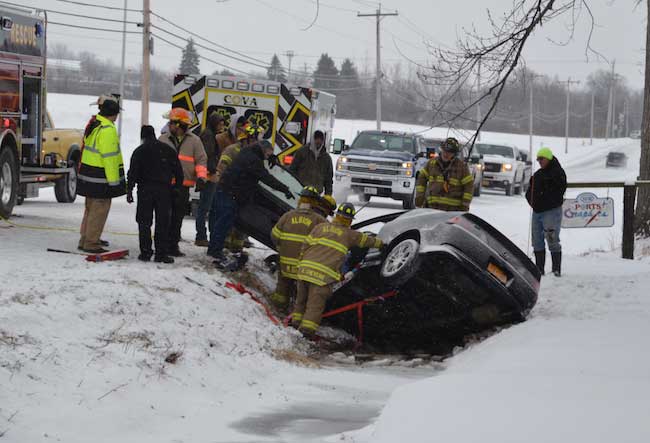
Photo by Tom Rivers
ALBION – The driver of a car suffered a broken right leg after the dashboard caved in on him when his vehicle struck a concrete embankment on Gaines Basin Road.
The vehicle slid off the road across from the Orleans Correctional Facility at about noon and landed in a ditch by the entrance to Sports & Graphics.
Firefighters used a jack to brace the car, and then needed extrication tools to free the driver, who was pinned in the vehicle for about 45 minutes.
The driver was taken by Central Orleans Volunteer Ambulance to Strong Memorial Hospital in Rochester.