

















Some events being cancelled locally due to coronavirus concerns
Concert at Medina library, Albion school dance on Friday both scrapped
Some local events are being canceled in response to concerns about the coronavirus.
• The Lee-Whedon Memorial Library in Medina decided to cancel the final concert of its winter series, Finally Fridays, after seeing an advisory from the Monroe County Department of Health to try to limit crowd sizes to 50 people.
The concerts at the library often draw about 200 people for the 7 p.m. events on Fridays. Serendipity Swings, a nine-member swing band from Buffalo, was scheduled to perform Friday.
Senior citizens are especially at risk of the virus, and seniors are the core group that attends the concerts, said Catherine Cooper, Lee-Whedon director
“We thought it was in the best interests of everyone to be careful,” he said.
• Albion Central School also announced the Albion Elementary PTA Dance for 3rd-5th graders has been cancelled for Friday “out of an abundance of caution.” Students will be given refunds for their tickets.
• Friday’s Niagara-Orleans League vs. Genesee Region League Exceptional Senior basketball doubleheader has been cancelled. The 21st annual senior girl-boy doubleheader was scheduled to be played at Albion.
• Saturday’s Winterguard program at Medina High School has been cancelled.
• The Albion Rotary Club also is planning to continue its St. Patrick’s Ham Dinner next Thursday, but will only be doing take-outs. The club decided today not to offer the dine-in option at the First Presbyterian Church of Albion.
People can still get a ham dinner with take-outs at a drive-through at the church or by going to the dining room door. The dinner is available form 4:30 to 6:30 p.m. on March 19.
Governor says no visitors to nursing homes, limits public gatherings to 500 people
Governor Cuomo announced today that public gatherings will be limited to no more than 500 people, effective at 5 p.m. on Friday.
“Additionally, for facilities with an occupancy of 500 or fewer, we are reducing the legal capacity by 50 percent,” the governor said.
Cuomo is taking action to “reduce the density of people across the state.” The governor said the action is needed to help slow the spread of the coronavirus.
There are now 328 confirmed cases of coronavirus in the state. The breakdown by county includes: Westchester, 148; NYC, 95; Nassau, 41; Suffolk: 20; Rockland: 7; Ulster, 4; Saratoga, 3; Albany, 2; Monroe, 2; Orange, 2; Broome, 1; Delaware, 1; Dutchess, 1; Herkimer, 1.
The governor said the state is taking special precautions with nursing homes & senior care facilities. No non-medical staff will be permitted to visit nursing homes.
“We are requiring that all staff at nursing homes wear masks and be monitored for symptoms,” the governor said.
The state is also planning to create a reserve workforce of healthcare professionals in the event of a staffing shortage. Some potential reserve staff include National Guard medics, medical school staff, and former doctors and nurses.
After coronavirus detected in Monroe, local health departments urge residents to be calm, take precautions
Press Release, Public Health Departments in Orleans and Genesee Counties
The Public Health Departments in Orleans and Genesee counties are geared up to respond to a positive case of coronavirus in the two counties. So far there hasn’t been a confirmed case in either Genesee or Orleans, said Paul Pettit, public health director for the two counties.
“In response to Monroe County releasing a travel-related positive case of COVID-19 we want to assure Genesee and Orleans County residents that our health departments are continuing efforts to be prepared and ready for action when COVID-19 is diagnosed in one of our residents,” Pettit said. “It has been determined there is no indication of community transmission in the Monroe County case. We currently have one person under precautionary quarantine and is not displaying signs of illness. Our responsibility in this outbreak is four fold: 1. To prepare and be ready. 2. Detect, protect and treat. 3. Reduce transmission and 4. Innovate and learn.”
“Our departments have been preparing for events such as this. We are diligently in conversation with the New York State Department of Health and Centers for Disease Control and Prevention for updated guidance. As we move forward with this outbreak we will be working with those returning from travel from Level 3 and Level 2 Travel Health Notice Countries as well as those who may have contact with someone who traveled and are displaying symptoms,” stated Pettit. “We encourage residents to remain calm; be prepared by making sure you have supplies on hand including a thermometer, fever-reducing over-the-counter medication, such as ibuprofen; and listen to factual reports from the CDC, NYSDOH, and Genesee and Orleans County Health Departments,” stated Pettit. “You can also call the NYS Coronavirus Call Center: 1-888-364-3065 for questions and answers about travel and symptoms .”
He also recommended the following websites: Centers for Disease Control and Prevention, Genesee County Health Department, and Orleans County Health Department.
It is important for everyone to be aware of how they can reduce transmission, not just for COVID- 19, but other respiratory related illness, such as the flu. For the majority of individuals infected with COVID-19 they will have mild symptoms. However, for those at risk, such as older people or those with underlying health issues such as heart, lung, diabetes, etc. they are at a higher risk of potentially life threatening symptoms. Limiting exposure to large group events and staying home when unwell are important steps. Organizations should start planning how they will meet the needs of their constituents if there is community transmission in our counties.
While there is currently no vaccine to prevent COVID-19, these simple steps can help stop the spread of this and other respiratory viruses, including the flu (influenza) which is currently widespread:
• If you need to go to your primary care provider, a health center or the emergency room, call ahead to let them know your symptoms, travel and contact history.
• Wash your hands often with soap and water for at least 20 seconds. If soap and water are not available, use an alcohol-based hand sanitizer with at least 60% alcohol.
• Avoid touching your eyes, nose, and mouth with unwashed hands.
• Avoid close contact with people who are sick.
• Stay home if you are sick. If you have a fever, vomiting and/or diarrhea you should stay home at least 24 hours after the last incident without fever-reducing / anti-diarrhea medications.
• Cover your cough or sneeze with a tissue, then throw the tissue in the trash. If you don’t have a tissue cover your mouth with your elbow.
• Clean and disinfect frequently touched objects and surfaces.
Barre opposes Cuomo’s proposal for more state control with large-scale energy projects

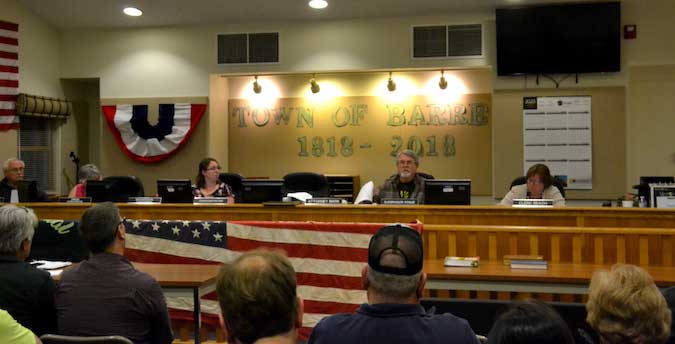
‘We don’t want the governor to take over eminent domain and what goes on in this town.’ – Town Supervisor Sean Pogue
BARRE – The Barre Town Board went on the record Wednesday to oppose Gov. Andrew Cuomo’s proposal to speed up review of large-scale energy projects, with the state taking more control of the process.
The governor introduced Article 23 as part of a budget amendment last month. He acknowledged large-scale solar and wind projects often are encountering resistance around the state. And the review process is often taking three years or more.
He wants to ensure that complete applications are acted upon within one year, except in the case of certain former commercial and industrial sites, which will be reviewed within six months.
Cuomo proposed creating a new Office of Renewable Energy Permitting to improve and streamline the process for siting of large-scale renewable energy projects. The governor said the projects deliver significant benefits to local communities.
Barre town officials see the proposal as taking local control away from towns.
“The Article 23 Amendment, if passed, would greatly limit the role of local zoning laws, avoid critical reviews of local environmental conditions requiring mitigation, allow the State to take certain lands through eminent domain and make them available to developers for construction of power plants, and limit a town’s taxation and assessment powers,” according to the resolution unanimously adopted by the Town Board.
If the project is acted on by the state within a year, the application would be deemed approved by default.
The resolution approved by Barre says the governor’s proposal would reduce public participation, limiting voices of opposition or disagreement to a project.
Barre, in the resolution, also states if Article 23 becomes law the town “will not provide any local resources or cooperation towards approval, administration and/or enforcement of any permits.”
The town already has two applications for large-scale renewable energy projects. Apex Clean Energy is proposing 33 wind turbines with a capacity for 185 megawatts as part of Heritage Wind.
Community Energy also wants to build a 200-megawatt project – Orleans Solar LLC – on 1,800 acres of land in Barre and Shelby near Townline Road by the wildlife refuge.
Sean Pogue, Barre town supervisor, said he expects most of the municipalities to pass similar resolutions. He is concerned the governor’s proposal could become law as part of the next state budget which is due to be passed by April 1.
“We don’t want the governor to take over eminent domain and what goes on in this town,” Pogue said.
Barre accepts $945K bid to construct Water District No. 9
BARRE – The Town Board on Wednesday accepted a $945,633 construction bid to build Water District No. 9.
Sergi Construction of East Aurora will install the water district. The project will extend public water service to 42 residential users and one commercial user on sections of Kams Road, Maple Street, Pine Hill Road, Gray Road, Eagle Harbor Road and Hemlock Ridge Road.
Barre has been approved for $1.3 million in federal funding – $708,000 in a low-interest loan and $493,000 in a grant – for Water District No. 9.
Town Supervisor Sean Pogue said he expects construction will start in the next four to six weeks.
1,800-acre solar project proposed for Barre, Shelby


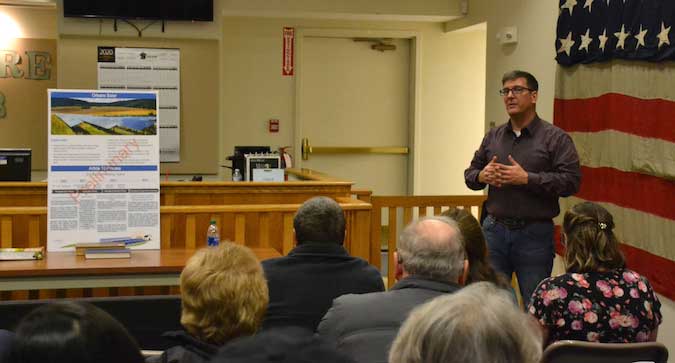
BARRE – A major solar energy project has been proposed for Barre and Shelby. Community Energy wants to build a 200-megawatt project – Orleans Solar LLC – on 1,800 acres of land in the two towns, with the project close to the Iroquois National Wildlife Refuge.
The big array of panels is not expected to have an significant environmental impact on the wildlife or wetlands, Joseph Green, director of development for Community Energy, said at tonight’s Barre Town Board meeting.
The project, if it passes local and state approvals, is expected to generate $750,000 annually in revenue for local governments.
“This is going to have a big impact on local taxes,” Green told residents at the meeting tonight.
National Grid transmission lines run right through the project area. Community Energy is seeking permission for an interconnection to get the power on the grid. Community Energy says it will generate enough electricity for 36,000 homes.
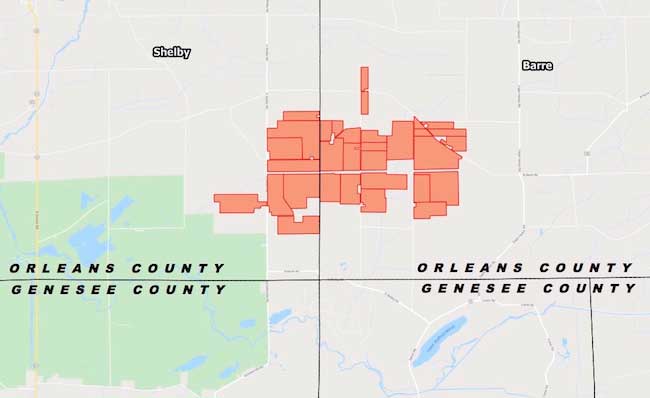
This map from Community Evergreen shows a preliminary layout for the project which would be near Townline Road in Barre and Shelby. The green in the lower left corner represents the Iroquois National Wildlife Refuge. The solar panels would be south of Hemlock Ridge Road with nearly all of them east of East Shelby Road.
The project is eyed for a sparsely populated area near Townline Road. The project would go on land that is currently mostly used for farming.
The project is listed as utilizing 1,800 acres, but Green said the solar panels and substation would take up about 1,200 acres. The company also needs to provide a buffer for setbacks near property lines and wetlands.
Among the solar array, about two-thirds of the land also will be open spaces, he said.
The company will put up a fence around the project, and will have “a robust planting plan” that is friendly to pollinators, Green said.
Residents and town officials can share their views on the project during many upcoming public meetings. The project also needs to go through the state’s Article 10 process for reviewing energy projects that are more than 25 megawatts.
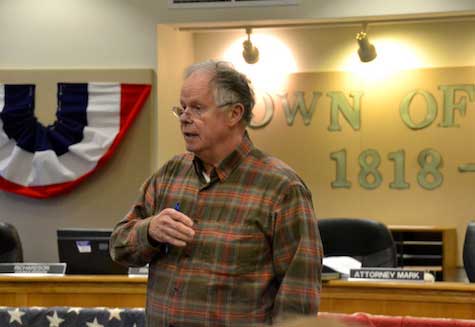
Tom Tuffey, one of the co-owners of Community Energy, said solar will be more popular as an energy source as coal-fired plants are decommissioned.
Green said the entire process would likely take about three years before there would be construction. He told residents at the Barre meeting the proposal is in the preliminary stage.
He wants to hear from residents and local officials throughout the process.
“We try our best,” he said. “You can’t please everyone but we try our best.”
Community Energy has projects in 20 states. The company was founded in 2009 and has developed 1,700 megawatts of solar and wind energy.
Green and Tom Tuffey, one of the co-owners of the company, said Community Energy has a proven record of working to minimize impacts of the projects through its site selection process and then through screening with plantings.
“We are not the kind of company that would just thrust something in front of someone’s home,” Green said.
The project doesn’t have the visual impacts of wind turbines. Heritage Wind is proposing 33 turbines that are about
From a distance the arrays of solar panels look like a lake, Green said.
The state’s goals for more renewable energy also is a factor in the project, and a push for renewable energy projects is good for the planet.
“We as a society have to do this,” Green said about the large-scale solar and other renewable energy.
Tuffey said solar is now much more affordable now and can compete with other electricity sources.
Green said Community Energy’s staff will become known to local residents as the company goes through the process.
He said the company would share more details as it finetunes to the application after hearing from regulators, residents and local officials.
“This is a preliminary project so I can’t give you the exact details,” he said.
You’re here checking the site, so you know: Orleans Hub is a vital resource for our community. Day in and day out, we share information and insights that matter to those who live and work in the towns, villages and hamlets of our county. Local advertisers help make the Hub possible, and so can you.
Donate today to keep Orleans Hub healthy and accessible to all. Thank you!

GCC cancels classes March 16-18, will then shift to on-line

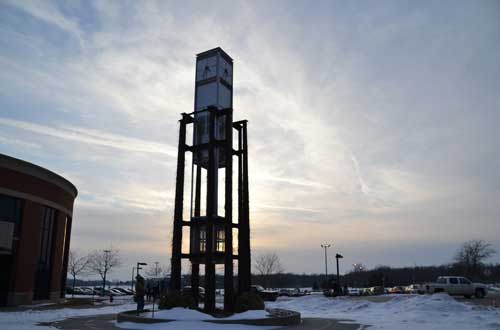
Photo by Tom Rivers: The clock leading to the entrance of GCC in Batavia is pictured with the Conable Technology Building at left in this file photo.
GCC cancels classes March 16-18, with classes to resume online March 19 and continue that way through the end of the semester.
GCC is taking the steps in accordance with guidelines for responding to the coronavirus from SUNY, Centers for Disease Control and the New York State Department of Health.
The GCC announcement on its website also states:
• Campus buildings will remain open during regular hours of operation unless further notice is provided.
• All employees are expected to report to work consistent with their normal schedules.
• College Village housing will also remain open.
• College leaders will continue to communicate regarding other on-campus activities and events as information becomes available.
• Tech Wars on March 12 has been canceled.
SUNY and CUNY will prepare for distance learning the rest of the semester

Governor confirms 43 more coronavirus cases, announces plan to expand testing
Press Release, Gov. Andrew Cuomo’s Office

Photo by Darren McGee, Office of Governor Andrew Cuomo: Governor Andrew Cuomo holds a briefing on coronavirus and discusses how SUNY/CUNY next week will implement distance learning for the remainder of semester.
During a novel coronavirus briefing, Governor Andrew M. Cuomo today announced that New York State will contract with 28 private labs to increase testing capacity for the novel coronavirus.
Following a call with the 28 labs, the Governor announced that he has instructed the labs to begin testing immediately as soon as they are ready. The 28 labs are specialized in virology and are routine partners with the New York State Department of Health.
The Governor also announced the State University of New York and the City University of New York will implement plans to maximize distance learning and reduce in-person classes, beginning March 19, for the remainder of the spring semester in light of the evolving novel coronavirus situation in New York.
All campuses will develop plans catered to the campus and curriculum-specific needs while reducing density in the campus environment to help slow possibility for exposures to novel coronavirus. Distance learning and other options will be developed by campuses.
Governor Cuomo announced the state will guarantee two full weeks of paid leave for all state workers who are subject to a mandatory or precautionary order of quarantine as a result of the novel coronavirus. Employees will not have to charge accruals during the time taken off work for quarantine. This will apply to all state employees, regardless of civil service classification, bargaining unit, and regardless of part time or accrual status.
Finally, the Governor also confirmed 43 additional cases of novel coronavirus, bringing the statewide total to 216 confirmed cases in New York State. Of the 216 total individuals who tested positive for the virus, the geographic breakdown is as follows:
Westchester: 121 (13 new)
New York City: 52 (16 new)
Nassau: 28 (9 new)
Suffolk: 6 (5 new)
Rockland: 6
Saratoga: 2
Ulster: 1
“While the risk to New Yorkers remains low, we are taking a number of steps out of an abundance of caution to protect public health including asking SUNY and CUNY to implement strategies to reduce density on campuses for the remainder of the semester,” Governor Cuomo said. “At the same time, we’re continuing to prioritize ramping up testing capacity because the more people you identify as having the virus, the better you can contain it. We’re also leading by example and providing paid leave to all state workers who are quarantined as a result of the virus – and we encourage businesses to voluntarily do telecommuting to the extent possible. Again I want to remind people to keep this in perspective: the facts do not justify the fear in this situation and the facts here should actually reduce anxiety.”
After speaking with business leaders today, Governor Cuomo also announced a new cooperative effort with New York business leaders to voluntarily implement different work shifts and telecommuting in an effort to reduce density.
SUNY Chancellor Kristina M. Johnson said, “We have been working closely with the Governor and the Department of Health to allow SUNY students to continue their education online or remotely, thus limiting their exposure to the COVID-19 while ensuring academic continuity. SUNY Online is a major initiative for our System, and we have been preparing to migrate many of our academic programs to this new distance-learning platform. With more than 100,000 SUNY students currently taking one or more of their courses online with us, we believe we are prepared and well-positioned to take advantage of remote instruction to further our student’s education during this crisis.”
CUNY Chancellor Félix V. Matos Rodríguez said: “The transition to distance learning protects our students and all of our campus communities, while enabling the University to ensure academic continuity, safeguarding students’ ability to finish the semester and protecting their financial aid. Our 25 campuses, including dorms, libraries, and research facilities, will remain open. The health and safety of the University community remains our top priority and I am glad that this measure allows CUNY to continue serving its students while alleviating pressure on our area during this public health threat.”
Holley family appreciates help after being displaced by fire

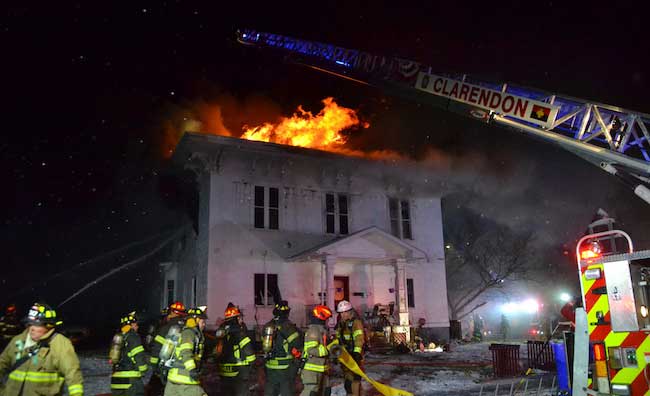
Community Action and United Way helped family
(Editor’s Note: This is the beginning of a series on the different ways the United Way assists people in the community.)
HOLLEY – Despite Ally Macey and her fiancée Jon Page losing all their possessions in a Jan. 6 fire that destroyed their apartment building, she says they have a lot to be thankful for.
The couple had just got back after bringing their 4-month-old daughter home from the hospital. About 10:30 p.m. on Jan. 5, Macey said there was a loud noise and then she heard screaming. She looked out and the whole porch was on fire.

Photo courtesy of Ally Macey: Jon Page naps with his infant daughter Mira in the apartment he and his fiancée Ally Macey were able to rent because of receiving funds for a security deposit from United Way.
They had no time to grab anything but their daughter and the dog.
“I left barefooted in a nursing bra and sweat pants,” Macey said. “I sat in an officer’s car and someone brought me a blanket and a pair of shoes that were three sizes too small.”
She said a watermain had broken so there was not sufficient water to fight the fire. Firefighters, however, were able to contain the blaze from spreading to neighboring structures.
Macey said she is from California and has no family in the area, and she didn’t know where they were going to stay. A small bus came and took the occupants to the high school.
The next day, a friend took their dog, and they were able to stay with family of Page’s, but had no idea how they were going to find another apartment.
“We hadn’t planned on moving and had no money saved for a security deposit,” Macey said. “The Red Cross came and gave us basic necessities. We both work, so we didn’t qualify for help from Social Services. The next day, someone told me to call United Way. I was told they fund Community Action and other community services.”
Community Action gave them non-perishable food and money for a security deposit. Macey didn’t know at the time the money they received came from United Way and had been donated by a Rochester corporate donor for the specific purpose of helping people find housing.
Community Action also runs the Eastern Orleans Community Center in Holley, where substitute coordinator Rachael Escobar had opened up the site the night of the fire in case any of the displaced occupants wanted to come in there out of the cold. Escobar also knew there was a vacancy in the apartment building in which she lived, and after receiving the money for a security deposit, Macey and Page were able to rent it.
She said she doesn’t know what they would have done without the help from Community Action and United Way.
 “The whole community has been awesome,” Macey said. “I’m so thankful and so grateful we are safe, but so sad at the same time because we lost everything. Within 30 minutes, the whole second floor was falling in. Two of our neighbors weren’t able to get their cats and dog out.”
She said every day she is reminded of the things they lost that can never be replaced, and they have a hard time sleeping because it was at night when the fire occurred.
She will forever be grateful to Community Action and United Way. The community is reminded that their donations all stay local to help people like Macey and Page.
FMC’s Middleport plant celebrates injury-free workplace in past year


Photo courtesy of FMC: FMC Corporation’s Agricultural Sciences Plant in Middleport celebrates one year as an accident and injury-free workplace. Joining in an acknowledgement of this safety milestone are (from left to right) Dr. Roberta Kloda, plant manager; Joseph Caputy, production supervisor; Allie Wagner, human resources manager; Patrick Stahura, operations manager; and Bob Brockman, quality supervisor.
Press Release, FMC
MIDDLEPORT – FMC Corporation’s Agricultural Sciences facility in Middleport recently celebrated one year as an accident and injury-free workplace without an OSHA recordable incident.
“FMC is committed every day to safety in the workplace as a core value of our operations so that all of our employees go home safely,” said Dr. Roberta Kloda, FMC Middleport plant manager. “This effort is the result of a work culture based on teamwork, strong management support, and the commitment by the International Association of Machinists and Aerospace Workers.”
The Middleport facility has been recognized several times in the past for periods of safe operations without an OSHA recordable incident. This facility was also part of FMC’s overall recognition last year for leadership in environmental, health, safety and security performance by the American Chemistry Council (ACC) with the Responsible Care Company of the Year Award for its “TH!NK. SAFE.” program, which is at the core of FMC’s safety commitment.
About FMC Middleport
FMC’s Middleport site formulates and packages a number of key product lines to protect over 100 crops in more than 75 countries worldwide. Plant operations in the Middleport area date back to 1904, with FMC acquiring operations at the facility in 1943. FMC continues to be a global leader in agricultural sciences, and the Middleport facility plays a key role in these endeavors. Safety is a core value at FMC which affects virtually everything we do as a company. Whether at work, at home, or on the road, FMC strives to keep safety in the forefront of our daily activities.
Holley’s big sidewalk, waterline project expected to start late April, early May
HOLLEY – Village officials say a $4.5 million waterline and sidewalk project is expected to start in late April or early May and will take about a year.
The Village Board on Feb.11 accepted a $2,556,000 construction bid from a contractor on Tuesday to replace sidewalks and water lines in the village. Most of the project is along Route 237 and the northeast section of the village.
Mark Cerrone, Inc. of Niagara Falls submitted the lowest bid for the project. Grants will cover the majority of the costs. Holley is responsible for 20 percent of the sidewalk work and 40 percent of the waterlines.
The village will put in sidewalks and waterlines on East Albion Street, Park Place and East Union Street as part of its share for the project.
Since the bid was approved, the village has worked with the state Department of Transportation to secure its final approval.
The village was approved for a $1,780,000 federal TAP grant (Transportation Alternatives Program) to construct curbs and sidewalks that are compliant with the Americans with Disabilities Act. The grant will allow the village to replace about one-third of the sidewalks in the village.
Cerrone’s share of the project includes sidewalks along Rt. 237 – both north and south of Rt. 31 to the village limits (from the water tower to the elementary school), as well as both sides of Geddes Street from Van Buren to Route 31, both sides of Perry Street, both sides of Morgan Street and the west side of East Avenue.
Holley also was awarded nearly $1.3 million from the state for upgrades to the water system through the Water Infrastructure Improvement Act, as well as the Intermunicipal Water Infrastructure Grants Program.
The waterline project includes 5,800 linear feet, just over a mile, and involves replacing 4- to 8-inch water mains with 8- to 12-inch water mains.
That project includes portions of South Main (from the water tower to Batavia Street), South Main from Jackson Street to West Albion Street, water service transfers only along North Main from West Albion Street to the high school, the northerly side of Geddes Street from Van Buren Street to Public Square, along with connections to existing waterlines at ends and side streets.
The village on Tuesday also approved a $318,100 contract with the Wendel firm for construction administration and observation services during the project.
Business owners ask for more parking enforcement in Holley downtown

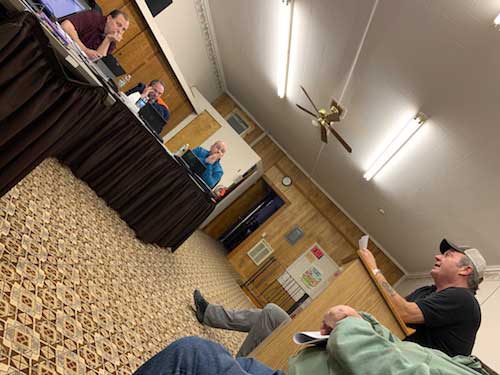
Photo by Tom Rivers: Dan Seeler, owner of the Holley Falls Bar & Grill, asks the Holley Village Board for more parking enforcement in the downtown business district and also to extend the 2-hour parking limit from 6 p.m. to 9 p.m. Pictured from left include Holley Mayor Brian Sorochty, Deputy Mayor Kevin Lynch and Trustee Jim DeFilipps.
HOLLEY – The Holley Village Board was asked to extend a two-hour parking limit in the downtown business district from 6 p.m. to 9 p.m.
Dan Seeler, owner of the Holley Falls Bar & Grill, said there are four businesses – Sam’s Diner, Lisa’s Dance Boutique, Dustin’s Pizzeria and Holley Falls Bar & Grill – that are open to at least 9 p.m.
He presented the board with a letter signed by 10 business owners in the downtown, asking for more parking enforcement and the extended hours for the parking limit. It is currently in effect from 9 a.m. to 6 p.m.
Those business owners also asked the Village Board to send a letter to all the building owners in the downtown business district asking that employees, tenants and owners park outside the Public Square between 9 a.m. and 9 p.m.
Seeler also asked that 10-minute loading zone be allowed in front of Dustin’s Pizzeria and the Holley Falls Bar & Grill.
If the parking limit was extended to 9 p.m. that would require a public hearing and a change in the local law, village attorney John Sansone said.
The best way for immediate relief could be ticketing people or giving them warnings if they exceed the 2-hour limit, Holley Police Chief Roland Nenni said.
The Police Department can step up its enforcement of the 2-hour limit. Often that help ensure some people are not taking parking spaces beyond two hours.
Seller said he believes the board to should change the law so the 2-hour limit extends through 9 p.m. He said there many vehicles parked in the Square well past 6 p.m. He urged the board to extend the parking enforcement to 9 p.m. and encourage the building owners to have tenants and employees park outside the Square between 9 a.m. and 9 p.m.
Holley Gardens move-in day pushed back to April
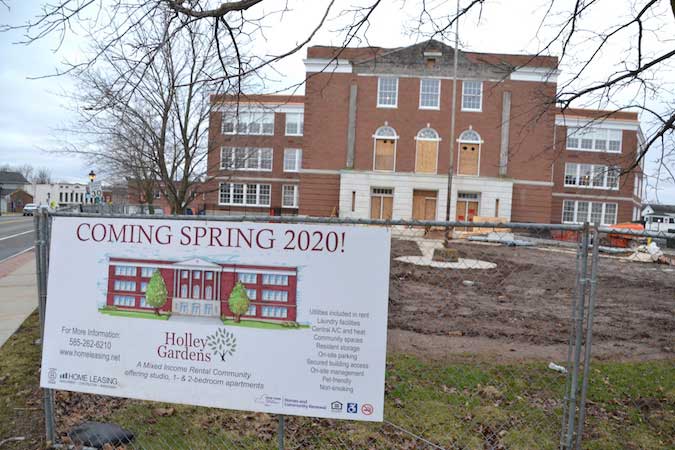
Home Leasing getting close to finish line in $17 million transformation of old high school
HOLLEY – The former Holley High School should be ready for tenants on April 1 with the space for the village offices to be complete on April 15, village officials said during this evening’s Village Board meeting.
Home Leasing started construction in November 2018 on the $17 million transformation of the former school, turning it into 41 apartments and the village offices. The apartments will include one studio, 35 one-bedrooms, and five two-bedroom apartments.
Home Leasing has the top three floors done, said Ron Vendetti, the village’s grants manager. The company is focusing on completing the basement and the 6,000 square feet for the village offices.
Home Leasing also needs to finish site work for the property.
The Rochester was pushing to have the offices ready for the Village of Holley government on Feb. 1 with the apartments ready to be moved in by Feb. 15. Last month, Home Leasing was hopeful the building could be ready in March.
The village will vacant its office on the Public Square when it move to the former school building. The village will pay about $2,000 in monthly rent, and Holley also agreed to mow the lawn. The village also owns the parking lot for the site.
Lewis Passarell, a former Holley mayor, inquired with the Village Board this evening about the village’s commitment for the project, and how much Home Leasing will pay in tax revenue.
Vendetti, the grants manager, said the village, town, school district and county all pushed to make the project a reality and approve a PILOT (payment in lieu of taxes) that offers a discount on property taxes.
“Otherwise the school would have sat there the way it was until someone came up with the money to tear it down,” Vendetti said.
Home Leasing is paying $13,500 in a PILOT beginning in 2021. The $13,500 will be shared among Holley Central, the Village of Holley, Orleans County and the Town of Murray.
The 30-year PILOT agreement has the amount in payments increasing 2 percent each year until it reaches $23,973.90 in 2050.
The property hasn’t generated any taxes for about two decades and the village has been mowing the lawn for years at the prominent location at the corner of routes 31 and 237.
The village is getting ready for the move to the school. The board at its meeting today authorized spending up to $17,000 for office furniture – desks, tables, chairs and storage cabinets. Holley will have three offices, two cubicles and its main meeting room at the former school.
Schumer, Gillibrand say FCC treating NY unfairly with broadband funding
Press Release, U.S. Senators Charles Schumer and Kirsten Gillibrand
WASHINGTON, D.C. — U.S. Senator Charles E. Schumer and U.S. Senator Kirsten Gillibrand today denounced the Federal Communications Commission’s (FCC) decision to move forward with the recently adopted Rural Digital Opportunity Fund (RDOF) Order that would exclude states that have been awarded funding through the U.S. Department of Agriculture’s (USDA) ReConnect program or other state-run broadband development or subsidy programs from being eligible for the RDOF.
In a letter to FCC Chairman Pai, the senators call for transparency over the new order and ask specific questions that remain unanswered. According to the senators, the order as adopted would penalize states like New York that have implemented their own broadband programs and further exacerbate the digital divide felt in rural communities.
The FCC’s Rural Digital Opportunity Fund will allocate $20.4 billion to connect millions of rural homes and small businesses to high-speed, broadband internet. However, the Senators explained, under the newly adopted Order from the FCC, that many unserved rural New Yorkers would be excluded from this vital pool of federal funding, stripping these communities of resources that could have a positive impact on educational, economic and health outcomes.
“In the modern economy, access to reliable, fast internet service is crucial to any Upstate New York community’s success,” said Senator Schumer. “This decision by the FCC sets a dangerous and counterproductive precedent that discourages states from investing in rural communities. The federal government should not be punishing New York, or any other state, for taking initiative, especially not for securing broadband access for rural communities that need and deserve top-notch high-speed internet. That’s why I’m calling on the FCC to reconsider their unwise decision and to provide clarification for why they’ve decided to undermine state broadband efforts.”
Senators Schumer and Gillibrand were joined by Senators Tammy Duckworth (D-IL), Cory Gardner (R-CO), Tom Udall (D-NM), Ron Wyden (D-OR), Richard Durbin (D-IL), Edward Markey (D-MA), Angus King (I-ME), Amy Klobuchar (D-MN), Mazie Hirono (D-HI), Chris Van Hollen (D-MD), Michael Bennet (D-CO), Jeff Merkley (D-OR), Bernard Sanders (I-VT), Tammy Baldwin (D-WI), Brian Schatz (D-HI), Patty Murray (D-WA), Bob Casey (D-PA), Mark Warner (D-VA), Patrick Leahy (D-VT), Ben Cardin (D-MD), Cory Booker (D-NJ), and Elizabeth Warren (D-MA).
“This order could be devastating to rural New Yorkers and rural communities around the country, and I’m disappointed that the FCC has chosen to exclude certain unserved communities from potentially accessing crucial broadband funding to improve internet services,” said Senator Gillibrand. “I’m deeply concerned that the FCC is penalizing states that have taken action to help rural communities get online. I demand clarity of the RDOF Order’s eligibility requirements and urge the FCC to reconsider so that all communities have the opportunity to access this critical funding to improve broadband services.”
Girl Scouts meet Albion village officials, police officers to promote cookie season



Press Release, Girl Scouts of Western New York
ALBION – Girl Scouts of Western New York Troops 82007 and 82261 visited Albion Mayor Eileen Banker and other Village Board members last week to kick off the start of their cookie booth season.
The Girl Scouts met the mayor, along with Village Trustees Stanley Farone, Gary Katsanis and Peter Sidari to talk about how their local government works and to share insights into their own cookie sales.
Mayor Banker explained how the village makes decisions and operates, including the roles of certain departments like the Department of Public Works or the caretaking of places like Mount Albion Cemetery. The girls asked questions about changing laws, the difference between a village and a town, and how elections work.

Albion Village Board members discussed local government with the Scouts. The board members pictured include Trustee Gary Katsanis, Trustee Peter Sidari, Mayor Eileen Banker and Trustee Stan Farone.
The Girl Scouts explained to the mayor and trustees that they sell cookies because it helps to build skills like being able to get more comfortable talking to people and counting money to make change, and that cookie sales also fund activities like travel trips, going camping, attending Girl Scout programs, or working on community service projects.
Everyone in attendance also took part in a cookie sampling with top choices being Peanut Butter Patties, Thin Mints and Lemonades.
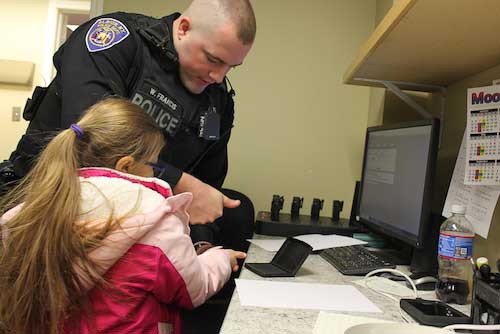
Will Francis gives this scout a tour of the police station.
After the meeting, the troop went around the corner to the village police station. The officers took the girls on a tour of the station and then showed them the inside of one of the police vehicles including all the gear they carry with them.
The Girl Scouts were also able to try on some of the police SWAT gear and were surprised at the weight. They also saw some of the equipment the officers use such as handcuffs and helmets with communication devices built into them. The girls brought some cookies as a gift and the officers also purchased additional cookies.
Girl Scout cookie season ends March 29. To learn more about Girl Scouts or to find a cookie booth, visit gswny.org.
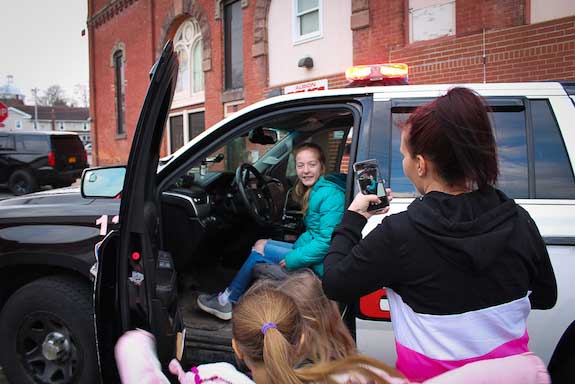
The Girl Scouts were given a chance to sit in a patrol vehicle.
About Girl Scouts of Western New York
Girl Scouts of Western New York (GSWNY) serves nearly 15,000 girls and over 6,000 adult volunteers across the GSWNY jurisdiction, including Cattaraugus, Chautauqua, Erie, Genesee, Livingston, Monroe, Niagara, Orleans and Wyoming counties. The council’s administrative service centers are located in Batavia, Buffalo, Jamestown, Lockport, Niagara Falls, and Rochester.