
















Orleans unemployment claims nearly 2,500 in 5 weeks
The number of people filing unemployment claims with the state was another 297 in Orleans County during the week ending April 18.
That brings the total filings in the county to 2,435 in five weeks since the state started closing businesses due to health concerns about the Covid-19 pandemic.
The county has a workforce of about 17,000 people. The 2,435 unemployment claims represent about 14 percent of the workforce. There were about 1,000 people on unemployment. Those people plus the 2,435 who recently filed for unemployment would put the county’s unemployment rate currently at about 20 percent.
The number of people filing for unemployment each week is going down locally and state-wide.
Here are the weekly unemployment claims the past five weeks in the GLOW counties and statewide:
- Genesee: 421 (April 18), 931 (April 11), 886 (April 4), 1,308 (March 28), 268 (March 21)
- Livingston: 403 (April 18), 918 (April 11), 996 (April 4), 1,338 (March 28), 227 (March 21)
- Orleans: 297 (April 18), 581 (April 11), 595 (April 4), 824 (March 28), 138 (March 21)
- Wyoming: 266 (April 18), 601 (April 11), 603 (April 4), 837 (March 28), 155 (March 21)
- Statewide: 207,172 (April 18), 399,015 (April 11), 347,573 (April 4), 369,025 (March 28), 80,753 (March 21)
Although the unemployment claims are going down, they are still far more than in a normal week. The 297 claims in Orleans County the week of April 18 is about 10 times more than the 29 filed during the same time period a year ago.
The 207,172 claims filed state-wide during the week of April 18 compared to 12,250 during the same time period a year earlier.
NYS Department of Labor says $3.1 billion in benefits paid since Covid-19 crisis started
The state Department of Labor announced it has distributed $3.1 billion in unemployment benefits to New Yorkers since the coronavirus pandemic started impacting New York businesses in early March.
In total, more than 1.4 million New Yorkers have submitted completed applications for unemployment benefits since the crisis began, including traditional unemployment insurance and Pandemic Unemployment Assistance.
“Every state is facing major challenges when it comes to unemployment, but in New York we are upgrading our systems in real time while delivering benefits to New Yorkers faster and more aggressively than any other state,” said NYS Department of Labor Commissioner Roberta Reardon. “We will keep working around the clock seven days a week to ensure every single New Yorker gets every single dollar they deserve.”
States across the country have faced an unprecedented increase in the number of people filing for unemployment insurance – 26 million Americans have submitted claims. Since March 9, New York State has processed 1.4 million initial applications for unemployment benefits.
The $3.1 billion distributed to support New Yorkers who lost their jobs includes traditional unemployment insurance and new federal programs like Pandemic Unemployment Assistance, which provides benefits for those not covered by traditional unemployment insurance; Federal Pandemic Unemployment Compensation, which provides an additional $600 per week for all benefit recipients; and Pandemic Emergency Unemployment Compensation, which provides 13 additional weeks of benefits, for a total of 39 weeks of unemployment benefits.
1 new case of Covid-19 reported in Orleans
There is one more confirmed case of Covid-19 in Orleans County, bringing the total confirmed cases in the county to 80, the Genesee and Orleans County Health Departments reported this afternoon.
There aren’t any new cases in Genesee, which has had 143 confirmed cases.
Contact tracing has been initiated in Orleans County and all who have had direct contact with the individual who tested positive will be notified by Health Department staff.
There is currently no further information to release on ages and location. Mapping to include the positive cases from the weekend will be updated on Monday afternoon, the Health Departments stated in a news release.
“We continue to encourage our residents to be vigilant about handwashing, cleaning frequently used surfaces, properly wearing cloth face coverings over the mouth and nose, keeping your hands away from your face, limiting time out in public and when you do need to go out for essentials you designate one person from your household, keep social distancing and stay home if you are sick,” the departments stated in the news release.
Governor outlines phased plan to re-open state, beginning with construction and manufacturing

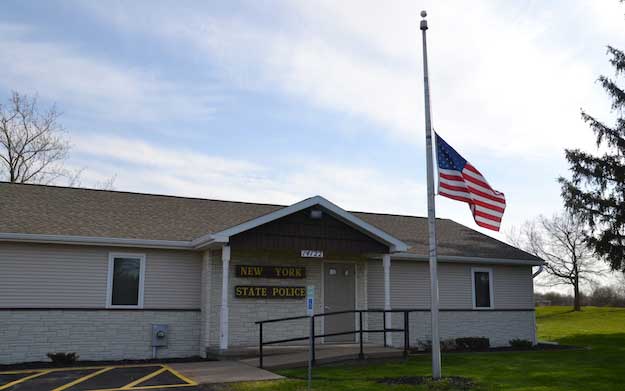
Photo by Tom Rivers: The flag is lowered at State Police barracks in Albion on Saturday out of respect for people who have died from Covid-19. Gov. Andrew Cuomo reported today that 367 people died from Covid-19 on Saturday, bringing the death toll from the virus in the state to 16,966. The 367 deaths on Saturday was the first time fewer than 375 had been reported in a day since March 31. There were 5,902 new confirmed cases of coronavirus on Saturday in the state, bringing the total cases in New York to 288,045.
Press Release, Gov. Andrew Cuomo’s Office
Amid the ongoing COVID-19 pandemic, Governor Andrew M. Cuomo today outlined a phased plan to re-open New York and re-imagine a new normal for the state starting with construction and manufacturing.
The plan will be implemented in phases and will be based on regional analysis and determinations. Based on CDC recommendations, once a region experiences a 14-day decline in the hospitalization rate they may begin a phased re-opening.
The State is closely monitoring the hospitalization rate, the infection rate and the number of positive antibody tests, as well as the overall public health impact, and will make adjustments to the plan and other decisions based on these indicators.
- Phase one will include opening construction and manufacturing functions with low risk.
- Phase two will open certain industries based on priority and risk level. Businesses considered “more essential” with inherent low risks of infection in the workplace and to customers will be prioritized, followed by other businesses considered “less essential” or those that present a higher risk of infection spread. As the infection rate declines, the pace of reopening businesses will be increased.
- The region must not open attractions or businesses that would draw a large number of visitors from outside the local area.
- There will be two weeks in between each phase to monitor the effects of the re-opening and ensure hospitalization and infection rates are not increasing.
- This plan will be implemented with multi-state coordination, especially in downstate New York. The plan will also coordinate the opening of transportation systems, parks, schools, beaches and businesses with special attention on summer activities for downstate, public housing and low-income communities, food banks and child care.
- The phased re-opening will also be based on individual business and industry plans that include new measures to protect employees and consumers, make the physical work space safer and implement processes that lower risk of infection in the business. The state is consulting with local leaders in each region and industry to formulate these plans.
“We’ve been talking about re-opening the state and re-imagining a new New York, and to do that we’re going to have to make governmental decisions in partnership with business decisions,” Governor Cuomo said. “Every business leader understands that we can’t just re-open and go back to where we were and what we were doing before – we have to move forward in light of the circumstances that have developed. So we are going to re-open the economy in phases, based on regional and specific industry determinations and CDC guidelines, and in the midst of all this continuing to monitor the public health impact because all that progress we made by flattening that curve we could lose in a matter of days if we’re not careful.”
ICU nurse working with Covid patients says virus wreaks havoc


‘All of these super-sick patients are sick because of Covid.’ – Kandace Pierce
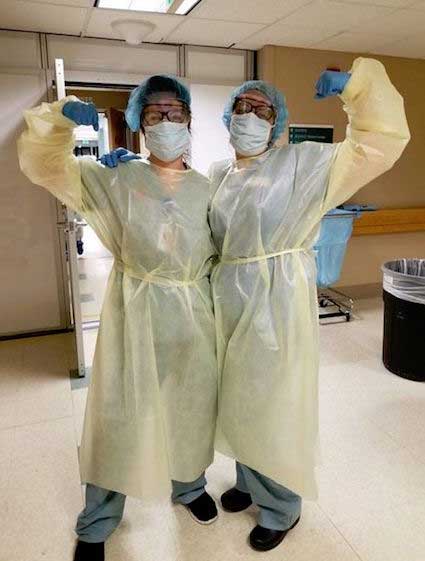
Provided photos: Kandace Pierce, left, and a coworker wear their protective gear while working with Covid-19 patients at St. Joseph’s Hospital in Cheektowaga. Pierce, an Albion resident, has been working 12-hour shifts with Covid-19 patients since March 26.
An ICU nurse from Albion has been on the front lines the past month treating Covid-19 patients at a hospital in Cheektowaga.
Kandace Pierce, 33, works 12-hour night shifts at St. Joseph’s Hospital in Cheektowaga. It was made a Covid-19 only hospital by Catholic Health with a capacity for 80 patients.
Pierce works with three or four patients a shift. They need a lot of attention. Some are in their 20s and 30s, and others are much older.
“These patients are some of the sickest I’ve ever seen,” Pierce said in a phone interview. “They are not normal ICU patients. These are very sick people.”
Pierce has been an ICU nurse the past 14 years. She has worked at St. Joseph’s for about four years. Before the hospital was changed to Covid-only, Pierce worked in the ICU and typically worked with two to six patients a shift.
The hospital was dedicated to Covid-19 patients on March 26. It went from having a few Covid patients in late March to about 40 now.
Pierce has watched people come in with shortness of breath and fevers, and quickly be in trouble, with multiple problems, not just respiratory issues. Their intestines slow down, and their kidneys and livers often are failing.
“This affects your entire body, not just your lungs,” Pierce said. “All of these super-sick patients are sick because of Covid. Once they are sick enough to need ICU care they go downhill really fast.”
Her advice to Orleans County residents: take the virus seriously.
People should keep washing their hands frequently, practice social distancing and wear masks, even after the state loosens some of the strict restrictions and allows some businesses to reopen, Pierce said.
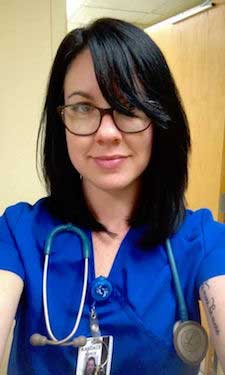
Kandace Pierce has been a nurse for 14 years and said the Covid-19 patients are among the sickest patients she’s ever seen.
She works in the “red zone” at the hospital with the sickest patients. Many have been intubated and are on ventilators.
The hospital is quieter than usual, because there aren’t any visitors. That also make a somber scene even worse because the patients are very ill, and don’t have the comfort of loved ones in the room. The hospital has iPads to help patients communicate with family. Nurses will sometimes need to hold the device for the patients.
“It’s hard to see somebody who is not doing well and their family can’t see them,” Pierce said. She worries about going to work and catching the virus. Thankfully, she said, none of her co-workers have got it. Catholic Health has provided employees with multiple personal protective equipment, with fitted N-95 masks, goggles, gowns, hair coverings and gloves.
“They provide us scrubs, so we change clothes before leaving,” Pierce said. “They also provide a local hotel room if we want to shower before coming home.”
Pierce is an Oklahoma City native. She and her husband Nicholas were on a vacation to Niagara Falls when they fell in love with Western New York. They moved to WNY in 2016, impressed with the quality of schools, the relatively low-cost living and the many healthcare options.
“We just thought the area was beautiful,” Pierce said.
They like the history of the area, and the big old houses with sizable back yards. And those houses are affordable, especially in the small towns. The couple has two sons, ages 5 and 10.
The family lived in Buffalo their first year in WNY before moving to Albion about three years ago.
Erie Canalway Heritage Corridor approves $60K in grants
Mural on Brockport book store among the projects
The National Erie Canalway Heritage Corridor has announced $60,000 of IMPACT! grants for eight projects in canal communities.
None of the projects receiving funding are in Orleans County, but one includes repairs to a mural at the Lift Bridge Book Store in nearby Brockport.
“We are fortunate to collaborate with an extraordinary network of community- based groups that are doing vital work to preserve and showcase canal heritage and welcome people to explore the canal in their local communities,” the National Erie Canalway Heritage Corridor stated.
The eight grants range from $2,000 to $12,000 and will leverage an additional $515,291 in private and public project support. The NYS Canal Corporation partnered in helping to fund the grants, which increase in the award threshold and the funding of additional projects in 2020.
The projects receiving funding include:
• 1st Amendment, First Vote – Civic Engagement Field Trip to Historic Seneca Falls for Teen Girls
Bring 100 high school girls from 19 school districts across the Canal Corridor to Seneca Falls for the commemoration of the 19th Amendment. The activity is part of a year-long immersive program in civic engagement. Awarded: $2,000
• Buffalo Maritime Center – Interactive Interpretive Exhibit at Buffalo Canalside
Design and plan exhibits for the Longshed at Canalside in Buffalo’s Inner Harbor, where a replica packet boat is being constructed to celebrate the “Wedding of the Waters” Bicentennial. The exhibits will feature interactive interpretive displays of the 1825 era replica packet boat. Awarded: $5,000
• City of Oneida – The History of the Erie Canal and Oneida
Design and fabricate four interpretive signs to be placed on walking trails in the city. Signs will highlight canal resources including an aqueduct, a dry dock, and the adjacent feeder canal. Awarded: $12,000
• County of Oswego – Oswego River Paddling Access Site
Design an ADA accessible car-top paddling access area on the Oswego River. The site will include an ADA accessible trail, parking, and accessible hand-launch docks. This will give paddlers access to a 4-mile section of scenic waterway between Locks 5 and 6. Awarded: $12,000
• Feeder Canal Alliance — Field School Environmental Lab on the Glens Falls Feeder Canal
Develop a hands-on field school environmental lab on the Glens Falls Feeder Canal. The program will practice an inquiry-based approach to education and focus on environmental themes, including water quality and invasive species. Awarded: $5,000
• National Women’s Hall of Fame, Seneca Falls – Exhibit Showcasing Inspiring Women in History
Create a movable exhibit that honors women and their contributions in history. The new exhibits will be located in the new home of the National Women’s Hall of Fame in the historic Seneca Knitting Mill. Awarded: $10,000
• Town of Lyons – Canalside Landscaping and Beautification
Design and implement a sustainable garden space alongside Lock 27 in downtown Lyons. With municipal support, landscape architects and volunteers will revitalize a waterfront space to welcome canal travelers. Awarded: $7,000
• Village of Brockport – Main Street Mural Restoration
Restore a prominent mural on Main Street depicting a scene from Peter Spier’s Erie Canal children’s book. Restoring the mural will ensure that the charm and grace of this canal community will continue to be appreciated by residents and visitors for years to come. Awarded: $7,000
Sunday Morning Positive Perks from your Sassy Small Town Missus
Mr. Penguin’s Smirk
 Mr. Penguin and I bonded at The Aquarium. If you look at his face it looks like he was grinning at me, but in a way that lets me know he thought he was “all that.” He knew he had a leg up on me because he’s aquatic and I like to swim, but I could never match his ability or gracefulness.
Mr. Penguin waddled around upright on the stones. I appreciate that because I waddle a bit too. A touch of arthritis in the old hip joints will do that to a lady in her 50’s. Penguins can move right along and from what I understand they are not afraid of humans.
Another thing we have in common. If the glass partition was not between us, he may have walked right up to me and I think we may have bumped elbows. Those big flappers allow him to plunge into the water and glide around with ease.
It can be quite peaceful soaring around under the clear water drowning out the noise from the outside. I have done it a few times myself in my very own pool, so I can relate. This little guy is a Humboldt Penguin and about 2 feet tall and maybe 15 pounds from my best recollection. However, his ego is quite large. I mean really, just look at that smirk.
Penguins like to colonize and select a mate to be monogamous with. Although from what I understand there are “serially”monogamous penguins that acquire a new mate each season. Both situations seem like another parallel to the human condition. When it comes to raising babies, it is not just females that do the rearing.
In a pinch a male will happily take on the responsibility when needed. As I was checking this guy out he seemed to know that I was watching him. He was quite the ham as he glided along the glass wall showing me his little tricks in the water. It took me a bit to get a good snap of him with my camera. He made me really work for it.
But in the end he stopped toying with me and offered up a full face photo-op of which I was very grateful. Sometimes when I am out taking photos it is difficult to tell what story the picture will tell until it’s downloaded onto my computer.
I really appreciated how photogenic he was, another quality he trumped me on… In the end I was left with the conclusion that he and I had quite a few things in common. Most of which he was better at than me from the hobbling, to the gliding to the cunning way he could use avoidance in a way that made him cute!
I hope this little light hearted post brings you a smile with the help of my friend, Mr. Penguin. And remember no matter what challenges fall upon us, just keep hobbling and gliding along with the confidence of a Penguin and you will be OK.
Fun fact – A Humboldt Penguin once scaled a 4 meter high fence and navigated through barbed wire to frolic in the Tokyo Bay for 82 days before being found and brought back to The Tokyo Park. Sometimes you just crave a little escape!
To see more Photos of Mr. Penguin visit my blog live online at https://www.positiveperksposts.com and catch up on weekly photo perks and past posts. Like and share your comments. Happy Perks to Everyone!
Deborah London
Erie Canal season won’t open as planned on May 15


The State Canal Corporation won’t open the Erie Canal as planned on May 15 for its 196th navigational season.
Due to the Covid-19 pandemic, the Canal Corp. suspended all non-essential construction and maintenance activities, which are needed to have the system in working order.
The Canal Corporation is evaluating options for opening the canal later this year, even if potentially on a regional basis, the Canal Corp. said in a notice to mariners on Thursday.
“We recognize that this is an extraordinarily difficult time and are sensitive to potential hardships Canal stakeholders, as well as many other New Yorkers, may experience,” the Canal Corp. said. “The situation with Covid-19 is ever-evolving and we are trying to adapt our plans accordingly.”
The canal has been operational every year since it opened in 1825.
The Erie Canalway National Heritage Corridor said a fully navigable canal system should be considered essential transportation infrastructure.
“Delays in opening the Canal System or opening the canals on a ‘regional basis’ will have significant negative impacts on the economy and social fabric of upstate communities and will impede a full New York State recovery,” the Erie Canalway stated in response to the Cana Corporation’s announcement.
“The NYS Canal System generates billions of dollars in economic impact each year for canal communities and businesses,” Erie Canalway stated. “Negative impacts will be keenly felt by boating-related businesses and service providers, commercial operators, communities that rely on canal tourism, and manufacturing.”
A delayed opening of the canal will further contribute to a climate of uncertainty across the entire state, the Erie Canalway said.
“More than 70 percent of upstate New Yorkers live within 20 miles of the canals. For 200 years, through wars and peacetime, prosperity and recession, the canals have remained navigable,” the organization stated. “Residents in canal communities celebrate the opening of the Canal System each year and embrace the beauty, history, and recreational opportunities that the canals provide. Opening the entire Canal System in a safe and timely fashion would provide a sense of normalcy and hope to millions.”
NY will make Covid-19 testing available for first responders, medical workers and essential employees

Governor authorizes 5,000 pharmacies to serve as sites where tests can be collected
Press Release, Governor Andrew Cuomo’s Office
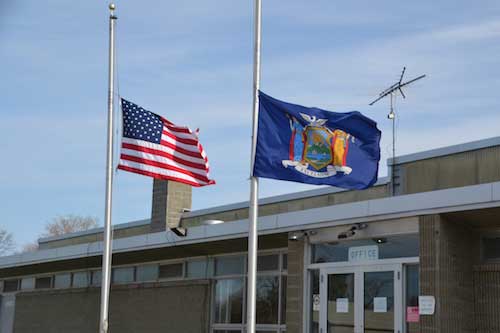
Photo by Tom Rivers: The American and New York State flags are lowered outside the state Department of Transportation facility today on Route 31 in Albion. The flags are at half staff in honor of the victims of Covid-19. There were 437 confirmed deaths in the state on Friday from Covid-19 n Friday, bringing the state’s total to 16,599. Friday there were also 10,553 additional coronavirus cases, bringing the statewide total to 282,143.
Governor Andrew Cuomo today announced the state is expanding diagnostic testing criteria to include more frontline New York workers – a direct result of rapidly increasing diagnostic testing capacity.
The expanded criteria will now allow all first responders, health care workers and essential employees to be tested for Covid-19 even if they aren’t symptomatic. The state will continue to expand testing criteria as testing capacity increases.
Cuomo also announced he will issue an Executive Order allowing pharmacists to conduct diagnostic testing for COVID-19. This action will unlock a network of over 5,000 pharmacies as COVID-19 testing locations and help the state build a collection network to meet laboratory capacity and increase overall testing capacity.
“I am issuing an Executive Order allowing our state’s 5,000 pharmacies to conduct diagnostic testing for COVID-19, which will greatly increase our testing capacity and allow us to expand eligibility for these tests to the frontline workers and essential employees who have been going to work and interacting with the public throughout this crisis,” Cuomo said.
The governor also announced the state is continuing to conduct antibody testing for frontline health care workers, including at four hospitals and health care systems in New York City today. The antibody testing will be conducted at Bellevue Hospital, Elmhurst Hospital Center, Montefiore Medical Center and SUNY Downstate Medical Center which is currently being used only for COVID-19 patients. Additionally, the state will begin conduct antibody testing for first responders and transit workers starting next week, including MTA employees and transit workers, New York State Police and the New York City Police Department.
The state wants to expand testing and include essential workers because they are out in the public and could possibly spread the virus to a lot of people.
“We had a protocol with eligibility, not everybody could get a test and that’s been a big complaint across the board. Everybody wants a test and they couldn’t get tests because we had a tight screen on the eligibility because we had a limited capacity to test,” Cuomo said. “As you increase the capacity to test, you can increase the eligibility. The first responders, health care workers and essential employees, why? Because these people have been carrying the load and they have been subjected to the public all during this crisis and because they’re public facing. These are the people who you interact with. You get on a bus, this is the bus driver. You get in a subway car, this is the subway conductor. You are interacting with government, these are the people you’re interacting with.”
Cuomo said the state has made progress in flattening the curve and defying more dire projections about infections and deaths from Covid-19.
“This is a terrible experience to go through, but we will manage it, we will handle it, and we will be the better for it,” Cuomo said. “56 days, all this inconvenience what you’re doing is actually saving lives. That’s not rhetorical. That’s not overly dramatic. You are saving lives. What we have done here has saved lives.”
2 more deaths, 4 more cases of Covid-19 at Villages of Orleans
9 residents at nursing home in Albion have now died from coronavirus
Two more residents of the Village of Orleans Health and Rehabilitation Center have died from Covid-19, and four more residents have tested positive for coronavirus, the Genesee and Orleans County Health Departments reported this afternoon.
The 120-bed nursing home in Albion has now suffered nine deaths from Covid-19 and 42 residents have tested positive for the coronavirus.
“Both individuals were residents at The Villages of Orleans with one person under the age of 65 and one person over 65,” said Paul Pettit, public health director of Genesee and Orleans counties. “Our sincere condolences go to the family and friends of these two individuals.”
The county’s total cases for Covid-19 is now up to 79.
Genesee County is reporting one more case of Covid-19, bringing the total cases in that county to 143.
Contact tracing has been initiated for all of the positive cases. All who have had direct contact with the individuals will be notified by Health Department staff.
There is currently no further information to release on ages and location. Mapping to include the positive cases from the weekend will be updated on Monday afternoon, the Health Departments said.
Travel Thoughts By Kim

Let’s go on an adventure together … Coast Starlight Train!
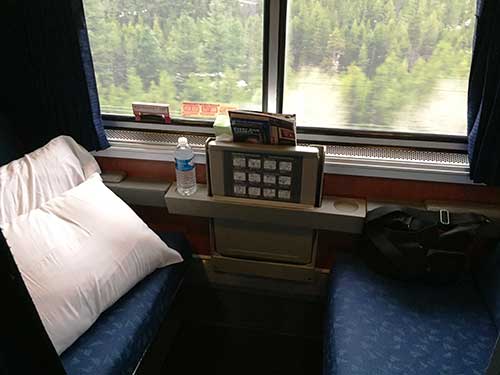
My private sleeper roomette – the seats convert to a bed to sleep overnight.
One of my favorite things is when I’m watching a movie or TV show and I have been where it is being filmed. I get all excited when I can say “I stood in that exact spot” or “I saw that building” or “I was there”! It helps me to insert myself into the story and relate to what the characters are doing…..and, it feels pretty dang cool, too. A couple weeks ago, I was watching a movie on Hallmark channel (been doing a lot of that while we’re on “pause”) that was set in Seattle. All through the movie, I kept spotting things I saw when I was there. Then, the next few days I couldn’t stop remembering a wonderful trip I took in 2017 – a two week adventure all along the west coast from top to bottom. There is no way I can summarize that trip in one article here for you – way too much to tell you about. I promise to share segments of it with you over time, but for now, I really want to share one very special 22 hour period from that trip.
My West Coast Adventure started out as a cruise and when I decided to expand it to spend more time in San Francisco area and also somehow include Oregon and Washington State with extra time in Seattle, I had to find a way to get from San Francisco to Seattle. I thought about flying, but that would eliminate seeing any of Oregon and most of Washington. I considered renting a car in San Francisco and driving to Seattle, but found out that is a very long drive – one I wasn’t sure I was willing to do by myself. The option of taking a bus was rejected quickly – I couldn’t imagine being cramped in a seat all that way. I was just about to give up on the expanded portion of the trip when the idea of taking the train came to me in the middle of the night. I got out of bed at 2:00 am and went down to the computer to see if that was a possibility. I found that Amtrak has a Coast Starlight Train that travels from Los Angeles to Seattle and that it has a stop in San Francisco. As I read about it, I knew that was what I wanted to do. The entire Coast Starlight trip runs mostly along the coast of California between Los Angeles and the border of Oregon then travels inland through Oregon and Washington to Seattle. For this trip, I got on the train in San Francisco. Someday, I hope to do the entire route to get the full experience and see the amazing ocean views while traveling comfortably through California.
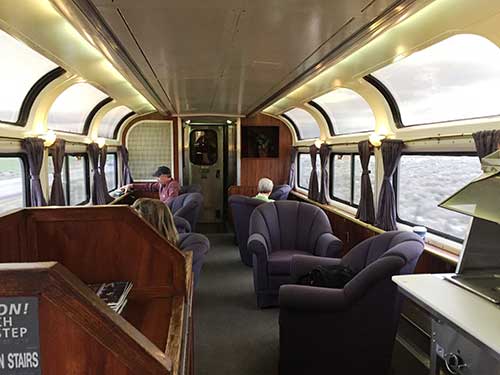
Observation lounge car available for travelers who book sleeper accommodations
The segment I traveled from San Francisco to Seattle took 22 hours and I loved every minute of it (the entire route from LA takes 36 hours). I boarded the train and began my adventure at 9:30 pm from the Emeryville, CA station (I took an Amtrak bus from Fisherman’s Wharf in San Francisco to the station). I reviewed all the options for tickets – the least expensive would be the coach seats, but given it was an overnight trip, I would have to sleep sitting up. There are a few different options for sleeper fares, each with pricing according to the accommodation– a roomette which includes a private room with two seats that convert to a bed and also has an upper pull down bed, a bedroom also includes an in-room toilet and shower, a bedroom suite is where two bedrooms connect and open up into one larger room, and a family bedroom which is a roomette with two extra sleeping options to accommodate two adults and two children. While reviewing the options, I also found out that sleeper fares include all meals in the dining cars and some additional perks that coach seat fares don’t have access to. I chose the roomette. I found that with three meals included and the extra perks, it would not be much more expensive in the long run than a coach seat and it would be more comfortable. I also felt that for one night, I could use the bathroom down the hall, which actually ended up being right across from my room, so a larger room at a higher price wasn’t important to me in this case. The room was very comfortable with two seats and a large window and the seats converted to a bed that was surprisingly comfortable. The sleeper cars also have conductors who are there to set up and break down the beds, be available if we need anything, and make our dining car reservations.
One of the perks of having a sleeper room is access to the exclusive observation lounge car. This car has tables, conversation areas, and swivel chairs all with large observation windows with unobstructed views of the scenery. There is also a bar with a variety of non-alcoholic beverages and snacks all included or alcoholic beverages at an additional cost. They also hosted a wine tasting event late afternoon for a small additional fee that offered tastings of some wonderful Oregon and Washington State wines. The food in the dining car was exceptional with a nice selection of options on the menu. For breakfast, I had scrambled eggs, bacon, potatoes, toast, juice and tea. For lunch I had a steak burger, fries, and a coke. And, for dinner, I had a ribeye steak, baked potato, fresh veggie medley, rolls, and a glass of wine. All included and all cooked beautifully and very delicious. The whole experience was very comfortable and made me feel like a celebrity in an old-time movie when traveling by luxury train was more common. I got to move around, take in the amazing views, sit in different places – including time in my own private roomette, and during the night, I slept like a baby.
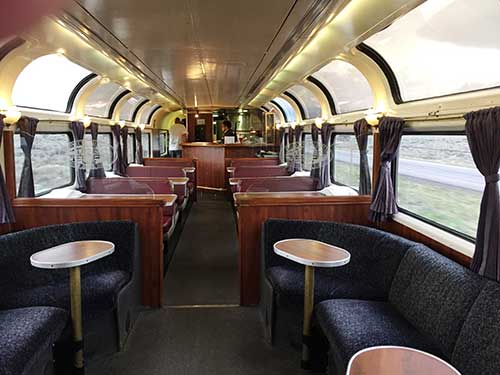
Comfortable swivel chairs and large windows in the observation lounge car are perfect for watching the beauty of America go by.
As for those amazing views: I woke up just before sunrise and we were in the final miles of California and crossed over into Oregon just about sunrise. The parts of Oregon we traveled through were breathtaking! Dense woods, streams, waterfalls, little lakes, very small rural communities and tunnel after tunnel after tunnel. At some points, we were so far up on the top of the mountains in the middle of nowhere that my ears kept popping and we didn’t have cell/internet service…and it was amazing. When we got back down out of the mountains, we saw a different kind of beauty to look at – farm land as far as the eye can see and all the little communities we passed through had “Elk Crossing” signs. I didn’t see any elk, though…..must be they chose to cross somewhere else. It is difficult to get good photos from a moving train – I took a lot and you can see many of them on my blog, but for the most part, the views are all in my memories and I love bringing them up in my mind from time to time.
When I arrived in Seattle, I spent a few days there and then flew home to end two amazing weeks all along the west coast of our great country and one of the major highlights of the trip was this train ride (which is saying something, cause the entire trip is right up there among one of my favorite trips). I highly recommend taking the Amtrak Coast Starlight Train – the whole route from LA to Seattle, if you can. You can add it on an already planned west coast trip or just fly out there to do this one adventure and come back home. Whatever you decide works for you, do it, if you ever get the chance – you won’t regret it! I see more long distance train trips in my future, too…perhaps I’ll do a cross country train ride, someday.
Visit my Coast Starlight Train blog post for more photos from this wonderful adventure.
Also remember – just because we can’t travel to faraway places, right now, doesn’t mean we can’t seek out amazing local adventures from the safety of our cars while keeping with social distancing requirements. Check out a long drive I took on Monday to visit some of Orleans County’s beautiful waterfalls.
Happy Adventuring,
Kim Pritt
44 county employees will be temporarily laid off starting Monday

The layoffs include 10 positions that currently aren’t filled

Photo by Tom Rivers: The sign for the Orleans County Administration Building is pictured last Saturday in Albion. The building will have fewer workers after employees agreed to a temporary layoff.
ALBION – Orleans County will be laying off 44 employees temporarily, starting Monday.
The County Legislature last Saturday voted to temporarily lay off 40 of the county workers, which is about 10 percent of the workforce.
The county asked for volunteers among the employees. Many of the employees stepped forward after the county agreed to continue their health insurance. The staff can collect state unemployment benefits and also $600 in weekly federal stimulus funding for being jobless due to the pandemic.
The layoffs will be re-evaluated monthly until July 31. The workers are expected to be back on Aug. 1.
The layoffs include 34 people currently working for the county, plus 10 positions that are currently in the budget but not filled.
The layoffs among current employees will be in the following departments:
- County Clerk – 5
- Department of Public Works – 3
- Department of Social Services – 12
- District Attorney – 2
- Mental Health – 1
- Office for the Aging – 4
- Personnel & Self Insurance – 1
- Probation – 4
- Sheriff’s Department – 2
The layoffs are spread over nine departments, and includes workers in the unions for CSEA and the Orleans County Sheriff’s Employees Association, as well as from management, said Jack Welch, the county’s chief administrative officer.
“We anticipate the savings from the temporary layoffs and from the vacant positions to be approximately $150,000 per month,” Welch said.
The county expects it will face steep revenue decreases in sales tax, and state reimbursements, plus likely higher costs for pension funding due to a stock market in decline.
The county annually receives about $17 million in sales tax. March was down 9 percent and that’s only with nonessential businesses closed for about two weeks.
Early projections from the state comptroller estimated the county would take a minimal hit of about $559,000. That estimate for the minimal decrease has since been doubled to about $1.1 million. And that’s on the low side. The county could see a bigger loss.
Welch said the county needed to take quick action to reduce costs.
“We are very appreciative of our unions and of our employees working together in these very challenging times,” Welch said. “We look forward to each of these 34 employees returning to our workforce by August 1, 2020.”
With people spending more time at home, state urges fire safety
Press Release, New York State Division of Homeland Security and Emergency Services’ Office of Fire Prevention and Control

File photo by Tom Rivers: Firefighters try to put out a fire at a house in Carlton on Route 18 on Dec. 10, 2017.
The New York State Division of Homeland Security and Emergency Services’ Office of Fire Prevention and Control urged all New Yorkers to keep fire safety in mind as NY-PAUSE remains in effect through May 15.
Approximately 94 percent of all the nation’s fatal structure fires occur in residences and with New Yorkers currently spending more time at home than usual, it’s more important than ever to check your smoke detectors and practice safe behaviors.
“Home fire prevention is the least costly and most effective firefighting anyone can do,” said New York State Homeland Security and Emergency Services Commissioner Patrick Murphy said. “As New Yorkers remain home amidst this global pandemic, the sad fact we must all remember is most deadly fires happen at home. Collectively we have the power to change this. The first step is acknowledging our own personal responsibility in this effort and practicing the safe behaviors we know will prevent fires from happening in the first place.”
If a fire does occur in a home today, a fatality is more likely to occur than 40 years ago. Construction materials, open design concepts and other factors of the building all contribute to a higher probability of death in a home fire. In older homes built with legacy construction, a person could expect to have 15 minutes or more to escape a house fire. By 1980, time to escape a house fire decreased to only eight minutes. Today, a person only has two to three minutes to get out and survive. Fire is fast and it doubles every 30 seconds so in a matter of a couple of minutes, a room or even the whole house may be engulfed.
Cooking, especially when unattended, remains the leading cause of both residential fires and fire deaths in the United States. Cooking may be a good educational opportunity and family activity, especially with more time being spent in the home, however it’s important to remember some basic steps to protect your family from potential fires. This includes making sure cooking is never left unattended, that surfaces are free from grease and that all combustible materials are kept well away from heat sources.
For more cooking fire safety tips, visit the State Office of Fire Prevention and Control website (click here).
“There is an unacceptable number of fatal fires occurring each year, and we must change people’s behaviors today to prevent fires and increase people’s chances of survival,” said State Fire Administrator Francis Nerney. “The good news is that by taking personal responsibility and following a few easy, inexpensive steps, we can dramatically reduce fires and their dreadful consequences. Everyone has the power to make a difference.”
Some additional tips for preventing fires and increasing survivability in the event of a fire:
- First, prevent the fire. If a fire event never happens, none of the loss, injury and death occurs.
- Have working smoke alarms. Working smoke alarms are the most important tool for early notification of fire, escape and survival.
- Have a practiced home escape plan. Know two ways out and practice escaping to a designated meeting point. Escape must be automatic when the alarm sounds. It’s not the time to figure what to do. You must already know your escape route and follow it.
- Consider installing home fire sprinklers. One or two sprinkler heads at the location where the fire starts can control or extinguish the fire, providing invaluable time to escape. Studies show that working smoke alarms and fire sprinklers can together reduce fire deaths by over 80 percent.
The statewide ban prohibiting residential brush burning remains in effect until May 14. With spring approaching, conditions for wildfires are heightened in springtime when most wildfires occur. Open burning of debris is the largest single cause of spring wildfires in New York State.
When temperatures are warmer and the past fall’s debris and leaves dry out, wildfires can start and spread easily and be further fueled by winds and a lack of green vegetation. New York first enacted strict restrictions on open burning in 2009 to help prevent wildfires and reduce air pollution.
The regulations allow residential brush fires in towns with fewer than 20,000 residents during most of the year, but prohibit such burning in spring when most wildfires occur. Since the ban was established, the eight-year annual average number of spring fires decreased by 42.6 percent, from 2,649 in 2009, to 1,521 in 2018.
Medina expanded sewer system in 1908 in a challenging public works project

“Overlooked Orleans” – Vol. 6, No. 16
MEDINA – In 1907, Gov. Charles Evans Hughes signed a law allowing the Village of Medina to raise approximately $60,000 to expand the sewer system. It was expected that the new pipelines would connect the southern and eastern sections of the village to a preexisting trunk sewer that previously discharged into the Oak Orchard Creek.
Upon the commencement of construction, the State Department of Health expressed concerns about potential issues that might arise from the increased flow of sewage into the main sewer line. Prior to 1903, sewage discharged at a point opposite of the intersection of Glenwood Avenue and Gulf Street.
The construction of A. L. Swett’s sixty-foot high dam created Glenwood Lake and in anticipation of changing sewage disposal needs, Swett constructed a pipe below the lake in order to discharge sewage beyond the dam. Even though this extension was constructed nearly five years earlier, the preexisting trunk sewer was never connected to Swett’s extension and sewage was discharged into Glenwood Lake. The Health Department understood that the increasing flow of sewage would eventually turn the beautiful waterway into a cesspool as solid waste settled on the lakebed.
Following the completion of this project, the Village encountered legal trouble with Dingledyne & Patton, the contractors assigned to complete the eastern section of the sewer line. Medina argued that the contractors failed to complete the necessary sewer work, which required the Village to assume responsibility of finishing the job and thus expending additional funds in the process.
Dingledyne & Patton issued a countersuit, claiming that the Village owed them more than $15,000 for completed work. An appeals court later issued judgement in favor of the contractors, noting that the Village illegally paid for work not completed and issued payment for work which laborers were required to work beyond eight hours per day.
This particular image shows a rather rocky section of East Center Street, looking west towards downtown Medina at the intersection of State Street. In June of 1908, an alteration was made to the proposed sewer line. The original plan involved running this line through a private right-of-way in order to avoid a rock vein. It is clear that the property owner understood the lucrative nature of this predicament and demanded an excessive sum for the right-of-way. Instead, the Village opted to run the line down the center of the street.
Holley seniors get surprise from teachers and staff with special signs

Photos by Tom Rivers
HOLLEY – Suzanne Lepkowski, senior class advisor for Holley, puts a sign in the front yard on North Main Street for Alexander Brimacomb.
The members of the Class of 2020 were paid a special visit today by a group of Holley teachers and staff, including Superintendent Brian Bartalo and Junior/Senior High School Principal Sue Cory.
They delivered signs to each member of the Class of 2020.
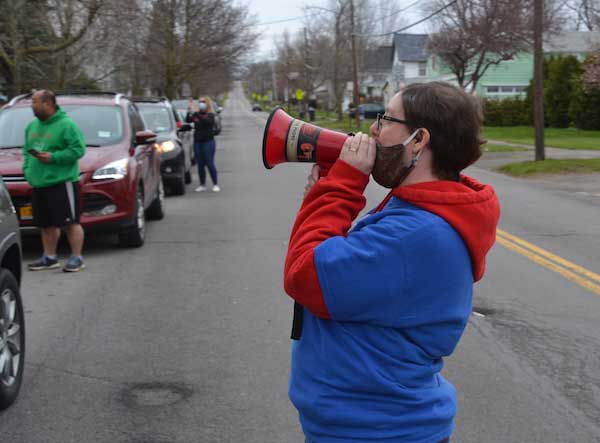
Suzanne Lepkowski, an English teacher at Holley, brought a mega phone with her and stood in the street to tell one of the seniors congratulations on their impending graduation. Lepkowski has been senior class advisor for 20 years. This is the first time in her lifetime a class has had their senior year disrupted by a pandemic. The students have been out of the school building for six weeks now.
There were several cars at each stop, honking their horns to try to get the seniors’ attention to come outside and see their sign.
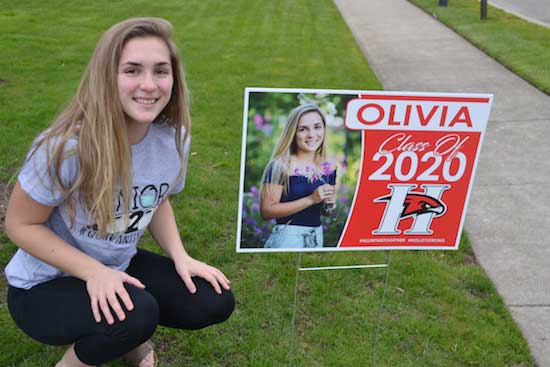
Olivia Radford, one of the 81 members of the senior class, poses with her sign after it was delivered by her soccer coach, Renee Wolf.
Radford said she is hoping the seniors can still have their prom and a graduation ceremony – “somehow or someway,” she said.

Roxanne Wagner, principal’s secretary, helps get the signs organized before the team of teachers and staff went out to deliver them beginning at about noon.
Sue Cory, the principal, sent an email to staff to see if any of them were interested in sponsoring a sign for $10 each. She received an almost immediate reaction from teachers, bus drivers, cafeteria workers, clerical staff and administrators. They raised more than the $810 needed for the signs. The extra money will be donated to the senior class.
The signs were made by Keith Neale of 585 Print. Neale, who has two kids in the junior-senior high school, offered a deal on the signs.
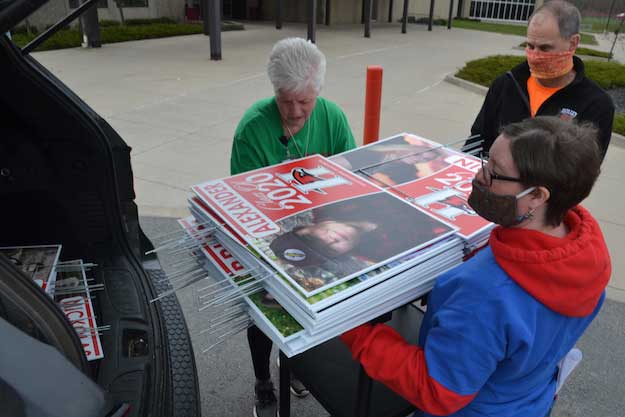
Suzanne Lepkowski and Penny Cole, a secretary in the guidance department, load the signs into the back of a vehicle with help from Brian Bartalo, the district superintendent.
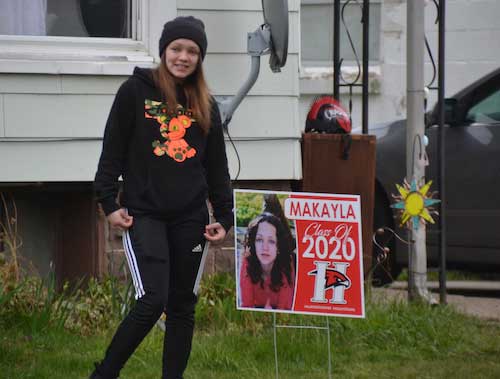
Makayla Famoly came out in the front yard to see her sign. She said she appreciated the gesture from the teachers and staff.
Makyla, 16, is graduating a year early. She is holding out hope students will be able to return to school this year.
“I just want to go to prom and walk the stage at graduation,” she said.

This sign is for Mikaela Auch, one of the seniors.

There are also some more generic signs celebrating seniors that teachers and staff requested to have in their yards. Sue Cory, the principal, is pictured in back.
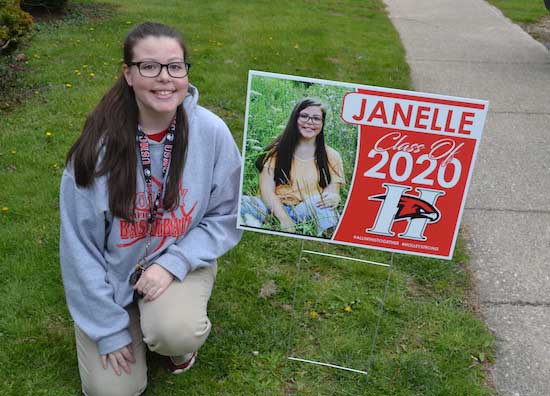
Janelle Miles was thrilled when her sign was dropped off today.
“I cried when they came up here,” she said. “I wasn’t expecting this. It was so nice because it’s been really hard not seeing everyone.”
Hospice recognizes top volunteer, key business supporter
ALBION – Hospice of Orleans normally has a big luncheon each year to recognize key volunteers and supporters. A big public gathering isn’t possible right now, due to the Covid-19 pandemic and restrictions on more than 10 people in one place.
Hospice of Orleans, however, wanted to publicly acknowledge its annual award winners. Chris Fancher, the volunteer coordinator and a social worker for Hospice, announced the winners today through Hospice’s Facebook page (click here).
Mary Janet Sahukar Award – Annette Mannella and Beverly Saskowski
This award in named for Hospice’s founding director, and for the first time there is a tie. Hospice is recognizing Annette Mannella and Beverly Saskowski with the award.
Mannella is the board secretary for Hospice and serves on the Personnel Committee. She also chairs the Nominating Committee. She is a generous donor and supporter of Hospice with an incredibly large and giving heart.
Saskowski is the board treasurer and serves on the Personnel and Development/Volunteer Services Committees. She also chairs the Finance Committee. Saskowski assisted with the review and hiring of IT contractors. She is a generous donor and supporter of Hospice.
In addition to their Board positions both Manella and Saskowski serve as direct care volunteers, residence volunteers, residence grocery delivery volunteers, and co-facilitators of volunteer Relias training.
Business/Civic Service Award – Holley Pharmacy
Holley Pharmacy works with the Hospice team on a daily basis to ensure patients have the medications needed to ensure their comfort and well being. In times of a patient crisis where new medications need to be ordered and quickly picked up, Luke Miller, owner and pharmacist, will come out in the middle of the night to open the pharmacy and dispense the patient’s medications.
Pharmacist John Carl, Pharmacy Tech Chris Penna, and Pharmacy Tech Corey Miller-Lamb are extremely helpful and work very hard to ensure Hospice patients have the medications they need.
“A special thank you to their driver, Duane, and all the awesome people behind the scenes at the Pharmacy,” Fancher said.
Volunteer of the Year – Janice Mann-Beech
Janice Mann-Beech serves as a family support volunteer, providing much needed respite care to family members who are caring for patients in their homes. She gives selflessly of her time and talents to Hospice families.
She serves the Martin-Linsin Hospice Residence as a greeter and participates in Hospice fundraisers and events.
“Janice exemplifies the model of a humble, dedicated, hardworking volunteer,” Fancher said. “Janice unassumingly and diligently conducts her Hospice work.”