By Ginny Kropf, correspondent Posted 13 May 2020 at 7:58 am
A second round of funding has come into Orleans County from the Covid-19 WNY Community Response Fund, according to Dean Bellack, director of United Way of Orleans County.
The fund was established by Buffalo area philanthropic organizations to help non-profit agencies and programs impacted by the coronavirus pandemic, and is dispersed through United Ways in Western New York.
Phase One of the funding on April 7 provided $4.5 million to 74 organizations, which included $74,000 for Orleans County.
Phase Two provided for $1 million of additional funding for 35 organizations, of which Orleans County’s share was $25,000, according to Bellack.
Bellack put together a committee, which met in a Zoom conference and included himself, Bruce Schmidt, president of Lyndonville Lions and a board member of Community Action and Ministry of Concern; Darren Wilson, president of the Lyndonville Area Foundation; and Jodi Gaines and David Cook, both board members of United Way of Orleans County. On Monday, they met to determine recipients of this recent grant.
“We had input from all the committee,” Bellack said. “This was a good collaboration which allowed us to share what is happening in the country from a view that was broader than our own. We felt good that what we gave out was fair, based upon our shared knowledge of their budgets and what dollars they have received this year.”
Funds approved by the committee went to United Way of Orleans County, Community Action, Calvary Tabernacle Assembly of God Food Pantry, St. Peter’s Lutheran Church Emergency Food Pantry, Kendall Food Pantry, Christ Community Church, Ministry of Concern, ARC Meals on Wheels, 211 WNY, GCASA, Praising Kids Child Care Center, YMCA, Hands for Hope, Project Stork and Oak Orchard Assembly of God.
Bellack said it is possible there may be a third round of funding in the near future.
Press Release, Orleans County Sheriff Chris Bourke
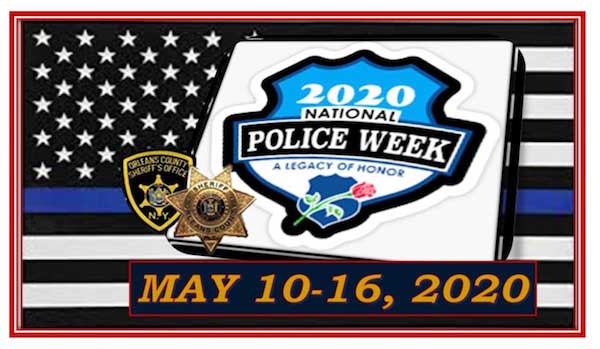
ALBION – National Police Week is set aside to honor America’s law enforcement community for their hard work and dedication in protecting and serving their local communities.
The men and women of the Orleans County Sheriff’s Office are dedicated to the mission of providing prompt, exemplary service while protecting the community. The Orleans County Sheriff’s Office is committed to protect the lives, property and rights of all people, maintain order and enforce the law.
Emphasis is placed on improving and maintaining quality of life to ensure our county is a safe place to live, work and visit. The members of this office are dedicated to this mission, to the County they serve, and achieving excellence within their profession.
During National Police Officer Week in 1962, President Kennedy proclaimed May 15 as National Peace Officers Memorial Day as a special recognition day for law enforcement officers who have lost their lives in the line of duty for the safety and protection of others.
Please join us in recognizing Orleans County’s Deputy Sheriffs and Police Officers for their hard work, dedication and service to our community.
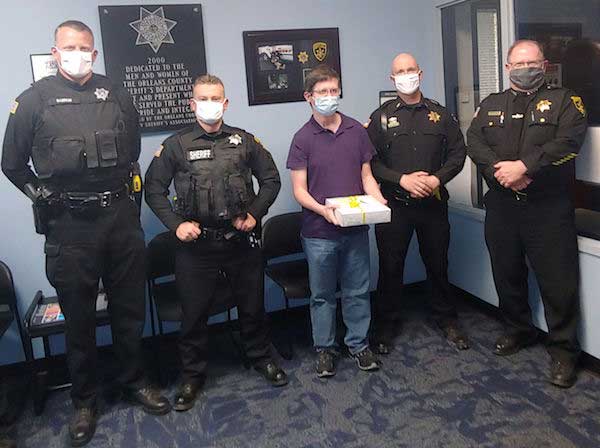
Provided photo: Jonathan Doherty, center, of the Self Advocate All Stars on Friday stopped by the Sheriff’s Office to deliver cookies to the deputies and staff. Pictured from left include: Deputy Jason Barnum, Deputy Kevin Colonna, Jonathan Doherty, Deputy Steven Fox and Sheriff Chris Bourke.
By Tom Rivers, Editor Posted 9 May 2020 at 12:04 pm
‘It’s just mind boggling and horrifically saddening what is going on over there.’ – Assemblyman Hawley
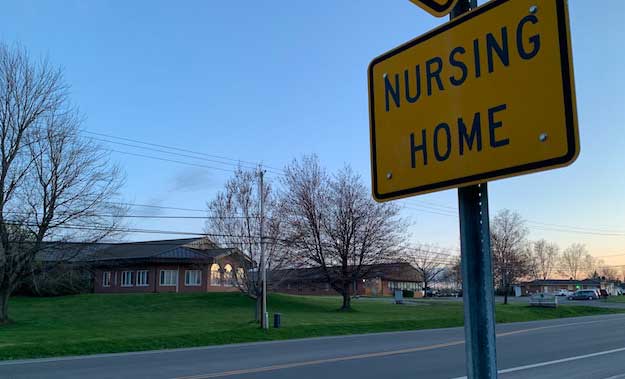
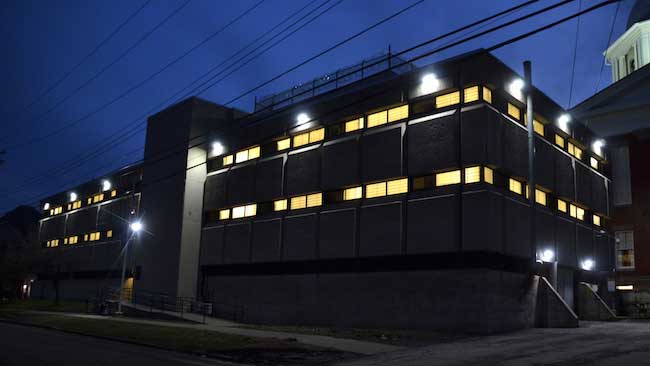
Photo by Tom Rivers: The Villages of Orleans Health and Rehabilitation Center is located on Route 31 in Albion. The center has had 68 residents test positive for Covid-19 and has suffered 17 deaths from the virus.
ALBION – State Assemblyman Steve Hawley said more agencies are investigating an outbreak of Covid-19 cases at The Villages of Orleans Health and Rehabilitation Center in Albion, where 17 residents have died from Covid-19.
“There is something gravely wrong at The Villages,” Hawley said this more on a conference call with about 50 local officials in Orleans County.
At The Villages, 68 of the residents have tested positive for Covid-19, out of 124 confirmed cases of Covid-19 in the whole county.
Hawley said the nursing home and rehabilitation center wasn’t prepared for Covid-19, and the virus has spread through the center, resulting in the deaths of 17 people.
“It’s just mind boggling and horrifically saddening what is going on over there,” he said this morning.
Hawley on May 1 called the State Department of Health to investigate the crisis and how the facility has handled its response. But Hawley today said the DOH has tipped off The Villages about inspections.
Today, Hawley said other government agencies have become involved in the investigation, including the Governor’s Office, the Attorney General’s Office, the Orleans County Sherriff’s Office, the District Attorney’s Office and the federal Department of Health and Human Services.
“My goal here is to get all the parties involved who can assist in making this investigation more thorough and complete,” Hawley said. “By involving all of these departments on all of these levels of government and public safety, we are ensuring that no stone is left unturned, and that our residents and staff at The Villages’ lives and quality of care are safeguarded.”
Hawley said he asked the state Department of Health back in October and November to take a close look at The Villages, which was among the lowest rated nursing homes in Western New York.
State Sen. Robert Ortt also was on the conference call this morning. He said the State Senate is asking for an independent investigation from the federal government in how the state’s policies during the pandemic has affected nursing homes.
The Villages isn’t the only nursing home in Western New York to suffer more than 10 deaths. The Newfane Rehabilitation and Health Center also has had 17 of its residents die from Covid-19.
The Buffalo News today reporting these nursing homes also have experiencing double0digit deaths: Father Baker Manor, 33 deaths; Harris Hill Nursing Facility, 19; Garden Gate Health Care Facility, 17; Seneca Health Care Center, 12; Absolut Care nursing home in East Aurora, 11; and Buffalo Center for Rehabilitation and Nursing, 11.
Ortt said the nursing home residents were considered the most vulnerable to the virus from the beginning. Ortt said state policies may have put them in harm’s way.
He wants invetsigators to look at policies that allowed covid-19 positive people to be admitted into nursing homes, especially when there was capacity in hospitals to provide care for those patients.
Some nursing home staff that were Covid-positive also didn’t have self isolate for at least two weeks and fully recover from Covid before returning to work.
Ortt also said nursing home allowed Covid-positive residents to be in the same room with residents who tested negative.
“We need far better answers than we’ve got from the State Department of Health,” Ortt said.
By Tom Rivers, Editor Posted 8 May 2020 at 3:55 pm
Orleans County has had more than 3,000 people file unemployment claims in the past seven weeks.
The State Department of Labor is reporting that 285 people in Orleans County filed for unemployment the week ending May 2. That brings the total unemployment claims in the county to 3,046 in the past seven weeks, since the state shut down many businesses or significantly curtailed their activities.
The 285 unemployment claims last week compares to 77 during the same week last year. State-wide, there were 197,607 unemployment claims last week, compared to 28,248 the same week in 2019. State-wide there have now been 1,837,766 unemployment claims the past two months.
Nationally the unemployment rate is 14.7 percent, the highest unemployment rate since the US Bureau of Labor Statistics started tracking the monthly data in 1948 and on par with the unemployment during the Great Depression.
Orleans County has a workforce of about 17,000 people. The 3,046 unemployment claims represent about 18 percent of the workforce. There were about 1,000 people on unemployment before the pandemic. Those people plus the 3,046 who recently filed for unemployment would put the county’s unemployment rate close to 24 percent.
Here are the weekly unemployment claims the past seven weeks in the GLOW counties and statewide:
By Tom Rivers, Editor Posted 8 May 2020 at 1:29 pm
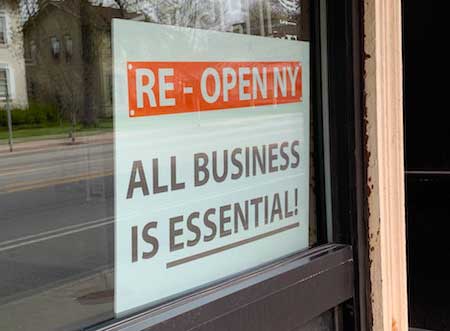
Photos by Tom Rivers: Adam Johnson has this sign at 39 Problems in Albion. He looks forward to when his business can reopen.
HOLLEY – A 50-mile trip throughout Orleans County on May 16 will highlight small businesses in the community, and their tenuous condition as many have been shut down or severely limited due to the Covid-19 pandemic.
Adam Johnson, owner of the 39 Problems bar and restaurant in Albion, is organizing the “Cruisin’ Main Street” event.
He welcomes all small businesses and farms to join on the ride that begins 9 a.m. in Holley at the Business Park off Route 31. (Participants are urged to arrive about 8:30 to begin lining up.)
The route will go from Holley to Kendall, along Route 18 to Carlton and then south on Route 98 to Albion. The caravan then heads west to Medina and ends in Lyndonville. Johnson expects the trip will take about 2 hours.
“I feel like a lot of the small businesses aren’t getting enough attention from Albany,” Johnson said today.
He sees Main Street business districts, which include family-owned businesses, largely shut down. Meanwhile the corporate retailers seem to be flourishing and can’t keep their shelves stocked.
“You can go to big box stores but not the mom and pop stores,” Johnson said. “It seems backwards.”
Johnson has been closed since late March. He supports the state going on PAUSE, and closing many of the businesses while the virus was spreading in the state.
But he said the state and country know more about the virus now, and hospitals are now better equipped with personal protective equipment and other supplies.
“We bought extra time,” Johnson said. “We can take precautions. We can do it safely. We have to start somewhere. We have to take the first step forward.”
Gov. Andrew Cuomo has the state on PAUSE until May 15. Some regions may be given permission to reopen in phase 1, which includes manufacturing and construction. If the number of hospitalizations and infections don’t increase, the regions can move to the next phase out of four phases.
As a restaurant, Johnson might not be given the OK until phase 3 or 4. He worries about his own income, and also for his employees. Some of them have told him they haven’t received any unemployment or a federal stimulus check. They are borrowing money from friends and family to get by.
The caravan on May 16 is intended to raise awareness about small businesses in Orleans County, and how critical they are to employing many people and providing much needed revenue for the local governments.
“Bring your car, motorcycle, truck, Jeep, tractor, whatever to show your love,” Johnson posted on Facebook on Thursday. “Small businesses, bring your work vehicle, show off who you are and what you do!”
He saw the popularity of a similar event on April 5 in Genesee County. Bruce Scofield of Scofield Roll-Off organized the Corona Convoy that included 160 truckers.
The May 16 event starts in Holley with vehicles urged to line up on Maziarz Drive in Holley. Johnson urges people to be out along the route to wave and show their support (while practicing social distancing). Participants can join for the entire 50 miles or for shorter stretches.
The route will pass by the nursing homes in Albion (The Villages of Orleans Health and Rehabilitation Center on Route 31) and in Medina (Orchard Rehabilitation and Nursing Center on Bates Road). Johnson also hopes some of the vehicle can pass by Medina Memorial Hospital. He wants to show support for healthcare workers.
Johnson is working with local officials to finalize a route for the 50-mile trip. A map will be posted soon on the 39 Problems Facebook page.
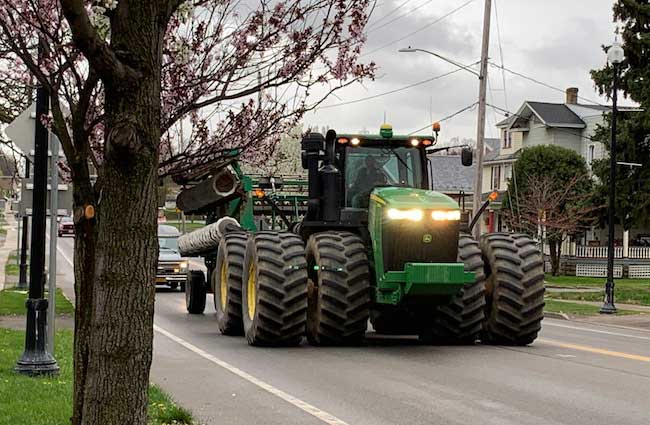
A tractor with disc equipment to get fields ready for planting heads north on Main Street in Albion on Thursday evening. Farmers are welcome to be part of Cruisin’ Main Street.
Clubs go online to stay connected, and work on projects
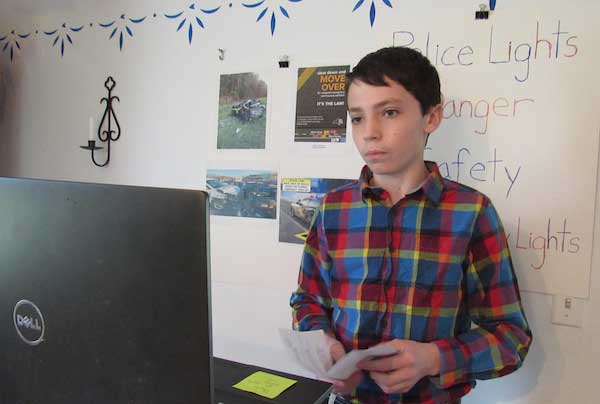
Provided photos: Hugh Gabalski, 13, of Byron makes a presentation on Wednesday using Zoom.
Press Release, Orleans County 4-H Program
KNOWLESVILLE – Orleans County was represented recently during the first-ever Western District 4-H Public Presentations held via Zoom.
4-Hers in the western counties of Orleans, Niagara, Erie, Wyoming, Cattaraugus, Chautauqua and Allegany were offered the opportunity to present online either May 2 or May 6. Makenzie McGrath, 12, of Medina, a member of the Abundant Harvest 4-H club, and Hugh Gabalski, 13, of Byron, a member of the Rabbit Raisers and Outback Orleans 4-H clubs, presented during the May 6 Zoom session.
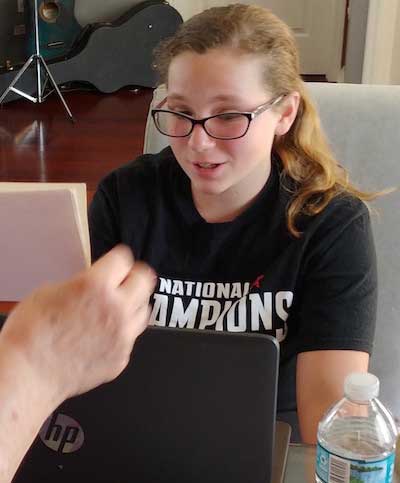
Makenzie McGrath, 12, of Medina makes her public presentation on Wednesday.
Both qualified during Orleans County 4-H Public Presentations in February. The traditional face-to-face District Public Presentations event was scheduled for late March in Erie County, but was cancelled due to Covid-19 restrictions.
“4-H educators and program coordinators in the Western District met and decided to offer the Zoom option to youth,” says Kristina Gabalski, Orleans County CCE 4-H program coordinator. “We knew it would be a learning experience for youth as well as ourselves. It was a great opportunity to learn a new technology and to gain skills in utilizing that technology.”
In all, 14 youth from throughout the Western District participated. Makenzie McGrath presented on the “History of Tap Dance,” and Hugh Gabalski presented on “Safety and Exterior Lighting Used on Law Enforcement Vehicles.” The experience using videoconferencing was a bit strange, Hugh said.
“It was interesting, it was challenging because you were not presenting to an in-person audience,” he said.
Youth were able to present using Power Points, photos and their posters. Evaluators provided immediate feedback and encouragement during the Zoom, and 4-H participants were also able to provide peer feedback during the event, Kristina Gabalski said.
Zoom and Facebook are becoming popular mediums for continuing local 4-H programs while social distancing and other safety measures are in place, she explained.
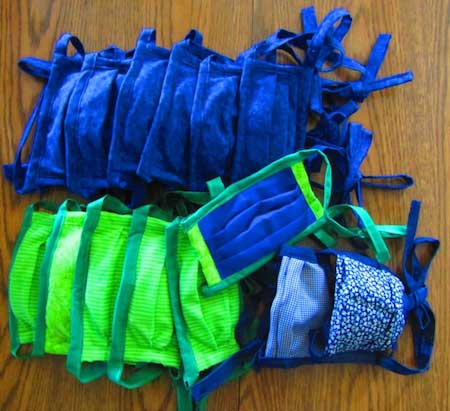
Lydia Scharlau of Medina and her family made these masks.
“There will be a similar Zoom in early June for participants in the Horse Communications program in Region 1, which includes Orleans County,” Gabalski said. “Additionally, Region 1 in Western New York will be going online with its annual horse 4-H Hippology Contest, another first for a region-wide 4-H event.”
Hippology is the study of horses and includes horse anatomy, care, nutrition, and equipment. 4-H Hippology Contests challenge the knowledge of horse program youth and include sections on topics like horse breeds, anatomy, equipment and judging, Gabalski said.
“Erie County CCE is making Power Points with photos and questions available on their website later this month, and youth will be able to complete answer sheets which can be returned for review,” she said. “Orleans County is anticipating that seven members of our horse program will participate – four in the junior division and three in the novice division. There is also a senior division.”
Orleans County 4-H Clubs and program development committees have been gathering via Zoom to meet during this time of social distancing.
“We have a brand new 4-H Feline Club, which is meeting regularly online and planning community service projects which can be accomplished while social distancing,” Gabalski said. “Additionally several other clubs are meeting via Zoom. Our 4-H Senior Council is meeting weekly via Zoom, which has been an opportunity for youth to experiment and learn the technology in a safe environment as well as discuss their projects and the status of 4-H events.”
‘This has been a frustrating time in many ways for our youth, but they are showing remarkable resilience.’ – Kristina Gabalski, 4-H program coordinator
Gabalski explained that in the midst of the COVID-19 pandemic, Orleans County 4-H is remaining active and providing resources to the Orleans County community.
“We are posting educational content on our Facebook page on a daily basis, something which includes digital literacy videos featuring members of our 4-H Tech Changemakers team,” she said. “We want the community to see the Orleans 4-H Facebook page and Orleans County Cornell Cooperative Extension as a resource during this time.”
4-Hers discuss a quadratic equation over Zoom.
4-H members are continuing to work on their projects. Some are sharing their animal science projects in their school Zoom classes, and others are learning new skills like making floral and herbal jellies during this time at home. Many have taken part in our effort to send hand-made cards to 4-H leaders and volunteers as well as senior citizens through the Orleans County Office for the Aging.
Orleans County 4-H has responded to the NYS 4-H Mask Task project by making face masks to be distributed to our local farmers and agricultural workers. Others are taking part in a state-wide 4-H Pen Pal program.
Additionally, members of the Orleans 4-H dog program have been sharing videos on their private Facebook page. The videos feature work that they are doing with their animals via weekly challenges which have included topics such as games 4-Hers play with their dogs and dog grooming practices.
“This has been a frustrating time in many ways for our youth, but they are showing remarkable resilience.” Gabalski said. “As events are postponed or cancelled, it has been rewarding to see our 4-H youth, families, leaders and volunteers respond in such creative and generous ways. We are working with the Orleans County CCE Master Gardener program to promote Victory Gardens this year and hope that as the weather finally warms up, 4-Hers will consider planting a Victory Garden and document its progress. Journaling about their COVID-19 experiences is also being promoted as a valuable coping tool as well as a way to document this historical event which they are experiencing personally.”
Gabalski added that there are a growing number of programs, events and opportunities online provided by 4-H at the state level.
“This year’s forestry program is going online, for example,” she said.
The NYS Virtual Forestry Series will run at 6:30 p.m. on Saturdays, May 9 to June 6, and will include topics such as tree identification, map and compass, invasive species and forest ecology.
If anyone has questions regarding the 4-H program and current opportunities and events, please call the Orleans County CCE office at 798-4265. Staff are working remotely from home, but have access to phone messages via email.
By Tom Rivers, Editor Posted 6 May 2020 at 3:21 pm
ALBION – Orleans County doesn’t have a drive-through testing site for Covid-19 while its neighbors all have those testing sites.
Gov. Andrew Cuomo is being asked today to place a drive-through site in Orleans County “as soon as practical” so more people can be tested.
State Sen. Robert Ortt (R-North Tonawanda), and State Assembly members Steve Hawley (R-Batavia) and Mike Norris (R-Lockport) sent a joint letter to the governor today. That letter also was signed by Orleans County Legislature Chairwoman Lynne Johnson and Paul Pettit, the county’s public health director.
“A drive-through testing facility would help track and treat Covid-19 in a county that has suffered from a lack of testing since the outbreak began,” according to the letter.
In Orleans County, 748 people have been tested so far for Covid-19, with 105 testing positive. The county has a population of 40,352, according to the 2019 Census estimate. With 748 tested, that is one out of every 54 residents in the county.
“Rural communities are often left behind in these decisions because the state wants to concentrate resources in densely populated areas,” according to the letter from the five officials. “However, low-density rural communities like Orleans County are precisely those who are in the greatest need of mobile testing facilities.”
Urban and suburban communities have “a litany of doctors and hospitals in their communities” where there is wide access for testing. However, in Orleans County and other rural communities there are fewer healthcare options, which results in less testing opportunities, according to the letter from Ortt, Hawley, Norris, Johnson and Pettit.
“Adequate testing is a critical step in treating and preventing the spread of the disease, and a mobile testing facility right in Orleans County would allow residents to get tested safely in their own community,” they wrote to the governor.
Photo by Tom Rivers: The Orleans County Jail on Platt Street in Albion is now used as a centralized location in the county for arraignments.
By Tom Rivers, Editor Posted 6 May 2020 at 11:56 am
ALBION – Orleans County has a new centralized arraignment program where people charged with crimes can be arraigned at 8:30 a.m. and 7:30 p.m. every day.
The new CAP uses the county jail for the arraignments. The program started about three weeks ago and has been doing about 6-10 arraignments a week. It was set up to use a larger room in the county jail for arraignments, with representatives from the District Attorney’s Office, Public Defender’s Office (or private counsel) and a judge.
However, due to the Covid-19 pandemic, the off-hours arraignments are being done through Skype. The defendants are still appearing in the jail while the judge, DA and Public Defender may be offsite communicating through Skype.
The relevant documents are scanned and transmitted online to all parties.
The court system locally and state-wide is largely shut down until June 1, due to the Covid-19 pandemic.
The CAP allows judges to do some arraignments and also issue orders of protection and suspend driver’s licenses.
“I’m glad on a limited basis we’re still doing these,” said District Attorney Joe Cardone. “We certainly don’t want things mounting up in the court system.”
The CAP means arraignments no longer need to be done at all hours at all 10 town courts. With the centralized program, town judges in the county will rotate serving as the judge for the arraignments. Kendall Town Justice Deborah Kluth and Clarendon Town Justice Tom DiFante are serving as the interim judges in the program until the end of May.
The Orleans County CAP needed approval from the state and that was granted by the New York State Unified Court System.
During regular court hours, from 9 a.m. to 5 p.m., County Court Judge Sanford Church will handle the arraignments.
One goal of the CAPs is to ensure defendants have counsel available during the arraignments. The CAPs also were intended to ease the burden on the town courts.
Sheriff Chris Bourke said the system is off to a good start.
“It’s a whole different world with the way we are dealing with everything,” he said on Saturday during a joint call with other elected officials. “It is going pretty smoothly now with the transfer of documents, and the judge, DA and public defenders all in different locations.”
By Tom Rivers, Editor Posted 5 May 2020 at 12:29 pm
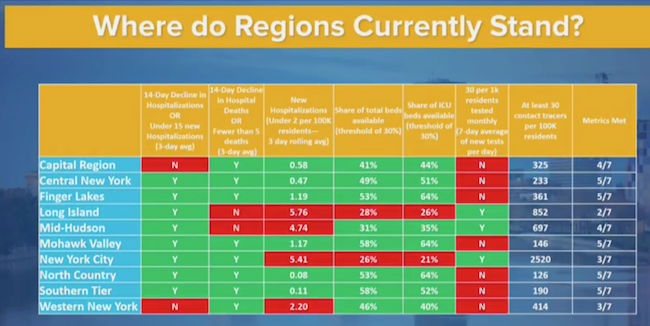
Source is Office of Gov. Andrew Cuomo: The state has seven criteria for evaluating if a region is ready to reopen.
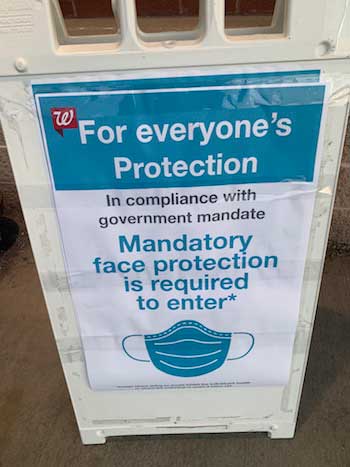
Photos by Tom Rivers: Walgreens in Albion has a sign by the front door telling customers they need to wear a mask to enter the building.
ALBION – The public health and economic development leaders in Orleans County are urging businesses to develop plans for maintaining social distancing and protecting the health of employees and customers.
Businesses shouldn’t wait for an announcement from Gov. Andrew Cuomo that a reopening is imminent for Orleans County.
The Orleans Economic Development Agency is developing a “ReOpen Orleans’ website with resources and advice for businesses to meet the state standards to reopen, said Jim Whipple, the chief executive officer for the Orleans EDA.
Businesses will likely have to reduce occupancy so there are fewer people in a building to better ensure social distancing of at least six feet. Businesses should have plans for hand sanitizers, wearing of masks or facial coverings, and signs or floor decals to emphasize social distancing.
The governor has the state on “PAUSE” until May 15 and then may reopen different businesses and public places in four phases.
“We are very hopeful that we will be in position locally to begin to peel back some of these restrictions that have been put in place,” said Paul Pettit, public health director in Orleans and Genesee counties. “The biggest thing is we want to be ready.”
The local municipalities and businesses need to have plans in place to protect public health in order to reopen, Pettit said.
Businesses that are currently closed could follow the examples of many grocery stores, which require masks to be worn by customers, have markings on the floor to spread out people – especially at the check-out lines, and have plexiglass to separate cashiers from customers.
The businesses’ reopening plans will be reviewed but Pettit said the state hasn’t offered guidance on that process yet.
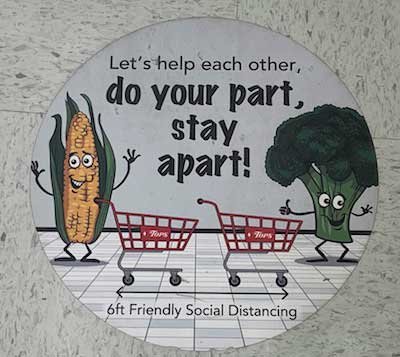
Tops in Albion has decals on the floor throughout the store encouraging people to stay at least six feet apart.
As the regions reopen and look to advance to the next phase, Pettit said the matrix from the state will be closely scrutinized to see if there has been in increase in infections and hospitalizations.
“If the regions see an increase in cases, we’ll be back on PAUSE,” Pettit said. “There’s not a lot of guidance yet on how this will all work.”
The state has developed seven criteria that need to be met to allow different businesses and public facilities to reopen to the public. Orleans County is part of a nine-county Finger Lakes Region.
The state has divvied the counties into 10 regions of the state. None of the 10 regions currently meet all seven of the governor’s criteria for reopening.
The Finger Lakes region meets all the standards except for testing and contact tracers. The state wants at least 30 people out of 1,000 tested monthly in each region. Only three of the 10 regions meet that threshold for testing (Long Island, Mid-Hudson and New York City). The state is expanding capacity to help all regions meet this threshold, Gov. Cuomo said on Monday.
Contact Tracing Capacity: Regions must have a baseline of 30 contact tracers for every 100,000 residents, and additional tracers based on the projected number of cases in the region. The state is currently building an army of contact tracers with former NYC Mayor Mike Bloomberg to meet the needs of each region statewide.
The Finger Lakes meets the criteria in other categories:
14-day decline in hospitalizations or under 15 new hospitalizations for a three-day average
14-day decline in hospital deaths or fewer than five deaths as a three-day average
New hospitalizations requirements of less than two per 100,000 residents (Finger Lakes has a three-day rolling average of 1.19 per 100,000)
Share of hospital beds available must be at least 30 percent (Finger Lakes at 53 percent)
Share of ICU beds available must be at least 30 percent (Finger Lakes at 64 percent)
The governor said regions can reopen in four phases, with the next phase to follow only if the rate of hospitalizations from Covid-19 don’t spike.
The four phases include:
Phase One: Construction, manufacturing and wholesale supply chain; select retail with curbside pickup.
Phase Two: Professional services; finance and insurance; retail; administrative support; real estate/rental leasing.
“I’m optimistic we’ll make the first round on May 15,” Pettit said. “Let’s prepare and let’s be ready and be optimistic when May 16 comes we’ll have a lot more of our businesses open and we’ll do it safely.”
By Ginny Kropf, correspondent Posted 4 May 2020 at 9:11 am
Dean Bellack
Beginning today, United Way of Orleans County will launch a new program to provide more help to members of the community who are struggling due to the Covid-19 pandemic.
In the new program – United We Help – United Way in collaboration with Community Action will present checks for $100 to individuals who qualify. The fund goes to people who have lost their jobs due to the Covid-19 pandemic but aren’t receiving unemployment yet.
The fund is a result of businesses, individuals, and community groups coming together. United Way is asking those who have the ability to donate to do so online during the month of May.
“We’ll start writing checks in the middle of May and long as the funding keeps coming in we’ll keep writing checks,” said Dean Bellack, United Way director in Orleans County.
The fund already is up to $20,000. Local companies who have made commitments so far include Baxter, Takeform, Heritage Wind and Twin Apple Properties.
Bellack wants to be able to write checks to 300 Orleans County residents who may be struggling at this time due to their job loss. Residents have until May 15 to apply. (Click here for more information.)
George Bidleman, president of United Way’s board, has donated his ad space on Orleans Hub to promote this program. For the next eight weeks, ads will run on the Orleans Hub to make people aware of this fund.
The first applications to apply for the checks were given out by Bellack at Community Action’s food distribution Friday morning at the Main Street Store in Albion.
While the checks aren’t huge, United Way hopes the money will help with groceries or gas in the car. It also shows Orleans County United Way is trying to fill a need in a trying time.
Photo by Ginny Kropf: Michelle Figueroa, emergency services case manager at Community Action, listens to Albion Police Chief Roland Nenni explain about the coronavirus to volunteers who helped with a food giveaway Friday morning at the Main Street Store.
“Our goal is to help the most vulnerable in our county,” he said.
Bellack said the United Way Board wanted to make sure they are doing their part in this time of crisis.
The funds Orleans County United way has brought into Orleans County in the past year are approaching $300,000. This includes direct donations from local giving, which will help fund $100,000 in allocations to our partner agencies, contributions from Eastman Savings and Loan and United Way connections to other donors, such as the WNY Covid-19 Fund.
In the next few weeks $25,000 of additional funds will be given in micro grants of $500 to $2,500. Bellack is forming a review committee now of board and community leaders to make sure the United Way isn’t missing those charities and agencies that need help.
Applications for the United We Help fund must be mailed to Community Action at 409 East State St., Albion by May 15. Checks will be issued by Community Action.
All applications will be reviewed to make sure only one person per address receives funding. Submitting an application is no guarantee of payment.
Applications are available on United Way’s website, and from LYFE Food Emergency in Lyndonville, Jim Hancock and the Emergency Food Pantry at St. Peter’s Lutheran Church in Medina, Calvary Tabernacle Assembly of God food pantry in Medina, Christ Church Community Kitchen in Albion, Kendall Food Cupboard and Community Action.
Anyone needing help to fill out an application may call the 211 Help Line, an agency funded by Orleans County United Way, to receive help from another person.