












Orleans County

Counties like Collins’ push to relieve locals of paying towards Medicaid

By Tom Rivers, Editor Posted 16 March 2017 at 11:09 am

Medicaid, a health insurance program for poor residents, accounts for about half of the county tax levy
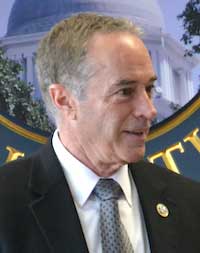
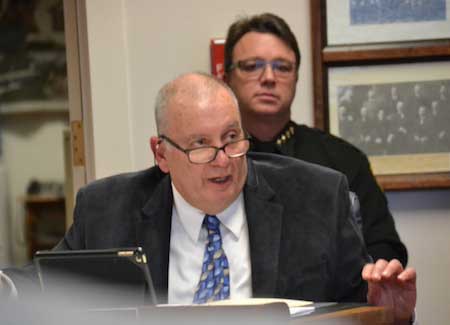
Chris Collins

Leaders from counties in New York are excited by a proposal by Congressman Chris Collins that would no longer require a local contribution to cover the Medicaid program.

In Orleans County that would cut the county property tax in half, said Chuck Nesbitt, the county chief administrative officer.

About half of the $16.7 million in county taxes goes towards Medicaid, a health insurance program for poor and disabled residents.

The county’s current tax rate is $9.86 per $1,000 of assessed property in 2017. If the state took over the county share of Medicaid, the county tax rate could be reduced to about $5. That would save a property owner with an $80,000 house about $400 a year.

Collins, a former county executive in Erie County, wants to see counties in New York freed from paying towards Medicaid, with that cost picked up the state.

Collins is proposing that change as part of a Republican push to replace the Affordable Care Act, or Obamacare.

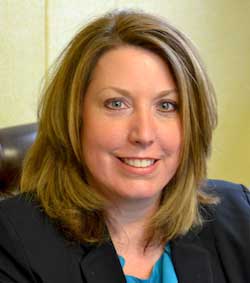
Kathy Hochul

Kathy Hochul, the lieutenant governor who lost a re-election bid for Congress to Collins, has fired back at Collins’ proposal, saying it would be costly for the state.

The counties used to pay 25 percent of Medicaid’s cost in New York. The state has capped the county share, which is now about 13 percent, Hochul said.

The state also has allowed counties to collect an extra penny in sales tax to help pay for Medicaid.

In addition to shifting $2.3 billion from county share to the state, the Republican plan for replacing the Affordable Care Act would result in lost federal funds and jeopardize hospitals, Hochul said.

“This ill-conceived plan would cost his home state approximately $2.3 billion,” Hochul said in a statement last Friday to the media. “Unbelievably, that’s on top of the cost of the Republican Affordable Care Act repeal plan – another $2.4 billion. Translation: Rep. Collins is proposing a tax increase on New Yorkers to the tune of $4.7 billion. This one-two punch would destroy all the hard work the Governor and Legislature have accomplished in the last six years to lower taxes across the board and achieve the lowest spending increases in recorded history. New Yorkers will be at risk of losing their healthcare, hospitals will be forced to lay off workers, and our vulnerable elderly will find it much harder to afford nursing home care.”

Few states require counties to pay towards Medicaid. It is a prime factor in New York’s higher property taxes, compared to most states, according to the New York State Association of Counties.

NYSAC issued its own response to the Collins proposal, and was critical of Hochul’s rebuke of the plan.

“The federal legislation introduced by Congressman Collins attempts to do what the State has been politically unwilling or unable to do,” said NYSAC Executive Director Stephen J. Acquario. “It provides real mandate relief for counties, so that counties can begin to reduce property taxes in the State.”

County leaders agree that property taxes are too high in New York, especially compared to other states, Acquario said.

The counties in New York contribute $7.5 billion to Medicaid, he said. In most states, the federal and state governments split the cost.

“We are disappointed that the State’s Lt. Governor, who has been a friend to counties, would oppose an action that would reduce property taxes and take a position against the state’s county government partners,” Acquario said. “The Governor’s administration can’t have it both ways. They cannot keep shifting costs to counties and force us to continue paying for their programs on the hand, and then demand lower property taxes on the other.”

Return to top

National Grid makes progress in restoring power in Orleans

Photo courtesy of Wayne Litchfield: Trucks are lined up on West Avenue in Medina last night.

By Tom Rivers, Editor Posted 11 March 2017 at 9:08 am

2,500 remain without electricity in county

National Grid, which has brought in numerous crews from outside the area, made progress since last night in restoring power to Orleans County and Western New York.

There were about 6,000 National Grid customers without power in Orleans County last evening. That number has been reduced to 2,576 as of 8:45 a.m. today.

Orleans County currently has the most National Grid customers without power. Monroe has 1,985 and Genesee, 1,383. National Grid reported there remain 6,573 customers without power in upstate. After the wind storm on Wednesday, the company lost power to 140,000 customers.

In Orleans, Shelby has been restored and outages remain in the following towns (with estimated time of restoration later today): Albion, 60 customers, 10 p.m.; Barre, 229 customers, 7 p.m.; Carlton, 511, 2 p.m.; Clarendon, 194, 10 p.m.; Gaines, 110, 2 p.m.; Kendall, 160, 10 p.m.; Murray, 309, 10 p.m.; Ridgeway, 175, 7 p.m.; and Yates, 414, 2 p.m.

The Red Cross has a shelter at the Kendall Town Hall, 1873 Kendall Rd. No one stayed overnight in the shelter last night.

Return to top

Genesee, Orleans officials meet to discuss possibility of shared jail

Staff Reports Posted 9 March 2017 at 4:56 pm

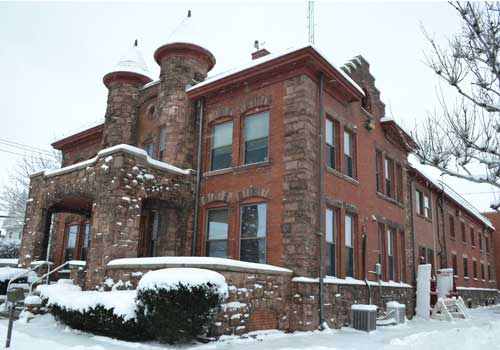
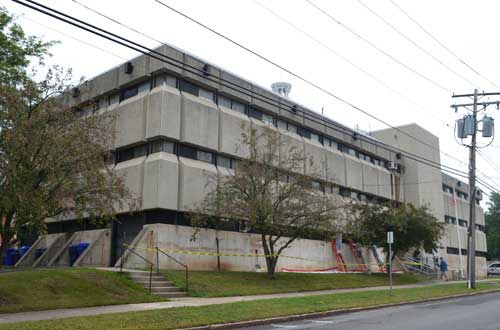
Photos by Tom Rivers: The Orleans County Jail was built in the early 1970s and has a capacity for 82 inmates.

County leaders from Genesee and Orleans counties met this afternoon in Batavia to discuss the merits of pursuing a regional jail facility.

The concept of a shared facility has been discussed informally in the past. But, this is the first time county leaders have met formally on the subject.

Genesee and Orleans Counties have a long and successful history of partnering to provide services including a cross jurisdictional sharing arrangement in the area of Public Health and Youth Bureaus which are considered fairly unique in New York State, county leaders said in a news release following the meeting on the jail.

“This is an initiative that we take very seriously,” said Orleans County Legislature Chairman Dave Callard. “Our long friendship with Genesee County provides an opportunity to have frank discussions and try extraordinary things for the mutual benefit of our taxpayers.”

The Orleans County Jail was built in two stages in the early 1970s. The county recently spent about $1.5 million in a series of improvements at the jail, which has a capacity for 82 inmates.

The Genesee County Jail was built in 1902-03 with an addition put on in 1985, boosting capacity to 97 inmates.

The Genesee County Jail was constructed in 1902-03 at 14 West Main St. The jail then had 10 to 15 cells. Genesee County put a brick addition on the jail in 1985. There is now capacity for 97 inmates.

The counties plan to apply for a state grant to hire a consultant to see if a shared jail has merit, said Chuck Nesbitt, Orleans County chief administrative officer.

All correctional institutions in New York State are regulated and overseen by the Commission on Corrections. Regional jails are widely used across the United States, but remain illegal in New York State, an obstacle that would require state legislation to overcome.

Current state law requires that each county in New York “maintain a county jail” (County Law, Section 217) and that each county sheriff shall have custody of the county jail.

County jails are funded almost entirely by local taxpayers.  When local jails find themselves with insufficient space to house the current inmate population, the facility must obtain a variance from Commission on Corrections or rely on boarding inmates out to other facilities at significant cost to the local taxpayer.

A possible first step is to apply to New York State for funding to study the concept of regionalizing including capacity, capital needs, governance, transportation, alternatives to incarceration and legal obstacles, the county leaders said in the news release.

Another logical step is to seek changes to the law from the State Legislature to overcome legal obstacles to a regional partnership.

“I’m excited that our talks have begun and that we all agree that we need to think ‘outside the box’ regarding a regional approach to our mutual jail issues,” said Ray Cianfrini, Genesee County Legislature chairman. “Orleans County has been a valuable partner in past joint ventures by merging our health departments and youth bureaus and we are confident we can work together again to the benefit of all involved.”

Return to top

Nearly 10,000 without power in Orleans County

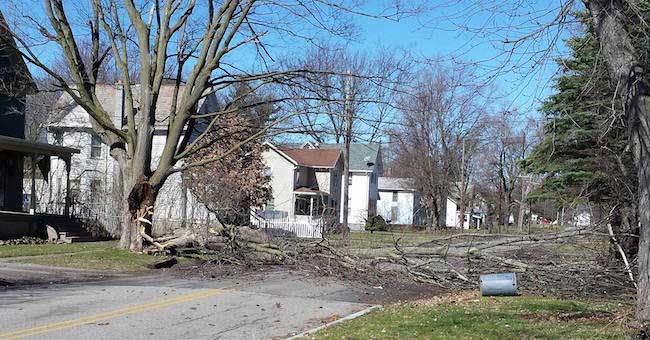
Dave Ingerson shared this photo of a tree that was knocked down on Elm Street in Medina. Trees and wires have been taken down throughout the county today, resulting in numerous power outages.

By Tom Rivers, Editor Posted 8 March 2017 at 3:52 pm

National Grid says power estimated to be restored at 3 p.m. on Thursday

Nearly 10,000 National Grid customers in Orleans County are without power, among the 103,672 National Grid customers who have lost electricity due to the high winds knocking down trees and wires in Upstate NY.

Orleans County has been hit hard by the wind with 9,802 of National Grid’s 18,221 customers without power, that’s more than half of the customers in Orleans County. National Grid said it expects power to be restored in Orleans at 3 p.m. on Thursday.

Other nearby counties also have extensive power outages, including Genesee, 16,016 without electricity; Niagara, 24,135; Monroe, 8,752; and Erie, 8,445.

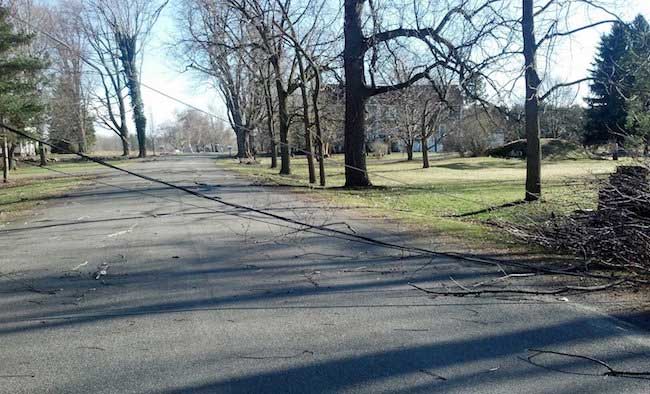
Bruce Landis shared this photo of downed wires on Johnny Cake Lane in Barre. A big tree fell down on that road.

Return to top

County treasurer won’t seek re-election this year

Photos by Tom Rivers, Susan Heard, the Orleans County treasurer for 23-plus years, announced she is retiring from the job on Dec. 31. She is pictured outside the treasurer’s office at 34 East Park St.

By Tom Rivers, Editor Posted 6 March 2017 at 6:53 pm

Susan Heard has worked in Treasurer’s Office for 40 years, intends to run for Gaines Town Clerk

ALBION – Susan Heard was 18 on a summer work program when she started in the Orleans County Treasurer’s Office. She was planning then on a career as a dental assistant.

But Heard liked the job at the Treasurer’s Office. She also decided that the job of a dental assistant, with her hand in someone’s mouth, wasn’t what she wanted to do.

She worked her way up in the Treasurer’s Office under then Treasurer Mary Basinait.

When Basinait retired, Heard was elected treasurer at age 34. She has been elected to six four-year terms.

“You’re accountable for every penny that comes into the county, everything from the federal and state governments, and the sales tax,” she said today.

Heard announced she will retire as treasurer on Dec. 31, deciding against another four-year term in the role.

However, Heard would like to continue a career in public service. She is running for Gaines town clerk. She also is backing her deputy treasurer, Kim DeFrank of Murray, to succeed Heard as treasurer.

Kim DeFrank

DeFrank has worked in the office for 23 years, starting from the bottom like Heard and working her way up.

“She knows the job,” said Heard. (The Treasurer’s Office includes 5 ½ employees.)

DeFrank has reached out to the executive committee of the Orleans County Republican Party, stating her interest in serving as the next treasurer. The GOP will meet April 27 to make its endorsement.

Heard is well regarded among the other treasurers in the state. They picked her as county treasurer of the year about a decade ago.

Heard said the treasurer is the “watchdog” of the county’s finances, an annual budget of about $65 million with hundreds of line items.

The treasurer is responsible for the investment of all funds, processes payroll, payroll tax returns and payroll deductions. The treasurer also maintains health insurance for all county employees and retirees.

A description of the treasurer’s work on the county website also states:

“The Treasurer issues and accounts for all vendor payments, with the exception of Self Insurance. Federal and State Aid are received through the County Treasurer and are reconciled against departmental claims. Bank reconciliations are performed in the Treasurer’s office for all funds.

The County Treasurer issues Certificates of Residency for enrollment at a Community College, collects and records bail deposits, fine payments, dog licensing, dog damage claims, accounts for unpaid school taxes and unpaid recycling fees.

The County Treasurer is the chief tax enforcing officer for County taxes; collecting and enforcing payment of all delinquent taxes, including tax billing, recording of tax liens, tax foreclosure and acquisition of County-owned property.”

Return to top

Newly merged Arc of Genesee Orleans unveils new logo, mission statement

Staff Reports Posted 4 March 2017 at 8:46 am

The NYSARC chapters in Genesee and Orleans counties completed a merger on Oct. 1, 2016, and are now known as “The Arc of Genesee Orleans.”
The organization on Friday announced a new logo for the chapter and a mission statement.

The Arc of Genesee Orleans chose the March observance of Developmental Disabilities Awareness Month to announce the news.

The organization serves 1,200 people with intellectual or developmental disabilities.

The new mission statement says: “Be a partner for people with disabilities, and a gateway to opportunities for each person to experience their desired potential.”

The vision statement: “Life-long relationships, enriched by inclusion.”

The Values: “Diversity, Respect, Integrity, Visionary, Equality, Empowerment, Excellence (DRIVE³)”

“Along with our new mission, vision and values, we are excited about our new logo,” Executive Director Donna Saskowski said. “It’s part of the national brand, uniting affiliated Arc chapters across the country. Look for the logo to be appearing on signs, buses, publications, our website, and at community events!”

The unification of the former Genesee ARC and Arc of Orleans County was a two-and-a-half-year process that was realized last fall and became effective Oct. 1.

“It has been a fairly smooth transition for families and individuals,” Saskowski said. “Administratively, some department locations had to choose a new home base, and our official, legal address is 64 Walnut Street, Batavia.”

The Finance Department and Quality Assurance Staff are among departments located at the former Orleans business office at 122 Caroline St. in Albion.

The agency will provide a variety of programs and services with renewed strength and commitment. Looking forward, The Arc of Genesee Orleans will be a partner for people with disabilities, and a gateway to opportunities for each person to experience their desired potential, Saskowski said.

Return to top

‘Safety house’ will be used for fire prevention training in Orleans County

By Tom Rivers, Editor Posted 24 February 2017 at 12:15 pm

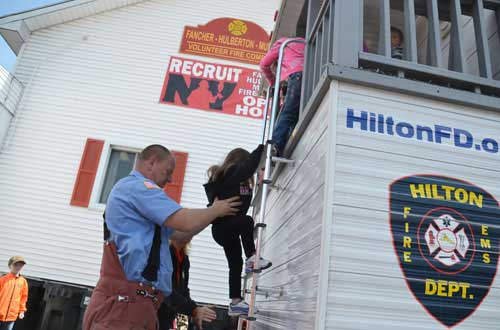
File photos by Tom Rivers: The fire safety training trailer from the Hilton Fire District was used by the Fancher-Hulberton-Murray Volunteer Fire Company last April 24 for an open house. This photo shows FHM firefighter Ray Keffer assisting a girl in climbing down a ladder of a trailer. That trailer also has a smoke simulator.

ALBION – Fire departments in Orleans County will have a new “safety house” to help teach children about fire prevention.

State Sen. Robert Ortt approved a $75,000 State and Municipal Facilities Program (SAM) grant to purchase a fire safety training trailer. The trailer will be owned by Orleans County’s Emergency Management Office, and will be available to all 12 fire departments in the county.

“I’m very excited about it,” said Dale Banker, the county’s emergency management coordinator. “It will be a great tool.”

The County Legislature on Wednesday accepted the $75,000 grant which comes through the Dormitory Authority of the State of NY.

Banker said a committee of fire officials has been formed. That group will visit other fire departments with the training trailers to determine what model would be best for Orleans County. North Greece, Gates and other departments outside Orleans have the training trailers.

Some of the trailers are designed to resemble kitchens, while others have bedrooms. The trailers can simulate smoke. Fireifghters use the trailers to talk with children and community members about the dangers of unattended stoves, overloaded extension cords and other household fire hazards.

Banker said the trailer is expected to be ready in the fall. He wants it in service before the first week of October, which is fire prevention week when local fire departments visit elementary schools to discuss prevention.

Banker said the trailer could be used by about 3,000 elementary students each year. He also expects it will be at fire department open houses, community festivals and the 4-H Fair.

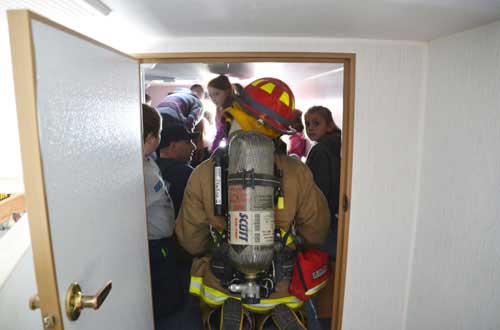
Kali Keffer, an FHM junior firefighter, joins children in a safety drill inside the trailer from Hilton during the April 24 open house.

Return to top

Orleans Legislature backs resolution for state to limit SAFE Act to NYC

By Tom Rivers, Editor Posted 23 February 2017 at 9:01 am

File photo by Tom Rivers: Robert Ortt speaks against the SAFE Act during a rally in Albion on Sept. 8, 2014. About 200 people attended that event outside a gun shop on Hamilton Street.

ALBION – The Orleans County Legislature went on the record Wednesday in support of partially repealing the SAFE Act and limiting the gun control legislation to New York City.

The SAFE Act was passed in January 2013 and remains bitterly opposed by many in Orleans County, who see the law as an infringement on Second Amendment rights.

The law, however, has been upheld in court and remains very popular in New York City. (Courts did find the seven-round firearm magazine limit to be unconstitutional.)

State Sen. Robert Ortt, R-North Tonawanda, is sponsoring legislation that would be a partial repeal.

“This bill seeks to reestablish the rights of law abiding citizens’ in rural and suburban areas of the state by limiting the application of the SAFE Act to Kings, Queens, Richmond, New York, and the Bronx,” according to the legislation. Click here to see Senate bill S879B.

County legislators passed a resolution that was critical of the governor and the State Legislature for rushing the SAFE Act into passage in January 2013, and for approving legislation that county legislators say infringes on the right to bear arms.

The SAFE Act also has a detrimental impact on recreational benefits of gun ownership for people who enjoy hunting and target shooting, county legislators said in the resolution.

Legislators said the SAFE Act has resulted in additional costs on Sheriff Departments, County Clerk’s Offices and County Judges.

There are about 5,000 pistol permit holders in Orleans County. The law-abiding gun owners have to verify ownership of certain types of firearms every five years, in addition to registering them on permits, which is “unnecessarily burdensome,” legislators said.

County legislators also stated they support removing state funds for enforcement of the SAFE Act.

Legislators did say the SAFE Act has some good points, such as the strengthening Kendra’s Law and Marks’s Law, as well as privacy protections for lawful permit holders.

However, “we find the legislation fails to offer little meaningful solutions to gun violence and places undue burdens where they don’t belong, squarely on the backs of law-abiding citizens,” the resolution states.

County Legislator Don Allport, R-Gaines, said the partial repeal of the SAFE Act would be “a step in the right direction.”

Because New York City strongly supports the SAFE Act, Allport said that part of the state should be able to keep the legislation.

David Thom, chairman of the Orleans County Chapter of the Scope Committee On Political Education (SCOPE), told county legislators that SCOPE’s ultimate goal would be a total repeal of the SAFE Act for all of New York.

County legislators approved two other resolutions about state issues on Wednesday:

• One resolution called for the state to increase the share of revenue for county DMVs. Right now local Department of Motor Vehicles provide customer service and process many no-fee transactions for the state. The current law gives the state 87.3 percent of all fees collected by county-operated DMVs, with 12.7 percent going to the counties. That percentage hasn’t changed since 1999.

• The County Legislature also approved a resolution urging the state to fully fund the costs for probation and other county departments associated with raising the age of criminal responsibility to 18. Gov. Cuomo wants to raise the age of criminal responsibility from 16 to 18. That would require more work for probation to provide diversion services. Other county departments could see an increase in juvenile detention and community support services, according to the County Legislature.

Return to top

County legislators vote yes on rifles for deer hunting

By Tom Rivers, Editor Posted 22 February 2017 at 9:48 pm

Photo by Tom Rivers: County Legislator Fred Miller states his concerns about rifle hunting for deer. Sheriff Randy Bower is in back. Miller cast the lone nay vote about the issue.

ALBION – Orleans County legislators today voted to allow rifles for deer and bear hunting, a vote that wasn’t unanimous.

County Legislator Fred Miller, D-Albion, said he has heard from many in the community who don’t want rifles to be used for hunting deer. Miller owns a hardware store in downtown Albion, and he said many people have come in to share their concerns about allowing rifles in a county with such flat terrain.

Miller also said he has personal experience getting hit by another hunter’s stray shot. About 40 years ago, Miller was out with his dog on Allen Road, near the end of Clinton Street, when he was hit by pellets from pheasant hunters. Miller said he was hit in the face and leg, and his dog also was hurt.

Members of sportsmen clubs attended Legislature meetings in December and January, asking the county to support rifles for big game hunting. (Rifles have been allowed for small game, such as woodchucks, foxes, crows and coyotes.) The sportsmen presented a petition signed by about 500 people, supporting rifles.

There are 62 counties in New York State, and 41 allow rifles for deer and bear, legislators were told.

Legislator Don Allport, R-Gaines, said he was strongly in favor of rifles, noting the 41 other counties support it. Allport also said today’s hunters make safety a priority.

“It’s not like 20 years ago when it was a big party in the woods,” Allport said.

Miller said after the meeting he would have liked more time for the Legislature to consider the issue. Miller said he wasn’t swayed by so many counties backing the measure. He said nearby Monroe, Niagara and Erie counties don’t allow rifles for deer and bears.

“Let’s not rush into it just because other counties are doing it,” Miller said.

Michael Van Durme, a retired chief conservation officer for Region 8 of the DEC, told legislators last month that rifles are much safer than shotguns for hunting.

“I can tell you rifles rounds for white-tailed deer are safer than shotguns,” he told legislators. “As far as a rifle round going long range and hitting people, it just doesn’t happen.”

Sportsmen insisted rifles are safer, because hunters tend to take only one shot with a rifle because they use scope and have better accuracy.

The issue now goes to the State Legislature to enact legislation to allow rifles for big game hunting in Orleans County.

Return to top

Tax increases in past decade vary wildly among towns, villages

By Tom Rivers, Editor Posted 22 February 2017 at 1:27 pm

Carlton sees biggest jump in taxes, while Albion town is lone municipality to reduce them

Tax comparisons February 2017

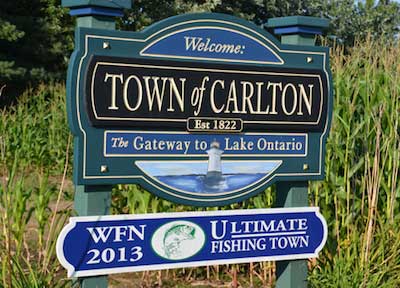
Photo by Tom Rivers: Taxes in Carlton have increased at a faster rate than any town in Orleans County since 2007.

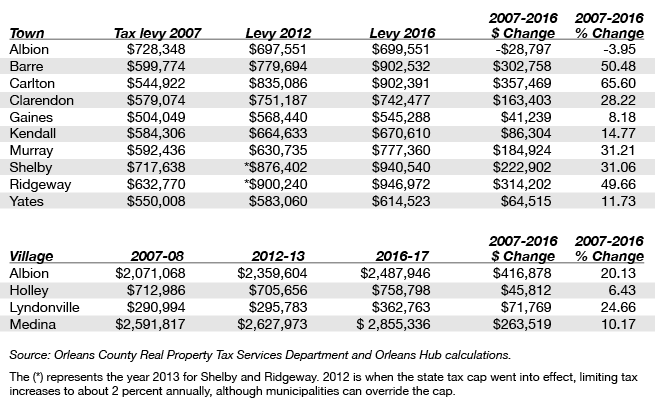
In the past decade, taxes in local towns and villages have increased at varying rates, with Carlton seeing the biggest jump – 65 percent since 2007 – while one municipality, the Town of Albion, has actually reduced taxes from 2007 to 2016.

The 10 towns collectively have increased taxes double the rate of the increase for the four villages from 2007 to 2016, according to an Orleans Hub analysis of tax levies for towns and villages.

The 10 towns collectively saw the tax levy, what the towns collect in property taxes, increased from $6,033,325 in 2007 to $7,742,244 in 2016. That $1,708,919 increase is up 28.3 percent in the nine years.

The four villages collectively went from $5,666,865 in 2007-08 to $6,464,843 in 2016-17, which is up $797,978 or 14.1 percent.

Carlton has seen the biggest tax increase since 2007, which the levy increasing by 65.6 percent, up $357,469 – from $544,922 in 2007 to $902,391 in 2016.

Gayle Ashbery, the town supervisor, said today she was aware of recent increases. She noted the town has wrestled with a re-evaluation of 2,400 properties in Carlton. It paid GAR Associates Inc. $68,000 to compile the data, visiting every property in the town and make note of swimming pools, additions, sheds, garages and exterior property improvements. That project, begun in 2014, was done to make sure Carlton had up to date assessment records following an outcry from residents in 2013 over reassessments that many residents said were too high.

One town actually collected less in taxes in 2016 compared to 2007. Albion’s town tax levy dropped 4 percent in the nine years, down nearly $30,000 from $728,348 in 2007 to $699,551 in 2016.

“You can do it but it takes some work,” said Matt Passarell, the town supervisor.

The towns face escalating health insurance and employee benefits costs, he said, “and every one wants a raise.”

Albion has looked for efficiencies, sharing a codes officer with Gaines, for example, Passarell said.

“You have to be creative,” he said.

The town has dipped into fund balances in recent years to help stave off tax increases. Passarell said grants are also helping to tackle infrastructure projects.

The town also has seen a little boost in sales tax revenue. The county shares $1,366,671 in sales tax each year collectively with the four villages and 10 towns. The town and village total has been frozen since 2001.

However, the amounts can vary for each village and towns with villages. If the town’s assessments grow faster than the villages’, the towns will get more sales tax, taking away some of the villages. That’s what has happened in Albion. The town-wide assessments have outpaced the village assessments. That has resulted in the town sales tax share growing from $111,754 in 2013 to $124,978 in 2017. The Albion village share has fallen from $180,457 in 2013 to $164,617 in 2017.

Tax cap introduced in 2012

The governor and State Legislature approved a tax cap in 2011. That took effect in 2012 and tries to limit tax increases to 2 percent annually, although the threshold can change each year and municipalities can override the cap.

The cap seems to have slowed tax increases in the towns since 2012. Clarendon, for example, raised taxes $172,113 or 29.7 percent from 2007 to 2012, but has actually cut taxes since then. Gaines also has reduced taxes since the cap was implemented, and other towns have slowed the growth in taxes since 2012.

Ridgeway, for example, raised taxes $267,470 or by 42.3 percent from 2007 to 2013. The three years after, Ridgeway increased taxes by $46,732 or 5.2 percent.

(Three of the four villages had tiny tax increases from 2007 to 2012 – Holley actually lowered taxes during those five years. Albion and Medina both eliminated their village courts which saved some costs, with the expense passed to the towns. The villages’ taxes have increased since the tax cap, some years exceeding the 2 percent threshold.)

Villages slow tax increases, but suffer from shrinking assessments

Among the villages, none raised their taxes more than 25 percent over the nine years. Six of the 10 towns saw increases above 25 percent.

Holley had the smallest increase at 6.43 percent. However, the village separated the fire department from the village budget. The fire department is now in a separate tax.

The town tax increases may not be as noticeable each year because the towns’ assessed values are increasing, giving a bigger tax base to absorb the larger tax levies. That means the tax rates are often the same or see small increases. Many of the local elected officials judge their budgets on how the tax rate changes, and don’t fret as much about the tax levy.

However, a stable tax rate for larger assessed values still results in bigger tax bills for property owners (if their assessments go up.)

The villages are facing shrinking assessed values, so many of the Village Boards in recent years have reduced village staff and projects, preventing big increases in the tax levy. However, because the assessed values are going down, often the tax rate still goes up.

In Lyndonville, for example, the tax rate has climbed from $9.70 per $1,000 of assessed property in 2008-09 to $13.65 in 2016-17. That is a 40.7 percent increase over eight years. Village officials say it’s difficult to prevent property tax increases when sales tax and mortgage tax revenues are declining.

Return to top

County Legislature plans to back rifles for big game hunting, oppose SAFE Act outside of NYC

By Tom Rivers, Editor Posted 21 February 2017 at 1:55 pm

ALBION – The Orleans County Legislature agenda for its monthly meeting on Wednesday includes resolutions in support of allowing rifles for big game hunting in Orleans County. The Legislature also plans to support a proposal that would limit the SAFE Act to New York City.

The Legislature’s regular meeting starts at 4 :30 p.m., at the County Clerks Building, Suite 2 at 3 South Main St.

The Orleans County Federation of Sportsmen Club attended the Legislature’s December and January meetings, asking the county to allow rifles for deer and bear.

The Legislature’s proposed resolution of support states the following:

“WHEREAS, the Orleans County Legislature has listened to both sides of the argument of the use of rifles to hunt big game in Orleans County at several past Conference Sessions and Legislature Meetings; and

“WHEREAS, a special state law must be enacted and the first step in the process is for this Legislature to request the legislation; now be it

“RESOLVED, that this Orleans County Legislature requests the New York State Legislature to enact legislation that will allow the use of rifles for big game hunting in all of Orleans County.”

The Legislature also plans to approve supporting legislation to partially repeal the New York Secure Ammunition and Firearms Enforcement (SAFE) Act of 2013. Excerpts of the Legislature’s proposed resolution includes:

“WHEREAS, Senate bill S879B has been introduced to the New York State Senate by Senators Michael Nozzolio and Katherine Marchione respectively, which would repeal part of the New York Secure Ammunition and Firearms Enforcement Act of 2013; and

“WHEREAS, this Legislative Body has long advocated for the protection of the rights afforded our citizens under the Constitution, which has for generations guided our Nation and served as a framework to our republic and society; and

“WHEREAS, the Second Amendment of the United States provides for the “right of the people to keep and bear arms” and further states that this right “shall not be infringed”; and

“WHEREAS, the Civil Rights Law of the State of New York states in Article 2 Section 4, “Right to keep and bear arms. A well-regulated militia being necessary to the security of a free state, the right of the people to keep and bear arms cannot be infringed.”; and

“WHEREAS, the lawful ownership of firearms is a recreational benefit to our residents through hunting and target shooting, along with an economic and environmental benefit to our region with several locally owned and operated gun/sporting businesses; and

“WHEREAS, the New York State Secure Ammunition and Firearms Enforcement (NY SAFE Act) of 2013 which was rushed to passage by the New York State Senate, Assembly and Governor, will have a detrimental effect on hunters, sportsmen and legal gun owners, creating a hostile environment both for them and for the sale and manufacture of legal firearms; and

“WHEREAS, the legislation unconstitutionally prohibits the sale of firearm magazines with a capacity larger than seven (7) rounds and, those firearm magazines with a capacity larger than seven (7) rounds, which are authorized to be retained by existing owners, may only be loaded with seven (7) rounds and eventually must be permanently altered to only accept seven (7) rounds or be disposed of; and

“WHEREAS, few or no low capacity (seven (7) rounds or less) magazines currently exist for many of the firearms commonly possessed by law-abiding residents of New York State; and

“WHEREAS, the legislation severely impacts the possession and use of firearms now employed by the residents of Orleans County for the defense of life, liberty and property; and

“WHEREAS, the legislation severely impacts the possession and use of firearms now employed for safe forms of recreation including, but not limited to hunting and target shooting; and

“WHEREAS, while there are some areas of the legislation that the Orleans County Legislature finds encouraging, such as the strengthening of Kendra’s Law and Marks’s Law, as well as privacy protections for lawful permit holders, we find the legislation fails to offer little meaningful solutions to gun violence and places undue burdens where they don’t belong, squarely on the backs of law abiding citizens; and

“WHEREAS, there are many parts of this legislation that place an unfunded mandate on the local Sheriff Departments, County Clerk’s Office and County Judges, while tax payers are crying out relief; and

“WHEREAS, there will be significant financial impact due to the approximately 5,000 Orleans County pistol permits that will have to be renewed requiring additional manpower and computer systems; and

“WHEREAS, requiring law-abiding gun owners to verify ownership of certain types of firearms every five years, in addition to registering them on permits, which now also must be renewed every five years, does not increase the safety of the public and is unnecessarily burdensome to the residents of New York State; and

“WHEREAS, this legislation effectively treats countless New York State law abiding gun owners as criminals; and

“WHEREAS, the enactment of the NY SAFE Act has engendered significant controversy over both the process by which it was enacted and certain provisions contained within; and

“WHEREAS, the manner in which this legislation was brought forward for vote in the State Legislature is deeply disturbing to the Orleans County Legislature; and

“WHEREAS, this legislative body unanimously voted to oppose the New York Secure Ammunition and Firearms Enforcement Act of 2013 for all reasons stated above in RESOLUTION NO.82-213 of the Orleans County Legislative proceedings of February 13, 2013; now be it

“RESOLVED, that the Orleans County Legislature does hereby support Senator Robert Orrt’s bill to repeal part of the New York Secure Ammunition and Firearms Enforcement Act of 2013, limiting the application of the “S.A.F.E. Act” to the five boroughs of New York City; and be it

“FURTHER RESOLVED, that this Legislature supports the introduction of an Assembly bill which calls for the repeal or partial repeal of the New York Secure Ammunition and Firearms Act of 2013; and be it

“FURTHER RESOLVED, that this legislature supports efforts by the New York State Legislature to remove funds for enforcement of the New York Secure Ammunition and Firearms Act of 2013 from the New York State Budget.”

Return to top

Extension will use state funds for performance stage at fairgrounds

By Tom Rivers, Editor Posted 16 February 2017 at 7:40 pm

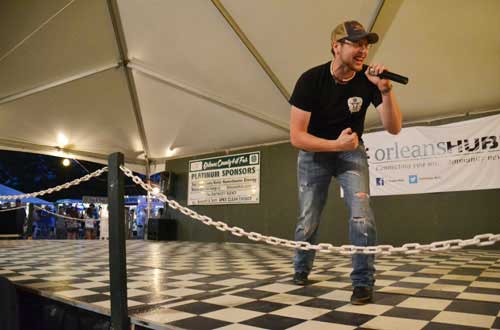
File photo by Tom Rivers: Rich Nolan performs “Eight Second Ride” during the karaoke finals on July 30, 2015. The Cornell Cooperative Extension of Orleans County wants to have a permanent stage at the fairgrounds, with the stage also available as an outdoor classroom for master gardeners and agricultural specialists.

KNOWLESVILLE – The Cornell Cooperative Extension has decided on the main project for a $96,000 state grant to be used to boost the fairgrounds.

Gov. Andrew Cuomo last month announced each county fair would receive an $89,285 grant for a capital project. That grant increased to $96,000 once the paperwork arrived, said Robert Batt, a 4-H educator.

A committee at the Extension wants to put most of the money into upgrading a performance stage at the Curtis Pavilion.

That stage could be used during the week-long 4-H Fair for dancers, bands and other activities. It also could serve as an outdoor classroom for the master gardeners and agricultural specialists at other times of the year, Batt said today.

The Extension would like to have a 40-foot-wide stage that is 30 feet deep. The project would also include a separate area that could be used as a changing room or a spot to prep materials for educational presentations, Batt said.

The new performance stage would spare the Extension from having to pay $2,000 each fair for a temporary stage with a large tent. That $2,000 could instead be put towards programming at the fair, he said.

The Extension also would like to install a sound system for the Curtis Pavilion if there is enough money in the grant.

If there is additional money left after the stage project, Batt said the Extension would also like to install a new wash rack for horses. Right now, 4-H kids wash their horses in the grass, which becomes muddy as fair week stretches on. Ideally, the horses would have a wash rack like the new one with a concrete base that was installed for cattle last year. That cost about $15,000, Batt said.

The state is making the grants available to all the county fairs in the state, hoping the capital improvements can help the local fairs better showcase local agriculture.

The performance stage met the criteria by the state because the stage will also serve as an outdoor classroom for agriculture specialists and master gardeners, Batt said.

“These investments will help these fairs attract more visitors, raise the profile of local vendors and businesses, and help spur economic growth across New York,” Cuomo said last month when he announced the grants.

Return to top

New 4-H road signs coming to Orleans County

By Tom Rivers, Editor Posted 16 February 2017 at 6:03 pm

Provided photo

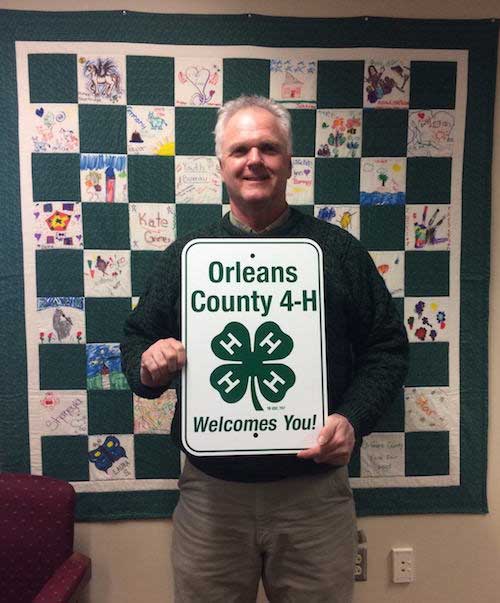
KNOWLESVILLE – Joe Sidonio of Murray holds one of the new 4-H signs he paid for and donated to the Cornell Cooperative Extension of Orleans County.

Sidonio donated seven road signs. Five will replace existing signs – one of Route 98, and two each on Route 31 and Route 104. The Extension would like to have two signs installed on Route 31A at the entrance of Orleans County by the Monroe County line and the Niagara County line.

“Several of the signs are rusted to the point where they are barely legible,” said Robert Batt, 4-H educator.

Sidonio donated the the signs to help celebrate the 100th anniversary of the 4-H program. His wife Amy Machamer is a former board member for the local Extension and their daughter, Amelia, has been a 4-H member for several years.

Batt said the new signs should go up in the spring. The five that will replace existing signs should be an easy swap, but the two planned for 31A will require a permit from the state Department of Transportation. If that permit is difficult to obtain, Batt said the signs planned for 31A may be installed at the 4-H Fairgrounds at Knowlesville.

“We just think it’s a good way to showcase that there is a strong and vibrant 4-H program in Orleans County, and the signs will also give people a reason to smile,” Batt said.

Return to top

4-H kids make public presentations

By Kristina Gabalski, Correspondent Posted 12 February 2017 at 3:33 pm

Photos by Kristina Gabalski

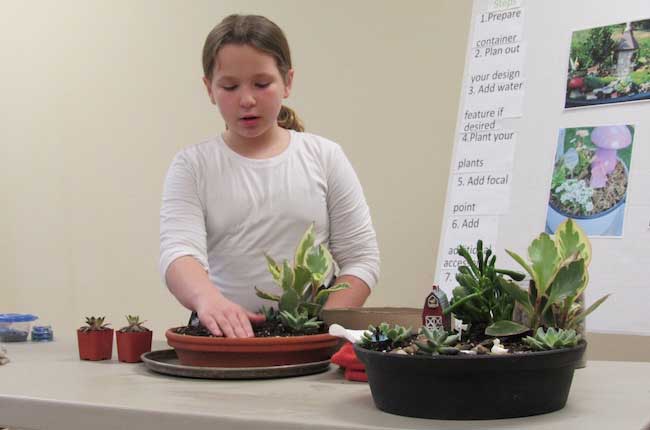
KNOWLESVILLE – Makenzie McGrath of Medina presents a demonstration on fairy gardens, showing how to plant succulents as part of the design, during 4-H Public Presentations Saturday afternoon.  This was Makenzie’s second year participating.

“I liked it,” she said of giving the demonstration.  “I didn’t get nervous. I got nervous last year, but not now.”

Orleans County 4-Hers are in the midst of their annual Public Presentations Program which provides an opportunity to improve public speaking skills.

Participants select a topic of their choice and present either an illustrated talk, demonstration, formal speech, recitation, or dramatic interpretation. 4-Hers who are members of a horse club or participating in a horse-related project can do presentations on horses either as an individual demonstration or a team demonstration.

The 2017 program will continue on Saturday, Feb. 18, in the Education Center on the Orleans County 4-H Fairgrounds.

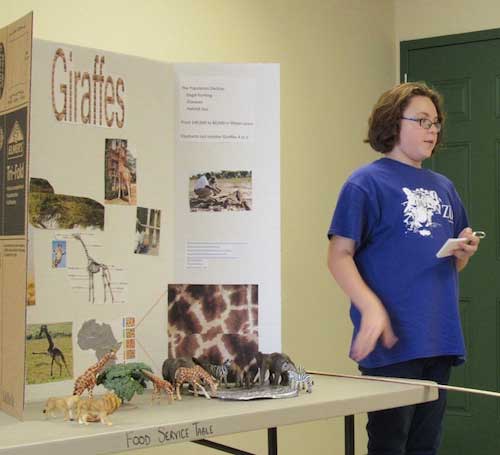
Lydia Scharlau of Medina presents an illustrated talk on giraffes.

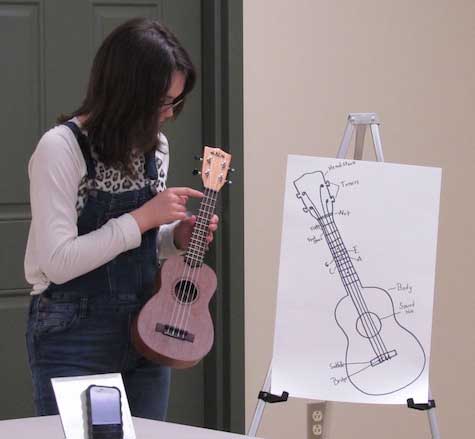
Megan Hardner of Lyndonville describes the parts of a ukelele as part of her 4-H Public Presentation on Saturday afternoon. Megan said she has been teaching herself to play the instrument because of her affinity for all things Hawaiian.

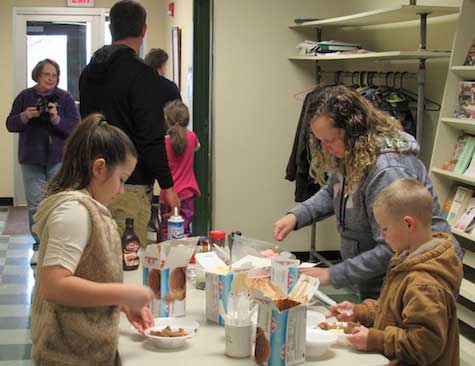
Following their presentations, 4-Hers and their families enjoyed ice cream sundaes before being awarded their certificates of participation.

Return to top

Governor’s budget boosts school aid in Orleans by $1.3 million

By Tom Rivers, Editor Posted 9 February 2017 at 8:51 pm

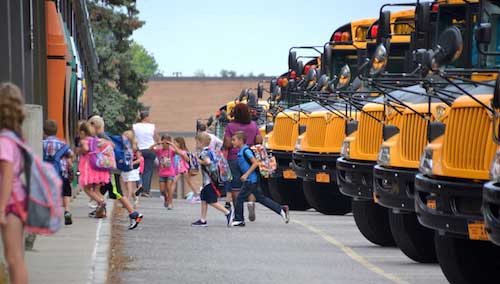
File photo by Tom Rivers: Students are eager to get to the Ronald L. Sodoma Elementary School in Albion on the first day of school on Sept. 7.

Orleans County school districts would collectively see about $1.3 million in state aid in 2017-18, according to Gov. Cuomo’s budget proposal.

The five school districts – Albion, Holley, Kendall, Lyndonville and Medina – received $86,780,004 in state aid in 2016-17. That would increase to $88,072,678 in 2017-18, according to the governor’s budget.

Cuomo is proposing a $1 billion increase in school aid state-wide, a 4 percent increase to $25.6 billion.

Cuomo, during a budget address on Jan. 17, said state funding for schools has increased 30 percent over six years.

“The people of this state believe that education is a priority. I agree with them, and we’ve put our proverbial money where our mouth is, the highest level of education spending in history,” Cuomo said.

The governor also wants to update the Foundation Aid formula to better reflect student poverty and consolidate prekindergarten funding streams.

Here is the breakdown for each school district in Orleans County:

• Albion would see overall aid increase by 1.7 percent or $445,327, going from $26,145,250 in 2016-17 to $26,590,577. The district’s Foundation Aid would increase from $19,586,268 to $19,909,890.

• Holley’s overall state aid would increase by 3.36 percent or $527,702, going from $15,694,417 in 2016-17 to $16,222,119. Holley’s Foundation Aid would rise from $9,772,927 to $9,952,814.

• Kendall would see overall aid jump 14.1 percent or a $1,490,671 increase, from $10,573,996 to $12,064,667. The district’s Building Aid is driving the increase with that going from $584,656 in 2016-17 to $2,154,370. Without the Building Aid, Kendall’s other state aid actually decreases by 0.79 percent or $79,043.

• Lyndonville would see an overall increase by 2.71 percent or $242,940, going from $8,964,368 to $9,207,308. Foundation Aid would see a slight increase from $5,908,151 to $6,009,994.

• Medina’s overall aid would drop by $1,413,966 or by 5.57 percent, from $25,401,973 to $23,988,007. The district’s building aid is dropping from $4,092,316 to $2,301,051. Foundation Aid, however, increases from $16,446,235 to $16,719,313. Medina’s school aid, without building aid, increases $377,299 or by 1.77 percent.

The school numbers often see an increase from the State Legislature over the governor’s proposal. The budget for the Legislature and governor to reach a budget deal is March 31.

Return to top