Turtles will be on the move in May and June to lay eggs
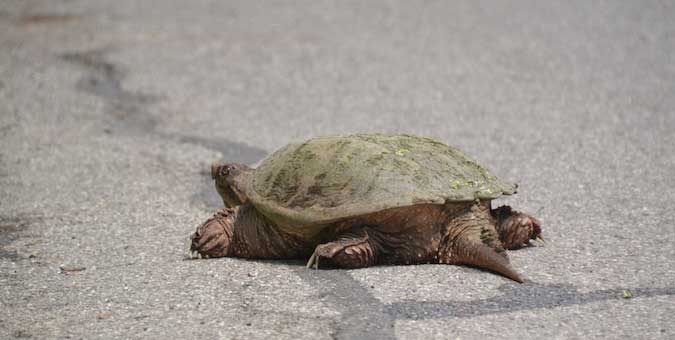
Photo by Tom Rivers: This snapping turtle is shown last June after it managed to cross Route 31 in Fancher. Many snapping turtles were on the move crossing roads to find spots to lay their eggs.
Press Release, NYS Department of Environmental Conservation
New York State Department of Environmental Conservation (DEC) Commissioner Basil Seggos today reminded New Yorkers that turtles are on the move in the months of May and June, and asked drivers to “give turtles a brake.”
In New York, thousands of turtles are killed each year when struck by vehicles while migrating to nesting areas. Increasing public awareness of turtles’ nesting behavior can help save this important species.
“A turtle’s shell provides good protection from natural predators, but it cannot protect a turtle from being hit by a vehicle while crossing a road,” Seggos said. “Vehicle strikes are a major cause of turtle mortality and New York’s native turtles are more active this time of year as they seek sandy areas or loose soil to lay their eggs, sometimes even near the side of a road.”
If a motorist sees a turtle on the road, drivers are encouraged to slow down to avoid hitting it with their vehicle. If the vehicle can safely stop, motorists should consider moving the turtle to the shoulder on the side of the road in the direction it was facing.
Motorists are advised not to pick turtles up by their tails to avoid injuring the turtle. Most turtles, other than snapping turtles, can be picked up by the sides of their shell. Snapping turtles have necks that can reach a long distance and have a strong bite, so if motorists try to help a snapping turtle, they should pick it up by the rear of the shell near the tail using both hands or slide a car mat under the turtle to drag it safely across the road.
DEC reminds people to never take turtles home. All native turtles are protected by law and cannot be kept without a DEC permit.
All 11 species of land turtles native to New York are in decline. Turtles are long-lived species and it takes many years for a turtle to reach maturity. Even losing one mature female can have a negative impact on a local population.
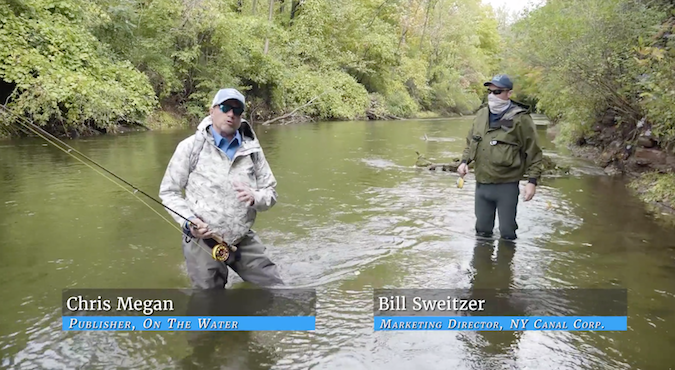
This screenshot from “On the Water” shows program publisher and host Chris Megan and Bill Sweitzer, marketing director for the Canal Corp., fishing in the Oak Orchard River. Megan caught a mammoth brown trout that day. The Oak Orchard benefited from a pilot program with canal water released into the tributary in November and December. That improved the water flows in the Oak Orchard and extended the fishing season.
Posted 8 May 2021 at 8:26 am
Press Release, NYS Canal Corp.
CARLTON – The New York State Canal Corporation on Friday announced the Reimagine the Canals initiative was recently featured on the NBC Sports program “On the Water: Angling Adventures.”
The television show highlighted the successful launch of a pilot program that strategically used water from the Erie Canal to enhance already renowned fishing opportunities in Western New York during the fall of 2020. The full episode can be seen by clicking here.
“The Reimagine the Canals initiative is making an outstanding positive impact on Western New York’s fishing communities and canalside businesses and we are thrilled that NBC Sports chose to showcase our recent pilot program that enhanced the angling experience along tributaries supplied by water from the Erie Canal,” said New York State Canal Corporation Director Brian U. Stratton.
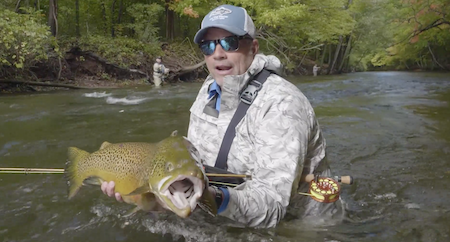
Chris Megan holds a big brown trout he caught in the Oak Orchard River. He praised the fishing opportunities in the Oak.
“The Reimagine the Canals initiative, first announced by Governor Cuomo in his 2020 State of the State address, is committed to supporting many recreational opportunities along the Canal system to ensure it remains a driver of economic development and tourism across Upstate New York,” Stratton said.
Filmed last fall, the episode features the fishing experience on Oak Orchard Creek and Sandy Creek in Orleans and Monroe counties. Through the Reimagine the Canals program, the Canal Corporation increased regulated water releases into the two streams from September to early December last year.
As seen during the episode, the higher flows successfully enticed more brown trout, steelhead, and Atlantic and Pacific salmon populations to run up these streams, improving conditions for the fish and expanding opportunities for local and visiting anglers.
“The New York Canal system presents anglers with world class angling opportunities steeped in American history,” said Chris Megan, publisher and host of “On the Water.” “An engineering marvel, the Erie Canal has been in operation since 1825, opening the Great Lakes to the Atlantic Ocean via the Hudson River. Hand dug by immigrants and farmers and enlarged twice, its effect on commerce was dramatic. As an avid angler and history buff, I jumped at the opportunity to spend two days fishing Upstate New York.”
The episode also includes a look at the history of the waterway with canal historian Art Cohn, a boat trip through the Cayuga-Seneca Canal onto Seneca Lake to troll late season lake trout, and a visit to one of New York’s hidden fishing gems where anglers come from all over the world to target the common carp that swim in the Erie Canal’s lakes and locks.
By Tom Rivers, Editor Posted 7 April 2021 at 10:42 am
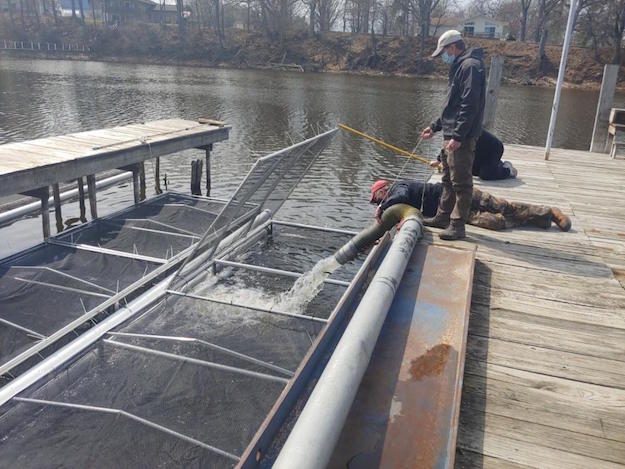
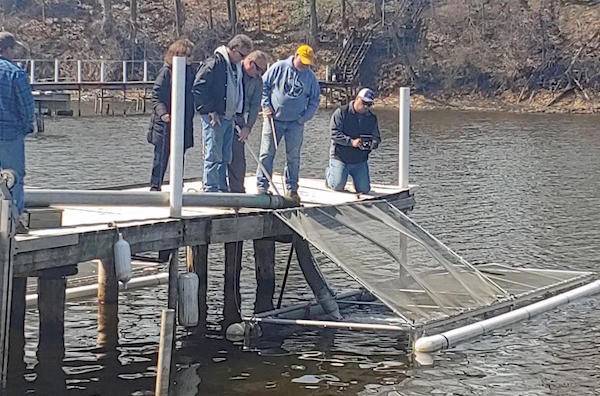
Provided photos: There were 10,000 steelhead fingerlings put in two pens in the Oak Orchard River on Monday. Volunteers will feed them the next month and then the fish will be released. They will be bigger with a higher chance of surviving and returning to the Oak Orchard when they are mature.
CARLTON – More than 100,000 fingerling fish were delivered by the state Department of Environmental Conservation on Monday to the Oak Orchard River.
Those fish will be raised in pens and fed regularly by volunteers the next month. The fish will nearly double in size which will increase their chances for surviving when they are released into the river and when they go out to Lake Ontario.
They also are “imprinting” on the Oak Orchard, and will have a better chance of returning when they are mature in about 3 to 4 years, with the steelhead topping 10 pounds and some of the salmon 30 pounds or more.
Oak Orchard volunteers have been running the pen-rearing project since 1998. It was the first such effort on the south shore of the lake. Now there are many.
Fishing communities have seen how the projects pay off with a better fishery, with more mature fish that draw bring in anglers from outside the area to support local businesses.
The state Department of Environmental Conservation delivered 111,000 Chinook salmon on Monday to pens in the Oak Orchard River. The Oak Orchard in 1998 became the first community with a pen-rearing project on the southshore of Lake Ontario. Now there are several similar efforts.
The DEC delivered 111,000 Chinook salmon and 10,000 steelhead on Monday. They will be kept in pens at Ernst’s Lake Breeze Marina.
Ron Bierstine, owner of Orleans Outdoor, has been coordinating the steelhead pens since 2019. He said the effort has paid off with more mature steelhead in the Oak Orchard.
“This year the steelhead fishing in the river the returns look pretty good,” he said. “We hear a lot anecdotally.”
In 2022, there should be more 3-year returns from the steelhead in the pens in 2019.
“I’m real excited about next year,” Bierstine said this morning.
The volunteers feed the fish on a feeding schedule from the DEC. The DEC provides the food in little pellets.
Bierstine said the pen-rearing has become a community effort at the Oak Orchard.
“All major ports do it now, but it started here on the Oak Orchard,” he said.
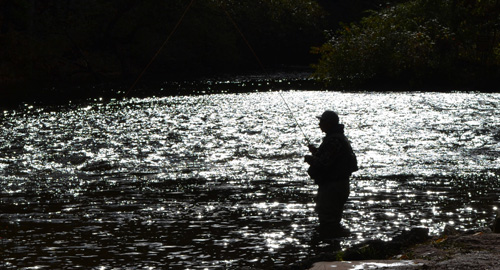
Photo by Tom Rivers: An angler tries to a catch a fish in the Oak Orchard River in Carlton.
Governor Andrew M. Cuomo announced that trout fishing season in New York State opens today. In preparation for opening day, the New York State Department of Environmental Conservation is stocking 1.8 million catchable trout in waters across the state.
In addition to larger size fish being stocked this year, some stream reaches will receive four stockings of trout.
“Every year, thousands of New Yorkers head outside on the opening day of trout season, and 2021 should be no exception, especially with a new trout management plan in place to improve access for anglers of all ages,” Cuomo said. “This is a longstanding and much-beloved tradition for generations of families, and I encourage New Yorkers to get outside, continue practicing safe behaviors like social distancing, and experience all the great fishing the Empire State has to offer.”
New York State offers a diverse set of fishing opportunities for wild and stocked trout. Under the State’s new Trout Stream Management Plan, DEC has grouped stream fishing opportunities into five distinct categories for improved management and easy-to-understand regulations to help make fishing more accessible and enjoyable for all anglers, from novice to expert.
“This year opening day represents the beginning of a new era in trout stream management for New York,” DEC Commissioner Basil Seggos said. “After more than two years of committed work with our angling public, DEC will begin implementing the new Trout Stream Management Plan.”
This fall, anglers will be able to fish for trout throughout the state due to the creation of a statewide catch and release season that will run from Oct. 16 through March 31. While year-round trout fishing has been enjoyed in many areas of the state, the season will provide an opportunity for anglers who have otherwise had to wait for spring. DEC will select a suite of streams and conduct a three-year study to evaluate the new regulation to ensure that the new season has no negative impact on natural trout production.
“In addition to new and fewer types of special regulations, we have made significant progress toward achieving our fish production objectives to stock larger yearling fish and seed all stockings with some fish 12 inches or larger,” Seggos said. “Best of all, anglers can continue to enjoy our trout stream resources through the fall and winter months thanks to the creation of a new catch and release season.”
To prepare anglers for the 2021 trout season with the new management plan in place, DEC will host virtual outreach events in the coming weeks, including “how to” Facebook Live segments where viewers can learn about beginner trout fishing techniques.
To access additional information about how and where anglers can find their preferred type of trout angling opportunities, DEC launched an interactive Trout Stream Fishing Map to provide a one-stop-shop for information about stocking, fishing access, season dates, and regulations on the DECinfo Locator.
Links to the Trout Stream Fishing Map and a User Guide are available by clicking here.
By Tom Rivers, Editor Posted 17 March 2021 at 3:26 pm
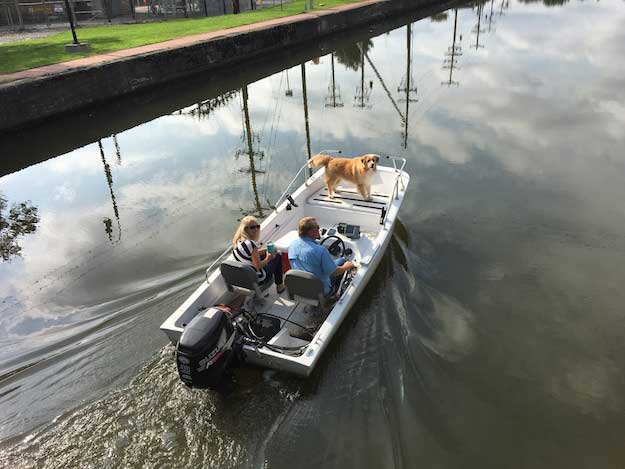
File photo by Tom Rivers: These two people and a dog pass underneath the Ingersoll Street lift bridge in Albion on Oct. 14, 2017, when it was a 70-degree fall day.
The State Canal Corp. today announced the schedule for the upcoming boating season with the canal opening on May 21 and continuing until Oct. 13.
That is close to being back to normal after last year’s start was pushed back until June 26. The start in 2020 was supposed to be May 15 but was delayed because canal staff and construction crews were sidelined early in the pandemic. That prevented the State Canal Corp. from doing some of the work needed before the canals could be opened.
In an announcement for the upcoming season today, the Canal Corp. said, “This proposed schedule of operations could be impacted by the Covid pandemic and/or the need to repair critical infrastructure.”
The Canal Corp. also again won’t be charging any tolls or fees for recreational use of the canal system. This is the fifth straight year the tolls have been waived. Those tolls were normally $25 to $100 for a season pass, depending on the size of the vessel.
The upcoming boating season will be the 197th continuous season. Last year the system was in danger of not opening due to Covid, but it opened later than usual.
Standard hours of operation will be from 7 a.m. to 5 p.m. The following lift bridges in Orleans County will operate on demand from 7 a.m. to 10 p.m. until September 15: Holley, Hulberton, Ingersoll Street in Albion, Main Street in Albion, Eagle Harbor, Knowlesville and Medina.
4 million visitors on towpath and trail system in 2020
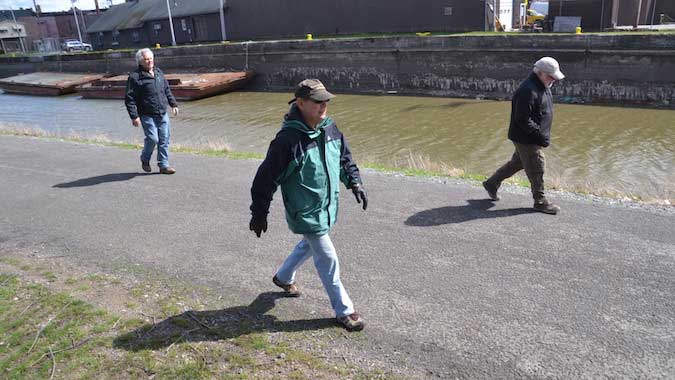
Photo by Tom Rivers: George Sokolsky, center, and his friends Jim Balmer, left, and Brad Alexander walk the Erie Canal in Albion while practicing social distancing in this photo from last April. The trio from Brockport walked stretches of the Erie Canal almost every day, gradually working their way from Brockport to Lockport. That’s about 40 miles along the towpath.
Press Release, Parks and Trails New York, New York Power Authority
ALBANY – Use along the Erie Canalway Trail and Champlain Canalway Trail increased in 2020 by about 30 percent with 4 million users last year, according to the 2020 Who’s on the Trail report from Parks & Trails New York and the New York State Canal Corporation.
The Canalway Trail system as a whole saw an estimated 4.2 million visits in 2020, including just under 4 million visits to the 360-mile Erie Canalway Trail between Albany and Buffalo and approximately 288,000 visits to the 90-mile Champlain Canalway Trail between Waterford and Whitehall.
The visits to the Erie Canalway Trail show a more than 30% increase over 2019 usage figures. These figures reflect the significant investments that were made as part of the completion of the Empire State Trail, and the increased interest and participation in outdoor recreational activities due to Covid-19.
“The Erie and Champlain Canalway Trails have proven to be an invaluable resource for individuals seeking refuge and recreation during these difficult times,” said Brian Stratton, Canal Corporation director. “Their integration into the recently completed Empire State Trail allows outdoor enthusiasts an opportunity to experience our iconic Canal system and the bucolic landscapes of Upstate New York. The Canal Corporation was proud to complete several trail projects in 2020, which not only closed gaps along the trail, but also enhanced the overall safety and experience for all trail users.”
In 2020, PTNY counted visits at seven locations along the Erie and Champlain Canalway Trails. Electronic counters recorded usage at Tonawanda, Camillus, DeWitt, Canastota, German Flatts and Schoharie Crossing on the Erie Canalway Trail and at Schuylerville on the Champlain Canalway Trail. All seven locations saw the heaviest use on weekends and holidays, suggesting the trail is particularly popular for recreational activities. Peak usage for all locations occurred between May and September, though the busiest month varied by location.
The majority of locations for which there was data for both 2019 and 2020 showed significant increases in visitation, with usage at Lock E-18 in German Flatts more than doubling in 2020. Niawanda Park in Tonawanda saw the highest number of annual visits ever recorded along the Erie Canalway Trail, with over 300,000 cyclists, walkers, runners, joggers, and other users enjoying the trail.
Each year PTNY issues a Who’s on the Trail report that provides a detailed summary of trail use at several sites along the Erie and Champlain Canals. Locations vary each year to ensure that usage is measured in all parts of the state.
The reports include the most popular stretches of trail and the most popular day, time, and season for trail use. Collectively, these numbers tell a compelling narrative about the trail’s popularity and offer further justification for continuing to invest in these popular resources. Click here to see the full report.
The usage figures are based on a methodology employed by the Hudson River Valley Greenway and Alta Planning and Design to estimate the annual number of users (8.6 million) expected to use the now-complete 750-mile Empire State Trail.
“The increase in visitors to the Canalway Trail system in 2020 is a testament to the critical importance of the trail as public health infrastructure, providing opportunities for New Yorkers across the state to get outside during the pandemic,” said Robin Dropkin, Executive Director of Parks & Trails New York. “The completion of the Empire State Trail has made the trail an even more valuable resource, filling in gaps and creating connections that make the trail more accessible to all. We expect visitation to the Canalway Trail system to continue to increase as more New Yorkers and out-of-state visitors take advantage of this popular resource for recreation and tourism.”
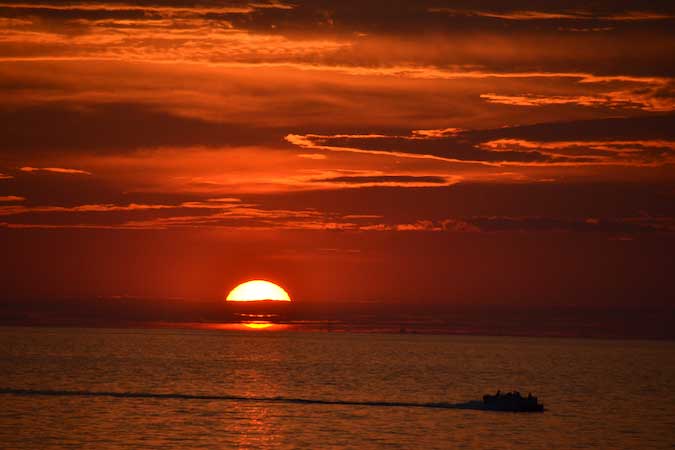
Photo by Tom Rivers: A boat heads east across Lake Ontario on Aug. 8, 2020 while the sun was setting off the shore of Barker.
Posted 10 March 2021 at 5:10 pm
Press Release, Assemblyman Steve Hawley
Assemblyman Steve Hawley (R,C,I-Batavia) is reminding constituents that due to a new boating law passed last year, all motorboat operators, regardless of age, must have a boating safety certificate by 2025 in order to operate motorized watercrafts, including personal watercraft such as jet-skis.
Under the new law, all motorboat operators:
Born on or after Jan. 1, 1993 needed a boating safety certificate beginning in 2020.
Born on or after Jan. 1, 1988 will need a boating safety certificate beginning in 2022.
Born on or after Jan. 1, 1983 will need a boating safety certificate beginning in 2023.
Born on or after Jan. 1, 1978 will need a boating safety certificate beginning in 2024.
All motorboat operators regardless of age will need a boating safety certificate beginning in 2025.
Information on taking the boating safety course in-person or online can be found by clicking here.
“I encourage anyone who has even a mild interest in boating to take the state boating safety course, because it’s never been easier to get your certificate,” said Hawley. “Whether taking the course in-person or online, it’s a great way to spend an afternoon and ensure everyone stays safe in New York waters.”
Press Release, NYS Department of Environmental Conservation
New York State Department of Environmental Conservation (DEC) Commissioner Basil Seggos announced today that DEC will resume holding in-person, instructor-led Hunter Education Program (HEP) courses starting April 1. DEC will continue to offer online hunter education courses, as well.
“To prevent the spread of Covid-19, last year DEC successfully transitioned all of our hunter education courses online,” Commissioner Seggos said. “I’m proud of the way our staff quickly pivoted, working with our contractor to offer online courses for new hunters and bowhunters, and I applaud their efforts to safely allow for resuming in-person instruction again in time for new hunters to pursue turkey this spring.”
Covid-19 safety protocols will be followed in every in-person course, including health screening upon arrival, mandatory mask wearing, social distancing, smaller class sizes, and sanitizing hands and equipment.
In-person courses are free and taught by volunteer HEP instructors. Courses are offered in hunter, bowhunter, trapper, and waterfowl hunter education. Registration is required and all in-person courses require mandatory homework that must be completed prior to participating in the class. For more information, or to register for a HEP course, visit the Hunter Education Program page on DEC’s website.
Although the number of courses offered may be limited this spring, interested participants are encouraged to check back often as new courses may be added. Online courses are also available. The cost of the online hunter education course is $19.95. The course can be found on DEC’s hunter-ed website. DEC also continues to offer an online bowhunter education course.
Since March 2020, DEC has seen more than a 12 percent increase in hunting and fishing license sales compared to sales from the previous 12-month period. During this time, which roughly coincides with New York State on PAUSE, resident turkey permits have increased more than 13 percent and junior hunting licenses increased by more than 25 percent.
Certain types of lifetime licenses also increased by as much as 50 percent. A combination of factors, including the availability of online hunter education for new hunters and more time available to participate in the hunting and other activities as New Yorkers looked for recreational options during the pandemic, likely contributed to the increase.
New record highs for Northern Saw-whet Owl, Common Raven, Brown Creeper, Carolina Wren, Winter Wren and European Starling
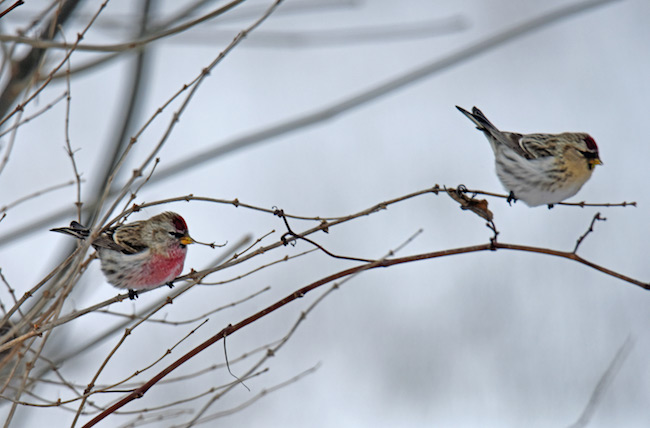
Photo by Celeste Morien: This photo of a Common Redpolls was not taken on count day of Dec. 28, which was very windy.
By Celeste Morien, Count Compiler for Oak Orchard Swamp Christmas Bird Count
SHELBY – The numbers are in and it was another successful Oak Orchard Swamp Christmas Bird Count.
On Dec. 28, 31 volunteers participated in the 53rd annual Oak Orchard Swamp Christmas Bird Count. The National Audubon Society, in collaboration with the U.S. Fish and Wildlife Service, sponsor Christmas Bird Counts annually throughout the country and beyond in the Americas. Each count consists of a tally of all birds seen within a 15-mile diameter circle on one day during a 15-day period at the end of December and the beginning of January. Audubon Christmas Counts provide valuable information on the range expansion or narrowing of wintering bird populations and have been taking place for 120 years.
The Oak Orchard Swamp Count Circle
The circle center for the Oak Orchard count is the point at which the Genesee-Orleans County line crosses Route 63. The 15-mile diameter circle includes the Iroquois National Wildlife Refuge, Oak Orchard and Tonawanda State Wildlife Management Areas, the Tonawanda/Seneca Native American Reservation, the Townships of Alabama and Shelby, the villages of Indian Falls, Medina and Wolcottsville and portions of Middleport and Oakfield.
Weather Factors
Weather can make or break the day for our observers, but we forge ahead! Count hours were cold and wet, with a low of 27F and high of 39F. The early morning began with rain and winds from the south at 11 MPH, which then began gusting throughout the afternoon from the WSW at 16 -21 MPH, making the temperatures essentially feel 10 degrees colder. By afternoon, birding was essentially precipitation free. Late morning and afternoon visibility was good.
Observers
Our 31 intrepid observers went afield in 23 parties from 6:15 a.m. until 6:45 p.m. These folks volunteer to attend from as far away as Rochester and Buffalo, and even with the Covid-19 restrictions in place, persevered in their determination to ensure that the 2020 count would become another accurate contribution in the collection of scientific information about wintering bird populations.
In 106.25 total hours, observers covered 25.75 miles on foot and 535.5 miles by car, which included 37 hours on foot and 69.25 hours by car! Two observers counted birds at home feeders. Participants also clocked 9 nocturnal hours and 39.25 miles searching for owls.
In total, these awesome observers tallied 73 species and 20,843 individual birds! As the compiler, I say thank you all and thank you again to Douglas Beattie, Elaine Dart, Don Bemont, Daniel Rosentreter, Thomas Morien, Garner Light, Judy Light, Rory Kuczek, Paul Hess, Kathryn Brenner, Janie Mellas, Robert Buckert, Jules Wagner, Greg Lawrence, William Wolanske, Denise Appleby, Pat Martin, Kim Hartquist, Bev Seyler, Bob DeLeon, Jennifer Caughel, Donna DeLeon, Emma DeLeon, Mike Vickner, Mike Galas, Gerry Rising, Chuck Mitchell, Heidi Kennedy, Tad Gerace, Christopher Hollister and Iroquois NWR and the NYS DEC.
Winter Diversity
Counters commented on good diversity overall with a few exceptions, such as the lack of waterfowl in the region because of the freeze in early December. Still, we had all three swan species and a smattering of waterfowl. Lack of snow cover on the ground and heavy winds made finding birds at roadside difficult, but there were birds to be found for those who had the opportunity and spent time walking. With a total lack of snow cover, participants reported that birds were difficult to see in fields and were not present at the roadsides. Wished-for irruptive species (those that visit in winter from the boreal forest when cone crops there are low) such as Evening and Pine Grosbeak were not found although they have been seen in other areas of the state, and even in our circle this fall. Irruptive species we did find: a few Pine Siskins, Common Redpolls, which have shown a recent uptick and Red-breasted Nuthatches.
Highs and Lows
Notable highest counts ever: Northern Saw-whet Owl, Common Raven, Brown Creeper, Carolina Wren, Winter Wren and European Starling.
Gerry Rising found the Saw-whet Owls and stated he’d never had an experience quite like this one in his many years of watching birds. Both owls flew out of conifers in response to a recording played in the early morning.
Common Ravens are increasing their presence in the Great Lake plains area, resulting in a total of five of these fascinating and intelligent corvids on count day. Fox Sparrow was the single “new to the count” species this year; Janie Mellas, one of our many sharp-eyed participants, found it lingering on the Iroquois Refuge. A single Red-winged Blackbird was recorded as a new low count. Count week birds seen in the three days before or after the count date, but not on the actual count date, were Sandhill Crane and Northern Pintail.
The Friends of Iroquois, Inc. usually sponsor our evening refreshments at the refuge, but because of the Covid-19 pandemic that was not possible. The INWR Staff was still able to contribute time and effort in covering the refuge areas. The NYS DEC staff also volunteered to report birds while on duty and conducted their winter raptor survey on count afternoon. Many thanks go out to everyone who participated! A list of species follows.
The 2021 Count
We rely on volunteer support every year to continue this important tradition. I might add that for next year, I welcome any homeowner in the circle who wants to count birds at their feeding station to contact me through the NYS Ornithological Association (NYSOA) or Buffalo Ornithological Society websites two weeks before the count. We also welcome permission for counters to access any private property trails or field edges within the circle for walking.
Look for the count date to be announced by mid-November and please put us on your calendar!
A list of species observed at the 2020 count includes (The asterisk represents an all-time high):
Governor Andrew M. Cuomo encouraged New Yorkers to take advantage of the upcoming first Free Fishing Weekend of 2021, on February 13 and 14, when anglers are permitted to fish for free without a license.
“New York is home to some of the best lakes, ponds, rivers and streams in the world, all offering exceptional fishing opportunities all year round,” Governor Cuomo said. “As the nation continues to grapple with the Covid-19 pandemic, families are seeking outdoor activities that don’t break the bank or require extensive travel, and this Free Fishing weekend is a perfect option for anglers of all experience levels to enjoy the very best that the Empire State has to offer.”
Those new to ice fishing are encouraged to download the Ice Fishing Chapter of DEC’s I FISH NY Beginners’ Guide to Freshwater Fishing for information on how to get started.
Additional information, including a list of waters where ice fishing is permitted, can found on the DEC ice fishing webpage. In Orleans County, Glenwood Lake in Ridgeway and Lake Alice in Carlton are listed as spots for ice fishing.
Recent cold weather has improved ice conditions across the state and DEC reminds those venturing onto the ice that four inches or more of solid ice is considered safe for accessing bodies of water on foot.
Ice anglers should note that ice thickness can vary on different bodies of water and even on the same body of water. Anglers should be particularly wary of areas of moving water and around boat docks and houses where bubblers may be installed to reduce ice buildup. The presence of snowmobile tracks or footprints on the ice should not be considered evidence of safe ice conditions. Individuals are strongly encouraged to check ice conditions and avoid situations that appear to present even a remote risk. It’s easy to test ice thickness with an auger or ice spud at various spots.
“Every year, more and more New Yorkers discover there are just as many fantastic fishing opportunities during the winter months as during the summer,” said NYS Department of Environmental Conservation Commissioner Basil Seggos. “Ice fishing is a great activity for families to do together, and the annual February Free Fishing weekend is the perfect time for first timers to give it a try on waters with ice thick enough to access safely.”
New York’s Free Fishing Days program began in 1991 to give people who might not fish a chance to try the rewarding sport at no cost, to introduce people to a new hobby, and to encourage people to support the management of the State’s freshwater fisheries by purchasing a New York State fishing license. February’s free fishing days are the first of several planned for 2021. Additional days include June 26 and 27, September 25 (National Hunting and Fishing Day) and November 11 (Veterans Day). During free fishing days, residents and visitors can fish for free on any of the state’s 7,500 lakes and ponds or 70,000 miles of rivers and streams.