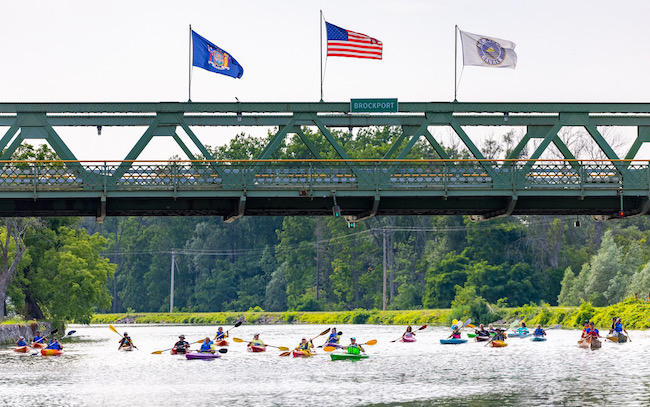
Photo courtesy of the Erie Canalway National Heritage Corridor: Kayakers enjoy the Erie Canal in Brockport.
Press Release, Village of Brockport Mayor Margay Blackman
BROCKPORT – The Village of Brockport is pleased to announce that it has joined the Erie Canal communities of Waterloo, Savannah, Amsterdam, Macedon and Medina to offer free kayak and bicycle excursions on the Erie Canal.
Brockport is offering 3 excursions each day on 4 Saturdays and 4 Sundays in September (18, 19, 25, 26) and October (2, 3, 9, 10). The excursion sites were selected and sponsored by the New York Power Authority and Canal Corporation.
Brockport’s Paddle/Pedal excursions begin at the Brockport Welcome Center (11 Water Street), and head west to Holley Canal Park in the Village of Holley. The 2 ½ hour tour comprises 3 miles of kayaking (between Brockport and Sans Souci Park in Clarkson) and 6.75 miles of cycling (Sans Souci Park to Holley Canal Park to Brockport).
Kayaks and bicycles are furnished for the tours. Refreshments courtesy of local farms are provided at Canal Park, and participants receive a coupon for a local Brockport restaurant at the conclusion of the tour.
For more details and to join a free tour visit Eventbrite by clicking here.
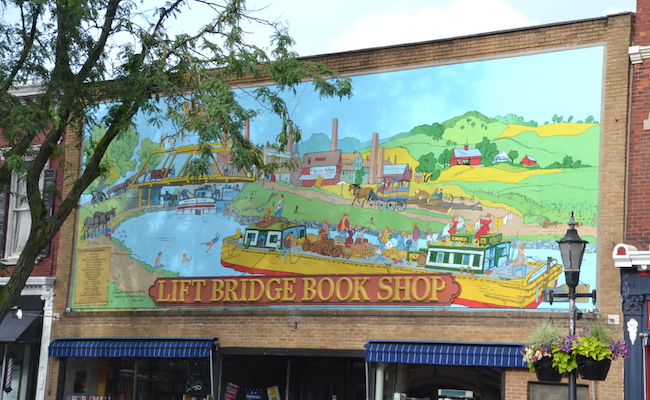
Photo by Tom Rivers: This mural on the Lift Bridge Book Shop in Brockport was completed this summer by Albion native Stacey Kirby Steward. It was partially funded with an IMPACT! grant from the Erie Canalway National Heritage Corridor. The mural is based on the illustration of a children’s book, The Erie Canal, by Peter Spier.
Posted 9 September 2021 at 3:16 pm
Press Release, Erie Canalway National Heritage Corridor
WATERFORD – The Erie Canalway National Heritage Corridor is now accepting applications for its IMPACT! grant program.
The grants range from $2,500 to $12,000 and will be awarded to municipalities, not-for-profits with a 501(c)(3) designation, and federally-recognized Native American tribes within the boundaries of the Erie Canalway National Heritage Corridor.
Applications are due by Friday, October 15, 2021.
“These grants provide critical funding for a host of projects that would not happen otherwise. We are eager to help communities and organizations across the state boost economic activity while safeguarding and celebrating our cherished canal heritage,” said Bob Radliff, Executive Director of the Erie Canalway National Heritage Corridor.
The grant program is competitive, and applications should focus on one or more of five key priorities: showcasing the canal corridor’s distinctive sense of place, protecting canal historic and natural resources, promoting recreational opportunities, creating “must-do” travel experiences, and spurring heritage-based economic growth.
A one-to-one match consisting of non-federal support is required and the awards are distributed on a reimbursement basis at project completion.
This grant program is made possible with support from the National Park Service and the New York State Canal Corporation.
“Grants like IMPACT! allow us to be good stewards of our State’s history and land by providing us with the vital opportunity to help preserve the Canal System by boosting heritage-based economic growth along the corridor,” said New York State Canal Corporation Director Brain U. Stratton. “We at the Canal Corporation are excited to see all of this year’s applicants and their commitment to honoring the Canal System and all it has to offer.”
Applicants are strongly advised to contact program staff to discuss proposed projects prior to submitting an application. Please contact: Andy Kitzmann, 518-237-7000 x201, andy_kitzmann@partner.nps.gov.
‘The Great Lakes are a massive economic engine, not only for the tourism and recreation industries, but also for the shipping, logistics, agriculture, mining, energy, and finance industries.’ – U.S. Sen. Charles Schumer
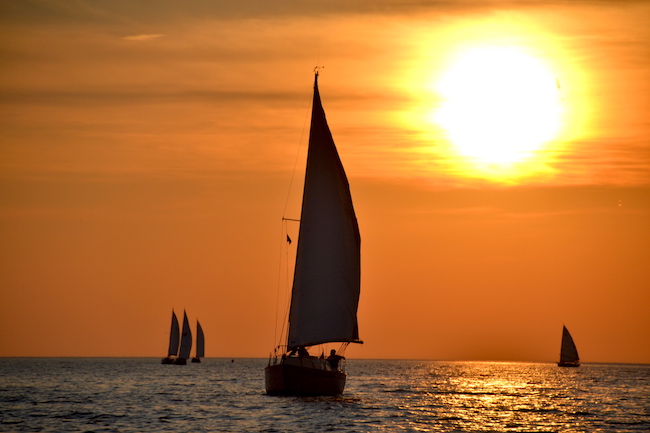
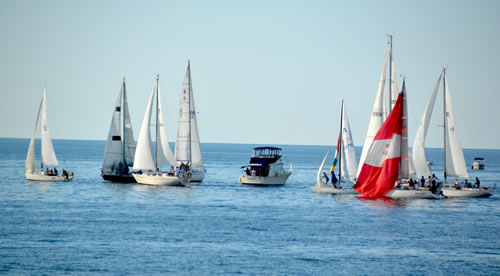
Photos by Tom Rivers: These sailboats race last Thursday in Lake Ontario near Point Breeze as part of the racing series organized by the Oak Orchard Yacht Club.
Press Release, U.S. Senate Majority Leader Charles Schumer
Standing on the banks of the Niagara River at Niawanda Park in Tonawanda on Monday, U.S. Senate Majority Leader Charles E. Schumer revealed an historic $1 billion federal investment – the largest ever single investment – in the Great Lakes Restoration Initiative (GLRI).
Specifically, this funding was secured to protect, improve, and preserve the Great Lakes and their related waterways, which Schumer was able to secure in the bipartisan federal infrastructure bill he just led to passage. Schumer detailed the unprecedented amount of funds, explained why he pushed to include them, and detailed how the Great Lakes Restoration Initiative (GLRI) has been helping Western New York since he first pushed for the funding in 2010. Schumer explained that these dollars will continue to improve water quality by reducing pollutants, restoring and protecting wildlife habitats, mitigating climate change impacts, and helping preserve waterways critical to New York State’s environment and economy.
“Today, I am unveiling the ‘catch of the day’ – $1 billion in funds we included in the bipartisan infrastructure package that will do a lot of good for Western and Central New York, and some critical things to protect one of the true gems of New York State – the Great Lakes,” said Senator Schumer. “This funding guarantees a ramp-up in our conservation efforts for the Great Lakes and their waterways, while allowing us to continue to fight for more as part of regular appropriations – so this is really unprecedented support for one of our most critical resources, both natural and economic. The Great Lakes are a massive economic engine, not only for the tourism and recreation industries, but also for the shipping, logistics, agriculture, mining, energy, and finance industries. Because of their huge impact on so many facets of life, investing in the Great Lakes means investing in the future economic health of Western New York.”
In total, the Great Lakes account for 84% of North America’s surface fresh water and contain about 21% of the world’s supply. More than 30 million people in the U.S. and Canada live in the Great Lakes Basin – roughly 10% of the U.S. population and more than 30% of the Canadian population. The Great Lakes themselves span more than 750 miles from west to east. Millions of people flock yearly to the Great Lakes for recreation, and the Lakes provide critical fresh water access. Additionally, the Lakes play host to diverse animal and plant life. The ability of the Great Lakes to support these uses is dependent on the quality of its waters, habitats, and living resources.
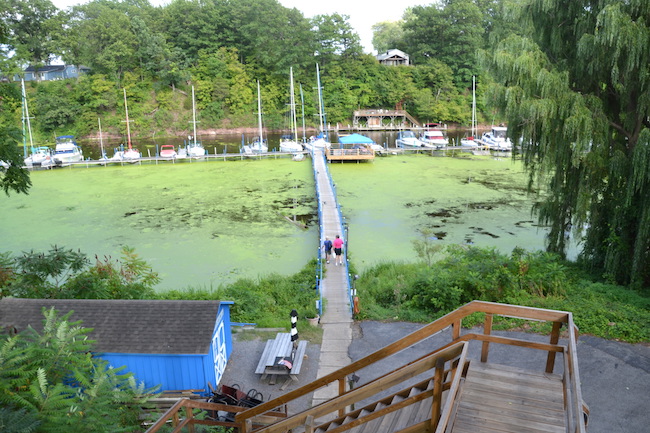
This photo shows the walkway leading to the docks and sailboats at the Oak Orchard Yacht Club along the Oak Orchard River, which is a Lake Ontario tributary.
Schumer also pointed out the massive economic impact of the Great Lakes region and its importance to Western New York. The Great Lakes region includes eight states – Minnesota, Wisconsin, Illinois, Indiana, Michigan, New York, Ohio, and Pennsylvania – and two Canadian provinces.
The Lakes are home to more than 175 species of fish, which contribute to our state’s vibrant commercial and recreational fishing industries. According to the Office of Coastal Management at the National Oceanic and Atmospheric Administration (NOAA), for every dollar invested in Great Lakes protection, the return on investment is $3.35, or 335%. Furthermore, for every $1 million invested in Great Lakes restoration and protection, 16 jobs are created. The Great Lakes Region is directly responsible for $3.1 trillion in Gross Domestic Product (GDP) for the United States and more than $6 trillion overall. It is estimated that 25.8 million jobs worth more than $1.3 trillion in wages spanning countless industries, including 7% of all American farm production, are directly supported by the region.
“We all know that our changing climate poses a threat to our Great Lakes and all the livelihoods that depend on it, so this $1 billion surge will help to accelerate efforts to protect and preserve one of our greatest natural resources,” Schumer added. “Even more, the economic impact of these Lakes is into the trillions. We cannot lose it. We must invest in sustainment, and we have to keep doing it to protect the economic future of Upstate New York and the environment.”
Schumer fought off budget cuts to the GLRI in 2019 and worked to secure a multimillion dollar increase in authorization levels for the program in 2018. Initiated in 2010, the GLRI has received roughly $3.48 billion since its inception, with the funds distributed across 16 different federal agencies including the Environmental Protection Agency (EPA) and the United States Army Corps of Engineers (USACE).
Over the last decade, the GLRI has controlled invasive species on at least 115,000 acres and kept more than 402,000 pounds of phosphorus out of the lakes, a $300,000 investment from GLRI which ended in 2020. GLRI has also played a critical role in fish and wildlife protection, specifically in Western New York. Efforts to improve the population of Lake Sturgeon are currently underway after a $90,000 investment to study their travel patterns, and the trout population is climbing once again thanks to the investment in bloater chub revival, a critical food source for the popular sport fish. Schumer noted that the $1 billion in funding, the largest the program has ever received in a single authorization, will help the agencies and their auxiliary partners prepare for the future.
Schumer was joined in Tonawanda by Erie County Executive Mark Poloncarz, Executive Director of Buffalo Niagara Riverkeeper Jill Jedlicka, Associate Director of the Citizen’s Campaign for the Environment Brian Smith, and other local stakeholders.
“New York is a Great Lakes state, and this $1 billion appropriation reinforces what we have known for a long time- that these freshwater lakes are the nation’s most important living infrastructure system,” said Jill Jedlicka, Executive Director of Buffalo Niagara Riverkeeper. “The health and restoration of the drinking water for 40 million people also supports tens of billions of dollars in economic activity and recreational resources. The Great Lakes Restoration Initiative has been one of the most impactful programs in our nation’s history by helping communities like Buffalo reclaim and restore their waterfronts, protect critical ecosystems, and put us back on a path to a clean water future. We applaud Senate Majority Leader Schumer for guiding this bipartisan infrastructure bill that will ultimately benefit all Americans and our Great Lakes.
The GLRI has also benefited additional sites in New York State. In September 2017, $900,000 worth of GLRI funds were awarded to the Great Lakes Institute at Hobart and William Smith College to fight invasive threats, including an infestation of hydrilla in Cayuga Lake. In 2015, Schumer helped secure $9.5 million in GLRI funding to restore Braddock Bay in the Town of Greece after decades of decline to ecological and recreational activities on the bay. The U.S. Army Corps of Engineers (USACE) used the funding to restore wetlands, habitat and to reconstruct a barrier beach that has been washed away, leaving the bay exposed to Lake Ontario’s damaging waters that destroyed habitat and the bay’s navigation channel needed for boating.
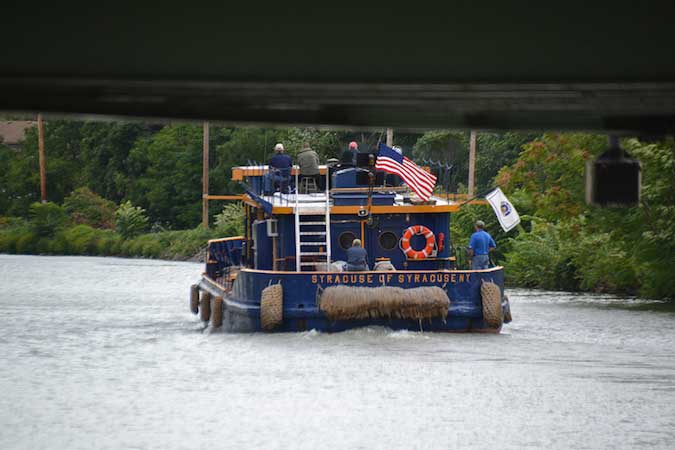
Photo by Tom Rivers: The tugboat Syracuse carries inspectors and officials from the State Canal Corp. on the Erie Canal in Albion on Sept. 14, 2016.
Press Release, Congressman Chris Jacobs
WASHINGTON, DC – Congressman Chris Jacobs (NY-27) cosponsored the Erie Canalway National Heritage Corridor Commission Reauthorization Act to provide federal funding and support to the Erie Canalway National Heritage Corridor.
“The Erie Canal is part of our heritage in Western New York, it supported our economic and industrial boom in the 19th century and continues to drive our economy and attract tourism today,” Jacobs said. “I am proud to support this legislation to provide additional federal support to the National Heritage Corridor. From Lockport to Medina, it is my hope that the Canal in NY-27 will be visited for generations to come.”
The Erie Canalway National Heritage Corridor Commission Reauthorization Act (H.R. 4192) would reauthorize the National Heritage Corridor through 2037 and authorize an additional $16 million in federal funding. National Heritage Areas are maintained by a mix of public and private sector investments.
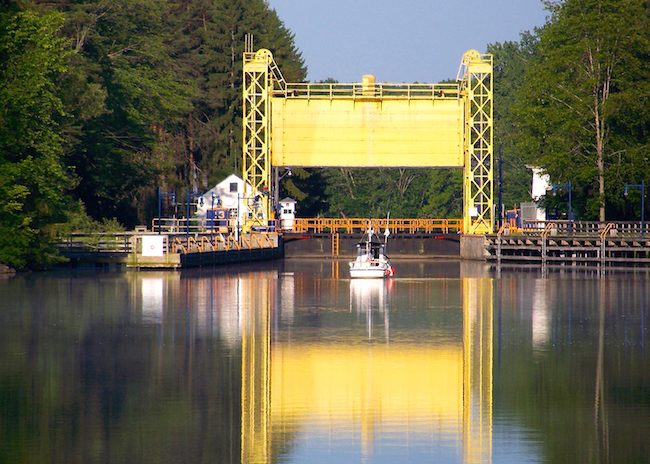
Provided photo: This photo by Suzanne Grosz shows a boat and guard gate on Erie Canal near Clay.
Posted 30 July 2021 at 10:14 am
Press Release, Erie Canalway National Heritage Corridor
WATERFORD – Erie Canalway National Heritage Corridor is calling for entries for its 15th annual Erie Canalway Photo Contest.
Images should convey the unique character of New York’s canals and canal communities. Entries must be postmarked by August 27, 2021. Winning photos will be featured in the 2022 Erie Canalway calendar.
Images will be judged in four contest categories: On the Water, Along the Trail, Canal Communities, and Classic Canal. Judges will select first, second, and third place winning images in each category, as well as 12 honorable mentions. Images must be landscape (horizontal) format.
Submitted images must be taken within the Erie Canalway National Heritage Corridor, which spans 524 miles across the full expanse of upstate New York. It encompasses the Erie, Cayuga-Seneca, Oswego, and Champlain canals and their historic alignments, as well as more than 230 canal communities.
Download official contest rules and an entry form by clicking here.
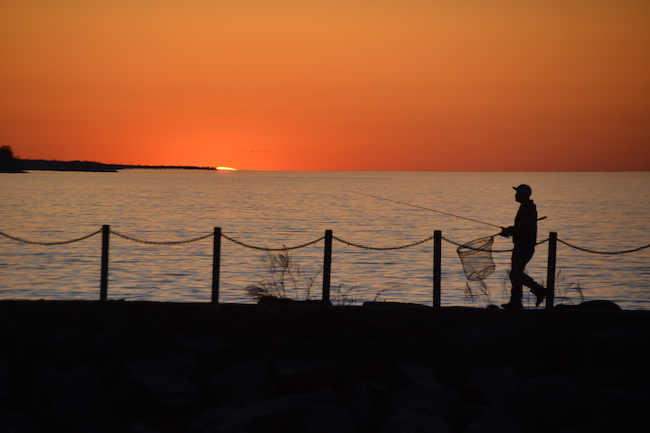
Photo by Tom Rivers: A fisherman walks along the western pier at the Oak Orchard Harbor at Point Breeze in this photo taken on March 20, 2021.
Press Release, Gov. Andrew Cuomo’s Office
Governor Andrew M. Cuomo announced that Saturday, June 26 and Sunday, June 27, is a Free Fishing Weekend in New York State, the second of six Free Fishing Days recognized across the state each year.
“As the school year closes out and the summer officially begins, the timing of New York’s upcoming Free Fishing Weekend couldn’t be better,” Governor Cuomo said. “Whether you’re returning to the angling as an expert, introducing a friend or family member, or casting a line for the very first time, Free Fishing Weekend is the perfect opportunity to experience firsthand all the benefits of fishing.”
During designated free fishing days, New York residents and non-residents are permitted to fish for free without a fishing license. Participating anglers are reminded that although the requirement for a fishing license is waived during free fishing days, all other fishing regulations remain in effect. Remaining 2021 Free Fishing Days include National Hunting and Fishing Day (Sept. 25) and Veterans Day (Nov. 11).
“New York is home to some of the most exceptional fishing opportunities in the nation and anglers from around the world visit our state’s waters every year in search of their next big catch,” said Department of Environmental Conservation Commissioner Basil Seggos. “I encourage all anglers, from first timers to experts, to take advantage of the upcoming free fishing weekend by casting a line in New York’s waters and experiencing the joy that comes with fishing.”
For beginning anglers interested in getting started, the I FISH NY Beginners’ Guide to Freshwater Fishing provides information on everything from rigging up a fishing rod to identifying catch and understanding fishing regulations.
DEC’s Places to Fish webpages are a reliable source of information for those ready to plan their next fishing trip. In addition, DEC recently launched an interactive Trout Stream Fishing Map on the DECinfo Locator to provide a one-stop shop for information on stocking, fishing access, season dates, and regulations.
Soil & Water Conservation District cites Elam’s lifetime commitment to the environment
Press Release, Orleans County Soil & Water Conservation District
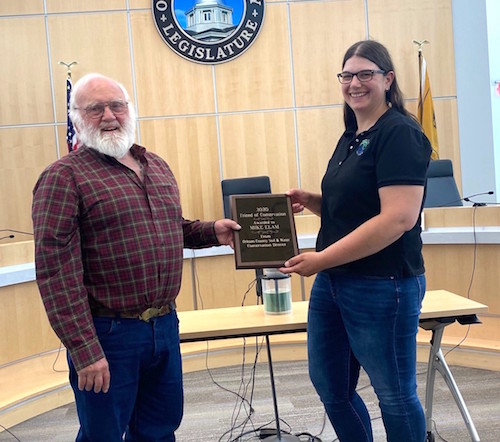
Provided photo: Mike Elam on Thursday received a Friend of Conservation Award, which was presented by Katie Sommerfeldt, manager of the Orleans County Soil & Water Conservation District.
ALBION – The Orleans County Soil & Water Conservation District is proud to award Mike Elam with the Friend of Conservation Award.
Mike has a long history of environmental conservation in Orleans County. In 1949 his father and grandfather bought what is now “Captain’s Cove,” though at the time it was called “Hatch and Elam Boat Livery.”
Both his father, Jack Elam, and his grandfather, Butch Hatch, were very influential in regards to conservation and nurtured respect for the environment. Growing up in that environment, and having Oak Orchard Creek as his playground, it’s no surprise that Mike grew up to follow in their footsteps.
“I was lucky to be raised in Orleans County and especially to live on Oak Orchard Creek,” Mike said. “Protecting Orleans County’s waterways was and still is important to me.”
He strives to not only educate himself, but to also pass along his knowledge and respect for the environment to future generations. His grandkids have already started following the same path. They enjoy going fishing, catching frogs, and picking up litter when out by the water. Mike knows that the best way to garner a love for the outdoors is to build that relationship early.
In 1976 Mike became a member of the Orleans County Federation of Sportsmen’s Clubs, and in the same year he helped found a B.A.S.S. chapter called Oak Orchard Bassmasters. He spent the mid-’70s on a committee to revise fish seasons, length, and bag limits, as well as lift the ban on salmon stocking. Mike was very outspoken on banning the practice of snagging salmon in the early 1980s, and also spent 5 years running water sample tests on Lake Alice through the Citizen’s Statewide Lake Assessment Program.
Mike started coming to Orleans County Water Quality meetings about 20 years ago to represent sportsmen’s interests, as well as his own interest in water protection and conservation. A few years ago, Mike was appointed to the chairman position and has been instrumental in keeping the committee alive and informed on all things water quality. During the same time, he would help the DEC as needed with banding ducks, geese and screech owls.
2007 was a busy year for Mike. All within that year he became the sportsman’s rep to the Region 8 Fish & Wildlife Management Board, a councilman to the New York State Conservation Council, and joined the Finger Lakes Conservation Council (which he currently leads as president).
All of this barely even scratches the surface of Mike’s devotion to environmental conservation. During his years he would volunteer with the DEC, the Fish & Wildlife Service, and the Iroquois Wildlife Refuge. It should come as no surprise that someone with such a lifelong dedication to our county and our planet will be receiving the Friend of Conservation Award.
“Conservation in the future will be an important issue as the public becomes aware of the value of clean water and clean air, and the importance of fish stocks and protecting wildlife,” Mike said. “If the pandemic did anything positive, it made people more aware of the environment and the need to protect it.”
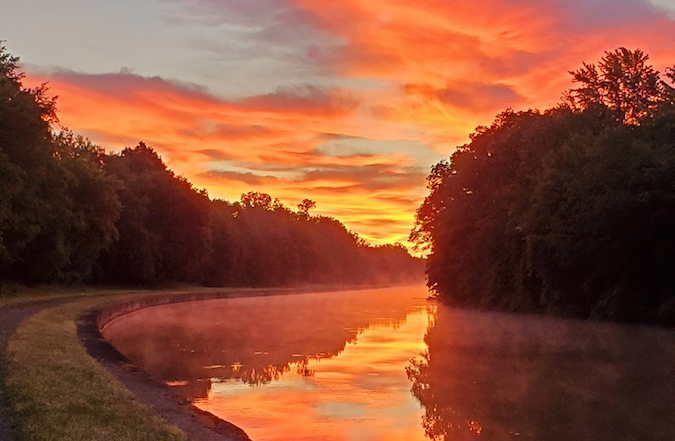
Cory Pawlaczyk took this photo of a sunrise along the Erie Canal in Medina. It won second place in the “Along the Trail” category in an annual Erie Canal photo contest in 2020.
Press Release, Erie Canalway National Heritage Corridor
WATERFORD – Erie Canalway National Heritage Corridor is calling for entries for its 16th annual Erie Canalway Photo Contest.
Images should convey the unique character of New York’s canals and canal communities. Entries must be postmarked by August 27. Winning photos will be featured in the 2022 Erie Canalway calendar.
Images will be judged in four contest categories: On the Water, Along the Trail, Canal Communities, and Classic Canal. Judges will select first, second, and third place winning images in each category, as well as 12 honorable mentions.
Submitted images should be horizontal format and must be taken within the Erie Canalway National Heritage Corridor, which spans 524 miles across the full expanse of upstate New York. It encompasses the Erie, Cayuga-Seneca, Oswego, and Champlain canals and their historic alignments, as well as more than 230 canal communities.
Download official contest rules and an entry form by clicking here.
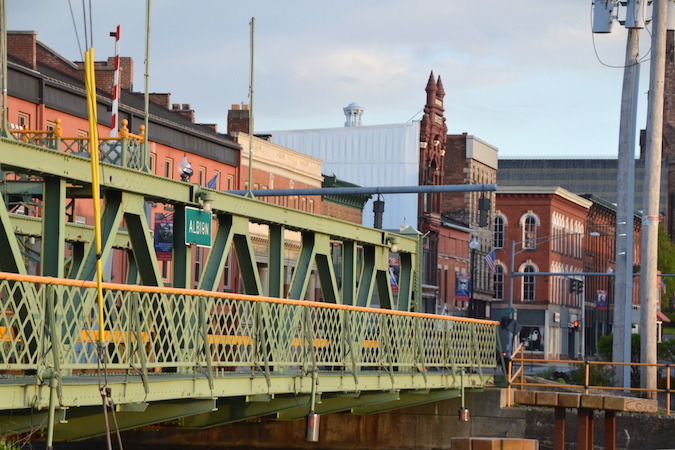
Photos by Tom Rivers: The Main Street lift bridge in Albion is shown in on May 10. Orleans County has seven of the 16 lift bridges on the canal, the most of any county. Albion has two of the bridges and the others in Orleans County are located in Medina, Knowlesville, Eagle Harbor, Hulberton and Holley.
By Tom Rivers, Editor Posted 21 May 2021 at 9:47 am
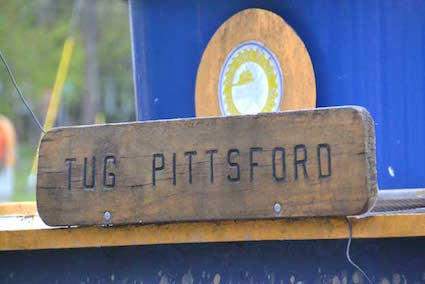
The sign on the tugboat, Pittsford, is shown in May 2020 in Albion, where the vessel is stationed.
A new navigation season started at 7 a.m. today on the Erie Canal for the historic waterway’s 197th season.
The canal is currently closed between Holley and Spencerport with the Holley, Brockport and Spencerport guard gates in the lowered position. That has allowed the Canal Corporation to lower the Erie Canal’s water level as engineers and contractors work to mitigate localized seepage occurring west of the Smith Street Bridge in the Village of Brockport, the Canal Corp. said in a notice to mariners.
The canal system is scheduled to close to navigation on October 13. That puts the canal on a schedule that is close to normal after last year’s start was pushed back until June 26. The start in 2020 was supposed to be May 15 but was delayed because canal staff and construction crews were sidelined early in the pandemic. That prevented the State Canal Corp. from doing some of the work needed before the canals could be opened.
The Canal Corp. also again won’t be charging any tolls or fees for recreational use of the canal system. This is the fifth straight year the tolls have been waived. Those tolls were normally $25 to $100 for a season pass, depending on the size of the vessel.
Standard hours of operation will be from 7 a.m. to 5 p.m. The following lift bridges in Orleans County will operate on demand from 7 a.m. to 10 p.m. until September 15: Holley, Hulberton, Ingersoll Street in Albion, Main Street in Albion, Eagle Harbor, Knowlesville and Medina.
Photo by Tom Rivers: This group of boaters, including many with sailboats, were out June 30, 2016 in Lake Ontario near the Oak Orchard Harbor.
May 22-27, 2021 has been named National Safe Boating Week by the National Safe Boating Council in partnership with the National Oceanic and Atmospheric Administration.
This is a good time to spend a few minutes considering what it takes to have a safe, fun boating season.
Are there any areas in our boat handling skills or our understanding of navigation rules that could use a refresher or more information about? Is all safety equipment on board and in working order?
During complimentary vessel safety checks provided by the U.S. Coast Guard Auxiliary or U.S. Power Squadron it is not uncommon to find a variety of both mandatory and recommended safety items inadvertently overlooked by even experienced boat owners.
The United States Coast Guard annual report “2019 Recreational Boating Statistics” prepared June 4, 2020 listed numerous statistics from their accident reports. Here are just a few:
79% fatalities were from drowning
86% of drowned victims were not wearing a life jacket
Alcohol was a leading factor in accidents with 23% of deaths involving alcohol
70% of accidents involved an operator with no formal boater training
Top five factors contributing to accidents were alcohol, inattention, inexperience, improper lookout and speed
For an in-depth look the full 83-page report can be found by clicking here.
New York State now requires a Boater’s Safety Certificate for powerboat operators, depending on their age and by January 2025 all power boaters, regardless of age, will need a boating safety certificate. Find information about a free boating safety course by clicking here.
Take advantage of a complimentary Vessel Safety Check (VSC) offered by local U.S. Coast Guard Auxiliary or United States Power Squadrons to make sure all essential equipment is present, working and in good condition. Information about Vessel Safety Checks and a VSC pre-check list can be found on the United States Power Squadron, America’s Boating Club website.
An engine cut-off switch is a proven safety device to stop the boat’s engine should the operator unexpectedly fall overboard or move away from the helm. Effective April 1, 2021 federal law began requiring certain currently manufactured power boats to be equipped with an the cut-off switch.
Most power boats have been manufactured with an engine cut-off switch for many years but up until recent legislation their use has not been mandated. Using an ECOS is now required while operating power boats less than 26 feet in length that are equipped with an engine cut-off switch with an engine over 2-3 horsepower, an unenclosed helm and operating on plane or above displacement speed. More information can be found by clicking here.
Submitted by John Zimmerman, director Youth Sailing and Education for the Oak Orchard Yacht Club in Waterport – www.oakorchardyachtclub.org.