









By Tom Rivers, Editor Posted 13 October 2015 at 12:00 am
Photos by Tom Rivers
Here is how the sign looked about two years ago.
GAINES – A historical marker on Ridge Road, next to the Gaines Carlton Community Church, honors pioneer settler Elizabeth Gilbert.
The marker had flaked off paint and was getting hard to read to motorists on Route 104.
Late last month the sign, with a fresh coat of paint, was reinstalled. Melissa Ierlan, president of the Clarendon Historical Society, has been repainting many historical markers in the county. She had help from Matt Ballard, the county historian, with the Gilbert marker.
There is a creek near this sign that last year was officially named “Gilbert Creek” in honor of Gilbert.
Early settlers liked to build log cabins close to a source of water. Mrs. Elizabeth Gilbert and her family chose the north side of Ridge Road, building their home where there was a rise in the land.
The cabin is long gone, but a historical marker notes the pioneering efforts from Mrs. Gilbert, one of the first settlers on the Ridge between Monroe and Niagara counties. Her husband died in 1808, leaving her to raise the children, and tame the nearby wilderness.
Local resident Al Capurso worked on the effort to name “Gilbert Creek” for more than a year, researching the issue and lining up the needed government support.
The creek begins from feeder sources south of Route 104 near Brown Road. It then marries Proctor Brook in Carlton, and then flows into the Oak Orchard River.
By Tom Rivers, Editor Posted 11 October 2015 at 12:00 am
Photos by Tom Rivers
ALBION – This gravesite marker for a Civil War veteran at Mount Albion recently had the rust scraped off and was given a fresh protective coat of black paint as part of a service-learning project by Albion seventh-graders.
Here is how the same marker looked late last month, before the restoration efforts. Students are also cataloging locations for the markers from the Grand Army of the Republic.
Students have other Civil War initiatives planned for the school year. They are going to research the names of every Orleans County resident who died in the Civil War and compare that with the 463 names carved in marble slabs inside the tower at Mount Albion Cemetery.
Provided photos
Albion Middle School seventh-grade service learning student Bailey Blanchard points to another “Blanchard” inside the tower at Mt. Albion Cemetery. The students are cataloging the names of soldiers who died during the war. To date there is no master list.
The tower includes marble slabs with the names of 463 residents who were killed during the Civil War. However, the memorial may not have included every local resident who perished in the war, said Tim Archer, teacher of the service learning class.
Bryne Dysard, an Albion seventh-grader, kneels next to the Herbert Charles Taylor grave at Hillside Cemetery in Clarendon. Taylor is the only known Orleans County soldier to fight and die at the battle of Gettysburg during the Civil War. Dysard and her service learning classmates have been studying Orleans County Civil War soldiers and are trying to secure a historical marker for him.
SUNY Brockport archivist Charles Cowling spent a morning at Drake Library at the college teaching Albion Middle School service-learning students about the importance of primary source documentation.
The students are in the middle of a large project researching Orleans County Civil War veterans. Their research has already uncovered many interesting facts about our local heroes and includes work at several area cemeteries. The documentation is important as the students write applications for a historical marker grant and a headstone for an unmarked grave from the Veterans Administration.
By Matthew Ballard, Orleans County Historian Posted 10 October 2015 at 12:00 am
Dr. Henry Dwight Bliss was later stricken by tuberculosis
HOLLEY – Born June 27, 1854 and a Kendall native, Henry Dwight Bliss was the son of Edwin and Mary Seymour Bliss. Receiving his earliest education from the one-room schoolhouses of Kendall, Henry moved to Holley as a young man where his father was to take over as manager of Luther Gordon’s newly constructed lumber and coal yard.
Bliss grew up around the construction and lumber business so it was only natural that he would attend the Rochester Business School after assisting his father with accounting and bookkeeping duties at the yard. Henry decided quickly that the merchant business wasn’t for him and he left the business school in Rochester after one year.
Bliss redirected his focus towards bigger and better things, starting in 1876 when he enrolled at Cornell University. Three years later, he transferred to the University of Rochester where he graduated in 1880.
Shortly after, Bliss enrolled in the University of Pennsylvania’s Medical Department earning his M.D. in 1883. Immediately after his graduation from Pennsylvania, he removed to Brooklyn where he served as resident physician at St. John’s Hospital in that vicinity. After a year of service at that institution, Dr. Bliss opened his own private practice at 1568 Fulton Street, Brooklyn.
From the eulogies delivered by fellow physicians following his death, they all spoke of Dr. Bliss’s dedication to research as an informed physician, his gentlemanly character, and the lucrative practice he built up while living in Brooklyn.
The life of Dr. Bliss was plagued by ill health for a large portion of his time spent outside of Orleans County. In 1891 he was forced to take a leave of absence from his practice in the hopes of restoring his failing health. Attempting to travel to Europe aboard the S.S. Dubbeldam, stormy seas wrecked the ship, requiring the crew to dock at Plymouth. Severe seasickness landed Dr. Bliss in the hospital, forcing him to recuperate in the U.S.
As the story was told, he had contracted tuberculosis from a patient and was never able to fully regain his health. After attempting numerous times to regain his strength and physical wellbeing, he was forced to sell his practice in 1898 and returned to the home of his parents in Holley.
After a short stay in an area sanitarium with little to show for his efforts, Dr. Bliss returned to Holley to live out the last days of his life surrounded by family. He died on April 12, 1900 at the age of 46, leaving a widow and three young children.
By Tom Rivers, Editor Posted 7 October 2015 at 12:00 am
Urger proves popular with fourth-graders
Photos by Tom Rivers
HOLLEY – The historic Urger, a tugboat from 1901, was in Holley on Tuesday as part of its state-wide educational mission. The tugboat was a working vessel on the canal, hauling machinery, dredges and scows on the canal system for 60 years until the boat was retired from services in the 1980s.
The boat was built in 1901 in Ferrysburg, Michigan, and was a commercial shipping vessel in Michigan before joining the canal fleet in the 1920s.
In 1991, the Urger got new life as a “Teaching Tug.” It visits canal communities from early May until late October, educating children and adults about the canal system, which opened in 1825.
Fourth-graders from School No. 2 in Rochester visit the boat on Tuesday morning. Holley students stopped by in the afternoon before Urger headed to Brockport.
The Rochester students used to tour the Mary Jemison boat until it retired two years ago.
When the lift bridge went up in Holley, the cameras and Smart Phones came out to capture the sights and sounds of the century-old bridge.
A modern boat passes by Urger and the lift bridge, heading east towards Brockport on Tuesday.
Students were welcome to tour the boat and see a small kitchen, a bathroom and the sleeping quarters for the crew.
A crew of four lives on the boat from early May until late October, sharing New York State history with a focus on the how the canal, completed in 1825, turned NY into an economic powerhouse for business, and breathing life into many small towns along the canal.
“They learn how important the canal was to New York State, and how important it could be,” said Mike Byrnes, a deckhand on the Urger.
He lives in Waterford near Albany and has spent 13 seasons on Urger.
“The fourth-graders are a lot of fun,” he said.
The Urger captain sounded the horn on top of the boat. It has a light sound, like a whistle, and a deeper signal. The fourth-graders enjoyed the loud, low noise the most.
There isn’t much in the way of fancy technology at the helm of the boat. The captain uses a wheel and bell that rings in the engine room.
The Urger is 75 feet long and weighs 83.7 tons. The engine weighs 19.5 tons. It is a 1944 Atlas Imperial engine that was surplus from World War II. It replaced a steam engine.
The Urger is shown in this photo looking under the lift bridge in Holley.
Mike Pelletier, the engineer on the boat, is in his second season with Urger. The Newark resident said it has been eye-opening serving on the vessel and seeing the canal communities.
He gave Holley high marks for developing a nice park with amenities by the canal for boaters, and also for lots of signage pointing them to businesses and other services nearby.
“This has been a very educational adventure,” Pelletier said. “There is so much to the canal and not just for boaters. It’s beautiful now for walkers, runners and cyclists (who use the towpath).”
Pelletier said more canal towns should work on signage for boaters, directing them to restaurants, local businesses, libraries and other services. He’d also like to see more displays by the canal about local communities’ histories, giving visitors a historical snapshot about the town or village.
“The towns and villages need to incorporate it more,” he said. “Before I had this job I was as guilty as anyone of taking the canal for granted.
The Urger will be in Brockport the next few days before heading to Spencerport on Oct. 13. Click here to see the schedule and a contact number for local schools to get on the Urger agenda for 2016. The Urger crew urged local schools to arrange tours for next year.
By Tom Rivers, Editor Posted 5 October 2015 at 12:00 am
Photos by Tom Rivers
HOLLEY – There was suffering and grief, lots of it in the 1800s and early 1900s. During a Ghost Walk on Saturday, when eight people at the cemetery were portrayed, many of the stories were heart-breaking, such as the life of Mary Youngs Buddery.
The Hulberton woman lost her husband John W. Buddery and four of their children to diphtheria in early 1888. Abby Blendowski, pictured in top photo, shared Buddery’s story.
Gina Buda, a GCC student from Bergen, portrayed Lillian Bentham, who survived the sinking of The Titanic in April 1912. Bentham was one of 710 to survive, while 1,514 died, including her godfather William Douton and another companion from Holley.
Orleans Hub editor Tom Rivers portrayed William Douton, one of two Holley men who perished on The Titanic. Douton and Peter MacKain were both British quarrymen who returned to the Isle of Guernsey for the winter of 1911-1912.
They were coming back to the Holley area in April 1912. A marker in the cemetery notes their deaths. It is a memorial for the two men, paid for by the Order of the Oddfellows.
Dan Hamner, a GCC history professor, portrays Joseph Hess, who was a boxer and bar owner before turning temperance evangelist.
He would write an autobiography called “Out of Darkness, Into Light” in 1890, detailing his early life, his subsequent religious conversion and the importance of a life dedicated to temperance. He died at his home in Clarendon in 1893.
Hamner passed out temperance challenge cards with Joseph Hess’s picture. The cards sought people’s pledge and signature to abstain “from the use of all intoxicating liquors.”
Hamner handed out nearly 100 cards on Saturday night, but no one was willing to take the temperance oath.
Alex Farley, a GCC student from Corfu, portrays John Berry, who helped establish Hillside Cemetery in 1866 and served as its long-time president until his death in 1892. The cemetery’s older section has a park-like setting and is included on the National Register of Historic Places.
Berry was also a politician who represented Orleans County in the State Legislature.
Another ghost included Lydia Wright Butterfield, who spoke about her husband Orson, who developed “Gold Fever” and headed to California, leaving his family for 16 years. Mr. Butterfield had a cobblestone house built in Clarendon in 1849. (The house was recently restored.)
Butterfield’s wife listed him as a widow in one census. He would come home and lived another 20 years with his wife. The family endured the loss of three young children.
The Ghost Walk tour included a visit with the “ghost” portraying Herbert Charles Taylor, who is believed to be the only Orleans County resident to die during the battle at Gettysburg.
Phoebe Sprague also was featured. She worked as a doctor in Holley, one of the first women in that role locally. A historic marker notes her distinction on Geddes Street.
By Tom Rivers, Editor Posted 5 October 2015 at 12:00 am
Photos by Tom Rivers
ALBION – Tugboat Urger, built in 1901, has spent the past week in Orleans County, first docking in Medina on Sept. 30 before coming to Albion on Friday. The vessel is heading to Holley today and will welcome Holley fourth-graders for a tour and educational program on Tuesday morning before departing for Brockport.
The tugboat was originally used as a fishing boat and commercial shipping vessel for its first two decades. In the early 1920s, the Urger was sold to New York and was used to haul machinery, dredges and scows on the canal system for 60 years until the boat was retired from services in the 1980s.
The tugboat, one of the oldest working vessels in the country, is pictured in Albion this morning with the Ingersoll Street lift bridge in back.
In 1991, the Urger got new life as a “Teaching Tug.” It visits canal communities from early May until late October, educating children and adults about the canal system, which opened in 1825.
Photos by Kim Pritt – Kyle Thaine portrays his great-uncle, Eugene Barnum, who was killed during World War II after shooting down two German planes.
Alyce Miller served as one of the speaking tour guides who lead each group through the walk offering historic references.
Zach Shaffer portrays John G. Rice, the Orleans County sheriff in 1894 who organized a posse to find murderer William Lake.
Riley Seielstad portrays Emma Ingersoll, who upon her death bequeathed the monument pictured here, as well as the beautiful Ingersoll Fountain and bench located near the entrance of Mount Albion Cemetery.
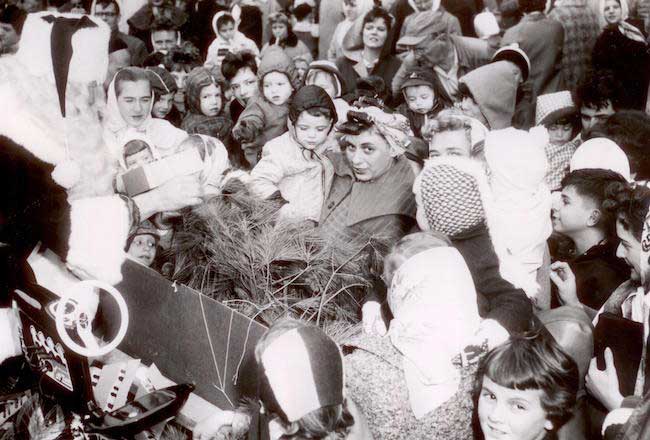
Nate Trembley portrays Charles Howard as Santa with Valerie Rush as Mrs. Claus.
By Kim Pritt, Contributor
ALBION – Gray skies and a strong wind in the trees helped set the ghostly atmosphere for the seventh annual Mount Albion Ghost Walk on Saturday night. Rain threatened earlier in the day, but moved on just in time for approximately 425 people to enjoy the popular annual event.
The Ghost Walk is a Service Learning project of the Albion High School Drama and Music Departments. A total of 55 students work to put the program together by researching a variety of residents of Mt. Albion Cemetery, writing their own scripts, and performing roles as ghosts, tour guides, singers, and tech crew. This year, 13 ghosts were featured, including war heroes, prominent citizens, two nationally publicized murders, and even Santa Claus.
“I am very interested in all the people and what they’ve done for the community – all the great inventions, suggestions, and impact they have made,” said Miller during rehearsal earlier in the day.
Several war heroes were highlighted along the tour, including Eugene Barnum, 1917-1944. Barnum was killed in action during World War II after shooting down two German planes. He died just months after his brother, William, was also killed in action.
Kyle Thaine proudly portrayed Barnum and was understandably knowledgeable about his subject – Barnum is Kyle’s great uncle.
“It was an honor playing my Great Uncle Gene,” Thaine said. “I didn’t know him, but I’ve heard many stories about him from the time I was a little kid from my grandmother. I love history and I love my family and it was so cool to put them both together in one place.”
Other notable ghosts were James Sheret, war hero that Albion’s American Legion Sheret Post is named for; Orleans County District Attorney and County Judge, Isaac S. Signor; and Emma Ingersoll, daughter-in-law of Nehemiah Ingersoll, one of Albion’s founding fathers, among others.
The tour ended at the grave site of Charles W. Howard, 1896-1966. Howard was world renowned as Santa Claus. Howard opened his Santa Claus School in 1937 on Phipps Road in Albion, where he trained people from all over the world how to be a proper Santa. Howard also ran his Christmas Park and toy shop.
He was also the Macy’s Thanksgiving Day Parade Santa and a consultant on the movie Miracle on 34th Street. Howard’s legacy lives on with his Santa Claus School now located in Michigan.
On Oct. 1, an interpretive panel was placed near his grave site commemorating his life. The panel was designed by last year’s Ghost Walk students and paid for with proceeds from that event.
By Tom Rivers, Editor Posted 4 October 2015 at 12:00 am
Photos by Tom Rivers
HOLLEY – The great-nieces of Lillian Bentham, the Holley teen who survived the sinking of the Titanic in April 1912, attended Saturday’s Ghost Walk at Hillside Cemetery and are pictured with Gina Buda, a Genesee Community College student who portrayed Bentham.
The great-nieces all live in Rochester. Bentham lived in the city after growing up in Holley. She lived at 11 Kay Terrace. The great-nieces include, from left: Carol Foresta, Sherry Bentham and Laura Allis.
Buda of Bergen was among a group that helped put on the first Ghost Walk in the cemetery as part of a benefit for restoration of the chapel.
Brigden Memorials in Albion donated the stone with the engraving, and delivered it on Thursday, almost four decades after Bentham’s death.
She was 19 when she survived The Titanic, one of 710 to be rescued. The other 1,514 on the shp died, including her godfather William Douton of Holley.
The great-nieces said they are thankful for the new gravestone at Hillside Cemetery for Bentham.
Bentham would live to be 85, and remained in the Holley and Rochester region until her death on Dec. 15, 1977. She was married to John Black, who died at age 81 on June 28, 1977.
Bentham was buried in Hillside Cemetery next to her sister, Daisy Bentham, who died at age 16 in 1904. Lillian never had a headstone until Thursday.
“It’s awesome,” said Foresta.
“It’s totally unexpected,” Allis said.
Lillian and her husband didn’t have children. Orleans Hub reported on Thursday that she didn’t have surviving relatives. That was what the Clarendon Historical Society thought.
But the great-nieces are proof Lillian has surviving family, who still love her. Lillian lived with their father, Walter Bentham, near the end of her life. Her great-nieces said she didn’t want to talk about The Titanic.
By Matthew Ballard, Orleans County Historian Posted 3 October 2015 at 12:00 am
Photos by Matt Ballard – The monument to Col. Patrick Henry O’Rorke features a bas-relief set in granite. Standing over eight feet tall, the marker rests atop the spot where O’Rorke was killed. His nose is polished as a result of visitors rubbing it for good luck, although he had little luck himself that day.
HOLLEY – A recent article in the Orleans Hub centered on Assemblyman Hawley’s 8th annual Patriot Trip to Washington D.C. and other important national landmarks, including the Gettysburg Battlefield.
I had the pleasure of visiting Gettysburg for the first time in nearly 10 years, a trip I last made as a senior in high school. Naturally, a new perspective and better understanding of the historical events of July 1st through the 3rd left me with a different impression of the site.
Upon Little Round Top rests a large monument dedicated to Col. Patrick O’Rorke, the site where New York’s 140th Volunteer Infantry made a valiant and daring charge down upon Hood’s Texans. Gen. Gouverneur Warren is often regarded as the “Hero of Little Round Top,” but one might argue that Col. O’Rorke and the 140th are the unsung heroes of Little Round Top.
At this point in time, we know of several soldiers from Orleans County who were with Col. O’Rorke on July 2nd at Gettysburg. Herbert Charles Taylor, one of those men, is believed to be the only county resident to die during that battle.
Looking down towards Devil’s Den from the summit of Little Round Top. Pvt. Herbert Taylor and the men of the 140th would have experienced this view as they reached the peak of Little Round Top. Without hesitation they advanced upon the Confederates with great fury and bravery.
As the regiment of New York men marched towards Sickle’s 3rd Corps, Gen. Warren intercepted the 140th in a desperate effort to defend Little Round Top. Knowing O’Rorke, Warren shouted, “Paddy, give me a regiment!”
With no time to dress the regimental line, O’Rorke led his men including Taylor and Graham Reed Scott of Orleans County to the top of the hill. Reaching the precipice O’Rorke dismounted his horse, threw his reins aside and shouted, “Down this way, boys.”
The 4th and 5th Texans released a volley of fire, sending bullets into the 140th, including a bullet that pierced O’Rorke’s neck killing him instantly. With every step, the men stumbled and tripped along the face of the rocky hill. Coming within close distance of the enemy line, many Confederates chose to surrender rather risk the possibility of death from Union gunfire and bayonet. The sudden fury of Union bayonets halted the Texans dead in their tracks.
Photo by Tom Rivers – Herbert Charles Taylor is buried at Hillside Cemetery. This photo shows his grave, which is in the historic section of the cemetery and includes a veteran’s marker with an American flag.
O’Rorke’s death and the subsequent attack made by the 140th New York upon the advancing Confederates was regarded as one of the most daring acts of bravery during the entire battle. Surely without the aid of the exhausted and winded men of New York, the outcome of July 2nd could have been far different. It was during this act of bravery that Pvt. Taylor of Holley was killed.
Upon his death, Joseph Gile of Holley wrote a piece for the local papers:
“Oh, that is ever a cruel blow,
However it falls in the strife,
Which stops the beat of a manly heart.
And the hopes of an honest life.”
He concluded with, “few who have fallen in the cause of the Union will be more sincerely regretted.” Dying on “the field of victory” at Gettysburg, Taylor’s body was returned to Holley and interred at Hillside Cemetery.
Editor’s Note
Taylor will be featured during a Ghost Walk today at Hillside Cemetery that begins at 7 p.m. with proceeds from the event used for restoration for the cemetery chapel.
By Tom Rivers, Editor Posted 2 October 2015 at 12:00 am
Photos by Tom Rivers – The Cobbblestone Universalist Church, one of the historic structures in the Cobblestone Museum grounds on Ridge Road in Gaines, will be part of this weekend’s Museum Crawl in three counties.
A multi-museum project that started last year, linking five museums along Route 98 from Batavia to Lake Ontario, is growing in a big way this weekend.
The Museum Crawl has expanded to 13 locations in three counties, and isn’t limited to spots along Route 98.
This weekend residents are invited to get a passport at one of the 13 participating museums and tour the locations on both Saturday and Sunday. A $5 admission gets history hunters into all of the locations. (It’s $10 for a family pass.)
The Ward House in the Cobblestone Museum includes household artifacts from the 1800s, including this bathtub for a small child.
If people get their passports stamped by at least 8 of the locations, they will be eligible for discounts and prize baskets.
“It’s a really good idea for museums to showcase themselves,” said Georgia Thomas, a member of the board of directors for both the Medina Historical Society and Cobblestone Museum. “People can crawl to all of these museums and get a sense of the local history and Western New York history.”
The 13 sites will be open from 10 a.m. to 5 p.m. on both days.
The Medina Historical Society includes a display of many of the toys made by Fisher-Price. The company started producing toys in Medina in 1970. This Pull-A-Tune Pony was among the first to be produced in the former Heinz factory on Park Avenue.
The groups participating in the crawl this year in Orleans County include the Oak Orchard Lighthouse, Cobblestone Museum, the Daughters of American Revolution House in Albion, Medina Historical Society Museum and Medina Railroad Museum.
In Genesee County, the participating sites include the Alabama Historical Society, Oakfield Historical Museum, Bergen-Harford Livery Museum, Stafford Historical Museum and Alexander Historical Museum. In Wyoming County, the Attica Historical Museum will be on the Crawl.
Thomas said the event has museum volunteers and staff networking, and sharing success stories and tips for best showcasing their collections.
She urges the community to check out some of the sites.
“Museums hold the past and there is room for the future,” Thomas said.
Fisher-Price made toys in Medina from 1970 to 1997, employing 950 people at its peak locally. Fisher-Price topped 100 million toys made in Medina on May 29, 1980 with this ferry boat.
By Tom Rivers, Editor Posted 1 October 2015 at 12:00 am
Photos by Tom Rivers
ALBION – Mount Albion Cemetery employees this morning installed a 2-foot by 3-foot interpretive panel that shares the story of one of the cemetery’s most prominent residents: Charles Howard.
Howard is best known as the man who started a Santa Claus School. He ran it from 1937 until his death in 1966. The school has been moved to Midland, Michigan, and still bears Charles Howard’s name.
Howard also was a farmer and a toymaker with a flair for the dramatic. He was part of community efforts to build a model of Niagara Falls with 10,000 gallons of sweet cider in 1928. He also helped make a 12-foot-wide apple pie in 1929 and a create a 14-foot-high cake that weighed 3.5 tons.
Howard developed the Santa School after noticing many Santas didn’t have training, and didn’t always interact with children well or meet a standard for dress. He established decorum for Santas and his Santa Claus suits became popular.
He remains a revered figure in the Santa Claus community. This past April more than 250 Santas were in Albion for several days for a Santa Claus convention.
The Santa community created a Santa Claus Hall of Fame in 2010 and Howard was inducted in the first class.
He was the Macy’s Thanksgiving Day Parade Santa and a consultant on the movie Miracle on 34th Street.
Bill Lattin, retired Orleans County Historian, looks over the new interpretive panel. Lattin worked with Albion students in creating the panel. Lattin, current Historian Matt Ballard, and local Charles Howard expert Ken McPherson all were consultants on the panel, providing inofrmation and sharing photos.
The panel was created by the AP US History students in Rich Gannnon’s class. More than half of the class has taken part in the Ghost Walk at Mount Albion Cemetery.
Albion students used money raised from past Ghost Walks to pay for the panel.
There will be another Ghost Walk on Saturday that will conclude at Howard’s grave.
To inquire about the Ghost Walk, call Susan Starkweather Miller at the school, (585) 589-2087 for reservations.
One of the photos includes Charles Howard with his wife, Ruth.
Takeform Architectural Graphics in Medina made the panel.
The panel is located next to the terrace where Howard is buried on the west side of the cemetery, south of the Civil War section.
By Tom Rivers, Editor Posted 1 October 2015 at 12:00 am
Photos by Tom Rivers
HOLLEY – She was 19 when she survived the sinking of The Titanic. Lillian Bentham, who grew up in Holley, was one of 710 people to be rescued when the famed ship hit an iceberg and went down in the ocean on April 14, 1912.
Bentham would live to be 85, and remained in the Holley and Rochester region until her death on Dec. 15, 1977. She was married to John Black, who died at age 81 on June 28, 1977.
Bentham was buried in Hillside Cemetery next to her sister, Daisy Bentham, who died at age 16 in 1904.
Lillian never had a headstone. That changed today when Bridgen Memorials delivered a headstone with the names of Lillian Bentham and her husband. The couple had no children.
Brigden donated the stone and the engraving, which notes Bentham is a “Titanic Survivor”. The stone offers a first-person account of her surviving The Titanic and her grief with the loss of her friends, including her godfather, William Douton of Holley.
Douton and another Holley man, Peter Mackain, were among the 1,514 who perished in the Titanic sinking. They were both quarry workers who spent the winter visiting family in the Isle of Guernsey in Great Britain.
They were among a group traveling The Titanic back to the United States.
Karen Gaylord of Holley has long been intrigued by The Titanic disaster. She wrote the inscription offering the account from Bentham’s perspective.
Gaylord and her sisters, JoAnn Norris and Janet Steidle, have visited The Titanic Museum in Pigeon Forge, Tenn. The museum gives visitors a boarding pass with a passenger’s name. The sisters have been to the museum twice, and both times they received Lillian Bentham’s boarding pass.
They didn’t know about her local connections until they researched Bentham and discovered that she was from their hometown.
“When we found out she was from Holley, we felt she was calling out to us,” Gaylord said.
She was at the cemetery at about 11 a.m. today when the gravestone for Bentham was delivered.
David Strickland, left, and David Oakley of Brigden Memorials set the stone for Lillian Bentham and her husband John Black at Hillside Cemetery.
Brigden owner David Oakley said the stone had been at Brigden’s site in Albion for many years. Oakley said he appreciates the recent efforts to upgrade Hillside Cemetery, a push led by Melissa Ierlan, the Clarendon code enforcement officer, cemetery caretaker and president of the Clarendon Historical Society.
“Melissa has been great to work with,” Oakley said. “She really does try hard.”
Bentham will be featured during a Ghost Walk on Saturday beginning at 7 p.m. Other prominent cemetery residents will be highlighted during the Ghost Walk, which costs $10. Proceeds will be used to help with restoration of the cemetery chapel.
By Tom Rivers, Editor Posted 30 September 2015 at 12:00 am
Photo by Tom Rivers – State Assemblyman Steve Hawley shared highlights of Patriot Trip tours on Monday with the Medina Historical Society. Hawley and his staff have taken about 1,000 people to see war memorials in Washington, D.C., and other notable sites, including Gettysburg.
MEDINA – Steve Hawley wanted to give his father, former Assemblyman R. Stephen Hawley, a gift about a decade ago. The younger Hawley took his dad to Washington, D.C. to see the war memorials, including the recently opened one for World War II veterans.
The elder Hawley served in World War II in Burma with the famed Merrill’s Marauders. The World War II memorial opened in 2004 in honor of more than 400,000 American soldiers who died in the war.
Another local World War II veteran, Michael Paduchak of Kendall, heard about Hawley’s trip to Washington and asked the younger Hawley, now the local assemblyman, if he would organize a similar trip for local veterans.
As a state legislator, Hawley thought it might be more appropriate for a federal official to organize the effort. He reached out to Tom Reynolds, the former local congressman, who urged Hawley to lead the effort. Hawley is a veteran and serves on the State Assembly Committee on Veterans’ Affairs.
Photos courtesy of Assemblyman Steve Hawley’s Office
The bronze statue depicts Gen. Kemble Warren, the Union general who fought off the Confederates during the Battle of Gettysburg. He is known as the “Hero of Little Round Top.” The Patriot Trip includes a stop at Gettysburg.
Hawley and his staff have now led veterans on eight Patriot Trips. That’s nearly 1,000 people in all. The early trips had many World War II veterans. The most recent one, which departed Batavia about two weeks ago, only had two WWII vets. There were more than 20 veterans from the Korean War, 36 who served in Vietnam, and others who served in Desert Storm, and more recently in Afghanistan and Iraq.
This memorial includes the name of Lyndonville native, Forrest L. Vosler, a technical sergeant who is buried in Arlington National Cemetery. He is a Medal of Honor recipient.
The eighth Patriot Trip included 104 people in all and they were able to see the WWII Memorial, Korean War Memorial, Vietnam War Memorial, Iwo Jima – The Marine Corps Memorial, American Veterans Disabled For Life Memorial, Air Force Memorial, 911 Memorial at the Pentagon, Arlington National Cemetery including the Changing of the Guard, Wreath Laying at the Tomb of the Unknowns – Vietnam Veterans, Gettysburg Battlefields and Mt. Vernon.
By Tom Rivers, Editor Posted 29 September 2015 at 12:00 am
Shelby site is listed on National Register of Historic Places
Photos by Tom Rivers
SHELBY – Alice Zacher, the Shelby town historian, speaks after a new historical marker was unveiled on Sunday at the Millville Cemetery on East Shelby Road.
Zacher wrote the application to have the marker paid for by the William G. Pomeroy Foundation.
Shelby Town Councilman Ken Schaal, left, and Mike Fuller, the highway superintendent, remove a cover from the historical marker on Sunday. The town pays for the upkeep of the cemetery. Fuller and the Highway Department installed the marker.
The Millville Cemetery was established in 1871. The cemetery was an early Quaker burial grounds. Back then the graves were close together. The cemetery would take on the rural garden cemetery style, with bigger spaces between graves, towering trees and ornamental grave stones.
The cemetery in 2007 was included on the National Register of Historic Places. Three other cemeteries in Orleans County are on the National Register: Mount Albion Cemetery, Hillside Cemetery in Holley/Clarendon; and Boxwood Cemetery in Medina.
Bill Lattin, retired Orleans County historian, leads about 30 people on a tour of the cemetery.
Lattin praised the Shelby citizens from more than a century ago for creating such a beautiful place. Those residents went to one-room school houses and graduated with eighth-grade educations, Lattin said.
They may not have earned college degrees, but they they knew about the power of trees, a well-designed chapel and an attractive landscape, Lattin said.
“This cemetery tells a lot about the people back then,” he said. “Look at their appreciation of nature and aesthetics. There is no other chapel like this in the world.”
The monuments and Victorian funerary art reflect the prosperity of the community back when it was home to three sawmills, gristmill and turning mill, according to the description of the site on the National Register.
The cemetery is elevated in an otherwise flat area. “The landscaping and roads and the plantings make it an exemplary vernacular rural cemetery,” according the Department of the Interior, which decides whether a site meets the threshold to be on the National Register.
Bill Lattin leads the group on a tour of the cemetery. He discussed many of the Victorian features of the gravestones, the ornamental symbols to reflect mourning and a belief in an afterlife.
Lattin congratulated current Shelby citizens, led by Alice Zacher, for getting the Millville Cemetery on the National Register and for the work in getting the chapel (behind Lattin in the photo) repainted this past August.
“They should be commended,” Lattin said about the Shelby citizens. “You’re carrying on a tradition of aesthetics.”
Lattin has family buried in the cemetery. He noted the names of many family plots, such as Dresser and Pask, that are names of roads in the community.
Many prominent local residents are buried at Millville, including this large grave marker for Arnold Gregory, who left money to start a hospital in Albion. The statue in back left marks the grave for Asa Hill, a Civil War soldier and local farmer.
By Matthew Ballard, Orleans County Historian Posted 26 September 2015 at 12:00 am
This image shows John D. Brush, Sr. taken in 1916 as a senior at Albion High School.
ALBION – The son of Dwight M. Brush and Eva Gill, John D. Brush was born at Albion on Nov. 5, 1897.
His father and grandfather, John E. Brush, engaged in the Pop Manufacturing and Bottling business on Moore Street in the 1880s and early 1890s. His father took control of the lease for the Exchange Hotel at 123-125 North Main Street around the time of John’s birth, operating that business until his untimely death in December of 1906. It was for this reason that John was forced to provide for himself starting at the age of nine.
John Brush graduated from Albion High School with the Class of 1916 and eventually completed studies at St. Lawrence University in 1922. He attended the Theological Seminary at St. Lawrence University, graduating in 1923.
In 1918, John enlisted with Company C of the 338th Tank Battalion but saw no service overseas due to the Armistice of November 11th of that year. Following his short time in the service and his studies at St. Lawrence University, John began his ministerial service.
Rev. Brush spent several years as the minister of the Church of Good Tidings in North Weymouth, Massachusetts and the Universalist Church of Norwood, Massachusetts before returning to Western New York in 1930.
It was the intention of John Brush to explore business opportunities in Rochester, to which he approached his brother-in-law, Willard Punnett, about engaging in safe box manufacturing. Punnett had already inherited a successful business from his father, Byron Punnett, and a partnership was established under the name of Brush-Punnett Co. in 1931.
Formulated around the concept of a safe produced with stamped parts to cut down on production expenses, Brush and Punnett delved into the manufacturing business amidst the Great Depression. Income was nearly non-existent and orders had all but dried up when Punnett called it quits, turning his part in the company over to Brush.
Two years later, a timely order from Vassar College for 2,200 wall safes provided enough business to allow Brush a weekly salary of $10. By 1937, he was making roughly $50 per week, which amounted to a salary equivalent to that of his ministerial wages.
The 1930s proved to be a time of great difficulty, sacrifice, and hardship. It was thanks to the commitment of his wife that the family was able to pull through the tribulations of the ’30s. A large order from Eastman Kodak in 1943 paired with the conclusion of the Second World War meant that the hardships of the last 10 years were now behind him.
With the eventual entrance of his sons John Jr., Richard, and Robert into the business, the company developed into the John D. Brush & Co., Inc. in 1955.
Operating under their flagship brand SentrySafe, John’s grandsons Doug and Jim would later purchase the controlling interest in the company. In July of 2014, the company was purchased by Master Lock Co. for a staggering $117 million, bringing an end to one of Rochester’s better-kept secrets.