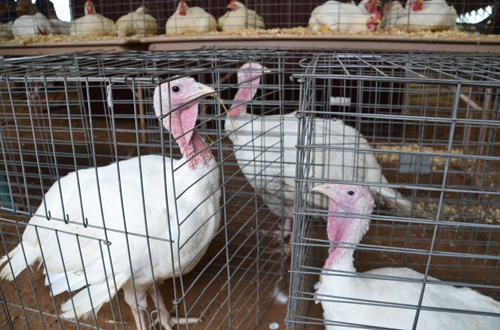
File photo by Tom Rivers: These turkeys were part of the 2014 meat auction at the 4-H Fair in Knowlesville. The cost of a turkey has dropped a little compared to Thanksgiving a year ago.
Press Release, American Farm Bureau
WASHINGTON, D.C – The American Farm Bureau Federation’s 31st annual informal price survey of classic items found on the Thanksgiving Day dinner table indicates the average cost of this year’s feast for 10 is $49.87, a 24-cent decrease from last year’s average of $50.11.
The big ticket item – a 16-pound turkey – came in at a total of $22.74 this year. That’s roughly $1.42 per pound, a decrease of 2 cents per pound, or a total of 30 cents per whole turkey, compared to 2015.
“Consumers will pay less than $5 per person for a classic Thanksgiving dinner this year,” AFBF Director of Market Intelligence Dr. John Newton said. “We have seen farm prices for many foods – including turkeys – fall from the higher levels of recent years. This translates into lower retail prices for a number of items as we prepare for Thanksgiving and confirms that U.S. consumers benefit from an abundant, high-quality and affordable food supply.”
The AFBF survey shopping list includes turkey, bread stuffing, sweet potatoes, rolls with butter, peas, cranberries, a veggie tray, pumpkin pie with whipped cream, and coffee and milk, all in quantities sufficient to serve a family of 10 with plenty for leftovers.
Foods showing the largest decreases this year in addition to turkey were pumpkin pie mix, milk and a veggie tray comprised of celery and carrots. A 30-ounce can of pumpkin pie mix was $3.13; a gallon of milk, $3.17; a one-pound veggie tray of celery and carrots, $0.73; and a group of miscellaneous items including coffee and ingredients necessary to prepare the meal (butter, evaporated milk, onions, eggs, sugar and flour), $2.81.
“Due to a significant expansion in global milk production, prices fell to the lowest levels since 2009, leading to lower retail milk and dairy product prices. Additionally, this year’s pumpkin prices are slightly lower following the production decline and higher prices seen in 2015,” Newton said.
Items that increased modestly in price were a dozen brown-and-serve rolls, $2.46; two nine-inch pie shells, $2.59; one pound of green peas, $1.58; 12 ounces of fresh cranberries, $2.39; a half-pint of whipping cream, $2.00; a 14-ounce package of cubed bread stuffing, $2.67; and a three-pound bag of fresh sweet potatoes, $3.60.
The average price is down slightly from last year to $49.87. After adjusting for inflation, the cost of a Thanksgiving dinner fell to $20.66 – the lowest level since 2010.
A total of 148 volunteer shoppers checked prices at grocery stores in 40 states for this year’s survey. Farm Bureau volunteer shoppers are asked to look for the best possible prices, without taking advantage of special promotional coupons.
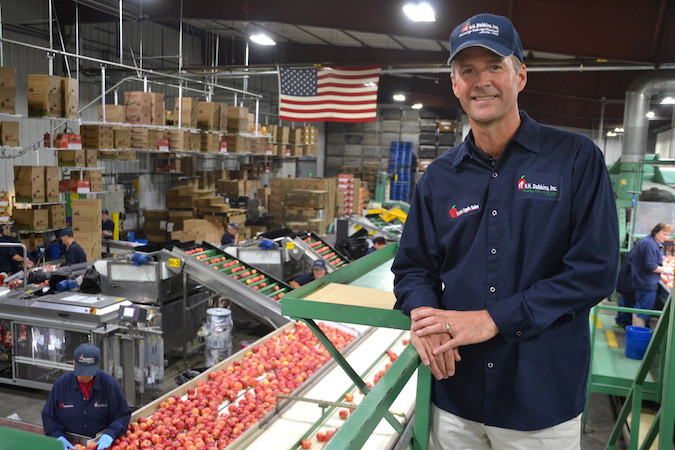
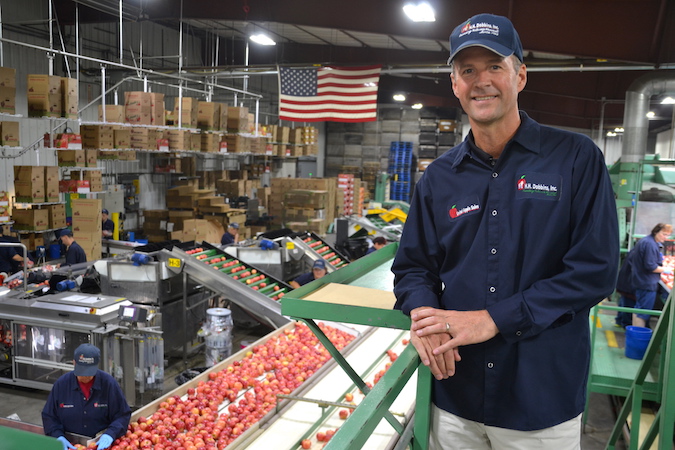
File photo by Tom Rivers: Ward Dobbins is pictured inside H.H. Dobbins in this photo from September. Dobbins is working on a 10,300-square-foot expansion to accommodate a larger packing line.
By Tom Rivers, Editor Posted 21 November 2016 at 8:21 am
LYNDONVILLE – A business that packs about 1 million bushels of apple each year is moving ahead with a $5 million expansion that will include a new packing line with the latest technology.
H.H. Dobbins (Empire Fruit LLC) will put a 10,300-square-foot addition on its complex at 129 West Ave. The added space will accommodate a new state-of-art packing line that can detect internal and external blemishes on fruit.
Right now, Dobbins has workers on the packing lines that sort fruit that doesn’t quite look perfect. The new packing line will have a defect sorter that quickly scans for exterior imperfections in fruit. Another big advantage to the technology will be seeing problems inside the fruit, such as water coring, that aren’t detectable to the human eye, Ward Dobbins, the company owner and chief executive officer, said in an interview in September. (Orleans Hub featured him in article in September because he was honored by the Orleans County Chamber of Commerce.)
Dobbins said the new line won’t displace workers. They will instead be packing boxes and bags of fruit. The new line will increase the volume from 140 bushels packed per hour to 900 bushels, Dobbins said.
The expansion project is estimated to cost $5 million for the new equipment, machinery, fixtures and furnishings, as well as construction of the new space.
The Orleans Economic Development Agency has approved a sales tax abatement that will save H.H. Dobbins $220,864 in sales tax. That is an exemption on the 8 percent tax on an estimated $2,760,800 in taxable purchases of equipment and materials. The EDA board of directors approved the incentive on Nov. 10.
That is the only tax break Dobbins will receive from the EDA for the project. The company isn’t pursuing a property tax discount with the project.
This is the second recent significant expansion and investment by Dobbins. The business last year opened a new 26,240-square-foot controlled atmosphere storage building on Millers Road, about 2 miles from the main packing house on West Avenue.
That $3.4 million project boosted Dobbins’ on-site storage by 300,000 bushels of apples. The CA also acts to put apples “to sleep,” allowing them to be stored for many months, sometimes up to a year.
H.H. Dobbins was started in 1905 and under the leadership of the fourth-generation owner, Ward Dobbins.
Dobbins is working to have the new packing line in production by next harvest season, EDA officials said.
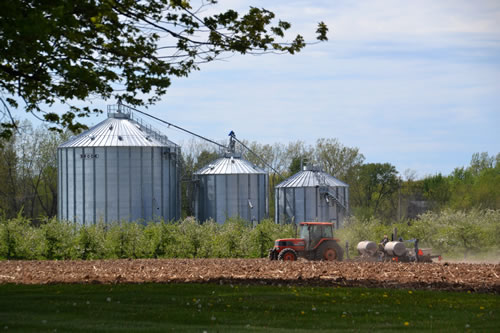
Photo by Tom Rivers: A farmer works a field by an orchard on Route 31 in Ridgeway in May.
Press Release, Gov. Cuomo’s Office
Governor Andrew M. Cuomo announced $1.5 million is available to help New York fruit and vegetable farmers join the New York State Grown & Certified program.
The $1.5 million comes from the Environmental Protection Fund to help farms implement an Agricultural Environmental Management plan, and a reimbursement of up to $1,000 is available for growers who participate in a third party audit of safe food handling practices.
Farmers must participate in programs supporting good agricultural practices and environmental management to be eligible for New York State Grown & Certified, and this funding will help more farms join the certification program.
“New York farms produce world-renowned, high-quality food, and the New York State Grown & Certified program strengthens the link between producers and consumers and promotes environmentally sustainable and safe practices,” Governor Cuomo said. “This funding will help more farmers certify their products to these higher standards and access the many opportunities offered by New York State Grown & Certified.”
Launched in August, the New York State Grown & Certified program assures consumers that the food they are buying is local and produced to a higher standard by requiring participating producers to adopt good agricultural practices and enroll in an environmental management program.
Reimbursement for Good Agricultural Practices Audits
Administered through the United States Department of Agriculture, the New York State Department of Agriculture and Markets Good Agricultural Practices program verifies that safe food handling practices are being used on farms, from growing and harvesting to packaging and handling. The Good Agricultural Practices program certifies the fresh fruit and vegetable farms that have implemented the necessary steps in their operations to minimize the possibility of product contamination and food-borne illness in accordance with USDA regulations.
The New York State Department of Agriculture and Markets, through a USDA Specialty Crop Block Grant, is providing up to $1,000 to reimburse farms for Good Agricultural Practices audits. The Department has conducted 234 audits in 2016 so far, already exceeding last year’s total number of audits.
Cornell University is a key partner in training and education for farmers as part of the program. The university holds online courses and in-person training throughout the year to help producers learn about the program and write their own safe food handling farm plan prior to the third-party audit.
Funding for Agricultural Environmental Management Plans
The Governor on Monday also announced $1.5 million is available for the implementation of an Agricultural Environmental Management plan to assist fruit, vegetable and other specialty crop growers in producing their products in an environmentally responsible manner.
Funding for the implementation of the Agricultural Environmental Management plan is provided through the Environmental Protection Fund. Assisting specialty crop farms to produce foods with the highest environmental standards will protect and improve New York’s natural resources, including water and soil quality.
New York’s County Soil and Water Conservation Districts are eligible to apply for the program on behalf of farmers. Maximum award amounts for projects are $50,000. Applications are due January 20, 2017.
Benefits for Growers, Buyers and Consumers
For growers, participation in Agricultural Environmental Management and Good Agricultural Practices certification allows for greater access to programs, especially New York State Grown & Certified, which includes a major marketing campaign to promote New York producers who meet the program standards. This includes on-product labels and promotional materials, such as a website, video and sales materials, to encourage program participation among producers and to educate retail, wholesale and institutional buyers on the value of the program. Consumer advertising and retail promotion will begin this fall.
The Good Agricultural Practices certification also provides producers access to the Farm to School procurement pilot program, which requires growers selling to school districts to be certified. The program also helps farms prepare for potential regulation from the Food Safety Modernization Act.
In addition, the Good Agricultural Practices program is significant for buyers. By purchasing products from a farm that is certified, there is a reduction in the potential for future food safety recalls, which can be costly to buyers and also impact consumer confidence and loyalty. Many consumers are looking for reassurance that the items they purchase in the supermarket have been properly handled on the farm.
Dean Norton, New York Farm Bureau President, said, “New York’s farmers value the quality and safety that goes into everything they produce. This includes taking part in AEM and GAP programs that work with farmers to be good stewards of the environment and have additional safe food handling protocols in place. The additional steps the state is taking to increase access to these valuable programs will not only benefit farmers but consumers as well who are looking to New York’s family farms for fresh, local food.”
Photos by Kristina Gabalski: Sadie Gregoire of Murray participated in the Junior Novice division, her first time participating in Produced in New York competition on Saturday at the Trolley Building. She used eggs and butter produced in New York to make a brownie recipe.
By Kristina Gabalski, Correspondent Posted 7 November 2016 at 11:48 am
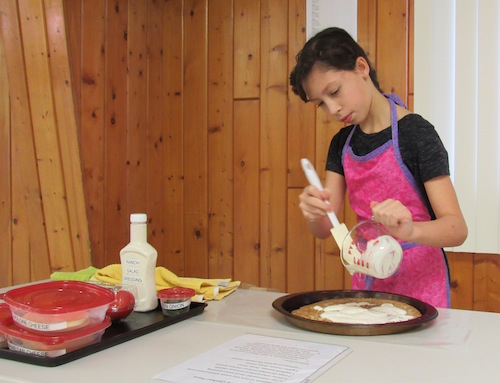
Ella Dahlhaus prepares Provolone Chicken Pizza which features New York ingredients provolone and parmesan cheese, tomatoes and chicken.
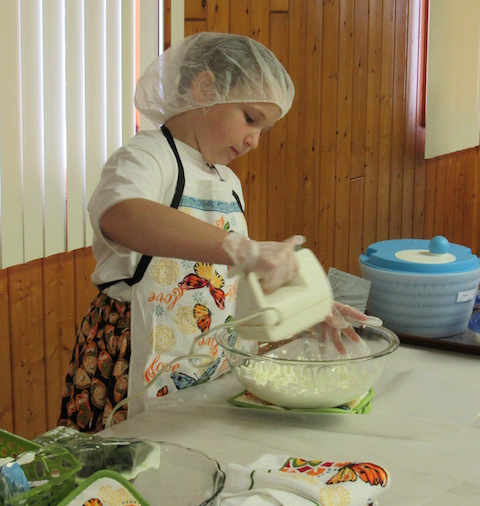
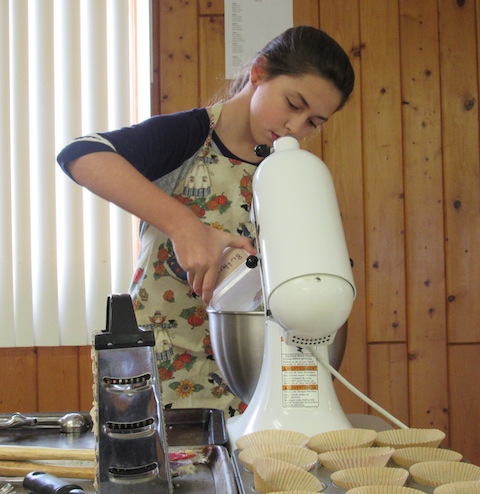
KNOWLESVILLE – Orleans County 4-Hers put their cooking skills to the test during the annual Produced in New York contest on Saturday morning. Food made and grown in New York State must be used in the competition.
Items which can be used include fruits, meats, vegetables, grains, maple syrup, and dairy products.
Twenty-five Orleans County 4-H’ers and Cloverbuds took park in this year’s contest, which was held in the Trolley Building on the Orleans County 4-H Fairgrounds.
Participants were evaluated during the demonstration for proper techniques and ability to prepare their recipe.
Judges also evaluated the product for eye appeal, taste and nutritional content.
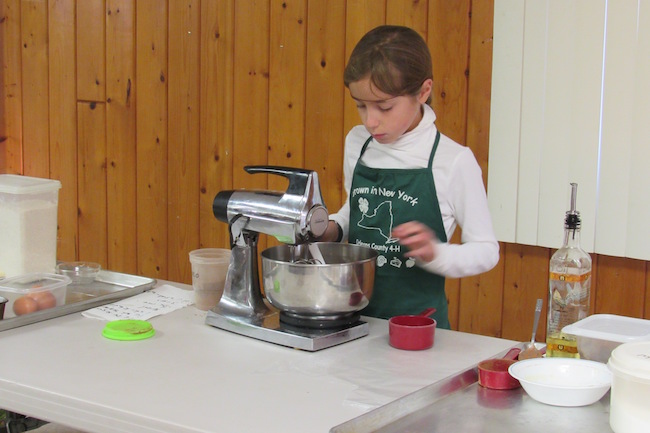
Taylor Soule used pumpkin as her featured NY ingredient for Pumpkin Cream Cheese Swirl Muffins during Saturday’s competition.
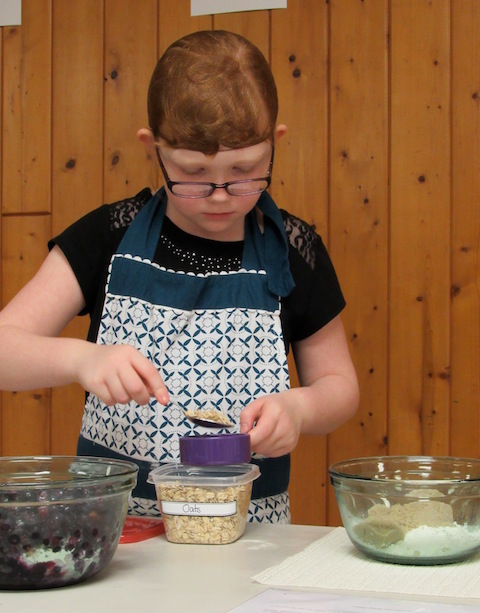
Cloverbud Olivia Andrews measures oats for her Blueberry Oatmeal Crisp featuring NY blueberries.
Makenzie McGrath whips up a tasty Grape Salad featuring grapes and NY dairy products.
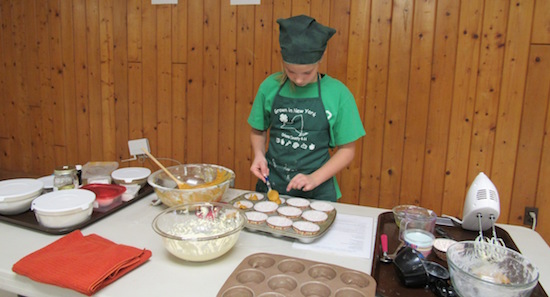
Olivia Kroening carefully adds ingredients to her Apple Cupcakes with Cream Cheese Frosting which featured NY apples.
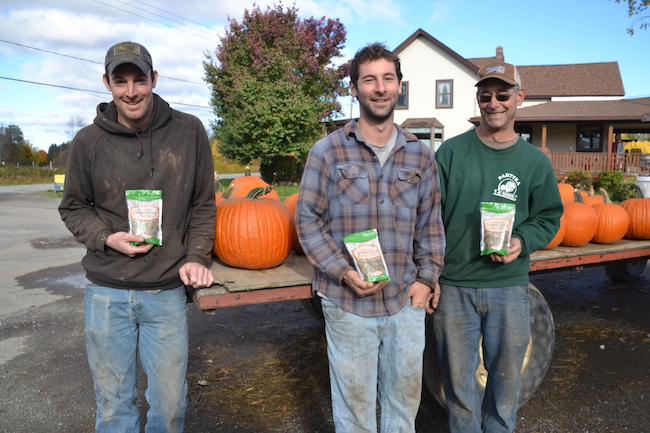
Photos by Tom Rivers: Steve and Scott Partyka, and their father Jeff are looking to expand the customer base for their dry roasted pumpkin seeds.
By Tom Rivers, Editor Posted 4 November 2016 at 4:46 pm
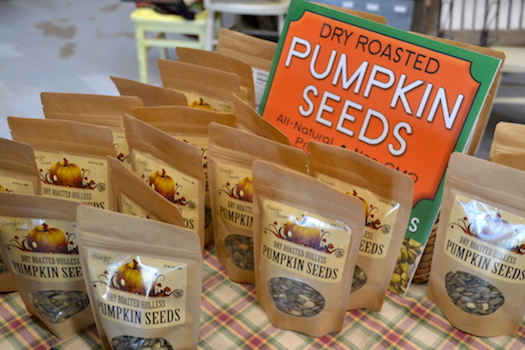
KENDALL – It started as a bit of an experiment. Jeff Partyka was at a presentation by Cornell University more than a decade ago and a researcher talked about pumpkins that produced hull-less seeds (those without a shell).
Partyka was guardedly intrigued. The owner of a fruit and vegetable farm with a market on Countyline Road said farms need to diversify, and look for many sources of revenue. A drought could hit like this year or prices could crash, imperiling a farm if it relies too much on one crop.
Partyka and his sons, Steve and Scott, planted some of the pumpkins. The seeds, after they were dry roasted, were popular with customers. The seeds are a healthy snack, high in iron and low in cholesterol.
“This is something that we have been playing around with for a while,” Partyka said today at the farm in Kendall. “It’s something different. It’s a niche that not a lot of other people are doing.”
The pumpkin seeds have jumped in popularity in the last three years, with Partyka selling them at Wegmans, and many other farm markets and natural food stores in the region.
Partyka sells the seeds, which are grown without shells, at the Partyka Farm Market, 1420 County Line Rd., Kendall. The seeds are available at Wegmans, and many other farm markets and natural food stores in the region.
The Partykas have equipment that pulls the pumpkins apart in the field and extracts the seeds, which are then washed, dried and roasted.
The Partykas see a bigger market for the product and the federal government announced on Thursday the farm was approved for a grant to help with marketing.
U.S. senators Kirsten Gillibrand and Charles Schumer announced a $170,465 matching grant for Partyka Farms. It was one of 14 grants, totaling $2,279,655, allocated through the U.S. Department of Agriculture’s Value-Added Producer Grant program. The money goes to help farmers create new products and improve their marketing strategy to raise brand awareness and increase sales.
“Ensuring that agriculture is able to flourish – and the unique needs of New York agriculture are considered in federal programs – has always been a top priority of mine,” Schumer said in a news release. “This direct USDA assistance will allow these businesses in New York State to generate increased economic revenue by bringing new products to market and expanding their operations. Helping our local companies grow their business will be a win-win for our agriculture industry, New York consumers, and the entire regional economies.”
The Partykas have to match the grant. They are looking at developing new bags for the pumpkin seeds and expanding their marketing efforts.
“We need our farmers and local producers to thrive if we’re going to have a strong and growing economy in New York,” said Gillibrand, the first NY senator to serve on the Senate Agriculture Committee in nearly 40 years. “This investment will help our producers receive the resources needed to bring their products to market and continue to help drive economic growth across the state.”
File photo by Tom Rivers: A dairy cow is pictured during the Orleans County 4-H Fair in Knowlesville in July 2013.
Press Release, Gov. Andrew Cuomo’s Office
Governor Andrew M. Cuomo announced his opposition to proposed regulations that would create a barrier for New York’s dairy farmers exporting a key New York dairy product to Canada.
In a letter to Prime Minister of Canada Justin Trudeau, Gov. Cuomo called on the Canadian Government to develop a national agreement that will mutually benefit trade across borders. If proposed provincial standards are implemented across Canada, they could result in a $50 million market loss for New York’s dairy industry.
“New York’s dairy sector is an essential part of our agricultural industry, and these regulations could have devastating effects on our dairy farmers and their families,” Governor Cuomo said. “I urge our Canadian neighbors to reconsider these potentially harmful regulations and to continue our courteous, mutually beneficial trade relations.”
The Governor’s letter coincided with the 25th Tri-National Agricultural Accord, held last week in the City of Niagara Falls, Ontario, Canada. The Tri-National Agricultural Accord provides a forum for the United States, Canada and Mexico to work together toward shared priorities and discuss important topics, including climate change, trade and the expansion of food processing sectors.
The Governor’s actions are in direct response to the Province of Ontario and the Canadian Milk Supply Management Committee’s regulatory plans, which include the Ontario Class 6 regulation and the proposed establishment of a new National Ingredient Strategy that could effectively restrict New York exports of ultra-filtered milk. Ultra-filtered milk is a protein-rich type of skim milk and is primarily used in the production of cheese and yogurt.
The letter calls on the Canadian government to confirm that Ontario’s Class 6 regulations and the Canadian National Ingredients Strategy are both consistent with existing World Trade Organization policies and the North American Free Trade Agreement.
Over the course of the last several months, New York State has made several attempts to find a solution agreeable to both parties. During a recent visit to Canada, New York Lieutenant Governor Kathy Hochul raised the concerns of New York State with Canadian officials, and in August, New York Commissioner of Agriculture Richard Ball sent a letter to his counterpart in the Province of Ontario, outlining the critical nature of the proposal and its effects on New York State. Commissioner Ball attended the Tri-National Agricultural Accord last week to raise New York State’s concerns in person.
New York exports more to Canada than to any other country in the world. Last year, the bilateral trade relationship totaled $32.93 billion in goods and supported over 500,000 jobs regionally. New York’s dairy industry is the State’s largest agricultural sector. With more than 5,000 farms, the majority of which are family-run operations, the dairy industry supports the framework of the agricultural economy. The dairy community brought in $2.5 billion in sales, and the dairy industry hired almost 20,000 people in New York in 2015. New York’s dairy products also account for at least 50 percent of all New York State agricultural commodities exported internationally.
State Agriculture Commissioner Richard A. Ball said, “New York’s dairy farmers rely heavily on the export of their products and we need to do what we can to ensure they continue to have a home for their milk. We are hopeful the Canadian government, as it weighs its options, will take into account its long and successful trade partnership with New York, and act to resolve this issue that would be detrimental to our agricultural industry.”
John Gould, Chairman of the Board of Directors of O-AT-KA said, “O-AT-KA Milk Products is a business that reflects the effort, investment and hopes of hundreds of dairy farmers in Western New York and the hundreds of people we employ in Batavia. Canada continually attempts to erect trade barriers where there should be none and this behavior places 20% of our sales or about 180 million pounds of annual milk production at risk of not having a market. We greatly appreciate the Governor’s support in fighting back as Canada should not be able to unilaterally change regulations that contradict their obligations to longstanding trade agreements.”
Dean Norton, New York Farm Bureau President, said, “Canada is an important trading partner for New York State and our agricultural community. At a time when low milk prices are threatening the viability of some family farms, any step by Canadian leaders to unfairly restrict the flow of milk into the Ontario province and beyond will have detrimental impacts on farmers and the overall farm economy. We appreciate Governor Cuomo and his administration for raising this issue with the Prime Minister, and New York Farm Bureau will continue to work with our state and federal leaders to keep milk flowing across the border.”
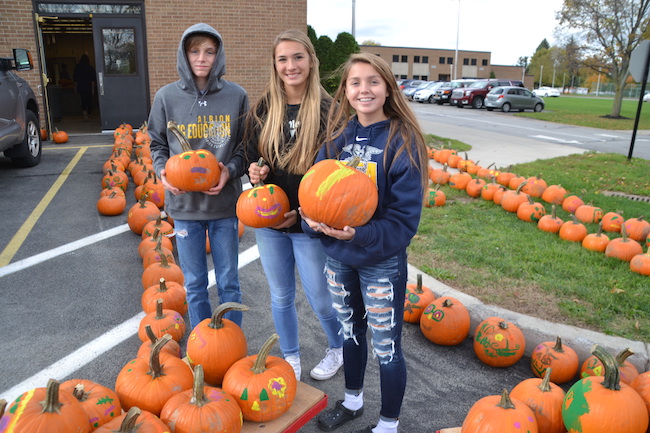
Photos by Tom Rivers: Members of the Albion FFA hold pumpkins painted by elementary students today during a fall festival that continues on Wednesday. These FFA members include, from left: Dylan Fox, Natalie DiCureia and Lizzy Baker.
By Tom Rivers, Editor Posted 25 October 2016 at 3:22 pm
ALBION – About 700 students will be welcomed to the FFA classroom and ag shop today and on Wednesday to paint pumpkins (donated by Panek’s), play ag-related games, have cider (donated by Roberts Farm Market) and have an apple (donated by Nesbitt Farms).
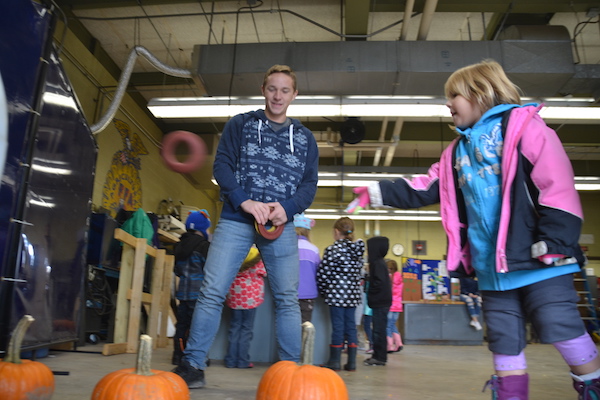
Nick Reed, a senior, mans the station where students, including this first-grader Kiri Keller, try to throw a ring on a pumpkin.
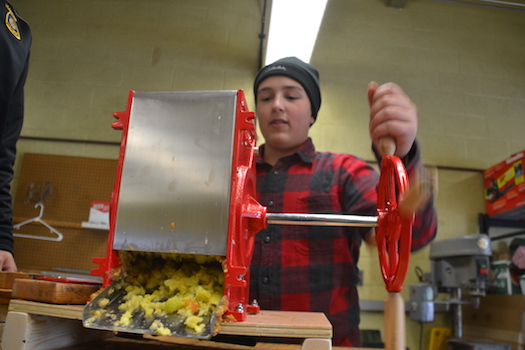
Nick Sacco, a sophomore, makes apple sauce.
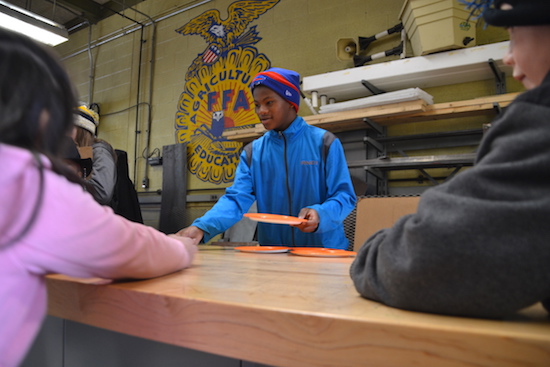
Omar Peterson, a freshman, runs the station where students try to match paper plates with Halloween themes.
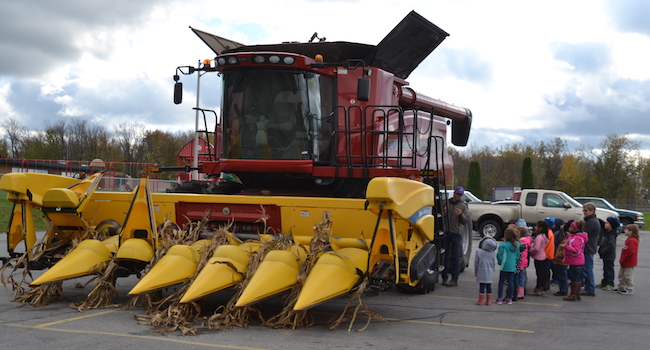
Haylett Farms in Albion loaned a combine for this display. Students in Pat Levandowski’s first grade class hear about the combine from student Harrison Brown.
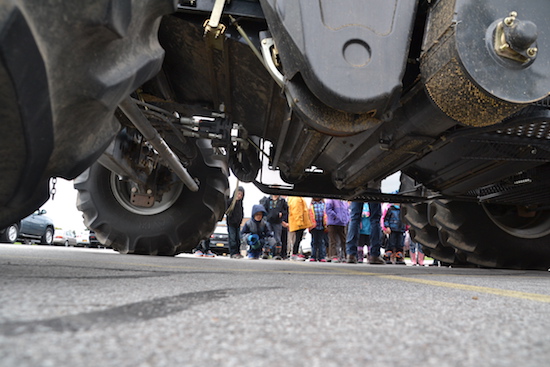
Some of the students take a peek underneath the big farm machinery.
Photo by Tom Rivers: A cow is pictured recently at Post Farms in Elba.
WASHINGTON, D.C. – U.S. Senators Charles E. Schumer and Kirsten Gillibrand have been joined by several other senators in seeking federal appropriators to include funding for dairy farmers across the nation in the Fiscal Year 2017 budget.
Specifically, the senators in the bipartisan letter requested appropriators to authorize the Secretary of Agriculture to refund farmers for the $73 million that they paid into the Dairy Margin Protection Program (DMPP) in 2015.
The senators are also calling on the committee to allow the USDA to provide emergency assistance to dairy farmers and take greater action to support dairy producers by excluding any provision preventing the USDA from implementing clause 3 of Section 32 of the Agricultural Adjustment Act of 1935 or from engaging in surplus removal and price support activities under section 5 of the Commodity Credit Corporation Charter Act.
Gillibrand and Schumer have been joined by Susan Collins (R-ME), Jack Reed (D-RI), Bernard Sanders (I-VT), Angus King Jr. (I-ME), Barbara Boxer (D-CA), Al Franken (D-MN), Elizabeth Warren (D-MA), Ron Wyden (D-OR), Jeanne Shaheen (D- NH), Patrick J. Leahy (D-VT), Chris S. Murphy (D-CT), Richard Blumenthal (D-CT), Kelly A. Ayotte (R-NH), Robert P. Casey Jr. (D-PA), Edward J. Markey (D-MA), and Sheldon Whitehouse (D- RI) in sending a bipartisan letter, seeking release of the federal funds.
“As you know, dairy farmers across the country are struggling to stay in business. This year alone, dairy farms in a number of states have been forced to close at alarmingly high levels,” the senators wrote in their joint letter. “The Dairy Margin Protection Program has not provided the safety net for farmers that was anticipated when the program was created. We believe that there are key measures that can be taken that will provide critical near-term support to cash-strapped dairy farmers and pave the way for longer-term sustainability in the industry.”
Milk prices have dropped by more than 40 percent over the past two years, and the U.S. Department of Agriculture (USDA) predicts low prices to continue for the near future. Dairy production costs continue to rise, and severe drought in some regions of the country has driven costs up further.
The letter concludes with the senators imploring the Appropriations Committee “to help our nation’s dairy farmers during this crisis.”
By Tom Rivers, Editor Posted 11 October 2016 at 9:16 am
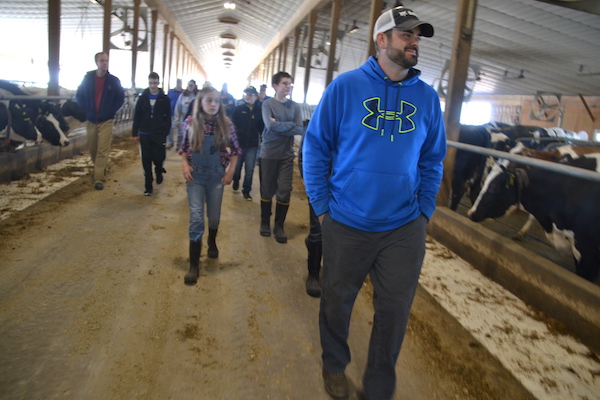
ELBA – Three teams in the Orleans 4-H Legos program visited two dairy farms on Monday to see how the farms use technology to milk cows and improve efficiencies in their operations. Jeff Post, co-owner of Post farms on Batavia-Elba Townline Road, gives the 4-H’ers a tour of the farm, which uses four robots to milk cows.
This year all of the First Lego League teams in the country have to do a project on “Animal Allies.” The Orleans 4-H’ers in the FLL program are researching animals and will need to present that information during next month’s competitions. The 4-H’ers also need to build and program a robot to perform different tasks.
There are three teams in the Orleans 4-H program competing in the First Lego League. The local program is led by Erik and Marlene Seielstad of Albion.
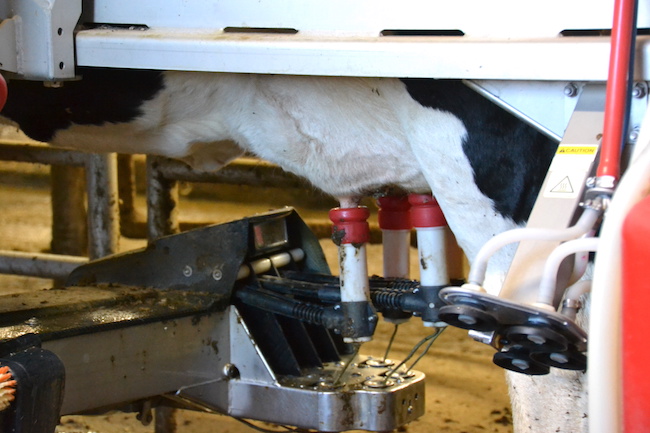
This photo shows a robot milking a cow. Post Farms added the robots seven years ago. Jeff Post said the robots are reliable, saving the farm on labor costs. Technology allows the robots to keep track of each cow’s milk production (an average of 78 pounds a day). Sensors are used for the robots to see the udder and attach to the cow.
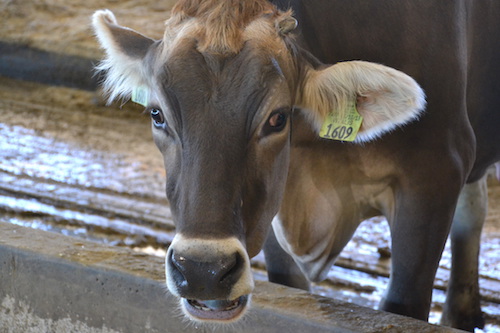
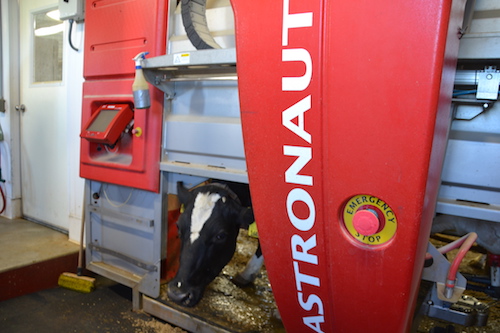
This cow takes a peak at the group visiting the farm. The cows milk on their own schedule at Post Farms. The farm is expanding and adding more robots.
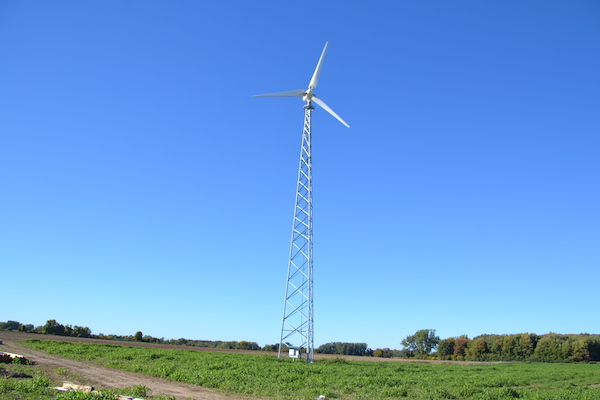
Post Farms also has a windmill that provides about one-third of the farm’s electricity.
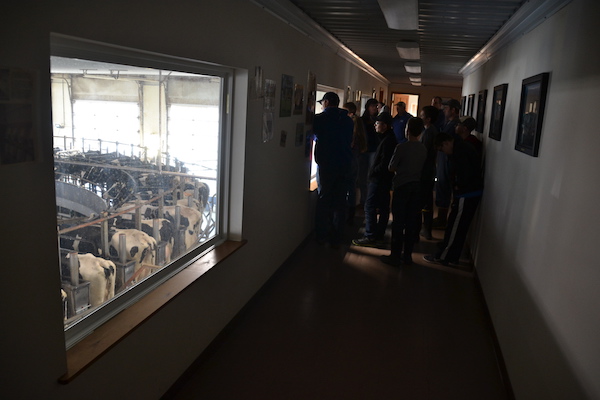
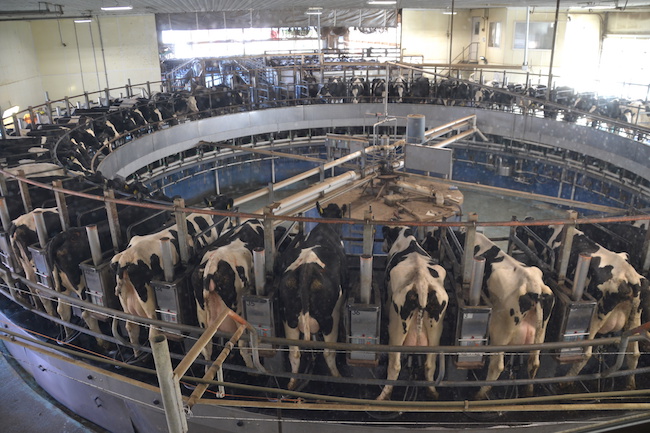
The 4-H’ers also visited Lamb Farms in Oakfield, one of the largest dairies in the state. Lamb Farms uses a rotary milking parlor that can fit 60 cows. The farm uses technology to help detect any health issues with the animals, track milk output, determine the best times for breeding and other issues, including cow comfort.
Lamb Farms added the rotary milking parlor 15 years ago. Matt Lamb, co-owner of the farm, said milking cows remains a physical job with lots of hand labor at Lamb Farms. He estimated that only 1 to 2 percent of cows in the country are milked by robots.
Lamb Farms also has a manure digester that uses the methane gas to power engines, creating electricity.
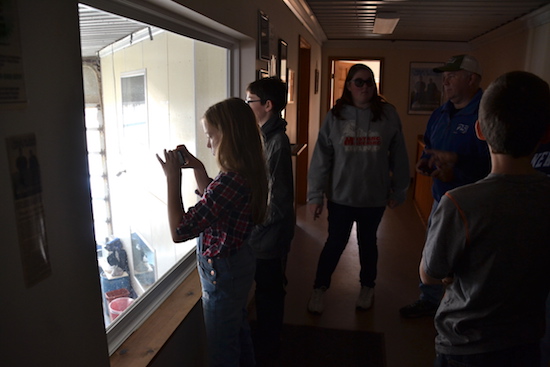
Emma Foote of Barre takes a picture of the cows on the rotary parlor. Emma and the other 4-H’ers visited two farms to get ideas for their projects in the First Lego League competition.
By Tom Rivers, Editor Posted 7 October 2016 at 5:27 pm
Photos by Tom Rivers
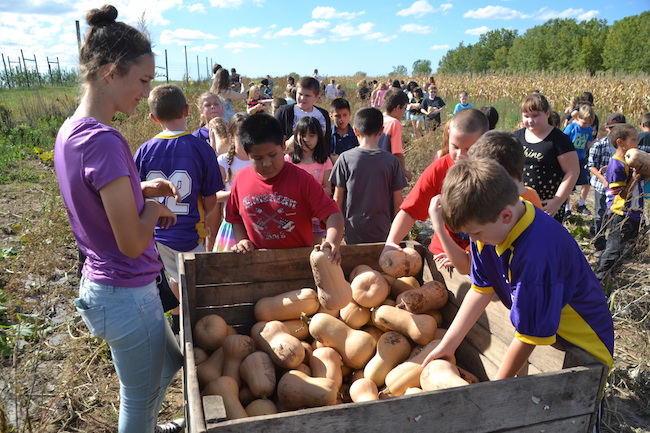
ALBION – Albion fourth-graders harvested squash this afternoon from the Land Lab on Clarendon Road that is used by the FFA and agriculture students.
The students planted the squash last spring when they were in third grade. Some of the students are pictured with Alexis Bentley, left, a member of the FFA.
About 40 bushels of squash were harvested and will be donated to Community Action of Orleans & Genesee.
This fourth-grader handles the butternut squash with one hand. The squashed will be boxed up by the FFA and delivered to Community Action.
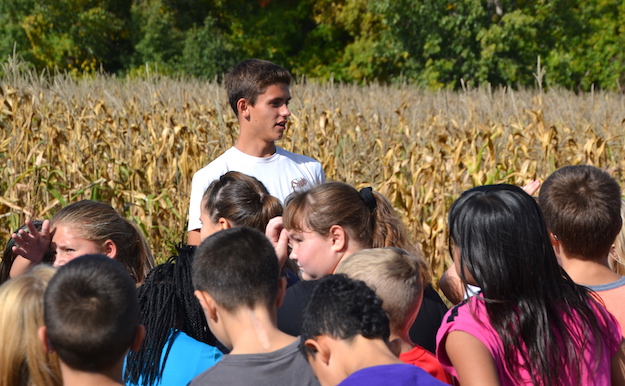
Harrison Brown, a member of the FFA, welcomes the fourth-graders to the Land Lab.
The FFA planted these pumpkins last spring and they have grown to a good size. They will be part of a harvest festival Oct. 25-26.
By Tom Rivers, Editor Posted 6 October 2016 at 3:43 pm
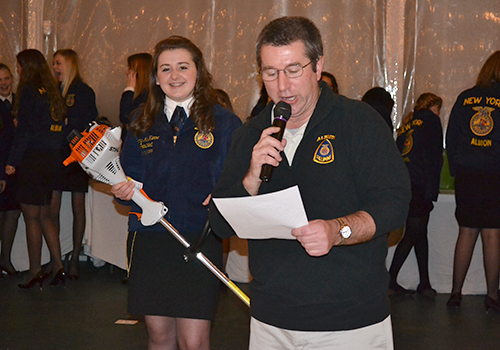
File photo by Tom Rivers: Barry Flansburg, president of the Albion Alumni FFA, leads an auction to benefit the FFA. Jenny McKenna of Albion holds one of the items up for bid during this photo from March 2015 during the annual Farmer-to-Neighbor night.
The president of the Albion FFA Alumni attended a regional conference with FFA leaders from several states this past weekend in Rochester.
Barry Flansburg was able to share how the Albion FFA Alumni have built an army of FFA supporters to help the Albion FFA chapter put on events, including competitions that draw FFA students from the region and state.
The Albion FFA Alumni also help round up fruits and vegetables after the harvest, which are part of the 30,000 pounds donated each year to Community Action and other local food pantries.
The alumni drop off tractors, gates and animals for the Mini Farm Day, and also help plant and harvest crops at the school’s Land Lab.
“We know how to get lots of volunteers to do lots of things,” said Flansburg. “You serve as an extended hand for your ag teacher and help put on events.”
There are about 200 FFA chapters in the state, but Albion is one of only seven that has an alumni chapter. Flansburg and the representative from the Vernon-Verona-Sherrill FFA Alumni Chapter near Utica represented NY at the regional conference.
The National FFA is looking for ways to strengthen alumni connections, to serve graduates and supporters of the FFA program, and also to utilize their skills in helping current FFA students.
The work of the Albion FFA Alumni hasn’t gone unnoticed, Flansburg said.
“As alumni, it is our responsibility to serve as a source of relief for our agriculture educators as well as attract new volunteers and supporters to help our FFA programs,” said National FFA Alumni Executive Director Josh Rusk. “Our hope is that the regional development conferences will give alumni the tools and support they need to be successful in that endeavor.”
This conference was one of six to be held this year. The other locations for the conferences include Oklahoma City, Burbank, Wash.; Ankeny, Iowa, Atlanta, Ga. and Oxford, Ohio.
The National FFA Organization provides leadership, personal growth and career success training through agricultural education to 629,367 student members who belong to one of 7,757 local FFA chapters throughout the U.S., Puerto Rico and the Virgin Islands.
Flansburg said the FFA is looking to establish a database of FFA students and alumni that will include resumes and opportunities to network for job opportunities or to help FFA chapters with projects.
By Tom Rivers, Editor Posted 21 September 2016 at 4:13 pm
Chamber honors H.H. Dobbins owner as ‘Business Person of the Year’
Photos by Tom Rivers: Ward Dobbins is pictured inside H.H. Dobbins while Gala apples are being packed on Tuesday. Dobbins has worked at the company for 30 years, and led a big expansion last year with plans for a bigger packing line next year.
LYNDONVILLE – An apple packing business that started in 1905 by the Dobbins family has grown to a worldwide footprint under the leadership of the fourth-generation owner, Ward Dobbins.
H.H. Dobbins packs 1 million bushels of apples a year, and about 20 to 25 percent are shipped out of country to the United Kingdom, Israel, Iceland, Central America and other distant locales. (Dobbins sold the first U.S. apples into Cuba when the embargo was lifted.)
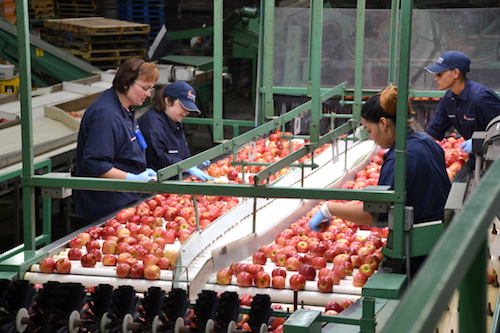
Workers on the packing line check Gala apples for any defects on Tuesday. Dobbins has about 75 full-time employees in Lyndonville.
Most of the apples packed and sold by Dobbins are grown nearby in Orleans County.
Dobbins, the company owner and chief executive officer, likes the company’s position in the apple market.
Last year it completed a $3.4 million project, adding a 26,240-square-foot controlled atmosphere storage building on Millers Road, about 2 miles from the main packing house on West Avenue.
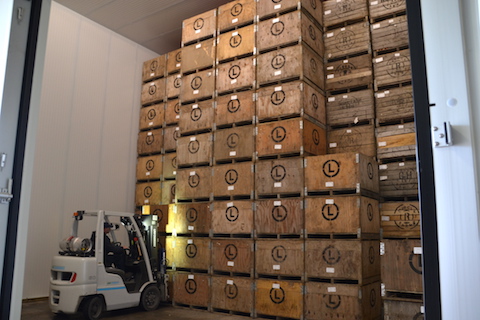
The new CA boosts Dobbins on-site storage to 300,000 bushels of apples. The CA also acts to put apples “to sleep,” allowing them to be stored for many months, sometimes up to a year.
The ability to pull apples out of storage well after the harvest season means Dobbins can become a year-round packing operation.
The Chamber of Commerce on Friday recognized Dobbins with its “Business Person of the Year” award.
Ward Dobbins is pictured outside the 26,240-square-foot controlled atmosphere storage building that opened last year on Millers Road.
Dobbins said the company’s success is due to a talented management team, dedicated employees and the high-quality apples from so many excellent local growers.
“We have a great team here,” Dobbins said. “I wouldn’t be doing what I am without them.”
Lyndonville has proven to be a great location for the business because the company is nestled nicely in the Lake Ontario fruit belt with growers from Niagara, Orleans, Monroe and Wayne counties.
Those farmers have switched in recent years to popular varieties such as Honeycrisp and many have planted high-density orchards which boosts the yield per acre.
“The growers around here are top-notch,” Dobbins said. “They have the new varieties and systems.”
Dobbins works with about 30 farms, but about 10 supply most of the 1 million bushels packed and shipped from Dobbins each year.
Those apples are packed for well-known customers including Costco, Sam’s Club, Aldi and the Stop & Shop grocery chain.
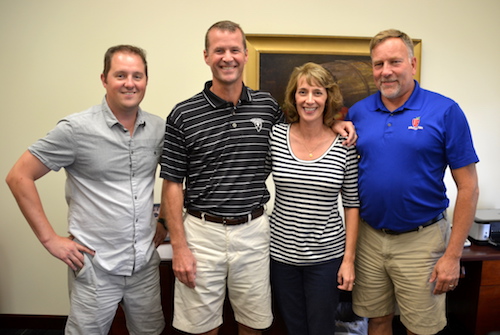
Ward Dobbins is pictured with some key members of the leadership team, including from left: Brett Baker, international accounts manager; Dobbins; Sheila Dobbins, (Ward’s wife) and the company controller; and Ron Wilkowski, general manager.
There used to be many more packing houses in the region, but many consolidated with larger packing houses serving many farms. Dobbins said his company’s goal is to operate as efficiently and inexpensively as possible to be in the best position to serve the apple growers and Dobbins’ customers.
The packing houses have become high-tech with CA storage that effectively put apples to sleep to allow some of the fruit to be stored for nearly a year. That happens by dropping the oxygen levels to about 2 percent (compared to 20-21 percent of the air people breathe). The CA rooms also have carbon scrubbers that drop CO2 levels to about 2 percent.
The CA storage rooms release nitrogen that displaces oxygen. The new rooms are airtight without leaks. Some of the older CA rooms aren’t as tight and cost more to run.
Dobbins is looking to upgrade its packing house even more. The company plans to replace a packing line next year with new technology that can detect internal and external blemishes on fruit.
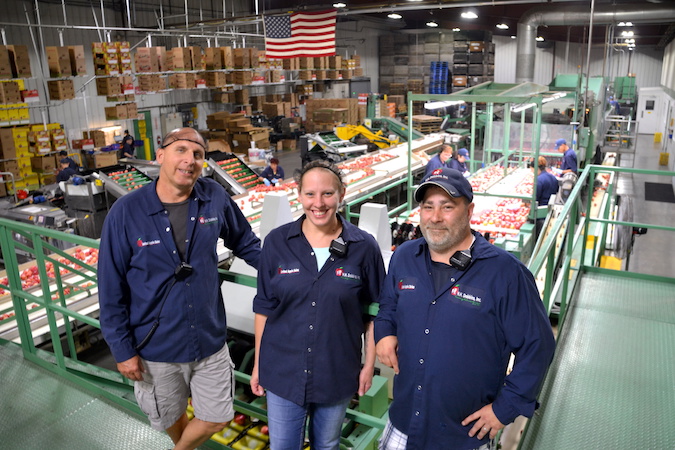
Some of the packing house leaders include, from left: Brian Murray, quality manager; Sherri Seefeldt, line operations and production supervisor; and Kyle Merritt, production manager.
Dobbins has 75 workers and many work on the packing lines, sorting out fruit that doesn’t quite look perfect. The new packing line will have a defect sorter that quickly scans for exterior imperfections in fruit. The big advantage to the technology will be seeing problems inside the fruit, such as water coring, that aren’t detectable to the human eye.
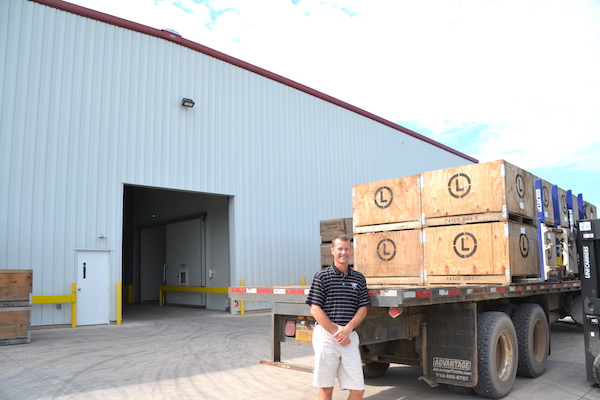
A truck from LynOaken Farms pulls up outside the new CA storage building on Millers Road. Dobbins said the company is fortunate to work with many of the leading growers in the region.
Dobbins said the new line won’t displace workers. They will instead be packing boxes and bags of fruit. The new line will increase the volume from 140 bushels packed per hour to 900 bushels, Dobbins said.
The new packing line will require an addition at the West Avenue complex. It will replace a packing line that is 20 years old.
Dobbins said there have been numerous technology innovations in the packing industry, from production lines to building designs.
The industry has also experienced major changes in food safety, from establishing standards for traceability to how workers handle fruit. (Visitors also must sign in, wear company-issued coats and either hair nets or hats. They also need to answer questions about any recent illnesses and medication they are using.)
With traceability, Dobbins can tell which bag of apples comes from which farm, and can even say which field it came from. Every bin of apples delivered at Dobbins is labelled by the farm. When the apples are packed and bagged, there will be a record on the bag noting which farm the apple is from. Should there ever be an outbreak of a foodborne illness, Dobbins can trace it to the farm.
Dobbins has two employees dedicated to food safety and five more that work in quality control.
“The consumer should feel very good,” he said about the many safety steps taken by Dobbins and the industry.
Dobbins about five years ago also merged its sales division with United Apples Sale Inc. to create United Apple Sales.
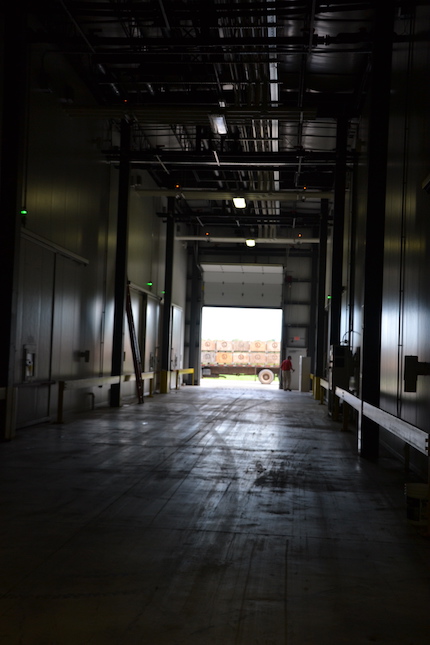
The apples are stacked high in the new CA storage building.
That company has boosted the exports for Dobbins. The company also opened a new office last week in the state of Washington, the country’s leading apple-producing state. (New York is second.)
Dobbins said the New York apple industry is in a good position. He mentioned a few reasons:
“We have the Great Lakes and rainfall,” he said. “We have access to a huge percentage of the population within an 8-hour drive from here. People are becoming more health conscious.”
Staff Reports Posted 13 September 2016 at 12:30 pm
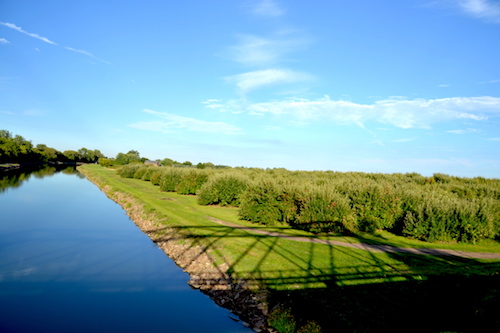
Photo by Tom Rivers: An apple orchard is pictured late Friday from the canal bridge on Presbyterian Road in Albion.
WASHINGTON — Orleans County has joined the list of counties in New York that have been declared primary natural disaster areas due to the drought conditions.
Orleans farmers were eligible for disaster relief because the county was contiguous to Genesee County, which made the list last month as a primary natural disaster area.
But now Orleans has its own designation following the the Sept. 9 designation by the US Department of Agriculture. Allegany, Cattaraugus, Cortland and Onondaga counties all were named to the list on Friday, bringing the total to 20 counties with primary designation, and six more that are contiguous.
Qualified farm operators in the designated areas are eligible for low-interest emergency loans from USDA’s Farm Service Agency, provided eligibility requirements are met.
Farmers in eligible counties have eight months from the date of the declaration to apply for loans to help cover part of their actual losses. FSA will consider each loan application on its own merits, taking into account the extent of losses, security available and repayment ability. FSA has a variety of programs, in addition to the EM loan program, to help eligible farmers recover from adversity, the USDA said.
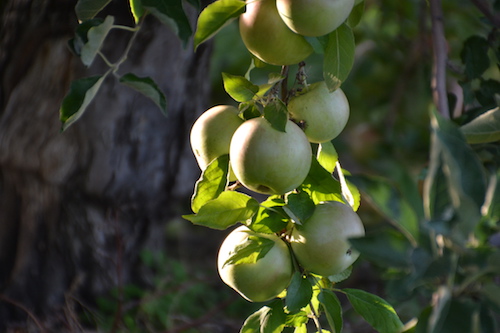
Photos by Tom Rivers: An orchard is pictured on Presbyterian Road in Albion, near the Erie Canal.
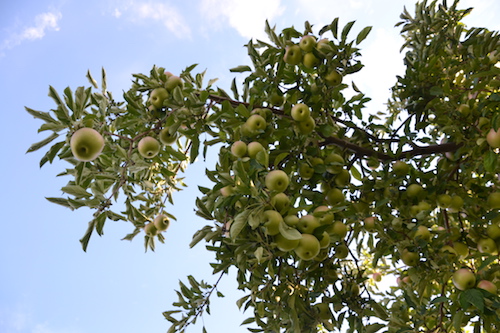
Apple growers in Orleans County and New York State are in harvest-mode, and they expect a nice crop despite drought conditions.
New York is the country’s second-leading apple producer with an average harvest of 28.6 million cartons annually the last five years. (Orleans County is the second leading apple county in the state, behind only Wayne County.) This year’s crop is expected at 30 million cartons, which would top the annual average, according to the New York Apple Association.
“By the time this crop gets off the trees and to market, all New York state apple fans are going to see is ‘great’ – great variety, great quality and great flavor,” said New York Association President Jim Allen.
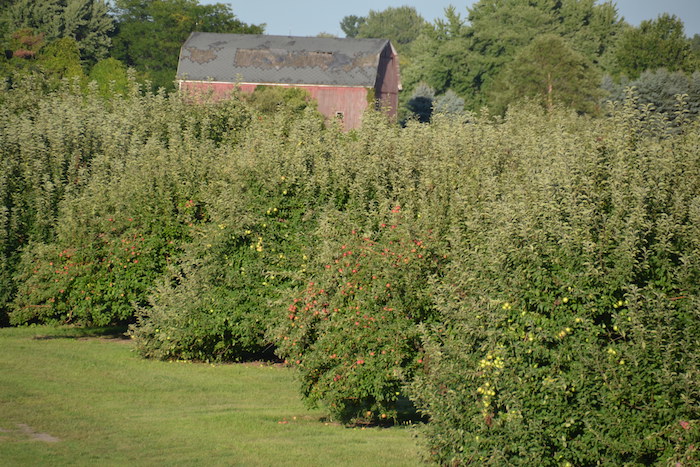
These apples are pictured on Allens Bridge Road in Albion.
Besides the drought, some apple growers battled a frost during the spring bloom and hail in some parts of the state.
The apples will be a little smaller this year because of the drought, Allen said.
“There are plenty of fruits on the trees this year, they’re just smaller in size than usual,” he said.
The drought has apples crunchier and sweeter. With less water content, the concentration of sugars in each apple is higher.
“Even downsides can have upsides in this industry,” Allen said.
Growers have been switching some of their acreage to high-density plantings of popular varieties, such as Honeycrisp, and new varieties – Zestar, SnapDragon and RubyFrost.
“Our growers produce more apples now on fewer acres because of technology – smaller trees that produce more fruit, computer-aided packing and sorting, and high-tech cold storage that puts apples to sleep until they are ready to ship to stores,” Allen said.
The orchards in Orleans County are loaded with apples that will be picked in the next two months. These apples are pictured at an orchard on Allens Bridge Road.
The New York Apple Association also is touting apples as healthy snacks. The association has launched the Big Apple Salad Challenge this fall, encouraging people to eat one salad a day with an apple included.
Fans who take the Big Apple Salad Challenge are invited to try NYAA’s salad recipes, and to send pictures of their own apple salads to NYAA – the association will share fan photos on its website and Facebook page. (Click here to see the NYAA website.)
“Whatever your health goal – eating cleaner, feeling better, losing weight – salads are a deliciously easy way to eat better without sacrificing flavor or satisfaction,” says NYAA Registered Dietitian Linda Quinn. “Apples add crunch, texture and flavor – as well as nutrients and fiber-related fullness – to any salad. Plus, apple cider and cider vinegar make great salad dressings!”
Quinn has developed a number of apple salad recipes to help apple fans get started on the Big Apple Salad Challenge, including: New York Apple Slaw with Sweet and Sour Cider Dressing; New York Apple-cado Salad (a fruity, crunchy twist on traditional guacamole), New York Apple Seasonal Salad with kale, quinoa and dried cranberries in a cider vinaigrette dressing.
There is also New York Grilled Apple Salad with a tangy cider mustard vinaigrette dressing, and New York Apple BYO Salad with Apple Cider Drizzle – build your own salad with what’s in your fridge.
Send NYAA a favorite salad recipe or salad photo by Oct. 31, and you will be entered in the Big Apple Salad Sweepstakes. NYAA will share sweepstakes winners’ photos after the sweepstakes has concluded. (You can also simply fill out and submit the sweepstakes entry form – no purchase, photo or recipe is necessary.)
By Kristina Gabalski, Correspondent Posted 11 September 2016 at 9:35 am
Murray farm one of 6 agriculture sites featured in Heritage Festival
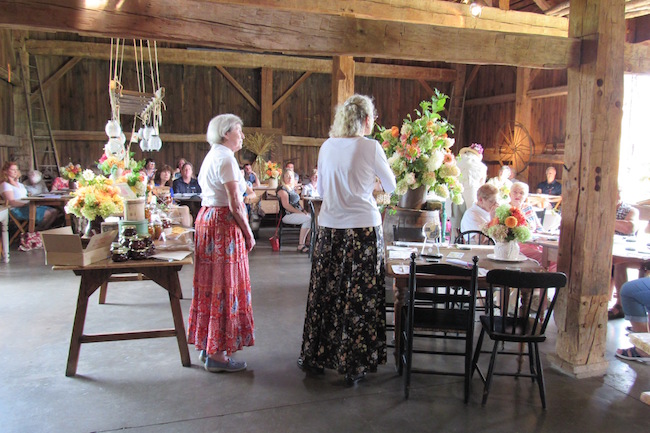
Photos by Kristina Gabalski: Sue Hurd Machamer, left, and her daughter Amy Machamer discuss the history of the canning industry which included information on food preservation basics and personal stories such as, “Aunt Helen Salisbury and the Birdseye Research Lab.”
MURRAY – Hurd Orchards on Ridge Road was one of six farms taking part in the agricultural facet of the Orleans County Heritage Festival on Saturday.
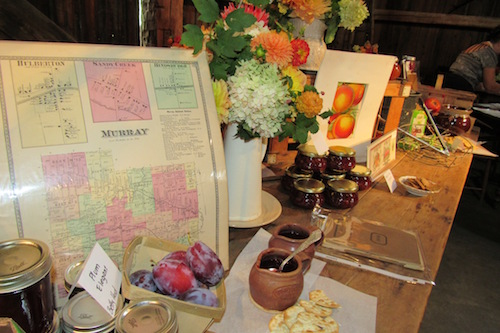
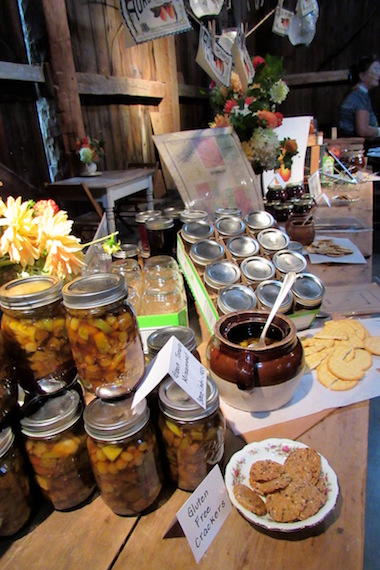
Colorful displays at Hurd Orchards featured information about the canning industry in Orleans County, vintage cookbooks, maps and produce labels.
The Hurd Orchards program included a Living History Lunch and Lecture on “The Cannery.”
Amy Machamer and her mother, Sue Hurd Machamer discussed how agriculture and the food processing industry have been the foundation of the local economy for more than 100 years.
The Machamers explained that during the 19th and 20th centuries, almost every village in Orleans County had its own cannery, surrounded by the fields and orchards which provided fruit and vegetables for processing. Examples include the Morton Canning Company in Morton, Hunt’s in Albion and H.J. Heinz in Medina.
The Machamers also shared stories about the packing houses, trucks, characters, and the enterprising business of producing fruit for the local canneries.
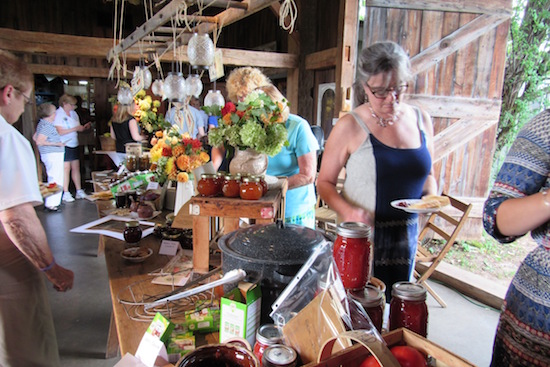
The luncheon that followed included fresh baked breads with heritage preserves made from original Orleans County recipes.
A portion of the program was subsidized by the Bayer Corporation. Hurd Orchards won Bayer’s 2016 Produce Innovation Award for their educational efforts in the field of agriculture including the luncheons, classes and tastings they hold each year at their farm.
Orleans County Heritage Festival goers Saturday enjoy a luncheon at Hurd Orchards. The menu included freshly baked bread and heritage preserves including Green Tomato Mincemeat and Plum Elegant.
Hurd Orchards offered Heritage Festival visitors samplings of heritage preserves and information about the history of the canning industry in Orleans County.
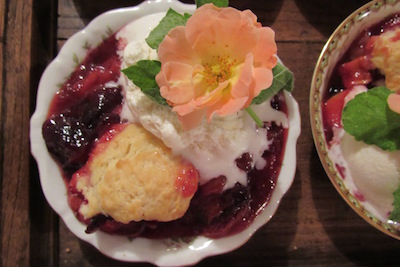
The luncheon dessert featured an apple/plum cobbler with vanilla ice cream.
Other farm operations included in the Heritage Festival included Leonard Oakes Estate Winery & LynOaken Farms in Medina, Orleans Poverty Hill Farms (dairy) in Albion, Partyka Farms in Kendall, Roberts Farm Market in Medina, and Watt Farms Country Market in Gaines.