By Tom Rivers, Editor Posted 17 April 2020 at 8:38 am
Local State Assembly representatives, Steve Hawley of Batavia and Mike Norris of Lockport, are among 42 Republicans in the Assembly seeking state assistance for the agriculture industry.
The Republicans in the Assembly have signed a joint letter to asking Gov. Andrew Cuomo and Assembly Speaker Carl Heastie to ease some regulations for farmers.
The Assembly members said efforts to prevent the spread of the coronavirus have led to severe disruptions to the dairy industry’s supply chain, dramatic reductions in demand, and have forced many farmers to dump valuable product.
“Farmers are one of our most important working groups, especially in a situation as dire as this one,” Hawley said. “If there’s any way to give them more support and more relief during this troubling time, we’re obligated to do so. It’s about keeping the supply chain running, keeping a small family farm’s doors open, and making sure everyone has food on the table. We can all agree we need to protect our farmers.”
The Assembly Minority Conference has compiled a list of recommendations to help farms survive and stabilize state and local economies.
“Farmers need immediate help,” the Assembly members state in the letter. “I hope that we can work collaboratively, along with the appropriate State agencies, to implement these changes and get New York’s agricultural community back on track.”
New York has more than 200,000 confirmed cases of the virus, which has killed more than 12,000 New York residents.
“No state has felt the social, economic, and public health effects of the virus like New York,” the Assembly members write. “As we identify ways to manage and minimize the devastating impacts of the virus, we must consider immediate steps to provide critical relief to New York State’s agricultural industry.”
The Republicans in the Assembly made the following recommendations:
Suspend, for 1 year, DMV registration requirements for agricultural vehicles and farm trucks;
Suspend the highway use tax, special hauling permit fees, and collection of New York State tolls for vehicles used to transport agricultural products, including milk;
Suspend, for 1 year, the 60-hour overtime threshold for farm laborers enacted as part of the 2019 Farm Labor bill;
Suspend, during the state of emergency period, the 24-hour agricultural rest requirement;
Extend the Milk Producers Security Fund to help producers who are unable to sell because of COVID-19;
Use additional federal stimulus money for direct cash infusions for Cornell Cooperative Extensions to assist in the provision of emergency services;
Use federal stimulus funding to invest in rural broadband infrastructure to assist in the provision of services to farms/rural areas during uncertain social and economic times;
Provide vouchers for food banks to purchase local dairy and agricultural products; and
Stipulate “green nurseries” as essential businesses for the remainder of the COVID-19 crisis, so that these businesses can re-open while following social-distancing guidelines.
Farms and restaurants seek better connections for utilizing food grown in the nearby community
(Editor’s Note: Madeline Gibbs of Albion is a senior at the Rochester Institute of Technology, majoring in Dietetics & Nutrition. This report follows a study on local foods, including interviews with farms and restaurant owners.)
Guest article by Madeline Gibbs
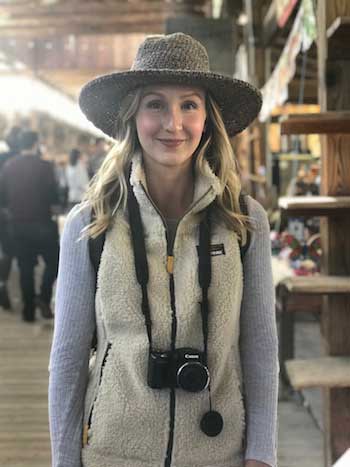
Photos courtesy of Madeline Gibbs: Madeline Gibbs is pictured at the Ithaca Farmers’ Market.
During the summer of 2018 I had the privilege to get my hands dirty and experience what it’s like to be a farmer at Kirby’s Farm Market, a family-owned and operated farm located on Ridge Road in Brockport.
The experience truly was life-changing, and by far, the best and most-rewarding job I’ve had to date; it also led me to pursue research on the local food movement—to assess what local really means for farmers and restaurants that source locally, as well as what it entails for our health, communities, economy…our world.
My findings revealed the transition from a more global to local market brings people together and the primary reason restaurateurs source locally is for the high quality, superior taste, and freshness—yes—but more importantly because they desire a connection with where their food came from and a connection with who grew it. I experienced how rewarding this connection is by working on a farm myself.
The new trending area in the restaurant industry is “farm to table” and sourcing locally, as more and more consumers become health conscious and desire to have a connection with growers and food. Being one of those consumers myself and living in Rochester where I have the luxury of local food around me through places such as Brighton Farmer’s Market and Public Market, I tend to shop locally the majority of the time and still go to Farmer’s Markets even in the winter.
As consumers are increasingly interested in where their food comes from, more restaurants are embracing local food and connecting with farmers. The COVID-19 pandemic has resulted in concerns about where to buy food as supermarkets struggle to keep up with demand; local farmers and food hubs may ensure community food resilience.
My study investigated farmers’, restaurateurs’, and chefs’ beliefs about the definition of local food, as well as how local food contributes to the local economy, community, overall health, and the quality of food. To my surprise, the current definition of “local” is very vague. U.S. Congress in the Food, Conservation, and Energy Act defines a “locally produced agricultural food product” as “any agricultural food product that is raised, produced, and distributed in (1) the locality or region in which the final product is marketed, so that the total distance the product is transported is less than 400 miles from the origin of the product, or (2) the State in which the product is produced.”
Working on a local farm, I felt this definition didn’t accurately encompass all that local food is. It turns out, the participants of my study had differing beliefs as well. Ten local farmers, and restaurateurs and chefs that source from local farms, participated in my study, allowing me to conduct one-on-one interviews with them. Questions addressed defining local, impacts that sourcing locally has, what it means to effectively source local in a restaurant, the infrastructure needed to see more restaurants go farm to table, etc.
Several themes were apparent in the interviews where participants were asked to define local. Relationships with farmers, being within one’s neighborhood or county, geographical distance, and proximity were all contributing factors in what local meant to restaurateurs, chefs, and farmers, but the most pertinent themes revolved around one central idea—that locality primarily meant familiarity to the participants, and furthermore, being a part of one’s community. The primary reason many chefs and restaurateurs sourced locally was to support their neighbors who are farmers and to connect within their communities. Two restaurateurs from fine-dining stated that local is “relationships, it’s very personal” and “the farms we are dealing with are our neighbors,” which further emphasizes the connection-based definition for local food. Quality, freshness, taste, and nutritional attributes were also a main focus of the results.
Small-scale production is a valuable aspect of the local food movement, but additional funds for local, small-scale farmers may help them reach more consumers and effectively provide to the restaurant industry.
Farmers, as well as restaurateurs and chefs, agreed that local food is better in quality and taste, and higher in nutrient content. Not only was eating with the seasons considered healthful, but consuming food soon after it has been harvested was also associated with higher nutrient content by chefs and restaurateurs. Chefs believed that local food is of better quality, of higher value, fresher, more flavorful, and easier to work with. Furthermore, local food was said to be more sustainable and better for the environment.
These findings suggest that local cannot be defined according to distance without also addressing the personal and community-based connection to local food. Both participant groups conveyed that local food is within reach and familiar to them.
The second finding revealed that local food is multifactorial, and its attributes go beyond just its definition. Local food has positive physical and sensory attributes, but there is also a perceived personal benefit of local sourcing that reverts to social connectedness. Restaurateurs, chefs, and farmers did not purchase local food for reasons solely dependent on consumer demand or trendiness, they support local sourcing because of personal values associated with the local food movement. Participants felt it was a rewarding act to buy local food and appreciated the restaurateur-farmer relationships that were formed.
While local food has many perceived benefits, that doesn’t come without barriers. For example, livestock farmers could benefit from more restaurants undertaking a nose-to-tail approach. Greater transparency can improve success of sourcing locally.
Policy initiatives to better assist local farmers should also be investigated. For example, meat producers struggle finding small USDA inspected slaughter houses and local butchers are limited in number, by implementing changes in this area, farmers may have less expensive butcher bills and be able to use that money in other areas of their farm.
Small-scale production is a valuable aspect of the local food movement, but additional funds for local, small-scale farmers may help them reach more consumers and effectively provide to the restaurant industry.
Strengthening community, collaboration, and local relationships were themes related to local food that proved to be of greater importance than the definition of local food itself. Thus, local food should be regarded as a pathway for bringing communities together, appreciating what agriculture a region has to offer, and providing a deep connection with not only who grew the food, but food itself.
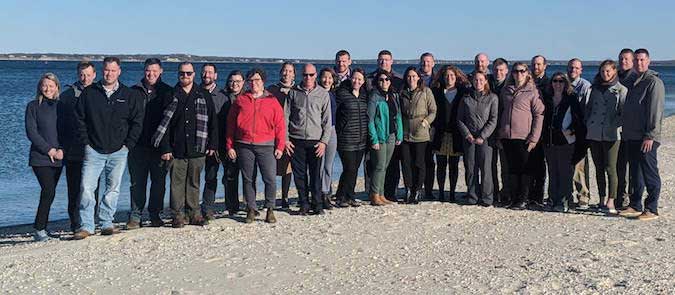
Provided photo from LEAD NY: The 18th Class of LEAD New York completed its first year with 28 people from agricultural businesses and organizations throughout the state.
By Tom Rivers, Editor Posted 14 April 2020 at 10:01 am
Three Orleans County residents are among a new class of 28 people who finished the first year of a leadership program for people in the agricultural industry in New York.
LEAD New York just completed the year-long training program with its 18th class. Among the class members are three Orleans County residents: Jessica Decker of Kendall (Quality Systems Manager for the Brockport plant of Bonduelle USA), Matthew Toussaint of Medina (Partner/Manager of Toussaint Farms LLC in Medina) and David Bittner of Lyndonville (Orchard manager for Bittner-Singer Orchards in Appleton).
Due to the ongoing pandemic, the first year of the program didn’t end the way the class had anticipated. They weren’t able to hold the final, in-person seminar in Corning. The group instead met via Zoom, and other content will be covered later in the summer.
“This first year of the program focuses on leadership skill development, heightened self-awareness, improved understanding of the food, agriculture and natural resource sectors in New York State, and building a team of aspiring leaders that will support each other on their development journey” said Larry Van De Valk, Executive Director of the program. “In the second year, we turn our attention outward, spending less time on skill development and more time on issues awareness, critical thinking, and developing a global perspective. The current crisis will certainly provide much for us to discuss about food systems, community, and leadership.”
LEAD New York is a leadership development program for adult professionals in the food, agriculture and natural resource sectors. It consists of seminars, workshops, and field travel experiences both in and out of New York State, including an international study trip. The class in the first year has looked at the industry throughout the state, including spending three days in the Batavia area from Dec. 5-7 to study production agriculture locally.
The program focuses on leadership skill development, enhanced self-awareness, civic engagement, a greater understanding of issues facing our food system and rural communities, and cultivating leadership networks. Currently, there are over 500 LEAD New York alumni serving in leadership positions in private business, local, state and federal government positions, not-for-profit organizations, and educational institutions.
Press Release, NYS Department of Agriculture & Markets
State Agriculture Commissioner Richard A. Ball today outlined several actions the Department of Agriculture and Markets has taken to assist the agricultural industry during the COVID-19 pandemic.
Many sectors of the industry, including New York’s dairy farmers, have faced extreme economic difficulties with the loss of wholesale markets, such as schools and restaurants, and uncertain consumer demand. The Commissioner, in a joint letter with the Pennsylvania Department of Agriculture, last week urged the United States Department of Agriculture to support New York’s farmers with immediate emergency relief funding. Read the letter here.
Commissioner Ball said, “The COVID-19 pandemic has affected our agricultural community, as it has all of us, in so many ways. The challenges and disruptions our farmers are facing are like nothing we have seen before and our farmers are experiencing extreme economic difficulties. The Department is working, with all its partners, to seek relief for New York producers, and find new avenues for New York products while providing guidance and resources that allow many of our vital agricultural businesses to continue their operations.”
The Department has convened members of the Milk Marketing Advisory Council and continues discussions with food banks across the state, in coordination with the NYS Department of Health’s Hunger Prevention and Nutrition Assistance Program, to identify ways to alleviate the surplus challenges that are impacting New York’s dairy, specialty crop farmers, and seafood producers. The Department is also working closely with the New York Farm Bureau to address industry concerns and provide critical updates.
In addition, the Department is working to address limits being placed on the sale of dairy and other agricultural products in grocery stores, in coordination with the Food Industry Alliance, the Retail Council of New York State, the Business Council of New York State, New York Farm Bureau, and the state’s retail grocery stores.
Guidance to Maintain Businesses
To keep the agricultural community informed on the most recent Executive Orders as they relate to COVID-19, the Department has issued guidance documents for its farmers’ markets, retail food and food manufacturing firms, fisheries, and animal care operations to help them maintain business safely.
It has also granted restaurants approval to sell grocery items, allowing additional revenue for restaurants and an additional market outlet for farmers and food businesses. In addition, fisheries have been permitted to temporarily sell and/or process seafood directly to the end consumer. A list of guidance provided to the industry is below:
All guidance documents and additional details are located on the Department’s website at agriculture.ny.gov/coronavirus, which is updated on a regular basis and as new information becomes available. The Department has also compiled and published a general resource guide for the agricultural community, which includes information on important actions and resources to help New York’s agricultural businesses, and information on other areas, such as food safety, companion animals, mental health, and more. The resource guide is available at agriculture.ny.gov/covid-19-resource-guide.
In addition, New York State has set up a COVID-19 hotline at 1-888-364-3065 and a space to submit questions online (click here).
WASHINGTON, D.C. — Today, U.S. Senator Kirsten Gillibrand, member of the Senate Agriculture Committee, announced landmark legislation, The Relief for America’s Small Farmers Act, to provide economic relief for small farmers suffering from massive financial losses due to reduced demand and supply chain disruptions during the coronavirus pandemic.
Currently, farm bankruptcies are at an eight-year high and net farm income has dropped by nearly half since 2013. The financial struggles of more than 30,000 New York farmers has only been exacerbated by the current crisis, which has devastated supply chains, as schools and restaurants have been forced to close.
The Relief for America’s Small Farmers Act will alleviate debt, keep farms open, and fortify the nation’s food supply, providing direct relief to the nation’s most vulnerable farmers.
“New York farmers are struggling and the coronavirus outbreak has pushed many into insurmountable debt,” said Senator Gillibrand. “The CARES Act does not go far enough to sustain small farms through this difficult time; they need urgent and direct loan forgiveness so they can continue maintaining operations, paying their workers, and keeping food on Americans’ tables. I’m proud to introduce this legislation that will go directly to the farmers who need it most, and I will fight to include this legislation in an upcoming stimulus package to make certain our farmers are not left behind.”
Family farms received minimal benefits through SBA under the CARES Act and have struggled to access emergency federal farm aid which was allocated to USDA in the same coronavirus response package. These measures are not nearly enough to support small farms and keep them operating throughout the coronavirus pandemic and beyond.
The Relief for America’s Small Farmers Act would directly address this crisis by providing a one-time debt forgiveness of up to $250,000, across three types of USDA FSA loans: Direct Farm Operating, Direct Farm Ownership, and Emergency Loans. All small farms with an average adjusted gross income of up to $300,000 for the previous five years will be eligible, regardless of their commodities.
Additionally, while many debt relief programs exclude farmers from future benefits, the legislation would ensure that farmers who receive debt forgiveness or write-downs maintain their eligibility for further USDA Direct and Guaranteed loans. It would also ensure that farmers receive the full relief by making the forgiveness nontaxable. The Relief for America’s Small Farmers Act will help nearly 40,0000 farmers get back on their feet by providing a one-year window to apply for debt relief and will keep them farming for at least two years after receiving the loan forgiveness.
New York is home to one of the most diverse agricultural industries in the country and is largely composed of small and medium-sized family operations. However, even before the coronavirus outbreak, farmers across New York and the country faced economic hardship caused by tight margins, growing debt, natural disasters, and an unstable trade market.
Over the years, farm bankruptcies have continued to rise, with many small farms just one natural disaster or bad farm season away from bankruptcy. Now, the coronavirus pandemic has become the bad season they feared, as closed schools, restaurants, farmers markets, have disrupted the nation’s food supply and devastated revenue streams for farmers in New York State.
Dairy is the New York’s primary agricultural product, yet farmers have been forced to dump between 25 million and 35 million pounds of milk while prices plummet and processing plants close in response to COVID-19. Additionally, produce growers across the country who have been recently unable to sell their product, are now worrying about the possibility of entire harvests being wasted in coming months if they lack access to labor to harvest.
The current problems are compounded by years of financial hardship which has led to an average of 12,000 farmers leaving the farming business between 2011 and 2018. This financial distress has damaged rural mental health and contributed to the growing epidemic of farmer suicides in the United States. The Relief for America’s Small Farmer’s Act would help put farms back on the path to economic stability, while ensuring that relief is provided directly to the farmers that need it most.
As a member of the Senate Agriculture Committee, Senator Gillibrand has prioritized support for farmers throughout the crisis caused by COVID-19. In addition to announcing the Relief for America’s Small Farmer’s Act, Senator Gillibrand has called on the administration to support dairy producers and provide assistance under the CARES Act for local food producers who have experienced losses due to the coronavirus outbreak.
“For more than six years, farmers and ranchers across the country have endured catastrophic price declines, volatile trade disputes, historic natural disasters, and now unprecedented challenges sparked by COVID-19,” said Alicia Harvie, Advocacy & Farmer Services Director at Farm Aid. “At Farm Aid, we hear everyday from farmers who struggle to endure these threats to their livelihoods, homes, and land, so many of whom are left out of federal farm policy. The Relief for America’s Small Farmers Act provides much needed and well-deserved debt relief for the farmers and ranchers who continue to feed us, steward our land, and bolster our local economies. These are the very farmers who are selflessly galvanizing to bring fresh, healthy food to communities in need during today’s crisis.”
By Tom Rivers, Editor Posted 6 April 2020 at 12:06 pm
‘He didn’t do things just to advance his business. He did it for everyone’s business.’
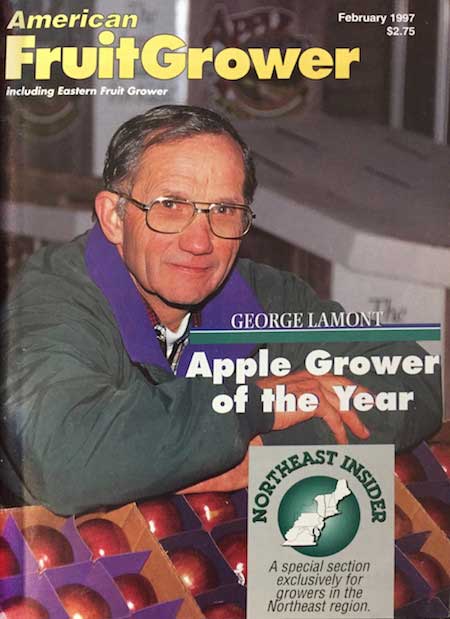
George Lamont was recognized as the Apple Grower of the Year in 1997 by the American Fruit Grower magazine.
ALBION – The apple industry is mourning George Lamont, an Albion grower who was a key leader locally, state-wide and nationally.
Lamont was influential in the start of the Lake Ontario Fruit packing house on Ridge Road in Gaines in 1982. That business joined several local apple growers in a joint facility for storage and packing.
Before Lake Ontario Fruit, local growers either had their own storage facilities, or needed to drive their apples to packing houses outside the county.
Lamont, who was 83 when he died on March 13 at his retirement home at Saranac Lake, was able to get several local apple farmers to work together in the venture on Ridge Road. The facility is now a leader in the state for storing and packing apples, utilizing the latest in technology to ship high-quality apples.
“He was a tremendous leader for all of agriculture at local, state and national levels,” said Eric Brown, one of the partners at Lake Ontario Fruit and co-owner of Orchard Dale Fruit Company in Waterport. “He was very industry focused, rather than on the individual. He didn’t just do things to advance his business. He did it for everyone’s business.”
Lamont served as president of the New York Horticultural Society, which works to advance the fruit industry.
His greatest contribution to the industry may have been in helping to create the Premier Apple Cooperative, which included apple growers east of the Mississippi. In the late 1990s, Lamont was able to bring together growers from many states in a plan for marketing their crop.
The Premier Apple Cooperative helped growers plan what to grow and sell, and ultimately led to a higher price returned for the farmers at a time when the industry was really struggling.
Lamont, in a quiet and unassuming manner, managed to bring people, often with strong personalities, together for a common goal.
“He wasn’t overbearing or loud,” Brown said. “He was very good at initiating and getting parties together.”
Rod Farrow was 20 when came from England to the Lamont farm on Densmore Road in 1980, looking to study fruit production. Farrow also studied in New Zealand, but returned to Orleans County in 1986 to work with Lamont. Farrow would eventually become the owner of Lamont Fruit Farm. Farrow also is an industry leader and was named the U.S. Apple Grower of Year in 2017.
Farrow said Lamont made a tremendous difference in for apple growers.
“He wasn’t just a local mover and shaker,” Farrow said. “He made an impact nationally.”
George Lamont
The Premier Apple Cooperative is Lamont’s “signature legacy,” Farrow said about an organization that has made a major difference for apple growers, boosting their bottom lines and fostering a spirit of teamwork among the farmers.
“It changed the way people communicated,” Farrow said. “They were all fierce competitors with each other. He got them to work together.”
In the 1990s, the apple industry was in “terrible shape,” Farrow said. The industry was in much better condition in the first decade of the 2000s through the work of organizations like the Premier Apple Cooperative.
Lamont in the late 1990s, largely stepped back from farming and devoted himself to leading groups on behalf of the industry – in unpaid roles.
Farrow spent 30 years with Lamont, seeing him nearly every day. Farrow even lived with Lamont his first year in Albion. Farrow said Lamont was like a second father. “He welcomed me with open arms.”
Lamont enjoyed life in the Adirondacks at Saranac Lake, where he went kayaking, skiing and for long walks. He died after suffering a stroke. A memorial service will be in Albion at a later date to be announced with burial to be at Mount Albion Cemetery.
Industry leaders praise Lamont
Jim Allen, vice president of marketing for New York Apple Sales and the former president of the New York Apple Association, wrote this tribute:
“Of all George’s accomplishments, perhaps his greatest legacy will be his dedication to IMPROVING the HEALTH of the apple industry. He explored the strengths and weaknesses of how business happens and has happened for decades. He dared to suggest change and restructuring, and most important of all, collaboration within the industry. In the late ’90s and easy 2000’s, many believed that this was a radical approach.
After over a year of almost monthly strategic planning meetings with New York, George led a group of traditionally independent thinkers from all walks of the industry, to grasp the concept of collectively working together to change and improve the future of NY’s apple industry.
We New Yorkers can often be “set in our ways” and tend to follow our predecessors rather than choose to change, but George had the talent to identify weaknesses and offer a path to improvement. The industry started to react and changes were seen.
Getting New Yorkers to agree is one thing, but taking this direction across state lines, for the betterment of the domestic industry, was yet another difficult task, but not insurmountable for George.
As a result, the Premier Apple Cooperative was formed, covered the Eastern apple producing states. The simple objective was to remove any fragmentation of the industry by uniting as growers to develop an open dialog and willingness to work together, to accomplish mutually agreed upon goals. This concept was adopted in the East, Southeast, Midwest and Western apple growing regions.
George Lamont was a humble person who did not seek out or ask for attention or credit for his work. He never flaunted his success, instead letting the results speak for him. George, a good friend, used to say, “If necessary to remind others of what you have done, then that memory was not worth having.”
Julie Suarez, associate dean for Land-Grant Affairs for the College of Agriculture and Life Sciences at Cornell University, said Lamont, a 1957 Cornell graduate, was “a giant in the farm community.”
She offered this tribute:
“His kindness and good humor, while remaining steadfastly committed to the profitability of the apple industry, was legendary. Through the years, I always regarded George with awe. Here’s a man who grew up in the apple orchards of Orleans County, and proudly displayed photos of him as a 5-year-old kid on the back of a tractor – who developed a world view that influenced far more than just his own farm, and in fact, helped lead an entire industry through a crisis.
George’s leadership in helping to develop an ‘apple pricing cooperative’ to ensure transparency so that growers were not pitted against one another during the bleakest times of apple pricing in the retail environment probably helped many of New York’s apple farm families survive in a truly difficult time.
‘While a giant in the industry, George was always personally modest and humble, preferring not to have a spot light trained on him and instead, shining that light right back into the community of NYS apple farmers seeking a better path to profitability, innovation and success.’
His strong support of ag research at Cornell helped generate new resources for faculty to work on systems that are now industry standards, such as spindle trellising and the new branded apple varieties for NY growers RubyFrost and SnapDragon. He revived the NYS Horticulture Association, making sure that growers had a specific organization dedicated to pursuing apple industry success in NYS.”
And throughout all of his leadership within the industry, George took the time to be a mentor, passing on his skills and his passion for farming in New York State to everyone he encountered. While a giant in the industry, George was always personally modest and humble, preferring not to have a spot light trained on him and instead, shining that light right back into the community of NYS apple farmers seeking a better path to profitability, innovation and success.
The food and farm community lost a wonderful friend and colleague, and while deeply mourning his passing, I am heartened with the legacy he leaves behind in the form of the many people whose lives he touched and made a little bit brighter. George’s life is a lesson in service and care for others and in these currently troubling times, his legacy should hopefully inspire us all to leave the food and farm community a little better than we found it.”
Photo by Tom Rivers: The Lamont family celebrated the 200th anniversary of the family farm during a celebration on Aug. 15, 2015. George Lamont is at far right, speaking when a historical marker was unveiled for Josias LaMont, the first generation of LaMonts to be born in the US. He moved his young family to Orleans County in 1815 and purchased a 140-acre farm in the Town of Gaines from the Holland Land Company. George and his brother Roger have been prominent local apple growers and industry leaders. Roger spelled his last name with a capital M in LaMont while George used a lower-case m. During the bicentennial celebration in 2015, Lamont said keeping the farm in the family six generations and for 200 years “takes more guts than brains.”
Lamont had the vision for Oak Orchard Health
Lamont also was instrumental in the start of Oak Orchard Health, which originally was focused on the healthcare of farmworkers. It started at a storefront in Albion in 1966.
Oak Orchard Health is now offering healthcare, dental and vision to the general population. Oak Orchard Health has locations in Albion, Lyndonville, Brockport, Warsaw and Hornell.
Dr. Jim Goetz started as a pediatric doctor at Oak Orchard in 1978 and served as the organization’s medical director for 30 years.
Goetz offered this tribute about Lamont and his impact on Oak Orchard Health:
“George dedicated the necessary time to not only open the doors of the Albion storefront on Main Street for migrant health services,” Goetz said. “It was also necessary to forge an alliance with the University of Rochester which was truly required. While the focus was on medical services to the agricultural workers in our area, George opened such an important avenue for the expansion of Oak Orchard Health to what it has become today. None of this could have happened without his vision and skills.”
“George was one of the early visionaries of Oak Orchard Health. Because of his knowledge and understanding of the needs of migrant farmworkers and his strong belief in quality health care for all people, he agreed, in 1973, to become the Health Center’s second Chairman of the Board of Directors. He served in that capacity for six years then spent another 11 years on Oak Orchard’s Board advocating for quality, comprehensive health service s in western Monroe County and eastern Orleans County.
“The early days of Oak Orchard were tumultuous in that at the time the local medical community was distrustful of this new model of health care but, with the support, advocacy and strength of conviction of Mr. Lamont and others, Oak Orchard got through those years and is now a leader in health services in the area.
“It is said that the only way that things get accomplished is through the work of dedicated individuals. George Lamont is the epitome of that philosophy and it is upon the foundation that he helped lay that the present Oak Orchard Health now stands.”
‘In these tough economic times, we must make sure rural communities get their fair share of federal and state dollars.’ – Sen. Kirsten Gillibrand.
Press Release, U.S. Sen. Kirsten Gillibrand
WASHINGTON, D.C. – U.S. Senator Kirsten Gillibrand today unveiled a new guidebook to help agriculture and rural development organizations access federal and state grant money.
Through Senator Gillibrand’s guidebook, agriculture and rural development organizations can access critical information to help them navigate the grant application process, including what the programs are, who is eligible, the terms, and how the funds may be used. By utilizing federal and state grants, organizations throughout New York can provide additional services to communities.
“In these tough economic times, we must make sure rural communities get their fair share of federal and state dollars,” said Senator Gillibrand. “By giving our agricultural and rural communities the resources they need to access federal and state grants, we’ll strengthen our economic growth efforts, create jobs and provide much-needed infrastructure development. These federal dollars will support critical services for our families and strengthen our rural communities.”
This book is a resource to navigate funding from the USDA, Dept. of Commerce, Dept. of Education, Dept. of Health and Human Services, Dept. of Housing and Urban Development, Dept. of Transportation, Appalachian Regional Commission, and Northern Border Regional Commission. It also helps navigate funding from New York State. It may be used in conjunction with any other grant guides from Senator Gillibrand’s office as well – such as the broadband guidebook.
A broad range of federal and state grants are available to help agricultural and rural communities deliver services to families and communities, including local economic development projects, housing assistance programs, infrastructure services, education development programs and health care services for rural communities.
The guidebook is the latest in a series to provide community organizations, state and local governments, schools and law enforcement agencies with the resources they need to access federal funding, in order to prevent cuts to services, to save and create jobs, and to create opportunities to improve the lives of all New Yorkers.
A copy of Senator Gillibrand’s guidebook for Agriculture and Rural Development can be downloaded by clicking here.
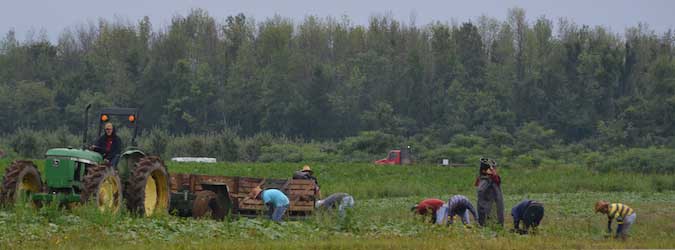
Photo by Tom Rivers: Farmworkers harvest vegetables last August by Townline Road in Barre.
By Tom Rivers, Editor Posted 25 February 2020 at 6:20 pm
New legislation on Jan. 1 gives overtime wages for farmworkers after 60 hours in a week
BATAVIA – New state legislation started on Jan. 1 that gives overtime wages to farmworkers after 60 hours in a week. This is the first time farmworkers have had overtime pay.
State Labor Commissioner Roberta Reardon announced on Monday she will convene a wage board for farm laborers that will hold hearings, review and make recommendations regarding overtime work for farm laborers in New York State. That could include requests to reduce the number of hours worked in a week for farm laborers to qualify for overtime.
There will be public hearings at five locations in the state, including one at 11 a.m. April 23 in Batavia at Genesee Community College, at the William Stuart Forum, 1 College Rd. (Click here to register to speak at the hearing and see other hearing locations.)
Under the Farm Laborers Fair Labor Practices Act, which Governor Andrew M. Cuomo signed into law last year, the wage board will consider and make recommendations as to overtime work and, specifically, will hear testimony about reducing the threshold for overtime below 60 hours per week and whether to do so in phases.
“We worked hard to ensure this bill included the proper labor protections and benefits that our farm laborers are entitled to,” said Commissioner Reardon. “We have an opportunity to improve the quality of life for tens of thousands of farmworkers. Overtime is a key component and we need to get it right.”
The Wage Board includes the following members:
• David Fisher, President of the New York Farm Bureau
• Denis Hughes, former President of the New York State AFL-CIO
• Brenda McDuffie, President of the Buffalo Urban League
Fisher, as president of NY Farm Bureau, released the following statement:
“What will be especially challenging for farmers and their employees alike is the timing of the statutorily required hearings. The law directs the Wage Board to hold its first meeting by March 1 with a report due by December of this year. It will be incredibly difficult for board members to reasonably determine if the overtime threshold should be justifiably lowered.
“Farmers have just started to implement changes on their farms to comply with the new law and are still determining what is best for their small businesses and employees. Further, crops are not even in the ground for the spring planting season, let alone having no real-world examples of how this new law will impact harvest season. This short window of time also does not allow any ability to see how different growing conditions due to extreme weather can impact overtime needs.
“New York Farm Bureau strongly believes it will take data from multiple growing seasons to appropriately evaluate the economic realities and labor challenges facing New York agriculture as a result of the new overtime threshold implemented only weeks ago. And until that can happen, it should not be lowered.
“New York Farm Bureau appreciates that the Department of Labor accepted our organization’s suggestion to hold the Wage Board hearings in areas of the state that provide easier access for the farming community to attend. We highly encourage our members to take the time to speak at one of the hearings or submit public comments to help better inform the Wage Board members.”
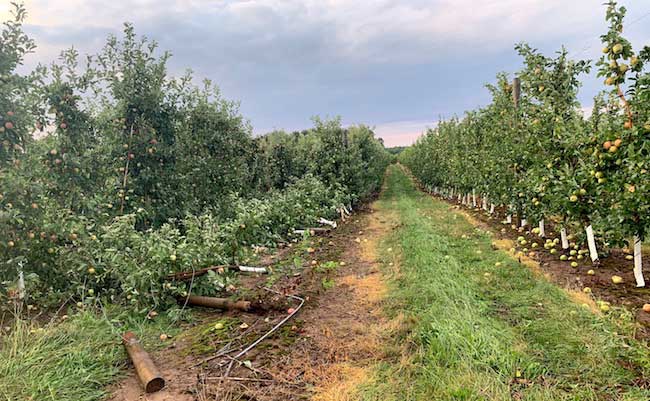
Photo courtesy of Adam Krenning: Powerful winds on Aug. 16 snapped apple trees that were in a trellis system on Howlett Road in Knowlesville. A big chunk of the apple crop was damaged and destroyed in Knowlesville by the wind and hail.
Staff Reports Posted 14 February 2020 at 10:08 am
Hail and wind ruined big chunk of apple crop in Knowlesville
Orleans County farmers and small businesses hurt by an Aug. 16 hail and wind storm are encouraged to seek low-interest loans from the U.S. Small Business Administration.
The SBA announced it is making Working Capital Disaster Loans available to small businesses, small agricultural cooperatives, small businesses engaged in aquaculture and private nonprofit organizations located in New York as a result of hail on August 15-16.
The loans are available in the following counties: Cayuga, Cortland, Genesee, Madison, Monroe, Niagara Onondaga, Orleans and Oswego in New York, the SBA announced.
Under this declaration, the SBA’s Economic Injury Disaster Loan program is available to eligible farm-related and nonfarm-related entities that suffered financial losses as a direct result of this disaster. With the exception of aquaculture enterprises, SBA cannot provide disaster loans to agricultural producers, farmers and ranchers.
The loan amount can be up to $2 million with interest rates of 4 percent for small businesses and 2.75 percent for private nonprofit organizations, with terms up to 30 years. The SBA determines eligibility based on the size of the applicant, type of activity and its financial resources. Loan amounts and terms are set by the SBA and are based on each applicant’s financial condition. These working capital loans may be used to pay fixed debts, payroll, accounts payable, and other bills that could have been paid had the disaster not occurred. The loans are not intended to replace lost sales or profits.
Applicants may apply online using the Electronic Loan Application (ELA) via SBA’s secure website at Disasterloan.sba.gov.
Disaster loan information and application forms may also be obtained by calling the SBA’s Customer Service Center at 800-659-2955 (800-877-8339 for the deaf and hard-of-hearing) or by sending an email to disastercustomerservice@sba.gov. Loan applications can be downloaded from www.sba.gov. Completed applications should be mailed to: U.S. Small Business Administration, Processing and Disbursement Center, 14925 Kingsport Road, Fort Worth, TX 76155.
Submit completed loan applications to SBA no later than Oct. 5, 2020.
Photo by Tom Rivers: A utility pole was knocked down by strong winds on Aug. 16 in Carlton on Winding Road, near Lake Ontario, just north of Kuckville.
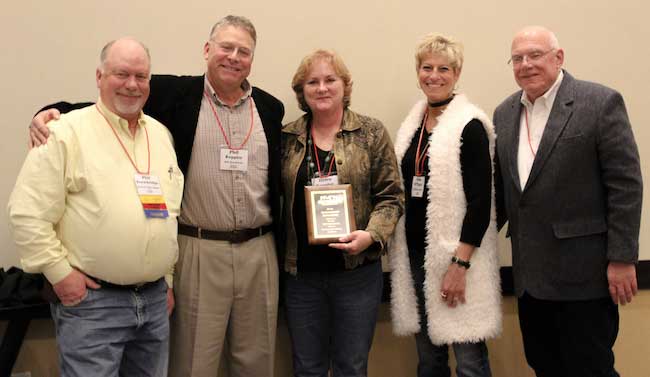
Provided photo: Pictured from left include: NY Beef Producers’ Association President Phil Trowbridge, SK Herefords partners Phil & Dawn Keppler, New York Beef Council Executive Director Jean O’Toole, and SK Herefords partner Dave Schubel.
Press Release, New York Beef Council
MEDINA – SK Herefords, LLC in Medina was presented with the Environmental Stewardship Award at the New York Beef Producers’ Association 2020 Annual Winter Conference.
This award was presented during the council’s annual meeting in Syracuse. The award was established to recognize the outstanding stewardship practices and conservation achievements of a New York beef producer.
The winner of this award is commended for their commitment to protecting the environment and improving fish and wildlife habitats while operating profitable cattle operations. The winner will be nominated for regional recognition through the National Cattlemen’s Beef Association.
SK Herefords is a family cattle operation which includes a long-standing partnership between Dave Schubel, Dawn & Phil Keppler, and Alana Welker and family. The operation consists of approximately 1,200 acres of pasture, row crops, and woodland. SK Herefords calves nearly 250 females every spring.
SK Herefords produces feed for their cattle on their farm, growing acres of corn hay and pasture. The corn is harvested for grain or chopped for silage for the cows to eat during the winter. As big believers in planting cover crops and following no till practices for almost four decades, SK Herefords covers their corn fields in cereal rye after harvesting.
“It really helps cut down on erosion and improve the health of our soil,” Phil Keppler said.
SK Herefords has passionately worked to develop the wildlife on their farm. Woodlot management techniques are implemented to optimize forest health, productivity and protective habitat.
Fostering healthy pasture and crop land is important to them, as is providing natural habitat for birds. In fact, each year hay harvest is delayed allowing grass nesting songbirds to fledge out. A parcel of hay ground is left unharvested each year to provide a protected habitat for the birds. The farm is located within the Atlantic flyway. Fostering habitats for the birds, this flyway means that a visit to the farm can provide opportunity to see dozens of different species of birds throughout the year during migration seasons.
In addition, the Oak Orchard Creek, part of the Great Lakes Ontario Watershed, runs through the farm. Buffer zones have been implemented to protect the water from runoff and cattle have been fenced out of the creek. These management practices are essential in assuring the quality of the water which feeds into a world-class trout fishery, a popular recreation area for brown and rainbow trout.
Implementing new practices and approaches on the farm is an important cornerstone of the farm philosophy at SK Herefords. When asked what Phil’s view on the future of agriculture was and how creativity plays into it, he shared, “Creativity is desperately needed in agriculture, let’s focus on solutions, let’s get creative, that’s what makes things work. Creativity helps you look at things not as being a problem, but helps you find the solution and that’s the exciting thing. Creativity gives you hope and that is the most important thing in life-hope.”
The common trait among all Environmental Stewardship Award winners is the desire to leave the land in better shape for future generations while also inspiring the next generation of land stewards. SK Herefords LLC. exemplifies these traits. The New York Beef Council and New York Beef Producers’ Association are thrilled to honor this exemplary farm.
You’re here checking the site, so you know: Orleans Hub is a vital resource for our community. Day in and day out, we share information and insights that matter to those who live and work in the towns, villages and hamlets of our county. Local advertisers help make the Hub possible, and so can you.
Donate today to keep Orleans Hub healthy and accessible to all. Thank you!
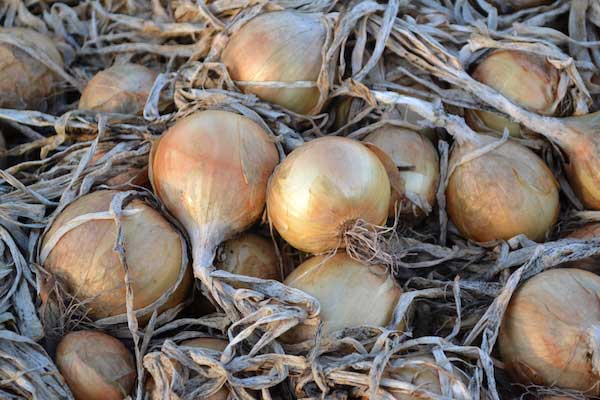
Photo by Tom Rivers: Some local onions from the Elba muck are shown in this photo.
Press Release, U.S. Senators Kirsten Gillibrand and Charles Schumer
WASHINGTON, D.C. —U.S. Senator Kirsten Gillibrand and Senate Minority Leader Chuck Schumer are calling for investigations into unfair trade subsidies to Canadian growers, as New York State onion farmers struggle against an influx of produce, priced below the price of production, coming across the border.
“New York State is home to prime onion-producing land, yet our farmers are unable to sell their goods in a domestic market that is flooded by cheap Canadian exports,” said Senator Gillibrand, a member of the Senate Agriculture Committee. “Farmers across the country have been struggling to keep up with growing production costs, while Canadian exporters have been able to dump cheap onions onto the market at prices comparable to 30 years ago.
“Since Canada has similar production costs, the only way this could be happening is through some type of government subsidy that is lowering their costs,” Gillibrand said. “This would amount to an unfair trade practice and needs to be immediately investigated. I stand with the National Onion Association in calling on the U.S. International Trade Commission and the United States Trade Representative for a full review of Canadian pricing, subsidies and exporting practices.”
New York State is home to Orange County’s famous “Black Dirt” Region, one of the premier onion-producing regions in the nation. Yet, New York farmers, including those who grow highly-prized black-dirt onions, are being forced to sell produce at market prices comparable to the 1980s.
Data from the U.S. Department of Agriculture shows that Orange County onion growers received between $5.25 and 5.75 for a 50-pound bag of medium yellow onions, which would amount to around $13.00 or $14.00 today. Today, those farmers are offered only $7.00 per 50-pound bag, less than $2.00 more than what they were paid nearly 30 years ago.
“Some of the best onions in the country come right from Orange County’s Black Dirt region, as well as from other upstate counties,” Schumer said. “However, due to Canada’s suspected unfair pricing practices, cheap Canadian onions are flooding United States markets and leaving New York onion farmers at a steep competitive disadvantage.
“As costs of production, labor, and equipment continue to rise, it’s time for the US International Trade Commission and US Trade Representative to immediately investigate Canadian onion exporters’ pricing practices along with the Canadian government’s trade regulations and level the playing field once and for all, allowing New York farmers to finally harvest the massive potential of their onions.”
Gillibrand’s and Schumer’s push for an investigation into the onion industry will help identify which factors contribute to unfair prices and ensure increased market transparency.
The two senators from New York sent a letter on Feb. 6 to the U.S. International Trade Commission and the United States Trade Representative.
In their letter, the senators asked for the following:
1. Initiate a fact-finding investigation into the alleged unfair pricing practices of Canadian onion exporters, including:
a. A review of any potential anti-competitive pricing practices, including the sale of Canadian onions in the U.S. market at prices below the cost of production;
b. A comparison of U.S. and Canadian tariffs and nontariff trade regulations that apply to onions; and
c. A review of Canadian government subsidy programs that support reducing the costs of shipping, fuel, imported seed and farm inputs, or crop price guarantees relating to onions through either country-wide or provincial-level support, or any other market-distorting practices;
2. Keep their offices apprised of any findings that result from such an investigation; and
3. Work in tandem with other relevant U.S. government entities, including the Office of the United States Trade Representative as the agency moves to implement and enforce obligations as part of the United States-Mexico-Canada Agreement (USMCA) and other international trade agreements, to address and rectify any discriminatory pricing or other unfair trade practices relating to Canadian onion imports.
By Tom Rivers, Editor Posted 1 February 2020 at 8:31 am
Provided photo: Adam Kirby, left, and Robin Root hold the trophies for winning the yield contests through the New York Corn & Soybean Growers Association.
SYRACUSE – The New York Corn & Soybean Growers Association honored two farmers from Orleans County for having the highest yields in the association’s annual corn and soybean contests.
Adam Kirby of Albion won the corn yield competition with an entry of 277.44 bushels per acre.
Root Brothers Farm in Albion had the top soybean yield with 80.56 bushels per acre. Robin Root accepted the trophy on behalf of Root Brothers.
The two farms were recognized on Jan. 23 during the New York Corn & Soybean Growers Association’s annual Winter Expo in Syracuse.
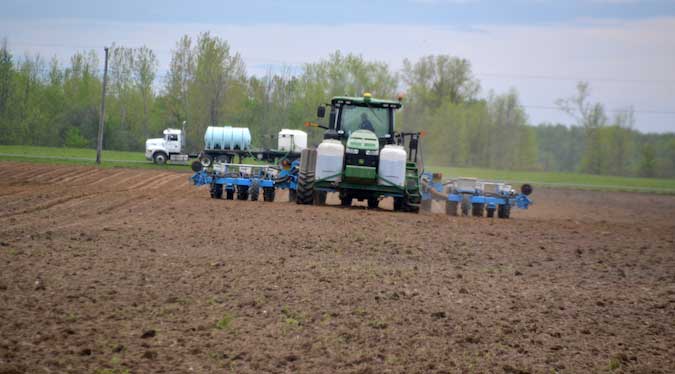
Photo by Tom Rivers: A farmer plants seeds in late May in Carlton on Waterport-Carlton Road. That sunny day gave farmers a chance to get their big equipment out in the fields.
By Tom Rivers, Editor Posted 31 January 2020 at 2:17 pm
WASHINGTON, D.C. – Orleans County has been named one of 43 counties in the state approved as a natural disaster designation after suffering heavy rains and severe flooding during the 2019 farming season.
This designation allows communities hurt by extreme weather to access certain federal assistance, such as emergency loans and other aid programs, from the Farm Service Agency (FSA) to help recover their losses.
In Orleans, there are usually about 125,000 acres planted each year with corn and soybeans. The wet spring delayed planting with farmers deciding not to plant 23,170 acres, according to the Farm Service Agency in Orleans County. There were about 90,000 acres that went unplanted in Orleans, Genesee, Niagara and Monroe counties, said Larry Meyer, FAS director.
The disaster declaration includes the following counties: Albany, Allegany, Cattaraugus, Cayuga, Chautauqua, Chemung, Chenango, Clinton, Columbia, Delaware, Erie, Essex, Franklin, Fulton, Genesee, Greene, Hamilton, Herkimer, Jefferson, Lewis, Livingston, Madison, Monroe, Montgomery, Niagara, Oneida, Onondaga, Ontario, Orleans, Oswego, Otsego, Rensselaer, Saratoga, Schenectady, Schoharie, Schuler, Seneca, Steuben, Sullivan, Tioga, Washington, Wyoming and Yates, which were designated primary natural disaster areas and farm operators in these counties are eligible for FSA emergency loans, provided they meet other requirements.
Additionally, farm operators in Broome, Cortland, Dutchess, Orange, St. Lawrence, Tompkins, Ulster, Warren, and Wayne counties are also eligible for assistance.
U.S. Senators Charles Schumer and Kirsten Gillibrand announced the declaration today.
“After weathering a brutal farming season last year, the USDA’s disaster designation will provide much needed assistance to farmers and growers throughout Upstate New York,” said Senator Charles Schumer. “From corner to corner of the state, I have seen firsthand the aftermath of last year’s severe rain and flooding. Thankfully, this disaster declaration means our Upstate farmers and growers will have access to critical emergency loans and more, at a time when they need it the most.”
USDA offers a variety of programs and services to help communities, farmers, ranchers, and businesses recover from production and physical losses due to drought, flooding, and other natural disasters. Click here for more information on the federal disaster programs to assist farmers.
“I’m pleased that the USDA has approved natural disaster designations across Upstate New York for counties that suffered extensive damage due to severe weather during last year’s farming season,” said Senator Gillibrand, member of the Senate Agriculture Committee. “This will allow FSA emergency loans and other assistance to flow to communities that need it. New York has a strong farming tradition, and it is past time for our farmers to get the help they need to recover. I will always do everything I can to ensure that New Yorkers have the resources to rebuild.”
Governor Andrew M. Cuomo announced the FY 2021 Executive Budget includes an expansion of the current income exclusion for farmers and sole proprietors and an expansion of the refundability of the investment tax credit so that more farming businesses can qualify.
“Agriculture remains a key industry in New York and we are committed to helping the farmers who help all of us put food on the table,” Governor Cuomo said. “These businesses are economic engines for their local communities, and with these key reforms, we are investing in a stronger Empire State for all.”
The Executive Budget triples the existing sole proprietor and farm business income AGI subtraction from 5 percent to 15 percent. This will further uplift small businesses that have an annual income of $250,000 or less and are paying taxes through personal income tax.
The budget also expands the refundability of the investment tax credit, which is currently offered only to new businesses, so that all taxpayers whose primary source of income is from farming operations can qualify, allowing them to receive the full benefit of their credits earned.
Building on these important tax benefits, the budget continues to support the agricultural industry at significant levels through local assistance funding. The Governor has proposed a budget of $27.4 million to ensure the future of New York State agriculture.
This funding is integral to the success of a number of programs that provide specialized technical assistance, research, agricultural education, workforce development, and marketing initiatives for the agricultural community. These include the NY FFA, Pro-Dairy, commodity-specific research and development at Cornell, funding for the Farm-to-School program, and more.
The Executive Budget would raise the spending threshold for school districts procuring local food for breakfast and lunch through the federal Child Nutrition Programs. This change will give schools more flexibility in realizing the Governor’s goal for schools to source 30 percent of their menu items from local farms as part of the No Student Goes Hungry initiative.


















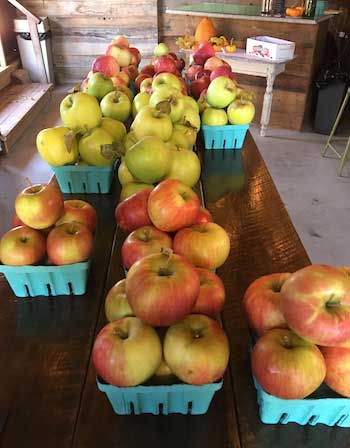 My study investigated farmers’, restaurateurs’, and chefs’ beliefs about the definition of local food, as well as how local food contributes to the local economy, community, overall health, and the quality of food. To my surprise, the current definition of “local” is very vague. U.S. Congress in the Food, Conservation, and Energy Act defines a “locally produced agricultural food product” as “any agricultural food product that is raised, produced, and distributed in (1) the locality or region in which the final product is marketed, so that the total distance the product is transported is less than 400 miles from the origin of the product, or (2) the State in which the product is produced.”
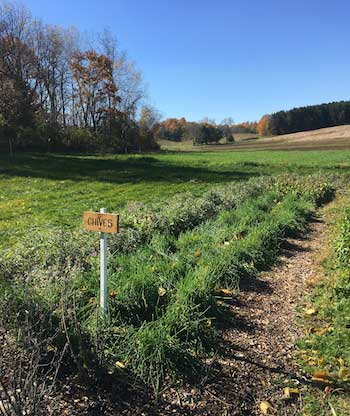 These findings suggest that local cannot be defined according to distance without also addressing the personal and community-based connection to local food. Both participant groups conveyed that local food is within reach and familiar to them.