













Page Sponsor





Editor:
I am writing to encourage residents, veterans, and local organizations to petition Orleans County school districts to hold public hearings on the newly authorized property tax exemption for permanently and totally disabled veterans under New York State Real Property Tax Law §458-a(11).
This legislation gives local governments and school districts the authority to provide a full property tax exemption to qualifying veterans who have been permanently and totally disabled as a result of their military service. However, each taxing jurisdiction must decide whether to adopt it.
Monroe County has already adopted the exemption, and some school districts have begun taking action. Yet here in Orleans County, there has been little public discussion about whether our school districts intend to offer this benefit.
I am a permanently and totally disabled combat veteran who served in Iraq. I live within the Kendall Central School District, which does not currently participate in the Alternative Veterans’ Exemption. I recently contacted the district’s Board of Education president to ask whether the new exemption had been discussed or would be considered. I was informed that the board had not discussed it and that there was no timeline for doing so.
This raises a larger question: Why should disabled veterans have to appear personally before a school board just to get elected officials to discuss a benefit that the state has already authorized?
Many permanently and totally disabled veterans live with serious physical injuries, PTSD, anxiety, and other service-connected disabilities. For some, appearing before a room full of people to publicly discuss their disabilities or advocate for themselves can be extremely difficult.
These veterans have already demonstrated their disabilities through the Department of Veterans Affairs. They should not have to stand before another government body and explain why their sacrifices deserve consideration.
I recognize that adopting this exemption has financial implications for school districts and taxpayers. Those implications deserve an open and informed discussion. That is precisely why I believe public hearings are appropriate.
I am calling on the Boards of Education in Kendall, Albion, Holley, Lyndonville and Medina to publicly consider this exemption, hold hearings, and give residents an opportunity to understand its potential benefits and costs.
I also encourage local veterans’ organizations, including VFW and American Legion posts, to help organize petitions and advocate for these discussions.
This is not a demand that school districts automatically approve the exemption. It is a request that they put the issue on their agendas, examine the facts, and make a decision in public.
Our disabled veterans should not have to fight another battle simply to have their needs considered.
Respectfully,
Dan Brundage
Kendall Central School District resident
Iraq War veteran
Photos by Tom Rivers
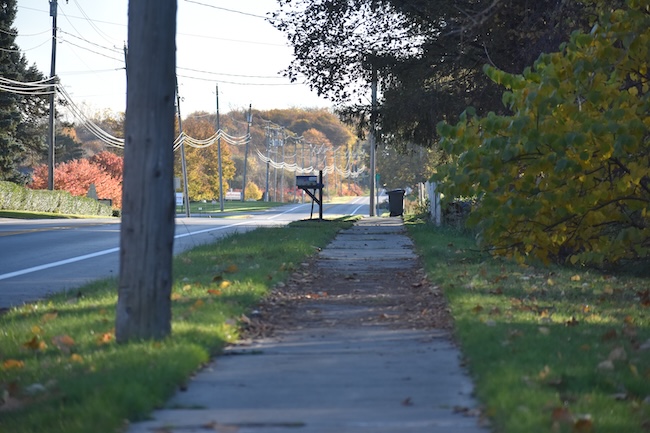
ALBION – Sidewalks run along the south side of East Avenue but stop across the road from St. Joseph’s Catholic Cemetery.
Albion town officials would like to see a joint project with the town and village to extend sidewalks to the Butts Road intersection and then going north on Butts past a healthcare site and then to a UConnectCare residence.
The Albion Town Board discussed the issue during its board meeting on Monday evening. The board said it will reach out to the village about a joint effort, and also see if there is any state funding to help with the sidewalk.
Mike Neidert, the Albion town highway superintendent, said he the sidewalks would be safer for pedestrians and people using scooters and wheelchairs to go to the healthcare facility and UConnectCare.
“This would be a great project,” he said. “There are a lot of pluses.”
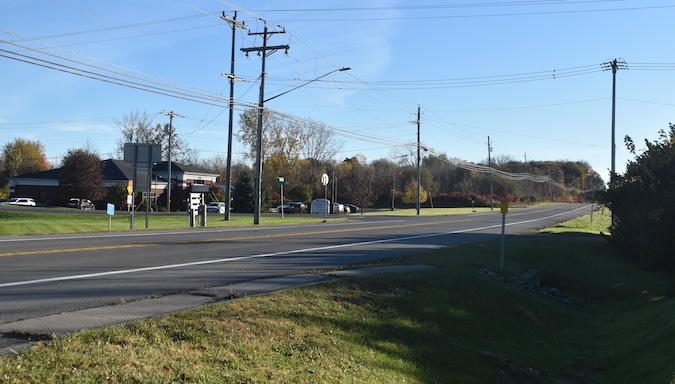
Orleans Community Health in 2012 opened the healthcare center at the northeast corner of Butts Road and Route 31.
UConnectCare last November opened a residence that can serve up to 25 women including 5 bedrooms for women with young children.
Neidert said both UConnectCare and Orleans Community Health would like an extended sidewalk down Route 31 and on the section of Butts Road, as well as a crosswalk at the intersection.
The highway superintendent said the town and village could discuss having mucnipal employees install the sidewalks. He estimated there would be about 600 feet of sidewalks that the town would be responsible for, while the village would have about 1,500 feet.
He would like to see the town and village leaders reach out to Assemblyman Steve Hawley and State Sen. Rob Ortt to see if they could secure funding for materials for the sidewalks. He estimated the materials for 600 feet of sidewalks for the town’s portion would be about $10,000.
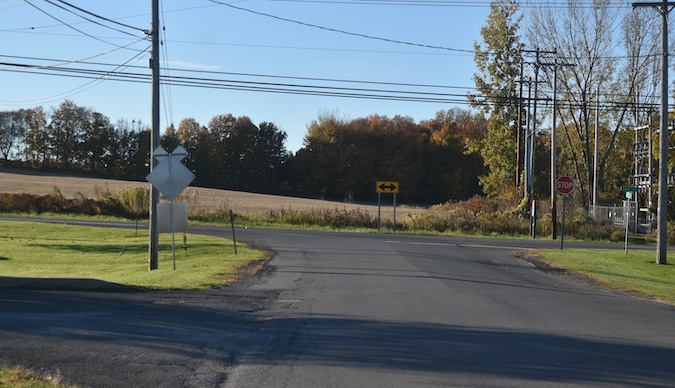
Mike Neidert, the Albion highway superintendent, would also like a cross walk at the intersection.
Editor:
My name is Kathy Harnischfeger, and I am a write-in candidate for Clarendon Town Supervisor.
I am writing in response to the SCOPE article. If elected, I will take seriously my oath to uphold the Constitution and will base my decisions on evidence, facts, and the best interests of our community—not on personal opinion.
I did not attend the SCOPE debate or respond to Mark Allen’s questionnaire because I have been focused on listening directly to residents and understanding their concerns through my door-to-door campaigning.
Across the community, people have consistently raised issues such as high taxes, rising energy costs, public safety, sewer infrastructure, and other local priorities. The Second Amendment has not been among the concerns most frequently raised with me.
For the record, I am a gun owner and support the right to bear arms. I also strongly support the First Amendment freedom of speech. These rights carry important responsibilities, and they should be approached with care and respect.
I encourage Clarendon voters to look beyond distractions and misinformation and to focus on the facts. This is an important moment for our community and an opportunity to demonstrate our commitment to honest, responsible local government.
Every eligible voter has a voice in Clarendon’s future. Please make a plan to vote and participate in this important election.
Sincerely,
Kathy Harnischfeger
Clarendon
Top seeded Wilson blanked visiting No. 5 Randolph 2-0 Monday evening in the semifinals of the Section VI Class C boys soccer playoffs.
Gage Gailie and Hayden Fellows scored the goals for Niagara-Orleans League champion Wilson which improves to 16-1-1.
The Lakemen will now face No. 2 seed Ellicottville-Franklinville in the championship game on Friday at 7:30 p.m. at Hamburg.
Ellicottville-Franklinville downed No. 3 seed Westfield-Brocton 3-0 in the other semifinals.
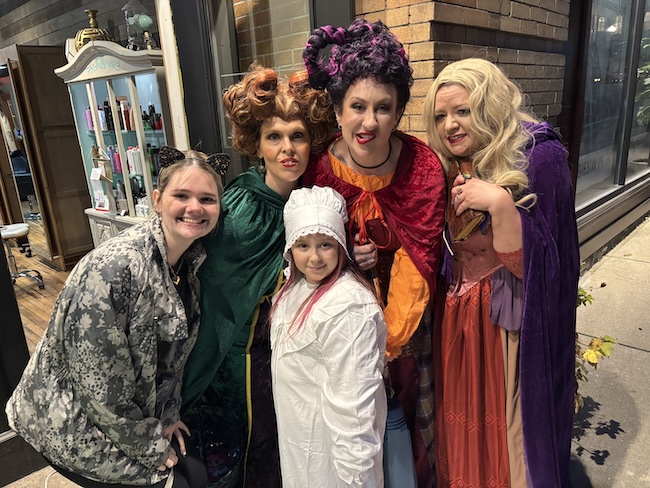
Photos by Tom Rivers: During Beggar’s Night last year on Oct. 25, the Fringe not only passed out candy but dressed up as characters from Hocus Pocus. In front, Khloe Mank, 9, is Emily Binx. In back from left are Leah Printup as Thackery Binx (the iconic cat), Jennifer Printup as Winifred Sanderson, Amanda Mank as Mary Sanderson, and Vanessa Lhommedieu as Sarah Sanderson. Lhommedieu is owner of The Fringe.
It will be candy galore and many kids in costume during Beggar’s Night on Friday in the Albion and Medina downtown business districts, and then on Saturday in Holley for the Hallow Fest.
Hundreds of children are expected in the downtowns of all three villages for the events.
The Albion Merchants Association is organizing Beggar’s Night in Albion from 5 to 7 p.m. Many businesses and organizations will be giving out treats to children. There will be a bonus of 20 gold bars filled with candy and goodies to some of the kids in the best costumes.
There isn’t a specific starting spot. The trick or treating line goes in a loop. People can park behind the fire department, next to Courthouse Square or the small municipal lot on Platt Street.
Medina businesses will have Beggar’s Night from 5:30 to 7 p.m. The starting point is the Print Shop on East Center Street and attendees often line up through the parking lot behind the buildings.
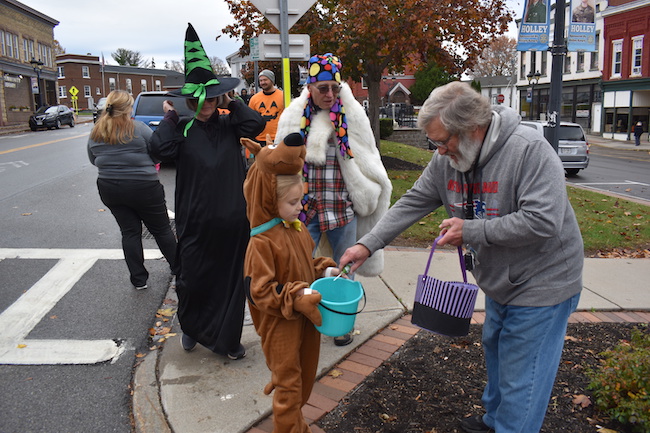
During Holley’s Hallow Fest in 2023, Bill Moroz hands out candy to Teagan, who dressed as Scooby Doo while joined by her grandparents, Tolanda and Dan Kronfield.
Holley will have its Fall Hallow Fest on Saturday with a costume parade at 10 a.m., with the lineup starting at 9:45 a.m. at the pharmacy.
There will be vendors from 10:30 a.m. to 3:30 p.m. at the American Legion and bounce houses at the old Holley High School. Trick or treating will be later throughout the village.
The Holley Police Department and Holley Volunteer Fire Department will be doing trunk or treat from 3 to 6 p.m. on Thomas Street between the police department and fire hall.
Community organizations and residents can set up a “trunk” beginning at 2 p.m. Contact Shannon at Smcmillion702@yahoo.com to reserve a spot. Trick or treaters are welcome in costume.
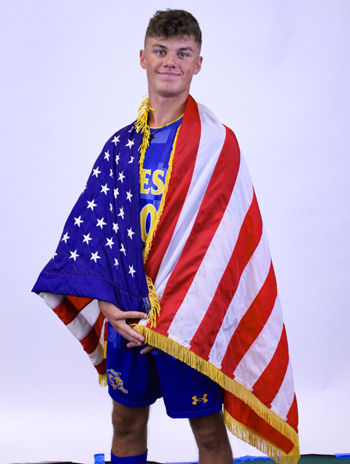
Photo by Ethan Heim – Austin Fonda posing with an American flag.
Press release from the Lyndonville School District
For more than 8 million high school students across the country, sports are a part of the high school experience. But for a much smaller percentage, those athletic careers continue beyond graduation.
For Austin Fonda, a 2026 graduate of Lyndonville Central School District, the final whistle of his high school career was not the end of his athletic journey. Instead, it marked the beginning of something new.
Fonda is now playing soccer at Genesee Community College (GCC), becoming just the second Lndonville student in a very long time to continue competing at the college level.
Although Fonda always hoped to play college sports, he originally imagined a different path. He planned to pursue baseball, but when that opportunity did not work out as expected, Fonda took a chance and tried out for the soccer team.
“I’ve had a lot of people, even opposing coaches, tell me that I could go further in soccer if I wanted to,” he said.
That chance changed the direction of his athletic career.
For Fonda, becoming a college athlete is an accomplishment he once thought might be shared by more of his teammates.
“It felt surreal,” he said. “I didn’t realize I would be one of the few teammates to choose this route of college athletics.”
His path ultimately led him to Genesee Community College, but he is quick to point out that he did not get there alone.
Fonda said there are far too many special people to name when discussing those who have helped him reach this point, but his family is at the center of that support system.
“My family is my cornerstone,” he said.
His father encouraged him for years to get into the gym, work in the field and continue developing himself as an athlete day by day.Fonda also pointed to former Lyndonville coach Joe Smith as an important influence. Fonda played under Smith for three years and has continued to stay in touch with him. Smith also served as a reference when Fonda was pursuing college soccer.
“He was such a bright, good person,” Fonda said. “Talking to him will make you smile no matter what. It’s not a trait a lot of people have.”
Another coach left an especially lasting impression on Fonda: Wes Bradley.
Bradley was an important coach during Fonda’s junior year, and Fonda remembers attending Bradley’s wake during the season.
“He was someone I looked forward to seeing at practice every day,” Fonda said.
Bradley’s approach to coaching went beyond what happened during games. After every away game, Fonda recalled, Bradley would sit down with every player on the bus. He would shake each player’s hand and talk with them about what they had done well and what they could improve, often with his notepad in hand.Bradley remembered what players had worked on in practice and what they had learned from the people around them.
“He was very impactful on me,” Fonda said.
Those lessons continued through Fonda’s relationships with his teammates. He credits them with helping shape him into a better player and person, teaching him about patience, kindness, honesty, communication and taking responsibility for mistakes.
He also learned how important it is to control his emotions.
“You need to keep your emotions in at times,” Fonda said. “If it comes out on the field, you will pay for it. Your emotions have to be left on the bench so you don’t end up sitting with them on the bench.”
Instead of allowing frustration to spill over onto teammates, Fonda learned to step back and reflect, asking himself what he could do differently the next day, whether that meant improving hver time, those lessons in communication and leadership helped turn a group of teammates into something more.
“It’s family,” Fonda said. “A team doesn’t go to a wake. A family does. A group of brothers does. It’s not a group of people you see for two hours a day. It’s family.”
College soccer has brought a completely new experience, with higher expectations and more commitment.“It is fast-paced,” Fonda said. “Practices are quick and difficult.”
Fonda said the players often walk back to the dorms together after practice, laughing and spending time together.
“I love these guys,” he said. “I love being on the same pitch as them.”
One of the most unique aspects of playing at GCC is the international makeup of the team. Fonda is one of only three Americans on the roster, with players representing 12 countries.
Being one of the few Americans has put Fonda in the position of being the “odd one out,” something that is new for him. He has even been trying to learn different accents to communicate more effectively with his teammates on the field.
“It is such an enriching experience because there are so many different languages,” he said. “It is a whole new world to experience. And I am loving every second of it.”
While soccer has opened the door to college for Fonda, he already has his sights set on what comes next. After completing approximately 40 GCC credits while still in high school, he hopes to graduate this spring with his associate degree in Teaching Sciences.
He plans to take college tours in the fall as he searches for a school where he can continue his education, with the goal of eventually earning a degree in elementary education.
And while soccer has helped take him to college, Fonda believes its impact on his life goes far beyond athletics.
“Without soccer, I would be nowhere close to the person I am today,” he said. “The people you meet, the coaches, the teammates, even the opponents.”
That perspective is also at the heart of the advice he would give to younger athletes hoping to compete at the college level.
Fonda emphasizes commitment. His advice is simple: keep your head down, work hard and stay focused.
He remembers receiving an email while on vacation informing him that practice would begin at 5 p.m. Monday.
His response was simple: “Yes, Coach.”
Rather than treating vacation as an excuse to take time off, Fonda spent several days preparing himself.“I would run on the beach,” he said.
But commitment, he said, is only part of the equation. Athletes also need resilience.
“You have to want nothing more than to be on that field,” Fonda said. “You exercise and gain strength. Athleticism can come through genetics, but you still have to work for it.”
He learned the same lesson through injury. After taking a hard fall while playing basketball,
Fonda dealt with pain for weeks. Rather than stop exercising altogether, he found ways to continue training.
“If my lower body hurt, I would exercise my upper,” he said.
For Fonda, resilience is as much mental as it is physical.
“Your brain can be your strongest muscle if you use it right.”
Now, as he continues his college soccer career and looks ahead to a future in education, Fonda is carrying the lessons he learned in Lyndonville with him, including the importance of hard work, resilience, leadership and the people who make the journey worthwhile.
“I’m very grateful for this opportunity,” Fonda said. “I am proud of myself for the accomplishment, and I am thankful to everyone who has helped me along the way.”
Editor:
These are the times that try America’s soul.
Our great Republic is at a major fork in the road. One path is staying with our Constitution, Rule of Law, Free Market Capitalism and Individual freedoms. The other is for big government (Democratic Socialism), Rule by Law, government owning everything and people are nothing more than servants to the government with no individual freedoms.
The last time the socialist movement in America was this big was during the 1930s’ Depression. This election is critical to what path, as a nation, we will go down, affecting not only us but future generations of American. It is critical to the future of our nation that all American Patriots vote. Socialism has never worked. It is not utopia. It only leads to death, poverty and the collapse of the country.
When our nation was being founded, one vote decided our national language. If any one of those who voted for English had voted the other way we would be speaking German today.
In the 1960 Presidential Election, if Richard Nixon had received one more vote in each election district in Illinois, he would have been President. One more vote. Think how that would have changed our history.
Vietnam, JFK assassination, riots and protest of the sixties, Kent State would not have happened. Johnson would not have become President and one of the most destructive big government programs in American history, The Great Society, would not have happened. This program was the most socialist takeover by government since Roosevelt’s “New Deal.” It destroyed low-income families, created government housing that is nothing but cesspools for gangs, violence and drugs.
The Great Society was the biggest takeover of our health care system. This takeover cost Orleans County taxpayers $10 million a year. Be very careful who you vote into office. Just one more vote would have changed the history of our great Republic.
Unfortunately, too many people feel that their vote doesn’t count. The opposite is quite true, every vote does count. The whole of anything is made up of the sum of the parts. The final count of any election is made up of every individual vote. How would history have changed and made America different, if in any of the examples above one vote had been different?
When Election Day comes, remember your power to make a difference. Your vote is deciding the course of history and the direction of your country, either individual freedoms or servants to big government’s ruling class.
News media and polls want to demoralize you, to make you think the election have already been decided, to stop you from using your power. Statistics can be manipulated to get the results you want by manipulating the numbers and half-truths as facts. Don’t let a handful of people who control the news decide your fate. Take the horse by the reins and decide on your government’s future.
You have the freedom to decide which path our nation takes, to march into the future as free citizens or kneel beneath the boot heels of tyrants. Show the politicians that you are watching, because nothing scares them more. Everyone is equal inside that voting booth. Remember always, the real power of our country is in your vote!
Donald Allport
Gaines
Mr. Allport is an Orleans County legislator in an at-large district.
Northshore Fury AAU Basketball has announced plans to expand its program for Spring 2027. The program currently operates a team for 9th and 10th grade athletes and plans to add two additional teams: one for 7th and 8th grade players and another for 11th and 12th grade players.
Serving athletes from Orleans, Genesee, Monroe and Niagara counties, the Northshore Fury emphasizes player development, fundamentals, teamwork and competitive experience.
The Fury is seeking coaches for all three grade-level teams, welcoming both experienced coaches and individuals interested in learning and developing their coaching skills. Positions include monetary compensation and additional benefits. Activities are scheduled to begin in February 2027.
The expansion follows a successful start to the fall season, highlighted by an undefeated championship performance at the John Wilbur Memorial Classic and a second-place finish at the Jammin for a Cause Hoopfest in Rochester. The strong showings in consecutive tournaments reflect the program’s growing competitiveness and commitment to developing young basketball talent throughout Western New York.
The program’s long-term goal is to strengthen the region’s basketball footprint by providing young athletes with opportunities to develop their skills and ultimately contribute to stronger high school basketball programs throughout the four counties.
Coaches and families interested in joining Northshore Fury for Spring 2027 are encouraged to contact Joshua Dix by call or text at 585-356-6215 or by email at ocfuryhoops@gmail.com.
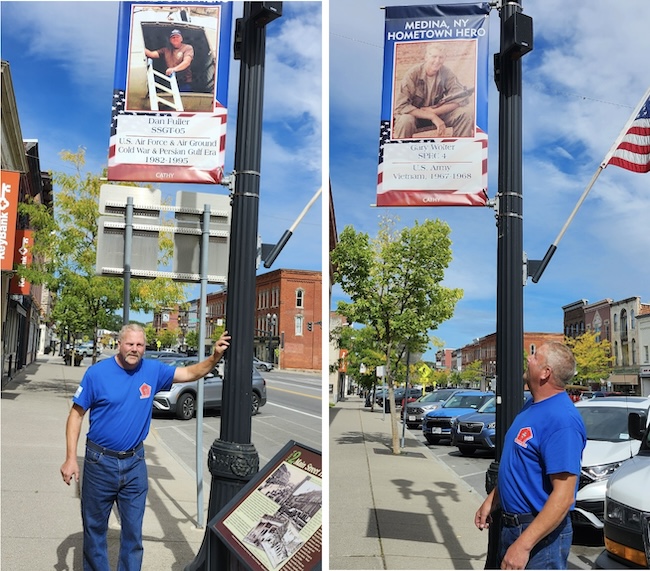
Photos by Ginny Kropf: (Left) Dan Fuller of Medina stands under his Hometown Heroes banner currently up on Main Street near the Presbyterian Church. He served with the U.S. Air Force and Air Ground during the Cold War and Persian Gulf era. (Right) Three members of Dan Fuller’s family have Hometown Heroes banners up this year. Here, Dan stands under the banner for his uncle Gary Wolter. Wolter served with the Army in Vietnam.
MEDINA – The banners for Hometown Heroes in Medina was started by Mary Woodruff after she saw a banner for her father-in-law while visiting his hometown in Alfred, south of Buffalo, in 2018.
She came home, presented the idea to the Village Board, and in 2019 Medina had its first Hometown Heroes’ banners. There were 38 in that first year. Banners are up for three years from around Memorial Day to just after Veterans’ Day, then they are returned to the family, Woodruff said. This year, the 2024 banners will be returned to the families.
The banners do more than showcase local heroes. For many of them, there is a story behind the banner.
Such is the case of Dan Fuller of Medina and his grandfather and uncle.
Fuller, commander of the Gasport American Legion, is one of 151 Hometown Heroes whose banners hang on the streets of Medina. Fuller served four years in Homestead Air Force Base as a radar repairman –and nine years at Niagara Falls with the Air National Guard.
Dan is a son of Paul Fuller, who was a corporal in the Air National Guard, serving from 1957 to 1963. What makes Fuller the proudest is his family’s history of serving their country. Not only does Fuller have a banner, but his uncle Gary Wolter and grandfather Harold Wolter also have banners hanging on Main Street, all sponsored by a family member who wished to remain anonymous.
Harold served in World War II as a nurse/field medic. He is a Purple Heart and Bronze Star recipient, having been a prisoner of war in Germany. He was called home after one year to run the family farm.
Dan’s Uncle Gary served from 1967-68 in Vietnam, and Gary’s son Chad was in the Marines.
Their ancestor Erastus Fuller served during the Civil War.
Dan has a long list of relatives who served their country, besides his uncle and grandfather – Bud Fuller, Bill Menz and Merle Draper, all of whom Dan says are heroes in his life.
In addition to his relatives, Dan says he looks up to Cliff Grant of Gasport.
“He is here because another guy took a bullet in front of him,” Dan said. “There are so many other stories that could be told.”
Dan Fuller’s story is just one of patriotism displayed in Medina’s banners. There are heroes, patriots and veterans from all branches of the military and the space program honored on Medina’s streets. Some served statewide, many went to battle and others were prisoners of war or Bronze Star and Purple Heart recipients. And others were killed in action.
There are numerous banners of families who had several members who served, such as Joseph Balcerzak and his son Paul. Joseph served in World War II and Paul in Vietnam.
Thomas Fisher served with the U.S. Air Force and his son Patrick was an Army veteran in the Persian Gulf War.
Robert Kerr and his son William were both World War II veterans – Robert with the U.S. Army and William with the U.S. Navy.
Terry Boyle served 10 years in the Army, six months of it in active duty on the front lines during the Gulf War. His son Zachary had three years in the Marine Corps.
There are several Civil War veterans honored with banners – two of whom are Patty Blackburn’s great-grandfather Henry Waters Jr. and Ziba Roberts Jr., great-great-grandfather of Virginia Kropf and Norma Fisher, and great-great-uncle of several members of the Roberts family.
Woodruff was thrilled last year to hang banners for two Revolutionary War veterans – Benjamin Darling, who lived on East Shelby Road and is buried in the Maple Ridge Road Cemetery, ironically on land owned by Ziba Roberts’ grandfather Daniel Roberts. Darling and Daniel both served in Connecticut, under the same leader.
Another veteran was Ed Grabowski’s father Leo, who survived the Bataan Death March – a story which will be featured in an upcoming story.
Families wishing to purchase banners may contact Woodruff at mbwoodruff16@gmail.com. The deadline for 2027 banners was Oct. 16, but Woodruff will take orders for 2028 banners. Cost is $200 per new banner.
Editor:
I ran for the office of the Town of Shelby Supervisor, not for power, not for ego, certainly not for money. I ran because it appeared that our municipal government was a mess and just maybe I could use my years of experience in the private sector to help.
Upon taking, office I found that things are much worse than I imagined. Failed accounting practices, wasteful spending that had depleted our reserve funds, outdated or no policies and procedures, contracts with vendors and other municipalities that hadn’t been renegotiated for years (one dating back 15 years).
Like every other municipality in New York State, we are struggling. The costs of providing the level of service you deserve keeps increasing, while our sources of revenue stay flat. For example, the day after we received a contract to increase the Town’s reimbursement for plowing and mowing the county roads by 30%, we received notification of a 25% increase in the cost of salt and we all know what’s happening to the price of fuel.
Then there are the increasing costs for energy, gas and electricity, equipment and labor. Unlike a business, we cannot increase our sales to make up the difference. Instead all these increases fall squarely on the backs of us taxpayers.
The world and the workplace has gotten ever more complex. The office of Town Clerk and Highway Superintendent are not immune to the increased complexity of everyday operations. Beyond the usual job functions, they must have the ability to operate in the age of computers, internet, online reporting requirements to the county and state, email, databases, spreadsheets, document control, and more.
However, for these elected positions, any one – regardless of qualifications, other than being a Shelby resident – can run for office. No experience or resume or interview required. Once elected, they are set for 4 years. No boss, no limit on vacation or time off. In fact I was informed by the Orleans County Office Personnel that by municipal law they only need to work an hour to collect full time pay.
So your representatives on the Shelby Town Board are proposing an idea that the positions of Town Clerk and Highway Superintendent be changed from elected to hired. We are not looking to take away your right to vote. In fact this idea is on the ballot come next Tuesday. If you have already voted or not interested in understanding our reasoning, then ignore the rest of this letter. But if you truly want to cast an educated vote then click here to read the analysis done by another town in New York State.
I don’t expect that reading this will convince everyone, but rather than listening to the uniformed opinions on social media or letters from outside interest groups, you will have employed your best efforts to make that educated vote.
At the end of the day our right to vote is the bedrock of our democracy. Next Tuesday make sure you get to the polls, make your voice heard.
Jim Heminway
Town of Shelby Supervisor