




















West Barre woman served as missionary in Japan for over 40 years
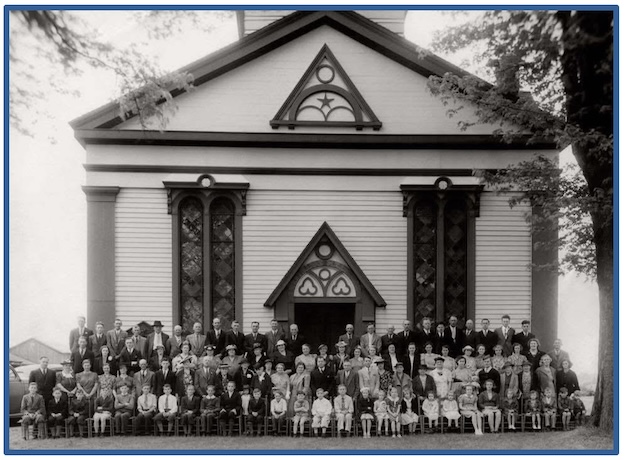
The West Barre Church as it appeared in 1940.
By Catherine Cooper, Orleans County Historian
“Illuminating Orleans” – Volume 5, No. 42
 WEST BARRE – Mildred Anne Paine, who grew up in the cobblestone house on Pine Hill Road in the Town of Barre, spent over forty years of her adult life as a missionary in Japan. Hers is a remarkable story.
Born on July 25, 1893, Mildred was the third of five children of Emory and Martha Waterman Paine. Emory was a farmer in Barre. Mildred’s great-grandfather, Elisha Wright, an early pioneer, was one of the organizers of the West Barre Methodist Episcopal Church, as it was then referred to, in the 1830s. (An historic marker on Eagle Harbor Road highlights the location of Wright’s home.)
Mildred received her early education at Schoolhouse #6, a one-room cobblestone structure close to her home. She later attended Genesee Wesleyan Seminary in Lima, NY and Oberlin College, Ohio. She then taught at West Barre and Shelby schoolhouses for several years.
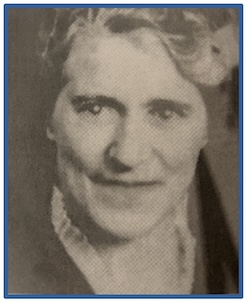
Mildred Anne Paine, 1893-1988
In 1919, at the age of 26, she was commissioned by the Woman’s Foreign Missionary Society as a missionary to Japan. The Society, which had been established in 1869, sponsored and sent women to establish schools and spread the word of Christ.
Mildred studied Japanese for one year and worked at the Japanese city of Kagoshima in southern Kyushu for five years. She wrote:
“The strange Japanese culture and baffling language were my environment at the Tokyo Language School and in Kagoshima until 1926.”
She returned to the U.S. in 1927 and studied for a Master’s degree at Boston College.
In 1928, she was assigned to rebuild an important Methodist sponsored Welfare Center in Tokyo. It had been destroyed by an earthquake in 1923. The center, named “Ai Kei Gakuen” (Garden Radiating Love and Grace) was located in a slum. Many residents were ragpickers, while scores were homeless or destitute. Mildred was associated with the Center for 33 years, during which time thousands were enrolled in the orphanage, schools, and clinics which she established.
In an interview with the Democrat and Chronicle while on a rare visit home in 1934, Mildred explained that their missionary work could not be overt:
“If we made any attempt to coerce the people towards the religion, the Buddhists and Shintoists would at once take their children away. If we live our faith, and the people find there is something in Christianity that these other religions do not have, then is the time to explain. Once they become our friends, then we can discuss any subject freely with them.”
She commented that life there was far from monotonous, but full of thrilling adventures and “underground currents.”
With the outbreak of WWII, Mildred was interned in September 1942. Her sister, Helen Parsons Frey, recounted that “The soldiers who came to arrest her shot their guns inside of her house. All of her dishes were broken – except one plate. She found the plate when she returned after her internment.”
Fortunately, Mildred experienced “very fair” treatment at the camp. She was also fortunate to be among the 1,300 repatriates who boarded the M.S. Gripsholm, a Swedish cruise ship which had been chartered by the U.S. government to transport civilians and POWs caught behind enemy lines.
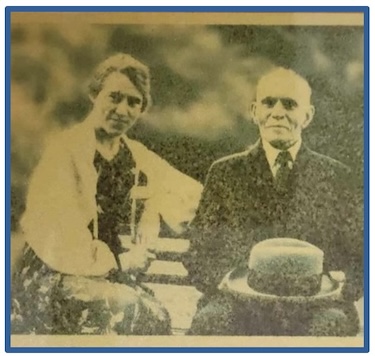
Mildred enjoyed time with her brother Cuyler following her return to the U.S. in 1963. He died in 1965.
The six-week return voyage began in Mormuago, a small harbor in Portuguese India, on October 19, 1943 and included stops in Port Elizabeth, South Africa and Rio de Janeiro. On her arrival in New York on December 1, 1943, Mildred was greeted by her sister, Helen (Howard Parsons) and by Rev. Jesse Young, and his wife Ruth, who later served at the West Barre Church from 1955-57.
Mildred spent several months with Helen, Howard and their family at the family home on Pine Hill Road. She returned to Japan after the war and remained there until 1962. She was awarded two honors by the Japanese government: a citation from the Welfare Ministry of Japan in 1958, for her “devotion to children, boys and youth welfare” and in 1960, the 4th Class of the Imperial Order of the Sacred Treasure from the Japanese Ministry of Health and Welfare in recognition of her social work at Ai Kei Gakuen.
Upon her return to the U.S. in 1963, she was involved in counseling and promotional work for the Wesleyan Service Guild. Following a stroke in 1967, she went to live at the United Methodist Retirement Home in Asheville, N.C., where she died on September 7, 1988, at the age of 95. She is buried in the family plot in the West Barre Cemetery.
A collection of Mildred’s personal papers, including 23 diaries, correspondence and photographs is held by the General Commission on Archives and History, an online mission of the United Methodist Church. This collection covers the years 1957-1974. Sadly, the material from 1926-1943, which would have chronicled her first impressions and early experiences, is missing. Most likely, it was destroyed at the time of her arrest.
Mildred’s brother, Cuyler and sister, Ruth continued the family involvement with the West Barre Church. In later years, her younger sister, Clara Otis, joined Mildred in Japan to assist her missionary work. Continuing the family tradition, her niece, Esther, and husband George Heustis spent forty-three years as missionaries in Brazil.
Mildred’s sister Helen served in the Youth Ministry in New York City along with her husband, Marvin Frey. Marvin wrote over 300 hymns and is the subject of an historic marker at the West Barre Cemetery.
Many thanks to Adrienne Daniels, Town of Barre Historian, and Karen Markle of the West Barre Church for their generous assistance.