

















Tour highlighted Otter Creek Cemetery on Route 104
Cobblestone mason, infant child, social butterfly and prominent residents featured
Photos by Tom Rivers
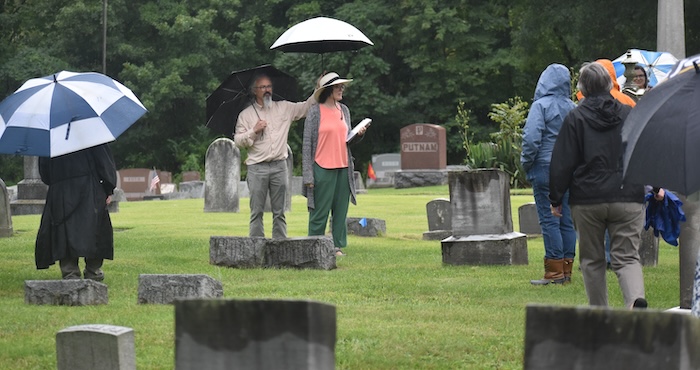
GAINES – Gaines Town Historian Adrienne Kirby leads a tour on Sunday evening of the Otter Creek Cemetery. Her husband Justin holds an umbrella during a rainy evening.
The tour was part of a Sunday evening cemetery tour during the month of August. The Orleans County Historical Association plans the tours. The final one will be this Sunday at Mount Albion Cemetery led by retired County Historian Bill Lattin (Adrienne Kirby’s father) and Village of Albion Historian Susan Starkweather Miller.
Adrienne Kirby is shown by the rave of Alma Lovewelll, the first woman to serve as president of the Otter Creek Cemetery Association in 1909. She helped grow the cemetery’s resources for upkeep and maintenance.
The cemetery is also known as the Anderson Cemetery. It was managed by the Anderson family until it was sold to the newly formed Otter Creek Cemetery Association in 1888. The cemetery is 3.17 acres and has about 850 graves. The Town of Gaines now is the caretaker of the cemetery, which is just east of Allens Bridge Road on the south side of Route 104.
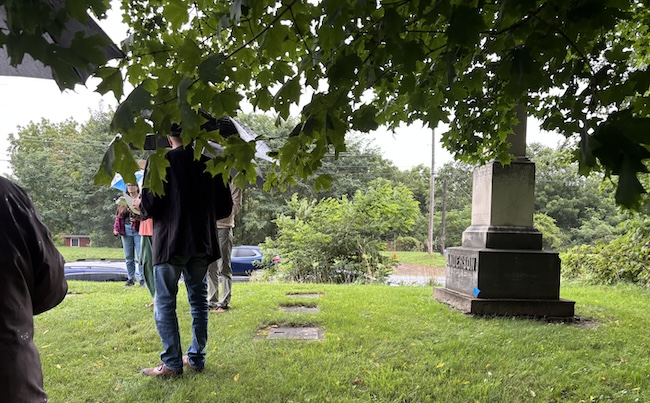
The Anderson site is on top of a mausoleum, which was dug into the side of a ravine. There are 12 slots.
John Anderson is a Revolutionary soldier buried in the Gaines cemetery behind the Congregational Church. He has 12 children, and 11 moved to Gaines in the 1810s and 1820s. Matthew and his brother Alva sold lots for the cemetery.
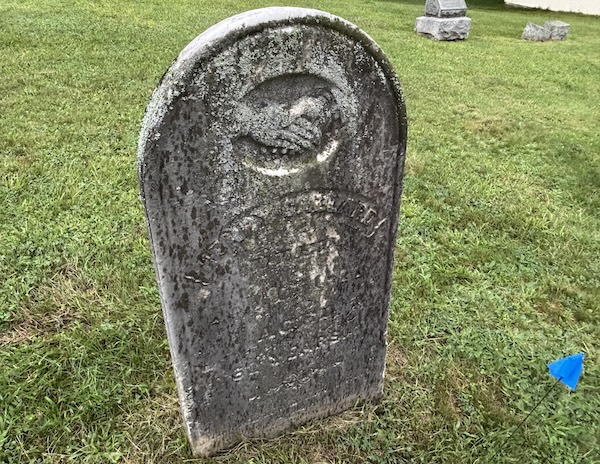
These clasped hands are on a monument for Henry and Elizabeth Callard, who raised three sons who were laborers.
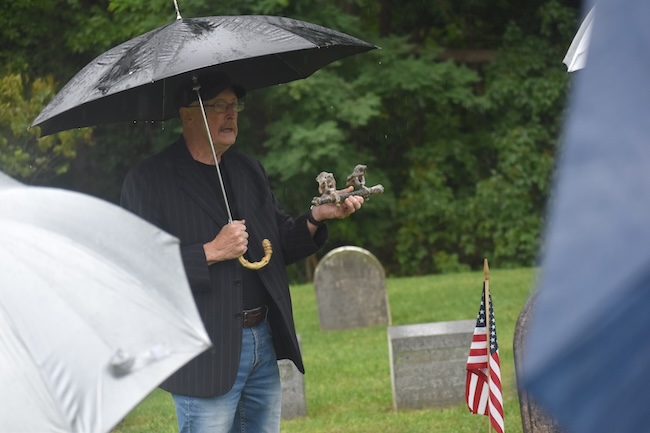
Bill Lattin holds casket handles that were taken from a casket by “grave robbers” – wood chunks. Former Gaines Highway Superintendent Ron Mannella found these handles about 25 years ago while doing maintenance at the cemetery.
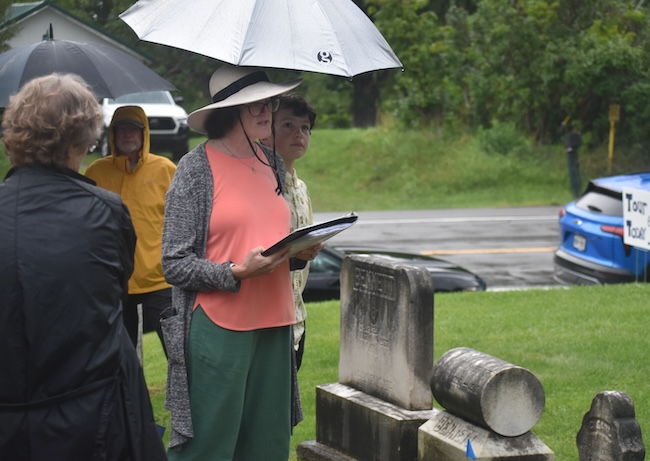
Adrienne Kirby, next to her son Graham Kirby, highlights Mary Bennett who was an active person featured in the social columns of the Lyndonville Enterprise.
Mary Bennett died at age 28 in November 1918. Her cause of death is unknown, but Kirby said it may have been from the influenza pandemic of 1918, where there were over 2,000 documented cases in Orleans County between October and December 1918.
The tour also highlighted the following:
- Cyrus Witheral, a local stone mason, who built cobblestone houses in a herring bone pattern, including several in the 1840s and 1850s along Ridge Road in Gaines.
- Joseph and Nellie Vagg, who lived in Vagg House at corner of routes 98 and 104. Mr. Vagg was the last working blacksmith on Ridge Road. His shop was donated to the Cobblestone Museum. His wife was very active in the Women’s Temperance Union, the Grange, Red Cross and the Congregational Church.
- Issac Saunders, who was born in Rhode Island and came to Gaines in 1838 at age 43. He had a striking cobblestone home built just west of Otter Creek Cemetery in the 1840s.
- Peleg Saunders, Isaac’s father, was a Revolutionary War solider in the Rhode Island militia. He had a farm in the town of Sweden and was taking provisions to American soldiers in the War of 1812 when he died in Fort Erie, Canada, on Oct. 28, 1814.
- S. Seymour Phelps, whose grave includes a logo for Woodman of the World, a life insurance society that is still in business. The group picked a symbol that was inspired by pioneer woodsmen clearing away the forest to provide for their families. This life insurance society wanted to clear away problems of financial security for its members, Kirby said.
- Dr. Isaac Cochran who lived in Knowlesville and was a doctor, surgeon and farmer.
- Colonel Ball, who served with the Canadian forces in 1914, moved to Gaines with his wife Sylvia in 1937. Mrs. Ball was a columnist for many years for the Albion Advertiser and a member of the International Press Association.
- Johnnie Hill, an infant who died at 7 months, and his mother Laura, who died a few days after giving birth. Their lives are noted on a zinc monument.
- Charles E. House, who served as a soldier in the Civil War in Company L of the 2nd Regiment of Mounted Rifles. They were part of the Overlord Campaign in the spring of 1864 under General Ulysses S. Grant, tasked with disrupting Confederate supply lines that summer in Virginia. House would die in late November 1864 when the regiment headed north towards the Weldon Railroad before the Hickford Raid.