















Q&A with Dr. Evan Silsby – Dentist embraces new technology while maintaining small-town feel in 10 years at Albion
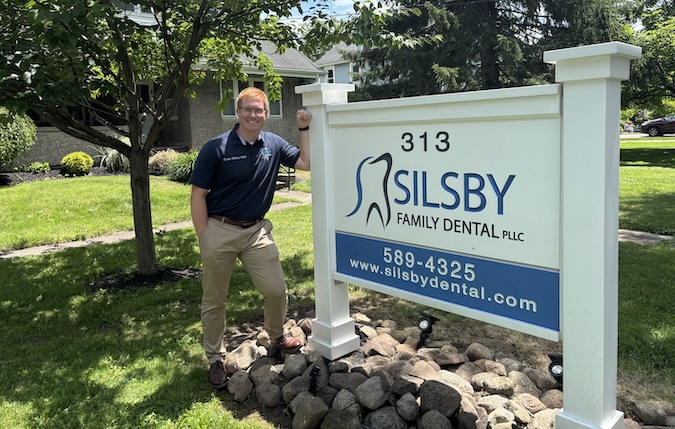
Photos by Tom Rivers: Dr. Evan Silsby has run a dental office for 10 years in Albion at 313 South Main St.
ALBION – Dr. Evan Silsby has been working as a dentist in Albion for a decade after acquiring the practice of retiring Dr. Karl Heuer at 313 South Main St.
Dr. Silsby, 39, has remodeled the interior, and invested in new technologies, including a CEREC milling machine that makes crowns on site during the same appointment. Silsby also uses digital technology for impressions.
The Gasport resident said working in a small town in Albion has been a great fit for his professional career.
He recently sat down for an interview to talk about the 10 years in Albion and the dental profession.
Question: You’ve been here 10 years. Were you somewhere else before?
Answer: I worked for a dental office in the Finger Lakes for just about two years.
Q: You are from these parts?
A: I’m from Gasport.
Q: Has this been a good fit for you?
A: I hope it has, certainly. Coming from a rural area it fits very well.
Q: Was the timing 10 years ago such that Dr. Heuer was retiring and it worked out?
A: There was a transition company that paired us together. This company matched us more by personality. Dr. Heuer listed it for sale, and I thought it would be a good fit.
Q: You have made some changes with technology and the looks of the place. What would you want to highlight?
A: There is certainly a blend between spending your money on tech and creature comfort. The latest, doing a lift instead of a ramp was because the ramp really needed to be changed. It wasn’t going to work much longer. We wanted to come up with something that looked better than the ramp that was there. We wanted to tie in something that looked a little bit nicer and gave people the functionality that they needed.
We spend a lot of time here as staff so we wanted to make it comfortable for us. Half of it’s that and half of it’s function for patients.
Q: It felt more like a house before.
A: Yes, there is a little bit more drywall. The outside certainly hasn’t changed much but the inside has.
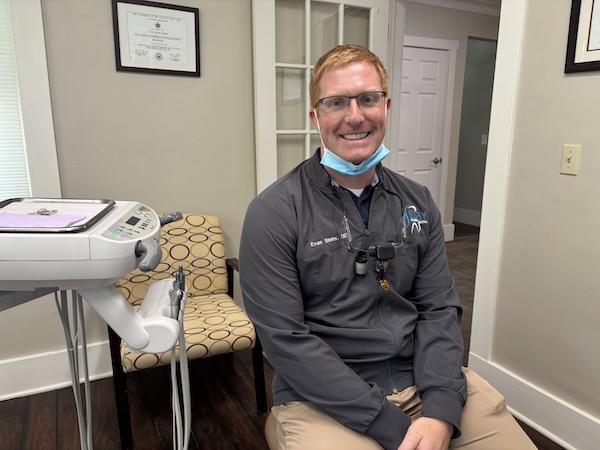
Dr. Evan Silsby likes the physical work in being a dentist, and using medicine to improve people’s health.
Q: I know with the new equipment you have that crown fabricator. (Silsby can make custom dental crowns using in-office CEREC CAD/CAM technology. This system takes optical 3D scans, designs the restoration, and mills a ceramic crown on-site in a single visit.)
A:Yes, some of the tech we’ve added to try to keep it in house and make it more efficient for people. The latest is a software update. AI has made it to dentistry now. We have software that reads X-rays. It gives us a feel of the progression of cavities. So we can then track them. It might not be something we fill now, but let’s check it in a year. Then the software can help us to track if it got bigger or smaller, or stayed the same.
Q: How many people work for you?
A: It kind of depends. We have a three temp hygienists right now. We have three permanent hygienists, three front desk, and two assistants.
Q: Has it become harder to have a dental practice, with insurance and you-name-it?
A: Yeah. It always has struggles. Things change. Insurance is a little bit more difficult now than it used to be.
The Knicks just won the NBA finals. Did you see the dental thing that is paired with the Knicks. A friend of mine posted this. The Knicks last won the NBA championship in 1973. So they said insurance reimbursement allotment has not changed per person since the Knicks won their last championship.
They gave people a thousand bucks a year through insurance, and they still give them a thousand bucks. It makes it harder on people.
Q: That’s what I wondered with the economics that people might not be getting care where they should given the out-of-pocket costs?
A: Probably. They may be delaying, postponing, and little things can turn into big things. But here I would say we have been very busy. But I know some people are feeling that pinch.
Q: What do you like about doing this job?
A: It’s medicine. So you’re helping people. That’s the human condition: we want to help people. But dentistry is different than a lot of fields of medicine because we actually do things physically with our hands. That compares to a neurologist where they don’t.
Dentistry has that ability. You get a little bit of the fun of building, but also helping people in medicine.
Q: Are there lasers that can help do some of the procedures?
A: Yes, I just went to a class on a hard-tissue laser. I’ve had a soft-tissue laser for forever, and that’s nice for a couple of little things but what they want to do is make hard-tissue lasers and cut a tooth with a laser instead of a burr spinning. You can do it. The one tagline is you can do it without numbing a person. I don’t know if that’s really accurate. You can drill on a tooth without numbing it, too. Some people don’t mind and some people do.
It’s slower to cut with a laser. The technology is around. They made a version about 15 years ago but it didn’t catch on so the technology has lagged a little bit. Now they are using a different beam strength. People are using them, but not many so far.
Q: Do you have a general advice for people, especially if they haven’t been to the dentist in a while?
A: Make sure you get your info from somebody who knows what they are doing. There are a lot of TikTok reel doctors out there that probably steer people the wrong way.
We’ve had to fight a little bit in our area about fluoride in the water. From a health perspective it’s one of the biggest health benefits we’ve ever done as a country is fluoridated water.
Using fluoridated pastes, drinking fluoridated water (you can buy fluoridated water) there are ways people can take care of themselves.
That being said, the American diet supersedes all that. It’s unbelievable how bad our diet can be for us.
The sugar and carbs we have, all the stuff sticking to our teeth. That’s the thing that kills people more than whether we have fluoride in our water or not. It’s all the stuff that we’re consuming. And that probably goes full circle with the economy. People are eating more of the bottom of the food pyramid stuff because it’s cheaper. It ends up being a lot of the sugar and sticky carbs.
Editor’s Note: For more information on Silsby Family Dental, check www.silsbydental.com.