By Tom Rivers, Editor Posted 7 October 2025 at 1:07 pm
Andrew London brings bright and welcoming business to his hometown
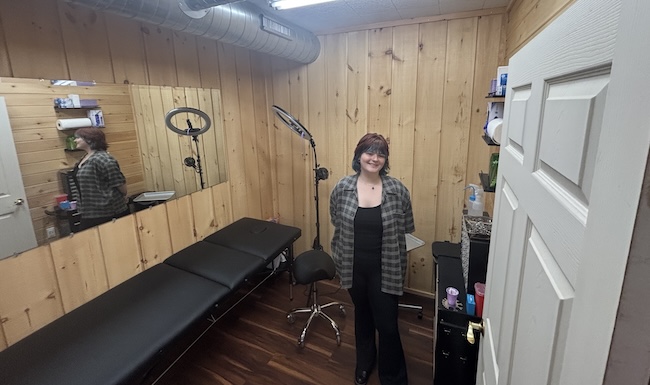
Photos by Tom Rivers: Andrew London opened Wish and Wonder Tattoo in Albion about two weeks ago at 115 East Bank St. London has worked as a tattoo artist the past 11 years.
ALBION – A new tattoo business in Albion features a hometown tattoo artist who wants to help the downtown business district grow.
Andrew London, 33, has worked as a tattoo artist for 11 years. He started at High Voltage Tattoo in Batavia and worked the past seven years at Canalside Tattoo in Medina.
London has a devoted clientele and he wanted to work in his hometown of Albion.
“I wanted to bring something to Albion that would brighten up the downtown,” said London, whose father Dean is a former Albion mayor and police chief.
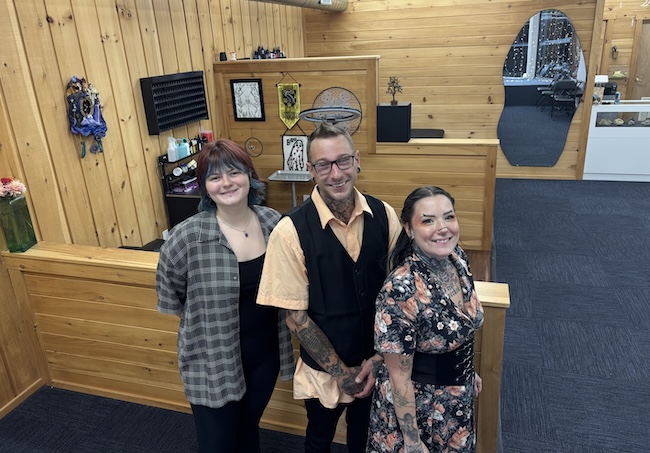
About two weeks ago Andrew opened Wish and Wonder Tattoo at 115 East Bank St. He is joined by his wife, Katie, who is an apprentice tattoo artist. Megan “Marge” Furness also runs a body piercing business at Wish and Wonder. Furness has worked as a piercer the past four years.
Wish and Wonder Tattoo includes, from left: Megan “Marge” Furness as a body piercer, Andrew London, the owner and a tattoo artist; and Katie London, an apprentice tattoo artist.
London has a bright atmosphere at Wish and Wonder. He picked a name for the business that he said “feels magical.”
He wanted a well lighted space for the tattoo artists and for the body piercer.
“It’s not dark and scary,” he said. “It’s light and airy.”
London said he has done tens of thousands of tattoos so far in his career.
Tattoos have become far more accepted in the past 10 to 20 years. Many people proudly post them on social media, and receive very positive feedback which encourages their friends to want them.
London said most people keep coming back after getting a tattoo. He does many memorial tattoos, and ones with birth stones and birth flowers that people want to represent their children.
“Tattoos are memories,” he said at Wish and Wonder this morning. “People get one, they like it and then they want more.”
He strives to make people feel comfortable during the process of getting a tattoo.
“They all have a fun time when they are in here,” he said. “That must be why they call it ink therapy.”
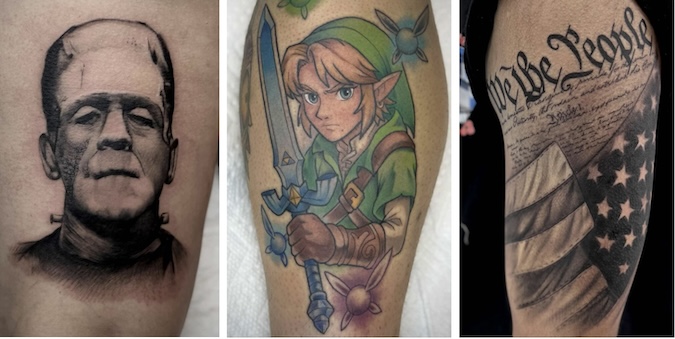
Andrew London recently created these tattoos of Frankenstein, Zelda and the American flag.
London and his wife Katie pushed to open Wish and Wonder once their youngest child entered kindergarten last month. That has freed them up to put more focus on their own business.
Katie also is an apprentice tattoo artist. She is starting with smaller tattoos and will be working her way up to larger artwork.
Her husband wanted to be an art teacher when he graduated from high school. He found being a tattoo artist fills his artistic passions. He also likes to connect with his customers, and bring them joy with tattoos that are often very meaningful and personal expressions.
London is a sponsored artist through Empire Inks, which provides inks for gray washes – black and gray tattoos.
Megan “Marge” Furness is a body piercer with a business, Piercings by Marge. She worked as a phlebotomist, collecting blood samples from patients, before getting into body piercing.
She did an apprenticeship at Canalside Tattoo to learn the craft. She does piercings for the ear, nose, eyebrow, lip, tongue and other body parts.
She uses a sterile, hollow needle instead of a piercing gun which she said reduces swelling and is easier for her clients. Furness said she talks through the process, especially with children.
“The best part is giving people a very good piercing experience,” she said.
For more information on Wish and Wonder, call (585) 283-4173 or check their Facebook page.
By Tom Rivers, Editor Posted 7 October 2025 at 7:40 am
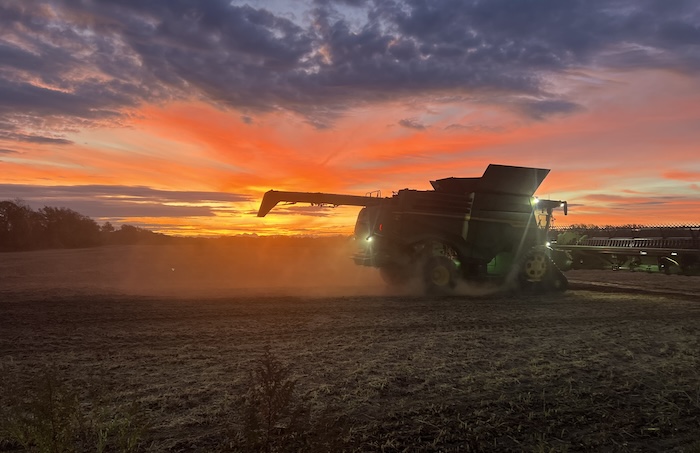
Photo courtesy of Jim Panek
ALBION – This combine from Panek Farms is out at sunrise to harvest soybeans on Route 98 between Route 31A and Barre Center.
The farm is trying to beat the rain this morning.
It’s been a tough year for the farmers due to the drought conditions in Orleans County. Jim Panek said the farm’s soybean yields are down to about 60 percent of normal.
By Tom Rivers, Editor Posted 6 October 2025 at 10:06 pm
Photos by Tom Rivers
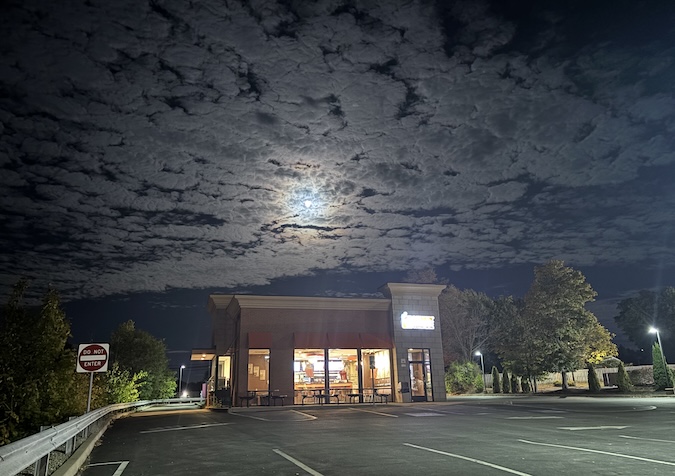
ALBION – It was a dramatic sky tonight with a Harvest Moon. The top photo was taken at 8:27 of the Dunkin’ Donuts in Albion.
The moon is shown at 8:47 p.m. high above the Pullman Memorial Universalist Church in Albion.
Bryan McDowell of Lyndonville sent in this photo he took up close of the moon.
It was also an amazing sunset this evening. Tim Archer sent in this photo looking west towards the sun.
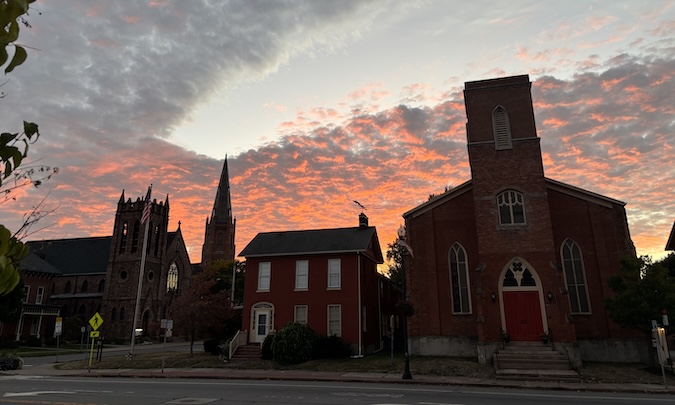
Photos by Tom Rivers: This photo at 6:55 p.m. shows St. Joseph’s Catholic Church at left, then the First Baptist Church of Albion, and Christ Church (Episcopal) at right.
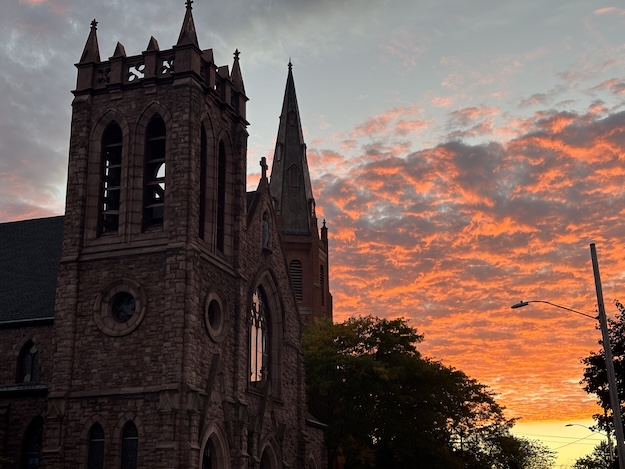
Social media has featured many photos of the this evening’s sunset. This one shows St. Joseph’s Catholic Church and the First Baptist Church of Albion.
After a couple of days in the 80s, the highs will be a little cooler the rest of the week with 72 on Tuesday, 60 on Wednesday, 57 on Thursday, 65 on Friday and 67 on Saturday.
Orleans County 4-H Fairgrounds hosting clinic on Oct. 25
Press Release, Genesee and Orleans County Health Departments
The Genesee and Orleans County Health Departments (GO Health) are urging residents to remain vigilant against rabies and to take advantage of upcoming clinics.
“Rabies is a deadly disease, but it is 100% preventable when proper precautions are taken,” said Paul Pettit, Public Health Director for GO Health. “We encourage residents to attend our upcoming clinics and protect their pets and community.”
Final Rabies Vaccination Clinics of 2025
GO Health will host its final free drive-thru rabies vaccination clinics in October. Funding is provided by the New York State Department of Health.
Genesee County Rabies Vaccination Clinic – Thursday, October 9, from 4 to 6:30 p.m. at Genesee County Fairgrounds (5056 East Main Street, Batavia)
Orleans County Rabies Vaccination Clinic – Saturday, October 25, from 9 to 11:30 a.m. at Orleans County Fairgrounds (12690 State Route 31, Albion)
Vaccinations are free for dogs, cats and ferrets. Animals must be at least 3 months old. Each animal must be leashed or crated and accompanied by an adult who can control the animal. Limit 4 pets per car maximum. Donations are accepted to offset costs to the health department.
NOTE: Proof of previous rabies vaccination must be provided at the clinic in order to receive a 3-year vaccination. Otherwise, only a 1-year vaccination can be provided. Originals, copies, and clear cell phone images may be accepted.
To help stop the spread of rabies, GO Health reminds residents to follow these important tips:
Keep pets vaccinated. Make sure your dogs, cats, and ferrets are up to date on their rabies shots. Not only is it required by law, but it is also the responsible choice for your pet and helps keep your neighbors and community safe.
Follow leash laws. Always keep pets on a leash and under direct supervision to prevent contact with wild or stray animals. If you or your pet is bitten, seek veterinary or medical care immediately and notify your local health department.
Avoid wild, stray, and unknown animals. Never approach or try to pet animals that don’t belong to you, even if they seem friendly. Do not feed, touch, or handle wildlife (such as raccoons, skunks, bats, rabbits, and foxes) or stray dogs and cats. Teach children to never touch unknown animals.
Never keep wild animals as pets. Do not attempt to adopt or bring wild animals into your home.
Keep bats out of your home. If you find a bat indoors, do not release it! Safely capture it and contact your local health department, For instructions, watch this GO Health Video (https://www.youtube.com/watch?v=rHK6-hmpiss)
Animal safety notice. If you see a stray animal or notice any animal showing possible signs of rabies, including aggression, excessive drooling, confusion, or trouble walking, contact your local animal control immediately.
For more information about GO Health Programs and Services, visit GOHealthNY.org or contact your local health department at:
By Tom Rivers, Editor Posted 6 October 2025 at 2:18 pm
About 65 attend event which was fundraiser to restore chapel at Mount Albion Cemetery
Photos by Tom Rivers
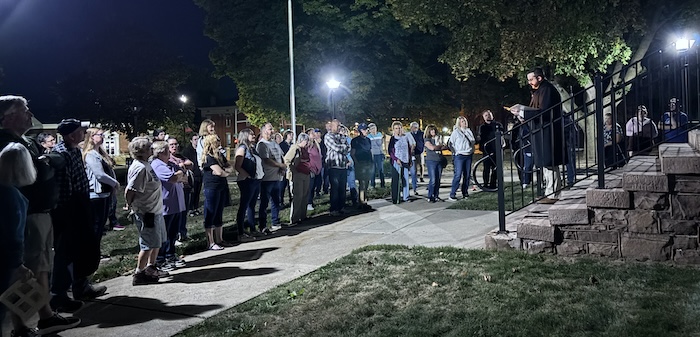
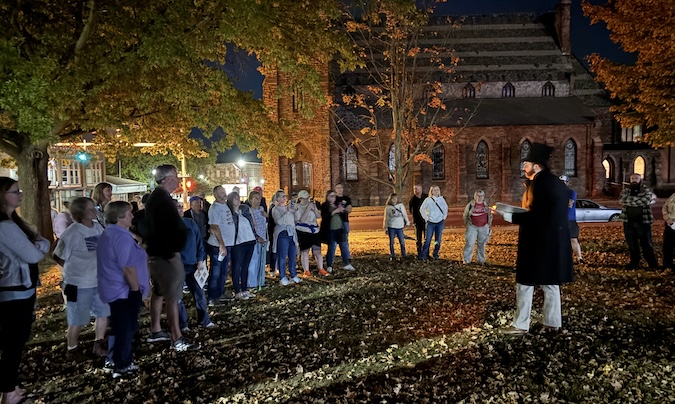
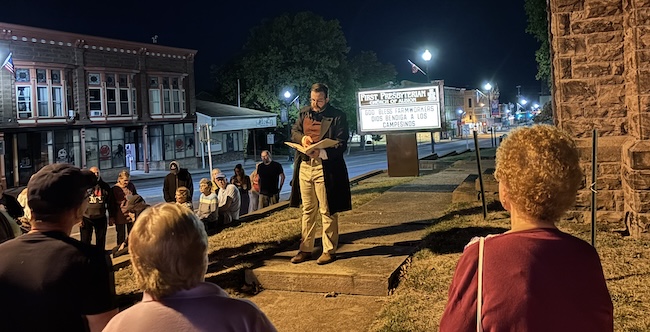
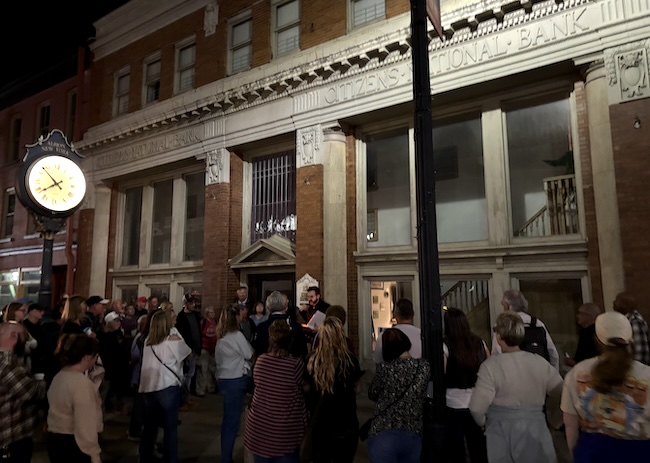
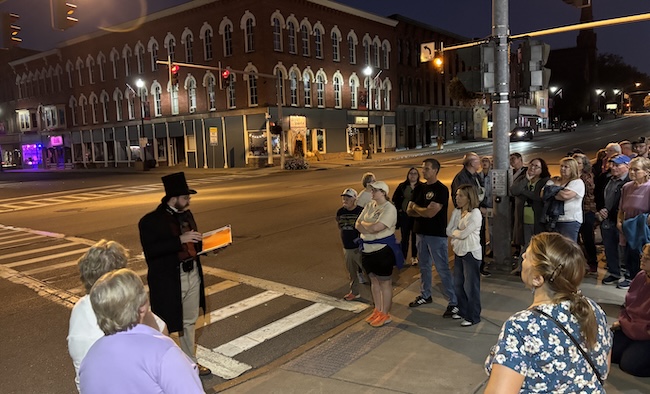
ALBION – Matt Ballard, former Orleans County historian, led a tour on Saturday at Albion’s downtown and Courthouse Square, highlighting “Murder and Mayhem” in the community’s past.
The event was attended by about 65 people who paid $20 each for a fundraiser to restore the chapel at Mount Albion Cemetery.
Ballard is shown speaking from the steps of the County Clerks’ Building. He highlighted two famous murder trials in Albion.
George Wilson was convicted by a jury of killing his wife Alice Wilson by strangulation. George was executed in 1888 in a stockade near where the current county jail is located. That execution on June 22, 1888 was the last one in Orleans County.
Wilson was allegedly having an affair with a girl under age 18. He and his wife had five children.
Wilson protested his innocence. His neighbor provided damning testimony against Wilson. That neighbor was found guilty of committing a murder in Rochester. Ballard said some people have speculated that Wilson didn’t kill his wife. Instead, it was the neighbor.
In another high-profile case, William Lake was convicted of killing Emma Hunt who spurned his advances. She was brutally murdered on Oct. 18, 1894. Lake would be the seventh person put to death at Auburn prison by the electric chair.
There would be 55 people put to death by electric chair at Auburn prison from 1890 to 1916.
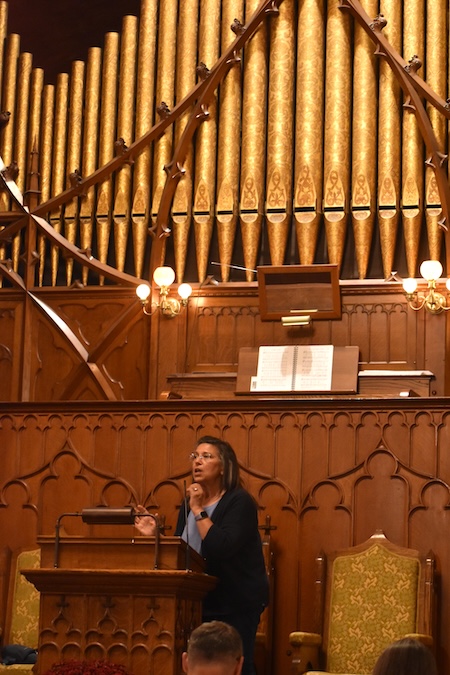
Susan Starkweather Miller, Village of Albion historian, welcomed the group for the tour which started at the Pullman Memorial Universalist Church. She is shown in front of the pulpit and church organ. Starkweather Miller has been leading the effort to restore the chapel and roof at Mount Albion Cemetery. She said the group has raised $200,000 towards at $225,000 goal.
Ballard, speaking from the lawn in front of the courthouse, shared about William Stafford, the district attorney during the Wilson murder trial. Stafford would later run for Orleans County judge and was defeated. He blamed the Baptist congregation, where he attended, for not giving him enough support.
When the Catholics were looking to build a church, Stafford sold them the property on West Park Street, with a stipulation the church building had to be so close to the street it would block the view of the Baptist Church.
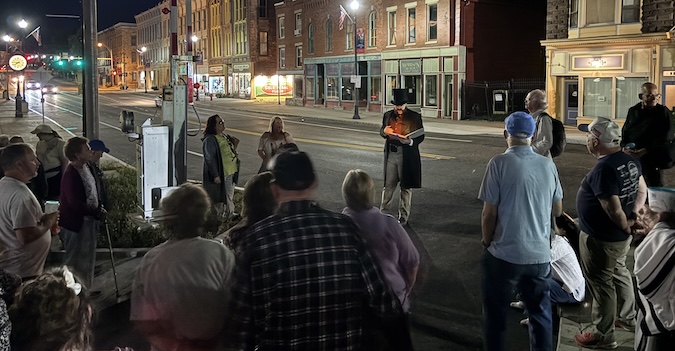
Ballard stands in front of the Main Street lift bridge and tells about one of the worst tragedies in Albion’s history. On Sept. 28, 1559, there were 250 people on the bridge to watch a wirewalker over the canal. The bridge also had five horses with loaded wagons.
The bridge would tumble into the water, and 15 people would die, including several children.
Outside the Presbyterian Church, Ballard spoke about the murder of Pierpont Dyer on Christmas eve in 1859.
The wirewalker in the bridge collapse had his rope strung across the canal from the second floor of the Mansion House south towards the second floor of Dyer’s building about three months earlier.
Mr. Dyer owned a grocery store. On Christmas eve in 1859, someone entered the store and smashed Dyer in the head, killing him. One man went to trial and wasn’t convicted. The murder remains an unsolved mystery.
The Citizens National Bank used to be the First National Bank of Albion. Ballard told how Albert Warner stole about $40,000 from the bank and then fled to Canada. Warner took leadership of the bank after the previous president died from a lethal dose of arsenic.
Warner was well respected in Albion. Not only did he lead the bank, but he was the Board of Education president and leader of the fire department. But poison, betrayal and greed did in his reputation, and left many in Albion facing financial ruin.
Warner was rumored to have returned to Albion briefly, when he dressed as a woman to attend his father’s funeral at Mount Albion in 1887.
Ballard also spoke in front of the former Swan Library, which was the hoe of Roswell Burrows. Burrows amassed a fortune value at over $6 million when he died in 1879.
He established the First National Bank in Albion, a bank where the coffers were embezzled by Warner.
Ballard speaks on Main Street in front of the Five Star Bank. He highlighted a catastrophic fire on Jan. 13, 1882 that wiped out the corner. The fire started in a building for a milliner that was located behind Five Star, where its parking lot is located.
The fire of 1882 badly damaged the business district. When the fire was finally put out, Ballard said a cat emerged from the rubble.
Ballard shared other stories during the nearly two-hour presentation.
Press Release, Office for the Aging in Orleans County
ALBION – The Orleans County Office for the Aging announced it will be hosting several events for Medicare beneficiaries during the fall annual open enrollment period which runs from Oct. 15 through Dec. 7.
Open enrollment is the time for Medicare beneficiaries to review plan information and make educated decisions on what they want their coverage to be starting Jan. 1, 2026.
OFA will be hosting two Medicare Vendor Fairs. Representatives from Medicare Advantage Plans will be present to assist people in understanding changes in current plans and discuss any new plans for 2026.
They can also help those interested enroll in a plan. Attendees should bring their original Medicare Card and a list of both their prescription drugs and medical providers. The Medicare Vendor Fairs are scheduled for:
Tuesday, Oct. 21 from 10 a.m. to 2 p.m. at Trolley Building on the Orleans County Fairgrounds
Friday, Nov. 21, 10 a.m. to 2 p.m. at the Hoag Library, 134 South Main St. in Albion.
OFA will also be hosting two Comparison Meetings, where health insurance counselors from OFA will be available to answer questions, screen for possible benefits and provide unbiased information unrelated to any particular plan. Those events will both be held at the Orleans County Administration Building located at 14016 NY-31 in Albion on:
Wednesday, Oct. 15 from 1:30 to 2:30 p.m. in Conference Room A/B
Monday, Nov. 3 from 2:30 to 3:30 p.m. in Conference Room C
“Seniors are bombarded with information and solicitations for their healthcare insurance needs and with so many choices and potential program changes, it can get overwhelmingly very quickly,” said Melissa Blanar, Director of Orleans County OFA. “The goal of these meetings is to really help people understand their choices and spend time answering questions so they can make the decisions that are right for them.”
In addition, OFA offers a Medicare comparison packet that outlines beneficiaries’ options. Those interested in attending any of these events or receiving the Medicare comparison packet are asked to call OFA at 585-589-3191.
Seniors can also visit www.medicare.gov or call 1-800-MEDICARE (1-800-633-4227) for assistance.
By Leah Brenner, Certified Pediatric Nurse Practitioner at Orleans Community Health
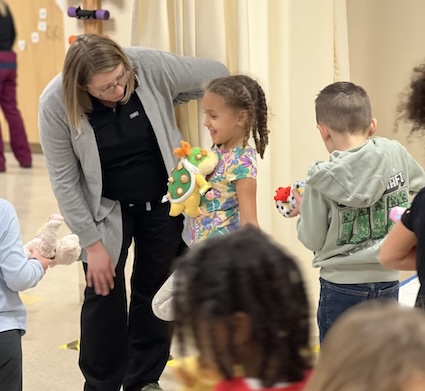
Photo courtesy of Orleans Community Health: Leah Brenner greets a child at Orleans Community Health.
Childhood is a time of incredible growth and change – and as parents, it can be both exciting and nerve-wracking to watch your child reach new milestones.
These milestones serve as important markers of physical, emotional, cognitive, and social development, helping you understand whether your child is progressing typically. Every small achievement, from a first smile to a first step, tells a story about your child’s development. Below are some key stages and what to expect as your child grows.
Infancy (0 – 12 months)
The first year is full of rapid physical and developmental changes. By 2 to 3 months, your baby should be able to lift their head while lying on their tummy, a sign of strengthening neck and upper body muscles. Around 4 to 6 months, most babies begin rolling over, sitting with support, and making cooing or babbling sounds. By 9 to 12 months, you may see your little one crawling, standing with assistance, and even saying simple words like “mama” or “dada.”
This is also when babies begin to recognize familiar faces, smile responsively, and show curiosity about the world around them—key steps in emotional and social development.
Toddlerhood (1 – 3 years)
Toddlers experience major leaps in both language and motor skills. Between 18 to 24 months, they often start using simple words and can follow basic directions. Their fine motor coordination improves too – they can stack blocks, turn pages, and begin feeding themselves with utensils. By age 3, many toddlers walk independently, kick a ball, and engage in imaginative play. Socially, they start to learn about sharing, taking turns, and expressing emotions.
It’s also common for toddlers to experience frustration as they learn to communicate and assert independence. Consistent routines, patient guidance, and encouragement from caregivers can make a big difference during this stage.
Preschool (3 – 5 years)
Preschoolers are curious, energetic learners. Between ages 3 to 4, children typically begin forming short sentences and love to tell stories. They can draw basic shapes, recognize some letters and numbers, and demonstrate a growing attention span. By ages 4 to 5, they refine motor skills like running, jumping, and climbing. Socially and emotionally, this is a time of growth in empathy, cooperation, and friendship-building.
Children also begin to develop self-control, creativity, and problem-solving skills through play, which is a vital part of learning at this age.
School Age (5 – 12 years)
Once children start school, their physical growth slows slightly while their cognitive and social skills expand rapidly. Around ages 6 to 7, many begin reading simple books, learning basic math, and developing hand-eye coordination through writing and play. They start to understand rules and routines, helping them navigate the classroom environment. By ages 10 to 12, children are capable of complex problem-solving and navigating more sophisticated social relationships. They also start taking on more independence and responsibility, both at home and in school.
Parents can encourage development by supporting hobbies, promoting healthy friendships, and keeping up with regular check-ups and screenings.
Every child develops at their own pace—there’s no single “right” timeline. These milestones simply offer a guide to what’s typical during each stage of growth. Regular well-child visits are important for tracking progress and addressing concerns early. If you ever have questions about your child’s development, reach out to a pediatrician. Early support and intervention can make all the difference in helping your child thrive and achieve their full potential.
By Ginny Kropf, correspondent Posted 6 October 2025 at 8:52 am
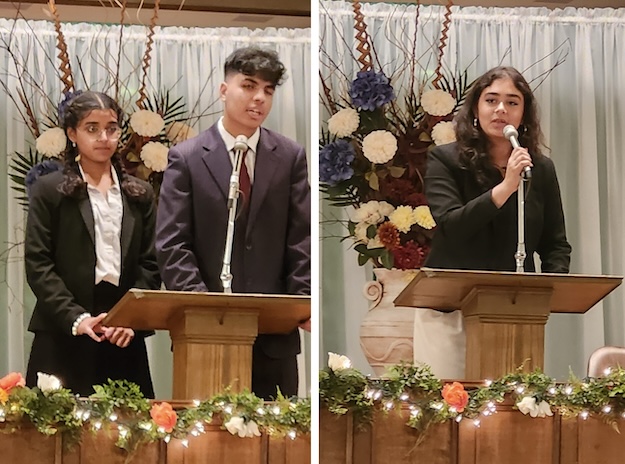
Photos by Ginny Kropf: (Left) Midha and Jaotin are co-presidents of the Voice Gavel Club from Oakville, Ontario, Canada. They performed a free concert titled “Leaves of Summer” at World Life Institute in Medina. (Right) The Voice Gavel Club member Hana sings “Dream a Little Dream of Me” during a concert Saturday at World Life Institute.
MEDINA – World Life Institute sponsored a free concert at their headquarters on West Center Street, titled “Leaves of Summer” and featuring the Voice Gavel Club from Oakville, Ontario, Canada. Coordinator of the Club is Lubna Zaidi.
World Life Institute member Deborah Wilson said she has seen the group before, and they are a young version of Toastmasters.
“They have adopted World Life Institute as a project,” she said.
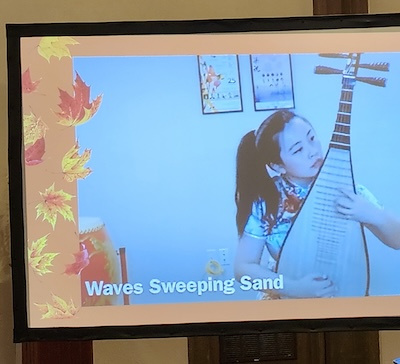
Wendy Zhou, a member of the Voice Gavel Club, was unable to attend World Life Institute on Saturday, so a video was shown of her playing a pipa.
Most of the young performers were known only by their first names and presented a musical program of song, poetry and instrumental offerings. This was their ninth annual concert.
Jaotin Ling is president and Midha Siddiqui is vice-president of the group. Midha said their performance was a celebration of music and talent.
The program included performances by Raheem on clarinet; Tatiana and her student on piano; Ekansh on guitar; Emma, Aman and Greig on flutes; Noah on violin; Carol on a Gujheng (a zither-like instrument); and Wendy on a pipa, sometimes called a Chinese lute.
Also part of the program was Hana singing “Dream me a Little Dream” and “The Leaves of Summer,” and a poetry reading from “The Harvest” by Zehra.
A student named James paid a tribute to the late Dr. Asaf Durakovic, a doctor, professor of Nuclear Medicine and Radiology, writer of poetry, a Colonel in the Army Reserves and founder of World Life Institute.
“He was generous with his time, wisdom and passion,” said James.
Bruce Carter, building superintendent at 229 West Center St. who hosted the concert, gave the young entertainers this advice, “Use your talent to take you as far as you can.”
By Ginny Kropf, correspondent Posted 6 October 2025 at 8:26 am
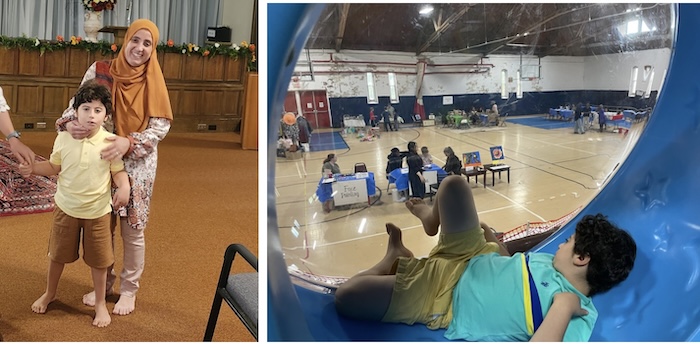
Photo by Ginny Kropf: (Left) Miriam Ajrond and her son Ahmed Cherif are pictured at the World Life Institute prior to a “Leaves of Summer” concert last Saturday featuring The Voice Gavel Club from Oakville, Ontario, Canada. Miriam brought Ahmed to America, with aid from Project Life, an initiative administered by World Life Institute, to seek medical attention for multiple health problems. (Provided photo – Right) Ahmed Cherif lays in the bubble on the play gym at the YMCA during a recent fundraiser for his medical care. He overlooks the gymnasium floor, where numerous activities were set up for adults and children.
MEDINA – When Miriam Ajrond brought her son Ahmed Cherif to America, he was suffering from multiple major health problems. They were brought here by World Life Institute hoping the medical attention he needed would be available here.
Since then, World Life Institute’s Project Life has provided funds for his ongoing medical care.
When Ahmed, age 10, arrived here from Tunisa in January 1924, he weighed 35 pounds club feet, intellectual disability, severe digestive problems and a rare genetic condition. He also is on the autism spectrum.
Since then, he has seen significant growth, thanks to ongoing treatment from a dedicated team of doctors, specialists and therapists. Over the past two years he has gained more than 11 pounds, grown nearly 2.5 inches and continues to make daily strides at the Aspire Center for Learning in Buffalo, where he receives occupational, speech, physical and vision therapy. His mother has also made incredible progress, growing more independent and active engaging in Ahmed’s care in their new life in Medina.
Deborah Wilson, Project Life’s deputy director and finance manager, talked about a recent fundraiser for Ahmed at the YMCA in Medina.
“The fundraiser was not just about raising money, it was about rallying around a family who continues to face extraordinary challenges with grace and determination,” Wilson said. “Every dollar raised goes directly toward essential services for Ahmed and his mother Miriam, including a monthly food, clothing and shelter allowance, transportation to multiple medical appointments, medications and home health supplies, educational resources and supplies and more.”
The Family “FUNraiser” focused on family friendly activities, including paint on canvas sessions for adults and children; face painting; henna art; and a bargain boutique. By popular demand, there was a bake sale and an international food section, which sold out at last year’s fundraiser.
During the afternoon, Project Life did a presentation on their decades-long history of involvement with international war orphans and children with rare health conditions.
Those who could not attend the fundraiser, but would like to donate to Ahmed’s care can donate directly to Project Life. Click here for more information or reach out to Shareefah Sabur at (216) 496-2986.
The replica of the Norwegian ship, the Restauration, is re-enacting the 14-week long voyage taken 200 years ago in 1825 by a group of 52 emigrating Norwegians bound for the deep dark woods of Murray on the southern shore of Lake Ontario.
By Catherine Cooper, Orleans County Historian
“Illuminating Orleans” – Volume 5, No. 35
On Thursday, October 9, H.R.H. Crown Prince Haakon of Norway will welcome the ship “Restauration” on its arrival in New York City. This will culiminate its successful re-enactment of the journey undertaken in 1825 by the group later referred to as the “Kendall Sloopers.” This event is part of a celebration of 200 years of Norwegian emigration.
It may come as a surprise to many Orleans County residents to learn that the Kendall Sloopers are still celebrated in Norwegian history. From an early age, Norwegian students learn about this brave group who are hailed as the first group of organized emigrants to America.
Their journey is referred to as the Norwegian Mayflower because of its impact on later emigration trends. It is estimated that, following the inspiration of the original group, some 800,000 people, about a quarter of the population, left Norway in the following years.
The story of that first Norwegian group is remarkable. Two factors influenced their decision to embark on this journey to America: freedom of religious expression and better economic prospects.
In the course of the Napoleonic Wars, a young Norwegian named Lars Larsson was imprisoned in England for seven years, 1807-1814. Members of the newly formed Society of Friends, or Quakers, visited the prisons. Their philosophy of pacifism, equality and rejection of rituals and ministers appealed to the Norwegian prisoners. The prisoners also learned to speak English. Upon his release, Larsson chose to stay in England for a year, working for Margaret Allen, whose son, David, was a prominent Quaker.
Back in Norway, Larsson proclaimed his new Quaker beliefs. Many people were attracted by the Quaker philosophies. Lutheranism was enshrined in the Norwegian Constitution, and a strict version was observed at that time. Hefty fines would be imposed on those who did not pay Church taxes. Larsson was soon in trouble with the authorities for convening Friends meetings.
Another group of religious dissidents emerged at that time, the Haugean Lutherans, who were also reacting against the strictures of the established Church. Both groups were harassed by the authorities. It became obvious that they would not be permitted to practice their beliefs. Some English Quakers who visited them had also been to America. They told of the freedom of religious practice permissible here and of the opportunities to purchase land and prosper.
Cleng Perrson, an adventurous Norwegian, acted as a scout. He journeyed to America in 1823, He made contact with Quakers in Farmington, Ontario County, and learned about land available in Western New York. He went to the land agent in Geneva, bought a parcel of land and arranged for five additional parcels to be held for a year. The land was located in northern Murray, which was split off to form the Town of Kendall in 1835.
Cleng returned to Norway with news of good prospects and plans were soon made for departure. Lars Larsson was a shipbuilder. He and a crew retrofitted a 54-foot sloop for an ocean voyage and named it the Restauration.
The ship set sail on July 5, 1825, with 52 people aboard: a crew of seven, and six families. Conditions were very cramped. The ship took a long and circuitous route, presumably to take advantage of the trade winds.
There were some misadventures. The ship stopped at the coastal town of Lizette in England but ran afoul of the authorities when they tried to trade alcohol for supplies and had to make a hasty departure. On their approach to Funchal, in Madeira, they were almost fired on for being a plague ship as the crew, who had enjoyed the contents of a floating cask of Madeira wine, failed to raise their flag.
After 14 long weeks, the ship arrived in New York on October 9, 1825 with 53 people aboard. A daughter, named Margaret Allen, had been born to Lars Larsson’s wife.
It is this journey that the Crown Prince will celebrate on October 9. While in America, he will also visit the Norwegian-American communities in Decora, Iowa and Minneapolis, Mn. As befitting the times, this event is chronicled online at www.vesterheim.org, https://vesterheim.org/programs/200th-immigration-anniversary or the Vesterheim Norwegian-American Museum’s posts on Facebook.
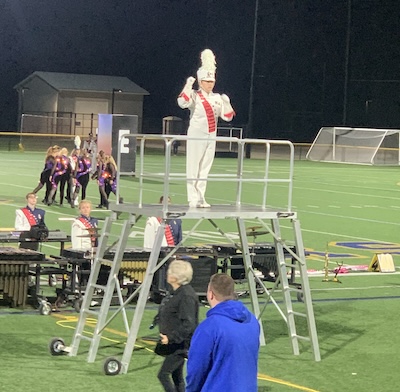
Photos and information courtesy of Medina Marching Band
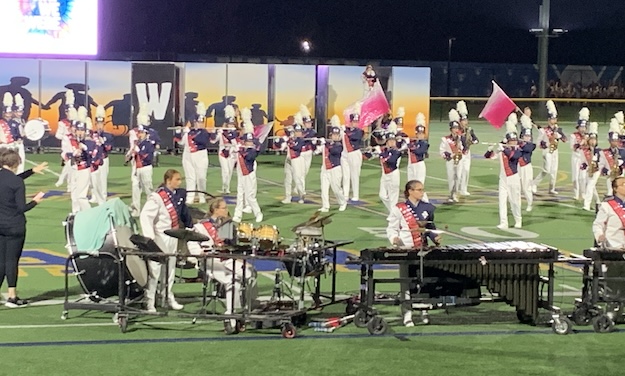
WEBSTER – The Medina Mustang Marching Band traveled to Webster on Saturday for the band’s fourth competition this season. It was a large enthusiastic crowd and the weather was perfect with no wind and a full moon.
There were 12 schools all from within NYS, broken down into six classifications. Medina was the only school in the SS1 class and they scored 76.80.
The National class had two competitors and their scores were very close: Victor with 85.875 and Webster at 85.05.
In SS3, Jordan Elbridge took 1st place with75.50. In LS3, Rochester was a sole competitor with 67.50 and Horseheads a sole competitor in SS2 class with 77.70. The LS2 class had five competitors and Lancaster earned 1st place with 83.0.
You really need to see a show to appreciate how complicated these performance are for the bands. There are students playing various instruments while marching around an entire field in choreographed patterns along with other students performing with flags, sabres and rifles (props not real).
Next Saturday, the Mustangs will travel to Victor and then to Orchard Park on Oct. 18. The championships are on Sunday, Oct 26, at the JMA Wireless Dome (formerly the Carrier Dome) in Syracuse.
By Tom Rivers, Editor Posted 5 October 2025 at 9:00 am
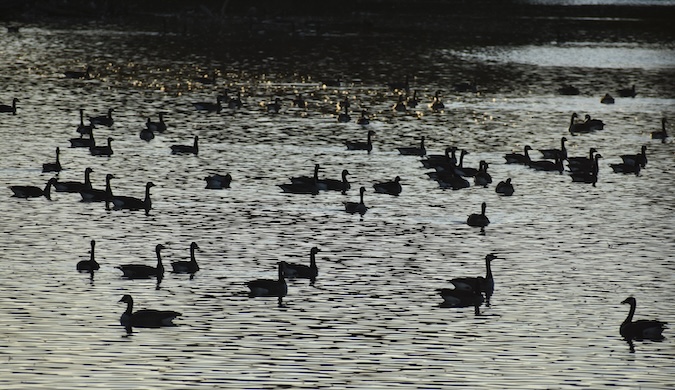
Photos by Tom Rivers: Some geese enjoy Johnson Creek in Lyndonville on Friday evening. This is the area behind the library and parking lot off Main Street.
The stretch of unseasonably warm weather continues to start the week in Orleans County with highs of 85 today and 83 on Monday. Both days will be sunny.
On Tuesday, the high will be near 75 with a 90 percent chance of rain, with a quarter to a half inch, according to the national Weather Service in Buffalo.
The highs the rest of the week include 62 on Wednesday, 61 on Thursday, 68 on Friday and 68 on Saturday.
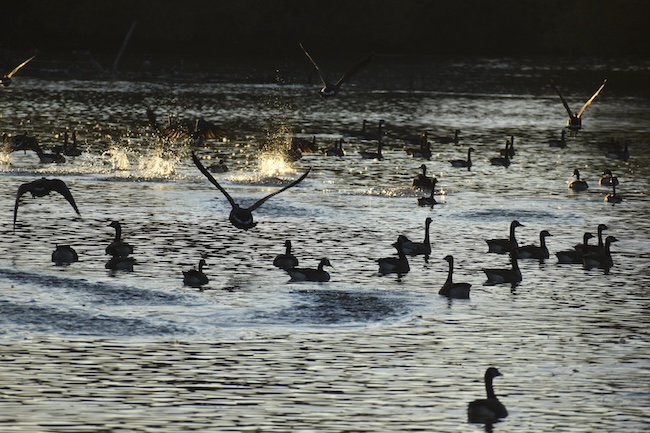
The geese don’t like to see a photographer getting close and they take off on Friday evening.
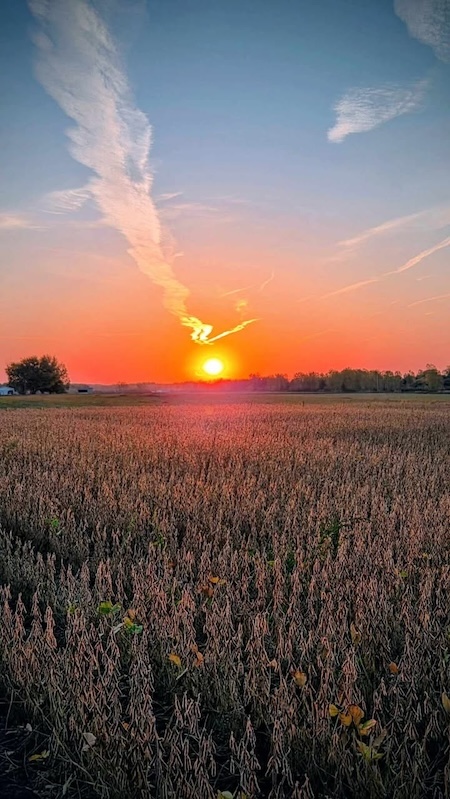
Kimberly Stawicki of Medina sent in this photo of the sun rise on Saturday on Fletcher Chapel Road in Shelby.
Kimberly Stawicki sent in this photo of the Oak Orchard Creek on a sunny Saturday.
By Tom Rivers, Editor Posted 4 October 2025 at 4:49 pm
Photos by Tom Rivers
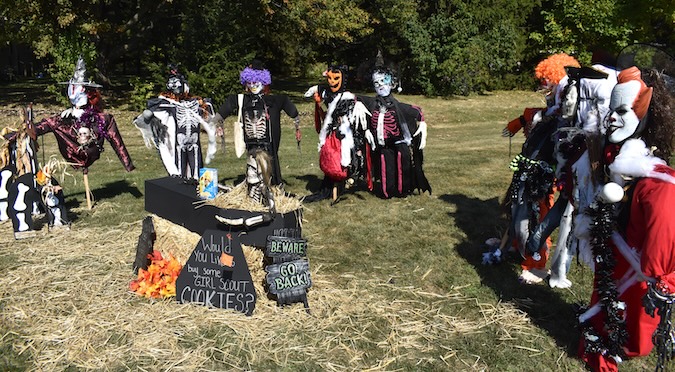
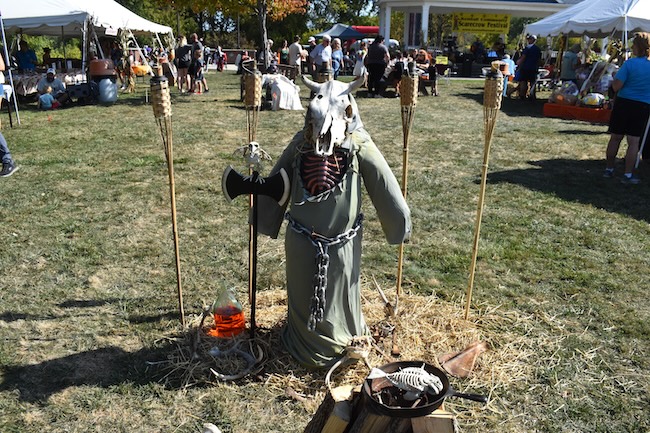
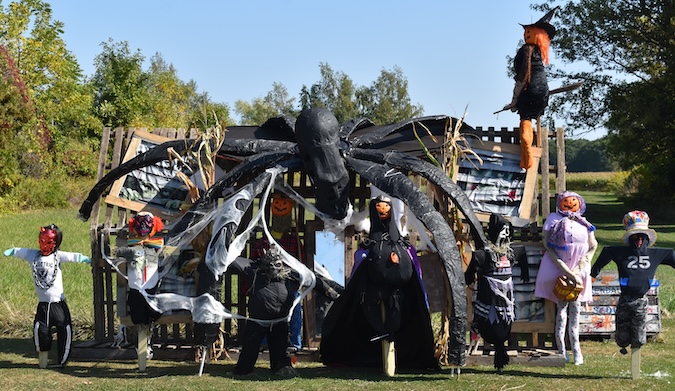
KENDALL – The scarecrows were a little scary today for the Kendall Scarecrow Festival. The top photo shows a group of scarecrows, many with characters from horror films. These scarecrows were created by Girl Scouts in Kendall and they were promoting an upcoming Girl Scout cookie drive.
The festival had nine entrants to be judged in a contest with a theme: “Spooky, Scary and a Little Creepy.”
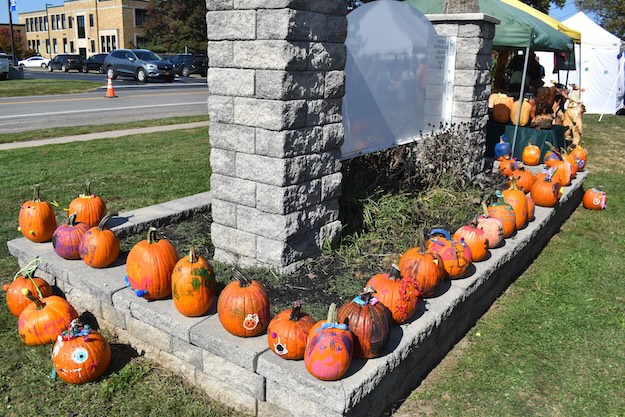
These painted pumpkins dry near the entrance of Kendall’s Community Park across from the elementary school. Panek Farms in Albion donated about 200 pumpkins for the event.
Kendall has had the festival since 2010. The activities are free with donations accepted.
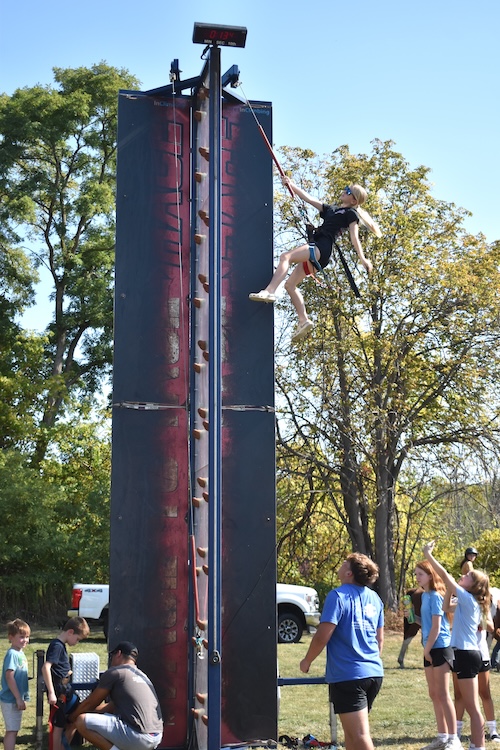
Eloise Baker, a seventh-grader, climbed the wall at the festival. The climbing wall was one of the new activities at the event.
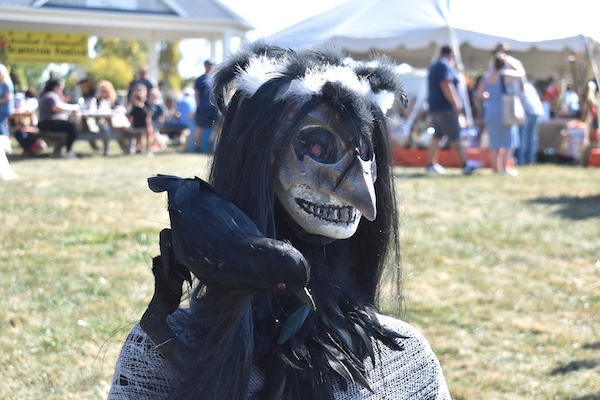
Colleen Fanton made this crow-themed scarecrow.
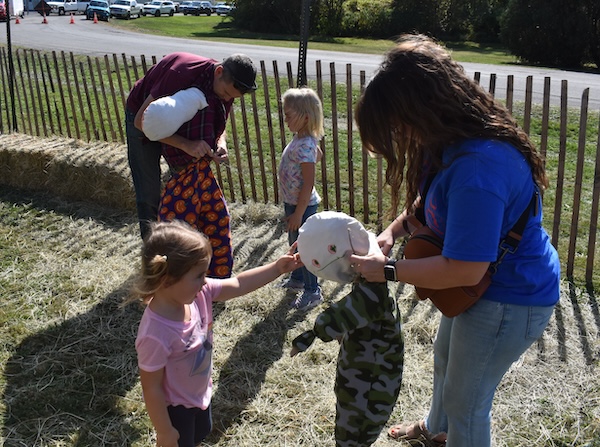
Katie and Lee Robinson brought their kids, Isla and Cami, to make scarecrows. Usually more than 100 scarecrows are made during the festival.
Jeffrey Lutes created this scarecrow.
The public could vote for their favorite scarecrow. The winner gets $75 worth of gift certificates, followed $50 for second place and $25 for third.
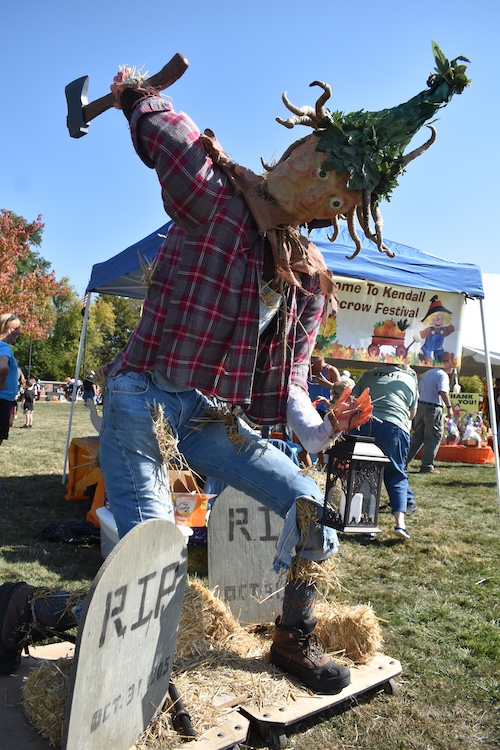
Mavis Williams, a member of the Kendall Scarecrow Committee, took the lead in creating this RIP scarecrow.
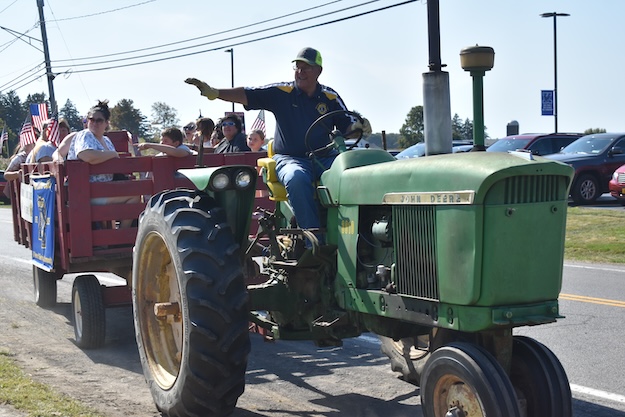
John Becker drives a tractor down Kendall Road. The Kendall Lions Club offered the wagon rides as part of the festival.
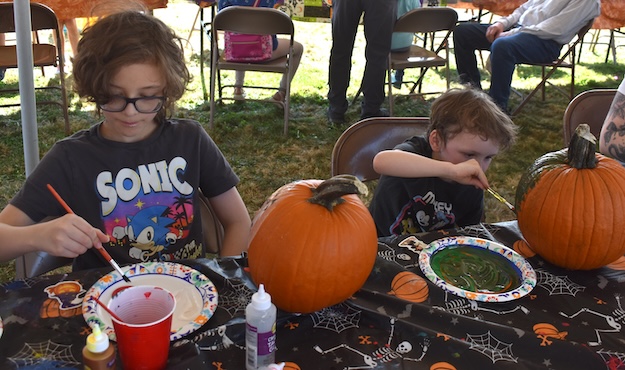
Dylan Bushnell, 10, and his brother Winston, 6, decorate their pumpkins. They were visiting from Big Flats. Their mother, Hannah Billings Bushnell, grew up in Kendall.
The Boy Scouts in Kendall made this display with a giant spider.
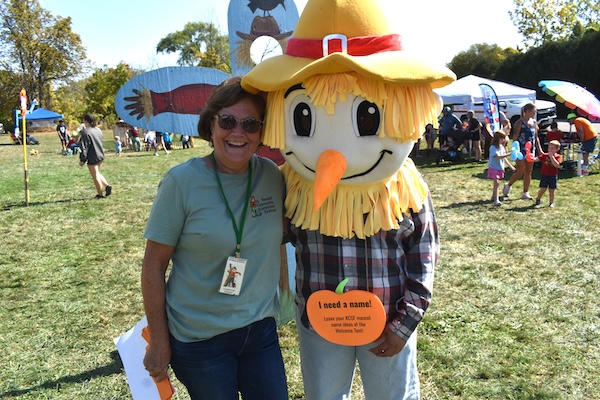
Becky Charland, who leads the Scarecrow Festival Committee, posed with the festival’s mascot. There was a naming-contest for the mascot as part of today’s events.
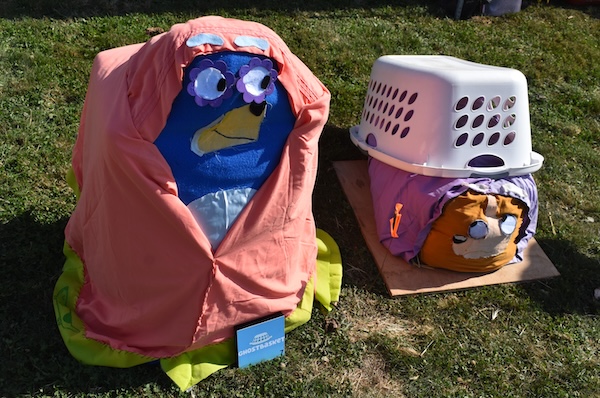
Preston and Everett Swetz created these “Ghost Basket” scarecrows.
By Tom Rivers, Editor Posted 4 October 2025 at 11:33 am
Photos by Tom Rivers
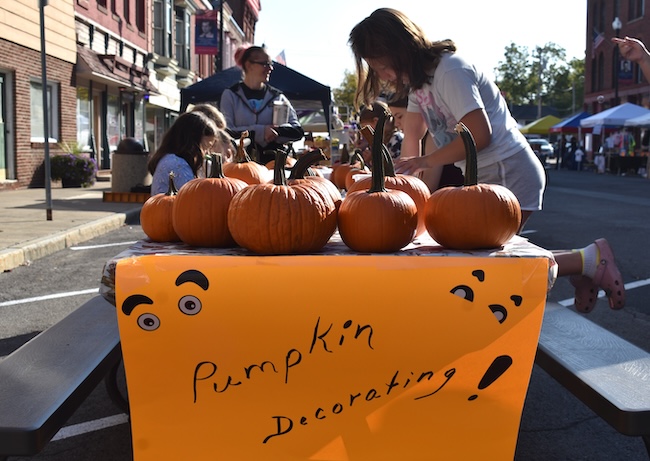
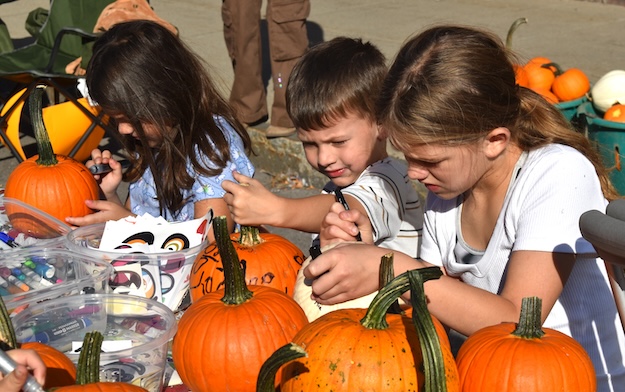
ALBION – Gia Baker, 9, of Albion decorates a pumpkin on East Bank Street in Albion this morning as one of the activities at Albion’s Fall Fest.
The Albion Merchants Association organized the event which continues until 3 p.m.
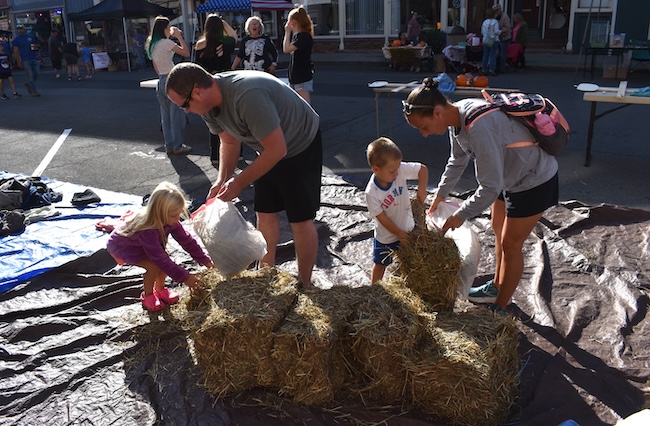
Andy and Rebecca Scroger brought their kids, Lizzy and James, to the festival to make a scarecrow.
These cousins are decorating pumpkins. From left include Malani Baker, 5; Gavin Baker, 4; and Mia Wilston, 10.
The pumpkins were decorating with stickers and markers.
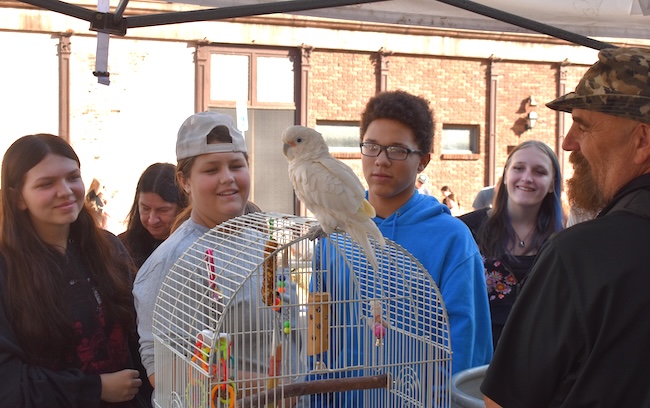
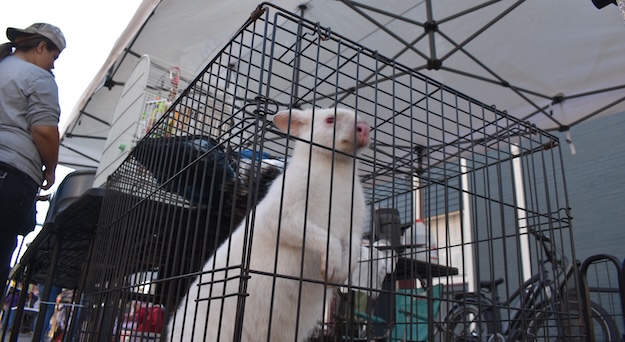
DeClerck’s Goldens in Albion brought several creatures for the public to see including “Caeser,” a Goffin’s cockatoo. Cary DeClerk was happy to share some of his animals and pets at the festival.
He also had a tortoise, golden retrievers, a wallaby, a sugar glider and others.
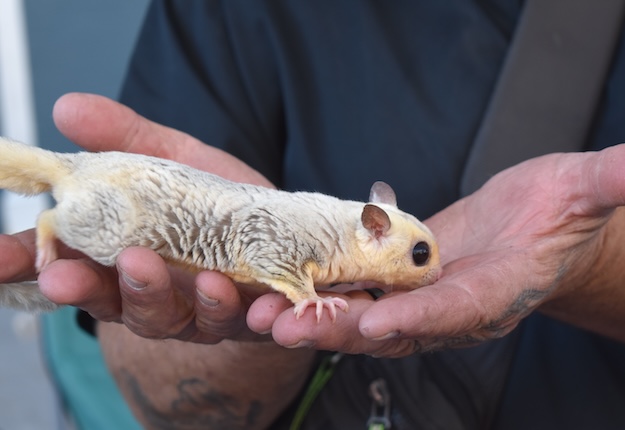
Cary DeClerk lets people see a sugar glider.
This wallaby attended the festival with DeClerck’s Goldens. Cary DeClerk also has kangaroos but they’re a little too big for the festival.
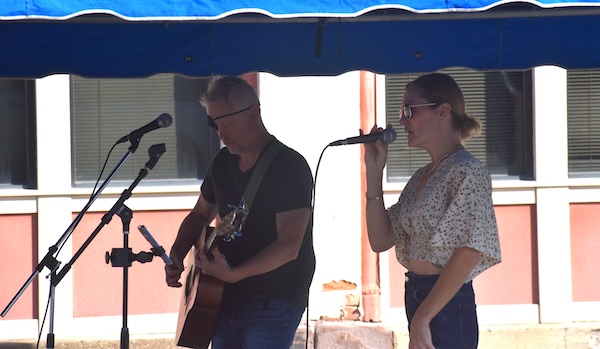
The Real News Duo performs at the end of East Bank Street. The Road Less Travelled also will be performing from 12:30 to 2:30 p.m.
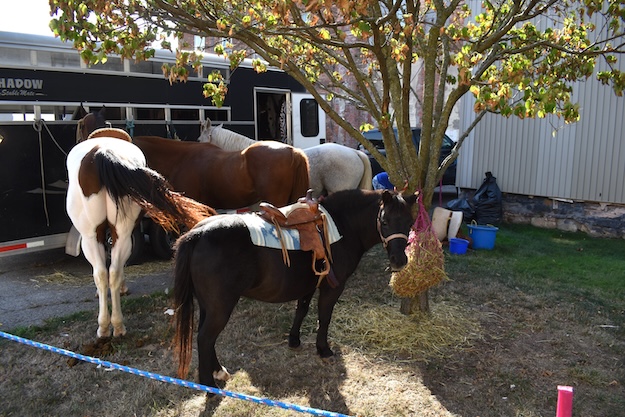
KTJ Saddle Up Pony Rides has a pony and horses at Waterman Park.
There are other fall festivals in Orleans County today.
The Lakeside State Park Fall Fest is from noon to 9:30 p.m. with food trucks, face painting, balloon art, Seneca Mobile Zoo, crafts and other activities. The musicians include Jim Aina from 1:30 to 3:30 p.m., Who Dats from 4:30 to 6:30 p.m., and Triple Play Band from 7:30 to 9:30 p.m.
Kendall also has its scarecrow festival today from 10 a.m. to 3 p.m. The theme: “Spooky, Scary and a Little Creepy” There will be music by Rebel’s Posse, a chainsaw carving demo by Jeff of Critters 3D, a chicken barbecue, hay rides and other activities.

























 WEBSTER – The Medina Mustang Marching Band traveled to Webster on Saturday for the band’s fourth competition this season. It was a large enthusiastic crowd and the weather was perfect with no wind and a full moon.