By Tom Rivers, Editor Posted 16 January 2024 at 3:31 pm
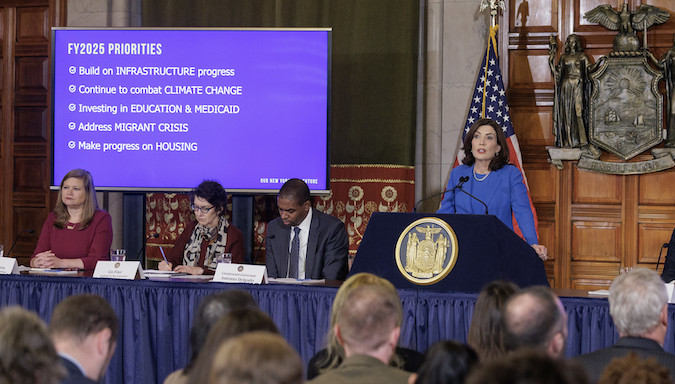
Gov. Kathy Hochul’s $233 billion budget proposal includes closing up to five state prisons, but doesn’t say which ones.
Of the 44 prisons in the state, there are two in Orleans County: Albion Correctional Facility, a women’s prison, and Orleans Correctional, a medium-security men’s prison.
“The Executive Budget includes legislation to allow the State to act expeditiously to right-size and eliminate excess capacity by allowing for the closure of up to five correctional facilities with 90 days’ notice. This legislation will allow for an increase in the operational efficiency of the correctional system,” states the budget book briefing from Hochul’s administration.
The New York State Correctional Officers & Police Benevolent Association, a union for corrections officers, said it is “deeply concerned that closures will exacerbate prison violence, cause relocated staff to leave service through resignation and retirement, and further the cycle of unsustainable staff attrition and prison violence.”
The announcement of impending closures comes at a time of increased violence that requires higher staffing ratios and lower inmate density, NYSCOPBA said.
Assaults on staff increased 13.4 percent in 2023, following a 25 percent increase the previous year when the Humane Alternatives to Long-Term Solitary Confinement Act (HALT) went into effect. Incarcerated individual assaults increased 41.5 percent in 2023, followed by a 34 percent increase in 2022, the union said.
“As the violence increases and staffing levels plummet, mandatory overtime for correction officers and sergeants has spiked to record highs,” said Chris Summers, NYSCOPBA president. “This overtime is well documented and it is unsustainable. Continuous mandates are straining members’ physical and mental health, their families, and their quality of life. Members are burning out at alarming rates. How can the State of New York demand that our members continue working in these conditions and have the mental and physical ability to keep incarcerated individuals and staff safe? Members need relief.”
Prisons are safest for staff and incarcerated people when the facilities are properly staffed and when incarcerated individuals are not forced to live on top of one another, the union said.
“Closing facilities fails to provide a long-term solution to staffing because staff do not want to uproot their families to move hours away,” NYSCOPBA stated in a news reelase. “Closing facilities fails to provide a long-term solution to violence because more densely populated prisons make it increasingly difficult to separate the bad actors from preying upon those who are quietly serving their sentences.”
ALBION – Governor Kathy Hochul today announced the highlights of the FY 2025 Budget, which she said makes New York more affordable, more livable and safer – while utilizing a fiscally responsible approach that keeps the State on a steady path for years to come.
“This budget makes it clear that fiscal discipline can co-exist with progressive, people-driven policies,” Governor Hochul said. “I am committed to fight the right fights on behalf of New Yorkers, and to pursue the common good with common sense – by seeking common ground.”
All funds spending is $233 billion, growing 4.5 percent. Governor Hochul prioritized bolstering the State’s reserves, which currently sit at just over 15 percent of operating costs. Under Governor Hochul’s leadership, New York State maintained a bond rating of AA+, reducing borrowing costs.
Improving Public Safety and Cracking Down on Crime
The FY 2025 Executive Budget makes targeted investments in initiatives that will strengthen efforts to keep New Yorkers safe. Spending for New York State’s public safety agencies includes:
$347 million investment in programs to prevent and reduce gun violence.
$290 million to restore the effectiveness of the continuum of the criminal justice system.
$120 million in victim assistance funding.
$40.2 million to address retail theft and bring relief to small businesses.
$40.8 million to reduce assaults with a focus on domestic violence.
$35 million for the next round of the Securing Communities Against Hate Crimes program.
$5 million for the Commercial Security Tax Credit to help business owners offset the costs of retail theft.
New legislation to strengthen the Cannabis Law, helping the Office of Cannabis Management and local governments seal or padlock unlicensed businesses.
Transforming the Mental Health Continuum of Care
New York’s mental health system has been underfunded for decades, but the FY 2025 Executive Budget raises state investment up over 45 percent, from $3.3 billion in 2022 to $4.8 billion over the entire continuum of care. These investments include:
$55 million to create 200 new inpatient psychiatric beds.
$45 million for youth mental health including school-based services and peer-to-peer counseling.
$43 million to keep supportive housing units for people in need of mental health services.
$42.2 million to increase reimbursement for mental health treatment services.
$37 million to build new programs for unhoused individuals living with mental illness
$24 million to help people with mental health problems who are in the criminal justice system.
Record-Breaking Investments in Public Education
Since taking office, Governor Hochul has increased school funding by record amounts — a total of $6 billion over two years – and includes a proposal to ensure every school district utilizes instructional best practices grounded in the Science of Reading. This year, Governor Hochul is proposing the highest amount of school aid in New York State’s history:
$35.3 billion in total school aid, an increase of $825 million (2.4 percent) from FY24. This includes a $507 million increase in Foundation Aid.
$10 million to train 20,000 teachers and teaching assistants in best practices for evidence-based literacy instructional practices.
4-year extension of Mayoral Control over New York City public schools.
The Executive Budget continues to implement Governor Hochul’s vision to transform the State’s public higher education system to become the best and most equitable statewide system of higher education in the country:
$1.2 billion for SUNY and CUNY capital projects.
$207 million for SUNY and CUNY operations.
$2.75 million for the SUNY Empire State Service Corps, offering students community service work opportunities.
$2.5 million for the operating costs of SUNY’s participation in the Empire AI consortium.
$2 million for SUNY’s role in NY SWIMS.
$1.5 million for the State Weather Risk Communication Center at the University at Albany.
Supporting New York’s Health Care System
Health Care is the largest single expense in New York State’s budget. Governor Hochul is proposing record funding to keep New Yorkers healthy, while also setting the Medicaid program on sustainable long-term fiscal footing.
$35.5 billion for Medicaid, along with targeted and transformational changes to ensure the long-term solvency and sustainability of the Medicaid program.
$315 million to provide health insurance subsidies for individuals up to 350 percent of the federal poverty line enrolled in Qualified Health Plans.
$67 million from the Opioid Settlement Fund for harm reduction, prevention and recovery services.
$45 million for disability services and independent living opportunities.
$25 million to catalyze innovation in research and treatment for ALS and other rare diseases.
$6.7 million to become an “employment first” state for the disability community.
The Executive Budget Includes $7.5 billion in funding over the next three years ($6 billion Federal, $1.5 billion state) through an amendment to New York’s Medicaid Section 1115 Demonstration program to support a comprehensive series of actions to advance health equity, reduce health disparities, and strengthen access to primary and behavioral health care across the state.
Promoting Economic Growth and Opportunity
Continued investment in New York’s economic recovery is a key component of the FY 2025 Executive Budget. Governor Hochul’s economic development vision focuses on industries where innovation is vital to success leading to the advancement of regional economic priorities through strategic investments in communities across the state.
$500 million in capital resources to support the State’s $1 billion commitment to expand and modernize the NY CREATES Albany NanoTech Complex.
$200 million for the One Network for Regional Advanced Manufacturing Partnerships (ON-RAMP) initiative to establish a network of four new workforce development centers along the I-90 corridor in upstate New York
$100 million for the FAST NY program to develop shovel-ready sites to ensure New York’s continued attractiveness to large employers and high-tech manufacturing companies.
$50 million for the Restore New York Communities Initiative to remove blight, reinvigorate downtowns, and generate economic opportunity in communities statewide.
$150 million in new capital grants and $75 million in new Excelsior tax credits to fund projects coordinated and planned by Regional Economic Development Councils.
$100 million for another round of the Downtown Revitalization Initiative.
$100 million for New York Forward to support the state’s rural communities.
$275 million to support the Empire AI Initiative over multiple years, complemented by more than $125 million in multi-year financial commitments from private partners.
$56.5 million for tourism and advertising campaigns.
$50 million to support an additional round of NYSCA’s grant program for capital projects of all sizes at arts organizations across the state.
Safer Roads, Better Transit
The FY 2025 Executive Budget includes investments to continue road, bridge and safety improvement across New York including:
$7.9 billion in State operating aid for the MTA, which Governor Hochul saved from the “fiscal cliff” in last year’s budget.
$7.6 billion for the third year of the five-year $32.9 billion Department of Transportation Capital Plan, the largest in New York’s history.
$577.8 million in funding for the Consolidated Highway Improvement Program (CHIPS) and the Marchiselli Program.
$551 million for non-MTA transit in the downstate region.
$323 million for transit systems in upstate New York.
$100 million for the Pave our Potholes (POP) Program
$45 million for engineering on the Interborough Express
$16 million to move forward with the planning of the Second Avenue Subway extension to Broadway.
Fighting Climate Change and Promoting Resiliency
New York’s climate goals are among the most ambitious in the nation. The FY 2025 Executive Budget proves Governor Hochul’s commitment to taking decisive action, meeting the scale and urgency of the climate crisis while growing our economy and protecting consumers.
The Executive Budget includes proposals that will accelerate New York’s transition to clean energy. The Affordable Gas Transition Act will protect utility customers from bearing the cost of unwarranted investments in fossil fuel infrastructure and establish new rules and guidelines applying to the extension of gas service in alignment with the Climate Act.
The Executive Budget also includes the Renewable Action Through Project Interconnection and Deployment (RAPID) Act, which will create a one-stop-shop for the environmental review and permitting of major renewable energy and transmission facilities within the Office of Renewable Energy Siting (ORES), streamlining the siting of green infrastructure necessary to meet the State’s climate goals. The Executive Budget also includes a proposal to expand the Climate Smart Communities program by increasing the maximum grant award to help localities meet the economic, social, and environmental challenges posed by climate change.
The Executive Budget includes:
$500 million for clean water over two years.
$435 million into resiliency projects to protect communities from severe floods, including
$250 million for a voluntary buyout program.
$400 million for the Environmental Protection Fund.
$100 million for the State Superfund Program.
$160 million invested in NY SWIMS to address the disinvestment in swimming facilities and lifeguards in underserved communities and an additional $446 million to invest in our State parks and pools.
$47 million to plant over 25 million trees across New York by 2033, as announced in the Governor’s 2024 State of the State Address.
Addressing the Migrant and Asylum Seeker Crisis
After allocating $1.9 billion over the past fiscal year for this issue, Governor Hochul will increase State support of the City’s efforts to $2.4 billion. This includes $500 million drawn from the State’s reserves which are intended for use during one-time emergencies.
Continued Focus on Housing
Governor Hochul’s FY 2025 Executive Budget includes initiatives to address the housing crisis throughout New York.
Require that localities receive Pro-Housing Community certification to access up to $650 million in state discretionary funding
$500 million in capital funds dedicated to developing up to 15,000 housing units on state-owned property.
Legislation to increase the housing supply in New York City including new tax incentives, authority for the city to lift outdated residential density restrictions where appropriate, incentives to encourage affordable housing in office conversions, and a path toward legalizing basement and cellar apartments
Legislation to increase protections for affordable housing providers by prohibiting insurance carriers from raising premiums on property owners based on tenant source of income, the existence of affordable housing units, or the receipt of government assistance
Legislation to protect homeowners by creating a clear definition of the crime of deed theft to help enhance enforcement and other measures to prevent against this heinous crime
Strengthening and Promoting Agriculture
New investments in New York’s agriculture industry and climate resilience.
$34 million in capital grants for on-farm milk storage technologies and processing infrastructure to improve supply chain efficiency.
$21 million to a new Alternative Waste Management and Enhanced Precision Feed Program to further the mitigation of agricultural greenhouse gas emissions
$10 million to continue a multi-year investment in support of kitchen facilities that prepare meals for K-12 schools from New York State farm products.
$10 million to reinvigorate New York’s aquaculture industry through the Blue Food Transformation and to grow New York’s bioeconomy
BATAVIA – UConnectCare (formerly Genesee/Orleans Council on Alcoholism and Substance Abuse) is continuing its Foundation Scholarship program for 2024.
$1,000 scholarships will be awarded, UConnectCare Chief Executive Officer John Bennett announced.
They are as follows:
One to a Genesee County high school student.
One to an Orleans County high school student.
One to an adult student pursing a bachelor’s or master’s degree.
One to a technical/trade school student.
Bennett said that the scholarships, which will be awarded at the agency’s annual membership meeting in May, will go to individuals pursuing their education at an institution of higher learning in the fields of human services or social services.
“With a goal of improving community health, the board of directors of both UConnectCare and the UConnectCare Foundation are excited about the prospects of supporting those who are committed to the behavioral health field,” Bennett said. “Without question, agencies such as ours are always ready to hire educated, dedicated and skilled employees.”
He noted that students enrolled in a Genesee or Orleans County school can apply for the scholarship even if their primary residence is in another county.
Applications are available on the UConnectCare website – www.uconnectcare.org – or can be obtained by contacting Diane Klos at Diane Klos at 585-815-1883 or dklos@unconnectcare.org. Completed applications must be received via email or postmarked by March 8.
Other pertinent scholarship information is as follows:
Applicant must be accepted at an accredited college or university and enrolled in or matriculated in an eligible program/major.
Eligible programs or majors include Social Work, Nursing, Health Science, Mental Health Counseling, Psychology, or Human Services.
Current UConnectCare employees, board members and UConnectCare Foundation board members are not eligible.
Relatives of UConnectCare employees, board members and UConnectCare Foundation board members are eligible.
Applicant must provide academic history such as high school and/or college transcripts.
Applicant must provide two letters of recommendation from someone who knows the applicant’s work/volunteer/academic history. Letters from relatives will not be accepted.
Applicant must provide a resume or personal biography including work history, volunteer experiences, and extra-curricular activities.
Applicant must provide an essay that addresses educational and employment objectives as they relate to the mission of UConnectCare. Financial need, volunteerism, employment history and civic involvement will be given careful consideration.
The scholarship monies will be awarded upon completion of the fall semester. The award recipient must provide a copy of their transcript demonstrating at least a 2.0 GPA.
Applicant may be invited for an interview before final awards are made.
By Tom Rivers, Editor Posted 16 January 2024 at 9:58 am
YATES – Town Assessor Patricia Laszewski is pushing to complete the first town-wide reassessment in Yates in five years.
There are 1,800 properties in Yates, and Laszewski will be assigning market values to all of them. The values will likely be up for most of the properties. Laszewski said the real estate market has stayed hot, although there are fewer properties for sale right now.
Laszewski led Ridgeway and Shelby through town-wide reassessments in 2023. She has retired from the two towns and remains with Yates in a part-time role.
Ridgeway and Shelby have appointed Julie Cecchini to be their new assessor. She was the assessor clerk in those towns.
Laszewski said Yates property owners will have the opportunity to challenge their assessments through a grievance process in the spring.
Town Supervisor Jim Simon said the reassessment schedule and grievance procedure will be highlighted in an upcoming town newsletter.
The towns in Orleans County used to be on the three-year cycle for doing the town-wide reassessments. Some towns held off in 2022 and 2023, thinking a hot real estate market would slow down. Some towns also have had changes in their assessor and have put of a full town-wide reassessment.
In 2023, Carlton, Kendall, Ridgeway and Shelby all completed full reassessments, at least four years since the last one.
By Tom Rivers, Editor Posted 16 January 2024 at 8:51 am
Orleans County’s costs for community college chargebacks were steadily rising so much that county officials decided to cap the amount at $2,050,000. Anything over that and the bill would be sent to towns in the county.
The county in 2020 paid $2,240,251 for community colleges. After the county imposed the cap at $2,050,000 in 2021, the costs dropped in 2021 and haven’t exceeded the $2,050,000 since then – but is getting close.
In 2021, the community college chargebacks to the county was $1,839,535. It dropped to $1,657,803 in 2022, but was up $244,790 in 2023 to $1,908,783.
If the cost tops $2,050,000 in 2024, the extra expense will be divvied up among the 10 towns in the county based on credit hours of residents in those towns.
County Treasurer Kim DeFrank said there is a chance some additional bills could come in this month for community colleges but she expects it won’t exceed $141,217, the amount the county is under the cap.
Community colleges were supposed to be funded with the state paying a third, the student paying a third, and the local town/county paying the other third.
But county officials say the state has pulled back on its contribution, putting more pressure on students and local municipalities.
The County Legislature said it needed to draw a line as the costs rose, putting pressure on the county budget.
Most community college students from Orleans go to Genesee Community College. But Orleans County has paid towards local students who attend other community colleges in the state, and some are far more costly than GCC, including the Fashion Institute of Technology in New York City.
Program modified to maximize benefits for small, rural and disadvantaged communities
Press Release, Gov. Kathy Hochul’s Office
Governor Kathy Hochul today announced $325 million in grants is available for clean water infrastructure projects through the next round of the State’s Water Infrastructure Improvement and Intermunicipal Grant programs.
This action immediately delivers on Governor Hochul’s clean water funding commitments announced in her 2024 State of the State, which include a series of changes to maximize benefits for small, rural, and disadvantaged communities.
“New York is committed to funding water infrastructure upgrades because every person has a right to clean water,” Hochul said. “With this additional funding for communities across the state, we are providing critical resources to local economies, creating jobs, and safeguarding the health and well-being of all New Yorkers.”
This round of WIIA/IMG boasts improvements announced as part of Governor Hochul’s 2024 State of the State to maximize benefits for rural and disadvantaged communities, including:
Additional benefits for rural communities. Even with extensive financial support from the State, some municipalities are left passing a large financial burden to their ratepayers. To alleviate this burden on small, rural, and disadvantaged communities, Governor Hochul is directing EFC to increase water infrastructure grants for small rural communities from 25 percent to 50 percent of net eligible project costs. This change will support smaller communities, like those in the Adirondacks, which often struggle with accessing clean water grants and delivering affordable projects.
Expanding community resources to ensure equitable access to funding opportunities. Small, rural, and disadvantaged communities are particularly impacted by deteriorating water infrastructure and emerging contaminants, and often do not possess the resources and capacity necessary to advance a project for infrastructure improvement. Governor Hochul is expanding EFC’s Community Assistance Teams program that launched in 2023 to provide essential support for updating New York’s critical water infrastructure. The teams are ready to engage with any community that needs help with its water infrastructure. Communities can request a meeting, register for upcoming webinars, and learn more at efc.ny.gov/cat.
Protecting drinking water. Continuing New York’s national leadership on addressing the threat of PFAS, Governor Hochul is increasing awards for emerging contaminant projects from 60% to 70% of net eligible project costs. This change will help ensure cost is not a barrier for communities working to make life-saving investments that eliminate risks to their drinking water supplies.
The Environmental Facilities Corporation (EFC) administers the WIIA and IMG programs in coordination with the Departments of Health (DOH) and Environmental Conservation (DEC). Governor Hochul’s plans will expand the success of these programs by assisting municipalities that have often struggled with accessing clean water grants and delivering affordable projects.
Applications and full eligibility criteria will become available at efc.ny.gov on Monday, Feb. 5.
By Ginny Kropf, correspondent Posted 15 January 2024 at 2:45 pm
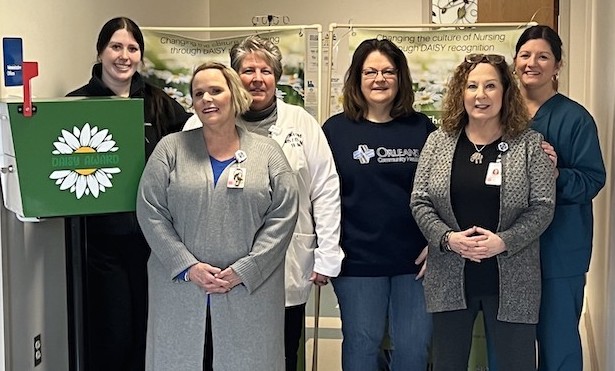
Provided photo: Orleans Community Health is enjoying the conclusion of a very successful year in several areas, including the establishment of a nurses’ recognition program through the Daisy Foundation. Pictured are those on the committee heading the awards program. From left are Cassie Maynard, Leighann VanAuker (in front), Christine Kropf, Jennifer Morgan, Rebecca Mannella and Kim Gray.
MEDINA – After completing a very successful year, Orleans Community Health is looking forward to more improvements in the new year ahead, according to Scott Robinson, director of Marketing, Communications and Outreach.
Robinson recapped OCH’s statistics for 2023, citing nurse Rhonda Woody’s recognition as a Healthcare Hero, the Wound Care Center named one of the top 10 in the country, Nicole Chapman winning a “Caring Heart” award, Emergency Room visits the highest since 2016, addition of three new surgeons to the hospital, an increase in patient days by 34 percent over 2022 and Primary Care cases at Albion Healthcare Center up 50 percent, the highest in its history.
Most exciting, according to Robinson, is a planned expansion at Albion Healthcare Center, adding two more primary care providers to keep up with the increased demand.
Robinson credits the addition of healthcare provider and Albion native Cheryl Kast for the uptick at the Albion facility, where announcement of the new providers will be made in less than a month.
“Overall, this shows more members of the community are choosing to receive care at Medina Memorial Hospital and the Albion Healthcare Center,” Robinson said. “We remain a steady hand for the community, and we’re here when we are needed – whether it’s routine or an emergency.”
He said the Transitional Care Unit at Medina Memorial Hospital doubled its numbers from the year before. While ER visits were the highest since 2016, the outpatient services were up 20 percent.
“With our full service radiology and award-winning Wound Care Center, people are hearing about Medina Memorial Hospital and choosing to come here,” Robinson said.
About two weeks into the new year, Robinson said they are already seeing increases continue at Albion Primary Care and Subacute Rehab.
In terms of the year ahead, Robinson said the hospital is approaching 99 years and plans are already underway for a 100th anniversary celebration in 2025.
By Tom Rivers, Editor Posted 15 January 2024 at 12:43 pm
Group will meet monthly throughout year to learn many facets of county
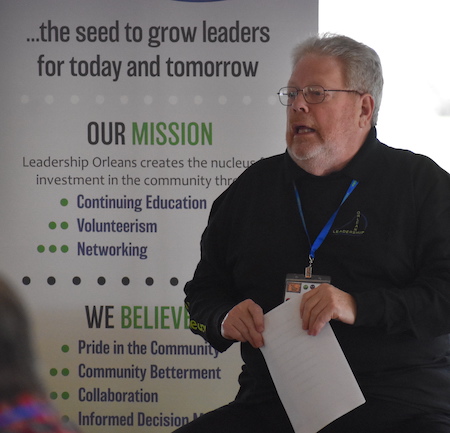
Skip Helfrich has been the Leadership Orleans executive director since the program started in 2018. He leads the class in a discussion on Friday at the White Birch in Lyndonville.
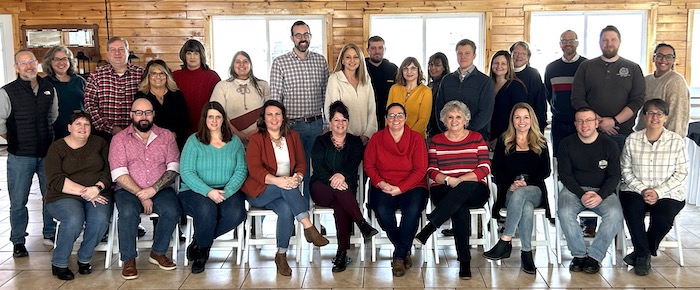
LYNDONVILLE – A new class of Leadership Orleans has started with a two-day retreat on Thursday and Friday. This is the seventh year of the program that graduated 149 in the first six years.
This year’s class is the largest yet with 28 members, and includes representatives from 10 organizations that haven’t been in the program before.
The 28 class members cover many sectors of the community, from agriculture to manufacturing, education and government, small business owners to nonprofit service providers, and a church leader and a director of the local arts council.
The program aims to build the “citizen capital” of the community, helping develop leaders who are educated on the many facets of the community. The class in the opening retreat did many ice-breaker activities to get to know each other. They also learned about their individual strengths and weaknesses, their personality types and how that shapes their decision-making and tendencies.
The class will meet monthly in the coming year, building leadership skills and gaining knowledge, experiences and meeting people from many different sectors in the community.
The program receives a stipend from the county, and there are many sponsors of programs throughout the years. The class members also pay tuition to be in Leadership Orleans.
This year’s class members include:
Tina Bell, office manager for Art Hill Excavating in Medina
Trisha Borrero, operations manager for Claims Recovery Financial Services in Albion
Lisa Bors, public relations director for Arc GLOW
Walt Breese, president of Subway in Albion
Darren Brodie, environmental health director for Genesee & Orleans County Health Departments
Melinda Daniels, executive assistant for Community Action of Orleans & Genesee
Reita Fletcher, branch manager of M&T Bank in Lyndonville
Gregory Hallock, executive director of Genesee-Orleans Regional Arts Council (GO Art!)
Courtney Henderson, owner of Babe Cave Inc. in Albion
Barbara Koert, assistant director of UConnectCare (formerly GCASA) in Albion
Liz Mastromatteo, coordinator/assistant principal of Orleans/Niagara BOCES in Medina
Betty Sue Miller, director of Hoag Library in Albion
Jeffrey Pasnik, council rep for North Atlantic States Regional Council of Carpenters in Cheektowaga
Brad Pritchard, principal of Albion Middle School
Melinda Rhim, coordinator of care management for Orleans County Mental Health Department
Marsha Rivers, pastor of First Baptist Church in Albion
Becky Robinson, partner with The Vintage Cigar in Medina
June Robinson, associate director of quality at Baxter Healthcare in Medina
Justin Robinson, dairy farmer with Poverty Hill Farms in Albion
Scott Robinson, director of marketing for Orleans Community Health
Pam Rounds, supervisor at Baxter Healthcare in Medina
Debbie Schiavone, payroll administrator for Community Action of Orleans & Genesee
Stacy Silker, court clerk for Town of Ridgeway and Town of Yates
Tiffany Smith, assistant chief of nursing for Rochester Regional Health
Lisa Stenshorn, clerk of the Orleans County Legislature
J.T. Thomas, operations director at Iroquois Job Corps in Medina
Linda Weller of Albion, president of Info Advantage Inc. in Rochester
Mike Winter, controller for Western New York Energy in Medina
Skip Helfrich said there are significant changes in how different generations approach daily living, from older people tending to pay with cash and trying to avoid debt, to younger people more geared to paying with debit cards and not carrying cash. Helfrich said the younger generation seeks a better “work-life balance” and doesn’t necessarily want the most overtime hours. The older generation tended to get as many OT hours as they could, seeking that higher pay rate, he said.
By Tom Rivers, Editor Posted 15 January 2024 at 9:17 am
It’s going to be cold in Orleans County this week with highs only about 20 degrees most days and lows typically in the teens. Most days have a chance for snow showers with no big snowfall in the immediate forecast.
Today on the Martin Luther King Jr. holiday, the high is forecast to reach 20 with an overnight low of 16, according to the National Weather Service in Buffalo.
Tuesday is forecast to reach a high of 21, with an overnight low of 10, followed by a high near 19 on Wednesday with a low of 16.
Thursday will stay cold with a high near 23 and low of 16, followed by a frigid Froday with a high near 22 and low of 10.
On the weekend, the forecast calls for a high of 16 on Saturday and low around 12, while Sunday is forecast to reach 24.
By Tom Rivers, Editor Posted 15 January 2024 at 8:49 am
The average price for regular unleaded continues to decline with the national price at $3.07, down a penny from a week ago, while the New York state average is at $3.28, down 4 cents in the past week. A year ago the NY average price was at $3.30, according to AAA.
In Orleans County, the average price is at $3.497 today, compared to $3.511 a week ago, a drop of 1.4 cents.
The price in Orleans has now dropped about 40 cents in the past three months. It was at $3.871 on Oct. 9.
Here are the average prices in Western New York counties today:
Orleans, $3.497
Genesee, $3.322
Wyoming, $3.490
Livingston, $3.479
Monroe, $3.255
Niagara, $3.306
Erie, $3.438
Chautauqua, $3.325
Cattaraugus, $3.289
Allegany, $3.480
AAA issued this statement this morning about gas prices:
“Since last week, demand for gasoline picked up a bit while total domestic gasoline stocks increased significantly. While prices are down across the board, the slight uptick in demand has limited pump price drops.
“This morning, oil prices range from $73 to $78 per barrel, the same as one week ago. The mid-winter blahs will likely keep pump prices waffling a few cents up and down for the immediate future. Analysts are also keeping an eye on frigid temps that can affect refinery production.
“Diesel prices are also moving lower. The national average price for diesel is $3.92, down three cents from one week ago, and down from $4.61 a year ago. The New York average for diesel is $4.41, down three cents from a week ago, and lower than $5.29 one year ago.”
Rural Orleans County residents have contended with lack of access to broadband service for some time, while their urban neighbors enjoy the advantages of high-speed internet connections.
But the urban-rural disparity in communications is not a new one – mail delivery experienced a similar issue from the 1860s to the early 1900s.
The Free City Delivery Act of 1863 mandated that free delivery of mail to individual homes be established at Post Offices where income from local postage was more than sufficient to cover the costs of providing the service. Before 1863, people were required to go to the post office to pick up their mail, as postage only paid for the delivery of mail from one post office to another.
The service proved to be very popular. Some urban areas even had mail delivery twice daily, this continued until 1950. Meanwhile, rural areas languished.
H. Justin Roberts, participant in the Oral History project, recalled:
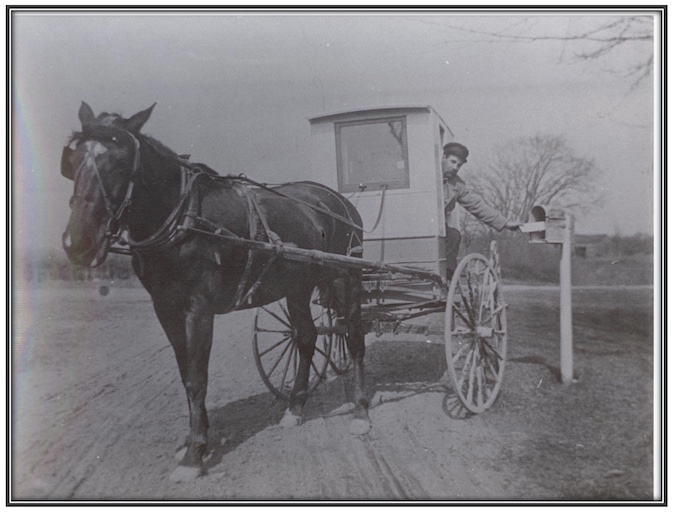
“We had to go two miles to get our mail. That would be in East Shelby. In those days, East Shelby, Millville, Knowlesville and all those little places had their own postmark. In the wintertime, neighbors along our road used to take turns going down to East Shelby to get the mail. They would bring the mail up and leave it at each house along the way. Mail was brought up from Knowlesville by horse and buggy. It would have been delivered at the Knowlesville depot.”
Proponents of rural mail delivery argued that if the government provided mail delivery to urban areas, it should provide a similar service to rural residents.
Following several years of political disputation, Rural Free Delivery, a huge undertaking, was established in 1896 though it took some time to implement nationwide. Routes had to be established, carriers hired – 32,000 by 1905.
In Albion, Postmaster R. Titus Coan posted the following description of Rural Route 1:
Beginning on Saturday, December 1, 1900, the carrier will go south to the Albion waterworks standpipe; then west to Mason’s Corners, thence south to Sheldon’s Corners, thence west to Porter’s Corners, thence south to the end of the road; thence west to the Pine Hill Road; thence south to Standish’s Corners; thence west to D. Tower’s corners; thence southeast to West Barre post office; then south to Mull’s Corners; thence east to Hill’s Corners; thence north to Manchester’s Corners; thence east to Grinnell’s Corners; thence north and northeast to Bragg’s Corners; thence west to Wetherbee’s Corners; thence north on West Barre road to Miller’s Corners, thence east to Sanderson’s Corners; thence north to Snyder’s Corners; thence east to Bond’s Corners; thence north to Lee Road, east on Lee Road to Benton’s Corners, thence north to the Albion post office. (Democrat & Chronicle Nov. 26, 1900.
Homer C. Heady was the Albion carrier.
Carriers had to furnish their own wagons and horses and pay for their upkeep. They carried with them a supply of postage stamps, postal cards, stamped envelopes, newspaper wrappers and money order blanks.
They traversed their routes through all kinds of weather, on unpaved roads, six days a week for a salary of $600 ($21,000 approx.). They were finally excused from Christmas Day delivery in 1923.
Rural free mail delivery ended the isolation of rural residents. They could connect to the outside world daily through their mailboxes. They felt that they were finally getting the benefit of a government service. With the introduction of parcel post in 1913, they could shop from home. Sounds familiar.
By Tom Rivers, Editor Posted 14 January 2024 at 3:14 pm
Photos by Tom Rivers
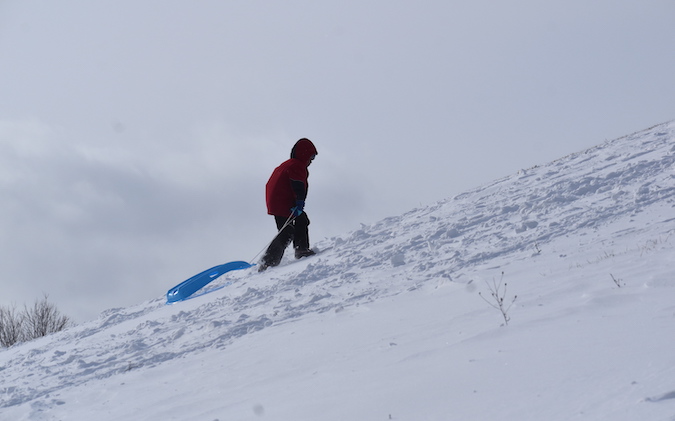
ALBION – Noah Harrison, 14, of Albion heads down the sledding hill at Bullard Park this afternoon.
This was the first big snowfall of winter for people to go sledding and get on their snowmobiles.
The sledders braved the hill despite strong winds and temperatures in the low 20s.
“It’s cold but it’s good,” Noah said about the sledding conditions.
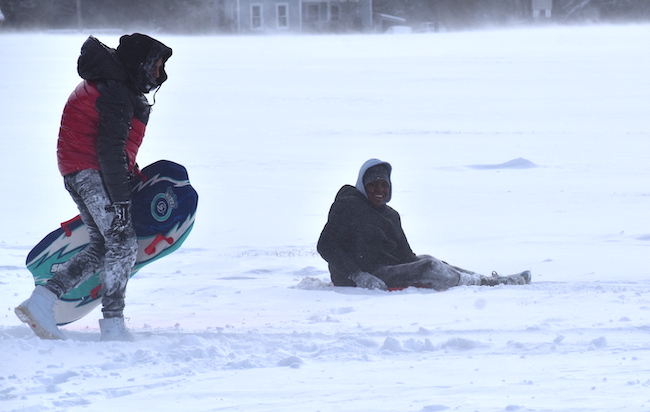
Ayden Coston, 14, of Albion takes a tumble of the sled at the bottom of the hill.
Cheryl Lane and her son Elijah, 3 ½, fight through the wind to walk up the hill for a another trip.
Cheryl and Elijah Lane head down the hill.
DeAvion Bloom, right, and Noah Harrison are ready for another go down the hill.
These sledders zoom down the hill.
The snow should stick around for a while. Today there will be high of 24 with overnight low of 13, followed by a high of 20 on Monday (Martin Luther King Jr. holiday) and an overnight low of 15, the National Weather Service in Buffalo said.
The highs then include 21 on Tuesday, 18 on Wednesday and 24 on Thursday.
Good morning! Grab your favorite cup. Fill it up. And let’s start this NEW YEAR right… TOGETHER!!!
Last Saturday I joined other volunteers helping out with the Hands 4 Hope Street Ministry.On this particularly cold morning it felt like my hands were frozen after only a few minutes as I wrote down people’s information before praying with them.
At one point I commented about how cold I was to a guy who had come by for the first time only to learn that he was homeless. There I was complaining about having to deal with the cold for only a couple hours when this young man, and a number of others who ended up stopping by, had to deal with the cold non-stop and would probably be grateful for even a couple hours of warm reprieve. It was a humbling realization to be sure.
It reminded me of when I first moved to the area nearly 20 years ago. I had posted a newspaper article by Tom Rivers on a bulletin board in my church. The article focused on the homeless in our community and I overheard people talking about it and not believing that it could be true. Thankfully though, not only have many others become aware of just how real the homelessness situation is in Orleans County but have also been prompted to do something about it.
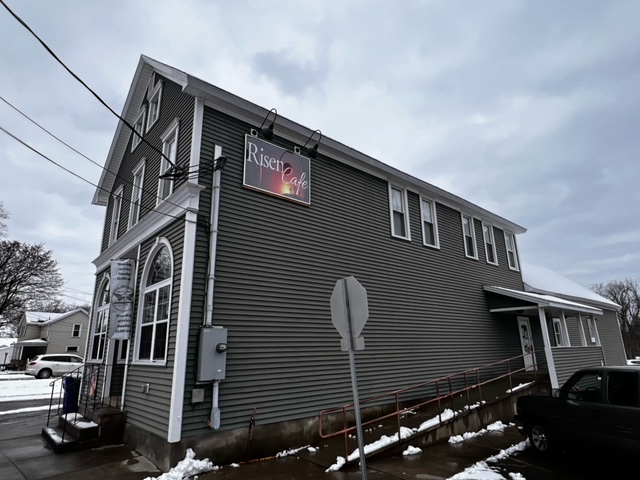
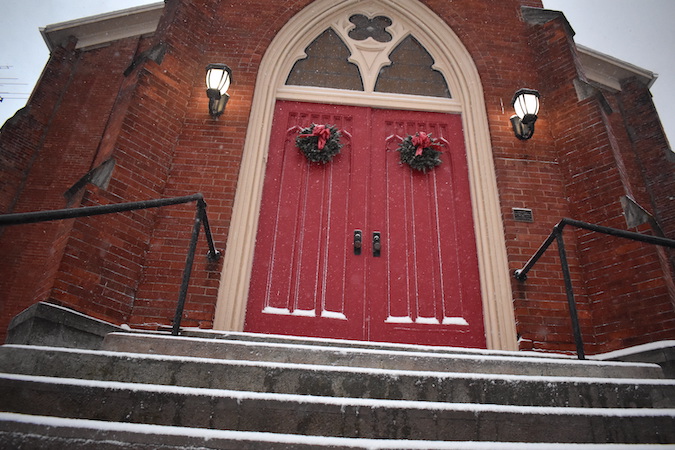
The Hoag Library is open and warm throughout most days, Christ Church in Albion is a designated Warming Center whenever the temperature drops below 32° (COLD BLUE), and other organizations are finding ways to make an impact on a more individual level. One that has been focused on feeding those in need is the Risen Café in Albion.
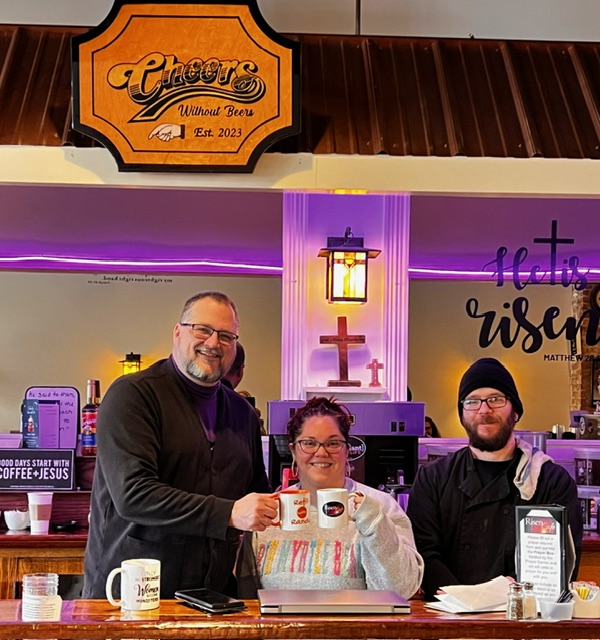
In October 2022 God’s Voice Ministries out of Lockport planted a church in the old Club 469 on E. State St. in Albion. In March of 2023 Pastor TerryBryant, Assistant Pastor Sarah Ferguson, and Head Chef John Angelucci, along with other volunteers from the church, opened Risen Café with the tagline “Sharing Christ 1 Cup of Coffee at a Time.”
Some things that stuck out right away were that their meals were delicious, affordable, included taxes in the pricing, and they did not accept tips. You heard that right, a decision was made early on that tips for servers would not be accepted but instead if anyone wanted to give a little extra they could support the “Ministry of the Month.” In 2023 a little over $10,000 was collected and distributed to such ministries as: Care-Net of Orleans, Hands 4 Hope Street Ministries, Hospice of Orleans, Trade 180, and Koinonia Kitchen. Throughout January 2024 they are collecting for Community Action.
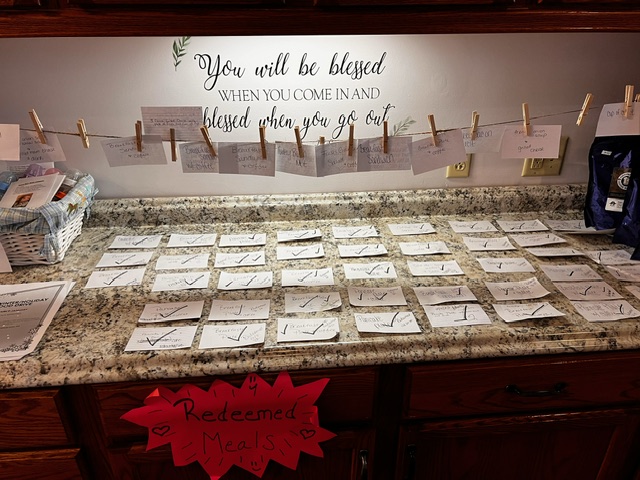
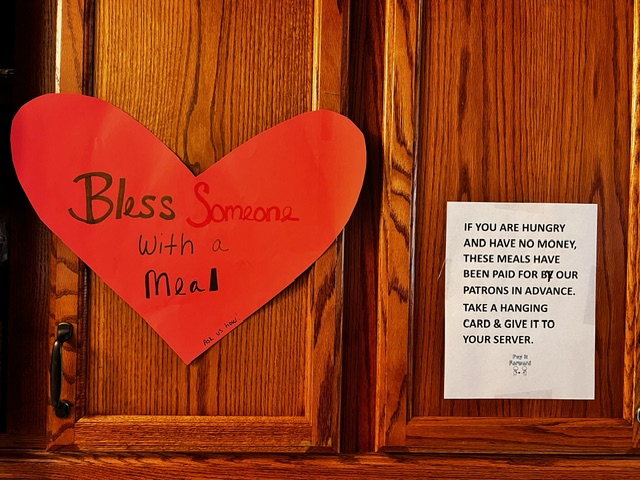
In a similar vein, there was a fund set up by the church which allowed for someone who may be having a bad day or was simply in need of some encouragement to receive their meal for free. By summertime this had evolved into providing free meals for a number of homeless individuals who had started to frequent both the Café and the church. In August almost $2,000 worth of meals were given away. After realizing that they did not have the funds to keep giving away meals at that rate, while not wanting anyone to have to go without, the idea of the “Pay It Forward” ministry was formed. Now customers at the Café can purchase specific meals which are then hung up for anyone in need to take down and to turn in for whatever food or drink the card says. The “used” meal cards are then left out as a visual to let supporters the fruit of their generosity.
In addition to “Pay it Forward” Risen Café also has a small food pantry and the church, which has a celebration service every Sunday morning at 11 a.m., hosts Redeemed Recovery, a faith-based meeting for anyone with troubles, on Sunday evenings at 6 p.m. The members of God’s Voice Ministries also picks one day a month to support and serve at another community-minded organization.
And, for anyone afraid that they might go in for a meal and get the Bible shoved down their throat instead, I personally guarantee you have nothing to worry about. If you have something that you want to talk or pray about you can certainly find someone willing spend time with you but if all you want is great burger served with a smile then that is what you will get. And of course, if you want to buy an extra meal and pay it forward, you too can be part of something special.
By Tom Rivers, Editor Posted 13 January 2024 at 5:34 pm
Churches are welcome to send in notices about cancelled services for Sunday. They should be sent to news@orleanshub.com or text (585) 590-2870.
The following churches have cancelled services for Sunday, Jan. 14, due to the bad weather:
Christ Church, Episcopal, in Albion
First Baptist Church in Medina
First Presbyterian Church Medina is cancelling the Sunday church service and postponing the 3 p.m. Martin Luther King celebration service.
St. Peter’s Lutheran Church in Medina
Lyndonville Presbyterian Church
The Lord’s House in Waterport will be closed. All are welcome for a service on a conference call at 10:30 a.m. The call-in number is (425) 436-6378, access code 5473403.
One Church in Medina
The River Church in Knowlesville
Lyndonville United Methodist Church
Oak Orchard Assembly of God in Medina
Eagle Harbor United Methodist Church
Alabama Full Gospel Fellowship
First Baptist Church of Albion
Albion Free Methodist won’t have in-person service but will do a live stream on the church’s Facebook page and YouTube page at 10 a.m.
Gaines Carlton Community Church
Calvary Tabernacle Assembly of God in Medina
First Presbyterian Church of Albion
East Shelby Community Bible Church
The Church of the Abundant Harvest in Millville
The Grove United Methodist Church in Medina
Light of Victory in Albion
Disciples United Methodist Church and Albion First United Methodist Church in Clarendon
By Tom Rivers, Editor Posted 13 January 2024 at 5:28 pm
Photos by Tom Rivers
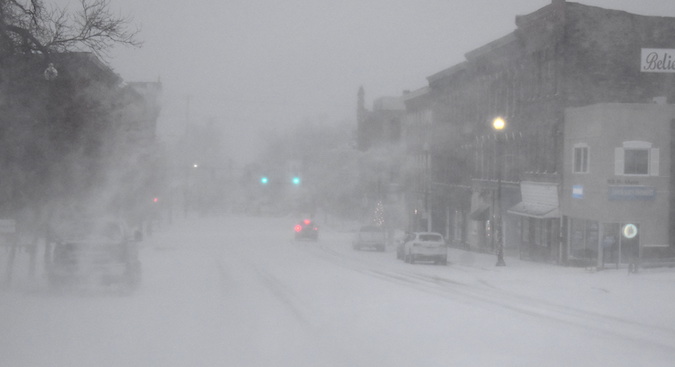
ALBION – A car heads north on Main Street in Albion near Bank Street at about 4:45 p.m.
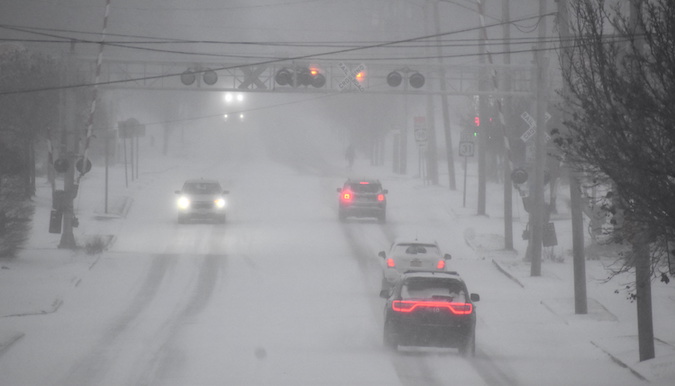
A winter storm warning remains in effect for Orleans and Niagara counties until 3 p.m. with 4 to 9 inches of snow expected, according to the National Weather Service in Buffalo.
The heavy lake effect snow will be mainly late tonight and Sunday morning. Winds will gust as high as 60 mph.
“Blizzard conditions will be possible at times late tonight into early Sunday morning,” the Weather Service said.
Traffic moves along Main Street at about 4:45 p.m. when blowing snow reduced visibility.






















 By Randy LeBaron