By Tom Rivers, Editor Posted 18 May 2024 at 9:19 am
Courtesy of Wolfpack Multisports: The T-shirt for the Strawberry Festival 5K and 8K includes a strawberry in a space suit.
ALBION – Organizers of the 36th annual Albion Strawberry Festival picked “Out of this World” for the theme of the two-day festival next month.
The festival committee thought the theme would build off all the hoopla for the solar eclipse on April 8. It wasn’t planned with lots of buildup like the eclipse, but the spectacle of the Northern Lights on the night of May 10-11 also had people looking to the skies.
Now, it’s up to the community and festival participants to rally around the theme. Becky Karls, the festival committee chairperson, wants to see many displays with a space theme for the parade at 10 a.m. on June 8. She said “Out of this World” lends itself to lots of creativity in the floats.
“I want to see more floats,” Karls said. “That would be my wish.”
Some of the events during the festival will feature the theme. Organizers of the 5K and 8K on June 8 unveiled the T-shirts for the race which show a strawberry in a space suit on a rocket. The dash plaques for the car show also have the festival theme.
The June 7-8 festival also will feature live music at four different locations, an arts and crafts show, many food vendors, and many other events.
Karls is leading the committee for the first time, after many years as a key volunteer.
“I love people and I love community events,” Karls said. “I think it’s great to have something in the community to bring people out.”
She said the committee has many dedicated volunteers who work well together.
The committee leaders include:
Mark Johnson – Business/Information/Raffle Vendors
By Tom Rivers, Editor Posted 17 May 2024 at 7:18 pm
Office for Aging honors Shirley Walter and Charlene Wisnewski for volunteer service
Photos by Tom Rivers
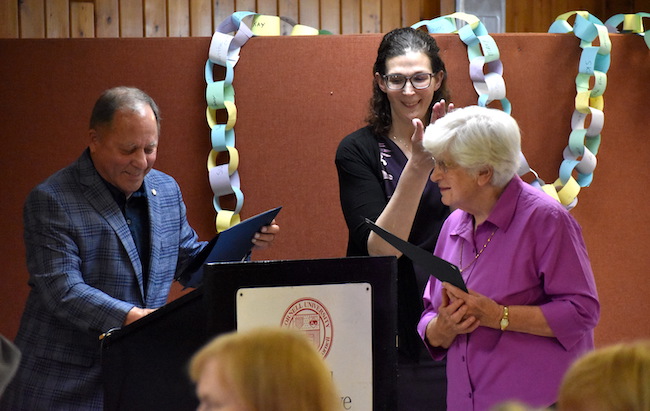
KNOWLESVILLE – Charlene Wisnewski, right, of Medina accepts a “Volunteer of the Year” award today from the Office for the Aging. Wisnewski is joined up front by Melissa Blanar, OFA director, and County Legislator Skip Draper who presented Wisnewski with a citation from State Sen. Rob Ortt.
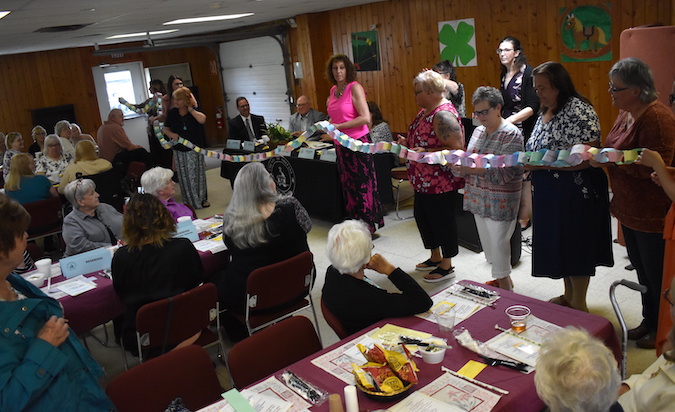
The OFA held its annual Spring Jubilee luncheon today and about 160 senior citizens had lunch at the Trolley Building at the Orleans County 4-H Fairgrounds. The 160 is the biggest crowd for the event since before Covid-19 hit in 2020.
Wisnewski is a retired civilian worker from the Albion Correctional Facility. The past two years she has volunteered as a driver for the OFA, taking seniors to appointments.
Wisnewski last year drove seniors to 55 appointments, logging 952 miles. She said she took about 15 different people, including three veterans. Two of those veterans are legally blind.
“You meet so many wonderful people,” Wisnewski said about volunteering as a driver.
Shirley Walter of Barre also was recognized as a “Volunteer of the Year.” She is shown being presented with an award by State Assemblyman Steve Hawley.
Walter is retired after a career as an accountant and bookkeeper. She also served on the Barre Town Board.
She has volunteered with the OFA at a new Caregivers Connections Respite program, which started in July at the Albion Academy on East Academy Street in Albion where the Meals on Wheels program is based. The respite program offers a break for caregivers of people with dementia or Alzheimer’s. It is from 10 a.m. to 2 p.m. the first and third Wednesdays each month.
Walter faithfully is there spending time with people who have dementia or Alzheimer’s. She has lunch with them, does crafts together, and chats.
“It is rewarding just to listen to them,” Walter said. “They have a lot to say.”
Walter also joins other volunteers in helping the OFA prepare the agency’s monthly newsletter, The Friendly Carrier, that goes to about 3,200 addresses.
Office for the Aging and Arc GLOW staff hold a paper chain that was intended to show how the group of 160 were all connected, with no one alone.
The luncheon was part of the OFA’s annual celebration in May of “Older Americans Month.”
County Legislator John Fitzak read a proclamation about the month. This year’s theme for the month is “Powered by Connections.”
“May is Older Americans Month, a time for us to recognize and honor Orleans County older adults and their immense influence on every facet of American society,” Fitzak said in reading the proclamation. “Whereas, through their wealth of life experience and wisdom, older adults guide our younger generations and carry forward abundant cultural and historical knowledge.”
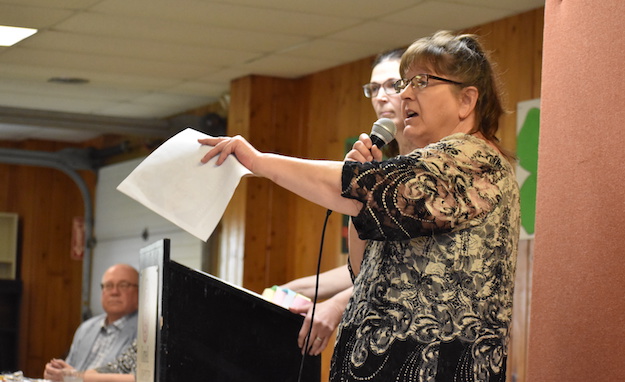
Vicki Havholm, nutrition program manager for Arc GLOW, emphasized the message that senior citizens aren’t alone and there are many services and opportunities to stay connected in the community.
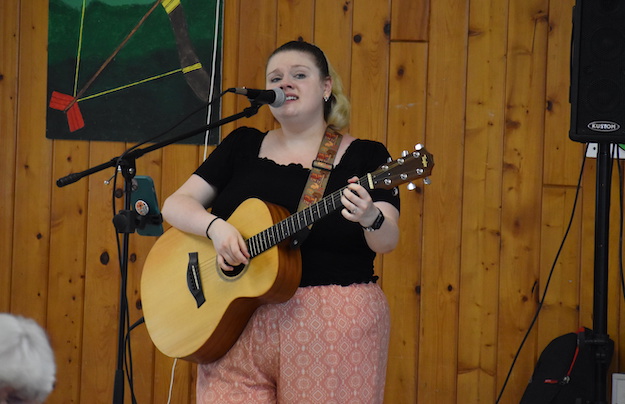
Kristina Suski-Jewell sings “Sweet Caroline” while entertaining the crowd before the luncheon. She sang for about 45 minutes.
By Tom Rivers, Editor Posted 17 May 2024 at 4:37 pm
Photos by Tom Rivers
ALBION – A group of Albion eighth-graders spent today painitng a flower-themed mural on a utility building at Bullard Park.
Two years ago, students in teacher Kamie Feder’s art classes painted the back of the building with colorful flowers. On Thursday and today, students painted the sides and front of the building.
They used leftover paint from the previous project.
“We wanted to make it fun and colorful,” Feder said. “Otherwise it’s just a tan building.”
Ayme Vallejo Morales works on painting a flower on the building. The students all designed their flowers for the mural.
This building used to be the bathrooms at Bullard Park until a new pavilion with bathrooms opened in 2021.
Drake Schomske, center, works on the mural this morning.
There were eight students working on the project on Thursday. Today’s group included nine: Schomske, Ayme Vallejo Morales, Mackenzie Cook, Cordelia Rivers, Tra’Monie Walker, Adelaide Pettit, Sophia Bouchey, Nate Wehling and Arian Fazliu.
Some of Feder’s students also painted a “Welcome to Albion” canal mural on the fire hall last fall.
ALBANY – Governor Kathy Hochul today announced a historic $50 million capital investment into the New York State Canal system as part of the FY 2025 Enacted Budget.
As the state prepares to celebrate the Erie Canal’s Bicentennial in 2025 and looks ahead to the next century of operation along the 524-mile Canal system, this funding ensures that the waterway will remain safe, operable, and a driver of tourism and economic activity. Investments will focus on high-priority infrastructure needs including the rehabilitation of water-impounding structures that have been in service for more than a century. Today’s announcement coincides with the seasonal opening of navigation on the Erie, Champlain, Oswego, and Cayuga-Seneca Canals.
“Nearly 200 years ago Governor DeWitt Clinton opened the original Erie Canal connecting the Great Lakes with the Atlantic Ocean and now we are making a significant investment to ensure the current Erie Canal and the entire canal system remain safe and a vibrant part of our state’s fabric,” Governor Hochul said. “As a lifelong boater who has plied the canal waters, I know firsthand that the canalway means so much to our communities. This commitment of funding will allow our historic canals to be part of New York’s story for generations to come.”
The funding included as part of the FY 2025 Enacted Budget is part of a comprehensive effort to revitalize the iconic Canal system by the New York Power Authority and New York State Canal Corporation. This effort includes strategically rehabilitating and improving the system’s infrastructure including locks, dams, embankments, culverts, and other civil assets so that the network of waterways and trails will continue to positively support the more than 200 upstate New York communities that are within the canal corridor.
Projects to be funded with the $50 million may include, but are not limited to, the following:
Rehabilitation of reservoir dams built in the 19th and early 20th century to supply water to the Enlarged Erie Canal (1836 – 1918) and other canals.
Waste weirs used to regulate the canal’s water levels.
Improvements to earthen embankment dams, including the continuation of extensive work in Royalton, Niagara County to install a soil-bentonite slurry wall to mitigate seepage.
Rehabilitation of other water management structures that provide resilience benefits, like guard gates which can be used to isolate and protect sites during high water events.
New York Power Authority President and CEO Justin E. Driscoll said, “Since the Canal Corporation became a subsidiary of the New York Power Authority in 2017, we have supported the development of Dam Safety and Asset Management programs, conducting more than 800 structural inspections each year, and assessing the vast majority of the civil structures across the 524-mile Canal system. While NYPA has increased investment into the waterway to approximately $140 million per year, the funding prioritized by Governor Hochul and the state Legislature allows us to invest more in critical water-impounding structures to ensure safe operations for canal users and neighboring communities.”
New York State Canal Corporation Director Brian U. Stratton said, “With the Erie Canal’s Bicentennial on the horizon, I applaud Governor Hochul and the members of the state Senate and Assembly for recognizing how vital the Canal system is to our local economies. Funding these critical infrastructure projects will safeguard downstream residents and businesses and allow the canal to continue to thrive.”
The Canal system’s 57 locks and 16 lift bridges will operate daily through Wednesday, October 16, 2024.
By Tom Rivers, Editor Posted 17 May 2024 at 9:31 am
Transformed Canal Basin parking lot, expanded farmers’ market get largest grants in NY Forward funds
Photo by Tom Rivers: The north end of Main Street in Medina is pictured in September. A $4.5 million state grant will pay for eight projects in the downtown area, including apartments at 409-413 Main St., the light green building at left.
MEDINA – Gov. Kathy Hochul has announced this morning how the state is divvying up a $4.5 million NY Forward grant in Medina.
The money will go to eight projects, with one of them a Small Business Fund that will assist small business owners with façade improvements, window repairs and smaller projects. A redesign of the Canal Basin parking lot is the biggest project at more than $1.3 million of the grant.
“The Village of Medina is very appreciative and excited to be selected as a recipient of this year’s New York Forward grant,” Medina Mayor Marguerite Sherman said in a news release from the Governor’s office. “The transformations, upgrades, and renovations will enhance Medina‘s ability to meet its goals in recreation, business, and housing for residents, visitors and businesses. The future is bright and promising in our beautiful historic village. I wish to thank everyone who played a role in making this happen. We can’t wait to get started!”
Medina officials and a committee of community volunteers worked last year to identify projects that would be submitted to the state for a final review. Medina’s committee had more than $9 million in considerations in the downtown and canal waterfront. The state whittled the list from 22 projects to eight that are approved for funding.
The eight projects include:
• Transform Canal Basin Park into a Waterfront Gateway – $1,345,000
Renderings from Empire State Development and Governor’s Office
The parking lot along the Erie Canal will be turned into a “waterfront gateway” complete with green space, seating areas and boater/cyclist amenities.
• Expand the Canal Village Farmer’s Market – $675,000
Upgrade the Canal Village Farmer’s market campus by modernizing the existing building, constructing a pole barn for additional vendor space and beautifying the site with green space.
• Redevelop the Walsh Hotel – $560,000
Convert the upper floors of the former Walsh Hotel into studio and one-bedroom apartments.
• Upgrade the Hart House Hotel – $500,000
Upgrade the Hart House Hotel with new amenities including an enhanced outdoor courtyard space, a gourmet gastropub, a hotel guest lounge, a new front porch and an improved facade.
• Develop Arenite Brewing Company on the Canal – $500,000
Create a microbrewery with tasting room and outdoor seating overlooking the canal, complete with a rooftop solar installation.
• Rehabilitate the Upper Floor Apartments at 409-413 Main Street – $370,000
Renovate the second floor into a mix of one-bedroom and two-bedroom apartments.
• Establish a Downtown Small Project Grant Fund – $300,000
Create a pool of funding to support business and property owners with smaller-scale projects like facade improvements, window replacement and other repairs.
• Install Downtown Wayfinding Signage – $250,000
Implement a system of directional, informational, and interpretive signage to direct visitors to key locations and destinations throughout downtown.
The NY Forward program favors upper-story redevelopment in buildings for housing and additional commercial space rather than new construction. The state guidelines prioritize elevating cultural, historical qualities that enhance the feeling of small-town charm. The state also made the program focus on a tight commercial activity area with an opportunity to enhance cultural heritage.
The governor’s announcement this morning also included $10 million of projects in the Village of Perry for the Downtown Revitalization Initiative and $4.5 million in Geneseo for another NY Forward community in the Finger Lakes Region.
State Senator Robert G. Ortt said, “It’s wonderful to see New York investing in local businesses throughout our rural parts of the state. The Canalside Village of Medina has seen a recent explosion of new stores, restaurants, and other local businesses and the recently awarded $4.5 Million in NY Forward grants will ensure economic growth and revitalization efforts continue to steam ahead in Medina for years to come,” said Senator Ortt.
Assemblymember Stephen Hawley said, “I’m proud to see the Village of Medina secure these projects through the NY Forward Program. This community has long been one of Western New York’s greatest hidden gems and these projects will help bring improvements for education, transportation and overall quality of life. This is a great step in the right direction to provide our upstate community and I look forward to seeing the impact it will have on the region.”
By Tom Rivers, Editor Posted 17 May 2024 at 8:35 am
Provided photos
LYNDONVILLE – Andrea Page, an author and educator from Rochester, visited the Lyndonville community on Tuesday for presentations and discussions about a book she wrote featuring seven Sioux code talkers of World War II.
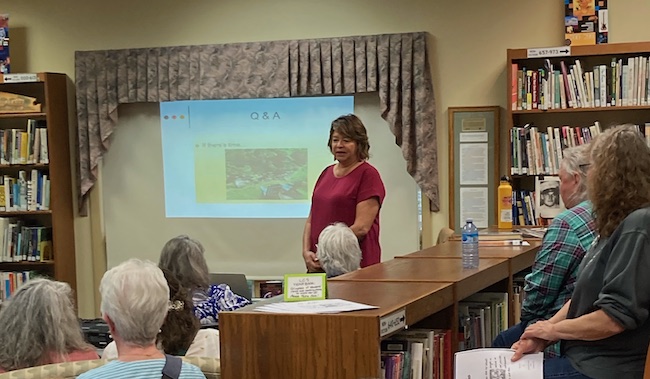
Many patrons at Yates Community Library read “Sioux Code Talkers of World War II” in the past two months. Page discussed the book at the library with about 40 people on Tuesday evening.
Earlier in the day she gave a presentation at Lyndonville Central School, where every eighth-grader received a copy of the book paid for by the Elisabeth Dye Curtis Foundation.
Page researched seven Sioux soldiers, whose native language ensured secrecy of the strategic messages from the U.S. military as they served in the Pacific Theater under General MacArthur. Page is the grand-niece of the one of the seven Sioux code talkers, John Bear King.
She shared about the Sioux code talkers’ most heroic actions, including their assist in the rescue of nearly 4,000 American POWs held in a college complex in Manila, the Philippines.
Andrea Page speaks to 40 attendees during a book discussion at the Yates Community Free Library. About 50 people checked out the book during “Lyndonville Reads,” a community reading effort.
By Tom Rivers, Editor Posted 17 May 2024 at 7:03 am
The Erie Canal opens its 200th consecutive navigational season today, with the lift bridges and locks to be operational with standard hours daily from 8 a.m. to 6 p.m. The season continues until Oct. 16.
During the peak navigational season from May 17 to Sept. 11, there will be extended hours from 8 a.m. to 9 p.m. at the lift bridges, including the seven in Orleans County. (The Albion Main Street bridge remains under construction this year.)
The standard hours have been moved back an hour this season. Last year the hours were 7 a.m. to 5 p.m.
There won’t be any tolls or fees for recreational use of the canal system for the 8th straight year. Those tolls were normally $25 to $100 for a season pass, depending on the size of the vessel.
There are seven lift bridges in Orleans County – Holley, Hulberton, Ingersoll Street in Albion, Main Street in Albion, Eagle Harbor, Knowlesville and Medina. There are 16 lift bridges on the canal and Orleans has more than any other county in the state.
The canal was completed in 1825, linking Buffalo to Albany. It has operated every year since. Next year will be the bicentennial of the original 363-mile-long canal, which took eight years to build, from 1817 to 1825.
By Tom Rivers, Editor Posted 16 May 2024 at 5:51 pm
Photos by Tom Rivers
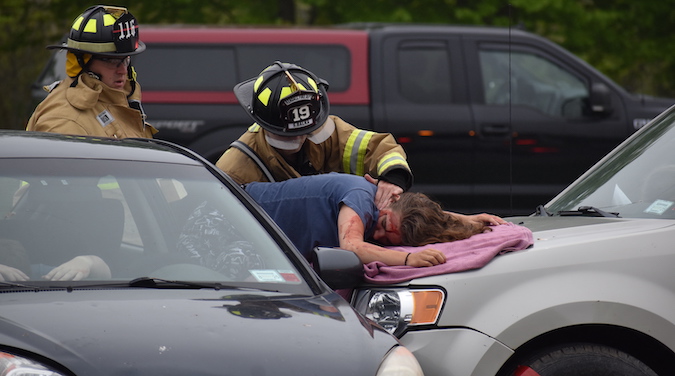
KENDALL – Bailey Schultz is covered in fake blood in a simulated car crash this morning at Kendall Junior-Senior High School. Five Kendall students role played in a message for their classmates about the dangers of drinking and driving.
Kendall did the event a day before Friday’s prom which will be at the White Birch Golf Course in Lyndonville.
Firefighters and school officials told students to avoid driving if they’ve been drinking alcohol, or if they are overly tired or texting. And that message applies at all the times, especially during the prom and upcoming season of graduation parties.
“Drinking and driving is not an option,” said Melissa Strelick, the school’s principal. “You need to look out for each other. This is totally avoidable.”
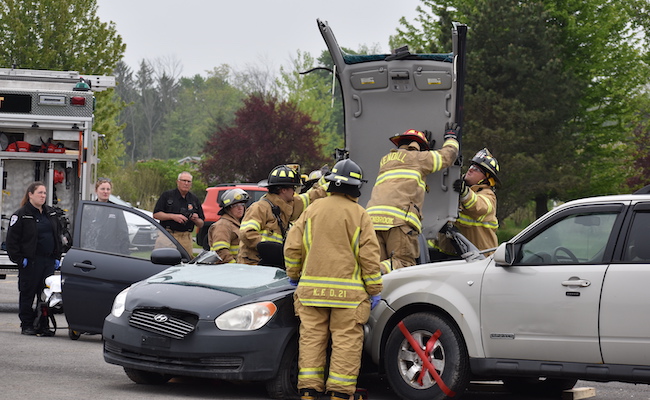
Kendall firefighters work to take apart the roof of the car, peeling back the metal. There were students inside to be rescued.
Kendall has done the simulation each year before the prom since at least 2013.
“It’s for the kids to show the effects of drinking and driving, texting and driving, and any impairments,’ said Mike Schultz, a lieutenant with the Kendall FD.
His daughter was one of the “injured” students. Schultz said it was painful to see his daughter in the simulation and he had to walk away because he was feeling so emotional.
Sgt. Adam Hazel of the Orleans County Sheriff’s Office does a DWI field sobriety test on Hunter Richards, who portrayed a drunk driver. He was handcuffed and led away in a patrol car.
Hazel spoke to the students and told them a fatal car accident can devastate the entire community.
“You have to make good decisions,” Hazel said.
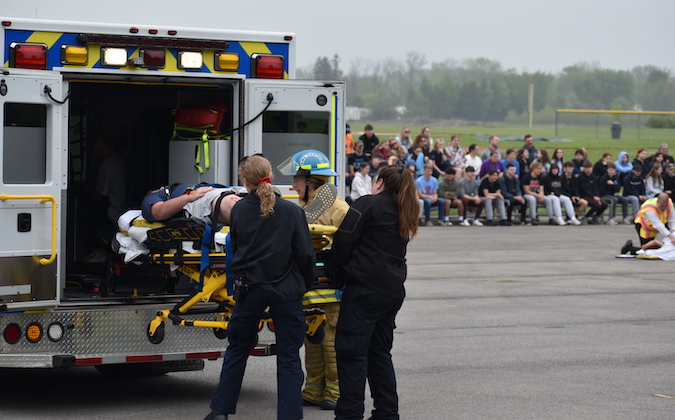
Monroe Ambulance medics have Jimmie Swift on a stretcher. He was one of three students taken away by ambulance as part of today’s simulation. Gracie Robb and Lucas Jones also portrayed injured students who needed ambulance transport.
About 100 students in the junior and senior classes watched the simulation this morning.
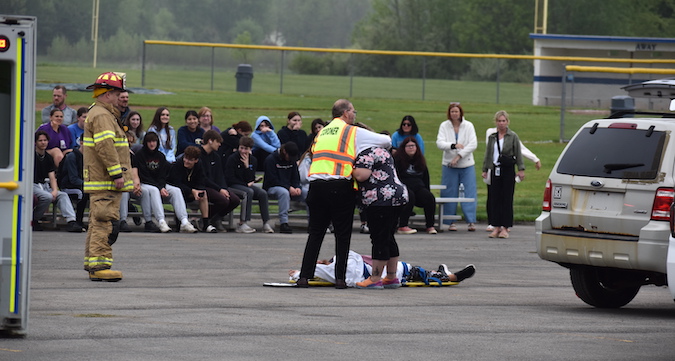
Orleans County Chief Coroner Scott Schmidt comforts Karen Jones, who was the “acting mom” for Bailey Schultz. Schmidt pronounced her deceased at the scene and covered her with a blanket. Jones is also Kendall’s director of transportation.
Kendall firefighters take off the windshield in one of the cars. The event is also a recruitment effort for the department. After the simulation, Fire Chief Randy Davis encouraged the students to get a close look at the fire apparatus and tools. Davis said about eight students in recent years have joined the department after seeing the DWI crash simulation.
A1 Towing & Auto in Holley donated the two vehicles for today’s simulation.
By Tom Rivers, Editor Posted 16 May 2024 at 3:33 pm
KENDALL – The Kendall Fire Department has about $20,000 in new equipment to serve the community during emergency responses.
One anonymous donor in Kendall gave $6,000 and the Kendall FD used that to purchase light, battery-powered equipment from the Milwaukee company. That includes four light towers, two chain saws, two 9-inch cutoff saws, two 18-inch fans, two leaf blowers, two 6-pack chargers, a reciprocating saw and 20 batteries.
The new equipment is light and battery-powered. The leaf blowers will be used to clean up debris at accidents or from a wind storm. The saws can cut through metal, shingles and concrete. The light towers can be used to illuminate the inside of a house that has lost power.
Randy Davis, the Kendall fire chief, said the new equipment has been in service about two weeks. He said it can be quickly deployed in the field, and is much lighter and easier to maneuver. He said many fire departments are switching to the new battery-powered equipment.
He is thankful to the local resident that met with fire department officials to determine a good use of the donation.
A local business, Partyka farm, also paid for nearly the full cost of a mechanical CPR machine. The Defibtech Lifeline Arm has a value of about $13,000. Davis said Partyka also donated Defibtechs to the Hamlin-Morton-Walker Fire District.
“We appreciate the community’s support of the fire department,” Davis said.
BATAVIA – The annual meeting Wednesday at Terry Hills Restaurant in Batavia may have been the first under the name UConnectCare, but it served as a celebration of the many ways the agency formerly known as Genesee/Orleans Council on Alcoholism and Substance Abuse is having a positive impact on community health.
Chief Executive Officer John Bennett, speaking to 73 employees, board members and award recipients, outlined a long list of recently added programs that, in his words, “are building access to essential services for those in need.”
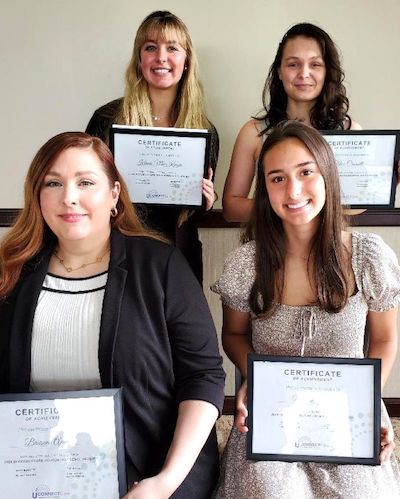
UConnectCare Scholars: UConnectCare Foundation scholars for 2024 are, seated from left, Brianne Amico and Megan Gates; standing, Kenna MacKenzie and Chloe Crossett.
“As far as quality of care, I look at two things – our staff and board members who go above and beyond each and every day, and the expansion of our service over the past seven years,” Bennett said.
The agency changed its name to UConnectCare Behavioral Health Services last fall to reflect its work toward implementing programs to reach a wide spectrum of people in the areas of prevention, treatment, recovery, detoxification, supportive living and residential.
In 2023, Bennett said, the agency received three significant grants:
A federal Rural Communities Opioid Response Program Neonatal Abstinence Syndrome II grant for $498,848 from the Health Services and Resource Administration to provide the Healthy Moms/Healthy Babies program to pregnant and postpartum women.
A federal Targeted Capacity Expansion Special Projects grant in the amount of $375,000 to provide harm reduction services in the community.
A Statewide Health Care Facility System Transformation grant for $985,250 from the NYS Department of Health to improve building capacity in the integrated outpatient treatment program in Batavia.
UConnectCare’s reach, as indicated by the 2023 numbers, is expanding as well, Bennett said, noting that more than 35,000 people were served by the agency’s Prevention department and more than 39,000 counseling visits were provided.
“Furthermore, we had 2,400 visitors at The Recovery Station (on Clinton Street Road), served 339 people in community residence or detox settings, served 1,538 patients in integrated outpatient services and provided 380 childcare sessions,” he said.
‘Friends of UConnectCare’ Honored
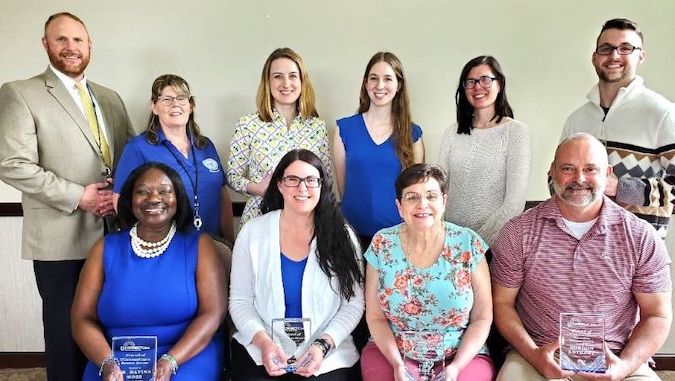
Four individuals, a public health agency and a Buffalo pharmacy received “Friends of UConnectCare” awards at the luncheon.
Honorees are as follows:
Erin Martin, case manager at Genesee Justice. Nominated by the Batavia clinic, Martin was recognized for her continued service to the agency by helping clients face their legal consequences and by encouraging them to make positive steps toward improving their lives.
Gordon Luthart, health teacher at Medina Junior-Senior High School. Nominated by Orleans County Prevention, Luthart, a Marine Corps veteran, was awarded for working with UConnectCare over the past decade to provide prevention education in the classroom.
Pam Gefell, mental health therapist for Orleans County Mental Health. Nominated by Orleans County Treatment, Gefell, a former UConnectCare counselor, provides evaluation and counseling services on a weekly basis in Albion for those who have co-occurring (substance use disorder and mental health issues) disorders.
Dr. Davina Moss, founder of Positive Direction & Associates, Inc., of Buffalo and creator of The Positive Direction Model. Nominated by Recovery Services, she is instrumental in starting and sustaining the agency’s Healthy Moms, Healthy Babies program. Dr. Moss said she shares the award with Jessica Budzinack, coordinator of UConnectCare’s program to help the pregnant and post-natal population.
Genesee/Orleans Department of Health (GO Health). Nominated by Genesee Prevention, GO Health partners with UConnectCare on the GOW Opioid Task Force and joined forces with UConnectCare on the HEALing Genesee group over the past 18 months. Both agencies have worked to implement new programs focusing on Naloxone and fentanyl education and medications for opioid use disorder, including the launching of the task force’s Text for Naloxone Line.
Riverview Pharmacy, Buffalo. Nominated by Residential/Detox Services, the pharmacy was acknowledged for its reliable and dependable service to those on medication and its communication with UConnectCare’s nursing staff.
4 receive Foundation scholarships
Three graduating seniors and a Genesee Community College graduate each will be receiving $1,000 scholarships, courtesy of the UConnectCare Foundation. The winners include:
Kenna MacKenzie, Le Roy High School, who will be attending SUNY Geneseo to major in Psychology.
Megan Gates, Kendall High School, who will be attending SUNY Brockport in the Nursing program.
Chloe Crossett, Kendall High School, who will be attending SUNY Brockport in pursuit of a degree in Social Work.
Brianne Amico, who earned an associate’s degree in human services from GCC before enrolling at SUNY Plattsburgh. She plans to work toward a master’s degree in social work at SUNY Binghamton.
Press Release, Orleans County Mental Health Department
ALBION – The month of May is recognized as Mental Health Awareness Month and the Orleans County Department of Mental Health is taking the opportunity to work with their local, regional, and national partners to promote the many mental services available to residents.
“It is important that we are always talking about mental health and the services and supports available, as it is an effort to reduce stigma and reinforce the importance of reaching out for help for anyone who is experiencing a mental health challenge or are in emotional distress,” said Danielle Figura, director of Orleans County Mental Health & Community Services. “Through efforts like Mental Health Awareness Month, I believe we have made tremendous progress on how the public views mental health, although we recognize we still have a lot of work to do.”
Figura said drawing attention to mental health awareness begins with promoting the county’s Care and Crisis Helpline. Those in crisis should call the helpline at (585) 283-5200. The helpline is available 24 hours a day, 7 days a week, 365 days a year.
“The helpline is there when people feel they have nowhere else to turn, whether its depression, anxiety, substance abuse, trauma or any other need that may be interfering with emotional wellbeing,” said Figura. “We want the people to know they are not alone.”
Figura said locally in Orleans County, there are many mental health supports and resources available to the residents of Orleans County. “These programs and services exist to support individuals and their families so if you feel you or someone you know may need assistance, please take advantage of them.”
New York State Office of Mental Health Licensed Article 31 Outpatient Clinic Treatment Programs offering individual therapy, family therapy, couples therapy and psychiatric services (to include psychiatric evaluation, psychiatric monitoring, and pharmacology). Open access hours for new clients are Monday to Friday at 12:30 p.m.
New York State Office of Mental Health Licensed Article 31 Outpatient Clinic Satellite Sites at UConnect Care (formerly GCASA) and Orleans County School Districts offering individual therapy at those host locations.
Health Home Care Management Programs serving both youths and adults. A program under New York State Department of Health, which looks to connect individuals to additional supports and resources to promote overall physical and emotional health wellness.
Crisis Supports & Resources
Spectrum Health CARES Team – Mobile Crisis Team Available Evenings, Weekends, Holidays for over the phone support, and in home assessments. Serving both adults and youth. Requests for the CARES Team can be made by contacting the Care & Crisis Helpline at (585) 283-5200 or contacting the Orleans County Sheriffs Dispatch.
Rochester Psychiatric Center MIT Team (mobile integration team) – Serves Adults only and is available Monday – Friday during business hours. Providing in home, community based assessments, outreach and engagement efforts.Requests for the RPC MIT Team can be made through the Care & Crisis Helpline at (585) 283-5200.
“988” National Suicide & Crisis Lifeline – Call or Text 988, Connect via chat at 988Lifeline.org or visit 988Lifeline.org for more resources.
Additional Programs & Resources
Mental Health Association of Genesee & Orleans Counties. Serving adults in Orleans County, through programs to include the Warm Line, Transportation, and Drop-In-Center. Click here for more information.
Oak Orchard Health. Click here for more information.
WASHINGTON, D.C. – U.S. Senator Kirsten Gillibrand on Wednesday held a virtual press conference to announce her push to provide a boost in federal funding for the Federal Emergency Management Agency’s (FEMA) Assistance to Firefighters Grant Program (AFGP) in the FY25 appropriations bill.
The AFGP provides funding for local fire departments to purchase equipment and emergency vehicles and address staffing shortages. As many fire departments across New York State continue to rely on outdated equipment and struggle with staffing shortages, Gillibrand is pushing for additional federal funding for the AFGP to ensure firefighters have what they need to stay safe as they protect their communities.
“Fire departments across our state are operating with outdated fire trucks and protective gear, and replacing it can cost millions of dollars that many of them just don’t have,” Gillibrand said. “This year, I’m calling for increased funding to address nationwide need. Firefighters put their lives on the line for us, and we owe it to them to provide the resources they need to do their jobs.”
The Assistance to Firefighters Grant Program offers multiple types of grants, including Assistance to Firefighters Grants (AFG), which help fire departments acquire new emergency vehicles, protective gear, and equipment, and Staffing for Adequate Fire and Emergency Response Grants (SAFER), which help fire departments hire and retain trained firefighters to meet industry minimum standards and ensure 24-hour staffing. Last year, Gillibrand helped secure over 200 AFG and SAFER grants totaling nearly $50 million for fire departments across New York State.
Gillibrand sent the following letter to Senate appropriators:
“Dear Chair Murray, Vice Chair Collins, Chair Murphy, and Ranking Member Britt:
“As you begin crafting the fiscal year (FY) 2025 Department of Homeland Security (DHS) Appropriations bill, we urge that you include increased funding for the Assistance to Firefighters Grant (AFG) Program and the Staffing for Adequate Fire and Emergency Response (SAFER) Grant Program. We appreciate the committee’s previous strong support of these vital programs, but were concerned to see the cuts levied against these vital programs in Fiscal Year 2024, as they make important investments in public safety in states and local jurisdictions throughout the country.
“The AFG Program has strengthened public safety by providing much needed funding for infrared cameras, personal protective gear, hazmat detection devices, improved breathing apparatuses, interoperable communications systems, and much more. This equipment is critical to ensuring the safety of firefighters as they respond to emergencies and protect our communities. The cost of this equipment, however, continues to increase year after year, and demand for the AFG Program continues to significantly outpace available funding.
“Similarly, the SAFER Grant Program provides much-needed funding for career and volunteer fire departments to hire, recruit, and retain firefighters. This program is critical because more than half of all career and volunteer fire departments in our nation do not have sufficient personnel to protect the public effectively. In order to bring our nation’s fire departments to the staffing levels needed to serve their communities and respond to emergencies, the SAFER Grant Program must be adequately funded.
“The AFG and SAFER Programs are vital to firefighters across the country, and yet, the programs face a statutory sunset date of September 30, 2024. We urge Congress to pass the Fire Grants and Safety Act (S. 870) to reauthorize these essential programs. Should the Fire Grants and Safety Act not be enacted prior to your drafting of the Homeland Security appropriations bill, we request that you include language to extend the sunset of AFG and SAFER for one year, until September 30, 2025.
“We have an obligation to protect those who protect us by providing them with the necessary resources to perform their jobs as safely and effectively as possible. We urge you to help Congress meet that obligation by accounting for the increased needs of firefighters nationwide and providing increased funding for the AFG and SAFER programs in FY 2025. Thank you for your consideration of this request and your ongoing commitment to our nation’s firefighters.”