By Tom Rivers, Editor Posted 26 December 2023 at 7:29 pm
ALBION – Genesee and Orleans counties will no longer share services for a county youth bureau. For about 30 years, Orleans has paid Genesee to administer youth bureau services for Orleans using Genesee County staff based in Batavia.
But that will end on Dec. 31. The Orleans County legislature said the two counties made a mutual decision to end the agreement and run their own youth bureaus. Orleans County Legislators said it wasn’t due to litigation between the two counties over whether a sewer main can be constructed on Route 63 in Orleans County, with treated sanitary sewer from the STAMP manufacturing site going into the Oak Orchard Creek.
The Orleans County Legislature last week voted to create a new part-time youth bureau administrator. Jack Welch, the county’s chief administrator officer, will serve as the temporary youth bureau administrator until the position is filled.
The Youth Bureau administers funding to counties made available by the NYS Office of Children and Family Services. The Youth Bureau contracts with agencies and municipalities to provide prevention, intervention and recreation programming.
Current Youth Bureau contract programs are Orleans Juvenile Adjustment Services, ARC Camp Rainbow, Hoag Library and the LIFE Program.
Youth recreation programs serve youth year round or during the summer months through drop-in programs and structured sports. The programs that receive state funds are Albion, Holley, Kendall and Medina recreation programs.
By Tom Rivers, Editor Posted 26 December 2023 at 4:43 pm
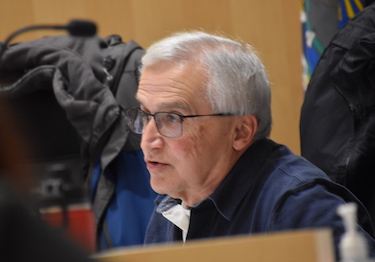
Town of Yates appeals State Supreme Court decision, seeks moratorium to modify local law for farm labor housing
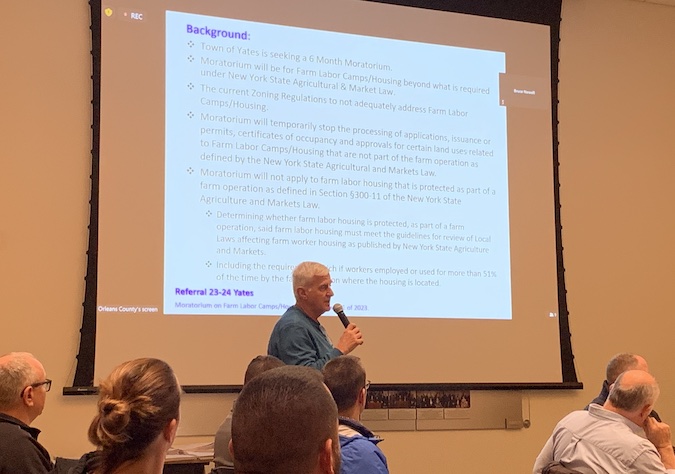
Photos by Tom Rivers: Yates Town Supervisor Jim Simon said the Town Board is seeking the moratorium to clean up outdated language in the local law about farm labor camps. He is speaking during Thursday’s Orleans County Planning Board meeting.
YATES – A State Supreme Court justice has sided with H.H. Dobbins & Son in the Lyndonville company’s effort to build housing on North Lyndonville Road (Route 63) for workers for its apple farm and its packing house.
Supreme Court Justice Frank Caruso on Nov. 8 made his ruling in favor of Dobbins in a lawsuit against the Zoning Board of Appeals and Planning Board in Yates. The judge also backed Dobbins in its request to make the housing year-round and not just seasonal.
Yates on Nov. 14 filed a notice of appeal from attorneys Charles Malcomb and Aaron Saykin, Hodgson Russ LLP lawyers working for the town.
Brian Napoli, the Planning Board chairman, said state Agriculture & Markets has struck down local laws deemed too restrictive to agriculture. Napoli supported the board’s decision to deny the Yates request due to litigation between the town and Dobbins.
The ruling from Caruso rescinds and annuls the ZBA interpretation dated June 29 regarding “whether farm labor camps may be occupied by H2B workers who pack apples?”
Dobbins employs foreign workers through the H2B program for the packing house. Foreign workers who work directly on farms come through visas through the H2A program.
The ZBA opposed the 30-bed housing because the H2B workers don’t just work for Dobbins. They also pack apples for about 50 other farms.
But the judge said the labor camp “may be occupied by H2B workers, and any other workers, who perform fruit packing operations and/or field work.”
Yates, besides appealing the judge’s decision, also seeks a moratorium on farm labor housing, and wants to amend the local law to say the housing must used by at least 51 percent of workers at one farm.
The town doesn’t have an issue with farm labor housing when the housing is used for people who are doing farm work for the farm that owns the housing. But Yates officials say H.H. Dobbins Inc. owns and operates a packing house that serves many farms, not a single entity.
Yates attorneys, in court filings, describe the packing house as a “factory” that shouldn’t be included under farm labor housing. Judge Caruso ruled the packing house employees should be considered farm workers and eligible for the housing.
Dobbins operates a farm and the packing house. H.H. Dobbin & Son LLC owns a fruit orchard and the 30-bed labor camp would be used solely by those workers from June through the end of November.
H.H. Dobbins Inc. owns the packing house, which utilizes the H2B program with foreign workers. That operation plans to use the housing from the end of November through May.
There are workers for the orchard from February through May, and Dobbins officials say they want the housing to be shared by workers from both operations during those three months.
The Orleans County Planning Board considered the town’s request for a moratorium on farm labor housing during its meeting last Thursday. The board ultimately voted to deny the referral from the town, with members saying they didn’t want to weigh in on an issue in pending litigation.
Jim Simon, the Yates town supervisor, said the town currently has more than 200 beds of farm labor housing. The town isn’t trying to block farm labor housing. It just wants to update the law which he said currently “has a lot of old language, etc.” That law was last updated in 2003.
He said the Town Board plans to work with the ag community to modify the regulations.
“We will work with farm for a good law,” he said.
Gary Daum, a member of both the county and town planning boards, said the town is seeking to address questions about the current regulations in place. He said he values Dobbins as an important local employer in the town.
Dave D’Anniballe, controller at H.H. Dobbins & Son LLC, said the town is seeking to change the law while Dobbins has already submitted a plan.
“We’re concerned the town is trying to move the goal posts while the kick is on the way,” he said.
Dobbins applied for the housing on Jan. 4, 2023 and still is in limbo on moving forward with a building that would be 104 feet by 40 feet. With more delays from the town’s court appeal, and now a proposed moratorium, D’Anniballe said it could be 2025 or later when the housing could be fully utilized. Dobbins should be able to get started on the labor housing in 2024 but would only have use of it for harvest workers from August to November, D’Anniballe said.
He presented a packet of information to the Planning Board that included a letter signed by 31 farmers against the moratorium and the plan to change the local law, requiring at least 51 percent of workers to be at a single farm.
Those farmers disputed a characterization from Town Board members that the labor camps are like “barns.” The farmers said new farm labor housing facilities have modern kitchens, cable TV, wireless internet, flat-screen TVs, high-efficiency heating and numerous energy-efficient windows to let in natural light.
Anna Shuknecht, a senior loan officer for Farm Credit East, sent in a letter supporting Dobbins in its push to improve the housing for the foreign workers. Dobbins packs 1.1 million bushels of apples, with Orleans County farms representing 75 percent of the farms served by the packing house. Dobbins has 71 employees overall including local workers.
Maureen Torrey, a farm owner in Yates for 30 years, said in a letter to the town that she is “quite disturbed” by Yates proposed moratorium on applications, approvals and construction of farm labor camps. The moratorium holds up investment in the housing and sends a discouraging message to the farm community, Torrey said.
She said many different visa programs allow for farm labor programs with the stays ranging from three to 10 months, and those programs are regulated by the federal government. The labor housing also is regularly inspected by local and state government officials.
Torrey said many farmers have formed cooperatives and work together for marketing and packaging of farm commodities – fruit, vegetables, dairy products and grain.
Chad Kirby, president of the Orleans County Farm Bureau, also sent a letter in support of the Dobbins labor housing, specifically the option to have housing that serves more than one farm. Kirby said other family farms may need to share housing, or may need to rent space because they cannot afford to build their own.
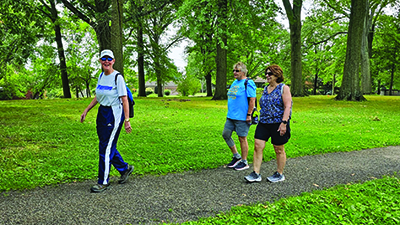
Modest changes can add up to big results for your body and mind.
By Lyndzea Corsetti, FNP, Oak Orchard Health, Brockport
As we kick off 2024, many of us are thinking about making a fresh start with our eating and exercise habits. Still, we’ve all seen family and friends who make New Year’s resolutions to change their habits but struggle to stick with them. That’s often because people bite off more than they can chew when it comes to making healthy changes. Making small, gradual changes can help you get big results over time, and they’re easier to stay with. Here are some things you can do in the new year to start making small changes that will pay off with major benefits.
Preventative medicine can help your overall health
Coming to the health center when you’re sick is important, but even more important is coming when you’re not. Be sure to have a physical each year and talk to your provider about what’s on your mind both physically and mentally. Are you planning to start or add to your family? Or maybe you’re not. Are you worried about weight loss or gain? It’s also the right time to discuss vaccinations, STD testing, and so much more. At Oak Orchard Health, we’re here for you.
Drink more water (and less sugar and caffeine)
It’s no surprise that drinking fresh water is going to be healthier for you than drinking sugary drinks. It’s a good idea to shift some of those drinks to ice water instead. Even so, you may be underestimating how much water you need every day. Nutritionists generally recommend drinking about half your body weight in ounces (and don’t worry—not all at once, just one eight-ounce glass at a time). It’s easy to calculate: For instance, if you weigh 140 pounds, you need 70 oz of water a day.
And if you drink caffeinated beverages like coffee, tea, and energy drinks, add 12 to 16 oz of water for each of those, because caffeine can dehydrate you. And while those energy drinks may give you a temporary boost, they’re not the healthiest choice. Want to scale back? Do so gradually and avoid the headaches that come from stopping caffeinated drinks too quickly. Just reduce the number of daily servings and drink water instead.
Reach for more unprocessed foods
Foods that come in boxes and cans often have a lot of extra salt, sugar, and fat. Whatever your daily routine—three big, traditional meals, six smaller meals—try to incorporate more fresh fruits and vegetables as much as you can. Coming off the holidays, this can be especially helpful after all the treats like cookies and candy and party foods.
By Tom Rivers, Editor Posted 26 December 2023 at 12:14 pm
ALBION – The Orleans County Planning Board has backed a 2.25 megawatt solar project in Albion and 525-foot-long screening berm for Barre Stone Products.
Planners met last Thursday and recommended the Town of Albion approve a special use permit and the site plan for a solar project with 5,048 panels at 12811 Route 31, on land owned by Rachael Murray near the Orleans County 4-H Fairgrounds. The project is an extension of the solar array on Long Bridge Road, but they are separate facilities with their own interconnections to the grid, planners said.
USLE/West Albion Community Solar of Latham, NY is the applicant for the new solar project. The panels will be connected to a single-axis tracker racking system. The system will encompass 16 acres of a 63-acre site. The solar array will be surrounded by a fence with a vegetative buffer. There won’t be a battery-storage system. Construction of the project will take 6-8 months.
Planners also recommended the Town of Barre approve a special use modification for a 525-foot-long screening buffer berm by a mine at 4412 Oak Orchard Rd.
Keeler Construction and Barre Stone Products will provide a visual shield and sound barrier for the mine. The berm will be 12 feet high with a base width of 112 feet, allowing for a 1:3 slope that will be easy to maintain with a mowable grass cover.
Barre Stone officials estimated the berm will take about two weeks to construct.
By Tom Rivers, Editor Posted 26 December 2023 at 11:32 am
The average gas prices went up 6 cents nationally since last Monday to $3.10 a gallon and increased 3 cents in New York to $3.38 a gallon, AAA said today.
In Orleans County, the average price for regular unleaded dropped 5 cents from $3.61 a week ago to $3.56 today, according to AAA.
“There is mixed news for gas prices on the day after Christmas,” AAA said in a news release. “The national average for a gallon of regular gas has risen six cents since last Monday, while the average for a gallon of regular in New York has fallen three cents. This is the first rise in the national average since September, when the cheaper to produce winter blend of fuel was reintroduced. Prices were slower to fall in New York when the national average first came down, and we may be seeing a similar effect now as prices in New York trail the national trend.”
“Demand for gas is strong amid a 10-day holiday travel period where AAA predicts nearly 104 million motorists will drive 50 miles or more from their home. In addition, oil prices are creeping higher back toward the $80 a barrel mark. If these trends continue over the next week, motorists everywhere may see gas prices rise.
“Diesel prices are seeing a similar mixed trend,” AAA said. “The national average price for diesel is $4.01, up one cent from last Monday, and down from $4.68 a year ago. The New York average for diesel is $4.48, down three cents from a week ago, and lower than $5.37 one year ago.”
Here are the average gas prices for regular unleaded in counties around Western New York:
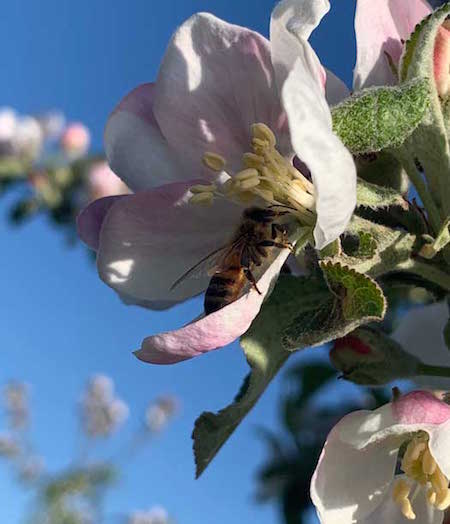
File photo: A bee pollinates a flower in an apple orchard in May 2020 in Knowlesville.
Governor Kathy Hochul has signed into law Legislation S.1856-A/A.7640, known as the Birds and Bees Protection Act.
This nation-leading legislation protects New Yorkers from potentially harmful toxins by prohibiting the use of certain neonicotinoid pesticide (neonics) treated corn, soybean, or wheat seeds and neonicotinoid pesticides for outdoor ornamental plants and turfs, creating important protections for New York’s pollinators, birds, and other wildlife.
“By signing the Birds and Bees Protection Act, New York is taking a significant stride in protecting our kids, environment and essential pollinators,” Governor Hochul stated on Dec. 22. “This law underscores our commitment to fostering a thriving ecosystem while we prioritize sustainable farming and agricultural practices.”
Legislation S.1856-A/A.7640 is a proactive measure to protect pollinators by restricting the use of neonicotinoid pesticides on certain seeds, outdoor ornamental plants, and turf. It allows sufficient time for innovative research on alternatives and the development of more cost-effective products that are less harmful to the environment. After this period, the use of neonicotinoids will be subject to science-based evaluations and waiver provisions to assist farm and agriculture operations in the transition to this new program.
New York is committed to promoting the health and recovery of pollinator populations, as highlighted in the State’s Pollinator Protection Plan (PDF). Pollinators contribute substantially to New York’s environment and economy. According to the U.S. Department of Agriculture, pollinators provide approximately $344 million worth of pollination services to New York and add $29 billion in value to crop production nationally each year. The state’s ability to produce crops such as apples, grapes, cherries, onions, pumpkins, and cauliflower relies heavily on the presence of pollinators.
This new law will build on action the Department of Environmental Conservation (DEC) has already taken to restrict the use of many neonics and work with registrants to narrow the uses of many of these products to protect pollinators or state resources.
Last year, DEC took action to limit the unrestricted use of pesticides that can harm bee and other pollinator populations by reclassifying certain products containing the neonicotinoid (neonic) insecticides imidacloprid, thiamethoxam, and acetamiprid as “restricted use” to ensure applications are limited to trained pesticide applicators in specific situations.
Governor Hochul continues to prioritize agriculture and recognizes its critical importance to New York’s economy and role in protecting the environment. The state is proud to be home to over 33,000 farms producing some of the world’s best food and beverages.
New York Farm Bureau President David Fisher said, “New York Farm Bureau greatly appreciates Governor Hochul’s leadership in offering thoughtful chapter amendments on the “Birds and Bees Protection Act.” She sought input from all sides and reached consensus on a balanced approach that ensures farms will have safe risk management tools that they need to grow food for our state. New York Farm Bureau also is pleased about the continued role the Department of Environmental Conservation will have in consultation with the Department of Agriculture and Markets to make science based regulatory decisions. The Governor once again demonstrated her willingness to find a reasonable pathway forward to support New York agriculture.”
New York Corn and Soybean Growers Association Vice President Brad Macauley said, “On a very complicated and consequential issue, Governor Hochul showed great leadership in protecting the agricultural industry while advancing environmental policy. Our association believes strongly in our role as stewards of the environment and following science backed policy. Governor Hochul struck the right balance for our industry and we look forward to continuing to work with the Administration on the implementation of the new law to properly protect both our environment and industry.”
Northeast Organic Farming Association of New York Policy Manager Katie Baildon said, “By signing the Birds and Bees Protection Act Governor Hochul is protecting human and ecosystem health and supporting the viability of the thousands of NY farms that rely on native and honeybee populations to pollinate their crops each year. By restricting wasteful neonic use, NY is protecting not only pollinators but also insect predators that farmers count on for natural pest control and soil microbial life critical for capturing carbon and nutrient cycling. NOFA-NY is celebrating this important win that will significantly curb contamination of our environment, our bodies and the entire NY food system.”
Hochul signs legislation banning contests for coyotes, foxes, bobcats, squirrels, raccoons, crows and other species
Press Release, Gov. Kathy Hochul’s Office
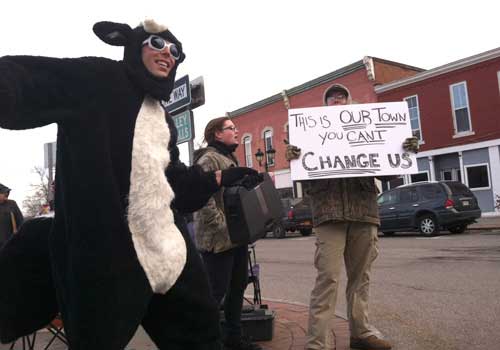
File photo by Tom Rivers: Derrick Bradley, wearing a skunk costume on Feb. 22, 2014, joins local residents as they respond to protestors who opposed the “Squirrel Slam” fundraiser in Holley.
Gov. Kathy Hochul has signed legislation ending wildlife hunting contests for coyotes, foxes, bobcats, squirrels, raccoons, crows and other species.
The legislation signed on Dec. 22 doesn’t include fishing and hunting. Legislation S.4099/A.2917 amends the environmental conservation law to make certain hunting contests, competitions, tournaments, and derbies that allow for the take of large numbers of wildlife unlawful.
“Protecting wildlife is critical to fostering the integrity and resilience of our environment and our outdoor recreation economy,” Governor Hochul said in a news release. “This legislation establishes strong safeguards for our state’s precious wildlife species and protects our important fishing and hunting traditions.”
The new law makes it unlawful for an individual to organize, sponsor, conduct, promote or participate in any contest, competition, tournament or derby with the objective of taking or hunting wildlife for prizes, inducement or entertainment. Any wildlife killed during these activities become the property of the New York State Department of Environmental Conservation.
The law specifically helps prevent the taking of significant numbers of animals, often coyotes, crows, squirrels and rabbits, in contests held for prizes and entertainment rather than the targeted management of wildlife populations. The legislation excludes contests for hunting white-tailed deer, turkeys and bears, as well as fishing contests, which are carefully regulated by the state. By enacting this legislation, New York joins a national trend of states banning such contests.
State Senator Tim Kennedy said, “With the signing of this legislation, we are sending a clear message that the wanton waste of one of our state’s most treasured resources will not continue. The indiscriminate, inhumane killing of our shared wildlife in exchange for cash prizes is a waste of life, and I am proud that New York State is taking the lead in outlawing these contests. Thank you to the dozens of organizations and countless advocates who supported this legislation, and Governor Hochul for signing it into law.”
Humane Society of the United States New York State Director Brian Shapiro said, “With Governor Hochul’s continued commitment to environmental stewardship, New York is now the tenth state to end wasteful cash-for-wildlife competitions. We thank and appreciate Governor Hochul for upholding sound policies that protect and celebrate our state’s precious wildlife resources.”
New York State Animal Protection Federation Executive Director Libby Post said, “With her signature, Governor Hochul is safeguarding wildlife in New York State. With this action, the Governor has shown herself to be a true champion for New York’s animals. Assemblymember Deborah Glick and State Senator Tim Kennedy, the bill’s sponsors, stood strong in the face of opposition and made sure one of our most precious natural resources—wildlife—is protected. A number of the Federation’s shelters help to rehabilitate wildlife. Banning wildlife killing contests means wildlife wantonly killed for cash and prizes won’t end up in a dumpster—which is exactly what happens.”
By Tom Rivers, Editor Posted 25 December 2023 at 10:32 am
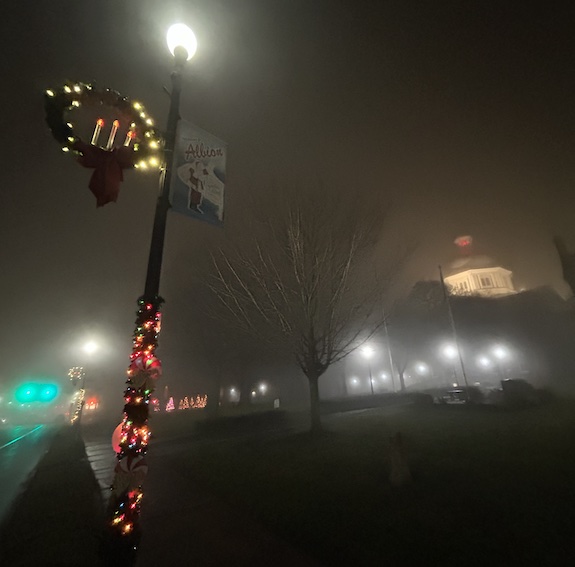
Photo by Marsha Rivers: It was a foggy Christmas Eve on Sunday. This photo from Main Street in Albion shows the Orleans County Courthouse.
Today’s high is forecast to reach 54 degrees. It’s quite a contrast from a year when travel was difficult and church services were cancelled due to a blizzard paralyzing the region.
The blizzard dumped snow, pounded the area with punishing winds, and left icy road conditions.
Today is unseasonably warm and the forecast calls for the highs to stay well above freezing. Those high temperatures include 50 on Tuesday, 50 on Wednesday, 42 on Thursday, 36 on Friday and 36 on Saturday.
Photo by Tom Rivers: St. Joseph’s Catholic Church in Albion was plastered in snow on Dec. 24, 2022 when the area was gripped by a blizzard. Many of the local churches were forced to cancel services due to the weather.
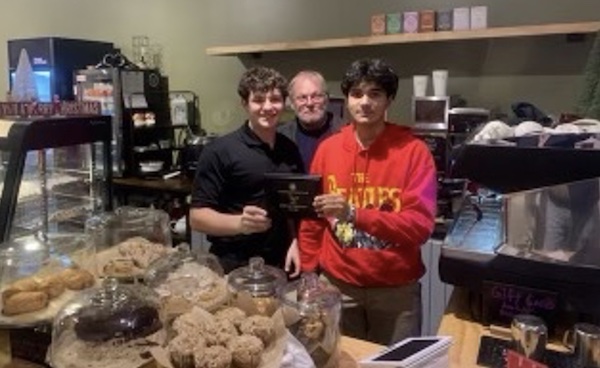
LYNDONVILLE – The Lyndonville Lions presented their Annual Holiday Lights awards on Wednesday to the Town of Yates residents. The three village awards were handed out to Darlene Hartway from the Webber Cafe on Main Street in Lyndonville.
The Webber Cafe was selected as the Best First Time Display.
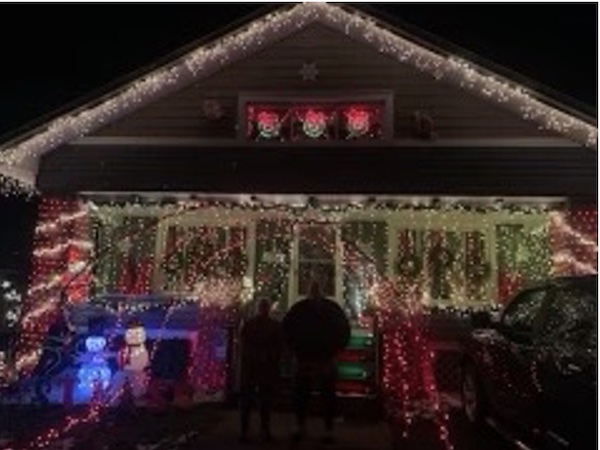
Dan and Shirleen Woodward, who have been displaying holiday light decorations for several years, won for Best Repeat Display. They reside on Garland Street in the Village of Lyndonville.
The awards for non-village residents went to the Seaman family on North Lyndonville Road. They received the award for the Largest Display of Christmas Inflatables. The Seamans decorate every year with the help of their son.
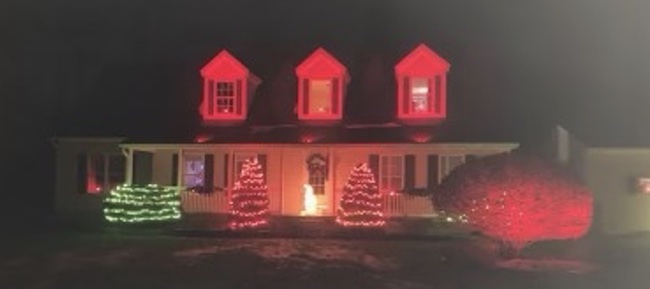
Mr. and Mrs. James Hydock from Roosevelt Highway were awarded the Best Holiday Color Display.
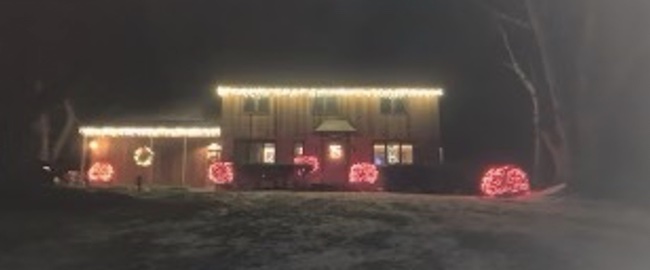
Mr. and Mrs. Mike Feigl from Platten Road were awarded the Best Newcomer Award for their decorations.
The Lyndonville Lions would like to thank the many town residents who decorated their properties for the holiday season. Your hard work and commitment to Christmas decorations is truly appreciated and enjoyed by all. In closing, the Lyndonville Lions would like to wish everyone a Merry Christmas and a Happy New Year!
Press Release, Genesee and Orleans County Health Departments
Have you been feeling sluggish lately? Have you been told you are overweight? Has a healthcare provider told you that you have prediabetes or are at risk of prediabetes?
Do you have a parent, brother, or sister with type 2 diabetes? Have you had gestational diabetes (diabetes during pregnancy) or given birth to a baby who weighed over 9 pounds? If you answered yes to any of these questions, you may be at risk of type 2 diabetes (Type 2).
The Genesee and Orleans County Health Departments (GO Health) are seeking feedback from residents to help plan upcoming Lifestyle Change education programs in both counties. We are asking anyone who is at risk of prediabetes or type 2 diabetes to take a few minutes and answer some questions so we can schedule training sessions in Genesee and Orleans counties.
Type 2 diabetes is when your cells do not respond normally to insulin (insulin resistance). Type 2 is a chronic disease that affects the way the body processes sugar (glucose) for fuel (energy). When a person has type 2 diabetes their pancreas makes insulin, but their body does not respond well to make the cells let the glucose in, giving the cells the energy they need. The blood sugar is not used and it builds up in the body.
“It is important to note that prediabetes (diagnosed with high blood sugar levels but not high enough to be diagnosed with type 2 diabetes) and type 2 diabetes can be prevented or delayed,” stated Brenden Bedard, Director of Community Health Services for GO Health. “Attending an evidence-based lifestyle change program can help people learn how to make healthier food choices, encourage them to be more physically active, and learn more about their overall health.”
We encourage residents to consider taking charge of their life and lowering their risk of prediabetes and type 2 diabetes. Getting feedback from residents will help us design a program that meets their needs. The survey is quick and can be accessed by clicking here:
For more information on GO Health programs and services, visit GOHealthNY.org or call your respective health department at:
By Tom Rivers, Editor Posted 24 December 2023 at 1:08 pm
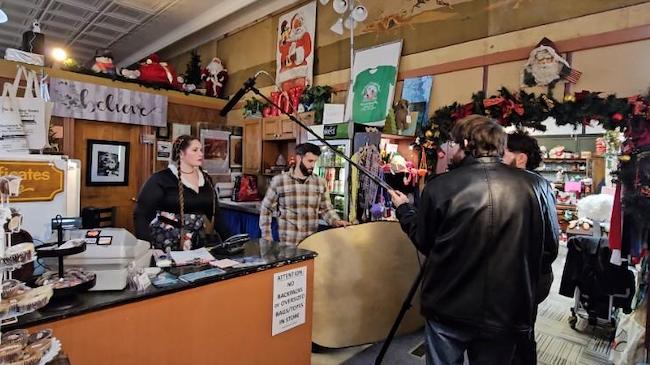
ALBION – The Coleman brothers have released the latest installment in their short horror films, and this one was shot in Albion, starring Santa. Click here to see “Merry Christmas Harold and Mabel” which is 8 minutes, 50 seconds.
Harold, a serial killer played by Michael Ciesla, plays a department store Santa at the Downtown Browsery. He is filling in for Nicholas, another Santa who is out sick. When Nicholas returns, Harold isn’t happy to give up a job he enjoys.
Stephanie Harlowe plays the role of Mabel who dresses as an elf and is very friendly with Harold. She creates a job opening for Harold by disposing of Nicholas. Harlowe has several millions views on her YouTube channel several million views on her YouTube channel exploring true crime and mysteries.
Liz Groat, one of the vendors at the Browsery, was impressed by brothers James and Vincent Coleman and their production.
“It is amazing to watch the process of creating the appearance of such murder and mayhem,” she said. “They wash off the fake blood, look to see if they needed another take, and then on to the next scene.”
The short film also includes a scene at the home of Charles W. Howard, a founder of a school for Santa Claus. Harold is shown by the historic marker about Howard, and walking to the front door of Howard’s former home now owned by John Kurtz and Brian Quinn. Harold also is shown taking a smoke break on Beaver Alley.
The Downtown Browsery provided the setting in a new short horror film by the Coleman brothers from Rochester.
About the Coleman Brothers
Coleman Brothers Films was started in 2013 by James and Vincent Coleman. They began their journey as filmmakers at the young age of 9 and 10 making numerous short experimental horror films. They went on to study cinematography through school and numerous film sets. This led to their fan film “Halloween Inferno” eclipsing over 1 million views and gaining them 10,000 new subscribers on YouTube. With the success of “Halloween Inferno” the Coleman Brothers wrote and directed the feature film “The Burned Over District.”
They took home multiple awards in several different categories including Best Feature and Best Cinematography at Horrorhound, Days Of The Dead and The Thing In the Basement film festivals in 2023.
James Coleman and Vincent Coleman, known professionally as the Coleman Brothers are Americans who write and direct horror, thriller, and short films. The brothers were raised in Rochester. They began making films in the second grade using a borrowed VHS camera which then turned into a Hi8 video camera gifted by their parents.
By Chris Busch, a parishioner and trustee at Holy Trinity Parish in Medina
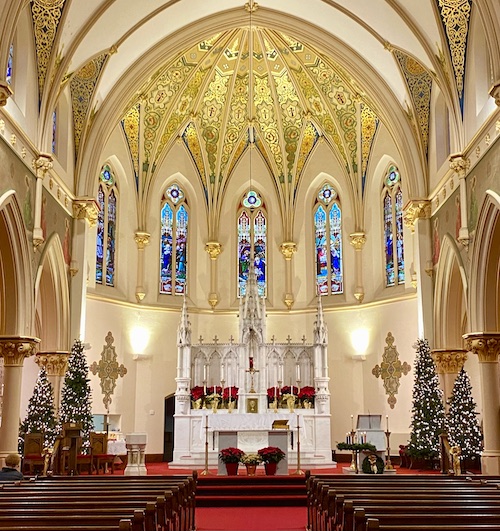
Photos courtesy of Chris Busch: The sanctuary high altar at St. Mary’s in Medina is ready for Midnight Mass.
MEDINA – As is the case in communities throughout WNY and all over the world, stained-glass church windows will be aglow on Christmas Eve as the faithful prepare to celebrate the birth of Christ.
Fr. Michael Rennier of St. Louis, Missouri reflects on Christmas Eve, stating on aleteia.com: “On Christmas Eve the atmosphere is charged with a rare sense of aliveness, as if on this night the entire world is enchanted and creation strains in anticipation.”
This year on Christmas Eve, the windows at St. Mary’s Church in Medina will glow at the midnight hour– later than they have in recent years. An age-old Christmas tradition is returning to St. Mary’s – the celebration of Midnight Mass.
In recent years, due to Covid and other mitigating circumstances, Midnight Mass has not been celebrated as it traditionally has been.
This year however, when the clock strikes midnight on Christmas Eve heralding the arrival of Christmas Day, the Catholic faithful will joyfully gather for Midnight Mass at St. Mary’s. It is the only worship site in the newly formed Orleans-Niagara East Catholic Community (known as ONE Catholic) that will be offering this unique and treasured liturgy.
During his long pastorate at St. Mary, former pastor Fr. Daniel Fawls always began his midnight homily: “There’s always something very special about coming out at this dark hour of the night to gather in this place and welcome the newborn Savior.”
Many of the parishioners agreed and annually attended the late-night liturgy as a matter of family custom and tradition. It is the only liturgy celebrated during the year at the midnight hour and for many, it is a singular spiritual and liturgical experience.
How did this unusual late-night tradition start? The story is quite actually interesting. The celebration of Midnight Mass finds its origins long ago during the Medieval period.
According to “Christmas 2021: What Is Midnight Mass? Know All About Its History & Significance”, ABP News Bureau, December 2021:
It is said that Midnight Mass services was started in the Western World from about 430 AD under Pope Sixtus III in the Basilica of St Mary Major. Midnight Mass became widely popular by the twelfth century.
The tradition was first initiated by a German woman Egeria who, during her pilgrimage to the Hold Land, noticed how in Bethlehem, the early Catholics of Jerusalem celebrated the Christmas mystery with a vigil during midnight.
The tradition was then picked by the Western World in 440 under Pope St. Sixtus III who, because of the long-standing Christian belief that Christ was born at midnight, celebrated Mass at midnight that year – a custom that he followed year after year.
As the celebration of Christmas traditions continued to evolve, the custom of celebrating three Masses for Christmas took root, with Midnight Mass becoming known as “The Angel’s Mass.”
Gretchen Filz, author of “The Symbolism of The Three Christmas Masses” December 2020, catholiccompany.com, writes:
Christmas is the holiest day of the year. Just as we celebrate Easter with a triduum of liturgies (Holy Thursday, Good Friday, and the Easter Vigil), Christmas is celebrated with a “triduum” of Masses.
There are three Masses celebrated on Christmas Day: one at midnight, one at dawn, and one during the day. Each Mass is distinct and highlights a different aspect of the Christmas story.
According to tradition, Jesus was born in Bethlehem at midnight.
The Church celebrates the first Christmas Mass at midnight to honor the very hour that our Savior came into the world to save us. The darkness of midnight also parallels humanity’s condition of spiritual darkness as the world awaited the radiant birth of the promised Messiah.
The Responsorial Psalm for this Mass proclaims the joyful tidings of the Angel: “Today is born our Savior, Christ the Lord.”
The Gospel reading for this Mass tells the first part of the Christmas story from the Gospel of Luke, when Baby Jesus is born and the Angels herald the Good News to the shepherds tending their flocks. That’s why the Midnight Mass is traditionally referred to as “The Angel’s Mass.”
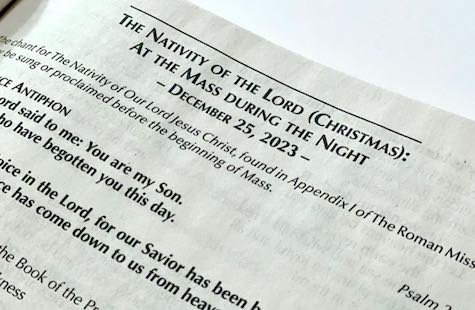
The Roman Missal officially refers to Midnight Mass as “Mass During the Night.”
By the twelfth century, the of offering these three Christmas Masses spread and became the widely practiced custom for the Catholic faithful throughout the world.
Today, the Roman Missal officially refers to Midnight Mass as “Mass During the Night,” and as such may be celebrated over a range of times.
So, why would anyone want to venture out into the cold, dark night to attend Midnight Mass when there are other seemingly more convenient daylight options readily available?
There are many reasons why one might choose this Mass above others. Fr. Michael Rennier reflects on his own personal experience with Midnight Mass. He writes in “Why all parents should let their kids experience Midnight Mass”, December 2018, aleteia.com, and sums it up nicely:
As if you needed another reason to skip the crowds at the vigil, here’s why Midnight Mass is worth the effort.
Years ago, before I became Catholic, I heard about their funny habit of staying awake and attending midnight Mass. I was intrigued by the mystery of why seemingly sensible people would choose to go to so much inconvenience instead of attending church earlier in the day. Out of curiosity, I stayed up late and went. This was the first Mass I went to as an adult. The memory lingers. At that midnight Mass, the incense soaked into my skin and became a part of me, forever cementing the emotions that came with that night, a physical reminder that, even if we enter the Mass as strangers, we are all intimately connected to each other through prayer. On Christmas, God comes not for a select few but to reveal His love to the whole world.
The chance to return this love is the reason so many crowd into the church. Who knows how God touches each individual soul, but for me, it’s enough to simply be in the presence of a love so strong that it exerts a gravitational pull on shepherds and kings alike. The feeling of being awake and praying while the rest of the world is asleep is a loosely kept secret shared by those who have journeyed to what is essentially a living manger scene. These are people who have heard the angels exulting and made haste to discover the reason why. Inside is light and candles and warmth, outside is cold and snow. Midnight Mass draws us to our spiritual home and is the perfect way to wait through the night and allow Christmas day to reveal itself.
There are times for all of us when life isn’t going well and even holidays can be stressful, or we find ourselves in a dark place spiritually, or simply struggle to make it through each day. Midnight Mass is a light in the dark, a beacon of hope that there is a love so strong that even in our darkest moments God is with us. And so, like shepherds bundled up against the chill of the fields, we arrive as pilgrims to an unknown destination. Whatever it is a person thinks will be found at midnight Mass, we know that we will find the God who has made His home in each of our hearts.
“The feeling of being awake and praying while the rest of the world is asleep.”
I believe this is what Fr. Fawls was getting at when he annually declared, there is indeed something very special about gathering at the midnight hour to welcome the newborn king.
Fr. Rennier seems to agree as do many of the local faithful. By local tradition, the midnight hour has long been cherished for Christmas Mass and has been so for time immemorial.
Come midnight on December 24, the magnificent stained glass windows of St. Mary Church will be aglow beneath a cold, star-lit winter sky, and this joyful tradition will again be celebrated here and all over the world.
One final thought from Fr. Rennier: “If the Savior of the universe can be born under a sky such as this, who knows what other miracles are possible in my life or yours?”
By Tom Rivers, Editor Posted 24 December 2023 at 8:20 am
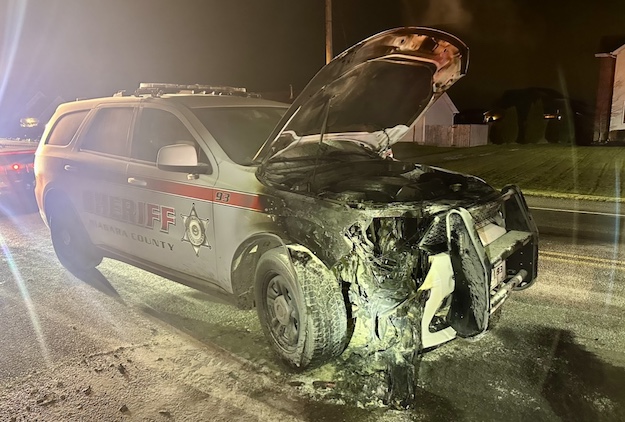
Photos from Niagara County Sheriff’s Office
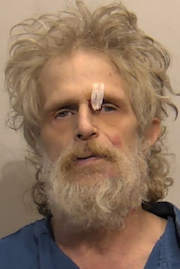
WHEATFIELD – A Niagara County man is accused of purposely driving into a Niagara County Sheriff’s patrol car in a head-on collision on Saturday at Mapleton Road in the Town of Wheatfield at about 5 a.m.
Schuyler P. Johnson
Schuyler P. Johnson, 52, of Cambria also allegedly then grabbed a gas can from the back of his pickup truck and poured gas on the patrol vehicle, and then ignited it.
Deputy Sikora, who was driving the patrol vehicle, used an extinguisher to put out the fire. Sikora wasn’t injured, Niagara County Sheriff Michael J. Filicetti said.
Johnson fled from the scene in his truck, going north on Shawnee Road.
Other patrol units started towards the area of Shawnee Road to assist and look for the fleeing vehicle. Johnson was located by a Sheriff’s patrol supervisor on Shawnee Road overturned after it was involved in another accident.
Captain Grainge located Johnson and engaged with verbal commands to surrender. Johnson not only refused the commands but advanced towards Captain Grainge with a knife. Grainge deployed his Taser on Johnson which was unsuccessful in stopping him.
At one point during this encounter with Grainge, Johnson dropped the knife he was holding, rearming himself instead with screw driver and continued to advance towards Grainge, who then deployed OC spray on Johnson, causing him to surrender, the Sheriff’s Office stated in a press release.
Johnson was transported by Tri-Community Ambulance to ECMC for injuries sustained in the two vehicle accidents. He has been released from medical care at ECMC and remanded to the Niagara County Correctional Facility awaiting arraignment.
He is charged with arson 3rd, menacing a police officer, criminal mischief 2nd, menacing 2nd – weapon, reckless driving, and multiple vehicle and traffic violations.
Press Release, Celeste Morien, count compiler for Oak Orchard Swamp Christmas Bird Count
BASOM – It’s time again for the Oak Orchard Swamp Christmas Bird Count! The count began in December 1968. The National Audubon Society has been sponsoring Christmas Bird Counts since their inception.
Count compiler and Medina resident Celeste Morien would like the public to be alert for counters with spotting scopes and binoculars who will be out and about December 27th on local roads, searching for birds in fields and at bird feeders.
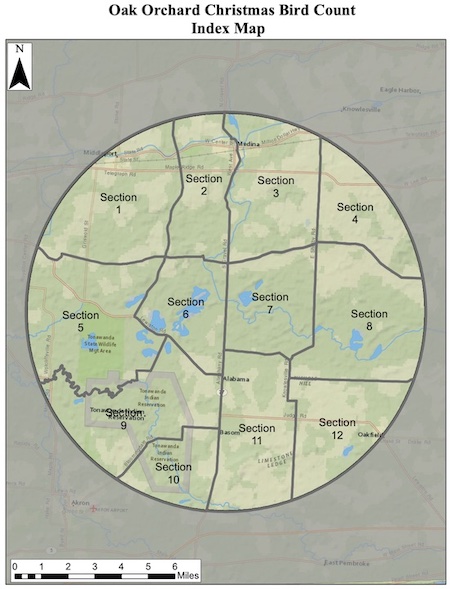
Here is the map showing different sections for the Oak Orchard Swamp Christmas Bird Count. One of the recent count totaled 20,843 birds in 73 species.
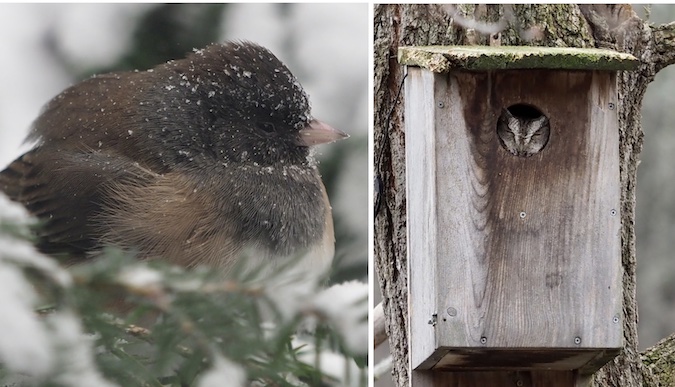
Filling bird feeders now and keeping them stocked ahead of the count helps fulfill the count objective of counting all wild birds seen and heard within the circle. The Oak Orchard Swamp count is centered at the Iroquois National Wildlife Refuge on the Orleans and Genesee County line at Route 63.
Count volunteers follow specified routes through a designated 15-mile diameter circle, which includes more than the refuge and state wildlife areas, counting every bird they see or hear all day. It’s not just a species tally—all birds are counted all day, giving an indication of the total number of birds in the circle that day.
According to the Audubon website, “Prior to the turn of the 20th century, hunters engaged in a holiday tradition known as the Christmas “Side Hunt.” They would choose sides and go afield with their guns—whoever brought in the biggest pile of feathered (and furred) quarry won.
Conservation was in its beginning stages in that era, and many observers and scientists were becoming concerned about declining bird populations. Beginning on Christmas Day 1900, ornithologist Frank M. Chapman, an early officer in the then-nascent Audubon Society, proposed a new holiday tradition—a “Christmas Bird Census” that would count birds during the holidays rather than hunt them.
So began the Christmas Bird Count. Thanks to the inspiration of Chapman and the enthusiasm of 27 dedicated birders, 25 Christmas Bird Counts were held that day. The locations ranged from Toronto, Ontario to Pacific Grove, California with most counts in or near the population centers of northeastern North America.
From December 14 through January 5 each year tens of thousands of volunteers throughout the Americas brave snow, wind, or rain, and take part in the effort. Audubon and other organizations use data collected in this long-running wildlife census to assess the health of bird populations, and to help guide conservation action.
The data collected by observers over the past century allow Audubon researchers, conservation biologists, wildlife agencies and other interested individuals to study the long-term health and status of bird populations across North America. When combined with other surveys such as the Breeding Bird Survey, it provides a picture of how the continent’s bird populations have
changed in time and space over the past hundred years.
The long term perspective is vital for conservationists. It informs strategies to protect birds and their habitat, and helps identify environmental issues with implications for people as well.
If you are interested in participating in the count for December 2024, to do so please contact celeste.morien@gmail.com.
Please consider donating to the Christmas Count here since the Audubon Society no longer collects fees from each participant. (Click here for more information.)



















 Modest changes can add up to big results for your body and mind.
 And if you drink caffeinated beverages like coffee, tea, and energy drinks, add 12 to 16 oz of water for each of those, because caffeine can dehydrate you. And while those energy drinks may give you a temporary boost, they’re not the healthiest choice. Want to scale back? Do so gradually and avoid the headaches that come from stopping caffeinated drinks too quickly. Just reduce the number of daily servings and drink water instead.