By Ginny Kropf, correspondent Posted 3 October 2019 at 7:08 am
Photo by Ginny Kropf: Two families of friends turned out in full force last October to support the Knights-Kaderli Walk/Run at East Shelby Fire Hall. Gary and Karen Barber of Brockport, at left, and Jay and Julie Mersdorf of Webster pose with children Haley Mersdorf, 8; Kennedy Barber, 6; Paxton Barber, 2; Brooks Barber, 4; and Brett Mersdorf. The 31stannual Knights-Kaderli Walk/Run is this Saturday.
EAST SHELBY – This Saturday will mark the occasion of the 31st annual Knights-Kaderli 5K race to benefit those living with cancer in Orleans County.
The fundraiser originally started as separate events in memory of two lifelong residents of Orleans County – Richard Knights and Sue Scharping Kaderli.
In 1994, their families merged their memorial funds into the Knights-Kaderli Memorial Fund. It was the wish of both families that money raised be used to provide financial support to Orleans County cancer patients and their families. Funds have been used to assist families with prescriptions, medical supplies, transportation costs, nutritional supplements and bills.
Since its inception, the fund has assisted about 600 cancer patients and/or their families, and gives out about $60,000 annually to assist families. The 5K walk/run is a big fundraiser for Knights-Kaderli.
Richard Knights grew up in Knowlesville, a son of the late William Knights Jr. and Sarah Marion Cox Knights. He was also a stepson of Mary Balcerzak Knights. He graduated from Medina High School and attended Morrisville and Kent State universities. He was prominent in an extensive farming operation in the town of Ridgeway under the name of Knights Land Company. He was also owner of Knights Real Estate and a partner in Ridge Sand and Gravel and Orleans Trucking.
Richard spent a decade in a policy-making position with the Republican Party in Orleans County and was a longtime member of the Republican Committee in the town of Ridgeway. He was a member of the First Presbyterian Church of Medina, a former member of the Medina Jaycees, an active member of various farm groups and was president of the West Ridgeway Cemetery Association.
Sue Kaderli grew up in Orleans County, a daughter of the late Earl and Viola Clack Scharping. She graduated from Medina High School in 1955 and worked in the Orleans County area most of her life. She spent the last 15 years of her life as a clerk at Main Liquor Store in Medina.
She was a member of St. Mary’s Catholic Church and was a dedicated and loving mother to her four children. She is remembered as a very compassionate person, always there to talk with or lend a hand to those in need.
Sue’s family copes with her loss by helping others who are fighting cancer. It is their hope that Sue’s gift of compassion for helping other people will live on through the aid of this fund named in her memory.
The Knights-Kaderli 5K race will take place at East Shelby Fire Hall. Registration will begin at 9:30 a.m., with the race starting at 11 a.m. The public is invited to attend the event for lunch and to participate in a giant basket raffle.
Minimum registration fee to walk or run in the race is $20 and includes a T-shirt and lunch.
More information or sponsorship and donation opportunities are available by calling Mary Zelazny at (585) 746-8455; Stacey Knights Pellicano at (716) 998-0977 or Melissa Knights Bertrand at (716) 983-7932.
Photos by Ginny Kropf: Dave Bellucci of the Medina Knights of Columbus presented a check for $1,260 to Pete Zeliff Jr. for the Warrior House on Saturday. From left are Bellucci, Zeliff, and Knights members Archie Washak, Mike Krupa and Bob Fox.
By Ginny Kropf, correspondent Posted 11 August 2019 at 1:20 pm
MEDINA – Saturday was a special day at the Warrior House on Salt Works Road.
Not only was it the third annual fundraiser for the veterans’ retreat, it was a day when several local organizations came together to show their support for veterans in the area.
The day began with a special presentation of a check for $1,260 by the Knights of Columbus in Medina. Members Dave Bellucci, Bob Fox, Archie Washak and Mike Krupa presented the check to Pete Zeliff, Jr., the landowner who donated the farmhouse and land on Salt Works Road which is used as a retreat for veterans.
The donation represents the proceeds of the Knights’ golf tournament July 27. Bellucci said they normally raise about $500 at the tournament, but this year because it was going to benefit veterans, golfers who won monetary prizes donated it all back. Five veterans actually golfed in the tournament.
It was the idea of Washak, a Vietnam veteran, to donate their proceeds to the Warrior House.
“The Warrior House is a great cause, he said.
These are some of the more than 200 Patriot Guard and ABATE riders who attended a fundraiser Saturday at the Warrior House on Salt Works Road, Medina.
“Funding from groups like this allows us to expand the things we do for veterans,” Zeliff said.
Tops on their list of things to do is to expand programs to include veterans and their families, such as picnics and special gatherings. Catherine Schmidt will head this new endeavor.
The Warrior House was founded in 2015 after Zeliff purchased land on Salt Works Road, but had no use for the farmhouse on the property. He met Ed Spence of Oakfield, who was the Western New York leader of Operation Injured Soldier, and the Warrior House was established.
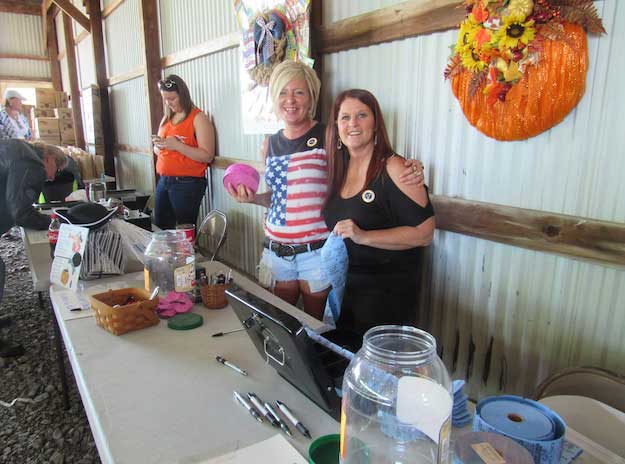
Saturday’s fundraiser grew out of efforts started by Todd Wilcox of Medina, who organized the first one two years ago. It was going to be a simple dice run for 30 to 40 bikes, but his wife Beverly, who tends bar at the VFW in Medina, suggested they add a basket raffle. This year, basket donations reached nearly 300, in addition to big ticket items, such as five weapons, a hand-crocheted blanket with an American flag and soldiers on it, a fire ring donated by the BOCES Advanced Manufacturing and Engineering Program, a picnic table donated by BOCES wood shop and more.
Diane Kephart, center, helped with the giant basket raffle to benefit the Warrior House. Kim Lockwood of Medina, right, sold 50/50 tickets during the fundraiser Saturday.
Bev Wilcox coordinated this year’s basket raffle. Other support came from Orleans County veterans’ organizations, including Medina VFW and Auxiliary; Patriot Guard Riders, led by ride captain Joe Joyce of East Pembroke; ABATE; Harley Davidson dealers across the country, who became involved because Medina veteran Jim Freas’ niece works for Harley Davidson; Bad Ash Barbecue, who loaned their food trailer; and M&T Heating in Albion.
Also this year, AMVETS Riders from Blasdell announced they would donate the proceeds of a fundraiser they did to the Warrior House.
Proceeds from the day are expected to exceed $20,000.
“This will go a long way toward helping any veteran in need,” Zeliff said. “This includes food and clothing for homeless vets.”
“It not only means food on the table for a needy veteran, but we have provided a truckload of wood for a veteran in the winter and money for HEAP to help with heating costs,” said Dan Anderson, commander of the VFW in Medina. “We also do a Christmas program, where we provide Christmas dinner and gifts for veterans and their families.”
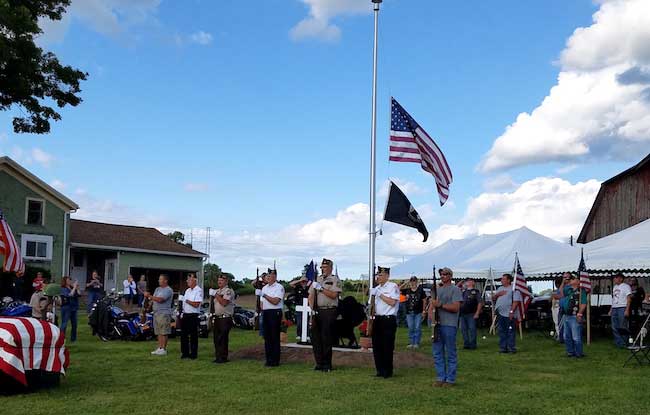
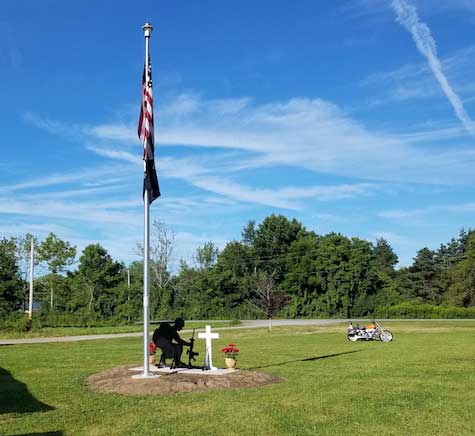
A highlight of the day’s event included dedication of a new flagpole in the yard. Mark Zacher of Zacher Construction laid out the ground work, Oak Orchard Concrete donated the concrete and BOCES welded the steel design, which depicts a soldier kneeling in front of a cross. The ceremony included singing of the National Anthem and raising of new American, MIA and POW flags. This was followed with Taps, a 21-gun salute by veterans’ Honor Guard and displaying a flag draped casket by Medina’s American Legion and VFW.
The Warrior House will continue to provide hunting and fishing trips for veterans across the country.
“There’s nothing else like the Warrior House anywhere around here,” Wilcox said.
Photos courtesy of Diana Anderson: Members of the Medina American Legion and VFW, along with their Honor Guard, participated in ceremonies Saturday afternoon to dedicate a new flag pole and memorial at the Warrior House.
A silhouette of a soldier kneeling beside a cross was dedicated alongside a new flag pole at the Warrior House on Saturday afternoon.
By Tom Rivers, Editor Posted 21 July 2019 at 10:33 pm
Photo by Tom Rivers
EAST SHELBY – A barbershop choir that includes Sara Dorpfeld of Medina, center, and Patricia Fox of Medina sing during today’s Old Tyme Day celebration at the East Shelby Community Bible Church.
The ladies in the choir were The Honey Bee Flats while the men were The Hound Dog Harmonics. The crowd was asked to vote for which of the two groups they preferred. The vote ended in a tie.
Evan Allen of Albion dressed as a chicken while the choir sang the popular children’s song, “Alouette,” which is about plucking feathers from a lark.
Lynnea Mayne and Will Trembley are in center while a group of youth dance to the reel.
Denise Jaczynski of Basom and Tony Dispenza of Akron get more pies ready for a crowd that was estimated at more than 2,000 people. The church served slices of pie for a penny, and went through 340 pies for the annual event.
Ken Baker of Medina cooks hot dogs. The East Shelby Community Bible Church served 2,750 hot dogs during the popular event at 5278 East Shelby Road. The hot dogs and everything else were available for a penny.
Paula Nesbitt fills cups of iced tea. The church went through 150 gallons of lemonade, ice tea and loganberry.
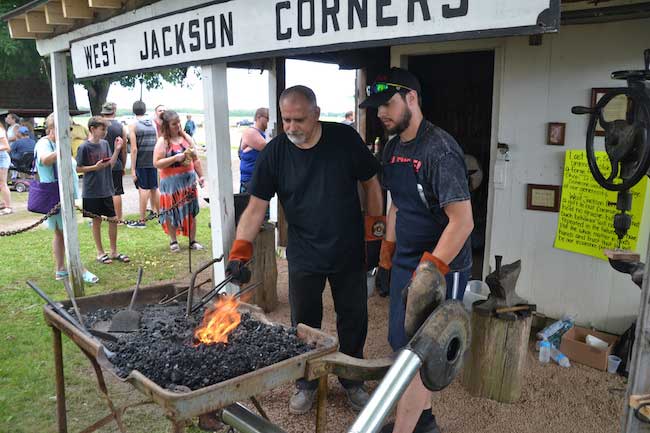
Randy Pearl, a blacksmith, led members of the community in making metal hooks. Carl Quackenbush, right, of Medina appreciated the chance to give it a try.
John Bentley of the Collins Draft Horse Ox and Pony Club leads a group on a ride around West Jackson Corners.
By Ginny Kropf, correspondent Posted 18 July 2019 at 1:00 pm
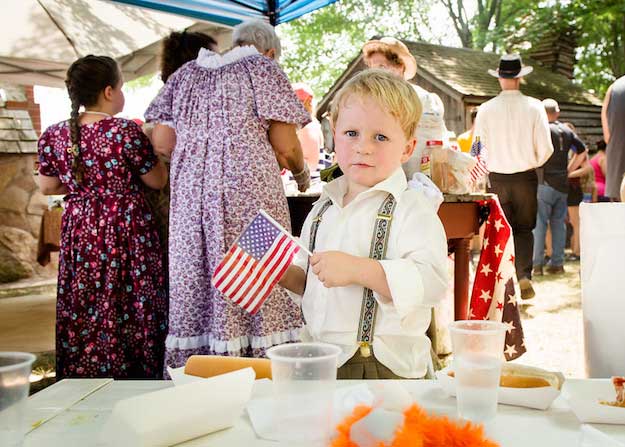
Photos contributed: Josiah Olsen waves an American flag as he waits for a hot dog at East Shelby Community Bible Church’s Old Tyme Day last year. The event returns on Sunday.
EAST SHELBY – The East Shelby Community Bible Church will again sponsor its Old Tyme Day on Sunday, beginning with a church service at 10 a.m. The church is located at 5278 East Shelby Road.
Visitors are invited to bring the entire family for an afternoon of food and fun in West Jackson Corners, the 1800s village built by the congregation across the road from the church.
There will be samples of classic dishes cooked in a log cabin, fresh breads baked in a beehive oven and served with homemade butter. Visitors may also enjoy all-you-can-eat homemade pies, hot dogs, hand-spun ice cream and popcorn, all for a penny.
Tony DiGuilio helps a young visitor at the woodworking station in West Jackson Corners during last year’s Old Tyme Day.
Other activities include kids games, wool spinning, candle making, basket weaving, old fashioned photos, horse and buggy rides and horseback riding. Also featured will be weaving on an old-time loom, a working blacksmith shop, a woodworker’s shop, a sewing shop, barn, penny candy store and a mill with waterwheel fed by a sluiceway.
This year’s Old Tyme Day will feature a musical competition. The East Shelby Choir has divided into two groups, with the ladies joining the sweet Adeline group called the “Honey B Flats,” and the men forming a barbershop group called the “Hound Dog Harmonics.” The two groups will sing barbershop-styled music and compete against each other for the audience’s votes.
The crowd will be asked to judge the choirs on their style, presentation and their costumes. The competition will include one major concert and several extra performances.
Before the day concludes, visitors are encouraged to come inside the church, where information detailing the history of the church and its founding parishioners from the 1800s will be laid out for viewing. This will include old-fashioned pictures, personal letters and articles. Some names of these historic members can be seen during a wagon ride to the East Shelby Cemetery, located about a mile from the church.
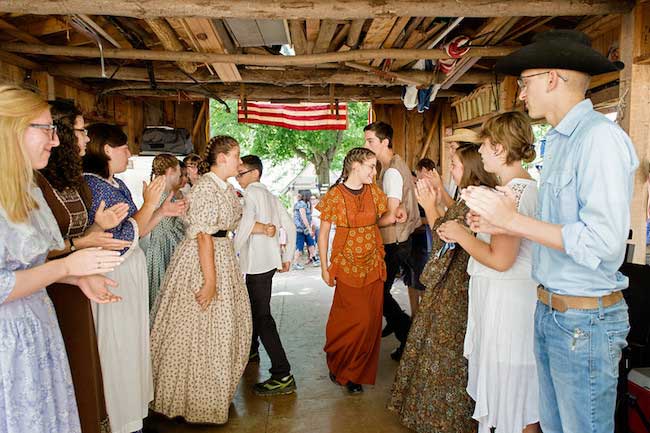
Youth from East Shelby Community Bible Church perform an old-fashioned dance in a miniature barn in West Jackson Corners.
Pastor Erik Olsen conducts the choir in singing old fashioned songs during last year’s Old Tyme Day in West Jackson Corners, the 1800s village constructed by East Shelby Community Bible Church.
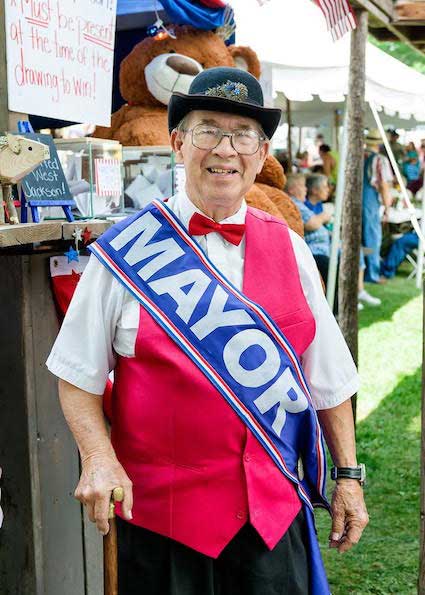
Charlie Silvernail of Basom masquerades as the mayor of West Jackson Corners during an Old Tyme Day in West Jackson Corners.
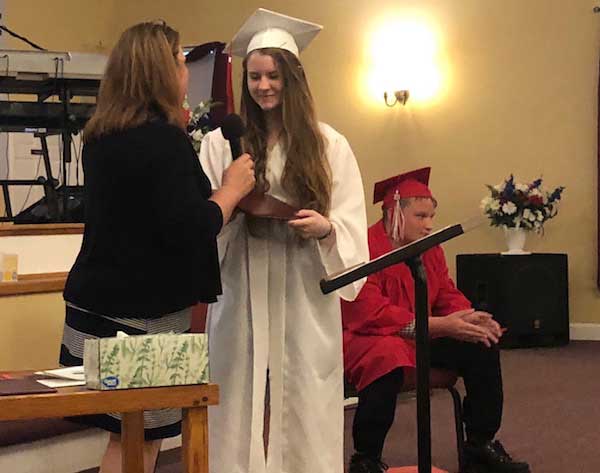
Provided photos: Aurora Zaidel of Middleport receives her diploma from Linda Strickland, administrator and principal of the Orleans County Christian School during the graduation ceremony. Spencer Burton of Albion also graduated from the school, which moved from the former Medina High School to the Alabama Full Gospel Fellowship Church on Route 63 in Shelby.
Spencer Burton of Albion and Aurora Zaidel of Middleport graduated from the Orleans County Christian School last month.
Press Release, Orleans County Christian School
SHELBY – Orleans County Christian School has provided a Christ-centered education for Orleans County for the past 23 years. This year was no different as OCCS held yet another graduation ceremony under the direction of Linda Strickland, the school’s administrator the past 15 years.
This year’s graduates were Spencer Burton of Albion and Aurora Zaidel of Middleport. Spencer began working immediately as summer help for the Village of Albion DPW, and thoroughly enjoys what he is doing.
Aurora took part in the Allied Health Program at Orleans-Niagara BOCES while attending classes at OCCS and GCC and holding down a job at Medina Memorial Hospital. Aurora will pursue a Bachelor of Nursing RN with GCC.
As of June 30, Linda Strickland has retired and handed over the reins of Administrator/Principal to Jodi Peters. Jodi has completed her sixth year of teaching at OCCS. She is married to Pastor Russell Peters of the Alabama Full Gospel Fellowship Church. Alabama opened its doors to the school this past fall as the former school building had been sold.
Jodi recently represented the school at a forum held at Orleans-Niagara BOCES in which she discussed alternative education to public school education. Mrs. Peters has been a piano/voice instructor to many students in Orleans and Genesee counties as well as a local author of Holding On When Your Ladder Breaks, Coping With Crisis, and her Bible study, Immersed in His Grace, both available on Amazon. Jodi says that her years of teaching, being a pastor’s wife and managing committees and departments, and working and speaking with the community have well equipped her for her new position.
The school averages 20 students each year and graduates one to three students annually. OCCS is now holding open enrollment for the 2019-2020 school years. For more information on how to enroll please visit orleanscountychristianschool.com or call (585) 798-2992.
Jodi Peters, the new school administrator and principal, congratulates the graduates and praised Linda Strickland, right, for her service to the school the past 15 years.
By Tom Rivers, Editor Posted 6 April 2019 at 9:24 am
Photos by Tom Rivers
EAST SHELBY – This house at 5582 East Shelby Rd. is a total loss after fire this morning. The fire started in the kitchen and quickly spread throughout the house.
Firefighters were dispatched for a structure fire just after 5 this morning.
“It was pretty much fully engulfed,” said East Shelby Fire Chief Andy Beach. “We saved as much as we could.”
East Shelby firefighter Dan Culver sprays water on hot spots inside the house at about 8:30 this morning.
A husband and wife lived at the house with their five dogs. The husband was at work when the fire broke out, Beach said. The woman and three of the dogs were able to get outside. Two of the dogs died in the fire, Beach said.
The Red Cross is assisting the family with temporary shelter while the Orleans County Animal Shelter temporarily keeps the three dogs.
East Shelby was assisted at the scene in fighting the fire by Alabama, Barre, Medina, Oakfield and Shelby fire departments.
Fire investigators are trying to determine the cause of the fire.
By Ginny Kropf, correspondent Posted 3 March 2019 at 7:25 pm
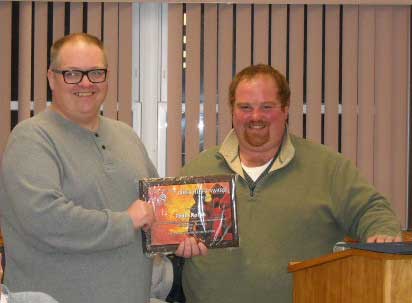
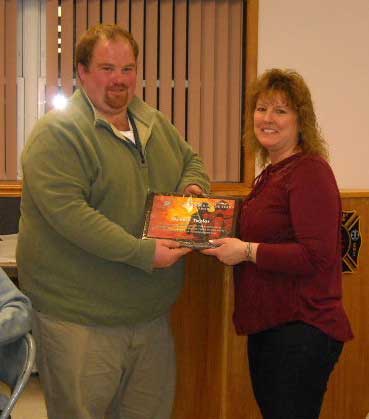
Photos by Ginny Kropf: Todd Ralph, left, was presented with the Chief’s Award by Andy Beach, chief of East Shelby Volunteer Fire Company, during their annual awards dinner Saturday night.
EAST SHELBY – The East Shelby Volunteer Fire Company may be one of the smallest in the county, having responded to the fewest calls, but that doesn’t diminish their importance in the community, Fire Chief Andy Beach said at the annual firemen’s banquet Saturday night.
Lifelong member David Green was emcee for the evening, who entertained fellow firefighters and their guests with his usual banter of jokes.
Welcomes were extended by Ladies Auxiliary president Shirley Printup and Fire Company president Mike Fuller. The Auxiliary accepted three new members this year and the Fire Company two.
A moment of silence was observed three Auxiliary members and one fireman who died during the year – Mildred Green, Jeanne Rechkahn Ralph, Cathy Balcerzak and Charles Allen.
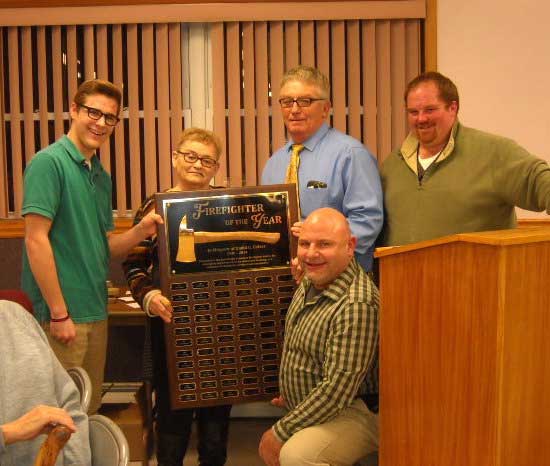
In a special presentation, the family of the late David Culver gave the fire company a plaque on which to record the names of those chosen as Firefighter of the Year.
Members of the East Shelby Volunteer Fire Company who are chosen Firefighters of the Year will be honored with their name on this plaque donated by the Culver family in memory of David Culver. Making the presentation to President Mike Fuller and Chief Andy Beach, right, during the fire company’s annual banquet Saturday night are David’s grandson Nicholas, widow Gail and son Dan (kneeling).
David’s widow Gail Culver, son Dan Culver and grandson Nicholas Culver wanted the fire company to have a proper place to permanently honor Firefighters of the Year. The fire company started choosing a firefighter for that honor in 1975 and David won it in 1976.
Newly elected president of the East Shelby Volunteer Fire Company, Mike Fuller, right, recognized outgoing president Jackie Keller for her years of service during their annual banquet Saturday night.
Officers of the East Shelby Ladies Auxiliary were installed by Rosemary Pray from Shelby Ladies Auxiliary. Officers for 2019 are Shirley Printup, president; Bronwyn Green, vice president; Sawyer Green, secretary; Carol Lonnen, treasurer; Melissa Bonafede, Sharlene Pratt and Elaine Newton, trustees; and Rose Allen and Carol Lonnen, chaplains.
Printup commended Pray, 89, who has been a member of Shelby Firemen’s Ladies Auxiliary for 66 years.
Andy Benz, chief of Shelby Volunteer Fire Company, installed the East Shelby Fire Company officers. Administrative officers are Mike Fuller, president; Dan Culver, vice president; Karen Bracey, secretary; Allen Turner, treasurer; Ken Printup, Sharon Grimes, Gordon Reigle and Walter Dingman, trustees; and David Green, steward.
Line officers are Andy Beach, chief; Devin Taylor, 1st assistant chief; Deb Taylor, 2nd assistant chief; Dennis MacDonald, 3rd assistant chief; Jeff Taylor, captain; Julie Taylor, lieutenant; Laura Fields, fire police chief; and Sue Behrend and Mike Fuller, EMS officers.
Andy Benz said he was honored to be asked to install East Shelby’s officers.
“It shows how far our fire companies have come in past years,” he said, no doubt referring to the rift back in the 1950s when several Shelby members split and formed the East Shelby Volunteer Fire Company.
Fuller and past president Jackie Keller announced Dan Culver as recipient of the President’s Award.
“It was an easy decision to choose this individual, because of his dedication to the fire company and high quality of service,” Fuller said.
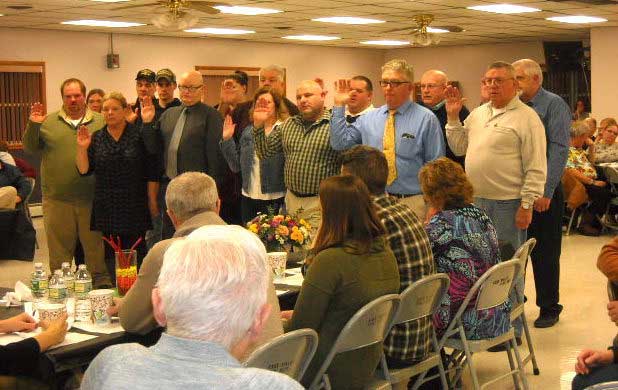
Officers of the East Shelby Volunteer Fire Company were sworn in Saturday night by Andy Benz, chief of Shelby Fire Company, during the annual awards dinner at East Shelby Fire Hall.
Fuller also present a plaque recognizing Keller for her service as president.
When it came to the fire chief’s award, Andy Beach said there were many deserving individuals, but after a lot of thinking, he named Debbie Taylor as “Firefighter of the Year.”
East Shelby Fire Chief Andy Beach presented his Fire Chief’s Award to Debbie Taylor.
“We have an outstanding line of officers on our team, but Debbie is always on top of things,” Beach said. “She reminds me of meetings and goes above and beyond. She even cleaned my office last week. She is available for calls day or night and is often the first person on the scene. I have no doubt that in a couple of years, Debbie will be the first female chief of the East Shelby Fire Company.”
Certificates were presented to members for years of service. Several had five and 10 years, with Mike Smith, Louise Covey and Wanda Dingman being recognized for 25 years. Bronwyn Green with 30 years and Mary Zelazny with 35 years also received citations from Senator Robert Ortt, Assemblyman Mike Norris and Michael Hicks, representing Congressman Chris Collins.
Beach announced the fire company had received a $150,000 grant through Ortt and a $20,000 grant from Rural Development to help with the purchase of a new pumper/tanker. Dan and Nicholas Culver worked on the $150,000 grant and Allen Turner worked to secure the $20,000.
While the money is taxpayer dollars, Ortt said he was privileged he was able to get some of it back for the community. He praised the firefighters, saying how much more difficult it is being a volunteer firefighter today, with all the required training hours, than it was 35 or 50 years ago.
The fire company hopes to have delivery of their new truck by the Orleans County 4-H Fair the end of July.
Mike Norris weighed in on the pending legislation in Albany banning gun raffles.
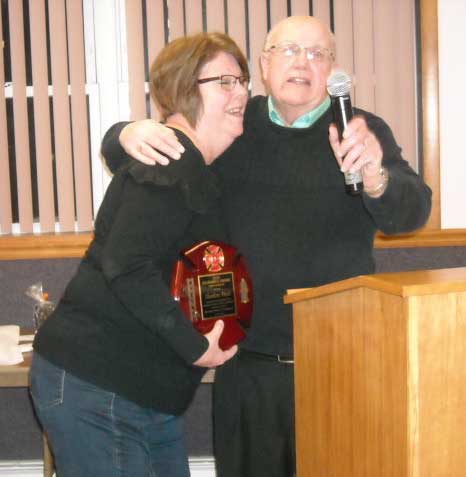
Dave Green gets a big hug from Sharlene Pratt after naming her as recipient of his Steward’s Award.
“This is the type of aggressive agenda coming out in New York state,” Norris said. “The folks in New York City don’t realize how these fire departments depend on gun raffles to fund their companies.”
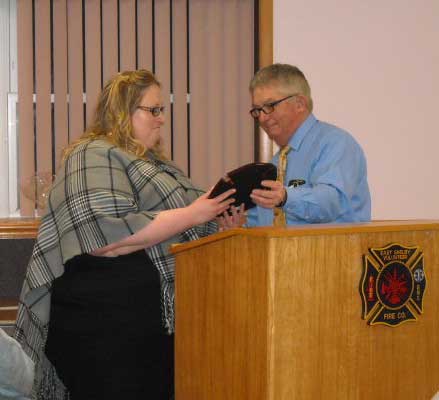
Todd Ralph was presented with the Fire Chief’s award for volunteering to teach the OSHA refresher class each year.
“One thing I always dreaded was having to find a location and go and take the eight-hour class,” Beach said. “Then Todd said he was certified and could teach it in-house.”
Printup and Sawyer Green recognized Debbie Green for serving as secretary of the Auxiliary and then named her as “Auxiliary Member of the Year.”
Jessie Green was acknowledged as an outgoing trustee.
It is customary for the Auxiliary to present the firemen with a gift each year, and this year they decided on new tables for the dining hall. Fifty eight-foot plastic tables have been purchased, which will be much easier to move around, Printup said.
David Green made the final presentation of the evening, giving his Steward’s Award to Sharlene Pratt.
“She is continuous here helping us,” Green said.
Debbie Green, left, was chosen Auxiliary Member of the Year by Shirley Printup, president of the East Shelby Ladies Auxiliary, and vice president Bronwyn Green.
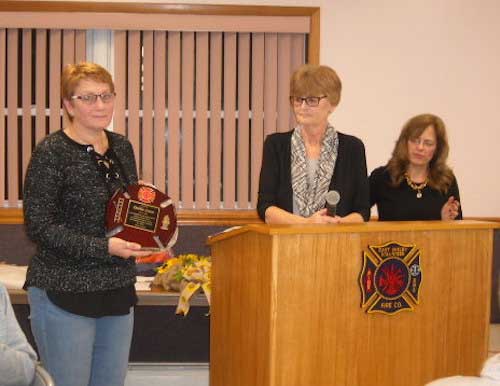
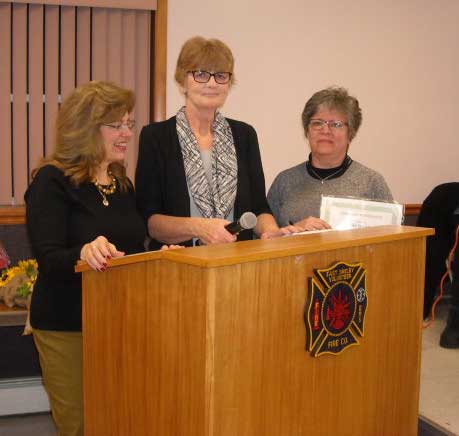
Bronwyn Green, left, vice president of East Shelby Ladies Auxiliary, and president Shirley Printup recognized Mary Zelazny for 35 years of membership.
By Tom Rivers, Editor Posted 23 February 2019 at 10:51 am
ALBION – The Orleans County Planning Board will meet at 7 p.m. Thursday to consider proposals from the Town of Shelby for regulating solar energy and also a law for regulating mobile food vehicles.
Local municipalities submit referrals to the County Planning Board, which offers its opinion, whether or not to recommend approval. If the county recommends against the proposal, towns and villages can override that negative opinion with a super-majority vote.
Besides the proposals for laws regulating solar energy and food trucks in Shelby, the County Planning Board will look at Kendall’s application to amend its comprehensive plan to rezone Peter Smith Road. That also will require a change to the town’s zoning map for Peter Smith Road.
In addition, the Planning Board will consider an amendment to Carlton’s zoning ordinance to establish a private airport through a special use permit in RR, WR, WD and B Districts.
The meeting Thursday is in Conference Room C at the County Administration Building at 14016 Route 31 West.
By Ginny Kropf, correspondent Posted 22 January 2019 at 7:40 am
Provided photo: Composer Steve Shewan of West Shelby recently won two national choral composition contests. Most recently, he flew to Minneapolis for the “Vocal Essence” premiere of his The Little Cradle Rocks Tonight.
WEST SHELBY – With a father who directed the Roberts Wesleyan Chorale for more than 30 years and his mother who conducted children’s choirs, Stephen Shewan comes by his musical talent naturally.
His father Robert once conducted the Orleans All-County Choir in Lyndonville, Shewan said.
His brother Paul is currently conductor of the Roberts Wesleyan Band and Choir and plays trumpet in the Rochester Philharmonic Orchestra.
“Music is a family trade,” Shewan said. “My whole life I knew I was going to do something with music.”
Shewan, who grew up in the Rochester area and now lives in West Shelby, got his bachelor of science in music education at Roberts Wesleyan, his master’s at Ithaca College with an emphasis in French horn and piano and a doctorate in composition at the Eastman School of Music. He is honored to recently win several prestigious awards for his chorale compositions.
One award was the 2018 first-place winner of the Edwin Fissinger Choral Composition at North Dakota State University’s Challey School of Music. The competition honors the legacy and traditions of noted choral composer and longtime NDSU choral conductor Edwin Fissinger.
Shewan won the award for his composition of “Mother Goose Gems” set to music.
He was inspired for the piece from a book of nursery rhymes he picked up at the Lee-Whedon Memorial Library in Medina.
“I wrote the six short movements for my mom, who was an elementary choral director,” Shewan said about his mother, who passed away in 2007.
On Dec. 1, Shewan flew to Minneapolis for the “Vocal Essence” premiere of The Little Cradle Rocks Tonight. In March he will travel to North Dakota to hear the North Dakota State University perform Mother Goose Gems, which will be published by Pavane Music Company as part of the Jo Ann Miller Choral Series.
Another of Shewan’s choral pieces, Silent Night, won the Master Chorale of Tampa Bay’s 2016 Christmas Carol Contest.
“I write a lot of Christmas music,” Shewan said.
The Genesee Chorale, under the direction of Ric Jones of Medina, has performed one of his pieces. Shewan just finished a piece for wind ensemble which premiered a week ago by the Williamsville East Wind Ensemble.
Shewan has also composed music for orchestra, string quartet, chamber ensembles, symphonic band, solo voice, choir and piano. His music has been performed by the Rochester Philharmonic Orchestra, Eastman Wind Ensemble, U.S. Army Strings, Master Chorale of Tampa Bay, Vrije Univeriteit Amsterdam Choir and numerous other musical groups across the United States, Europe and Australia.
His music has been broadcast on more than 200 radio stations in America.
Shewan continues to teach in Williamsville and said today’s kids are as nice as any.
“How fortunate I am to get paid to teach these kids a subject I love,” Shewan said.
He added he loves living in the country, having moved with his wife Ruth to the former Jay Brackett home when he got the job at Williamsville.
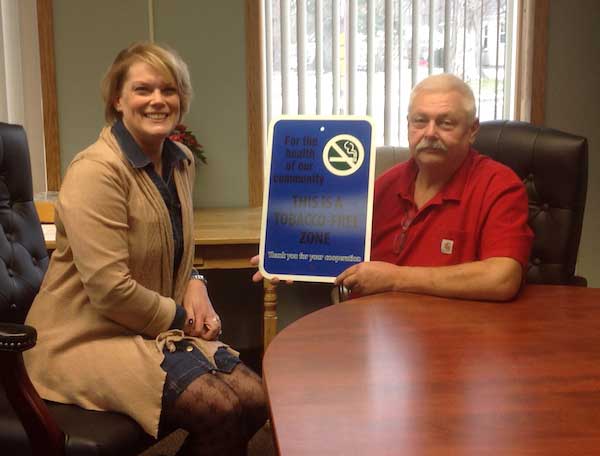
Provided photo: Shelby Town Supervisor Ed Houseknecht and bookkeeper Miranda Bennett say the decision to declare tobacco-free grounds was to protect the health of all citizens, especially cancer survivors.
Press Release, Tobacco-Free GLOW
SHELBY – Each January, roughly one in three Americans resolve to improve their health in some way. This January, the Town of Shelby made good on a healthy, tobacco-free grounds resolution that will benefit the entire community for 2019 and beyond.
The new law, which was drafted by town bookkeeper, Miranda Bennett, and submitted to the Town Board by recently elected Town Supervisor Ed Houseknecht, prohibits the use of tobacco products on town grounds. Town Board members Kenneth Schaal, Stephen Seitz, William Bacon and Jeff Smith passed the resolution unanimously.
As of Jan. 1, there will be no smoking on the Shelby Town Hall grounds, which also serves at the town court for Shelby and Ridgeway.
The decision to make the grounds smoke-free was simple, according to Houseknecht.
“There are cancer survivors in our community, some awaiting to appear in court and some who are Shelby Town staff, who are required to walk into the doors past smokers,” he said. “Second hand smoke is a risk for these folks. They shouldn’t have to walk through a cloud of smoke to come to work or come in and wait for court.”
For more information on how to make your municipality or business smoke-free, contact Tobacco-Free GLOW at 585-219-4064.