By Tom Rivers, Editor Posted 30 January 2017 at 10:10 am
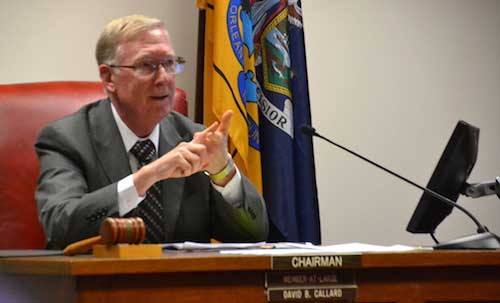
Photo by Tom Rivers: Orleans County Legislature Chairman David Callard said giving towns and villages more of the local sales tax would result in higher county property taxes.
ALBION – Orleans County legislators were asked last week to modify the sales tax sharing formula locally so towns and villages would receive a boost in funding.
Paul Lauricella of Lyndonville said the towns and villages have high tax rates and directing more local sales tax to them would help to bring down those tax rates.
“Every town and village is cash-strapped,” Lauricella told legislators during last week’s meeting. “You guys seem to have money for everything you want to do.”
The county receives about $16 million annually in sales tax and shares $1,366,671 collectively with the four villages and 10 towns. The town and village total has been frozen since 2001.
The village amount, however, has been decreasing because the local share is based partly on assessments. The town assessments have been increasing while villages have been going down.
The share for the four villages – Albion, Holley, Lyndonville and Medina – in 2013 was $404,661 of the sales tax. But it dropped by about $25,000 to 2017. The village share fell to $400,681 in 2014, to $398,111 in 2015, to $391,230 in 2016 and the biggest decrease yet, $379,265 for 2017.
“There is a limited pot of money. To take it from the county doesn’t serve any practical purposes. There is no extra sales tax money to share.” – David Callard
Legislature Chairman David Callard said he doesn’t support taking sales tax funds from the county and giving more to the towns and villages. The towns, however, could consider modifying the formula for the $1,366,671, so villages wouldn’t lose money as the assessments change.
“There is a limited pot of money,” Callard said. “To take it from the county doesn’t serve any practical purposes. There is no extra sales tax money to share.”
Village leaders periodically request the county to look at how it shares sales tax with the local municipalities, noting that in some counties, it’s more of a 50-50 split with the county getting half of the funds and cities, towns and villages sharing the other half.
Orleans, even though it keeps about 92 percent of the sales tax, is actually being generous, Callard said, because most of the 14 counties under 50,000 population don’t share any of the sales tax.
Orleans picks up some expenses that other counties push onto towns, such as community colleges. That cost has jumped for Orleans County from $694,823 in 2005 to over $1.85 million in 2017.
Callard said the county continues to be strained by mandated programs from the state, with Medicaid the biggest budget burden. If the state pulled back some of the benefits in that program, it would ease costs for the counties and state.
Lauricella said the taxes are too high locally.
Callard said the taxes would come down if the state scaled back some of benefits with Medicaid and if the state paid for more of its mandated programs.
“The best way to cut taxes would be with mandate relief,” Callard said.
By Tom Rivers, Editor Posted 29 January 2017 at 10:12 am
ALBION – The Orleans County Planning Board approved a zoning change for East Center Street that will allow three properties to go from single-family residential to general commercial.
The zoning change accommodates growth for Medina Transport, a taxi service owned by David Stalker. Planners said the zoning change blends in with the area, which includes a Mexican grocery store and other businesses. The former Towne Primary School also is in back of the property and has been zoned for business.
The zoning change includes 501 East Center, 493 East Center, and 491 East Center.
“The village feels it makes a lot of sense to do this,” said Marty Busch, the village’s code enforcement officer and also a member of the County Planning Board.
Stalker’s business was called a “great success story for Medina,” according to a letter from his attorney, Nathan Pace.
“The success of this business is stretching the limits of what is possible in the Residential district,” Pace wrote to Medina Mayor Michael Sidari and the Village Board. “The change in zone would be in line with the general plan for Medina and the area, as there is already a light industrial zone across the street and the section in question is immediately contiguous to a presently existing general business zone.”
Stalker said one of the houses with the rezoning is lived in by employees. He is looking to add additional parking space. He also acquired land across the street that could be used for parking vehicles.
The Planning Board on Thursday recommended the village approve the zoning change. Planners said the business draws few, if any, customers to the site.
Other decisions by the board include:
• Approval for the site plan and special use permit request for construction of a ground-mounted solar system (11.725 kW) at 10506 Telegraph Rd. That property, owned by Graydon and Eileen Owen, is located in a Agricultural/Residential District in Shelby. The site is along the Erie Canal and the solar system won’t be visible from the road, planners said. The system will be constructed by CIR Electrical Construction Corp.
• Recommended Medina and Ridgeway both approve amendments to their zoning ordinances for regulating solar energy systems, including requiring building permits, setting up systems to minimize visual impact, limiting ground-mounted systems to side or back yards and no more than 2,000 square feet or up to 50 percent of lot coverage in the village. Larger systems will limit the maximum height of solar panels at 15 feet in Medina (20 feet in Ridgeway), establish minimum setbacks from property lines at 25 feet in Medina (100 to 500 feet in Ridgeway), and require landscape buffer around solar collectors and equipment.
A decommissioning plan also will be required with solar systems to be removed within 180 days of cessation of use.
• The board also re-elected Brian Napoli of Ridgeway as board chairman and Tibbs Ahlberg of Gaines as vice chairman.
Photo by Tom Rivers: Michael Van Durme, a retired chief conservation officer for Region 8 of the DEC, said rifles are safer than shotguns for deer hunting.
By Tom Rivers, Editor Posted 26 January 2017 at 10:44 am
Emerson “Tinker” Young, past president of SCOPE (Shooters Committee on Political Education) in Orleans County, told the Orleans County Legislature on Wednesday that not all hunters favor allowing rifles for big game hunting in the county.
ALBION – Orleans County legislators continue to be pressed to allow rifles for hunting deer and bears.
Several speakers urged the Legislature to support rifles for big game hunting. On Dec. 21, several leaders of the sportsmen’s groups in Orleans stated their support for the measure.
On Wednesday, the former president of SCOPE (Shooters Committee on Political Education) said not all hunters favor allowing rifles for shooting deer and bears.
“I’m not 100 percent in favor of it,” said Emerson “Tinker” Young, the past president of SCOPE. “There’s not enough guys out there with common sense.”
Young said high-powered rifles can send ammunition 1,000 yards. He worries some hunters would empty their rifle shooting at a deer, and those bullets could hit houses.
“There’s a lot of people out for this and I understand what they’re saying,” Young said. “I just wish we could sit down and figure out a way so guys don’t misuse it.”
Doug Piedemonte of Holley said his house has been hit by slugs from shotguns, including one that tore through his home, breaking a mirror inside.
Doug Piedemonte of Holley said he would support allowing rifles. His house has been hit by slugs fired from shotguns.
Michael Van Durme, a retired chief conservation officer for Region 8 of the DEC, told legislators that rifles are much safer for hunting.
He said there hasn’t been any accidental deaths by hunters using rifles in the past 40 years while they were deer hunting.
Legislator Lynne Johnson asked Van Durme if he misspoke, and he said his statement was true.
Johnson said she heard of a man in Parma hit in the stomach from a long-range rifle round.
Van Durme said that was from someone who was target shooting, not hunting.
Van Durme’s career as a conservation officer included seven years in Orleans. He now manages a consulting company that specializes in hunter and firearms safety.
“I can tell you rifles rounds for white-tailed deer are safer than shotguns,” he said. “As far as a rifle round going long range and hitting people, it just doesn’t happen.”
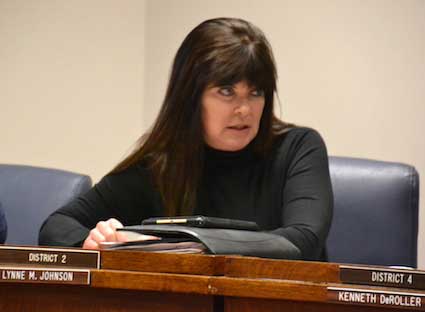
Legislator Lynne Johnson asks a question during Wednesday’s meeting.
Sportsmen Club leaders told county legislators that 41 out of 62 counties, including counties with more residents than Orleans, allow rifles for hunting.
The Orleans County Sportsmen Federation last month presented the Legislature with a petition signed by about 500 people, supporting center-fire rifles for deer hunting.
The county allows rifles for small game hunting – woodchucks, foxes, crows and coyotes. Other counties also allow rifles for smaller animals and Van Durme said there hasn’t been any accidental deaths.
“Hunters use rifles for woodchucks and no one has been shot long range,” he said.
Sportsmen insisted the rifles are safer, because hunters tend to take only one shot with a rifle because they use scope and have better accuracy.
Legislators said they will continue to discuss the issue.
By Tom Rivers, Editor Posted 26 January 2017 at 9:07 am
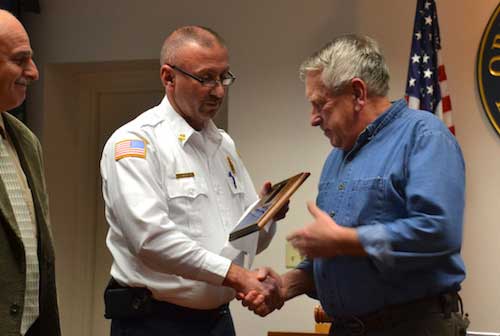
Photo by Tom Rivers: David Thom, a volunteer for 27 years with the Auxiliary Police, receives a plaque for his service to the group that was disbanding last month by the county. Thom accepts the plaque from Dale Banker, the county’s emergency management director. County Legislator John DeFillipps is at left.
ALBION – Orleans County officials on Wednesday praised an all-volunteer group for its many years of dedicated service.
However, liability concerns and the demands of training to meet the standards of peace officers, prompted the county to dissolve the Auxiliary Police last month.
The group was started in Orleans County in 1952 and was to be activated at times of civil defense. The county was never attacked, and the group’s duties strayed from that original mission. The Auxiliary Police provided crowd control at the 4-H Fair, football games, festivals and other community events.
The group had shrunk to seven members.
“They always did a great job,” said Dale Banker, the county’s emergency management director who oversaw the group. “I have nothing but praise for them.”
The Legislature on Wednesday presented a plaque to Lt. David Thom, who volunteered 27 years with the group.
Capt. Jack Monell has 47 years with the Auxiliary Police and has been its leader. He also will be getting a plaque, and so will Joe Riley, who served 43 years with the group.
Banker also has certificates of appreciation for Lawrence Bale, 11 years; Dixie Woodworth, 7 years; Ray Keffer, 7 years; and Craig Wilston, 7 years.
Ray Hertel also served with the group for 22 years before retiring last year.
Banker said the Auxiliary Police donated about 1,000 to 1,200 hours a year.
The county may fill some of the void without the group by having seasonal deputies work at some more community events.
By Tom Rivers, Editor Posted 25 January 2017 at 11:55 am
‘It wasn’t a decision made lightly. We agonized over this discussion for months.’
ALBION – Orleans County officials last month decided to disband an all-volunteer auxiliary police force, citing concerns over liability.
The auxiliary police was formed in 1952 with a mission to provide civil defense if the community was under attack. The actual work, however, changed to helping manage crowds at large community events, such as the Orleans County 4-H Fair, fireworks displays, festivals and football games. The auxiliary police also directed traffic at events.
“They served the community well and did many wonderful things,” said County Attorney David Schubel, who recommended the group be disbanded.
The group was down to six members, and would have needed more training and equipment to meet standards of peace officers.
“If you’re going to do it and do it well it would have required enormous training,” Schubel said today. “If we continued, we would have needed more people.”
The auxiliary police operated under the Emergency Management Office. Schubel said many people in the public likely assumed they were deputies with the Sheriff’s Office.
Many of the auxiliary police carried their own firearms with holsters and equipment that weren’t up to police standards.
“They certainly had the best interests of the community at heart,” Schubel said.
During the Orleans County Association of Municipalities meeting on Tuesday, County Legislator Bill Eick told the group the auxiliary police had been dissolved.
“Liability is No. 1,” Eick told the village, town and county officials. “There was declining interest from younger people.”
The county may fill void of the auxiliary police with seasonal deputies, who currently work on the marine patrol. Those deputies all have law enforcement training with the proper equipment. They would operate under the Sheriff’s Office.
“It wasn’t a decision made lightly,” said Chuck Nesbitt, chief administrative officer. “We agonized over this discussion for months.”
By Tom Rivers, Editor Posted 24 January 2017 at 9:13 am
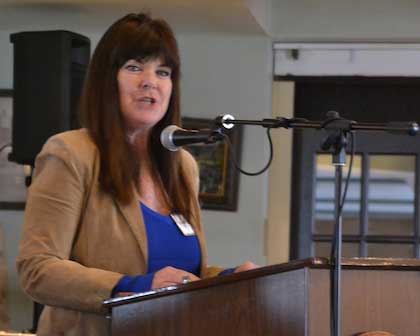
Lynne Johnson, vice chairwoman of the Orleans County Legislature, speaks during Friday’s Legislative Luncheon for the Orleans County Chamber of Commerce.
GAINES – Orleans County has made progress on many fronts by tackling neglected infrastructure – roads, bridges, culverts, building roofs – while also getting closer to bringing high-speed Internet to underserved pockets of the county.
That was the message from Lynne Johnson, vice chairwoman of the County Legislature. She addressed nearly 100 people on Friday at the annual Legislative Luncheon put on by the Orleans County Chamber of Commerce at the Village Inn.
“2016 was a great year for Orleans County,” Johnson said at the luncheon.
She sees many positive developments for 2017.
Pride Pak’s construction of a 68,000-squarefoot vegetable and processing facility in Medina topped the economic development efforts last year, Johnson said. She praised the Orleans Economic Development Agency, led by Jim Whipple and Gabrielle Barone, for working with Pride Pak to make the company’s $12.5 million investment a reality.
Pride Pak also is considering two expansions in the future in Medina, with 200 workers eventually on the payroll. It opened in Medina in November with 40 employees.
Orleans County’s unemployment rate has also fallen to its lowest level in a decade, Johnson said.
Orleans took on an $8 million bond to tackle a series of infrastructure projects from 2015 to 2017, including six bridges, six culverts, and new roofs on some of the county buildings. The county also built two new pole barns for the Highway Department.
The county also purchased a paver for the Highway Department that is available for other municipalities. The Highway Department last year paved 29 miles of roads, more than doubling the previous high.
Orleans officials have been pressing the state for several years about the weight restrictions or closures with many of the canal bridges in the county, as well as the deterioration of the Lake Ontario State Parkway.
The state has about $20 million-plus approved to work on canal bridges and the Parkway, Johnson said on Friday.
The state has set aside $14 million to improve the Parkway in 2017-18 with most of the work upgrading the Parkway in Monroe County near Orleans. The Parkway paving includes $8.97 million to pave the road from Route 19 east to Payne Beach in 2017, and then $5.2 million to pave the Parkway from Route 19 in Hamlin to Route 237 in Kendall in 2018.
The Department of Transportation’s 5-year plan, which runs until 2020, doesn’t include paving for the Parkway west of 237 in Kendall.
A five-year capital by the State Department of Transportation, however, includes repairs to the lift bridge on Main Street in Albion, and $13 million to rehab six other canal bridges in Orleans County.
Gov. Cuomo last week also announced $2,989,000 for four other bridges in the county, including $1.045 for the Portage Road bridge over Fish Creek; $1.140 million for the Monroe-Orleans County Line Road bridge over East Branch Sandy Creek, $630,000 to Orleans County for South Holley Road over a branch of Sandy Creek, and $174,000 to the town of Albion for a small bridge on Clarendon Road over West Branch Sandy Creek.
Johnson has been the county’s point person for efforts to extend broadband Internet into Orleans. The county has teamed with Niagara County in the Niagara-Orleans Regional Alliance to press the state for more high-speed Internet coverage.
The effort received good news late last year when Charter Communications announced it would serve most of the remaining gaps for coverage in Orleans as part of its merger with Time Warner. The state is requiring Charter to extend service to an additional 145,000 homes and businesses in New York over four years as part of the merger.
Niagara County Legislator David Godfrey said a two-county alliance has advanced projects in Orleans and Niagara counties.
In Orleans County, there are about 3,600 households without access to high-speed Internet, but that number would shrink to 77 as part of the merger.
Charter would also make significant improvements in Niagara County, reaching all but 943, with most of those gaps in rural eastern Niagara County.
“The broadband has been a long struggle and we’re not done,” said David Godfrey, a Niagara County legislator who has been teaming with Johnson on the broadband push through NORA.
The high-speed Internet is critical for attracting and keeping residents, who need the service for homework, job searches and a desired quality of life, Godfrey said. Businesses need the service to file many reports and to be competitive in the marketplace.
Godfrey said the extended service will fill a need, “so we are no longer deprived and discriminated against because we are rural counties.”
NORA also has been working together to oppose a new lake level plan for Lake Ontario. A plan approved by the bi-national International Joint Commission has been approved, despite concerns that it would lead to more erosion and bigger fluctuations in water levels on the southshore. Johnson said she is optimistic the Trump Administration will overturn the plan.
NORA also has been pushing for a dredging plan and federal funds to ensure harbors, including Oak Orchard, are dredged on a regularly basis to prevent a buildup of sediment that could make the harbors impassable for boaters.
“We are working on a long-term mechanism to dredge our harbors,” Johnson said.
By Tom Rivers, Editor Posted 18 January 2017 at 1:43 pm
The state has announced funding for bridges and culverts today and four of the projects are in Orleans County.
The funding – $2,989,000 total for Orleans – includes:
• $1.045 million to Orleans County for Portage Road over Fish Creek
• $1.140 million to Orleans County for Monroe-Orleans County Line Road over East Branch Sandy Creek
• $630,000 to Orleans County for South Holley Road over a branch of Sandy Creek
• $174,000 to the town of Albion (Orleans County) for Clarendon Road over West Branch Sandy Creek
The county applied for five projects and received funding for three, Chief Administrative Officer Chuck Nesbitt said.
“We were hopeful we would get something,” he said. “But we weren’t counting on it until it was announced.”
The state will pay 100 percent of the cost for culverts, and 80 percent of the work for bridges. Nesbitt said there may be other funds available besides county dollars to cover the remaining 20 percent for the bridges.
He expects the three projects for the county to be in design phase this year, with the construction to be in 2018.
The Albion bridge is actually a culvert on Clarendon Road, near the Holley Road intersection. Michael Neidert, the highway superintendent, said he expects that culvert to be replaced this summer after school is out.
Orleans County fared better than most other counties in the Finger Lakes with the bridge and culvert projects announced today.
Gov. Andrew Cuomo announced $19.7 million for 23 projects in the Finger Lakes, which includes 1 in Seneca, 2 in Genesee, 5 in Livingston, 3 in Monroe, 4 in Orleans, 5 in Wayne, 1 in Wyoming, 1 in Ontario and 1 in Yates.
Nesbitt said a 10-year capital plan had the county prepared to apply for the funding.
“We can continue to move the ball forward with our capital plan,” he said.
The funds announced today are part of a $21.1 billion multi-year capital plan – BRIDGE NY – to upgrade roads, bridges, and other vital transportation infrastructure across New York State.
“Infrastructure is the key to our prosperity and through this program, we are providing funding to local governments in every corner of this state to help ensure their bridges remain reliable, resilient, and able to meet the demands of current and future generations of New Yorkers,” Cuomo said in a statement. “This is another step toward a safer, stronger and more secure New York for all.”
By Tom Rivers, Editor Posted 13 January 2017 at 1:27 pm
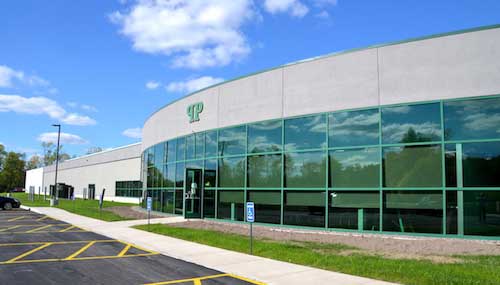
Photos by Tom Rivers: The new Pride Pak vegetable and fruit processing plant on Maple Ridge Road was the largest economic development project in Orleans County in 2016. The new 68,000-square-foot facility represented a $12.5 million investment.
ALBION – The Orleans Economic Development Agency said 2016 was a big year for the agency with nearly $20 million invested by businesses and 91 new jobs created in the county.
“It was a very good year,” Jim Whipple, EDA chief executive officer, said this morning.
Pride Pak opened a new 68,000-squarefoot vegetable and processing facility on Maple Ridge Road in November. The facility represented a $12.5 million investment and the EDA said it created 80 jobs.
Pride Pak may do two additional expansions in the future.
The EDA board of directors met this morning and EDA staff went over highlights from 2016.
In addition to Pride Pak, the EDA cited a $5 million investment by Helena Chemical for a new facility in Ridgeway on Allis Road. That project will create seven jobs, according to the EDA.
Also in Ridgeway, Sierra Biological took over a former auto repair shop on Swett Road and turned it into a nematode growing facility. The company invested $250,000 and created one job.
On the other side of the county, Karl Driesel opened a new woodworking shop and showroom on Kendall Road in Kendall. The site is a new 5,884-square-foot building for Orleans Millworks. It represents a $500,000 investment and created a new job.
The EDA counted $18,625,000 in total investment with 91 new jobs in the county in 2016.
That doesn’t include a loan to help BCA Ag Technologies with its relocation from Oakfield to Route 31A in Albion. The company is investing $375,000 and created two jobs as part of its expansion, the EDA said.
Several projects could also come to fruition this year in Orleans County, EDA officials.
Holley Gardens, the conversion of the former Holley High School into apartments and offices for the Village of Holley, tops the list for investment at $16 million. That project would add two positions. The developer, Home Leasing of Rochester, is waiting to hear if federal tax credits will be available to help make the project more affordable.
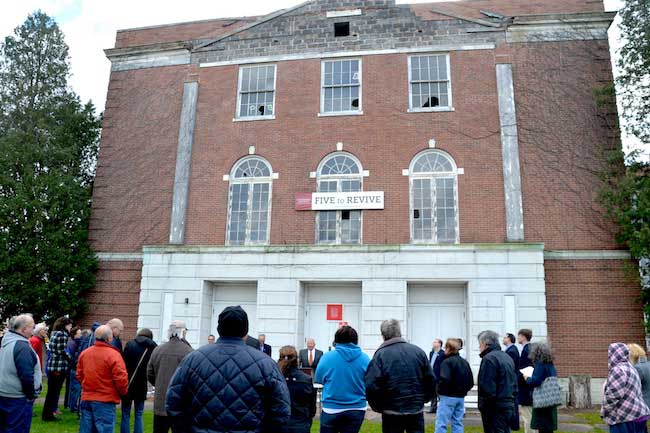
Nelson Leenhouts, chairman and CEO of Home Leasing, addresses a crowd on Nov. 11 outside the former Holley High School. Leenhouts wants to redevelop the site into senior apartments and the village offices.
Home Leasing wants to create 41 mixed-income apartments for seniors, new village office space, and restore the auditorium for public events.
• The EDA identified other projects for 2017, including a $3.5 million investment by Niagara Food Specialties in the former Atwater Foods facility in Yates, at the corner of Route 18 and the Orleans-Niagara Countyline Road. Niagara Food would add 20 jobs as part of the project.
• A developer may also commit to building a new hotel in Medina, next to Pride Pak on Maple Ridge Road. That $4 million project would add 4 jobs, according to the EDA.
• The EDA also said the following companies are looking at expansions or significant investments in Orleans: H.H. Dobbins in Lyndonville, Western New York Energy in Medina, WNA (formerly Precision Packaging Products) in Holley, Snappy in Medina, and Arbre Group Holdings (Holli-Pac and Holley Cold Storage) in Holley.
By Tom Rivers, Editor Posted 12 January 2017 at 9:29 am
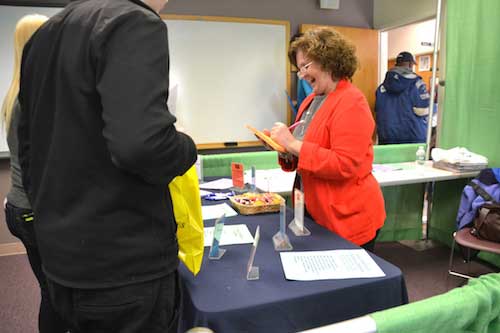
Photos by Tom Rivers: Bonnie Seelbinder, a recruiter/specialist with ATB Staffing Services, discusses job options available locally at a job fair on Wednesday at Genesee Community College in Albion. She touted jobs in light industrial, clerical and other entry level positions.
ALBION – About 150 people attended a three-hour job fair on Wednesday, inquiring about a range of job opportunities in Orleans County.
There were 23 businesses or agencies at the site looking to hire people for jobs in healthcare, manufacturing, human services and other businesses.
“We are looking for outgoing, energetic people who are go-getters,” said Michelle Spies, quality control coordinator for Weed Man in Albion.
The business is looking for employees to work in sales, outdoor marketing and as technicians.
The job fair was organized by the Orleans County Job Development Agency with support from GCC and the Albion Rotary Club. Job Development said there are more than 200 positions open in the county.
Virtual Polymer Compounds on Ridge Road in Medina is expanding and looking for workers in sales and fabrication. The company manufactures fiberglass manhole covers, benches, equipment shelters and other products.
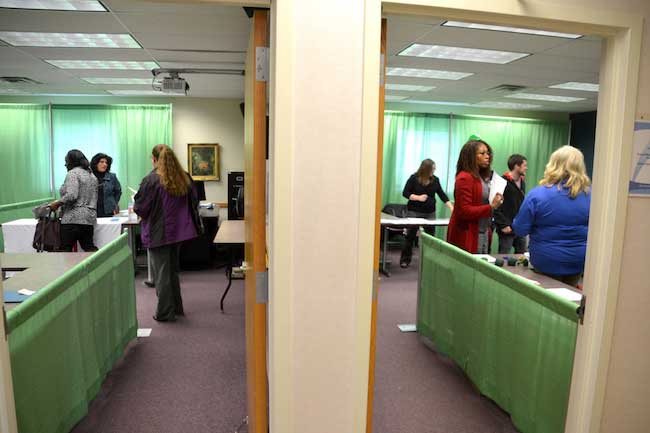
The classrooms at Genesee Community College were used for companies and agencies to present job options to the prospective applicants on Wednesday.
Dan Bryndle, business development manager for the company, said VPC is looking for job applicants with a carpentry or building background.
“We are looking for fiberglass craftsmen, people who can manufacture our products,” he said.
Katie Harvey, a personnel assistant for Orleans County, discusses positions available in local governments, including custodians, clerks and caseworkers.
Holli-Pac in Holley also is looking to hire people. The fruit and vegetable packing plant has 65 employees. It has an immediate need to hire 4-5 people, and long-term needs another 5 or 6 additional staff, said Cindy Romanowski, human resources director for Holli-Pac.
Orchard Manor in Medina also was at the Job Fair, looking to hire registered nurses, licensed practical nurses and certified nursing assistants.
“There’s always going to be jobs in healthcare,” said Patty DiNardo, human resource director for Orchard manor.
She said the company has tuition assistance for eligible staff looking to improve their education, such as CNAs looking to become LPNs.
Orchard Manor has about 200 employees and currently has six jobs open.
“There is a lot of potential in healthcare,” she said.
By Tom Rivers, Editor Posted 9 January 2017 at 1:39 pm
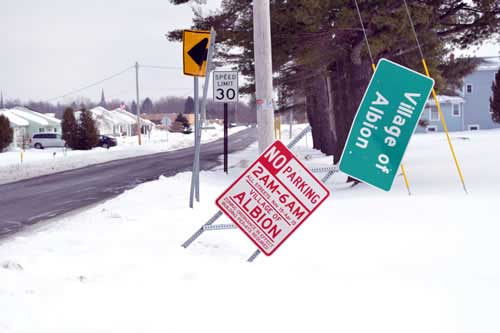
File photo: A smashed sign shown in the winter of 2014 in the village of Albion is symbolic of the rough roads villages are charting due to miniscule aid from the state. Cities get far more in per capita funding than larger villages despite providing similar services.
It’s a new year, a time of goals and initiatives to better ourselves, our community, our state and country.
Gov. Andrew Cuomo delivered a “State of the State” address today. He has put out at least 15 proposals in the past week or so. Cuomo says he wants to rev up the economy, help Middle Class families and improve infrastructure, among many issues. The governor and state legislators generally don’t have much to say about rural NY, especially Orleans County.
Orleans Hub has tried before to at least get our community on the radar screen of Cuomo and the State Legislature. We’re going to follow Cuomo’s lead in putting out proposals.
Our top issue is reforming the AIM program. The state sets aside $715 million in Aid and Incentives to Municipalities. Cities get almost all of that money, 90 percent, with a few crumbs for towns and villages.
For about three years, Orleans Hub has tried to highlight the alarming disparity in state aid between cities and villages. Some of the local Village Boards, Town Boards and the County Legislature passed resolutions in 2015, asking the State Legislature and governor to boost AIM (Aid and Incentives to Municipalities) for villages and craft a plan for a fairer distribution of the money.
Local elected officials seemed to forget about the issue last year, even though it’s a shocking form of structural discrimination that is a leading culprit in the sky-high village taxes around here.
The cities get a per capita of $277 per resident in AIM while villages and towns only get $7 per resident.
Consider that Albion (population 6,056) and Medina (population 6,065) receive $38,811 in AIM funding and $45,523, respectively. Sherrill, the state’s smallest city with 3,071 people in Oneida County, gets $372,689. Salamanca in Cattaraugus County is nearly the same size at Albion and Medina. Salamanca gets $928,131 for a city of 5,815 people.
If Albion and Medina received what Salamanca did in state aid, the two villages could cut their taxes by about 40 percent. No longer would these villages be near the top of the list for most oppressive tax burdens in the Finger Lakes and Western New York.
Medina and Albion also are high poverty communities, topping the 20 percent threshold. Normally that level of poverty would draw local and state action, a push for attention and resources. But not for Albion and Medina.
If the state gave Albion and Medina more AIM funding, even at $100 per resident, the residents in these poverty-stricken villages would get significant relief in their wallets. They would have more money to spend at local businesses, boosting our local economy. None of the state or regional poverty plans include our local village residents. The cities get all of the attention and resources.
Check out this chart to see the discrimination, and ask why doesn’t the governor, the State Legislature and our local political establishment fight for fairness? It’s discrimination, plain and simple.
City (County)
State aid
Population
Per Capita
Salamanca (Cattaraugus)
$928,131
5,815
$159.61
Dunkirk (Chautauqua)
$1,575,527
12,563
$125.41
Batavia (Genesee)
$1,750,975
15,465
$113.22
Sherrill (Oneida)
$372,689
3,071
$121.35
Norwich (Chenango)
$1,089,279
7,190
$151.50
Waverliet (Albany)
$1,210,193
10,254
$118.02
Cortland (Cortland)
$2,018,330
11,183
$180.48
Beacon (Dutchess)
$1,537,478
15,541
$98.93
Gloversville (Fulton)
$2,302,592
15,665
$146.99
Johnstown (Fulton)
$1,388,910
8,743
$158.86
Canandaigua (Ontario)
$1,119,304
10,545
$106.15
Geneva (Ontario)
$1,942,613
13,261
$146.49
Rensselaer (Rensselaer)
$1,137,317
9,392
$121.09
Mechanicville (Saratoga)
$662,392
5,196
$127.48
Ogdensburg (St. Lawrence)
$1,708,659
11,128
$153.55
Village (County)
State aid
Population
Per Capita
Albion (Orleans)
$38,811
6,056
$6.41
Medina (Orleans)
$45,523
6,065
$7.51
Holley (Orleans)
$17,786
1,811
$9.82
Lyndonville (Orleans)
$6,251
838
$7.46
Brockport (Monroe)
$110,171
8,366
$13.17
Fredonia (Chautauqua)
$89,140
11,230
$7.94
East Aurora (Erie)
$50,569
6,236
$8.11
Le Roy (Genesee)
$34,391
4,391
$7.83
Geneseo (Livingston)
$72,701
8,031
$9.05
Whitesboro (Oneida)
$73,012
3,772
$19.36
Cobleskill (Schoharie)
$36,461
4,678
$7.79
Massena (St. Lawrence)
$132,671
10,936
$12.13
Potsdam (St. Lawrence)
$111,864
9,428
$11.87
Bath (Steuben)
$103,906
5,786
$17.96
Monticello (Sullivan)
$46,903
6,726
$6.97
Newark (Wayne)
$65,833
9,145
$7.20
Source: New York State Division of Budget for state aid in 2013-14 (The state aid numbers haven’t changed for several years.) Population is from U.S. Census Bureau, 2010 population count. Orleans Hub calculated the per capita numbers.
Orleans Hub would like to again challenge the local municipal officials to at least pass formal resolutions seeking a fairer distribution of AIM funds. The local officials should lobby, and do a public protest about the issue. I would suggest forming a village coalition and marching the length of the canal. That might be ambitious this year. So maybe just cover the length in Orleans, or Western New York with groups of residents, police officers, firefighters, children – who all are treated as second-class citizens by the AIM program. A march for fairness would generate some publicity and put pressure on the governor and state legislators.
But, first off, let’s start the year with resolutions demanding equity in state aid. Here is sample resolution that the local boards are welcome to use or tweak.
RESOLUTION No. 1, January 2017
WHEREAS, New York State provides $715 million in Aid and Incentives to Municipalities each year, and 90 percent of that goes to upstate cities;
WHEREAS, the AIM funding per capita is $277 per city resident and only $7 for residents in towns and villages;
WHEREAS, there are 549 villages with a combined population of 1,918,032 in New York State, including four (Albion, Holley, Lyndonville and Medina) in Orleans County with a population of 14,770;
WHEREAS, many villages wrestle with the same problems as cities, with aging infrastructure, blighted housing, abandoned commercial sites, brownfields and increased crime rates;
WHEREAS, villages are similar to cities with a high concentration of senior citizens and low-income families;
WHEREAS, villages mirror cities as centers for culture, civic and religious life, especially in rural counties;
WHEREAS, villages are like cities with many important community structures – churches, courthouses, schools and other public buildings – that do not pay taxes, shifting the tax burden for those sites to other residents in the village or city;
WHEREAS, the state’s tiny share of AIM funding for villages has put villages at a competitive disadvantage in attracting and retaining businesses and residents;
WHEREAS, the huge disparity in AIM funding between the cities and villages is a form of state-sponsored economic discrimination, resulting in much higher tax bills for village residents and a diminished quality of life;
WHEREAS, the erosion of the village tax base has shifted a greater burden of town, county and school district tax burden outside the village, punishing the outside-village residents as well;
WHEREAS, the high tax rates in the village encourage suburban sprawl and development of green space and farm land for housing tracts, industrial parks and “Big Box” stores;
WHEREAS, village residents are no less a New Yorker than a city resident;
RESOLVED, the Legislature/Town Board/Village Board/Board of Education, call on Gov. Andrew Cuomo and the State Legislature to adopt a fair formula for sharing AIM funding so village residents can enjoy municipal services and their homes without being taxed to death.
RESOLVED, that the clerk of the Legislature/Village Board/Town Board/Board of Education shall forward copies of this resolution to Gov. Andrew M. Cuomo, Senator Robert Ortt, Assemblyman Steve Hawley, Assemblyman Michael Norris, and all others deemed necessary and proper.