By Tom Rivers, Editor Posted 24 December 2019 at 9:03 am
Photos courtesy of Melissa Ierlan
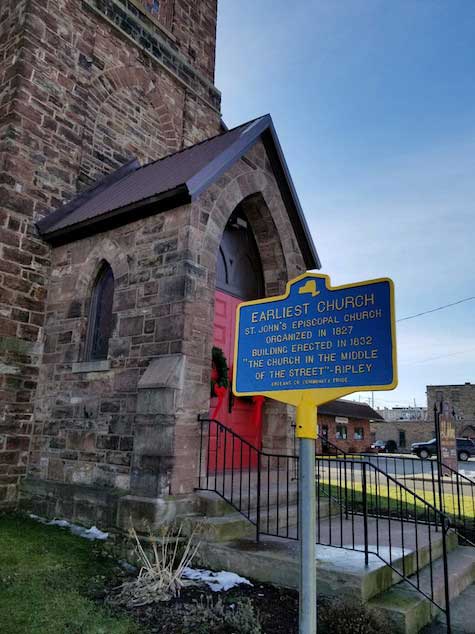
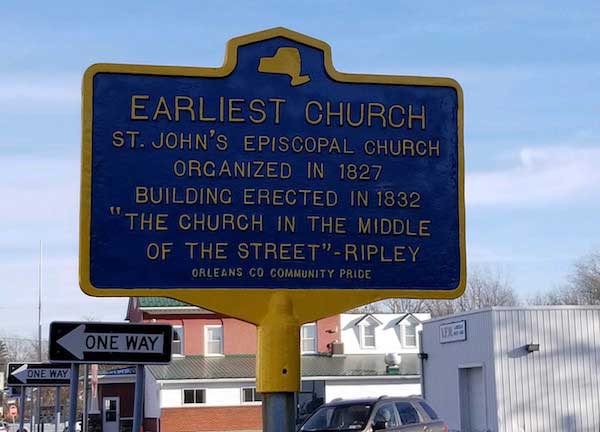
MEDINA – The historical marker for the St. John’s Episcopal Church returned on Monday after it was repainted by Melissa Ierlan of Clarendon. This is the 21stmarker she has given an extensive makeover since 2015.
St. John’s Episcopal Church was built in 1832, making it the oldest remaining church in Orleans County. The church was featured in Ripley’s Believe It or Not as “The church in the middle of the street.” Church Street splits by the church near the intersection with East Center Street (Route 31).
The church was built with Medina sandstone before there were any commercial quarries.
Many of the markers had flaked off paint and were difficult to read. Ierlan starts by removing the top of the sign and then takes it home to give it a fresh look. She scrapes off the paint.
After stripping off the paint to the bare metal, she gives it a coat of gray primer. Then she paints the sign with two coats of blue. Ierlan gives the sign two coats of yellow and a final clear coat.
By Tom Rivers, Editor Posted 22 December 2019 at 9:17 pm
Photos courtesy of Marsha Rivers
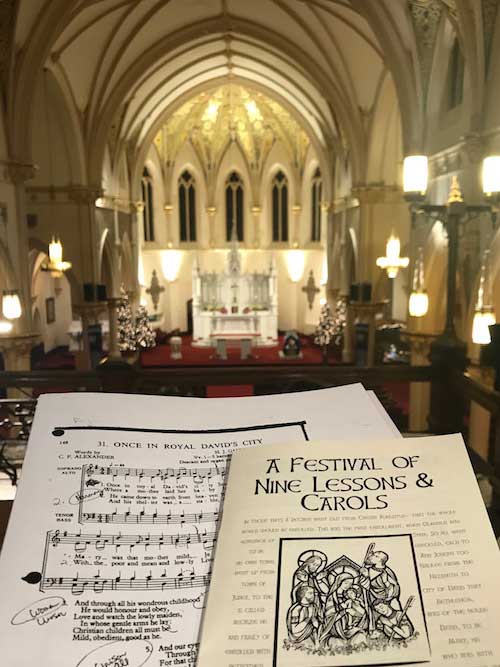
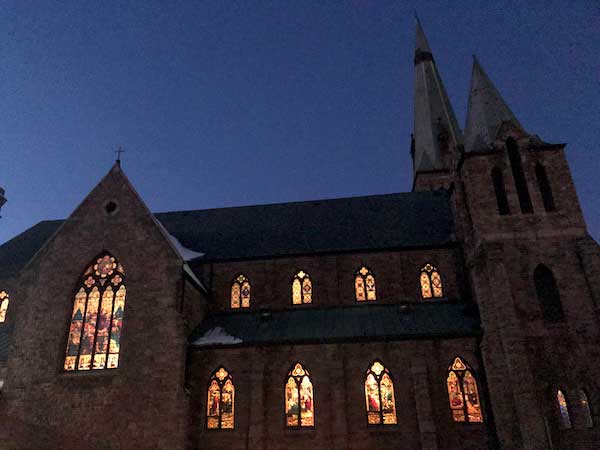
MEDINA – This photo is taken from the choir loft at St. Mary’s Catholic Church in Medina on Saturday during the Festival of Nine Lessons and Carols. Aaron Grabowski, music director of Holy Trinity Parish (St. Mary’s Church), led the choir.
He also pushed to start the event a decade ago to focus on the joyful and spiritual season of Christmas, instead of the commercialism of the holiday.
The service alternating from Christmas music and scripture readings. The nine scriptural readings telling the story of the birth of the Messiah.
A free will offering was taken to benefit the community food pantry at St. Peter’s Evangelical Lutheran Church.
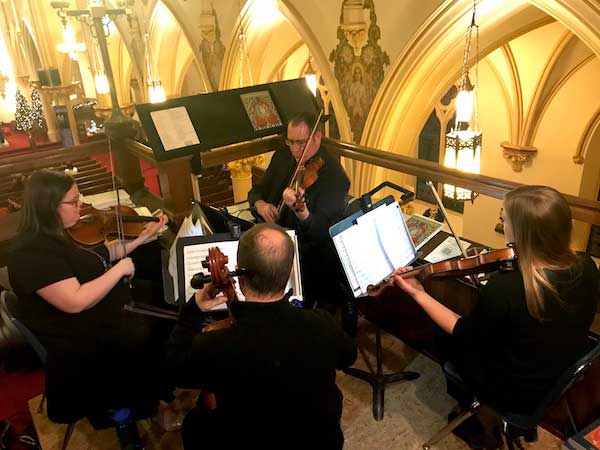
The Greycliffe String Quartet, a Buffalo-based string ensemble under the direction of Paul-Joseph Struckmann, was featured during the prelude. The group played two selections, “Riu Riu Chiu,” arranged by Marshall Fine, and movements “Sarabanda and Giga” from the “Violin Sonata in D Minor, Op. 5 No. 7 for Violin and Harpsichord” by Arcangelo Corelli.
The local ecumenical event has been hosted by Holy Trinity Parish for the last 10 years at Medina’s historic St. Mary’s Church.
You’re here checking the site, so you know: Orleans Hub is a vital resource for our community. Day in and day out, we share information and insights that matter to those who live and work in the towns, villages and hamlets of our county. Local advertisers help make the Hub possible, and so can you.
Donate today to keep Orleans Hub healthy and accessible to all. Thank you!
By Ginny Kropf, correspondent Posted 20 December 2019 at 5:35 pm
Provided photos
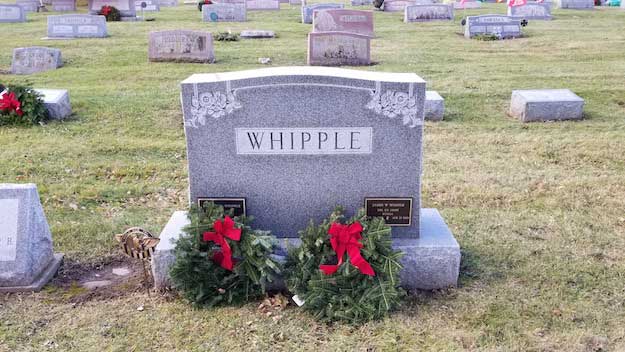
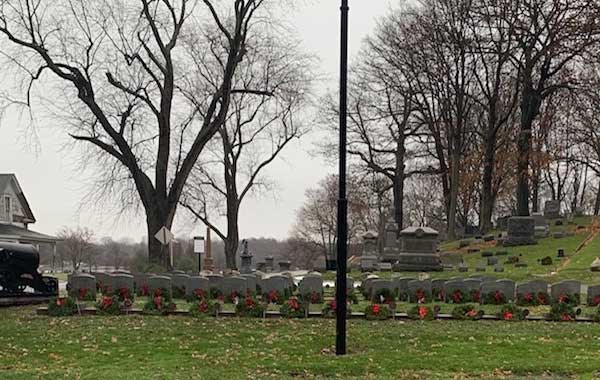
LYNDONVILLE/MEDINA – Volunteers last Saturday set nearly 700 wreaths at veterans’ graves in Lyndonville and Medina, including this one pictured at top at the grave of James Whipple, a Korean War veteran who died on April 25 at age 91.
There were 402 wreaths placed at veterans’ graves at six cemeteries in Lyndonville. Seven memorial wreaths were laid in honor of the Army, Marine Corps, Navy, Merchant Marines, Coast Guard, Air Force and POWs. Veterans buried in Lyndonville are from every conflict the United States starting with the Revolutionary War.
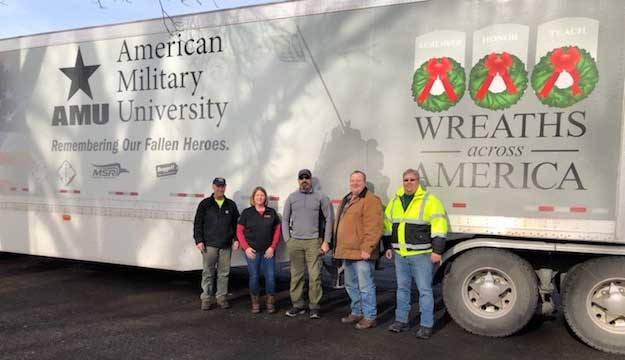
This is the first time Lyndonville participated in the Wreaths Across America. The event was made possible by an endowment fund established by Miss Anna Stelianou in memory of her parents and her five brothers. Those brothers all served in the U.S. military during World War II and the Korean War.
Approximately 50 volunteers helped to lay the wreaths in Lyndonville, including at Lynhaven Cemetery.
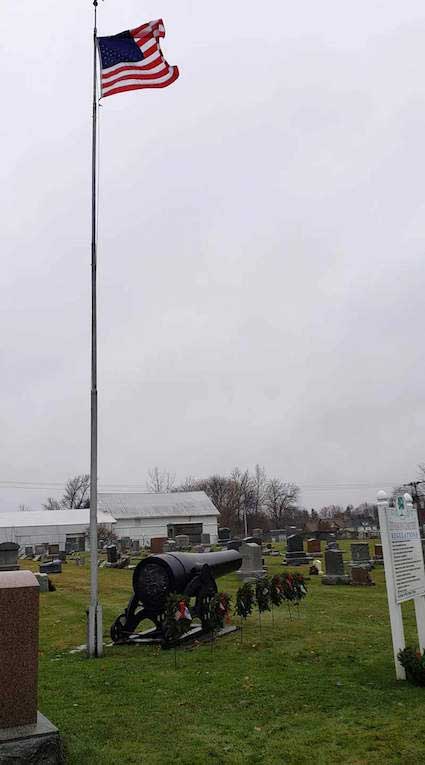
Boxwood Cemetery in Medina also is participating in Wreaths Across America, one of 2,100 cemeteries involved in the effort this year.
Boxwood first took part in Wreaths Across America in 2013. Only nine wreaths were placed that first year, said Kathy Blackburn, who has organized the event each year.
“This year, we had 261 wreaths, the largest number yet,” she said. “It grows every year, and this year was so successful because of a $1,900 donation from the veterans’ program called Peer to Peer. The VFW, American Legion, Junior Wilson’s Club and Sacred Heart Club are all generous donors to this program, along with individual supporters.”
Veteran Jim Freas of Medina salutes as wreaths are placed on veterans’ graves at Boxwood Cemetery on Dec. 14 as part of the national celebration of Wreaths Across America.
Even with the terrible weather, with rain and cold, the turnout was bigger than ever, and even included Medina Girl Scouts, Blackburn said.
“We saw many more families who brought their children to help place wreaths,” she added. “It was very moving to see these kids learning what it takes to have our freedom, and I can’t thank the parents enough for bringing their children to learn and honor.”
Members of the Boxwood Commission placed ceremonial wreaths for each branch of the service. In addition, Assemblyman Stephen Hawley from Batavia placed the POW wreath.
A veterans’ honor guard was led by Jim Freas of Medina.
The national Wreaths Across America organization is sponsoring a program from now until Jan. 15. If anyone goes online and orders a wreath for the December 2020 ceremony, the organization will match each donation.
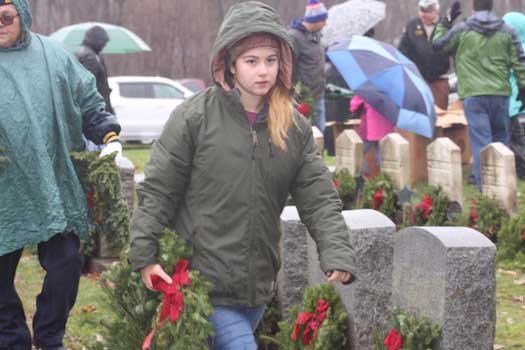
A young girl prepares to place a wreath on a veteran’s grave at Boxwood Cemetery, during Wreaths Across America on Dec. 14. Organizer Kathy Blackburn said more people participated this year, especially young people.
By Ginny Kropf, correspondent Posted 19 December 2019 at 7:48 am
Photos by Tom Rivers: St. Mary’s Catholic Church in Medina is shown on Dec. 21, 2014 during the Festival of Nine Lessons and Carols. The service will be held again this Saturday at St. Mary’s.
MEDINA – It was 10 years ago when Aaron Grabowski, music director of Holy Trinity Parish (St. Mary’s Church), decided something was badly needed to draw the community together at the joyful and spiritual season of Christmas – something to celebrate the true meaning of the season and bring people back from the brink of rampant commercialism.
So began what has become a growing and cherished annual tradition in Medina, a “Festival of Nine Lessons and Carols.”
“As I’ve said many times in the past, I think people are hungry for this kind of spiritual respite at Christmastime, and more so with each passing year,” Grabowski said. “In a restless world, this evening of Christmas music and scripture brings a measure of peace and hope. I know for many, it annually revives the true spirit of the season. It does for me, too. That’s why we continue to do it.”
The festival, first held on Christmas Eve in 1918 in King’s College Chapel, Cambridge, England, is a liturgical program consisting of nine Scriptural readings telling the story of the birth of the Messiah, Grabowski explained. The program is also interspersed with seasonal choral music. Over the past 100 years, it has become much beloved world-wide and is celebrated in thousands of parishes around the globe at Christmastime.
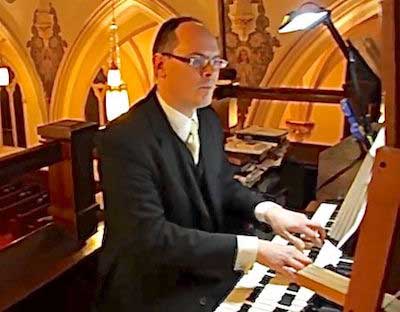
Provided photo: Aaron Grabowski, organist at St. Mary’s Church in Medina, will play the church’s historic organ at the 11th annual Festival of Nine Lessons and Carols.
The local ecumenical event has been hosted by Holy Trinity Parish for the last 10 years at Medina’s historic St. Mary’s Church. This year’s event will take place at 7 p.m. on Dec. 21, with a prelude at 6:30 p.m., featuring the pipe organ, string quartet and harpsichord.
This year, as every year, a free will offering will benefit the community food pantry at St. Peter’s Evangelical Lutheran Church.
“Every year, the need is especially great at community food pantries during Christmastime,” Grabowski said. “The generosity of those who attend Lessons and Carols greatly helps to replenish food stocks that sustain those in need. Again, Lessons and Carols helps us to open our hearts and live the true meaning of Christmas.”
Helping people to regain the spirit of Christmas through scripture and music is the goal of the event, said Chris Busch, president of Orleans Renaissance Group, which supports the concert.
“This year’s musical offerings promise to fill the hearts of all in attendance with the joy of the season,” Busch said.
The 2019 Festival Choir will once again feature voices from the Genesee Chorale – 16 in all. The Batavia-based Chorale under the director of Ric Jones of Medina, is widely known across Western New York. The choir will be accompanied by the massive pipe organ in St. Mary’s, along with the Greycliffe String Quartet, a Buffalo-based string ensemble under the direction of Paul-Joseph Struckmann.
The quartet will also be featured during the prelude with two selections, “Riu Riu Chiu,” arranged by Marshall Fine, and movements “Sarabanda and Giga” from the “Violin Sonata in D Minor, Op. 5 No. 7 for Violin and Harpsichord” by Arcangelo Corelli.
St. Mary’s Church in Medina will host the 11th annual Festival of Nine Lessons and Carols. The event is free, but a free will offering benefits the community food pantry at St. Peter’s Evangelical Lutheran Church.
Music selections this year include “Once in Royal David’s City,” “Past Three O’Clock,” “The Lord at First Did Adam Make,” “The Holly and the Ivy,” “O Come, O Come Emmanuel,” “Low, How a Rose E’er Blooming,” “What Sweeter Music,” “A Maiden Most Gentle,” “How Far is it to Bethlehem,” “Gesu Bambino,” “While Shepherds Watched their Flocks,” “God Rest Ye Merry Gentlemen,” “All Bells in Paradise,” “O Come All Ye Faithful” and “Hark! The Herald Angels Sing.”
In addition to the Greycliffe String Quartet, the prelude will feature three selections by Grabowski on the pipe organ, a harpsichord selection by Grabowski and two movements by Struckman on the violin and Grabowski on the harpsichord.
Scripture readers for the event include Ryder Jones from St. Peter’s Evangelical Church, Sophia Goyette from Holy Trinity Parish, Patricia Worrad from St. John’s Episcopal Church, Marc Smith from St. John’s Parish in Lockport, Regina Simon from Our Lady of the Lake Parish in Lyndonville, David Schubel from Trinity Lutheran Parish in Medina, James Punch from Holy Trinity Parish, Vicar Rick Mollenkopf-Grill from St. Peter’s Evangelical Lutheran Church and the Rev. Bernard U. Nowak, pastor of Holy Trinity Parish.
The event is family friendly, open to all and free of charge, Busch added.
Refreshments will be served at the conclusion of the concert.
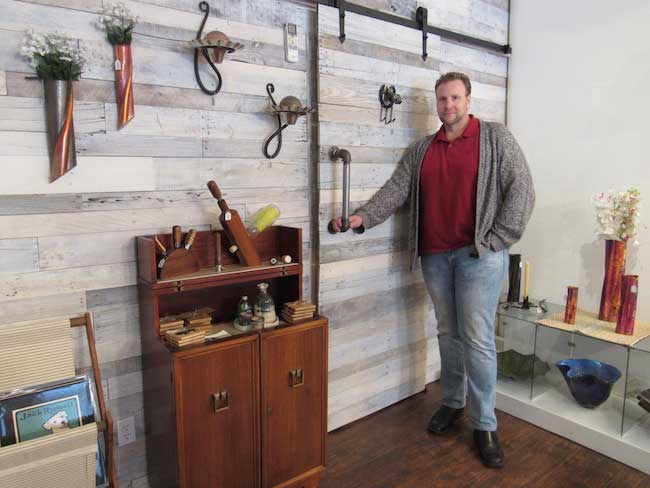
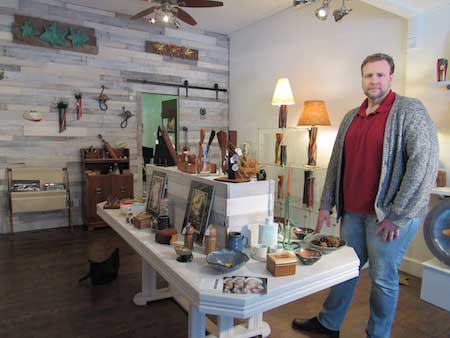
Photos by Ginny Kropf: Timothy Dunn of Albion has opened a fine crafts gallery at 419 Main St. in Medina. Dunn remodeled the space for his new fine crafts gallery, including building all the displays and covering the back wall with wood from used pallets.
By Ginny Kropf, correspondent Posted 18 December 2019 at 4:04 pm
MEDINA – Although he has always had a full-time job, opening a fine crafts gallery has been a dream of coppersmith Timothy Dunn of Albion for a long time. This year, his dream came true when he acquired space at 419 Main St. in Medina and opened American Craftsmen Gallery.
Dunn, 48, was born in Albion and still lives near Albion with his partner Jackie and their son Ethan, 12. He always thought he wanted to be a cartoonist and attended Genesee Community College in Batavia to pursue his career. That took a detour, however, when he chose to take a craft fundamentals class.
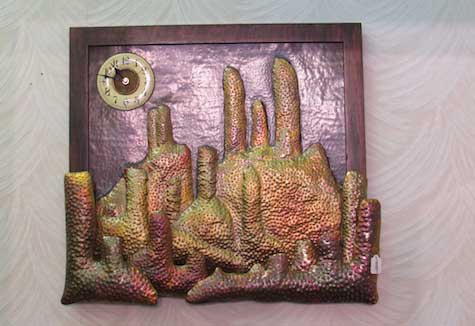
This wall hanging called repousse, which also features a clock, was crafted out of copper and is on display at coppersmith Timothy Dunn’s new fine crafts gallery in Medina.
“The professor told me if I wanted to play with clay, go to one side of the class, but if I wanted to learn metal to go to the other side,” Dunn said. “I didn’t want to dry my hands out working with clay, so I chose the other side.”
Dunn chose to make a chalice out of copper for his semester project, and when the professor took him by the arm and marched him through the halls holding up his chalice while declaring to everyone, “My student made this,” Dunn knew his career choice had been made.
“My head just exploded and all ideas of drawing were gone,” Dunn said. “My professor was a potterer and said he couldn’t help me if I wanted to continue working with metal. He suggested I transfer to Brockport, where I met Thomas Markusen of Kendall. He taught me everything I know about copper – how to make it, how to display it and how to pack it up to take to a show.”
After graduation, Dunn worked for Markusen at his studio in Kendall for 15 years. Dunn doesn’t sketch his design before he starts working on a piece. He said when he begins working with copper, he takes a piece of tubing, sheet or rod and just starts forming it.
Dunn has always held a full-time job, in addition to his crafting with copper. He worked for Sigma at the Olde Pickle Factory and has been at Sigma/Baxter for 10 years. He has done hundreds of craft shows over his more than 20 years as a coppersmith, where he says he sees fellow craftsmen frantic to sell their wares, because that is their only income.
“I always thought I’d open a gallery, and I didn’t know if I was ready now, but this space became available and it is just what I was looking for,” Dunn said. “I was going to a copper shop in East Aurora one day when I drove through Medina and saw the ‘For Rent’ sign in the window. I stopped and got the phone number and called Bill Bixler, the building owner. I told him I wanted to see the space and that I was 100 percent sure I wanted it.”
Dunn is committed to making a visit to his gallery a pleasant one. When a customer opens the door, soft Christmas music is playing and the light smell of cinnamon pine cones fills the air. A hand-crafted candy dish always has candy in it – Christmas candy for this time of year.
Dunn runs the gallery alone, while maintaining his job at Baxter as a senior technician mechanical engineer.
“I know others are very capable, but my mentality is if I don’t do it myself, it isn’t done right,” Dunn said.
Gallery hours are 4 to 8 p.m. Thursday, 1 to 6 p.m. Friday and 11 a.m. to 5 p.m. Saturday.
An assortment of lamps with copper bases are among the items coppersmith Timothy Dunn has created for his new fine crafts gallery in Medina.
Items in his gallery include a lot of copper items, such as lamps, vases, bowls, candle holders and wall hangings; a lot of wood, including cutting boards, spoons and a chess set; block prints; pottery (even concrete pottery); handmade candles; glass orbs; pewter; and area rugs.
Dunn is also one of the elite “Roycrofters.” The Roycroft was a communal arts, business and crafts colony founded in 1895 in East Aurora by Elbert Hubbard. The Roycroft Artisans became well-known for their pottery, furniture, metalwork and hand-printed, tooled leather books which exemplified the principles of quality, beauty and the worthwhile life.
Timothy Dunn is shown here with displays of some of the 20 crafters whose work he sells.
The Roycroft closed in 1938, but inspired by the Roycroft’s principles, the Roycroft Renaissance was born in 1976 and a new community of independent artisans was established.
To become a RoyCroft Renaissance Artisan, an artist must submit his/her work to a jury comprised of master artisans. Only artisans whose work exemplifies certain criteria are awarded the use of the RR mark. An artisan must be juried annually to demonstrate continued excellence and growth.
Dunn is displaying work in his American Craftsmen Gallery by 20 artisans from throughout the United States, including half a dozen local crafters from Medina, Gasport, Barker, East Aurora and Rochester. Most of the items he buys from them, rather than sell them on consignment. Everything in his gallery is hand made by fine crafters.
He is hoping to line up other fine crafters, especially someone who works in glass.
He admits the most fun he’s having is building and creating displays for the merchandise.
Dunn is also thrilled to be doing business in Medina, although he is an Albion native.
“I am awed about what is happening on Main Street in Medina,” he said. “If Medina isn’t ready for a fine crafts gallery, it soon will be. Medina is only going to get better.”
Dunn doesn’t mind having his cell phone posted on the door of his gallery, and he welcomes calls for viewing from anyone at any time. His number is (585) 729-5539, or he may be reached by e-mail at timothy@americancraftsmengallery.com.
By Tom Rivers, Editor Posted 18 December 2019 at 12:18 pm
LaQuita Amos, Class of 1998, remembered as ultimate team player for Medina girls basketball team
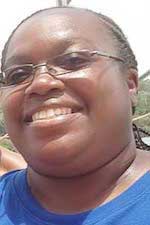
LaQuita Amos
LaQuita Amos, a Medina graduate and former varsity basketball player for the Mustangs, was killed last Thursday from a gunshot in Greensboro, NC.
Amos, 39, was killed and two others were wounded in a shooting at about 7:30 p.m. at a residence.
She graduated from Medina High School in 1998 and went to Howard University, where she received her bachelor’s degree in business administration. She continued her education at Forsyth Technical College and received a project management technology degree. Amos was employed at Lincoln Financial for several years.
‘LaQuita represented all the best qualities we could ask for in a student, an athlete and a person.’
Eric Hellwig was a teacher and coach for Amos, who graduated in 1998. He wrote the following tribute about Amos:
“Late last week the Medina community suffered another loss of a former student. Most of her former teachers have retired in the two decades since LaQuita Amos, a 1998 graduate, received her diploma.
Current students likely wouldn’t have known her because, after graduation, her connection to the area faded, as so many do. People come and go: from the area, from the school, and from our lives. And, with LaQuita, that is a shame, because she represented all the best qualities we could ask for in a student, an athlete and a person.
LaQuita was a very bright young lady who enjoyed learning and got the most out of her schooling. She could be found at the high school all hours of the day, and even on weekends, as a part of the Upward Bound program. Upward Bound was, and still is, a program aimed at students from lower-income families who would go on to be the first in their household to attend college.
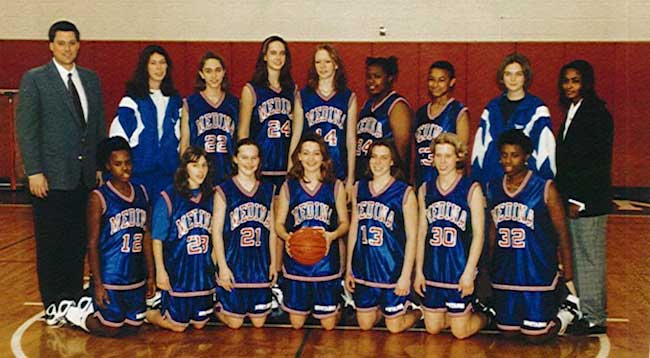
Photo courtesy of Eric Hellwig: In this 1997 team photo of the Medina girls varsity basketball team, LaQuita Amos is in the 2nd row, 3rd player in from the right, #34.
LaQuita relished working with Mrs. Isabella Mark, the Upward Bound counselor at the time, and made the most of her experience. Each summer during high school, LaQuita would join with others in the program to experience college life, living on The College at Brockport campus for a few weeks and taking courses that would help them become more independent and adjust to life after high school.
Through that program, LaQuita gained the self confidence that would be the foundation for her future success, and ultimately resulted in her being accepted to Howard University, in Washington, DC, one of the most prestigious historically black colleges in the country, where she would earn her undergraduate degree.
LaQuita loved Upward Bound, just as she loved and appreciated all aspects of life. There was never a time you wouldn’t find LaQuita with a big smile on her face, even when she was trying to fake an injury to get out of running sprints in basketball practice! It is that great big smile that those who knew Laquita will remember about her most. She had a cheerful, positive personality and was the type of person you always wanted to be around.
LaQuita loved sports, basketball in particular. She was never the best player on the team, but she was always one of the most invaluable. Laquita understood and accepted her role with eagerness. She was a top rebounder, would battle on defense in the post, and scrap for loose balls.
‘She would do the hard, unglamorous work so that other teammates could also be successful.’
She was the type of player whose name wouldn’t necessarily stand out in the box score, but if you asked any coach, she was exactly the type of person you need to have to be successful. She would do the hard, unglamorous work so that other teammates could also be successful.
That’s why, when LaQuita had the one moment every basketball player dreams of – the chance to be the hero – everyone on the team was so happy for her. She had committed herself to helping other, and being genuinely happy for their success, and now, here she was, in that starring role.
We had a very successful girls basketball team both LaQuita’s junior and senior years, winning league championships and advancing to the sectional title game each year.
However, her senior year, it was a very near thing. We faced a very strong quarterfinal opponent in Fredonia, a team that featured a future Olympic gold medal winner and a future Division I basketball player. We knew it would be a tough game, and were maybe a little bit intimidated, even though we were the higher seed and were playing a home game.
Whatever the reason, we started the game flat and faced a really big deficit by the start of the fourth quarter. Down 17 points with 3:30 left to play, after taking a timeout to regroup and sending the players back onto the court, I turned to one of my assistants at the time and said, “Well, it looks like it’s over, but we’ve had a really good run.”
And that’s when LaQuita and her teammates gave me the lesson of my lifetime: IT’S NEVER OVER! A couple of big three-point shots, a couple of steals and quick lay-ups, and a couple of forced turnovers had cut Fredonia’s lead to single digits. With just three seconds to go, Helen King, who had a 22-point fourth quarter, hit a “3” to cut Fredonia’s lead to two points, 62-60. A win was still improbable. All Fredonia needed to do was inbound the ball and that would be the game, and the end of our playoff dominance. But…
Sometimes things don’t go as expected. Sometimes you need to keep your focus. ALL the time, you need to not give up. LaQuita didn’t give up. She quickly found the opponent she was guarding, out near half court.
As the inbound pass came toward her opponent, LaQuita stepped in front, stole the ball, took one dribble passed half court, and heaved a shot toward the basket as time expired and the buzzer sounded. The shot missed.
But… again, things don’t always go as expected. As she released the ball, LaQuita was fouled and awarded three free throws, with no time on the clock. Down 62-60, Laquita had a chance to be the hero and extend our season at least one more game.
I remember thinking at the time, and maybe even saying, “Please, just make two so we can get to overtime!” LaQuita was a decent free throw shooter, but imagine the pressure – being on the court all by yourself, with all eyes in a packed gym on you, both sets of fans screaming.
Fortunately, LaQuita was a lot calmer than I was. She stepped to the line, took the ball from the official, went through her pre-shot routine, and calmly sank the first, and the crowd went wild. Second shot, same routine, same result, same crowd reaction. We are now guaranteed at least four more minutes of overtime basketball, and LaQuita has the chance to do what most players only dream of. And once again, she gets the ball, goes through her routine, and calmly sank the shot to win the game.
The crowd erupted, fans and players ran onto the court and gave LaQuita a proper hero’s congratulation. It was a moment all involved will never forget, and I’m sure LaQuita never forgot it, either. After the game, I asked her what was going through her mind as she went to the line, and she said something to the effect of “I just remember all those sprints we ran for missing free throws in practice, and I wasn’t missing those shots.” It was a moment all players and coaches wish they could freeze in time and share with all their teammates, past and present. Sadly, we can’t.
‘LaQuita did not relish the spotlight. She thrived on being a part of something bigger, a part of a team. And the last memory we will always have of LaQuita was her genuine, unabashed, and unconditional love for her teammates.’
After college she graduated from college, I lost touch with Laquita. Her family moved to Greenville, North Carolina, and LaQuita followed in order to be close to them. I don’t know many things about the time in between then and now, but I imagine LaQuita touching the lives of everyone she came in contact with, just as she had touched ours. Horribly, last week, LaQuita was the victim of a domestic violence dispute, and was killed at the age of 39, which I do know is all too young.
There are many things I’m sure I do not know about LaQuita Amos, but there are other things frozen in my mind and, I’m sure the minds of everyone who knew her. First was that beautiful smile she always displayed. And I do mean ALWAYS. There was no happier person in the school, regardless of circumstances.
Second was her humility. LaQuita did not relish the spotlight. She thrived on being a part of something bigger, a part of a team. And the last memory we will always have of Laquita was her genuine, unabashed, and unconditional love for her teammates. If someone experienced success, LaQuita was just as happy for them as she was for her own success. And most importantly, I know this about LaQuita: Her team loved her back.”
By Ginny Kropf, correspondent Posted 17 December 2019 at 9:38 am
Provided photos: Sherry Tuohey, who heads MAAC’s Christmas Red Barrel program, accepts a check from Don Marchner on behalf of Junior Wilson’s Sportsmen’s Club.
MEDINA – Delivering toys and food to children and families in the Medina and Knowlesville area is a tradition started more than 50 years ago by the Medina Fire Department, who collected broken toys, repaired them and delivered them to children just before Christmas.
For the last few decades, the Christmas giveaway program has been run by the Medina Area Association of Churches with help from firefighters from the Medina, Ridgeway, East Shelby and Shelby fire departments.
Sherry Tuohey who has taken over organizing the drive, now known as MAAC’s Red Barrel program, says they couldn’t do it without the firefighters.
Each year in November, the firefighters deliver 34 red barrels to businesses, libraries and churches, where they can be filled with donations of toys and food. Then the first week in December, the firefighters pick up the barrels, which hopefully are filled, and return them to the Medina United Methodist Church. There, volunteers sort the donations and pack holiday boxes for families who have applied for assistance.
Each box contains toys appropriate for the children in the family, in addition to food for a complete Christmas dinner. This includes a ham, potatoes, vegetable, stuffing and dessert. If an appropriate gift hasn’t been donated for a child, MAAC volunteers will buy gifts from money which has been donated.
Tuohey said this year Sara Cinquino, Student Association adviser at Medina High School, collected more than 1,900 food items, which meant families got a lot more food than they usually would have.
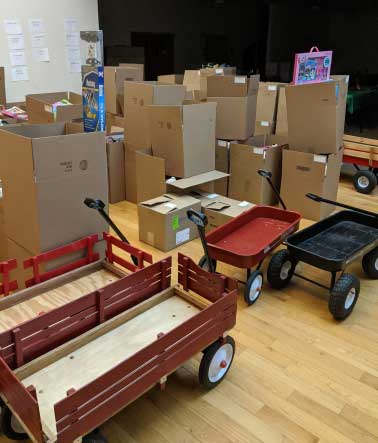
Every year it has become a custom for Bob Harrold of Lyndonville to restore children’s wagons and donate them to MAAC’s Christmas Red Barrel program.
All in all, more than 100 volunteers helped to make the program a success, Tuohey said.
“We couldn’t do it without the individuals, businesses and organizations who helped physically and financially,” she said.
One supporter of the giveaway is Bob Harrold of Lyndonville, who for the past few years has restored and donated little red wagons to the MAAC program. Tuohey said one mother commented that the little red wagon was the most wonderful gift her family could have received. Another family who didn’t have a car said the wagon was a blessing when it came to going to the store.
Tuohey added the most important thing about MAAC’s Red Barrel drive is that all the donations stay to help families in the Medina school district who live in the Medina and Knowlesville area.
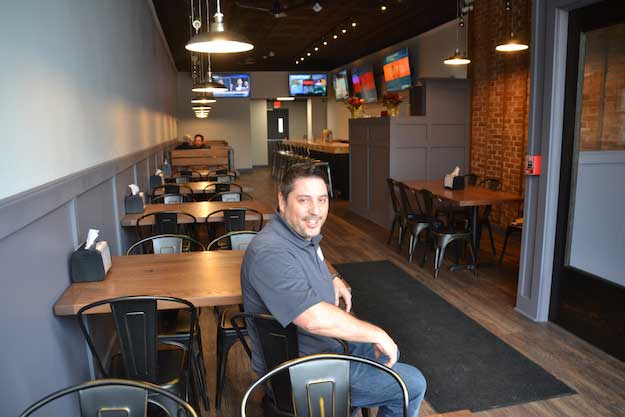
Photos by Tom Rivers: Brian Christiaansen, owner of Mark’s Pizzeria in Medina, sits in the new dining area that he opened last week for Mark’s at 549 Main St.
By Tom Rivers, Editor Posted 13 December 2019 at 7:17 am
MEDINA – For 22 years, customers at Mark’s Pizzeria in Medina could stop by 549 Main St. for pizza – on the go.
The business last week now has a dining room, and owner Brian Christiaansen also has added a bar, the first Mark’s franchise with beer and wine.
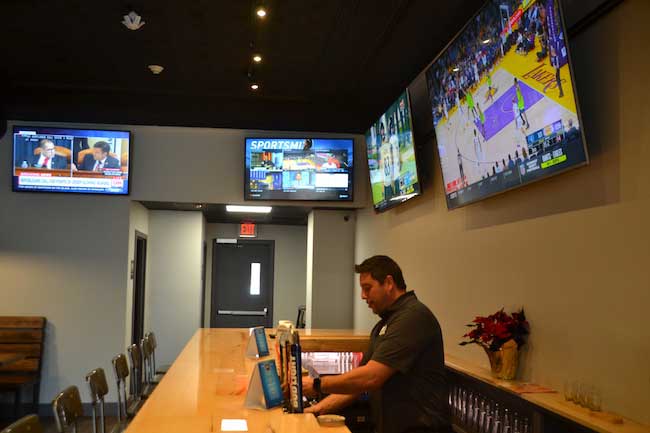
Christiaansen had major renovations done on the side of the building for the bar and dining area. He wanted to create a sports bar atmosphere. He has five large flat-screen televisions on the walls, and will be adding historic images of Medina in the dining area.
The Mark’s Pizzeria will soon have improvements to the façade with gooseneck lighting and a sign for the dining area.
“I always wanted a bar and I love the pizza business,” he said. “This is the best of both worlds.”
Brian Christiaansen pours a drink at the bar, the first in the Mark’s franchise to serve beer and wine. Christiaansen had the space gutted and totally redone, and added five flat-screen TVs on the wall.
Christiaansen, 48, has owned the Medina location for 22 years. He also owns Mark’s in Albion and Newfane.
He said he is a very social person who welcomes the chance to get to know his customers better with the bar and dining room.
He purchased the building about 1 ½ years ago from Lance Mark. Before tackling the dining room and bar, Christiaansen had the kitchen for the pizzeria totally redone. It was closed for two months from April to June so new ovens and kitchen equipment could be put in, as well as heating and air conditioning. It was redone from the floor joists to the rafters.
Now it’s a steady 70 degrees in the kitchen, regardless if it’s a hot summer day or frigid winter evening.
“The crew is very happy,” Christiaansen said about his 25 employees.
Chris Marquart serves two slices of pizza at Mark’s, which put in new kitchen equipment and ovens in a major remodeling for the pizzeria, when it was closed for renovations from April to June. Marquart is co-owner of the Mark’s in Newfane with Christiaansen. Marquart and his father Dave did the remodeling work for the dining area for Mark’s in Medina.
Christiaansen lives in Medina. He and his wife Lisa are heavily involved in the community, including with their children’s youth sports teams.
He sensed the dining option would be a nice addition to the Medina downtown.
“People are looking for a nice place for a quick bite to eat,” he said. “People can come in and sit down for a slice and a soda.”
Christiaansen said he enjoys the fast pace of the pizza business, and the energy of his employees, many who are teen-agers and young adults.
“I enjoy working with the younger people,” he said. “They keep me young.”
Mark’s is open 11 a.m. to 11 p.m. Monday through Thursday, 11 a.m. to midnight on Friday and Saturday, and 11 a.m. to 10 p.m. on Sunday.
This is the architect’s rendering of Stonehurst showing a three-story addition with ground to roof glass on the north side of the building.
By Ginny Kropf, correspondent Posted 11 December 2019 at 10:37 am
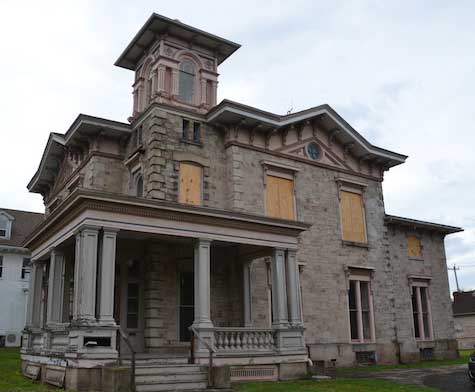
Photos by Tom Rivers: This is Stonehurst (also known as the Luther Mansion) at the corner of West Center and Prospect streets, which is being restored by Roger Hungerford’s company, Talis Equity Historic Restoration. Tales is also working on major projects at Bent’s Opera House and former Medina High School.
MEDINA – The house at 304 West Center St. is an architectural gem, a one-of-a-kind mansion built of pink Medina sandstone.
Knowing his dedication to his hometown, it’s no surprise Roger Hungerford should include it among the historic buildings he is seeking to preserve.
“Driving by it every day with its central location, it was a shame to see it deteriorating,” said Tessa Hartway, director of Marketing for Hungerford’s company, Talis Equity. “The home has so much character.”
Stonehurst, as it is known, was built in 1861 by A.M. Ives, who owned the first harness trade in Medina and was also involved in the produce business of Swan, Ives and Whalen. Sometime in the 1800s, the home was expanded. The servants’ quarters were in the attic, Hartway said.
The more-than-5,000 square foot home sits on little more than half an acre at the corner of West Center and Prospect streets. When Ives died, his widow sold the home in 1898 to Homer J. Luther, vice president of the Union Bank, resulting in the home’s designation as the “Luther Mansion.”
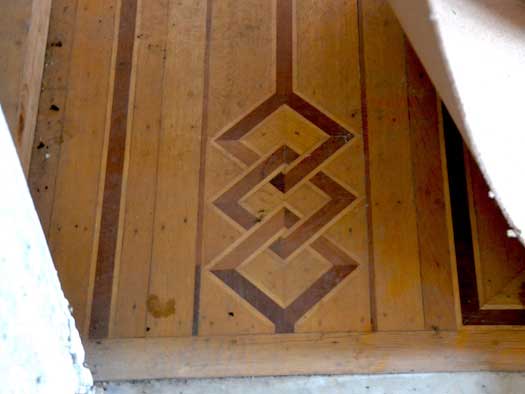
The home has had a succession of owners, not the least of whom was Ron Balcerzak, a construction management engineer. He purchased the home in 1979 and undertook considerable renovation to restore the home to its place as one of Medina’s finest pieces of architecture. He worked years to restore portions of the home that involved marble, crystal and parquet flooring.
Later owners removed many of these costly restorations. After years of neglect, the property suffered serious deterioration. Talis Historic Restoration purchased the home in March 2018 and began the task of repairing and restoring the property.
“We’re telling the building’s story,” Hartway said.
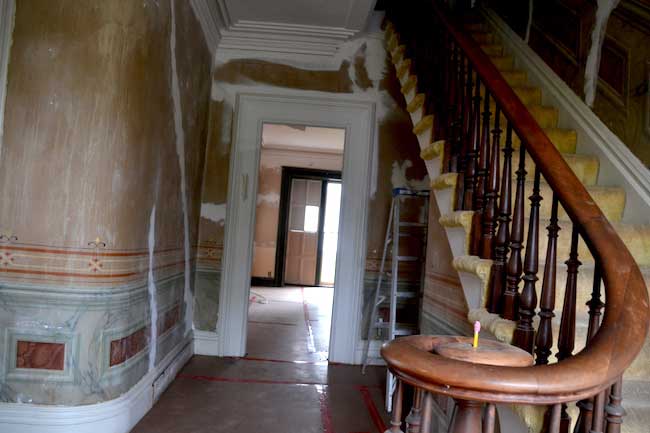
This open stairway in Stonehurst (also known as the Luther Mansion) will be preserved during its current restoration by Talis Equity. The basement will house a modern kitchen for catering staff.
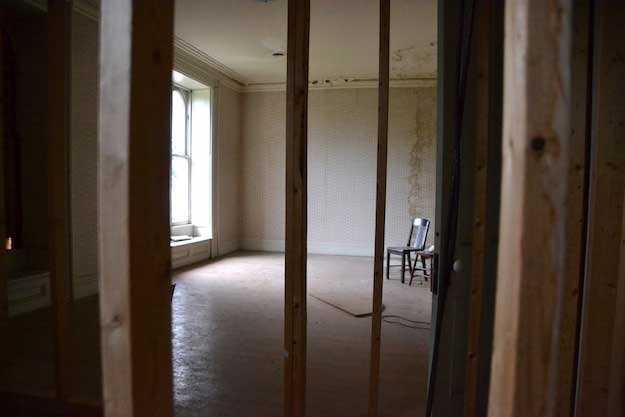
The interior of the home will receive a full makeover, as much of it has been destroyed. Redesign will include improvements to add modern architectural elements to contrast with the historic character, increasing the number of bedrooms and developing the attic into livable space. These improvements include a three-story addition on the north end, with ground-to-roof windows.
“This addition will tie in with the rest of the historic home,” Hartway said. “We don’t want to change its integrity or its footprint. Just add on to it.”
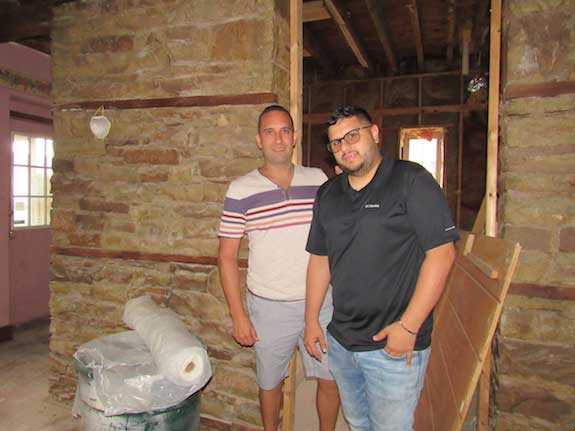
Photo by Ginny Kropf: Chef Lionel Heydel, left, and sous chef Jose Ocasio stand in front of the sandstone wall which once formed the north wall of Stonehurst, until owners put an addition on. Another addition to add a third story on the north with glass from ground to roof is being planned during its current restoration by Talis Equity Historic Restoration.
The basement will be outfitted with a modern kitchen. The exterior will be fully restored to its original grandeur, including extensive landscaping. The new owner’s vision includes an elaborate garden and full renovation of the carriage house on the property.
When complete, the home will be an event venue with rooms available to stay overnight as an Airbnb.
The upstairs rooms will be available for overnight stays.
Carpet will be removed and wooden floors will be showcased.
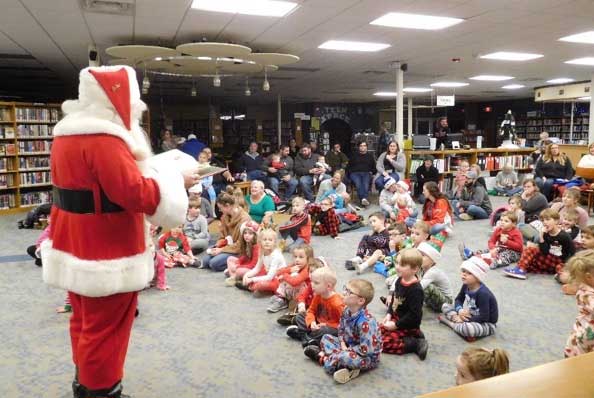
MEDINA – Lee-Whedon Memorial Library hosted some very special friends on Friday night. The Santa Pajama Storytime program celebrated its 37th year as children, along with family and friends, eagerly awaited an evening with Santa.
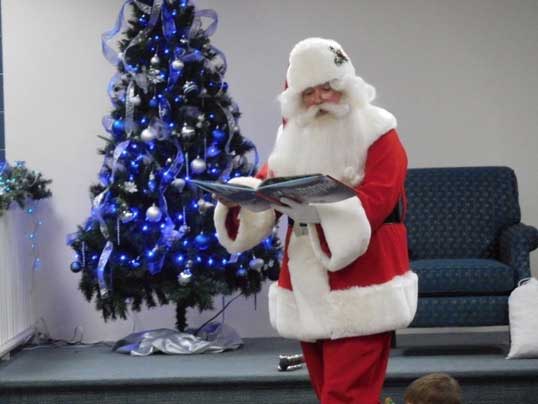
The children were treated to a movie titled “What is Christmas?” Then, to everyone’s delight, sleigh bells began to ring as Santa arrived to entertain everyone with special songs and activities. Next, over 100 people settled in as Santa read, The Broken Ornament by Tony DiTerlizzi.
Santa reads, The Broken Ornament, to children and families.
The evening culminated with each child visiting with Santa and everyone was encouraged to make crafts, read books and visit with friends and family.
Families also contributed to the local food bank as part of this annual event.
Kendall Oliver Farewell shares her list with Santa.