

















New Butts Park sign will include portrait of Medal of Honor recipient
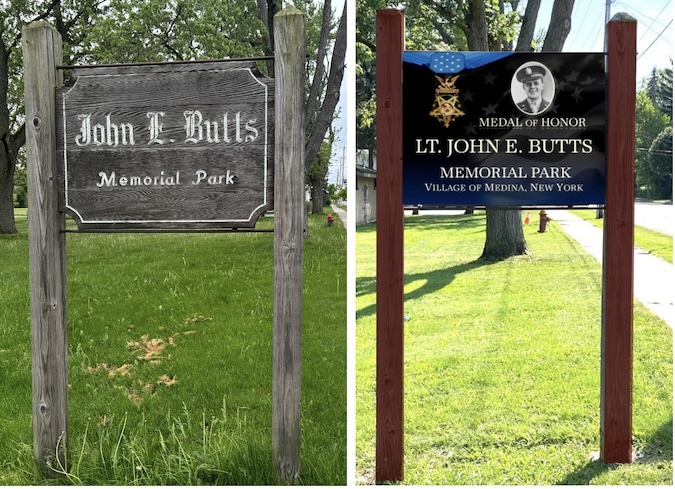
(Left) The current sign for Butts Park at 1127 South Main St. is a wooden sign. (Right) The new sign will have a metal exterior with a portrait of John Butts, a recipient of the Medal of Honor for bravery during World War II.
MEDINA – There will soon be a new sign along South Main Street for Butts Park.
The new sign will go over the current wooden sign. The new one will have a metal exterior and will include a portrait of Lt. John Butts, who was awarded the Medal of Honor for bravery during World War II.
Butts was posthumously awarded the Medal of Honor for “courage, unflinching valor and inspiring actions” in Normandy, France on June 23, 1944.
The new sign will be made by The Print Shop and it is being funded by Rick Drilling. Chris Busch, chairman of the Orleans Renaissance Group, shepherded the project.
The Medina Village Board approved the new sign on Monday during its board meeting.
“That will be lovely,” Mayor Debbie Padoleski said about the new sign. “Thank you to Rick Drilling for that.”
Butts is one of five Medal of Honor recipients from Orleans County and the only one to be awarded it posthumously.
Butts was a Boy Scout and played right guard for the Medina High School football team before enlisting with the New York National Guard on Oct. 12, 1939.
Former Orleans County Historian Matthew Ballard researched the Medal of Honor recipients from Orleans County. He shared the following details in a previous column when he was historian:
When Company F of the 108th Infantry was federalized, Butts was 17 years old and lied about his age in order to join. He was sent to Hawaii in the months following the attack at Pearl Harbor and later returned to the mainland in November of 1942 to enroll in the Officer Candidate School at Ft. Benning, Georgia. Butts graduated from the school, commissioned as a Second Lieutenant at the age of 19; he was believed to be the youngest commissioned officer in the U.S. Army Ground Forces at that time.
His service overseas began in North Africa with the invasion of French Morocco as part of Operation Torch, where the 60th Infantry Regiment, 2nd Battalion encountered heavy resistance from German forces at an ancient fortress called “the Kasba.” The 9th Infantry Division earned its first Presidential Unit Citation during the Battle of Sedjenane when the unit repulsed a four-pronged attack from two German infantry battalions. Butts was then sent to participate in the invasion of Sicily, landing at Palermo on August 5, 1943 and remaining on the ground there until November of 1943.
After seven months of training at Winchester, England in preparation for the Allied invasion of mainland Europe, the 60th Infantry Regiment landed at Utah Beach just five days after the D-Day landing. Butts was placed in command of four squads in Easy Company of the 60th Infantry Regiment, 2nd Battalion, 9th Infantry Division charged with driving towards St. Colombe, France.
On June 12, 1944, 2nd Battalion progressed so quickly towards their objective that the remainder of 9th Division thought the 60th Infantry was lost. In fact, 2nd Battalion had pushed forward through heavy German resistance and established a bridgehead at the Douve River. Butts was wounded twice, first near Orglandes on June 14th and then at the Douve River just two days later; he refused medical treatment on both occasions in order to remain with his men.
On June 23, 1944, the 60th Infantry led the 9th Division’s advance from the Cotentin Peninsula as part of the breakout from St. Lo. While moving towards Flottemanville-Hague, Butts and his men encountered a German stronghold atop a hill, well defended with tanks, machine guns, and mortars. Butts was struck in the stomach by machine gun fire while progressing towards the objective. Pulling himself into the shelter of a nearby hedgerow, he planned a flanking maneuver with his Sergeants.
One squad was to progress up the left flank, another up the right flank, and the third was to remain in reserve. Holding one hand over his midsection and the other grasping his carbine, Butts charged the hill alone. The might of the entire German stronghold fell upon him directly, Butts falling approximately 10 yards from his objective. The distraction allowed the two flanking squads to outmaneuver the Germans while the third squad hit the hill head-on.
Awarded on July 19, 1945 by President Harry Truman, John Butts’ Medal of Honor citation references the two painful wounds he received in the days leading up to the deadly assault on June 23, 1944. His citation concluded by stating, “By his superb courage, unflinching valor and inspiring actions, 2d Lt. Butts enabled his platoon to take a formidable strong point and contributed greatly to the success of his battalion’s mission.” His brother, Charles, who visited John’s body wrote home to their parents, “John’s life reached a glorious end. It terminated exactly as John hoped it would – while performing magnificently in the face of the enemy…in an effort to relieve pressure on his men and buddies.”
The body of John Butts was interred at the U.S. Cemetery at Ste-Mere-Eglise on June 25, 1944. On April 8, 1948, his body was disinterred and sent home for burial at Medina. His body arrived in Buffalo on July 7, 1948 at the Connecticut Street Armory along with the remains of two other Medal of Honor recipients, Pfc. William Grabiarz and Pfc. Charles DeGlopper. He was buried in the family plot at St. Mary’s Cemetery in Medina.