By Tom Rivers, Editor Posted 3 November 2016 at 3:11 pm
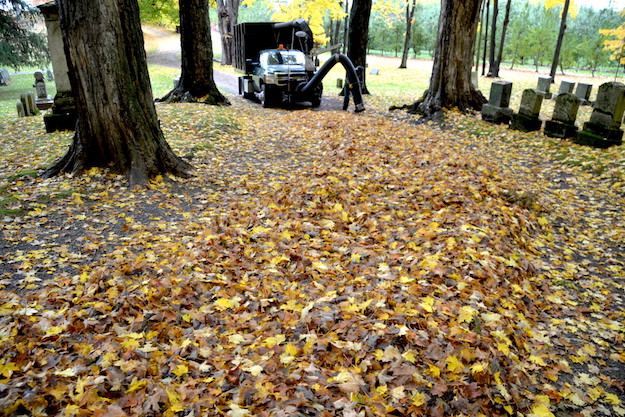
ALBION – Parts of Mount Albion Cemetery look like a blanket of orange, red and yellow leaves.
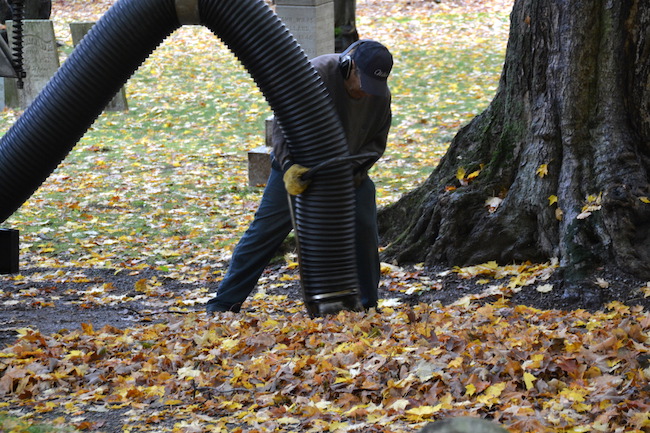
The cemetery’s workers have been making long piles of leaves and then sucking them up with a vacuum truck. Kenny Blank, one of the cemetery’s workers, was clearing leaves on the east side of the cemetery this afternoon.
Blank and the cemetery workers are busy trying to clear the historic cemetery, home to many tall mature trees, from numerous leaves.
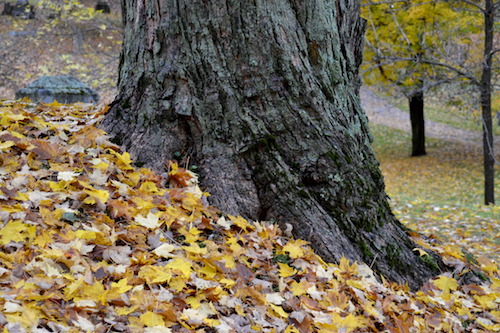
Many leaves are yet to fall at Mount Albion.
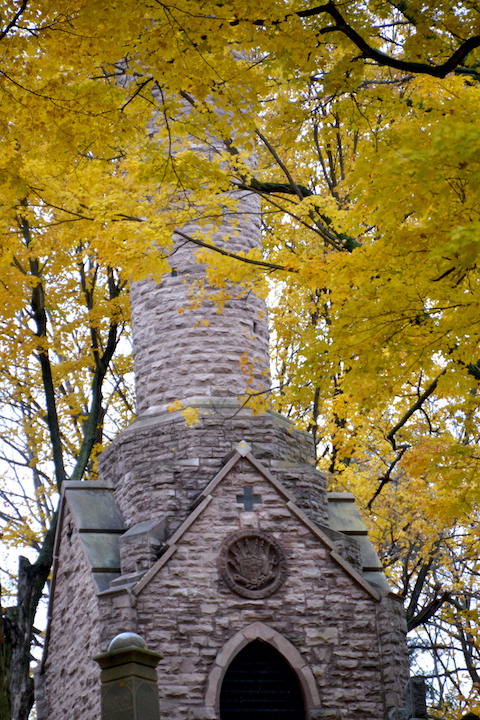
The tower at Mount Albion, a memorial that was built in 1876 to the nearly 500 Orleans County soldiers killed during the Civil War, is more visible now that the trees are shedding leaves.
Mount Albion is even more stunning in the fall, with the blast of colors from the fall foliage.
By Tom Rivers, Editor Posted 30 October 2016 at 9:45 pm
ALBION – The the leaves are putting on a colorful display in Orleans County, although there is still a lot of green out. We still have time to enjoy fall before winter rears its head.
I was out for a jog/walk today along the canal in Albion. (A little jaunt was needed after the Patriots dismantled the Bills.)
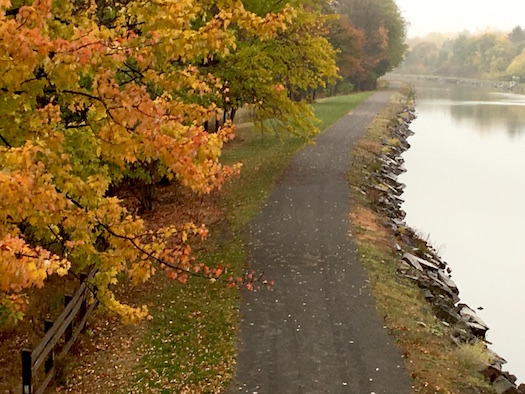
The top photo shows the canal and towpath looking east from the Brown Street bridge.
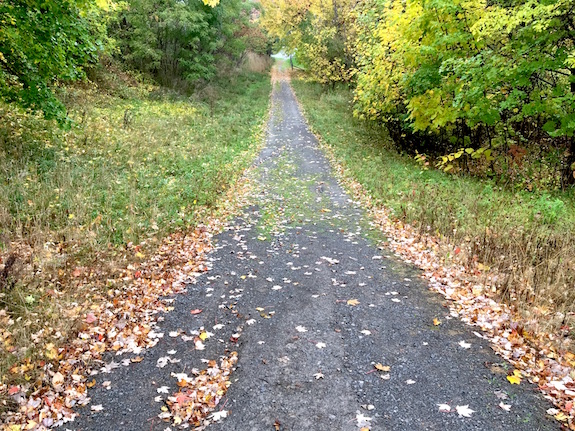
These leaves were on a path near the canal that leads to Brown Street.
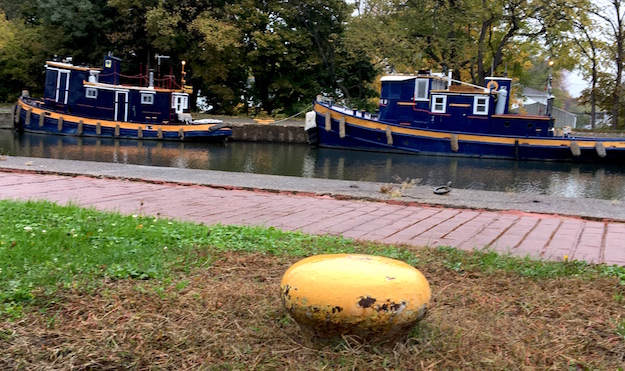
Several tugboats and tenders are tied up in Albion between the Main Street and Ingersoll Street lift bridges. The canal season ends on Nov. 20.
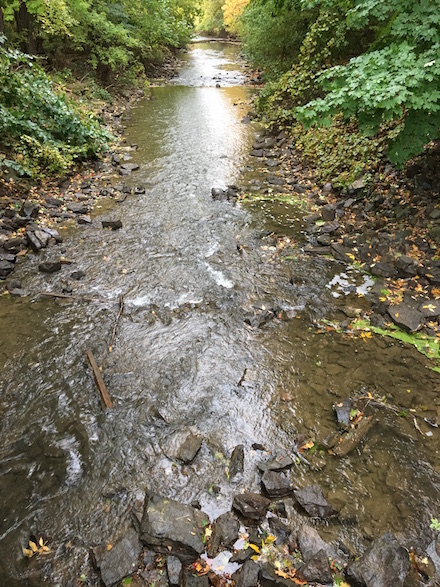
This is the spot where Sandy Creek runs under the Erie Canal. This is just north of the canal. Community Action of Orleans & Genesee is on the south side of the canal.
Here is that path from the canal to Brown Street.
There are still some 60-degree days in the forecast. Monday (Halloween) will reach a high of 47, followed by a high of 69 on Tuesday and a high of 68 on Wednesday. Thursday is forecast for a high of 59, followed by Friday topping out at 49, according to the National Weather Service in Buffalo.
By Tom Rivers, Editor Posted 27 October 2016 at 7:24 pm
File photo: The dredging barge is near the breakwall at the Oak Orchard Harbor in this photo from August 2014.
POINT BREEZE – Orleans County legislators want to reignite a push for a dredging plan for harbors on the southshore of Lake Ontario.
The harbors haven’t been dredged on a timely basis the past decade, leaving a buildup of sediment and silt that can make some channels impassable for larger boats.
The Oak Orchard Harbor was last dredged in 2014. It went 10 years between dredgings. County officials said the harbor should be cleared of sentiment every three to five years.
Orleans wants to partner with other southshore counties to come up with a plan for cyclical dredging, said Legislator Lynne Johnson, R-Lyndonville.
Niagara County already is interested in the project, and so is Wayne County. If there are multiple counties in a dredging plan that could help with convince companies with dredging equipment to offer a better price for the sediment removal, Johnson said.
The Army Corps of Engineers has been determining the dredging schedule, and in recent years the Corps has given priority to busier harbors, rather than those that are primary for recreation, such as Oak Orchard’s.
The Oak Orchard Harbor was dredged when federal funds from Superstorm Sandy were directed for the job.
Congress hasn’t set aside money on a regular basis to clean out recreational harbors like the Oak Orchard. During low lake-level years, boats can run aground in the harbor. That happened to the Oak Orchard in 2012.
A clogged harbor makes the county’s fishing and recreational boating industries vulnerable. The harbor generates about $7 million in economic activity for the county, resulting in 117 direct and indirect jobs. It also yields $283,484 in sales tax revenue for the county with the same sales tax for the state, according to a consultant, Frank Sciremammano of FES Environmental and Marine Consultants.
Sciremammano worked with six southshore counties on a plan for regular harbor maintenance and dredging back in 2014. The Army Corps of Engineers has been dredging the Genesee River and the Port of Oswego, which are both commercial harbors, but the recreational harbors have languished.
“We need to have a plan, a cyclical schedule,” Johnson said today. “We don’t want to wait 10 years before we have our harbor dredged again.”
The federal money from the aftermath of Superstorm Sandy took some of the urgency away for the harbor dredging plan. But Johnson said the county wants to push the plan again.
Orleans and Niagara (and perhaps Wayne and others) intend to seek state funding from the Department of State. That money may go to a contractor with dredging equipment, Johnson said.
The Oak Orchard Harbor is important for the fishing industry, which is the county’s top tourism draw. It’s also popular with many recreational boaters.
“We need to capitalize on the tourism and fishing industries,” she said.
Provided photo by Landmark Society of WNY – Credit Richard Margolis: The Lake Ontario State Parkway runs near the lakeshore in Orleans and Monroe counties and has been in need of paving and repair in recent years.
By Tom Rivers, Editor Posted 19 October 2016 at 2:24 pm
Landmark Society calls Parkway a top preservation priority
ROCHESTER – The five top preservation priorities in the region for the Landmark Society of Western New York includes the Lake Ontario State Parkway, a road which residents and elected officials have tried to draw attention to due to deteriorating conditions in recent years.
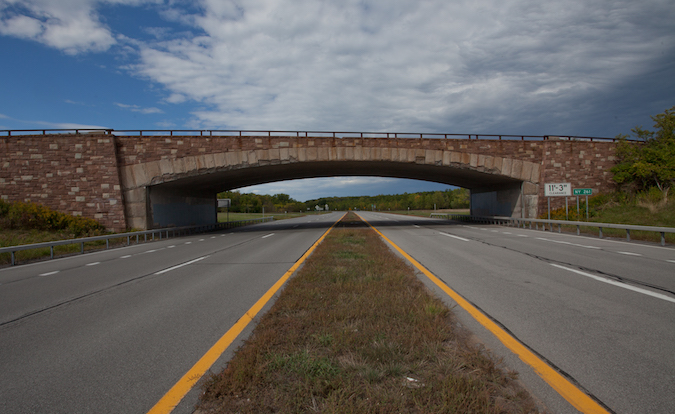
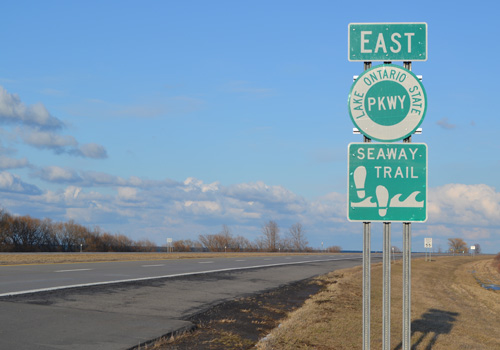
Photos by Tom Rivers: The Lake Ontario State Parkway has two westbound and eastbound lanes. The road is bumpy in spots with cracks and pockmarks, especially just across the Orleans County line in Hamlin. Many of the off-ramps are in bad shape.
The Landmark Society announced its annual list of “Five to Revive.” The group has picked five priorities each year since 2013.
It has previously named the old Holley High School (2013) and Hillside Cemetery and Chapel in Clarendon (2014) to the list. That designation has drawn interest from a developer for the old school in Holley and grant funds for the chapel at Hillside.
The Parkway is 35 miles long, including 12.7 miles into Orleans County. The road ends near the Lakeside Beach State Park in Carlton. The Parkway includes bridges that go over the Oak Orchard River
The Landmark Society noted the road is one of only two state parkways built in western New York. It was constructed beginning in the late 1940s. It was originally planned by Franklin D. Roosevelt to connect Fort Niagara to the Thousand Islands.
“The Lake Ontario State Parkway is architecturally significant as a designed historic landscape in the tradition of earlier parkways in New York State, featuring a picturesque curving route, rustic sandstone bridges and buildings, and park-like landscaping, offering scenic views of Lake Ontario and the surrounding countryside,” the Landmark Society stated.
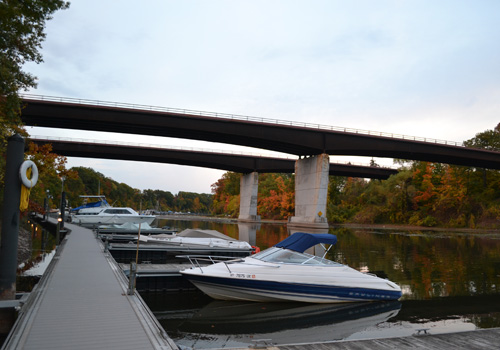
The bridges over Oak Orchard River were built for the Lake Ontario State Parkway, which ends abruptly 2 miles west of the river.
The organization said the Parkway needs significant investment.
“A part of the Great Lakes Seaway Trail National Scenic Byway, the Parkway could present an opportunity for reuse as a multi-purpose recreational corridor, with road maintenance costs decreased as the Parkway’s use and appeal is diversified to better serve varied groups of users,” the Landmark Society said.
Other sites on the “Five to Revive” include:
Former Rochester Brewing Company complex, Rochester, NY
Downtown Perry Block of Commercial Buildings, Village of Perry, Wyoming County
Dove Block, City of Geneva, Ontario County
The Traditional Trades
In listing the traditional trades, the Landmark Society said there is a shortage of trained professionals in carpentry, masonry, stained/decorative glass, painting, roof repair, metalwork, and window restoration with historic buildings.
“Without a new generation of craftspeople to take over, we are approaching a crisis level of diminishing resources and knowledge to care for our historic resources,” the Landmark Society stated. “Rehabilitation of historic buildings has increased exponentially during the past several decades, providing employment opportunities for craftspeople who are trained in these specific skills.”
The organization said other communities have developed trade schools and preservation skills programs.
“This the fourth year that The Landmark Society of Western New York is announcing the Five to Revive list to call attention to key properties and priorities for revitalization in western New York,” said Wayne Goodman Executive Director.
“The Five to Revive initiative is proving to be very successful and continues to showcase our ongoing efforts demonstrating that preservation and adaptive reuse are effective strategies for revitalization in Western New York,” said Tom Castelein, Vice-President of Preservation on The Landmark Society Board who chairs the Five to Revive initiative.
October marks the start of waterfowl hunting and the New York State Department of Environmental Conservation (DEC) is reminding waterfowl hunters in Western New York that extreme drought conditions have dropped water levels in most wetlands and dried some completely. As a result, waterfowl hunters scouting potential hunting sites could encounter difficulty this season.
DEC Region 8 is home to the state’s best waterfowl hunting areas in the managed marshes at Iroquois and Montezuma National Wildlife Refuges and Northern Montezuma, Oak Orchard, and Tonawanda Wildlife Management Areas (WMA). All of these areas have been impacted by the lack of rainfall.
The drought that began in late spring caused water levels in most wetlands to drop substantially, and in some cases, to dry up completely. Soils exposed by low water levels have resulted in thick vegetation growth in marsh areas.
In addition to some intentional drawdowns of impoundments to stimulate the growth of seed-producing annual plants preferred by waterfowl, the drought caused some additional units to go dry and several to drop below normal levels. Water levels are expected to be well below normal for much of the waterfowl season.
Food for ducks in these areas exists in the form of seeds from moist soil annual plants in the WMA wetlands, but in many cases more water is needed to shallowly reflood these areas to make the food accessible to ducks. However, there are some excellent shallow water marsh areas on the WMAs with abundant food resources providing excellent habitat for ducks.
One of the drought’s most significant impacts will be to hunters who usually access the marshes by boat. The low waters may make it impossible to float a boat and will require wading to access the more remote locations. The increased vegetation may also make it more difficult to find downed birds.
Due to the lack of water and the growth of thick vegetation, DEC reduced the numbers of permits issued to hunt waterfowl each day of the opening weekend of duck season by 40 percent at both Tonawanda WMA (Niagara, Genesee and Orleans counties) and Oak Orchard WMA (Genesee and Orleans counties).
By Tom Rivers, Editor Posted 9 October 2016 at 7:46 pm
Photos by Cheryl Wertman
BARKER – The Friends of the Thirty Mile Point Lighthouse celebrated Christmas early today with festivities at the Golden Hill State Park.
Santa makes an appearance with the help of his two elves, Adrienne and Renee, who handed out candy canes to the kids.
Bob Humbert of AWARE (Association for Wild Animal Rehabilitation and Education) shows his Red-Tail Hawk that was rescued in the Hartland area and is used for show purposes.
Logs made into pumpkin faces were for sale for Halloween.
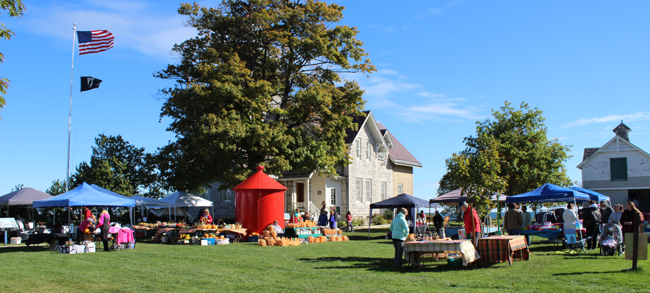
Here is an overall view of the vendors with the lighthouse in the background.
Noah Bradley (center) leads the way in the first annual bike parade.
The interior of the lighthouse had a Christmas tree set up and also offered tours to the top of the lighthouse.
Fall produce was also an item for sale today along with local wineries, breweries and crafts.
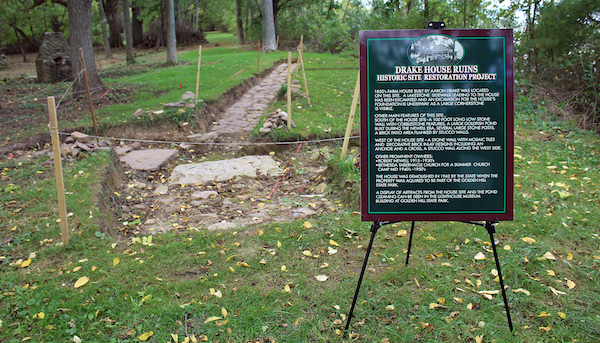
Unveiled today, this new sign will become a fixture at the Drake House Ruins site. Shown in front of the area that was uncovered this summer as part of the original house, the sign describes the history of the site as well as what is at the site.
People make their picks for the basket raffle. There were almost 100 donated items up for raffle.
Photo by Tom Rivers: These boaters are out in lake Ontario near the Oak Orchard Harbor on June 30, 2016.
Press Release, Congressman Chris Collins
WASHINGTON, D.C. – Congressman Chris Collins (NY-27) and Congressman John Katko (NY-24) continued to voice their strong opposition to the International Joint Commission’s (IJC) Lake Ontario-St. Lawrence River Plan for the 2016 Fiscal Year after receiving a briefing on Wednesday from federal officials involved in the plan’s implementation.
“The IJC’s Plan 2014 will devastate homeowners and businesses along Lake Ontario’s shoreline,” said Congressman Chris Collins, R-Clarence. “This plan is an example of government decision-making at its worst. The plan fails to take into account the devastating economic impact it will have on our lakeshore communities, and doesn’t adequately protect our eroding shore-line. I remain vehemently opposed to this ill-conceived plan and will do everything in my power to ensure it does not receive the funding needed for its implementation.”
“It is deeply disappointing that the Administration continues to push Plan 2014 without properly consulting with the people who would be most directly affected by it,” said Congressman John Katko, R-Camillus (near Syracuse). “My lakeshore constituents have voiced concerns for years about the potentially devastating impact this Plan could have on their communities, but have not had their concerns addressed, or even meaningfully acknowledged. Until the Administration directly addresses the concerns of my constituents, I will do everything in my power to stop Plan 2014.”
Staff Members from the Council on Environmental Quality, the Department of Commerce, the Department of the Interior and the State Department were present at Wednesday’s briefing.
Also known as Plan 2014, the Lake Ontario-St. Lawrence River Plan would require federal funds to increase the frequency by which Lake Ontario’s water levels are raised and lowered. Plan 2014 would raise the current maximum water levels by 2.4 inches, significantly increasing the annual costs of shoreline maintenance. Local residents are concerned about the negative impact this plan will have on Lake Ontario’s already rapidly deteriorating shoreline. These water level changes will also threaten the economic activities of residents, businesses, and farms which rely on consistent lake water levels.
Local legislators also reaffirmed their strong opposition to the plan.
“If Plan 2014 goes through, every taxpayer in our lakeshore counties will suffer because everyone has to make up the difference in the loss of sales tax revenue from our fishing industry, recreational boaters, and the devaluation of lakeshore property on the south shore of Lake Ontario,” said David Godfrey, Niagara County Legislator. “This is not only a shoreline issue; taxpayers will have to pay the price for this totally irresponsible plan.”
“The approval by the IJC (International Joint Commission) of Plan 2014 is government at its worst. The IJC did not listen to the voice of people,” said Lynne Johnson, Orleans County Legislator. “This plan is going to be economically devastating for our entire area. There appears to be no interest from the IJC to assist with what will be the equivalent of a manmade disaster, with no economic mitigation to our lakeshore communities.”
“Plan 2014 is based on inconclusive data and speculation,” said Steve LeRoy, Sodus Town Supervisor and Chairman of Wayne County Board of Supervisors. “Hundreds of houses, roads, bridges, wastewater plants, public water lines and countless businesses have been built based on the current Order that was implemented nearly 60 years ago. No one person or group should feel so empowered that they could disregard that Order at this point in time and force massive hardship on our communities. Plan 2014 violates an international treaty, it places 100% of the losses on the south shore of Lake Ontario and if implemented, will guarantee a “man-made” multi-million dollar catastrophe. The possible benefits simply do not outweigh the inevitable losses.”
By Tom Rivers, Editor Posted 16 September 2016 at 10:40 am
Photo by Tom Rivers
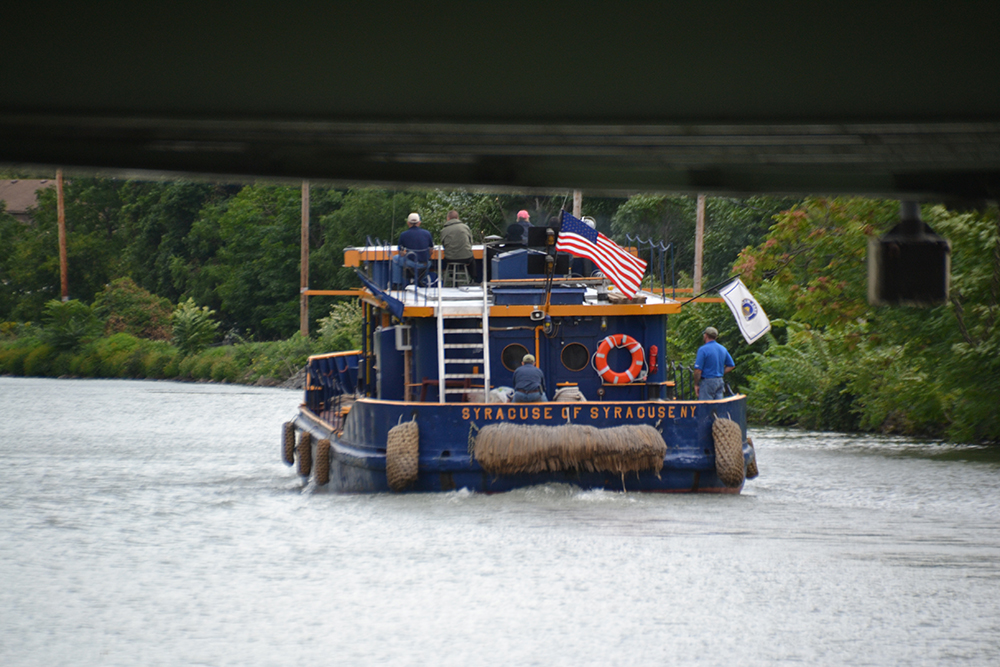
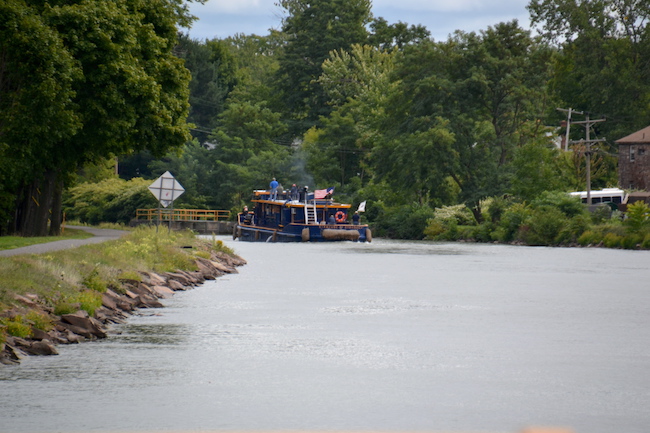
Albion – The tugboat Syracuse carries inspectors and officials from the State Canal Corp. on the Erie Canal in Albion on Sept. 14, 2016. The inspectors are headed east after passing under the Ingersoll Street lift bridge in Albion. They were doing the annual inspection of lift bridges, locks, navigational aids, embankments and some other canal infrastructure.
By Tom Rivers, Editor Posted 14 September 2016 at 2:00 pm
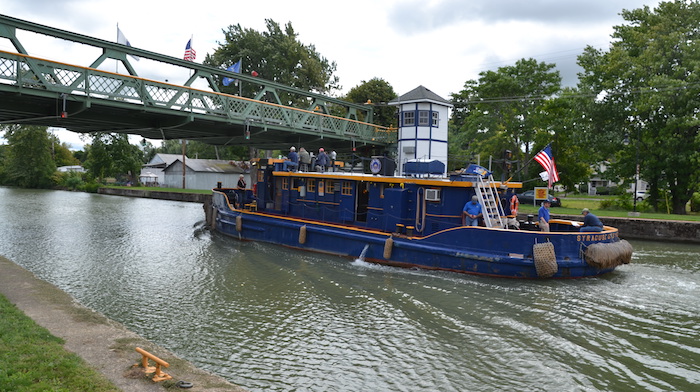
Photo by Tom Rivers: The Tugboat Syracuse carries engineers and Canal Corp. officials, as well as local planning and tourism leaders, during an inspection of the canal system in Orleans County today. The tug is approaching the Ingersoll Street lift bridge.
ALBION – The lift bridges that are part of the Erie Canal may be 100 years old, installed when the canal was widened a century ago, but the spans remain in good working order, state Canal Corp. officials said today.
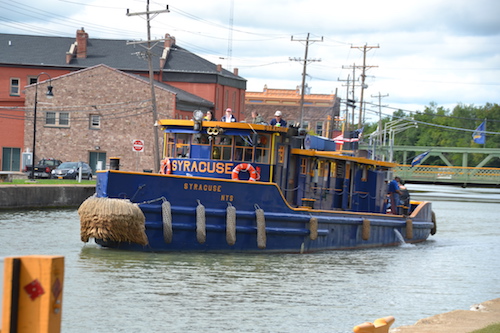
The Tug Syracuse is in Orleans County today for the annual canal inspection. It is pictured in Albion with the Main Street lift bridge in the background.
The Canal Corp. is doing its annual inspection of the system. Today, canal engineers and officials are checking all seven lift bridges in Orleans County, as well as two in Brockport.
Orleans Hub checked with canal officials at about noon, when the crew was in Albion. It still had to check bridges in Hulberton, Holley and Brockport.
The five lift bridges from Medina to Albion all passed the Canal Corp. inspection in flying colors.
“We’re very encouraged,” said John Callaghan, Deputy Director of the NYS Canal Corporation. “There is a lot of attention to detail. It’s really a tribute to the dedicated and talented workforce.”
The canal crew travels by the tugboat, Syracuse, and grades the embankment walls, spillways, navigation aids, locks and lift bridges. The canal officials also make notes of those with dock permits on the canal.
Callaghan said the lift bridges, despite their wear and tear, are still getting the job done. Employees apply grease and do lots of preventive maintenance to keep the hydraulics and mechanical systems in reliable shape.
The canal is approaching its 200th anniversary. It opened in 1825. It was widened from 1905 to 1918 and many of the bridges, guard gates, waste weir systems and other canal infrastructure remain in use today from the “Barge Canal” widening.
Callaghan said the state remains committed to canal’s maintenance and viability. “We have a working museum here,” he said about the canal. “It’s really special.”
The bridges’ deck and other structural elements are the responsibility of the state Department of Transportation. The Canal Corp. oversees the hydraulics, and infrastructure below ground.
The DOT plans to do a major rehab of the Main Street lift bridge in Albion in the near future. A specific timetable hasn’t been identified, Canal Corp. officials said today. The Knowlesville bridge also will be rehabbed by the DOT, although it’s not on the schedule yet.
The Syracuse heads east from Albion to its next stop in Hulberton. Along the way, canal officials will check embankments, spillways and navigational aids.