
















Municipal electric official speaks about price spike last winter for Holley
Severe, prolonged cold spell strained electric system, causing big jump
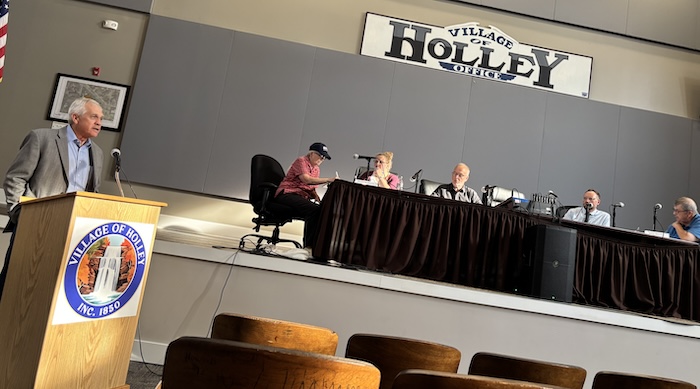
Photos by Tom Rivers: Jim Stokes, executive director of the Municipal Electric Utilities Association, speaks during the Village of Holley board meeting on Tuesday. In back from left include board members Rochelle Moroz, Jessica MacClaren, Mayor Mark Bower, Brenden Bedard and John Morriss.
HOLLEY – Village residents are accustomed to getting a very good deal on their electric bills. But last winter those costs skyrocketed after a prolonged cold spell in late January and part of February.
There were about two weeks total of very cold weather, and the frigid temperatures affected the Northeast, straining the electric system.
The power stayed on, but the price was up exponentially, even for municipal electric systems like Holley, said Jim Stokes, executive director of the Municipal Electric Utilities Association.
He addressed the Holley Village Board and residents during Tuesday’s Village Board meeting. Stokes said the state has taken some big power plants off line in recent years. That has hurt the in-state power generation capacity.
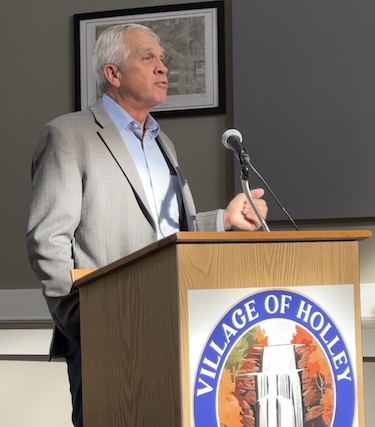
Jim Stokes said the state’s electric-generating capacity remains vulnerable to peak demand times where the power would need to be purchased from other states or Canada.
During times of peak demand, such as a prolonged freeze, the demand soars, and New York State looks to get power from Canada and neighboring states. Those areas also saw increased demand during last winter’s drawn-out severe cold, Stokes said.
Holley typically gets its electricity at a very lower price through a Niagara hydropower allocation. The Municipal Electric Utilities Association hedges that price and secures a low price for the 51 municipal systems. Holley has 1,008 customers on a 2,400-voltage system.
But the if the power demand exceeds the hedged amount of power, the municipal systems have to get more power from the open market at a time of high demand and very high prices.
“The market price went through the roof,” he said.
A kilowatt hour is typically about 29 to 30 cents in New York State. But in a municipal-owned system like Holley the cost is about 3 to 3.5 cents. During last winter’s severe cold, the price on the open market shot to 60 cents to a $1, causing shockingly high electric bills, even in Holley.
Stokes said the state hasn’t added significant electric capacity and is vulnerable again this coming winter if there is a prolonged cold spell.
He suggests insulating houses and taking other actions to reduce use during a peak demand time.
The best way to avoid the price spike is for an easier winter, without a prolonged deep freeze.
“Milder temps is our best hope,” he said.
He also was asked by Mayor Mark Bower if larger industrial users can cause price spikes. Stokes said the larger users help keep the base rates down because they pay a high percentage of those costs. But if the demand soars and the municipal systems needs power from the open market, a larger user can be a detriment.
“Large uses are not necessarily bad users,” he said. “The systems without industrial users struggle because it’s all on the backs of the residents.”
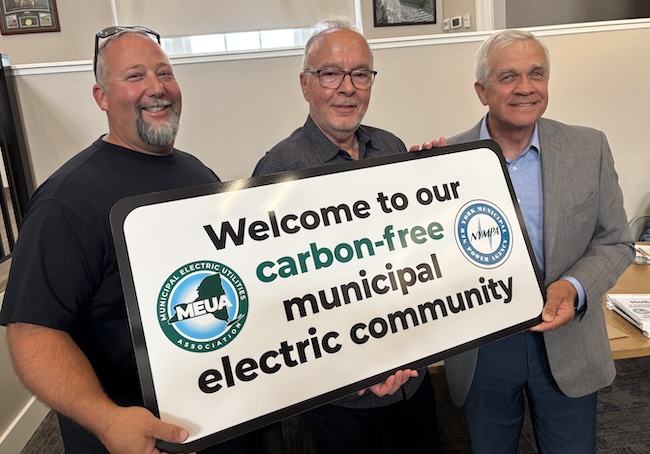
Jim Stokes presented Holley with two signs and plaques that proclaim Holley’s is a carbon-free electric system. The village gets a hydropower allocation from the Niagara Power Project. Pictured with Stokes include Matt Campbell (left), the village’s electric & water superintendent; and Mayor Mark Bower. The signs will likely be displayed with the Holley welcome signs at each end of Route 31 in the village.