















Local wildlife technician wins statewide award for conservation efforts
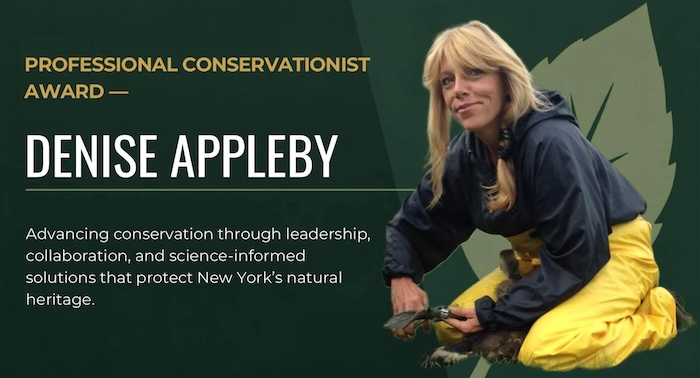
Denise Appleby works as a wildlife technician for the NYS Department of Environmental Conservation out of the the DEC’s sub office at the Iroquois National Wildlife Refuge.
By Douglas H. Domedion
BASOM – Overall it is the New York Department Of Environment (DEC) that manages our wildlife and environment lands and there is a lot of work to that.
Other outfits also get involved and one of the leaders is the New York State Conservation Council (NYSCC) which is our oldest statewide non-profit conservation organization (founded in 1933). It advocates for sound policies and practices to protect, restore and manage forests, wildlife, fish and scenic and recreation areas.
The Conservation Council represents over 300,000 sportsmen and women across the State which includes county federations, rod and gun clubs and affiliated groups. It works to protect the rights of individuals to hunt, fish, trap and own firearms. It is a volunteer-run, non-government organization that receives no state or federal funding. Members meet annually and with legislators and the DEC on environmental issues.
An outfit that is a member of the NYSCC is WNY Delta Waterfowl. They are dedicated to land conservation, habitat restoration and supporting waterfowl and hunters in Western New York. Locally they have put up and maintained many waterfowl nesting structures and even have trash pickup throughout our Alabama Swamp.
Every year the NYSCC awards folks who have done outstanding work towards their goals. This year WNY Delta Waterfowl nominated an individual who is a DEC Wildlife Technical 3 that has done an outstanding job in her duties for many years at the four Wildlife Management Areas (WMA) in our area (Tonawanda, Oak Orchard, John White and Braddock Bay).
So what are the duties and responsibilities of a wildlife technician 3? There is not enough space in this column to list them all but here are a few.
- Duck and goose banding which is a dirty and rough job. Issuing trapping and waterfowl permits.
- Managing the water levels to provide the best conditions for wildlife and marsh maintenance.
- Bird surveys and monitoring which include eagle, osprey, waterfowl, shorebirds, marsh birds, grassland birds, prothonotary warblers etc.
- Fall pheasant stocking (twice a week) throughout the hunting season (another duty requiring a lot of endurance).
- Nuisance wildlife work (mainly deer and goose) which includes issuing permits and onsite visits and advise.
- Then there is the job of keeping track and coordinating removal of them which again be a very difficult job.
- Assist Operations (the part of local DEC that does grassland, dike and access road maintenance) with posting of boundaries and certain restricted areas.
- Maintaining the information on all the kiosks (over 10) in all the WMAs which contain a lot of information for the public.
- Come deer season there is the aging of deer at many butcher shops and the collection of deer parts for disease checking such as CWD and EHD.
- Then there is the periodic assigned regional phone duty and also at the local office phone too. This duty requires a vast amount of knowledge about wildlife and DEC regulations.
- Maintaining historical data of all marsh history and maintenance activities is a big and important job, too.
- Then there is the coordinated use of a couple hunting blinds on the WMAs. This is also the person who has to coordinate volunteers and supervise and train the local Wildlife Technician 2.
- There are often requests for information or appearances at sportsmen shows, fairs, field days and schools, too.
There are many more smaller duties but I’m running out of room! So who got this award for outstanding work in conservation field for performing all these duties? Why our own Wildlife Technician 3 Denise Appleby who works out of the DEC sub office at the INWR headquarters!
I have worked with this gal as a volunteer for 26 years and I can tell you no one deserves this award more than she does. I know how hard those duties can be out in the field and she has done them all in a very professional way and with great knowledge of what she was doing. Her dedication is top of the line.
One her pet projects was the coordination with Operations of the revamping of the Education Center on the Oak Orchard WMA. Another has been the coordination of the spread of a special insect that has helped control the spread of the invasive Purple Loosestrife plant in our WMA’s. Congratulations Denise, you deserve this award for all the professionalism work you have provided us in the Alabama Swamps for all these years! Thank you!
Douglas Domedion is author of the Great Outdoors column.