









local history

OCHA talks will highlight bicentennial of county, Erie Canal

Posted 23 May 2025 at 11:22 am

Series starts May 28 featuring first Norwegian settlement in U.S. at Kendall

Press Release, Orleans County Historical Association
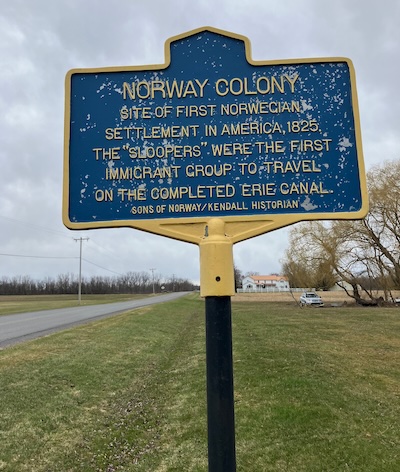
Provided photo: A historical marker at the intersection of Norway Road and Bald Eagle Drive  in Kendall highlights the Norway Colony.

GAINES – The Orleans County Historical Association once again welcomes the community to their monthly history talks.

The talks are held from May through October on the last Wednesday of the month at 7 p.m. in the Gaines Basin Cobblestone Schoolhouse on 3286 Gaines Basin Rd. The talks are free and donations are gladly accepted.

This year’s presentations will spotlight the 200th anniversary of Orleans County and the Erie Canal.  The schedule includes:

  • May 28: “The First Norwegian Settlement in the U.S. – Kendall, NY (1825)” – Dee Robinson, retired Gaines town historian, will share the fascinating history of how the Norwegians came to the United States and made their way to Kendall, settling on Norway Road.
  • June 25: “The Life of Joseph Ellicott, Surveyor of the Wilderness” – You won’t want to miss Dennis Upton, a storyteller and re-enactor as he brings to life the story of Joseph Ellicott who was an agent of the Holland Land Company and helped to survey and sell land in Western New York as well as advocate for the Erie Canal.
  • July 30: “The Haudenosaunee Confederacy” – The Confederacy consists of six Indigenous nations whose traditional lands encompass New York State. Guest speaker Kae Woodruff Wilbert will share their history in New York State and Orleans County.
  • August 27: “Orleans County Fruit Culture as Living History” – Guest speaker Amy Machamer, Owner of Hurd Orchards, will share her experiences and insights about the rich and unique fruit culture of Orleans County.
  • September 24: “The Erie Canal & The Burned Over District; History is not Accidental” – Retired history teacher Doug Miller will share how multiple religious ideas and beliefs, of which some were uniquely formed, developed and spread along the Erie Canal in the early 19th century.
  • October 29: “New York State Historical Markers” – Orleans County Historian Catherine Cooper has updated the 2001 Orleans County historical markers book and will share information on some of the new markers that have been installed in the County during the last 24 years.
Sweet Adelines chorus from half century ago crooned many classics

Posted 12 May 2025 at 12:36 pm

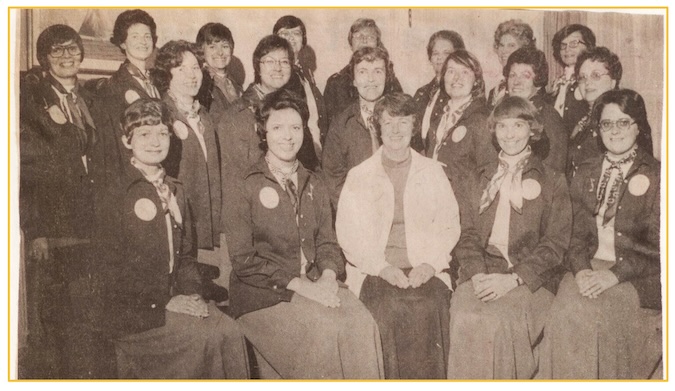
Members of the Ontario Shores Sweet Adelines photographed in November 1976. Front row, from left: Edna Walck, Bonnie Powley, Marcia Housel (musical director), Betty Cole and Penny Powley. Second row: Pat Balcerzak, Joan Arnold, Pat Few, Phyllis McCarthy, Mary Lee Knights, Sylvia Allen and Theda Powley. Third row: Kathy Stahl, Audrey Lamb, Carol Lenhardt, Linda Rau, Janet Walck, Jean Gates and Helen James. Members absent from the photo: Claire Simons, Jan White, Elaine Jamele, Mary Lou Zimmerman, Kathy Hartway, Sue Wingfield and Janine Holbrook.

By Catherine Cooper, Orleans County Historian

“Illuminating Orleans” – Volume 5, No. 18

MIDDLEPORT – Ladies who liked to sing, harmonize and socialize formed a local chapter of the Sweet Adelines in 1972.
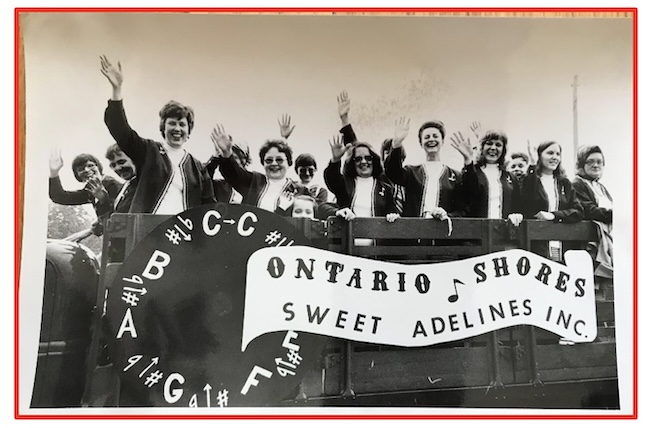

Named for a barbershop song popular in the early 1900s, the Sweet Adelines started in Tulsa, Oklahoma in 1945 with a small group of women who liked to sing. It grew into an international, educational and social organization which promotes the folk-art style of singing four-part harmony, barbershop style.

The local chapter, named the Ontario Shores Sweet Adelines Chorus of Middleport received its international charter in February 1976. It included Niagara and Orleans counties and was part of Region 16 which covered New York State to Kingston, Ontario. Ontario Shores members at that time hailed from Holley, Lyndonville, Medina, Barker, Middleport and Newfane.

Marcia Housel of Lyndonville, a founding charter member, was the group’s music director for 16 years. An ardent proponent of the power of group singing, she believed that it provided “a real lift.” In a November 1974 interview, she explained that the Sweet Adelines repertoire focused on familiar tunes “music you can hum along to,” show tunes, patriotic songs and the “old classics” such as “Down by the Riverside.”

The newly formed Sweet Adelines presented their first annual show on November 6, 1976, at the Roy-Hart School auditorium in Middleport. The theme was “From Bonnets to Bellbottoms” and featured early and contemporary music.

Thus began a busy schedule of shows, competitions and performances at civic events and of course weekly rehearsals. A professional choreographer instructed the group in facial expression, mime acting, characterization and dance.

In 1984, Ann Gemerek of Holley was the director of the Christmas entertainment presented at the Carl I. Bergerson auditorium in Albion.

In 1985, a double quartet from Ontario Shores performed for the 700 members attending the Region 16 annual Music School event held at the Ramada Inn in Niagara Falls. They included: Jan Pritchard and Jean Gates of Medina; Janet Walck, Lyndonville; Joyce Compson and Mary Brocksopp of Holley; Laurie Costello, Brockport, Pat Few and Marie Krockenberger of Lockport.

The group’s activities were chronicled in the Medina Journal Register newspaper through the late 1980s. Carol Oschmann of Kendall was awarded the “Sweet Adeline of the Year” in 1987. Rosanne Mauragis became a new member in 1987 and Bonnie Orgar joined in 1988.

Cindy Parada’s mother, Elaine Jamele, was a member of the Sweet Adelines for many years. Cindy recalls: “Mom loved being a member of the Sweet Adelines! They just had so much fun. She joined with her best friend, Linda Rau. There was a great sense of camaraderie among the members. They sang music that they liked and wore fun costumes. It was theatrical, they enjoyed the thrill of performing but as a group which made it easier. Good times.”

It appears that the chapter discontinued in the early 1990s. We are sure that those ladies who loved to sing, harmonize and socialize kept photos, scrapbooks and other memorabilia of their Sweet Adeline adventures. The Orleans County Dept. of History would like to chronicle this aspect of our musical history, please contact Catherine.Cooper@orleanscountyny.gov. if you have material to donate.

Can any readers help us identify these happy harmonizers?

Albion native started first travel agency; ‘Ask Mr. Foster’ expanded to 75 locations

Posted 4 May 2025 at 9:02 am

With this succinct slogan, Albionite Ward G. Foster launched the first travel agency in Florida in 1888.

By Catherine Cooper, Orleans County Historian

“Illuminating Orleans” – Volume 5, No. 17

ALBION – “WARD G. FOSTER, 80, TRAVEL AGENT, DIES; His Slogan, ‘Ask Mr. Foster,’ Known to Tourists in All Parts of the World THE FIRM HAS 75 OFFICES A Woman in Charge of Each, After Long Training at Headquarters Here” – New York Times headline, March 18, 1940
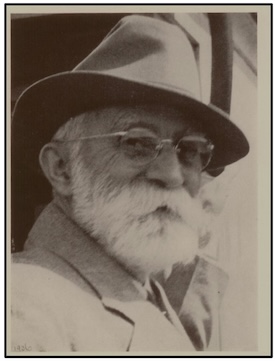
This New York Times obituary headline from March 18, 1940, summarizes the career of Ward Grenelle Foster who died on March 17, 1940. Born in Albion on May 6, 1860, he was the son of Carlton T. Foster and Charlotte Corday Foster.

According to the 1879 Orleans County Directory, Ward’s father was a “hatter & furrier” with a store at the corner of North Main and West Bank streets. The family home was listed as 36 West State St.

Ward G. Foster established the first travel agency.

Ward attended the Albion Academy. He married Harriet Brainerd in 1884, and the couple moved to St. Augustine, Florida, which was then just beginning to realize its potential for tourism. Foster was employed as a timekeeper on the construction of Henry Flagler’s luxury resort in St. Augustine, the Ponce de Leon Hotel.

In 1888, the Fosters opened a gift, book and stationery shop across the street from the hotel. Foster had earned a reputation for being knowledgeable about the area’s activities and amenities as well as about transportation lines and timetables. Guests at the hotel were directed to his store with the instructions “Ask Mr. Foster” who graciously answered their queries.

Recognizing the potential of this market, Foster took over the advertising of a popular local publication “The Standard Guide to St. Augustine.” He added the statement: “Ask Mr. Foster for Further Advice” on every page and soon he was busy dispensing travel information and had unwittingly started the first travel agency.

Tourism in Florida expanded rapidly. Ward opened “Ask Mr. Foster” travel offices in Jacksonville and Palm Beach. In 1902, he opened an office in Washington D.C. By 1937 the “Ask Mr. Foster” travel service operated 70 Information Offices in 52 cities throughout the U.S. and Canada.

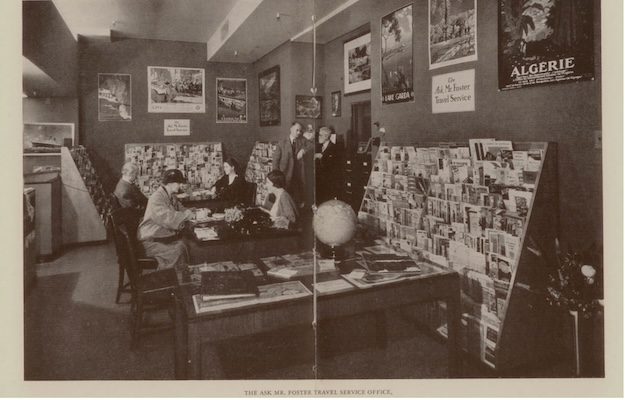
As the New York Times headline indicated, a unique feature of the Ask Mr. Foster offices was that they were managed by women. Foster recognized that gracious service, empathy and a sincere spirit of helpfulness in dealing with customers were key components for the success of his enterprise and he believed that women were more likely to possess those characteristics. The goodwill generated by such a service, he felt, would guarantee return visits and word-of-mouth promotion.

Naturally, this business model was successful. In 1936 over 400,000 customers received information, planned trips and tours, purchased tickets, and made hotel and transportation reservations, all free of charge.

The “Ask Mr. Foster” Travel Service Office is shown at the R.C.A. Building, Rockefeller Center, New York.

Foster sold the business in 1938 to a group which incorporated as the “Ask Mr. Foster Travel Service.” Though the business struggled during the war years, it rallied and in 1957, two of the stockholders bought the company for $157,000.

In 1972, Peter Ueberroth purchased the business for $1 million.

A complex series of corporate purchases ensued. Carlson Companies, Inc., acquired the business in 1979. In 1990, the name “Ask Mr. Foster” was retired and integrated into the Carlson Travel Network. This eventually became part of the Travel Leader’s Group corporation which evolved into the Internova Travel Group in 2020.

Internova, now one of the travel industry’s largest travel service companies, focuses exclusively on leisure, luxury and corporate clients. To this day, the company proudly traces its roots and ethos of service back to Ask Mr. Foster Travel.

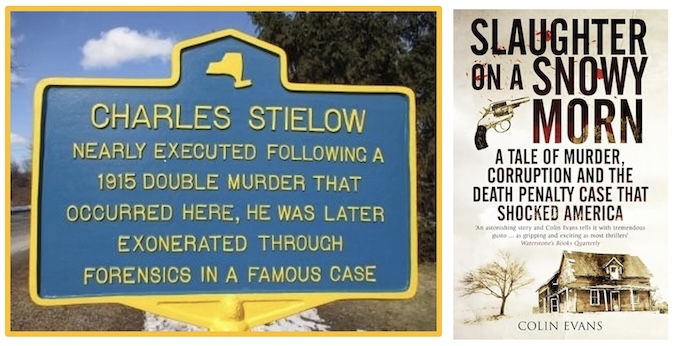
Historic marker notes famous case of Charles Stielow, falsely accused of murder in Shelby

A historic marker highlights Charles Stielow, who was on death row after being falsely accused of murder. A book, “Slaughter on a Snowy Morn,” was published on 2010, detailing the case.

Posted 27 April 2025 at 8:34 am

By Catherine Cooper, Orleans County Historian

“Illuminating Orleans” – Volume 5, No. 16

SHELBY – April 24-27 has been designated as National Historic Sign weekend. The Historic Marker Database site lists 143 signs in Orleans County. This sign is located on Salt Works Road in West Shelby. It was erected in 2014 through the efforts of Nicholas Culver.
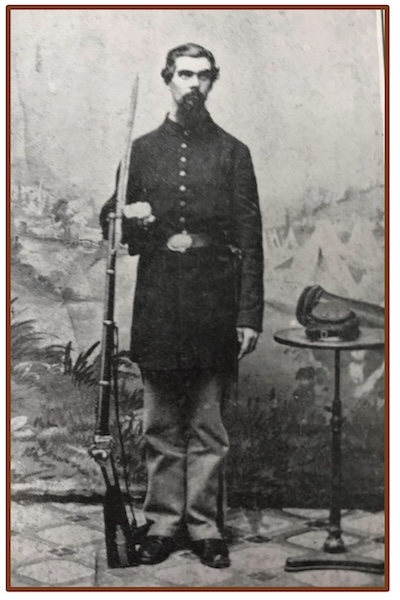
An innocent man was found guilty of murder and was sentenced to death by electrocution. He bade a tearful farewell to his family and was escorted to Death Row. He narrowly avoided execution several times and was exonerated after three long years.

 The plot of a TV drama? Regrettably not, but an all too real nightmare endured by a Shelby family.

The reference, of course, is to the Charles F. Stielow case. He was convicted in Albion in 1915 of the murders of George Phelps and Margaret Woolcott in Shelby. An overwhelming combination of circumstances conspired against Stielow – prejudice against immigrants, unscrupulous investigators, a  “confession” obtained by coercion and threats, a charlatan “expert” witness.

A thorough account of this dramatic case may be found in the book “Slaughter on a Snowy Morn” written by Colin Evans and published in 2010. It is a book that never fails to elicit a passionate response from readers: the nightmarish sequence of events described, the familiarity of the setting, and the blatant corruption all contribute to its power.

Concluding a year of exploring aspects of Orleans County history in honor of the county’s Bicentennial, members of the Medina Tuesday Club met recently to discuss this book. One overlooked aspect – the actual cost of the trial – was referenced and seemed worthy of exploration.

In New York State, criminal prosecutions are county expenses, a fact that we rarely consider or just take for granted. In 1915, Orleans County was governed by a Board of Supervisors. A record of the Board’s meetings and decisions was published annually under the title “Proceedings of the Board of Supervisors.” A  primary source, these volumes form a core part of the Orleans County Dept. of History collection. The following material was sourced from the Proceedings for 1915, 1916 and 1917.

On Jan. 8, 1916, a committee appointed to tabulate the items of expense of the trial reported that the county had expended $12,649.97 at that point. The details of the expenses were listed:

  • Automobile Hire: $131
  • Barber: $11
  • Board & Meals: $606.21
  • Crier & Attendance Officers: $316.60
  • Coroner: $93.05
  • Coroner’s Physician: $64
  • Death Watch: $18
  • Detectives: $3,815.88
  • Defendant’s Witnesses: $44.30
  • Defendant’s Counsel: $1,379.19
  • Expert Witnesses: $1,189.26
  • Grand Jury: $438.70
  • Grand Jury Witness: $438.70
  • People’s Witnesses: $44.30
  • Sheriff’s Expenses: $250
  • Stenographer etc.: $1,763.40
  • Trial jurors: $1,746.20
  • Witness Allowance: $128

(Most likely, the Barber and Death Watch expenses occurred at Sing Sing on July 28, 1916, when Stielow came within hours of death. His head and legs were shaved in preparation for the attachment of electrodes. A Death Watch was maintained during what was expected to be his last night.)

On May 8, 1917, the Board of Supervisors approved $5,465.87 in payments to lawyers who acted as Counsel to the DA in the Stielow case: Thomas A. Kirby: $1,450, Frederic M. Thompson: $1,450, Harold A. Blake: $2,425 plus expenses of $140.87.

Additional expenses for $2,395.62 were submitted on January 18, 1917. Among these expenses were:

  • George W. Newton, detective services: $648.09
  • Byrne National Detective Bureau: $126.32
  • Expert testimony and expenses: $582.04
  • Automobile hire: $358.87
  • Stenographer and typing: $264.84
  • Photographer for DA, Patrick A. Grimes: $5.35

These expenses alone total $20,511.46 ($560,600 approx. in today’s cost). Additionally, on Jan.31, 1917, Gov. Whitman allocated a special appropriation of $25,000 for a reinvestigation of the case. Meanwhile, Stielow’s family, deprived of their breadwinner, were impoverished.

Charles F. Stielow was released, a free man, on May 9,1918. He received no compensation for his ordeal, nor did he seek it, he was just happy that it was over. He died at the age of 63 on Aug. 9, 1942 at his home on Church Street, Medina, having had some years to enjoy his favorite pastime – sitting on his front porch and smoking his pipe. He and his wife, Laura, are buried at the Pioneer Cemetery in Akron, NY.

Soldier from Orleans County was at Ford’s Theater when Lincoln was shot

Posted 20 April 2025 at 12:37 pm

By Catherine Cooper, Orleans County Historian

“Illuminating Orleans” – Volume 5, No. 15

Corporal John H. Stevens of Knowlesville, a member of the 151st Regiment, had the distinction of several interactions with President Lincoln.

While we were busy celebrating the Bicentennial of Orleans County on April 15, we overlooked April 14, 1865, the assassination of Abraham Lincoln, 160 years eariler. Remarkably, one young man from Orleans County was among the audience of approximately 1,700 in attendance that night at Ford’s Theater in Washington, D.C.

John H. Stevens was born in Knowlesville on Sept. 23, 1839, the son of Andrew Stevens and Sophronia Harding. Andrew Stevens had moved to the area in 1816 and was one of the earliest settlers in what was then a wilderness. A farmer, he benefitted greatly from the opening of the Erie Canal.

In the summer of 1862, additional recruits were needed for the Union cause. Captain Hezekiah Bowen of Medina received authority to recruit a company of riflemen. John Stevens was one of the one hundred who quickly enlisted, mostly sons of well-to-do farmers. They were nicknamed the “Top Buggy Company,” since many of them could afford to take their young ladies out in top-buggies, then considered an item of luxury.

They bought their own guns, Sharp’s Rifles, each paying over forty dollars apiece for them. The ladies of Ridgeway presented them with a silk flag embroidered “Bowen’s Ind. Rifles.”

Stevens was mustered in as a Corporal of Company A, 151st N.Y. Volunteer Infantry on October 22, 1862. He was wounded at the Battle of Mine Run, Va.  on November 27, 1863, receiving a bullet wound to his right thigh. Following his recovery, he was placed on duty at the Medical Purveyor’s store in Baltimore on March 4, 1864.

In June of that year, Stevens received a ticket to attend the Republican National Convention from Senator E.D. Morgan of New York. Stevens was present when Lincoln was nominated for the second time.

Stevens voted for Lincoln twice, on Nov. 6, 1860, and Nov. 8, 1864.

He was transferred to work at the Medical Bureau of the Provost Marshal General’s Office in September 1864. He attended church on Thanksgiving Day, 1864, sat in Senator Morgan’s pew and at the end of the service, walked down the aisle alongside President Lincon.

On January 1, 1865, Stevens attended the Annual Meeting of the Christian Commission, listened to a speech given by Lincoln and afterwards, shook his hand.

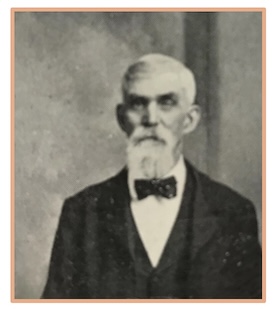
John H. Stevens in later years

On Good Friday, April 14, 1865, Stevens was seated in the front center seat of the dress circle at Ford’s Theater. He saw Booth leap from the box after he shot the President. Stevens was unable to see Lincoln’s remains lying-in-state because of the crowds, but he did witness the funeral procession.

Stevens was discharged on May 11, 1865. He returned to Knowlesville, and married Alice Andrews in 1866. They had two children, George and Avery. Alice died in 1875. Avery died in 1881, aged 11. Stevens married Mary D. Clapp in 1876, they had two daughters, Florence and Mary.

Stevens was an active member of the G.A.R. and a member of the S.J. Hood Post 91 for many years. He attended reunions of the 151st Regiment and liked to recount his encounters with Lincoln.

Stevens died on February 15, 1919, at the age of 80, in the home in which he had been born, having fulfilled his wish of living to mark the centenary of that home which had been built by his father in 1816. He is buried in Tanner Cemetery in the Town of Ridgeway, NY.

Bell at Courthouse will be rung at noon on Tuesday for County Bicentennial

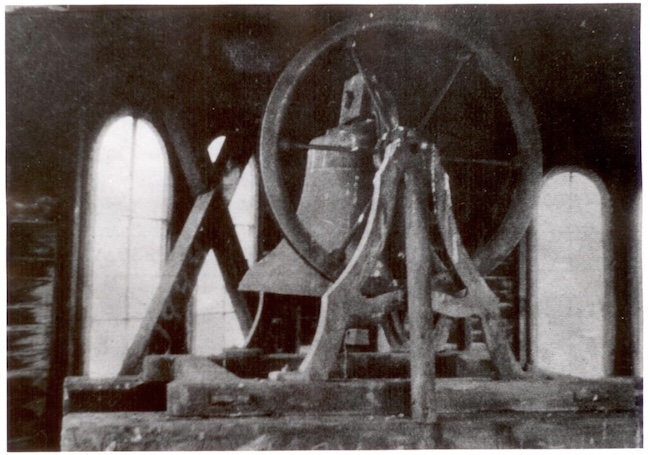
Photo from Orleans County Department of History: The bell in the County Courthouse was installed in 1860.

Posted 13 April 2025 at 1:35 pm

By Catherine Cooper, Orleans County Historian

“Illuminating Orleans” – Volume 5, No. 14

ALBION – Listen for the peal of the Courthouse Bell in Albion at noon on Tuesday April 15, 2025!
The bell will ring for one minute on that date, in celebration of the Orleans County Bicentennial. Churches throughout the county are encouraged to ring their bells also.

Albion’s Courthouse bell was installed in the dome in 1860, two years after the construction of the building. The cost of hanging it was $24.06. At one time it was used regularly to indicate when the Court was called to session.

It was rung on Armistice Day, November 11, 1918, by some boys who had gained access to the belfry, on January 19, 1959, to celebrate the Courthouse Centennial and again in 1976 for the country’s Bicentennial celebration.

According to a File Feature reference in the Journal-Register newspaper, the bell was next rung on August 20, 1985, by David Stevenson, an employee of the County’s Buildings and Grounds Dept. who had joked that he would ring the bell if his first grandchild was born on his birthday.

The ringing of the bell at noon on Tuesday, April 15 will mark the beginning of the Bicentennial event to mark the 200th anniversary of the formation of Orleans County on April 15, 1825.

The event will take place in the Courthouse, a fitting location, long recognized as “a central focus for the citizens of Orleans County,” to quote Irene Gibson, author of Historic Sites in Orleans County, New York. Hon. Sanford A. Church will launch the event which will feature Proclamations and remarks by legislators and historians, followed by cake, of course.

Seating is still available. Descendants of the early settlers are encouraged to attend. The event may be viewed remotely on the Orleans County Tourism Facebook page (click here).

Descendants of Orleans County pioneers urged to attend Bicentennial celebration on April 15

Posted 30 March 2025 at 8:25 pm

By Catherine Cooper, Orleans County Historian 

“Illuminating Orleans” – Volume 5, No. 13

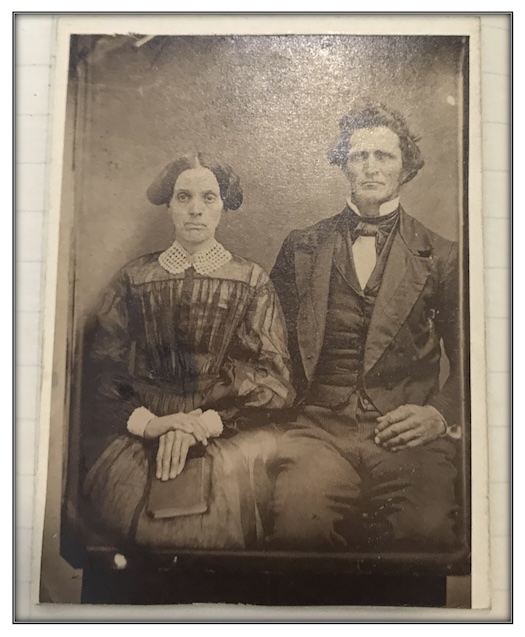
ALBION – The original handwritten volumes of the Pioneer Association records include several photographs. Shown in the top photo are Martin Evarts (1817-1873) and his wife, Charlotte Burnham Evarts who died in 1862. Martin was a farmer in Clarendon and Town Supervisor in 1863.

Members of the D.A.R. and the S.A.R. proudly trace their lineage back to an ancestor who “aided in achieving American independence.” So too, descendants of the early settlers of Orleans County trace their genealogy back to those hardy pioneers and can now chronicle up to nine generations of continuous residence in the county.

The Orleans County Bicentennial Committee invites these descendants to attend the Bicentennial Celebration of the formation of the county which will take place at the Courthouse in Albion on April 15, beginning at 11:45 a.m. So that we may ensure seating for all, please complete the brief registration form at https://www.orleanscountytourism.com/bicentennial.

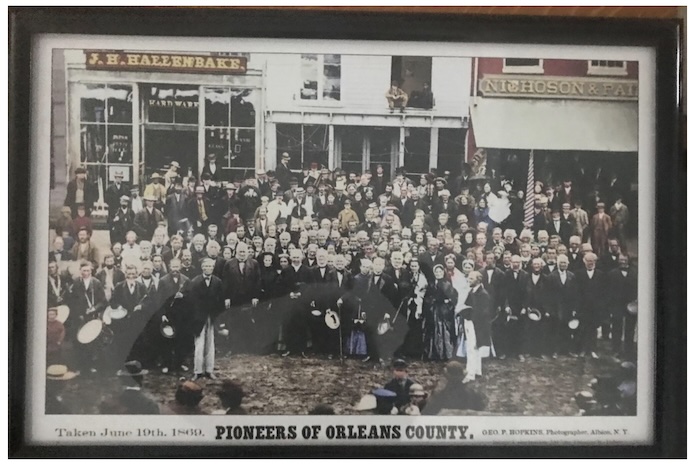
Members of the Pioneer Association of Orleans County photographed in Albion on June 19, 1869.

On June 19, 1869, those in attendance at the Eleventh Annual Meeting of the Pioneer Association of Orleans County, held at the Courthouse in Albion, assembled for a group photo. The Bicentennial Committee plans to echo this now iconic photograph by taking a group photograph of those in attendance immediately following the event.

We are interested in learning about your connections to those early settlers – please email Catherine.Cooper@orleanscountyny.gov.

In 1979, community created keepsake of favorite recipes

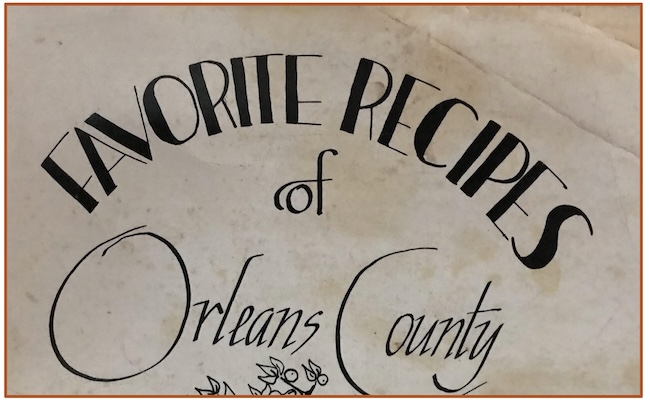
A treasury of recipes was compiled by the Orleans County Historical Association in 1979.

Posted 23 March 2025 at 3:02 pm

By Catherine Cooper, Orleans County Historian 

“Illuminating Orleans” – Volume 5, No. 12

ALBION – “Tucked among the keepsakes that reflect the earlier years of this unique county are the recipes found in this treasury. Some are copied, some created, some from yesteryear and some from today. All with a special touch from a special person – the one who so generously shared their favorite recipe.”
“Favorite Recipes of Orleans County” is a spiral bound community cookbook produced in 1979 by the Orleans County Historical Association. It was printed in Albion by the Eddy Printing Company. Mary Shuler and Millie Scofield were co-chairwomen.

A hefty tome, with over 300 pages, it is double the size of a regular community cookbook. It includes the staple community cookbook recipes one would expect but also includes heirloom recipes from grandmothers and great-grandmothers, thus linking back to the early years of the county.

Mrs. Charles Defendorf (Rose Hart) submitted a recipe for Salt Raising Bread which was passed down from her great grandmother, Matilda West, 1826-1899. It begins:

“Start bread at night. Scald 2tbsp. of cornmeal and ½ tsp each of salt, sugar, and soda in 1 cup sweet milk. Cover and set in warm place overnight…..”

A recipe for Gingerbread submitted by Doris Bannister is traced back to a descendant of John Proctor, “the Paul Revere of the Ridge” who, in 1813, alerted the residents along Ridge Rd. that “the British were coming.”

A recipe for Corn Bread which includes yeast, mashed potato and cornmeal is traced back to the Matthew Dunham family, the earliest settlers in the Lakeside area of the Town of Carlton.

A recipe for Homemade Ale copied from the Journals of Samuel Brent, Canterbury, England, dates to 1829. It was submitted by his great-granddaughter, Betty Hurd.

Not surprisingly, there are many variations of apple recipes: Apple Grunt, Apple John, Apple Roll, Elegant Apple Pie, French Apple Pie, Apple Cake, Apple Chip Cake, Applesauce Cake, Apple Pie Cake, Apple Pudding Cake, Glazed German Apple Bread, Apple Stuffed Pork Chops, and Squirrel in Apple Bake.

Several recipes reflect the strong English heritage of the county’s population: Grandma’s English Trifle, English mincemeat and 19th Century Whig Rolls.

So many recipes with intriguing names: Taylor Duff, Tell Your Neighbor Cake, Seafoam Salad, Pickled Seckel Pears and The Old Stand By, to mention but a few.

Interspersed with the recipes are nuggets of local history such as: how Troutburg got its name, the Orleans Meat Processing Company in Albion, canning in Holley, the cheese factories. A section on Remedies includes instructions on how to make soap using potash, lard, and rosin, how to remove wrinkles, make a liniment or a mustard plaster.

“Favorite Recipes of Orleans County” is a heartfelt homage to the families who have lived in Orleans County and to the cooks who sustained them. If you don’t own a copy, keep an eye out at yard sales and book sales. If you are lucky, you may even find an edited version, with the former owner’s comments critiquing the recipes!

Presbyterian Church had 2 different buildings in Knowlesville with first built in 1832

Posted 16 March 2025 at 4:37 pm

First building was demolished in 1893, and second fell into disrepair and was razed in 1969

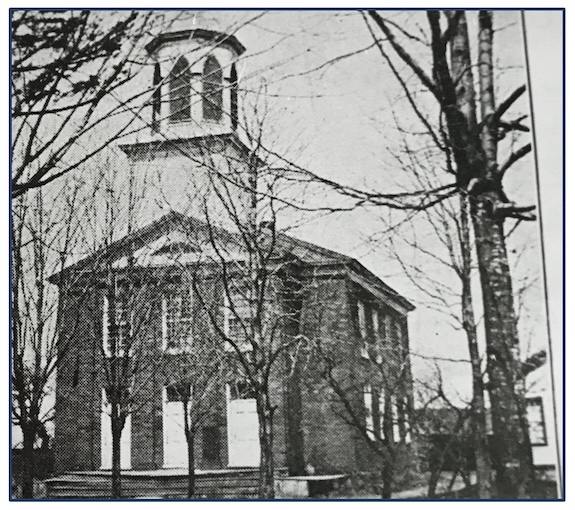
The first Presbyterian Church in Knowlesville was constructed in 1832, and then demolished in 1893 when a new building was erected.

By Catherine Cooper, Orleans County Historian 

“Illuminating Orleans” – Volume 5, No. 11


“Like all things earthly, passing away,

“The old brick church may no longer stay,

“Though dear to our hearts as our childhood home,

“Within its walls we may no longer come.

“Now lingering near the old church ground,

“We hear the busy workmen’s sound

“And see the fragments here and there

“Of what was once our house of prayer”


These lines, composed by Mrs. I.O. Root in 1893 concerning the demolition of the first Presbyterian Church building in Knowlesville, still resonate. They capture that acute feeling of loss that is felt when a church closes and remind us that nothing is permanent.

The early settlers in this area, having first built their homes, soon turned their attention to providing a place of worship. On August 27, 1817, the following eleven people convened at the Oak Orchard schoolhouse and formed the First Religious Society of the Town of Ridgeway: Orange Wells, Leonard Dresser, Daniel Gates, Elizabeth Whipple, Mary Ann Taylor, Lois Robbins and Sarah Lawrence, Dr. William White, Archy B. Lawrence, Martha Marsh and Anna Sheldon.

At that time the township comprised the present townships of Ridgeway, Barre, Shelby, Yates, Carlton and Gaines, all but four of the present towns which had not yet been named.

At first, the Society affiliated with the Congregationalists, but in 1820 resolved unanimously to unite with the Presbytery of Rochester. For the first fifteen years, meetings were held in homes, schoolhouses and barns.

The Holland Land Company provided a tract of one hundred acres to the first organized religious society in a township. The new trustees secured this “Gospel lot.”

With the completion of the Erie Canal, a settlement grew in the area later named Knowlesville. In 1831, the Society voted to accept a piece of land from John Aldrich and to purchase as much as was necessary for the site of a church building from John Vedder at the rate of $50 per half-acre.

A Federal style brick building was erected at a cost of $3,500. William Knowles provided half of the cost. The building was dedicated in 1832 and remodeled in 1861. It was demolished in 1893. A second brick church was built on the same site at a cost of $12,000. The Gospel Lot was sold at that time, and the proceeds were used for construction costs.

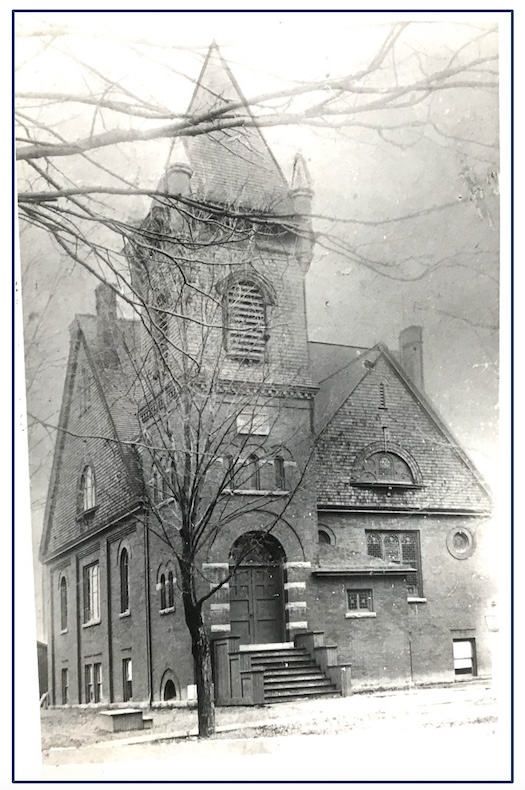
The second Knowlesville Presbyterian Church building, constructed in 1893, was demolished in 1969.

The “New Brick Church,” Victorian Romanesque in style, was dedicated in 1894. It flourished for many years, but closed in 1964, due to declining attendance. The parish was dissolved, and the physical assets were turned over to the Rochester Presbytery. The church building was demolished in 1969 as it had fallen into disrepair.

Today, a vacant lot remains on the north side of the street where the church was once located but its presence is still remembered by the street name: Presbyterian Street.

Photo from 1890s shows a much different Kuckville hamlet

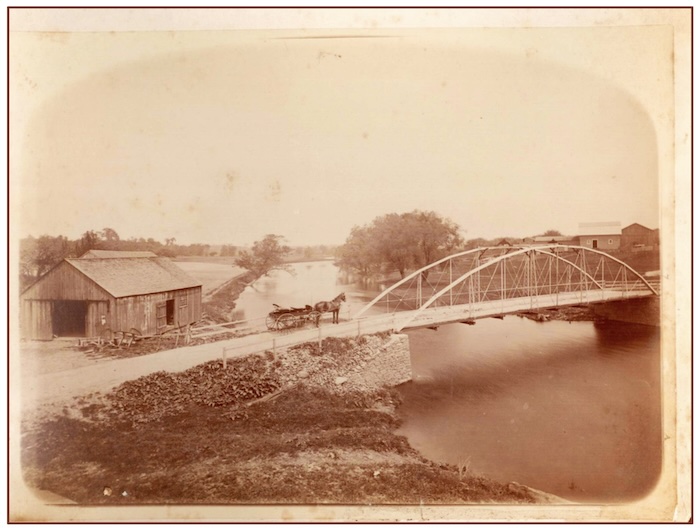
This photograph from the Orleans County Department of History collection is labeled “Kuckville in the early ninty’s (sic). Looking east.”

Posted 9 March 2025 at 5:48 pm

By Catherine Cooper, Orleans County Historian

“Illuminating Orleans” – Volume 5, No. 10

KUCKVILLE – A visual puzzle!

The scene shown in this photograph from the late 1890’s does not resemble the Kuckville you are familiar with as you breeze through on Route 18, unaware that you are even crossing a creek, and, unless you are driving north on Lakeside Road, perhaps even unaware of the hamlet.

The barn and bridge shown in the photograph no longer exist, and the area is wooded now, but the bridge abutments are still visible. Writing in 1981, Betsy Hoffman, a former Town of Carlton Historian, explained the changes:

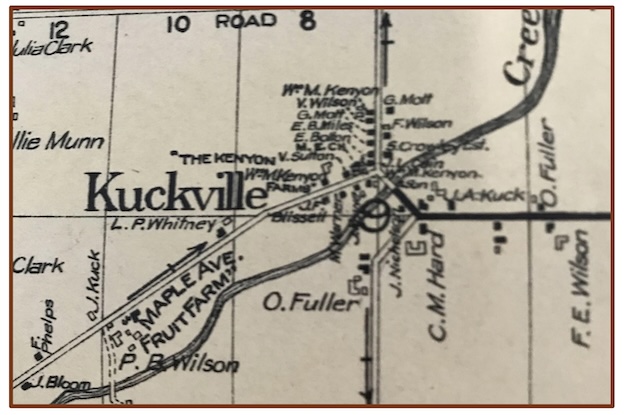
“Prior to 1933, the road now known as Church Street came into the hamlet of Kuckville from the west, continued on to the east across the old bridge with the Kuck estate on the left and Joe Nicholson’s house on the right sitting on what is now the middle of what now is Route 18. The house was moved from that position to where Townsends store is now. The store as we know it in 1981 is part of the old Joe Nicholson house”

Detail of Kuckville from the 1913 Atlas of Niagara and Monroe counties which shows the original road configuration.

The Medina Daily Journal of March 27, 1930 noted that “Work has begun on the bridge at Kuckville.” The new road bypassed the hamlet. Identified on maps as the Roosevelt Highway and the Great Lakes Seaway trail, the road is locally referred to as “Route 18.” The “old” bridge across Johnson Creek was dismantled in the 1940s.

Hoffman’s notes continue with details on “who lived where” that delight residents and their descendants, fodder for after-dinner discussions and ramblings:

“Prior to 1933, Kuckville remained much the same as it did in years previous with John Cann’ s store setting next to the church on the northwest corner of the road. To the south of Cann’s  store set the coopershop…To the west was a large building that stored the barrels, and west of that was Howard Miller’s garage which set next to his house which is now owned by Jack Szyikowski”

Local history at its finest. Should any readers be interested in these specific accounts, please contact me at Catherine.cooper@orleanscountyny.gov.