By Matthew Ballard, Orleans County Historian Posted 5 January 2019 at 8:58 am
“Overlooked Orleans” – Vol. 5, No. 1
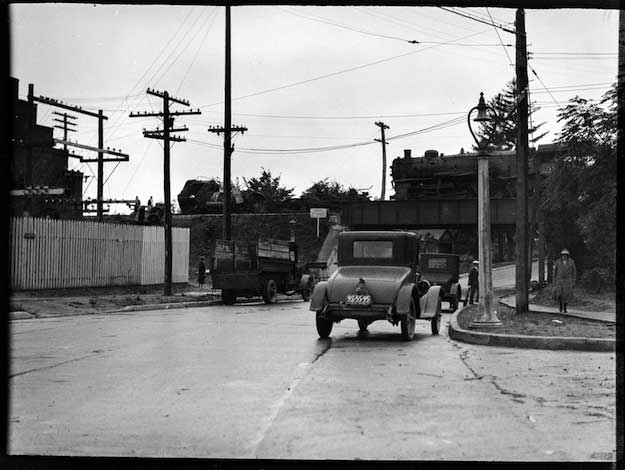
HOLLEY – This photograph, taken September 25, 1926, shows the aftermath of a locomotive collision at Holley. Looking south on South Main Street, the Holley Electric building is pictured on the left. A few individuals are in the vicinity, including a young girl standing between the tall white fence and truck along the left side of the road. Upon closer inspection, a bicycle is lying on the curb near the railroad overpass, possibly left there by the girl.
At 3:33 p.m. on September 24, 1926, an express train, Engine 3373, pulling 28 cars and two coaches departed the Fancher station on the New York Central Railroad. Meanwhile, Engine 485 operating at a local quarry just east of Holley was pulling two cars along a segment of track. According to reports following the accident, Engine 485 was switching cars near the Holley station located immediately west of the railroad overpass as the express train approached.
Travelling westbound against current traffic, the engineer in charge of Engine 485 observed the approaching express train, warned his fireman of the impending danger, and both quickly jumped to safety. A similar scenario unfolded aboard Engine 3373 and the two locomotives collided travelling at approximately 20-25 mph. While the engineer of Engine 3373 was able to safely jump from the express train, his fireman Frank Maloney was not as fortunate.
Both trains derailed, mangling the tracks and piling up cars behind them. Engine 3373 rolled onto its left side, striking the railroad station on the north side of the tracks while Engine 485 rolled in the opposite direction, striking the freight house. A large portion of the station was damaged and freight house knocked from its foundation. Maloney, who was unable to jump from the engine, was pinned under the wreckage and severely scalded; he died shortly after the collision.
This photograph shows the scene the following morning when a wrecking crew arrived on scene to clean up the debris. By the time this image was taken, Engine 3373 was turned upright, but the mangle pieces of Engine 485 are visible to the east of the overpass. A local brakeman was found at fault for failing to warn the oncoming express train.
By Matthew Ballard, Orleans County Historian Posted 29 December 2018 at 8:40 am
“Overlooked Orleans” – Vol. 4, No. 51
ALBION – This photograph, taken September 7, 1925, shows the Western New York Province 8 Klonverse held at the Orleans County Fairgrounds on the western end of the Village of Albion. The term klonverse is likely foreign to most readers, as it should be, since the term was used to describe a convention of the Knights of the Ku Klux Klan.
Pulled from a collection of negatives within the Department of History, the photograph shows a number of robed men intermingled with common folk at the conclusion of a parade through Albion. Papers throughout Western New York published news of the impending gathering, the Buffalo Evening News noting that this particular meeting was the first of its kind in Orleans County.
Chester Harding, president of the Orleans County Agricultural Society, rented the fairgrounds to the Klan for $100 “…and considerable criticism [was] heard of the action,” and Hiram Wesley Evans, Imperial Wizard of the Knights of the Ku Klux Klan from Atlanta, Georgia, was scheduled to headline the festivities. Local members of the Klan applied for the parade permit and village officials barred any Klansmen from marching with their faces covered; state police and local officers were present to keep the peace.
The parade of approximately 900 members commenced at 5 o’clock in the afternoon and a modest crowd of 500 gathered to watch the procession. Three bands and two floats escorted Klan members, all adorned in their white robes, as they processed through the streets. Residents who lined the streets to observe the spectacle did so out of curiosity, either never seeing a Klan parade before or hoping to catch a glimpse of the unmasked participants. As the parade reached the fairgrounds, only members and those with cards given to them by members were permitted to enter the event; a $.25 entry fee was charged. National and state organization leaders spoke to members in the evening, preceded by the burning of a massive cross and induction of new members into the Klan.
Aside from the shocking nature of such a meeting, a Buffalo resident by the name of Julius Grass stirred up extra commotion at the conclusion of the parade. Losing control of his automobile, Grass struck Nelson Spears of Middleport and 68-year-old Melvin Waterbury of Lyndonville. Perhaps more interesting than the accident itself was the mention in the paper that both victims were Klansmen, the only mention of any local member of the organization by name. Waterbury suffered a concussion and Spears a broken leg.
Bill Lattin wrote an article about this same event in Bethinking of Old Orleans (v. 14, no. 35, 1992) and concluded his story by writing, “very little is known of the organization locally.” Such statement appears to be true, but a relatively limited history of the Ku Klux Klan is discernable from local papers despite the secret nature of the organization.
On May 15, 1924, the Medina Tribune noted the intent of men in Lyndonville to organize a Klan in that area (the word Klan was used to describe a local “chapter”). Nearly three months later, a large KKK float participated in a festival parade in Lyndonville organized by local Masons. Members mounted the float with placards on which the objectives of the organization were printed. The Medina Daily Journal noted that “this [was] the first public appearance of the Klan in connection with a community celebration in this section of the state.”
Early Klan activity was limited to residents traveling to Genesee County, where they participated with activities in those areas. Evidence does suggest that the Klan was active enough in certain townships to support political candidates. Several months after the Klonverse, local papers printed the results of local elections in which Ross Hollenbeck defeated Fred H. Rhodey for Sheriff of Orleans County. The Buffalo Evening News ran this story with the headline, “Klan Candidate for Sheriff Assured of Election by 3200 Votes.” Klansmen in several towns offered their support to Hollenbeck in the months leading up to the election, suggesting that this particular gathering in September may have increased local activity.
Many will be surprised to read that the Ku Klux Klan was active in Orleans County, although the exact extent of that activity is unknown. Focused on upholding Prohibition and fighting moral wrongs, a series of events impacting the Klan in other states contributed to a sharp decline in membership and thus local activity would die out by the 1930s.
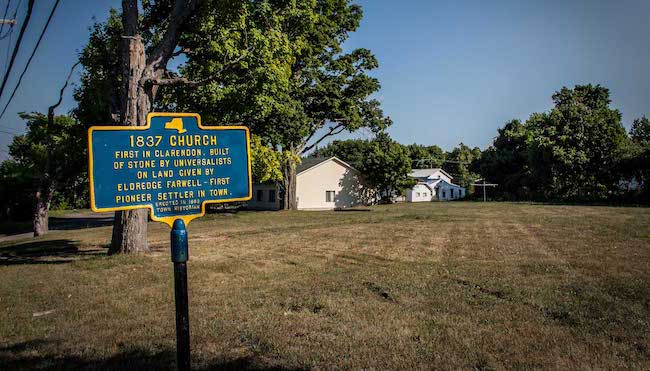
Photo by Matthew Ballard: A historic marker in Clarendon stands on the property where there used to be a Universalist Church.
By Matthew Ballard, Orleans County Historian Posted 22 December 2018 at 9:26 am
“Overlooked Orleans” – Vol. 4, No. 50
The Christmas season is upon us and it is customary to write a piece about Charlie Howard, his Santa Claus School, or Christmas Park. If I had the privilege of sitting on Howard’s lap, what would I ask for? Simple answer: historic preservation.
Unfortunately, our history is marred by poor decisions even though we make some of those decisions with the best intentions. The protection of our historic treasurers is perhaps the best representation of this. Material culture serves a valuable purpose in the process of interpreting the past. Void of any physical representation of past cultures, we would lose all ability to understand the lives of those who lived without a voice.
Historic preservation is one of the four basic functions of the municipal historian; preservation of documents, records, diaries, ephemera, and photographs, but also the preservation of structures deemed important to the history of our communities. Past historians have carried the burden of this cross for decades, some experiencing success and others failure.
Take for instance the once beautiful limestone Universalist Church in Clarendon. A focal point in the community for over 150 years, its life cut short after a painful battle against the ages. In 1967, the family of Earle Smith attempted to prevent the destruction of the building by petitioning the New York State Convention of Universalists to deed the property over to a newly formed private corporation. At some point, the Clarendon assessor realized the property was taxable and placed it back on the rolls.
The result of such undue burden forced the corporation to offer the property to the Orleans County Historical Association and Town of Clarendon with both entities refusing. The property was sold at auction on August 21, 1980, slowly creeping into an irreversible state of disrepair. Community officials met in 2005 to discuss the future of the structure. Some residents felt that taxpayer dollars should not support such a project and one taxpayer remarked, “a farmer never feeds a dead horse, and this building is a dead horse.” The property was sold May 6, 2006 and demolished soon after leading one historian to write, “the people of Orleans County absolutely had an architectural jewel in the historic Clarendon Universalist Church…and no one was smart enough to preserve it, what a shame!”
A rather shabby house stood near the intersection of Platt and East State streets in the Village of Albion, adjacent to the Free Methodist Church. Once the home of Dr. Orson Nichoson, a pioneer physician and the first county clerk, the brick home and attached framed wings constituted one of Albion’s earliest homes. County Historian Bill Lattin estimated the house was constructed prior to 1835 and possibly as early as the 1820s, perhaps several years before the incorporation of the village. That home was later razed to make way for a parking lot.
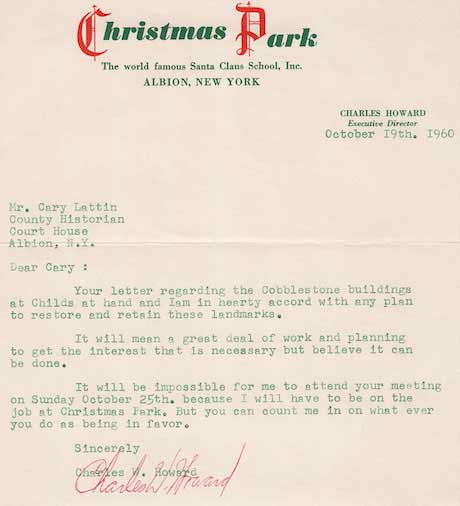
Charles Howard sent a letter of support in favor of the newly formed Cobblestone Society in 1960.
Another other example included the sudden disappearance of the old Buffalo, Lockport, & Rochester Railway power station, a large cast cement block structure that sat on the far east end of East State Street near Butts Road. Yet another, perhaps without any inherent value on the surface, was a once stately home that sat at 106 South Clinton Street. The property was a frequent meeting place for local suffragists who labored to organize suffrage schools and local conventions.
Architecture Destroyed in Orleans County, a wonderfully thorough account of historic structures that vanished over the lengthy history of our area, calls attention to dozens of valuable assets lost. Of course, the short volume is in need of an update as the above-mentioned examples have occurred during my lifetime, after the book’s publication. Although the examples of material culture lost to progress over the last decades are numerous, there are plenty of examples that demonstrate the rewards that come with persistence and hard work.
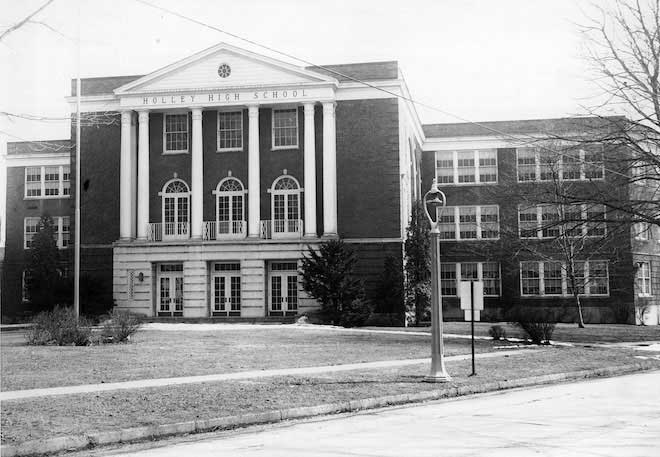
Home Leasing LLC’s recent undertaking of renovation work at the former Holley High School, the Town of Clarendon’s purchase of the Old Stone Store as a records storage site and office for the historian, and the Orleans County Historical Association’s ongoing work on the Gaines District No. 2 Cobblestone Schoolhouse all represent huge wins for the preservation community. Such efforts are supported by thousands of volunteer hours and community leaders who lobby for funding.
A letter written by Charlie Howard to Cary Lattin on October 19, 1960, regarding early efforts to establish the Cobblestone Society says a great deal about Howard’s community-centered mindset. He wrote, in part, “Your letter regarding the Cobblestone buildings at Childs at hand and I am in hearty accord with any plan to restore and retain these landmarks. It will mean a great deal of work and planning to get the interest that is necessary but believe it can be done…You can count me in on what ever you do as being in favor.”
I can rest assured that if I had asked Santa for historic preservation, he would have delivered!
By Matthew Ballard, Orleans County Historian Posted 15 December 2018 at 6:04 am
“Overlooked Orleans” – Vol. 4, No. 49
HOLLEY – After years of diligent work by the residents of Holley, the long-term preservation of the old Holley High School is finally secure. Historians commend those who undertake such noble work as communities so often set aside the difficult task of investing in historic treasures, instead investing in new construction as a symbol of “progress.”
The history of this particular structure dates back to 1930, but the story of the particular lot upon which it rests dates back to the 1840s. In 1847, the community selected Hiram Frisbee, Augustus Southworth, and William Hatch as members of a committee tasked with gathering subscriptions to establish an academy. This industrious team procured the necessary resources – money, lumber, millwork, timber, lime, brick, building stone, plows, boots and shoes, teaming (horses), and labor – so that a two-story brick building could be constructed on a $300 lot of land donated by Frisbee.
The school operated for nearly three years as a private academy until its formal incorporation by the Board of Regents as the Holley Academy in 1850. At this time, the institution’s assets totaled $3,021.25 including the building, library, academic apparatus, and land; Augustus Southworth was selected as the first president of the organization’s Board of Trustees. According to Isaac Signor, “For eighteen years this institution did most excellent work, but like many other academies was not financially a success.”
The apparent financial woes of the academy, combined with the increasing population of students in Holley, forced the community to explore alternate accommodations. The resulting decision established a Union Free district, combining this newly formed entity with the Holley Academy to form the Holley Union School and Academy.
A Union Free district typically involved the combination of two or more common schools within a particular geographic area to form a district with boundaries that matched the limits of a village or city. The Board of Trustees for the Union School and Academy included George Pierce, Jeffrey Harwood, Dr. Edwin R. Armstrong, James Farnsworth, Nelson Hatch (son of William Hatch), and D. H. Parsons; Col. John Berry, Augustus Southworth, and Horatio Keys were selected as honorary members.
Dr. Armstrong wrote the following concerning the academic coursework offered at the institution:
“Young men who desire a collegiate course can here go through the preparatory studies for admission to any College in the land. Those who are not able or desirous to enter College but with a thorough Academic education that will fit them for most any vocation in life can obtain it here. Young ladies who aim to secure a good knowledge of science and literature that will fit them for most any position which woman is permitted to occupy, need not go abroad to obtain it as we have a school here affording all the facilities for intellectual culture that may be found elsewhere.”
Praising the institution and calling the community to support the school Armstrong wrote:
“Good schools like good churches are paying institutions in any community, not only morally and intellectually, but even financially, for they enhance the value of real estate far more than the amount required to support them…If God has seen fit to give you money, and your poor neighbor children, contribute your money to educate your neighbor’s children that they may thereby become intelligent citizens.”
In 1882, the school constructed an addition at a cost of $4,500 in order to support an increase in attendance; seven years later the school purchased the Coy House and lot on the corner of Wright and Main streets, converting two rooms for use as classrooms. According to Signor, the school employed eight teachers to instruct 350 students in 1894. A remodeling project was undertaken in 1896 and two years later, the institution formally changed its name to the Holley High School.
Recognizing the growing population of the community and the failure of the aging building, now four times its original size, to meet the needs of a larger student body, residents made the decision to construct a new school by passing a $260,000 capital budget project. Designed by the Rochester architect Carl C. Ade, the new building would accommodate approximately 750-800 students, more than double the number attending the institution in 1894.
M. Iupa & Maggio Company of Rochester was selected as the general contractor, bidding $191,496 to complete the project. William C. Barber of Rochester was selected to complete the heating and ventilation work ($35,527), the Reinagel Lighting Company of Buffalo was selected to complete the electric ($12,020), and John Corcoran of Holley bid $9,814 to complete the plumbing work. Overall, the project came in well under budget, costing taxpayers approximately $.28 per square foot.
During this massive project, all grades below seven were relocated to three buildings on Geddes Street while all other grades remained in the old building; the old academy building was eventually razed in 1930.
By Matthew Ballard, Orleans County Historian Posted 8 December 2018 at 9:03 am
“Overlooked Orleans” – Vol. 4, No. 48
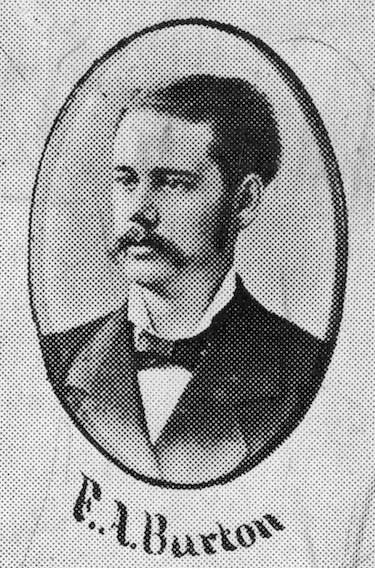
Courtesy of the La Crosse Public Library Archives: This photograph of Frank A. Burton is from a composite of the Rescue Hose Company in La Crosse, Wisconsin.
Occasionally, an interesting story with local ties surfaces while researching an unrelated subject. The story of Frank A. Burton would fall into that category; a man with local ties, but not necessarily a local man himself. Although unknown in Orleans County, Burton’s story represents one of the most heinous crimes in the history of La Crosse, Wisconsin.
The tale of Frank Burton begins with his grandparents, Joshua B. and Clarissa Adams, who arrived in Western New York prior to 1818. The young couple established themselves in the wilderness of the Genesee Country as one of the pioneer families and founders of the Town of Sweden. Available resources reveal that the couple reared at least two children in Monroe County, two daughters named Clarissa and Charlotte. Clarissa, the older of the two and named in honor of her mother, married Albion attorney Hiram Slade Goff and remained in Albion for duration of her life. The other daughter, Charlotte, met William Nathaniel Burton and married at Cuyahoga, Ohio on December 7, 1840. Burton was an insurance agent for mariners across the Great Lakes and the family traveled between Western New York, Chicago, Detroit, and Wisconsin.
Some records suggest that William and Charlotte’s son Frank was born in Chicago while others suggest New York, but by 1860 the family had settled in Kenosha City, Wisconsin where William was employed as an insurance agent. At some point in time, Frank returned to Albion and enrolled in the Albion Academy, likely living with his aunt and uncle in the village. Upon the completion of his studies, he returned to Wisconsin, settling in La Crosse and finding work as a telegraph operator. Burton eventually became a grain broker and ascended the social ranks, becoming a premier businessman in La Crosse and assuming prominent roles in local civic and political activities. One of those positions, president of the local Republican Party, would lead to his demise.
While preparing to celebrate James G. Blaine’s presidential campaign on October 16, 1884, Burton was set to lead a parade through the streets of La Crosse. Taking place at 8 o’clock in the evening, the torchlight parade included speeches, fireworks, and other festivities as thousands of people lined the streets. As he assisted with the arrangement of parade units, a man named Nathaniel “Scotty” Mitchell observed Burton’s movements from across the street.
Waiting for an opportunity, Mitchell emerged from the crowed and meandered across the street in Burton’s direction. As he slowly approached from behind, Mitchell slipped a revolver from his pocket and fired into Burton’s back. Four bullets left the barrel, one striking him in the head, another in the neck. Mitchell threw the empty revolver at Burton’s head, drew a second pistol and fired five shots into his victim before kicking the lifeless body and shouting, “Damn you, you SOB, now I’ve got you!”
Bystanders were unaware of the events that had just transpired, assuming the pops of the pistols were firecrackers. A nearby man standing beside Burton grabbed Mitchell and held him until two police officers rushed over and seized him. As they shuffled the criminal towards the local jail, throngs of crowds began shouting, “Lynch him! Lynch him!” Understanding the gravity of his dastardly deed, Mitchell begged his guards to get him to the jail posthaste. Meanwhile, Burton’s young wife was escorted to a nearby pharmacy where her husband’s body was examined and officially pronounced dead.
A crowd swelled around the jail, shouting at the sheriff to release the prisoner so justice could be served. After hours of refusing, the unruly mob busted through the doors, broke open Mitchell’s jail cell, and dragged him into the street. Procuring a rope, the crowd strung him up by his neck with such fury the noose broke. They secured a second rope, hauled the killer into the tree and thus the deed was done. The tree used to lynch Mitchell for the assassination of Frank Burton was dubbed “The Lynching Tree” until it was cut down shortly after.
Newspapers across Western New York printed their condolences to Mr. Goff for the loss of his nephew in this senseless crime. The motive remained unknown.
By Tom Rivers, Editor Posted 5 December 2018 at 9:17 am
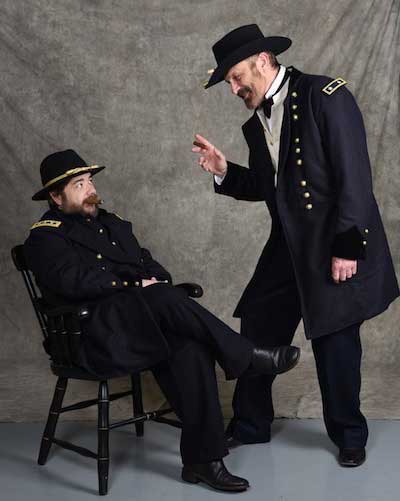
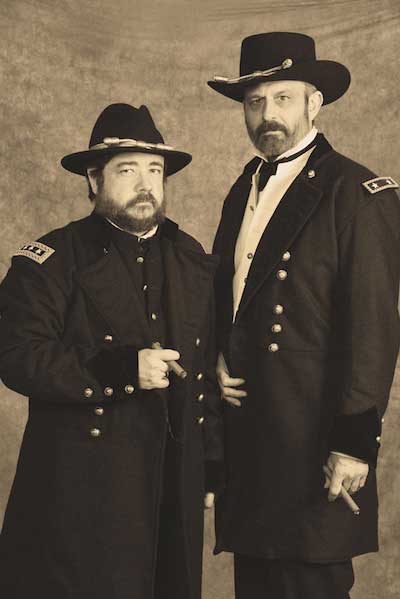
Photos courtesy of GCC: Derek Maxfield, left, is General Ulysses S. Grant and Tracy Ford is General William Tecumseh Sherman in a 45-minute theatrical “conversation” between the two Civil War generals for the Union. They will present “Now we stand by each other always” at 7 p.m. today at GCC in Batavia.
BATAVIA – Two Genesee Community College professors will portray Civil War generals this evening, sharing a conversation between the two leaders of the Union Army near the end of the Civil War.
Derek Maxfield will portray General Ulysses S. Grant and Tracy Ford will be the more charismatic General William Tecumseh Sherman. They will perform at 7 p.m. at GCC in Batavia in room T102 of the Conable Technology Building. The event is free and open to the public.
Maxfield has worked as a history professor the past 10 years at GCC. He wrote the script in the 45-minute presentation.
“We are both looking for new ways to reach out and educate,” Maxfield said.
Ford, an Albion resident, is in his 19th year of teaching English at GCC. Maxfield and Ford have both been part of living history events at GCC, portraying famous people from the past.
The presentation as the two generals is based on historic resources and references. Together, they recount the important meeting and conversation held at City Point, Va. in March 1865 when the two Union generals discuss the campaigns in Georgia and the Carolinas and consider how to close out the Civil War.
“It’s really an experiment and a new way of teaching,” Maxfield said about the event.
Grant is a calm and reserved personality, while Sherman is the opposite.
“It really is the Tracy Ford show in many ways,” Maxfield said.
He reached out to his colleague about portraying Sherman because Maxfield said Ford resembles the general and has an engaging personality.
Ford said one biographer has compared Sherman to Daffy Duck. Ford welcomed the chance to bring out Sherman’s character.
Derek Maxfield, left, and Tracy Ford said they are looking for ways to engage students in understanding history.
“You read about a character in a book and it’s a very two-dimensional thing,” Ford said. “Sherman is quite vigorous, chain smoking cigars and pounding bourbon. It gives you a human face.”
Ford will have an unlit cigar during the presentation and a liter of unsweetened tea.
The two professors debuted the show at the Clarendon museum during the Orleans County Heritage Festival in September. They also performed in Hornell at a historical society. They have upcoming performances in Brockport in early 2019.
In 2020, they will be in Lancaster, Ohio for the 200th anniversary celebration of William Tecumseh Sherman. He was born on February 8, 1820.
Ford praised Maxfield for creating the script and pushing for the production.
“He is the brains and I’m the frenetic energy,” Ford said. “It has been a lot of fun. This is another way to do it and spread it out into the community.”
By Matthew Ballard, Orleans County Historian Posted 1 December 2018 at 9:03 pm
“Overlooked Orleans” – Vol. 4, No. 47
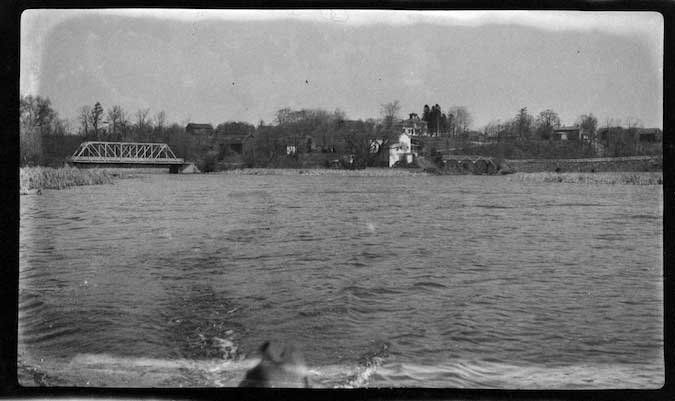
CARLTON – While digging through a box of negatives, I discovered this image of the Oak Orchard River and Marsh Creek from the 1920s. Absent from the photograph is the Route 18 bridge that crosses over the Oak Orchard, so at this point in time the little hamlet pictured here was known as “Two Bridges.” Thinking about the origin of names, a letter within the Department of History’s files provides some insight into the source of the Oak Orchard name.
The letter, addressed to Samuel C. Bowen of Medina, is from Arthur C. Parker, the Secretary Treasurer of the Society of American Indians (and grand-nephew of Gen. Ely S. Parker). In the letter, he writes “Albert Cusick the Onondaga authority defines Ti-ya-na-ga-ru-nte creek as “Where-she-threw-a-stick-at-me,” which was the label for a river to the east of Johnson’s Harbor. Parker offers an alternative name for the creek; “two-sticks-approaching” from the Seneca name “Da-ge-a-no-ga-unt.” This name is recorded in other records, along with “Skano-dario,” the Mohawk word meaning “beautiful lake” and the origin of the name Ontario. It should also be noted that the Tuscarora gave this creek the name “Ken-au-ka-rent.”
Capt. Pierre Pouchot, the commandant at Ft. Niagara sometime between 1755 and 1757, labeled the Oak Orchard as “Riviere aux Boeufs,” which roughly translates to “Beef River” or Buffalo River. This name was shared with the French River near Buffalo, which was subsequently changed to Buffalo Creek while our Riviere aux Boeufs became “Oak Orchard Creek.”
Orasmus Turner, in his history of the Holland Land Purchase, notes that the first road opened in this area was surveyed by the Holland Land Company in 1803 and ran from Batavia to the mouth of the Oak Orchard. At this natural harbor, Joseph Ellicott anticipated the birth of a bustling port city called Manilla which never came to fruition. Earlier records of this location as indicated by Turner, suggest the name of the harbor as “Tonawanda Bay.”
Although there is no indication that the Oak Orchard was ever called Tonawanda Creek, an interesting correspondence between Aaron Burr and the Holland Land Company suggest that pre-1800 maps labeled the harbor as Tonawanda Bay. Poised to purchase a tract of land, Burr noted that his survey contained an indented bay, which was considered public land, and therefore should not be included in his $1.50/acre bill for the land. The lack of documentation of a purchase of said tract suggests that Burr and the Holland Company were unable to agree on this particular matter.
Despite these older references, the term Oak Orchard appears in documents as far back as the early 1810s as surveyors prepared a path for the Erie Canal. The name Oak Orchard itself has a logical origin story. It is believed that upon the arrival of the first settlers to the present township of Carlton, a large grove of oak trees grew upon the banks of this creek and resembled, in some ways, an orchard; thus Oak Orchard.
In October of 1913, a meeting gathered at Pt. Breeze with the purpose of addressing the term “creek.” A committee of Dr. Richard Bamber, Virgil Bogue, and H. L. Brown were placed in charge of pursuing a geographical name change with the U.S. Government. The following month the Orleans County Board of Supervisors passed a resolution following suit, forwarding the resolution to the U.S. Board of Geographic Names, U.S. Senators from New York, and Congressmen in the hopes “…that they use their influence to effect such change in name.” The resolution proposed that the Oak Orchard Creek become the Oak Orchard River, in the hopes that the term “river” would attract more attention when seeking federal aid for improvement projects. The U.S. Department of the Interior still recognizes the name Oak Orchard Creek.
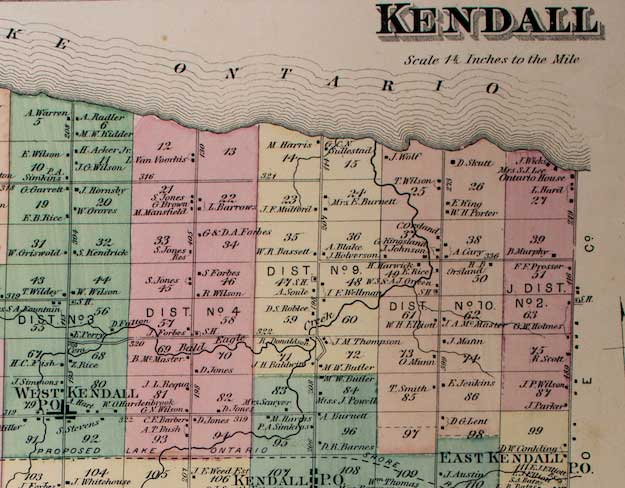
Map of Kendall, c. 1875, showing Norway Road and Woodchuck Alley (along Bald Eagle Creek).
By Matthew Ballard, Orleans County Historian Posted 24 November 2018 at 7:41 am
“Overlooked Orleans” – Vol. 4, No. 46
KENDALL – The abundance of town, village, hamlet, road, and street names provides an opportunity to understand the past. Many of the towns and villages in Orleans County are named in honor of prominent men in the United States; Kendall, for example, is named in honor of U.S. Postmaster General Amos Kendall (an ardent supporter of President Andrew Jackson).
Hamlets often serve as an indicator of local status or early settlement; Kuckville in honor of George Kuck, Hindsburg in honor of Jacob Hinds, or Knowlesville in honor of William Knowles.
The origins of street and road names, on the other hand, are more elusive. In some simple cases, they indicate early settlement. In other cases, they may indicate the past presence of an early service offered in the area, but on occasion the names seem rather silly and lacking in sensibility.
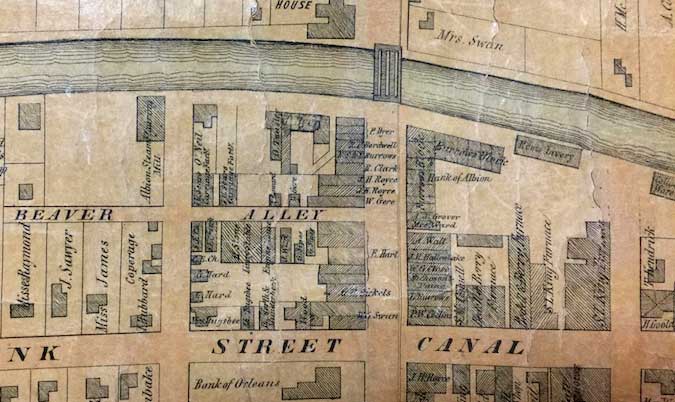
Beaver Alley in Albion is a clear oddity, but considering the possible origin of the name, perhaps it makes sense. Woodchuck Alley in Kendall is another example. Bill Lattin writes in v. 19, no. 2 of Bethinking of Old Orleans that “…we can assume [Woodchuck Alley] was simply named for the proliferation of those critters in that area.” The explanation seems logical, as tracing the name as far back as possible reveals that in the early 1950s the road was known locally as “Woodchuck Alley” but on the record as Backus Road. It appears as though the name originated with Charles Backus, a farmer who lived on the road.
A similar example in Barre, Johnny Cake Lane, has a story very similar to that of Woodchuck Alley. Bill Lattin wrote two possible explanations for the naming of the road; “One is that children attending Barre Dist. #14 School frequently took Johnny Cake in their lunch pails to school. The other legendary explanation is that at one time there was an advertising sign at one end of the road which promoted Johnny Cake Chewing Tobacco.” A 1913 atlas shows the road listed as “High Street,” even though newspapers show record of the Johnny Cake Lane name around the same time. It is interesting to see that in both of these cases, colloquial references to a particular street eventually took hold as the official name.
One particular story that demonstrates the rather simplistic nature of road naming references the old Norwegian settlement located in Kendall. Established in 1825 under the guidance of Cleng Peerson, with assistance from Andreas Stangeland, the first organized group of Norwegian immigrants settled an area of land near the shore of Lake Ontario. The early experiences of this group were discouraging at best, leading many families to abandon their little settlement and venture westward to the Fox River Valley in Illinois. All that remains of this very important landmark in organized Norwegian immigration to the United States is the Norway Road, running from Ridge Road north to the shore of Lake Ontario.
A 1857 map of the Village of Albion shows Beaver Alley.
By Matthew Ballard, Orleans County Historian Posted 17 November 2018 at 7:27 am
“Overlooked Orleans” – Vol. 4, No. 45
ALBION – Toponymy, the study of place names, origins, meanings, and use, is an area of focus often overlooked locally. The history of Orleans County is a mixture of the ordinary and the extraordinary, so it is no surprise that the origins of place names in our area would follow a similar pattern.
A recent influx of questions regarding name choices for various hamlets, towns, and streets sparked an interest in digging deeper beyond the brief notations found within the files of the Department of History. A file marked “Place Names” reveals very little about the variety of titles affixed to points of interest in our area, so I thought it would be worthwhile to delve into a few examples over several articles.
Beaver Alley is perhaps the most notable local street oddity and is likely to arouse a chuckle or two on occasion. Neil Johnson described several street name origin stories in his column “Albion, Oh Albion” (no. 1195, 14 SEP 2006). Of course, Bank Street was named for the Bank of Orleans that sat on the southwest corner of Bank and Main Streets, Clinton Street was named in honor of New York Governor and Erie Canal supporter DeWitt Clinton, and East and West Academy Streets were named for the nearby Albion Academy. As for Beaver Alley, he wrote, “It is clear, from early maps and deeds, that there was a little canal basin or canal right behind the stores on Main Street that extended to Beaver Alley. Whether that influenced the name or not I have no idea.”
On occasion, historians dig deep into the available information to develop an educated guess as to why something, a street in this case, was named in a particular manner. In most cases, documentation describing the process of officially accepting or designating a place name exists within local records. However, rarely do those records provide any insight into the discussion that surrounded the selection of the name in the first place, or who generated the idea in the first place.
Harvey Goodrich, a native of Herkimer County, New York, travelled to Albion in the mid-1820s after spending several years as a hat maker in Auburn. According to Arad Thomas, Goodrich “having been successful in accumulating property…with his brother-in-law, George W. Standart, took a job of work in making the Erie Canal, and leaving Auburn after his canal work was completed…located permanently at Albion in the year 1824, and engaged in selling dry goods and groceries…” Thomas also noted that after the death of his brother-in-law, Goodrich discontinued his dry goods business and commenced in the manufacturing of hats and dealing in furs.
The production of hats using beaver fur was quite common up into the 1850s, so popular that by the mid-1600s, the beaver’s natural breeding ground in Europe was nearly exhausted. From that point forward, North American became the primary supplier for hat fur in both the Old and New World. At the time Goodrich was operating his business in Albion, beaver fur was still a common material used in the manufacture of hats, but the addition of wool or hare fur was used in the production of less-expensive headgear.
Isaac Signor provides one other piece of information that is helpful in tracing the origin of the Beaver Alley name. In Landmarks of Orleans County, Signor writes, “The west side [Main Street] consisted of a warehouse on the dock, which was afterward burned, and one or two brick stores, extending as far as Beaver alley, on the corner of which Harvey Goodrich kept a hat store.” This information would suggest that Goodrich’s business became the source of the Beaver Alley name.
It may be worth noting, as a humorous side-note, that mercury was used to manufacture hats though it was generally understood that the chemical caused damage to the nervous system. While hat makers labored in poorly ventilated areas, the exposure to mercury would cause trembling and aggressiveness, symptoms of insanity. This is believed to be the origin of the phrase “mad as a hatter.”
By Matthew Ballard, Orleans County Historian Posted 10 November 2018 at 7:59 am
Albion, which is home to a women’s prison, has been ‘rehabilitating’ women for more than a century
“Overlooked Orleans” – Vol. 4, No. 44
This photograph, from a collection donated to the Department of History from Ruth Webster Howard, shows the rear side of the Administrative Building at the Western House of Refuge in Albion. The structure sat at the west end of the main walk and served as the residence for the superintendent, assistant superintendent, marshal, parole officer, purchasing agent, and housekeeper, and housed offices for the institution.
The Western House of Refuge opened on December 8, 1893, but did not “receive” any inmates until January of 1894. This institution represented a rather interesting period in the U.S. penal system, where women between the ages of 16 and 30 were sent for “rehabilitation.” Those guilty of crimes ranging from petit larceny to public intoxication, prostitution, or “waywardness” found themselves committed to the institution for a period of three to five years. During that time they received instruction in the domestic sciences – cooking, housekeeping, sewing, laundry, etc.
In 1923, the institution’s name was changed to the Albion State Training School and became the female equivalent of the Institution for Mentally Defective Males located at Napanoch. Although the name was changed to the Institution for Mentally Defective Females around 1931, the harsh name carried an undesirable connotation and the name reverted back to the Albion State Training School shortly after. The first head of the institution, Dr. Gordon F. Willey, made quick work of bringing “defectives” from Bedford Hills in Westchester County while sending “normals” downstate.
On October 1, 1932, Dr. George C. Stevens, a psychiatrist who worked at the Gowanda State Hospital relocated to Albion and took charge as superintendent. The Annual Report from 1933 shows a total increase in the number of inmates from 132 in 1932 to 168 in 1933. During that time, 34 women were committed for crimes ranging from “endangering the morals of a minor” and incest to forgery, intoxication, burglary, larceny, and vagrancy. Of those committed in 1933, all the women were first time offenders between the ages of 16 and 61; 14 were married, 15 single, two widowed, and three divorced. The majority of those committed held a common school education, while two could neither read nor write.
The tenure of Dr. Stevens was a tumultuous one, hindered by conflicts with employees and struggles with the School’s Board of Visitors. Upon his arrival to Albion, a report identified a large number of significant repairs and needed improvements. Although the Commissioner of Correction agreed with the assessment of the facilities, with an estimated cost of $1.5 million, members of the community felt that the requested funding was excessive. In addition to building improvements, Stevens requested funding to hire a social worker, a psychologist, an assistant physician, a physical director, a first assistant matron, a cook, and a laborer despite relatively stagnant rates of incarceration.
Aside from the excessive expenses, Stevens failed to win over the support of the community when he suspended Dr. Eli Efron, the assistant superintendent, and Edward Van Vleet, the farm superintendent. Although Stevens claimed that both men were discharged as the result of insubordination, rumors swirled throughout the community, some claiming that Stevens had evicted the Efron and Van Vleet families from their residences at the Training School without food or shelter.
No individual was more outraged at Stevens’ behavior than Marc Wheeler Cole, Sr. of Albion. A one-time New York State Assemblyman whose political career was cut short by his failure to adhere to party politics, Cole was vocal in his distaste for the unprofessional behavior of the superintendent. “This community is shocked and unanimously indignant at the hasty, unjust, and tyrannical action of the superintendent of the Albion State Training school in the unwarranted suspension of employees at an order from him calling for eviction of the assistant superintendent from his home and causing him, with a wife and two children, to seek shelter in the community,” Cole sent in a telegram, “…We demand, therefore, the immediate removal of all authority from the present superintendent pending further investigation.”
Although Stevens claimed that the discharged employees in question were “blocking his program from the start,” he found little sympathy from residents. Cole rallied his “troops,” forming an Albion Citizens’ Committee to pursue Stevens’ resignation while focusing on the waste and excess of the superintendent’s administration. To make matters worse, Marc Wheeler Cole, Jr., lodged a complaint against Stevens for illegal voting in the November 7th election. Stevens, an immigrant from England, had just secured his naturalization papers in September and failed to wait the required 90 days before voting.
Following an intense and spiteful battle, Stevens formally resigned his position on February 15, 1934; he was replaced by Dr. Walter B. Martin, a psychiatrist at Attica Prison. The administration building, one of the structures targeted for the massive capital project upon Stevens’ appointment, was rebuilt at a cost of $298,950 shortly after.


















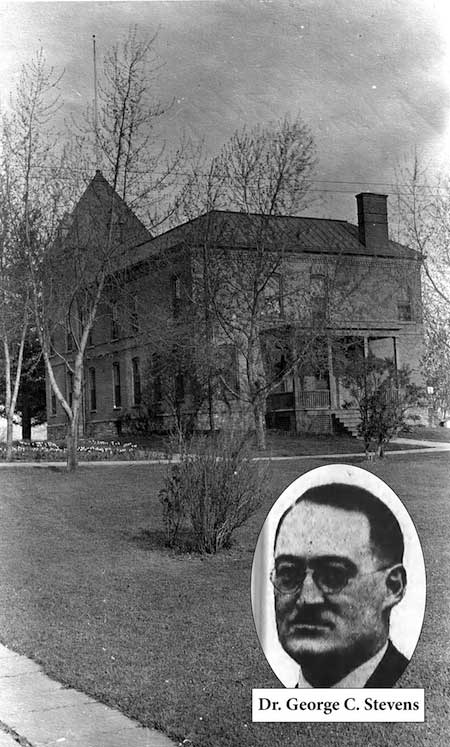 This photograph, from a collection donated to the Department of History from Ruth Webster Howard, shows the rear side of the Administrative Building at the Western House of Refuge in Albion. The structure sat at the west end of the main walk and served as the residence for the superintendent, assistant superintendent, marshal, parole officer, purchasing agent, and housekeeper, and housed offices for the institution.