

















Local agricultural clubs tried to find way around alcohol prohibition a century ago
492 bottles of beer seized from Kendall Hotel in 1914
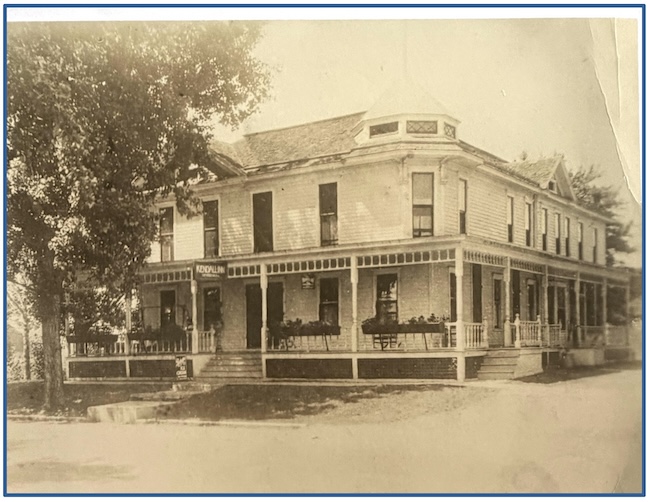
Photo from Orleans County Department of History: This photo of the Kendall Hotel is dated 1935. Opened in 1901, the building escaped several destructive village fires. Later known as the Kendall Inn, it is now a restaurant named The Grove 1848.
By Catherine Cooper, Orleans County Historian
“Illuminating Orleans” – Volume 6, No. 11
 KENDALL – The Kendall Agricultural Club, which assembled at the Kendall Hotel in 1913-1914, played a role in the Temperance campaign leading up to Prohibition.
As early as 1912, six of the ten towns of Orleans County were “dry” or “no-license” to use the parlance of the day, meaning that the sale of alcohol was prohibited in these jurisdictions. The energetic lobbying efforts of the Women’s Christian Temperance Union (W.C.T.U.) had secured these local victories.
However, not all residents were in favor of these restrictions. Taking advantage of a loophole in the 1896 NYS Liquor License Law, Farmers or Agricultural Clubs were organized in dry towns. One such was the Kendall Agricultural Club.
Incorporated in the summer of 1913, it had the stated goal of “the scientific study of agriculture and horticulture, the effect of insectivorous pests” and other farming questions. Club members were allowed access to the two hotel rooms rented at the Kendall Hotel. Members who paid $1 were given a ticket which allowed them 20 bottles of beer. They could also fill out continuous order vouchers directing the Bartholomew Brewing Company to deliver them one case of beer weekly.
Soon there were four other flourishing Farmer’s Agricultural Clubs in the county, three in the town of Gaines and one in Lyndonville.
However, the Temperance League was a force to be reckoned with. An article in the Buffalo Sunday Morning News of Feb. 8, 1914, mentions that the Orleans County Temperance League held their meeting with church temperance organizations to discuss lobbying plans for upcoming local elections at the Court House in Albion.
The article also mentions that several detectives had been employed by temperance leaders of the Town of Kendall to conduct investigations. Shortly after their departure, on January 16, 1914, Constable Louis J. Cady of the Town of Kendall filed a petition with the Supreme Court Justice, Cuthbert W. Pound, alleging that Warren C. Miller, Ida C. Miller, Ray Miller and Garret Rocque had liquor at the Kendall Hotel for the purpose of unlawful sale and distribution.
The following day, Constable William C. Singleton of the Town of Ridgeway seized 492 bottles of beer and one bottle containing whiskey from the Kendall Hotel.
In response, Norman Lindaler, Oscar Lind, William Scheplar, John H. Scheplar, Atley Stevens, John J. Norton, Ray R. Miller, Thomas Jeffrey, William Scheik, Garret Recqua, Henry Scheik, Otto Greinke, Henry Scheplar, Charles Backus and Cornelius Fenner, each filed a claim that they were part owners of the seized beer.
They said that they were members of the Kendall Agricultural Club, a duly incorporated club, and that they each had their own beer at the hotel lawfully, that it was for their personal consumption, and not for sale or distribution.
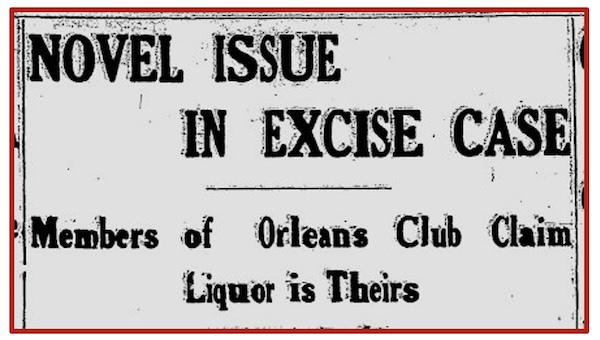
Medina Daily Journal headline, Feb. 3, 1914
At a hearing at the Court House in Albion on February 16, 1914, Supreme Court Justice Cuthbert W. Pound of Lockport presided over the case of the State Commissioner of Excise against the 492 seized bottles of beer. An unusual case, it had no precedent in the district. At issue was whether “Agricultural Clubs” were operating as a pretext for the unlawful sale of alcohol and avoiding the excise tax law.
The four members of the club who testified confirmed the social aspects of their activities, though none could remember any occasion on which they actually discussed any aspect of agriculture.
Judge Pound heard the evidence of Raymond Miller, who conducted the Club, and of four members of the club whose testimony confirmed the social aspects of their activities. He then took the case from the jury and directed that “it appears without dispute that this alcohol was kept within the state for unlawful distribution and that the jury is directed to take proper judgement for seizure of the same and its turning over to the State Excise Dept. to be auctioned off according to the new law by that department.”
He also stated that he did not think that there was any evidence to show that Raymond Miller was guilty of unlawful selling of beer. He directed that the Kendall Agricultural Club and similar organizations were “illegal and had been perfected for the purpose of trafficking in liquors and the evasion of liquor tax law” (Buf. Enq., 2-17-14)
New York State Excise Commissioner Farley hailed the verdict as a severe blow to the evasion of the law by these so called “clubs” and in the enforcement of excise laws in dry towns.