

















In 1893, several from Orleans County visited World’s Fair in Chicago
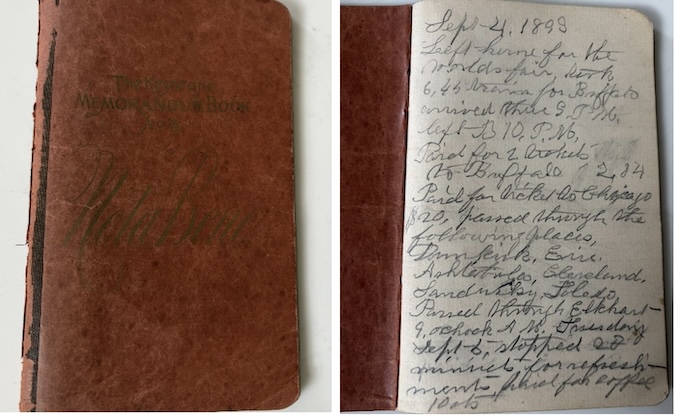
(Left) This notebook was used in 1893 to record a trip to the World’s Fair, held in Chicago. (Right) The first page of the notebook.
By Catherine Cooper, Orleans County Historian
“Illuminating Orleans” – Volume 6, No. 25
 A small, modest notebook with a brown cover. It is easy to overlook. Its condition belies its age though, it is a surprise to open it, read the date and the first page:
Sept. 4, 1893
“Left home for the World’s Fair. Took the 6:44 train for Buffalo, arrived there 9 p.m., left at 10 pm. Paid for two tickets to Buffalo $2.04
Paid for ticket to Chicago $20. On the way we passed through the following places: Dunkirk, Erie, Ashtabula, Cleveland, Landusky, Toledo. Passed through Elkhart 9’o clock a.m. Thursday. Stopped 20 min. for refreshment. Paid for coffee .10 cents.”
This notebook is unique. It is a hand-written record of a visit to the World’s Columbian Exposition, generally referred to as the World’s Fair, which was held in Chicago from May 1 – October 30, 1893. The entries are short and terse. We are assuming that this traveler is a gentleman traveling with his wife. His record of this three-week trip covers only 26 of these short pages. He includes a list of expenses on the last five pages. The remainder of the notebook is blank.
[P.2] “Passed through South Bend, 9:50 am. Passed through Seaport 10:50 am, 5 miles from Chicago.
Weds. Sept 5 paid for 1 room at Calumet Hotel .75c and 4 meals $1.40. Went to Fairgrounds at 8:00 at 64th St. entrance, gate fee .50c.”
Naturally, we were intrigued by the prices. Yes, .75c for a room! We checked.
Our anonymous traveler chose to travel by train. He would have traveled on the Nickel Plate Road, which advertised three fast express trains daily between Buffalo and Chicago, “with superb dining carriages.”
One could also have traveled by steamer. The Cleveland & Buffalo Transit Co. advertised the “Great All-Water Route” on magnificent side-wheel steel steamers from Buffalo, with the option of visiting Cleveland, Detroit and Mackinac Island.
The theme of the 1893 World’s Fair was a celebration of human achievement and progress. Our diarist was suitably impressed with all that he saw. Visiting the New York State building, he wrote: “Elegant chandeliers hang from the ceiling. The shades and ceiling are carved too beautiful for description.”
Over the course of the next few days, he saw:
[P.4] “The old pistol that shot Tecumseh… A punch bowl used by General Washington which was on display in the Pennsylvania Building and also a plaster cast of his face after death ….The old charter from Charles II to William Penn 1682 also a seal attached to the charter for the territory now known as Pennsylvania.”
At the Art Gallery, he saw a statue of Charles Dickens; the Emperor of Germany; William Shakespeare; Abraham Lincoln; Emperor William 2 of Germany; a painting of the Death of Archimedes and a painting of deer by Rosa Bonheur, owned by Consul General of Spain. In Governor’s Building, a flag used on the tent of General Washington was on display.
[P.8] “Paid .50c for coffee, tea & doughnuts at Wellington Café in the Fishery Building. Paid for lunch, .35c Thursday evening.”
This World’s Fair visitor certainly made the most of his trip. Over the next three days, he visited the Leather & Shoe exhibit, listened to Flecker’s Elgin Band, and toured the Machinery and Agricultural Buildings. He went into Marshall Field’s store and saw the Pullman building on Michigan Avenue.
Twenty-seven million people visited the 1893 World’s Fair. Many people from Orleans County made the trip as this “news” was reported in the newspaper social columns: Mr. & Mrs. Walter Tuttle, Mrs. E.J. Vosler, Mrs. Hawley and Mrs. George Lum were part of a group from Lyndonville that went in June, Martin Sutter and John Griffin from Medina went in August.
Some World’s Fair attendees took advantage of their trip to Chicago to expand their trips. George W. Kohler of South Dakota attended the Fair in June and then came east to visit family in West Shelby, after an absence of 14 years.
Our diarist also visited relatives during the last week of his trip – Dean Jaquith, Ben Jaquith, Aunt Flora, Cousin Lydia and visited Willie Tanner’s grave in Cleveland.
The final entry on September 27:
“Took cars in Cleveland for home, got into Buffalo 3 PM, found friends waiting for us, reached Albion 6:30 pm. Fred came for us, found Mr. Tanner not well, having been poorly during the three weeks of our absence.”
This little notebook gives us a glance into everyday life in the 1890s. Travel and communication were efficient. Public transportation worked. Travelers could expect to be met at the train station, as arranged. The city of Chicago handled the influx of Fair visitors. People assumed that these systems would work and felt confident about traveling. The speed of travel may have increased over the past 130 years, but as to efficiency and public confidence, well, that’s debatable.