




















In 1889, spire from Methodist church collapsed, damaging neighboring home
By Catherine Cooper, Orleans County Historian
“Illuminating Orleans” – Volume 6, No.1
 MEDINA – The gusty winds of January revive generational memories of terror for one household in Medina. A news article in The Daily Press, Jan 10., 1889, gave a vivid description.
“Nearly all day yesterday, the wind blew a strong gale from the west…. About four o’clock (a.m.), a terrible crash that could be heard even above the roaring of the wind, shook the town. People who heard it awoke with fear and trembling, and it was soon learned that the Methodist Church spire had fallen, and that the residence of M. Cooper, situated about twenty feet directly east, was partly buried under the pile of debris.
“People began to collect and it was found that the spire had fallen in a northeasterly direction, just grazing the west wing, tearing the cornice off and completely crushing the woodshed. The yard is filled to a depth of some three feet with a pile of broken timbers, brick and slate, all of which are broken in fine pieces and the collapse could not be more complete.”
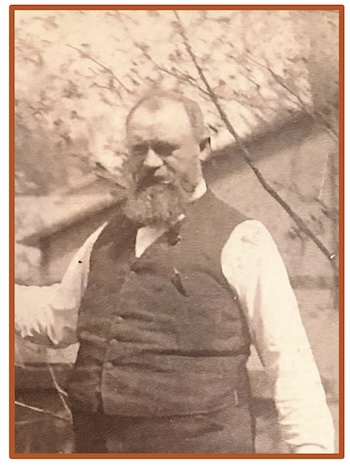
Medina businessman, Michael Cooper (1839 – 1899) had a narrow escape when the spire of the Methodist Church fell on his home on January 10, 1889.
The residence at 216 West Center St. had been built in 1850 by Sylvester Sherman. Michael Cooper purchased it in 1866 for $3,000. At the time of the steeple collapse, it was occupied by Michael Cooper, his wife Catherine and sons John and George.
Construction of the First Methodist Episcopal Society of Medina Church at 222 West Center St. was completed in 1876. A prior location on Main Street had been destroyed by fire.
A notable feature of the new construction was a 156-foot-tall spire. (The height of the spire was also described as 180 feet and at 235 feet.) Currently, the 175-foot–high spire of the Presbyterian Church in Albion is the highest point in Orleans County.
Whatever its exact height, the spire was not structurally sound. A high wind in May 1884 caused a three-foot-long crack in the brick work. Architect A.J. Warner of Rochester, who was hired by the Board of Trustees of the Village of Medina, described the spire as “unsafe and in a ruinous condition and liable to fall and do serious damage to life and property.” He recommended that it be taken down or “rendered entirely safe” without delay.
Architect William Morgan of Somerset agreed that it was unsafe but proposed that it could be made perfectly safe with new braces. He supervised the repair which was carried out by “a force of men” and “pronounced it entirely safe, in fact stronger than ever.”
The repair only lasted four years. The church was badly damaged by the collapse of the spire, the Cooper house was badly jarred, but “the family of Mr. Cooper had a very narrow escape and are receiving the congratulations of their many friends today.”