By Tom Rivers, Editor Posted 18 January 2021 at 10:20 am
Region’s Covid positivity rate remains above state average
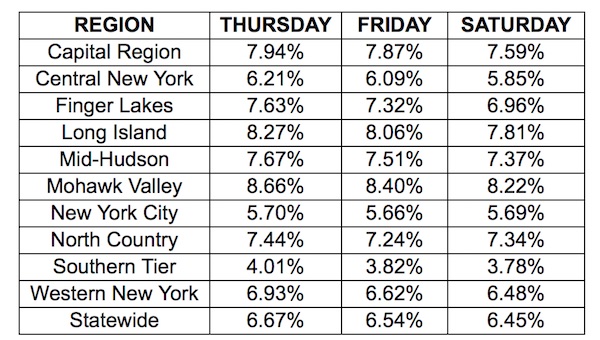
Chart from Gov. Andrew Cuomo’s Office
The Finger Lakes Region, which includes Orleans and eight other counties, continues to see the Covid-19 positivity rate and number of hospitalizatons from Covid decline.
Local and state health officials want to see those numbers continue to fall. Although the numbers are still high, the downward trend is encouraging for the health officials.
The Finger Lakes had a positivity rate over 10 percent in early January. It fell below 7 percent on Saturday.
That is still more than a percent above the state average. The 6.96 percent positive in the Finger Lakes on Saturday compares to the statewide average of 5.61 percent.
The positivity rate state-wide fell below 6 percent on Friday and Saturday for the first time since it was 5.9 percent on Dec. 26. On Friday, the statewide positivity rate was 5.77 percent (and 7.32 percent in the Finger Lakes).
Hospitalizations
The number of people hospitalized due to Covid in the nine counties was at 752 on Saturday. It was 830 on Wednesday, 919 on Jan. 1 and a high of 964 on Dec. 28.
Statewide the hospitalizations are also going down slightly. They were at 8,771 on Saturday, which was less than the 8,888 on Jan. 15, and 8,926 on Jan. 12. The 8,926 is the most since the cases and hospitalizations started to surge in November. The state reached a pandemic high with 18,825 on April 12.
By Tom Rivers, Editor Posted 16 January 2021 at 12:19 pm
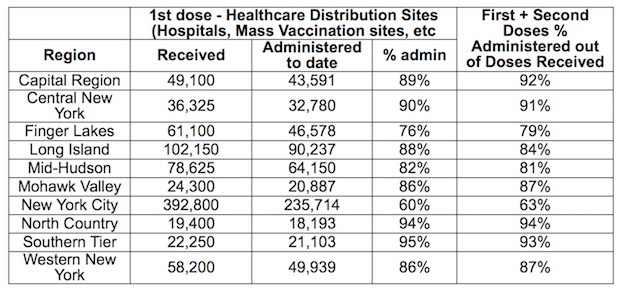
The Governor’s Office provided this chart showing how much of the vaccines have been administered so far.
Gov. Andrew Cuomo acknowledged the frustrations of many in the state with trying to get a Covid-19 vaccine.
The governor said the federal government has expanded the eligibility for the vaccine while reducing the weekly allotments to New York.
The CDC earlier this week expanded the eligibility of senior ctiizens from 75 and older to 65 and older. And that was before the state had worked through the 1a population, mainly healthcare workers and nursing home residents.
The CDC guidelines make 7 million New Yorkers currently eligible for the vaccine but the state only received 300,000 doses last week, and it dropped to 250,000 this week, Cuomo said.
“Our constraint is the federal supply and that is creating a scheduling backlog, and it’s creating pressure on what was supposed to be the prioritization process,” Cuomo said on Friday.
The state is scheduling appointments, and the distributors are fully booked 14 weeks in advance.
“There was no increase in supply and in the meantime, there was a dramatic increase in the eligibility,” Cuomo said. “So, now you increase the eligibility, you don’t increase the supply, and now you have a very complicated situation.”
Hawley: Let locals be part of vaccine distribution plan
State Assemblyman Steve Hawley, R-Batavia, and the Republican conference sent a letter to Cuomo and Health Commissioner Dr. Howard Zucker, calling on them to include local home rule authorities in the process of developing vaccine distribution plans. The letter was drafted in response to reports that vaccine distribution has been slow and ineffective in New York state, with some vaccine doses reportedly being wastefully disposed of due to improper storage.
“What we do in these next few weeks with vaccine distribution will determine how much tragedy we will all have to endure as a state, so we need to act now to get these vaccines to the people that need them most, as quickly as possible,” Hawley said in a news release. “We need to give the people who know their communities better than anyone a say in planning vaccine distribution, because a singular top-down approach will not work for the varied and unique communities that make up New York State. Getting these vaccines out effectively and promptly will save lives, and we cannot afford to let even a single dose of the vaccine go to waste during this unprecedented public health crisis.”
Vaccine distribution network expanding
Cuomo said the state’s vaccine distribution network is expanding rapidly – almost 5,000 pharmacies, 194 hospitals, 2,500 private doctor networks, city departments of health, 58 county departments of health and state mass vaccination sites.
Some regions are doing better than others in getting out the vaccine. The Finger Lakes Region, which includes Orleans and eight other counties, had administered 76 percent of its doses, the lowest percentage of the 10 regions. The Southern Tier is the highest at 95 percent.
Cuomo said the state needs more people trained to administer the vaccine shots. So far 827,000 total doses have been administered – 731,000 first doses and 96,000 second doses.
“Get needles in the arms,” Cuomo said. “We want to do better. The faster you get people the vaccine, the better for them and the better for the entire state.”
By Tom Rivers, Editor Posted 15 January 2021 at 6:21 pm
Orleans also reports 29 new Covid cases, while Genesee has 55 more
Orleans County today is reporting three more Covid-related deaths, with two at the Orchard Rehabilitation and Nursing Center in Medina and the other a community member over age 65.
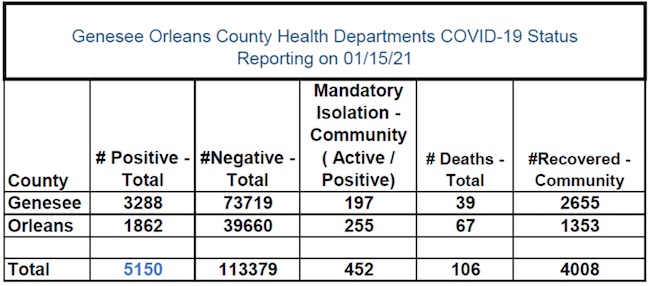
Both residents at Orchard are over age 65. That facility has now had 26 residents pass away due to Covid during the pandemic. The county has 67 deaths total from Covid, according to the Genesee and Orleans County Health Departments.
In Orleans County, there are also 29 new Covid cases to report today for a total of 1,862 positive cases since March.
The positive cases reside in the West Region (Yates, Ridgeway, Shelby), Central Region (Carlton, Gaines, Albion, Barre) and East Region (Kendall, Murray, Clarendon).
The individuals are in the age groups of 0-19, 20s, 30s, 40s, 50s, 60s and 70s. Of the new cases, 7 were on quarantine prior to testing positive.
Orleans also is reporting that of the new cases 2 are residents of Orchard Rehabilitation and
Nursing Center, and 2 are inmates at the Orleans Correctional Facility.
The county also is reporting today that 38 more individuals have recovered and been removed from the isolation.
Orleans currently has 18 residents hospitalized due to Covid.
Albion Central School reports today that one remote student from Middle School has tested positive for Covid-19. Due to the fact the student is remote, there is no need to contact trace any additional staff or students, the district officials stated on its website.
Medina Central School is reporting one high school student has tested positive for Covid-19. The district is in process of notifying the families of anyone who may have come into close contact with the student.
In Genesee County, there are 55 new positive cases to report today for a total of 3,288 confirmed cases since March.
The new positive cases reside in the West Region (Alabama, Darien, Pembroke), Central Region (Alexander, Batavia, Bethany, Elba, Oakfield) and East Region (Bergen, Byron, LeRoy, Pavilion, Stafford).
The individuals are in the age groups of 0-19, 20s, 30s, 40s, 50s, 60s, 70s, 80s and 90s.
Genesee County did a drive-through testing clinic on Thursday. Of the 600 tests, 42 tested positive, including 38 from Genesee County.
Genesee also has 72 more people recovered and removed from the isolation list.
There are 9 residents from Genesee currently hospitalized due to Covid.
• Data Update – There will be no reporting or map update on Monday, which is the Martin Luther King, Jr Holiday. Check the state site for updates. To review the raw positive data for each of the counties, click here.
By Tom Rivers, Editor Posted 14 January 2021 at 6:41 pm
2 counties combined pass 5,000 Covid cases in pandemic
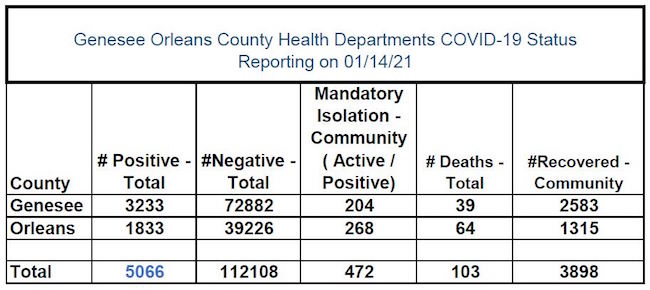
Orleans and Genesee counties combined are reporting 99 more Covid-19 cases today, which pushes the two counties past 5,000 since March at the start of the pandemic.
The two counties together have 97,632 people (57,280 in Genesee and 40,352 in Orleans, according to the 2019 Census estimate.) With 5,066 confirmed cases, that represents 5.2 percent of the combined population who have had Covid-19.
Genesee has had a higher percentage of its population test positive compared to Orleans. Orleans has had 4.5 percent (1,833 out of 40,352) while in Genesee, the percentage of the population that has tested positive is 5.6 (3,233 out of 57,280).
In Orleans County, today there are 50 new confirmed cases for 1,833 total since March.
The positive cases reside in the West Region (Yates, Ridgeway, Shelby), Central Region (Carlton, Gaines, Albion, Barre) and East Region (Kendall, Murray, Clarendon).
The individuals are in the age groups of 0-19, 20s, 30s, 40s, 50s, 60s, 70s and 80s. Of the new cases, 2 were on quarantine prior to testing positive.
The new cases include two residents of Orchard Rehabilitation and Nursing Center in Medina.
Orleans County hosted a rapid Covid testing clinic on Wednesday at the Orleans County 4-H Fairgrounds. Of those 513 tests, 22 were positive for Covid, including 21 Orleans County residents.
Orleans is reporting 34 of the previous positive individuals have recovered and been removed from the isolation.
Orleans currently has 17 residents hospitalized due to Covid.
• Albion Central School is reporting today that three students – hybrid student from the High School and two hybrid students from the Middle School – have tested positive for Covid-19. One of the students was last in school on Jan. 5. Due to the 48-hour look-back period, the Department of Health determined there is no need to quarantine any additional staff or students, the district stated on its website.
The second and third students were in school on Jan. 11. Students and staff members deemed to have been in close contact with the student have been identified by the Department of Health.
• Medina Central School is reporting today a student at Wise Middle School has tested positive for Covid. The district is in the process of notifying the families of anyone who may have come into close contact with the student.
Out of an abundance of caution, this student’s class will switch to 100 percent virtual during the quarantine period, said Mark Kruzynski, the district superintendent, in a letter on the district website.
In Genesee County, there are 49 new confirmed cases of Covid reported today for a total of 3,233 positive cases since March.
The new positive cases reside in the West Region (Alabama, Darien, Pembroke), Central Region (Alexander, Batavia, Bethany, Elba, Oakfield) and East Region (Bergen, Byron, LeRoy, Pavilion, Stafford).
The individuals are in the age groups of 0-19, 20s, 30s, 40s, 50s, 60s, 70s, 80s and 90s.
Genesee also is reporting 66 of the previous positive individuals have recovered and been removed from the isolation list. (The Genesee and Orleans County Health Departments said there was a miscount for reporting the number of people recovered yesterday. There were 2,517 people recovered from Covid-19 yesterday in Genesee County, not 2,515.)
Genesee also has 10 people hospitalized due to Covid.
The county also has had two more residents pass away due to a Covid-related illness. They were both residents over age 65 at Premier Genesee Center for Nursing & Rehabilitation in Batavia. Genesee has now had 39 people die due to Covid, including 32 since Dec. 1.
NYS Vaccination Sites – Message from the Genesee and Orleans County Health Departments: (Updated today) The “Am I Eligible” website has changed this afternoon to only show the NYS-run vaccination sites. The Covid-19 Vaccination Hotline is for scheduling vaccination appointments for eligible New Yorkers at the New York State-run vaccination sites only: 1-833-NYS-4-VAX (1-833-697-4829). Use their online tool to find a location. Appointments are required. If you visit a location without an appointment you will not receive a vaccine. We apologize for any confusion, the state just updated this information late this afternoon.
By Tom Rivers, Editor Posted 14 January 2021 at 3:15 pm
The Finger Lakes Region, which was the leading the state with the highest positivity rate and hospitalization rate, is seeing a drop in both.
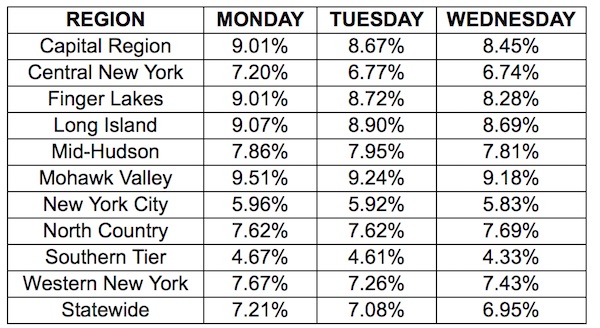
The Region, which includes Orleans and eight other counties, is still above the statewide average for positive tests – 6.95 percent on Wednesday in the state compared to 8.28 percent in the Finger Lakes.
The Finger Lakes had the fourth highest percent on Wednesday, behind the 9.18 percent in the Mohawk Valley, 8.69 percent on Long Island and 8.45 percent on the Capital Region. The Finger Lakes was over 10 percent as recently as Jan. 7 when it was 10.22 percent.
Wyoming County has the highest positivity rates among the nine counties in the Finger Lakes Region in the past seven days (10.1 percent) and in the past 14 days (12.4 percent).
Positivity rate in Finger Lakes Region counties
Genesee, 8.2% last 7 days; 10.1% last 14 days
Livingston, 8.2% last 7 days; 9.6% last 14 days
Monroe, 8.1% last 7 days; 8.8% last 14 days
Ontario, 8.4% last 7 days; 9.4% last 14 days
Orleans, 9.3% last 7 days; 9.8% last 14 days
Seneca, 7.1% last 7 days; 8.5% last 14 days
Wayne, 8.0% last 7 days; 8.8% last 14 days
Wyoming, 10.1% last 7 days; 12.4% last 14 days
Yates, 9.7% last 7 days; 9.7% last 14 days
Among the 10 regions, the Finger Lakes has the fourth highest percent positive in last 7 days at 8.3 percent. That’s less than the Mohawk Valley, 9.2 percent; Long Island, 8.7 percent; and the Capital Region, 8.4 percent. Western NY was at 7.4 percent. The Southern Tier is the lowest at 4.3 percent
Going back 14 days, the positivity rate in the Finger Lakes is 9.1 percent, which is lower than the Mohawk Valley, 9.8 percent; Capital Region, 9.2 percent; and the same as Long Island, 9.1 percent. Western NY is at 7.9 percent over the past 14 days and the Southern Tier, at 4.8 percent, is the lowest among the 10 regions.
Hospitalizations
The number of people hospitalized due to Covid in the Finger Lakes was 830 on Wednesday, which is down from 874 on Tuesday, 919 on Jan. 1 and a high of 964 on Dec. 28.
While hospitalizations are decreasing the Finger Lakes, they have been steadily rising statewide. The 8,929 hospitalizations on Jan. 12 was the most since 9,179 on May 5. The state reached a pandemic high with 18,825 on April 12.
By Tom Rivers, Editor Posted 13 January 2021 at 9:03 pm
Not nearly enough supply as state expands priority groups, including people 65 and older
Orleans County officials are working to set up Covid vaccination clinics, possibly at the Orleans County 4-H Fairgrounds later this month.
The county Health Department is being inundated with calls from residents who want the vaccine, but there is far too little supply so far, said Paul Pettit, the county’s public health director.
So far the Health Department, Orleans Community Health and Oak Orchard Health Center have been administering the vaccine mostly to Priority Group 1A. With the recent addition of Priority Group 1B and the addition of those aged 65 and older, the supply of vaccine is not meeting the demand.
“At this time, Orleans County would like to ensure the public that we are working tirelessly to administer the limited doses we have on hand immediately, and we will continue to get vaccine to the qualifying populations in the most efficient and equitable manner possible,” said Lynne Johnson, Orleans County Legislature Chairwoman.
“As the quantity of available vaccine doses increases and we begin to have some confidence in delivery amounts and timing from the state, the county will communicate with those in the priority groups and the general public to notify them of vaccination opportunities,” Johnson said. “In the meantime we are asking our residents, to be patient.”
The county is planning Point of Dispensing (POD) mass vaccination clinics for Priority Groups 1A and 1B. Residents can check their eligibility to either of these groups by clicking here.
Links for pre-registration are updated on a week to week basis based on vaccine availability. If appointments become full, check the state vaccine web page by clicking here or go to the Genesee and Orleans County Health Departments Health Vaccine web page (click here).
Due to high traffic volume, the registration links may temporarily become unavailable. Continue to try again if experiencing any errors with registration, the Health Departments advised.
The process of getting the vaccine out to priority groups and eventually the general public is going to take many weeks and months, the Health Departments said.
For more information about the vaccine and access for those who are 65 and older who do not have internet access, contact the Office for the Aging in Orleans County at 585-589-3191 between 9:30 a.m. – 4:30 p.m. and leave a message.
In Genesee County, the Office for the Aging can be reached at 585-813-2457 for Covid-19 Vaccine assistance between 9 a.m. to 4 p.m. and leave a message and someone will return the call.
By Tom Rivers, Editor Posted 13 January 2021 at 6:43 pm
Orleans reports another death from Covid for 64 during pandemic
The Genesee and Orleans County Health Departments reported 88 more cases of Covid-19 today in the two counties.
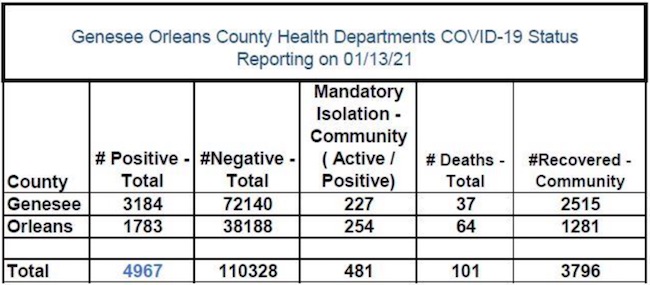
In Orleans County, there are 39 new confirmed cases of Covid from Tuesday through earlier today for a total of 1,783 positive cases since March.
The positive cases reside in the West Region (Yates, Ridgeway, Shelby), Central Region (Carlton, Gaines, Albion, Barre) and East Region (Kendall, Murray, Clarendon).
The individuals are in the age groups of 0-19, 20s, 30s, 40s, 50s, 60s and 70s.
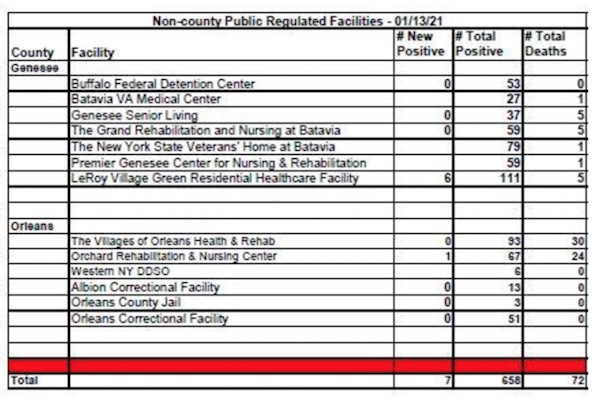
Of the new positive cases, one is a resident of Orchard Rehabilitation and Nursing Center in Medina, which has now had 67 of its residents test positive during the pandemic.
The county is reporting 8 of the new 39 positive individuals were on quarantine prior to testing positive. The county has had 26 more people recover from Covid and be removed from the isolation.
Orleans currently has 14 residents hospitalized due to Covid.
The county also is reporting a resident has passed away due to Covid. The individual was younger than 65. This is the 64th resident to die from Covid during the pandemic.
• Albion Central School is reporting today that a staff member from the High School has tested positive for Covid-19.
The staff member was last in school on Jan. 8. Students and staff members deemed to have been in close contact with the individual have been identified by the district and will be notified by the Department of Health, the district stated on its web site.
• Lyndonville Central School is reporting today that a student and staff member have tested positive for Covid-19.
The student who tested positive was last present on district property on Jan. 11 and has immediately begun isolation at home. Contact tracing was completed in collaboration with the Orleans County Health Department. As a result, two students were placed under quarantine and no staff.
The staff member who tested positive was last present on district property on Jan. 8. Contact tracing was completed in collaboration with the Orleans County Health Department. As a result, no students or staff have been placed under quarantine.
• Medina Central School is reporting today that three students and two staff members have tested positive for Covid.
One of the students is in the high school but is 100 percent virtual. The Department of Health has determined that no further quarantines are required from school contact.
A middle school student also tested positive. The district is in the process of notifying the families of anyone who may have come into close contact with the student. Out of an abundance of caution, this student’s class will switch to 100 percent virtual during the quarantine period, Mark Kruzynski, the district superintendent, said in a letter on the district website.
An Oak Orchard Elementary school student also tested positive. The district is in the process of notifying the families of anyone who may have come into close contact with the student. Out of an abundance of caution, this student’s class will switch to 100 percent virtual during the quarantine period.
The two staff members are not based in a school building. The has notified anyone who needs to be quarantined.
In Genesee County there are 49 new positive cases Covid for a total of 3,184 cases since March.
The new positive cases reside in the West Region (Alabama, Darien, Pembroke), Central Region (Alexander, Batavia, Bethany, Elba, Oakfield) and East Region (Bergen, Byron, LeRoy, Pavilion, Stafford).
The individuals are in the age groups of 0-19, 20s, 30s, 40s, 50s, 60s, 70s, 80s and 90s.
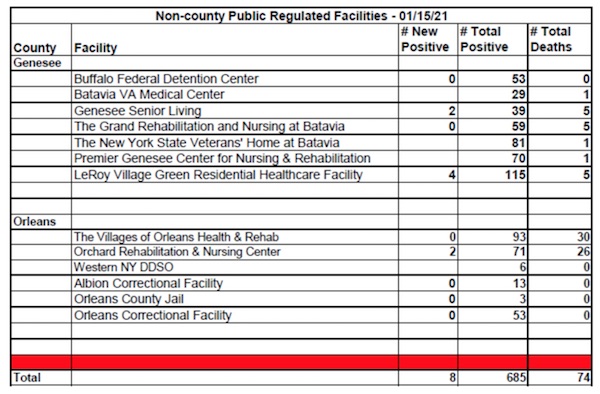
Of the new cases, 4 are residents of Premier Genesee Rehabilitation and Nursing Center in Batavia and 6 are residents of the LeRoy Village Green Residential Healthcare Facility.
In Genesee, 47 more of the previous positive individuals have recovered and been removed from the isolation list.
Genesee has 16 residents currently hospitalized with Covid.
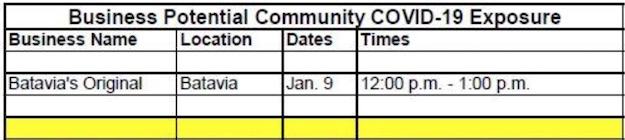
• Health Alert – People should monitor themselves for symptoms of Covid-19 if they were at Batavia’s Original from noon to 1 p.m. on Jan. 9.
If the symptoms develop, contact a primary care provider to seek testing immediately and self-isolate until the test results are received.
Symptoms of Covid-19 include but are not limited to fever or chills, cough, shortness of breath or difficulty breathing, fatigue, muscle or body aches, headache, new loss of taste or smell, sore throat, congestion or runny nose, nausea or vomiting, and diarrhea.
By Tom Rivers, Editor Posted 12 January 2021 at 5:31 pm
Genesee reports 2 more deaths from Covid; 2 counties have now had 100 residents die from Covid during pandemic
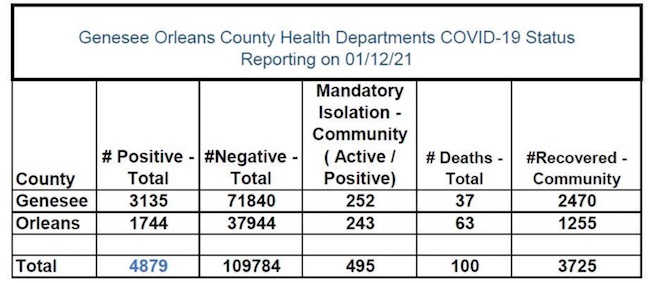
Orleans County chart info hasn’t been updated to include new cases reported since Monday afternoon. The total should say 1,773 in Orleans County.
The Genesee and Orleans County Health Departments announced today they will no longer be reporting mandatory quarantine data “due to the volume and rapidly changing numbers.”
There are 108 new confirmed Covid cases in the two counties since the last update Monday.
In Orleans County, there are 29 new cases for a total of 1,773 cases since March. The data on those cases will be included in the Wednesday news briefing from the Health Departments.
Today’s data is from the 100 cases in Orleans from Friday through Monday morning. Those positive cases reside in the West Region (Yates, Ridgeway, Shelby), Central Region (Carlton, Gaines, Albion, Barre) and East Region (Kendall, Murray, Clarendon).
The individuals are in the age groups of 0-19, 20s, 30s, 40s, 50s, 60s, 70s, 80s and 90s.
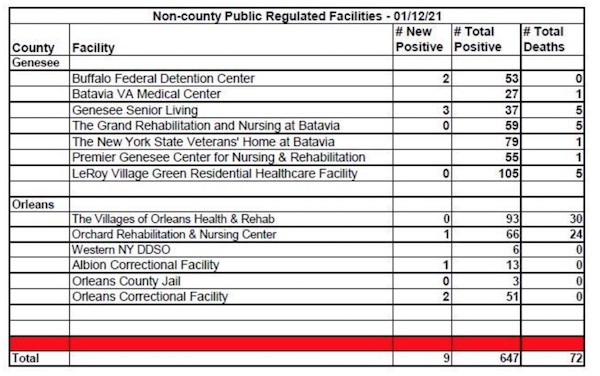
Of the new cases, 1 is a resident of Orchard Rehabilitation and Nursing Center in Medina, 2 are inmates at the Orleans Correctional Facility, and 1 is an inmate at the Albion Correctional Facility.
Of those new 100 cases, 14 were on quarantine prior to testing positive.
Orleans is reporting 114 of the previous positive individuals have recovered and been removed from the isolation.
Orleans has 19 residents currently hospitalized due to Covid.
• Holley Central School said a Middle/High School Teacher has tested positive for Covid-19. The last day the teacher was in school was Monday, January 11.
“The Health Department is still processing this case and we will cooperate with them,” said Brian Bartalo, the district superintendent. “If warranted, any official decision on mandatory quarantining of students or staff members will come directly from the health department. If the health department indicates to us that there is quarantining required for the students (Red Hawks) who may have had close contact with this teacher on Monday, we will reach out to those families ASAP. In the meantime, if you don’t hear from the school district or the department of health, there’s nothing for anyone to do at this time.”
• Lyndonville Central School was notified today that a staff member tested positive for Covid-19. The staff member was last present on district property on Jan. 8, District Superintendent Jason Smith said in a notice on the school website. Contact tracing was completed in collaboration with the Orleans County Health Department. As a result, no students were quarantined and one staff member was quarantined, Smith said.
• Medina Central School is reporting a staff member in the high school and a staff member in the middle school have both tested positive for Covid-19. The Department of Health has determined that no further quarantines are required from school contact other than those who have already been notified, Mark Kruzynski, the district superintendent, wrote in a letter posted on the district website.
In Genesee County, there are 79 new positive cases for a total of 3,135 cases since March.
The new positive cases reside in the West Region (Alabama, Darien, Pembroke), Central Region (Alexander, Batavia, Bethany, Elba, Oakfield) and East Region (Bergen, Byron, LeRoy, Pavilion, Stafford).
The individuals are in the age groups of 0-19, 20s, 30s, 40s, 50s, 60s, 70s, 80s and 90s.
Of the new cases, 3 are residents at Genesee Senior Living, 2 are residents at the Batavia VA Medical Center, 2 are inmates at the Buffalo Federal Detention Center, and 2 are residents at the New York State Veteran’s Home at Batavia.
Genesee is reporting 35 of the previous positive individuals have recovered and been removed from the isolation list.
Genesee has 21 residents currently hospitalized due to Covid.
The county is reporting two more deaths from Covid. They both resided at Genesee Senior Living and were older than 65. Genesee has now had 37 residents pass away from Covid during the pandemic, including 30 since Dec. 1.
By Tom Rivers, Editor Posted 11 January 2021 at 5:08 pm
Genesee passes 3,000 Covid cases during pandemic
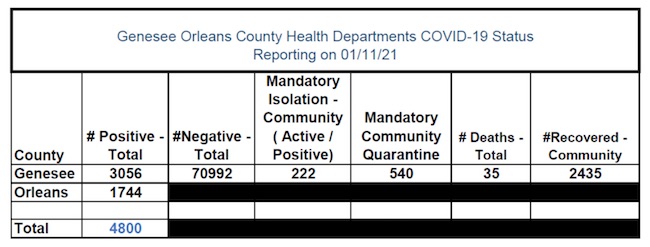
In the first update since Friday, the Genesee and Orleans County Health Departments reported 100 new Covid-19 cases in Orleans and 170 in Genesee.
Orleans County is only reporting 100 positive cases since late Friday through Monday. The Health Departments expect the data will be updated in tomorrow’s report. There will be no data chart for today.
• Albion Central School reports a hybrid learner from the High School has tested positive for Covid-19. The high school student was last in school on Jan. 5.
Students and staff members deemed to have been in close contact with the student have been identified by the district and will be notified by the Department of Health.
• Holley Central School reports two students have tested positive for Covid-19. The first is a high school student in the Alternative High School program and the second is an Elementary School student.
The last day the Alternative High School student was in person was Monday, Jan. 4, and the Elementary School student was last in school on Thursday, Jan. 7.
The health department has informed the district that students and staff connected to both of these cases will be quarantined. Given the unique setting of the Alternative High School, that program will be fully remote for all students at least until Friday, Jan. 15. The students and staff who will be quarantined for close contact of the Elementary School student have also been notified.
In Genesee County, the 170 new positive cases of Covid-19 for a total of 3,056 positive cases. ( The county’s population totaled 57,280 in the 2019 Census estimate.)
The new positive cases reside in the West Region (Alabama, Darien, Pembroke), Central Region (Alexander, Batavia, Bethany, Elba, Oakfield) and East Region (Bergen, Byron, LeRoy, Pavilion, Stafford).
The individuals are in the age groups of 0-19, 20s, 30s, 40s, 50s, 60s, 70s, 80s and 90s.
Genesee is reporting 155 of the previous positive individuals have recovered and been removed from the isolation list.
There are 21 Genesee residents who are hospitalized due to Covid.
Of the new cases, 8 are residents at the Leroy Village Green Residential Healthcare Facility, 7 are residents at Premier Genesee Center for Nursing and Rehabilitation in Batavia, and 2 are residents at the Batavia VA Medical Center.
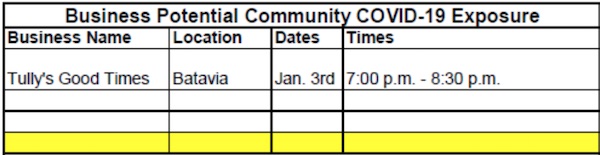
• Health Alert – People should monitor themselves for symptoms of Covid-19 if they were at Tully’s Good Times in Batavia from 7 p.m. to 8:30 p.m. on Jan. 3rd.
If the symptoms develop, contact a primary care provider to seek testing immediately and self-isolate until the test results are received.
Symptoms of Covid-19 include but are not limited to fever or chills, cough, shortness of breath or difficulty breathing, fatigue, muscle or body aches, headache, new loss of taste or smell, sore throat, congestion or runny nose, nausea or vomiting, and diarrhea.
‘There is nowhere near the amount of vaccine for the number of people who are eligible to receive it. This whole process will be determined by the supply of the vaccines and as such we need to be flexible as we anticipate the situation will continue to change. We ask and urge patience among our residents.’ – Shelley Stein, Genesee County Legislature chair
Press Release, Genesee County Legislature
With New York State under increasing pressure to allocate the various Covid-19 vaccinations that in some instances have been destroyed or continue to be stored without being used, Governor Andrew M. Cuomo announced on January 8 that a new group of recipients would be eligible to receive the vaccinations.
This new group – categorized as 1b – is confined to those 75 years and older as well as utility workers, corrections officers, first responders (police, firefighters, EMTs and support personal) and primary through grade 12 school faculty and staff, including licensed childcare providers. For a full list of priority workers, click here.
People age 75 and over will primarily be vaccinated at pharmacies and other sites that are part of the “retail network.” Use the online tool to find a location. Beginning at 4 p.m. today, the Covid-19 Vaccination Hotline will open for scheduling vaccination appointments for eligible New Yorkers: 1-833-NYS-4-VAX (1-833-697-4829).
“Residents need to be aware that we have already received reports where people are being contacted by scammers about how they can get a vaccine,” said Genesee County Legislature Chair Shelley Stein. “We are asking those who are eligible for the vaccine to please register on-line or call the Covid-19 Vaccination Hotline to schedule an appointment.”
For others in groups 1a and 1b they can see local information about clinics and clinic schedules (click here) and fill out a registration form and schedule an appointment. Clinics may fill quickly, so please be patient and check the site periodically.
In Genesee County there are approximately 4,892 residents/employees in 1a and in Orleans County there are about 4,321 residents/employees in 1a.
There are approximately 8,525 residents/employees in 1b in Genesee County, including 4,809 age 75 years and older and 6,032 residents/employees in 1b Orleans County, including 2,959 age 75 years and older.
To date, approximately 200 doses of the vaccine have been received by both counties (400 total). Not all of the doses of the vaccination have been administered, but all of the doses are already scheduled for vaccination over the next few days.
“As the numbers demonstrate, there is nowhere near the amount of vaccine for the number of people who are eligible to receive it,” Stein said. “This is a rapidly changing situation, so we understand the frustrations, questions and concerns that we are receiving from many residents. This whole process will be determined by the supply of the vaccines and as such we need to be flexible as we anticipate the situation will continue to change. We ask and urge patience among our residents.”