By Tom Rivers, Editor Posted 20 April 2022 at 9:06 pm
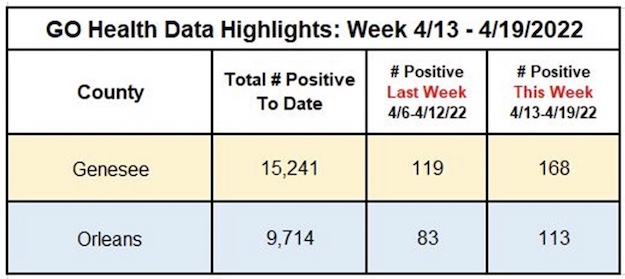
Chart courtesy of Genesee & Orleans County Health Departments
The Covid cases in Genesee and Orleans counties continue to climb, with Genesee at 168 and Orleans at 113 during the week of April 13-19.
That is up from the previous week when Genesee had 119 cases and Orleans had 83, according to data from the Genesee and Orleans County Health Departments.
Statewide the cases are also on the rise. There were 7,862 new cases on Tuesday with a positive test rate of 6.92 percent. The statewide positivity rate in the 7 days is at 5.56 percent. It was 4.35 percent the 7 days before from April 6-12.
Orleans is among the nine counties in the Finger Lakes Region where the 7-day percent positive rate is 11.81 percent, third highest of the 10 regions. Only Western New York at 13.48 percent and Central NY at 13.91 percent are higher. New York Cry is the lowest at 3.67 percent.
The new Covid cases in Orleans in the past week include 29 from home tests and 84 from labs. Genesee’s new cases include 43 from home tests and 125 from lab results.
Gov. Kathy Hochul discussed Covid during a news conference today in Syracuse. She said the state will continue to require masks for public transit, correctional facilities, nursing homes, health care settings, domestic violence centers, buses and train stations.
“With new contagious subvariants circulating, let’s be vigilant in using the tools to keep ourselves and our loved ones healthy and out of the hospital,” Hochul said.
MEDINA – Medina Memorial Hospital is expanding visiting hours beginning today.
Orleans Community Health announced the following update:
Visitors must abide by the following guidelines:
Visiting hours on the Medical-Surgical floor/Transitional Care will be from 10 a.m. to 7 p.m.
Exceptions may be made in end-of-life situations.
All visitors will be required to undergo the Covid-19 screening upon entering the hospital.
Visitors must wear face coverings at all times (covering mouth and nose), regardless of the visitor or patient vaccination status for influenza or Covid-19.
Visitors who fail to wear a face covering and other PPE as requested by the facility will be asked to leave the facility.
Visitors must be 16 years of age or older.
Once in the facility, visitors must remain in the patient’s room throughout the visit, except when directed to leave by hospital staff during aerosol-generating procedures or other procedures or circumstances for which visitors are usually asked to leave or to use the restroom, and must be appropriately distanced from any other patients or staff.
Department visitation guidelines:
General visiting on the Medical-Surgical floor/Transitional Care: Two visitors may be permitted between the hours of 10 a.m. to 7 p.m., except in certain circumstances. On a case-by-case basis, limitations may need to be made due to the clinical condition of the patient or at a patient’s request. In addition, caregiving by family members is encouraged, at the discretion of the family and patient.
Emergency Department: One visitor may be permitted. On a case-by-case basis, limitations may need to me made due to the clinical condition of the patient or the treatment being performed.
Anyone who reports or exhibits shortness of breath, fever, cough, or other potential Covid-19 symptoms
Individuals who have an active diagnosis of Covid-19 or who are persons under investigation for Covid-19.
Individuals wanting to visit a hospital patient who has an active diagnosis of Covid-19 or who is a person under investigation with Covid-19 or had contact with a person who is actively under investigation for Covid-19 within 10 days.
Individuals under quarantine for any other reason as defined by the most current New York State travel advisory.
Press Release, Genesee and Orleans County Health Departments
Lead is a heavy metal that is toxic to our bodies and there is no safe level of lead to have in our blood. Lead can be found in homes built before 1978 (before lead in paint was banned), gasoline, water pipes, toys, ceramics, jewelry, pottery and more.
The effects of lead poisoning are irreversible and can affect a child into adulthood.
“Lead poisoning can affect anyone, but it is especially dangerous for infants and small children because their bodies are rapidly developing,” stated Paul Pettit, director for the Genesee and Orleans County Health Departments (GO Health).
Childhood lead poisoning can damage the brain and nervous system leading to learning difficulties, lower IQ, difficulty in paying attention, hyperactivity, kidney damage, and, at very high levels, it can be fatal. Lead poisoning can also be dangerous for pregnant women because lead can pass to the baby during pregnancy.
Childhood lead poisoning is a concern throughout the year, but cases of lead poisoning increase during the spring and summer months because children spend more time outdoors, on the porch or in the yard.
Homes built before 1978 may have chipping and peeling lead paint on the porch or on siding, which could be more deteriorated than other parts of the house due to the effects of weather. Children playing on the porch can unknowingly pick up lead paint chips and dust on their hands and toys and then place hands or toys into their mouths.
Lead dust can also be found in the soil outside where children are playing. Strong winds can blow lead dust from nearby factories or from the chipped paint off houses and then settle into your yard. Although leaded gasoline was phased out in the 1970s, lead may still be in the soil after it was released into the air from car exhausts and then settled into the ground nearby.
Lastly, many home improvements begin in the spring and summer. Renovations to areas of the home containing lead-based paint can put lead dust into the air, both inside and outside of the area being worked on. Lead dust can also collect on windowsills and in window wells. On warm days when the window is open, lead dust in these areas can blow into the house.
“Lead poisoning in children is completely preventable,” Pettit said. “You can follow these steps to protect yourself and your family from the effects of lead exposure.”
Talk to your doctor about a simple blood lead test. New York State requires that health care providers test children for lead at ages 1 and 2 and whenever there is a risk of lead exposure.
Wash children’s hands before eating and naps or bedtime.
Wash children’s toys regularly.
Have children play in a sandbox, rather than on the ground.
Clean floors with a wet mop and cleaning solution.
Wet-wipe dusty areas such as windowsills, window wells, countertops, and furniture.
Keep your home free of chipping or peeling paint and renovate safely.
Mist surfaces with water before scraping or sanding to prevent creating dust.
Have your children eat a balanced diet rich with iron, vitamin C and calcium.
For more information on GO Health’s Lead Poisoning Prevention Programs, visit GOHealthNY.org. You can also contact your respective health department:
By Tom Rivers, Editor Posted 19 April 2022 at 11:53 am
Sarah Hallifax Bateman previously led North Wing in Medina, now works in Rochester
Sarah Hallifax Bateman
A Medina native has been named a “Women of Distinction” among nursing home administrators and will be honored during a celebration in Chicago on May 12-13.
Sarah Hallifax Bateman graduated from Medina in 2006. She served as director of the North Wing facility at Medina Memorial Hospital from July 2018 to September 2020. She is currently administrator of the Edna Tina Wilson Living Center, which is part of the Long Term Care Division of Rochester Regional Health.
Bates said she is “truly honored and humbled” to be included in the 2022 McKnight’s Women of Distinction program.
She enjoys here career in long-term care.
“The most rewarding part about being a nursing home administrator is the relationships – relationships with residents, families and staff,” she said. “Nursing homes become a family of sorts – and those relationships grow within the walls of the facility, but extend far beyond into every facet of life.”
Bateman has worked 10 years with Rochester Regional holding various roles from social worker to administrator. She worked two years at the North Wing as part of a collaboration with Rochester Regional and Orleans Community Health.
She said she has had many great mentors, including the late Jim Sinner, who was the administrator of the Medina Memorial Hospital for many years.
“I am proud of my Medina roots and owe the start of my career to Orleans Community Health, Mr. James Sinner, and my grandparents Lloyd and Janet Hallifax whom both were longstanding members of the Medina community and worked at Orleans Community Health,” she said.
About the Event
McKnight’s Long-Term Care News, McKnight’s Senior Living and McKnight’s Home Care are thrilled to once again recognize women making a mark in skilled nursing, senior living and home care, inspiring others and having a powerful effect on the lives of the individuals they serve.
“As the pandemic continues to challenge long-term care providers, we’re so pleased to be able to offer this opportunity to give the exceptional women working in long-term care — often behind the scenes, making a difference in the lives of their colleagues and those they serve — the recognition they deserve,” says McKnight’s Senior Living Editor Lois A. Bowers.
By Tom Rivers, Editor Posted 13 April 2022 at 9:59 pm
Charts courtesy of Genesee & Orleans County Health Departments
The number of confirmed Covid cases in Genesee and Orleans counties continues to climb after very low numbers in February and most of March.
Orleans is reporting 83 new cases the past week from April 6 to 12, while Genesee has 119 new cases.
That is up from 54 in Orleans and 62 in Genesee the previous week. The week before that from March 23 to March 29 there were 25 cases in Orleans and 33 in Genesee.
Both counties remain low for community spread, according to the federal CDC.
The Genesee and Orleans County health Departments reports that another Genesee resident passed away from Covid bringing Genesee’s total Covid-related deaths to 185 during over two years of the Covid pandemic. Orleans has had 113 Covid-related deaths.
The new Covid cases in Orleans include 53 from lab tests and 30 from at-home tests. Genesee’s 119 cases include 75 from lab tests and 44 from at-home tests.
Statewide the positivity rate for tests is up to 5.32 percent or 6,546 confirmed positives out of 123,079 tests on Tuesday. The 7-day positive rate is 4.35%, Gov. Kathy Hochul announced today.
“As we inch closer to the Easter and Passover holidays and many New Yorkers prepare to travel and gather with their loved ones, it is critical that we continue to utilize the tools at our disposal to prevent COVID spread and protect those around us,” Governor Hochul said. “Those who are traveling should get tested before they leave home, and those who test positive should stay home and discuss possible treatment options with their doctor.”
In 2021, GO Health tested 46 animals for rabies and 4 tested positive
Press Release, Genesee & Orleans County Health Department
Spring is here and that means wild animals will be giving birth to their babies. Sometimes these cute baby animals will stray away from their mothers and wander into backyards, into barns, and onto porches tempting people to catch them and take them in as their own.
“Please leave them alone because it can put you and other family members at risk of exposure to a fatal disease such as rabies,” stated Paul Pettit, Director of the Genesee and Orleans County Health Departments (GO Health).
Rabies is a central nervous system disease, which attacks the brain and almost always results in death if a rabies exposure is not treated. Rabies is most often spread through bites, scratches, and contact with infected saliva. According to The Centers for Disease Control and Prevention (CDC), rabies is most often seen in bats, raccoons, skunks and foxes, but any mammal can be infected with rabies. In addition, pets and livestock can get rabies if they are not vaccinated to protect against infection.
In 2021, GO Health tested 46 animals for rabies and four tested positive. Additionally, 221 dogs and 54 cats were observed in 10-day confinement between the two counties. A domestic animal is subject to 10-day confinement if they bite a human. The animal’s health and behavior is monitored for 10 days to determine if rabies may be present and if further action is required.
What can you do to protect yourself against rabies?
Leave all wildlife alone, including any injured animals. If you find an injured animal, do not touch it and contact your local animal control office for help.
Avoid feeding, approaching, touching, or adopting wild animals and stray domestic animals such as cats and dogs.
If you see a stray dog or cat, do not pet it. This is especially important if you are traveling out of the United States to a country where rabies in dogs is common.
If you find any animal that is acting strangely, you should contact your local animal control office for help.
Be sure that your pets (dogs, cats, and ferrets) are up-to-date on their rabies vaccination. Even indoor pets should be vaccinated and it is also recommended that livestock animals are vaccinated.
Public Health Law, Article 21, Title 4 requires New York State (NYS) residents to keep their pets (cats, dogs, and ferrets) up-to-date on their rabies vaccination.
Keep family pets indoors at night and do not let them roam alone.
Anyone who has been bitten by any animal or may have been exposed to rabies needs to take immediate action. Make sure to thoroughly clean any wounds or bites with soap and water, and then call your health care provider for further instructions. If you can do so safely, capture the animal (being careful not to damage the head/brain) and call your local health department to report the incident. Capturing the animal is vital in order for it to be tested for rabies. Testing will confirm if the animal is infected with the virus or not, making sure that only those who need treatment get it.
A doctor in consultation with the health department will determine who needs to be vaccinated with rabies post-exposure prophylaxis (RPEP). The cost to treat an individual varies considerably based on weight, number of doses, and insurance. In 2021, treatment costs ranged from $2,000 to $9,000. GO Health will work with the patient’s insurance company, but what is not covered by insurance is ultimately the responsibility of the taxpayers. In 2021, Genesee County treated 14 people and Orleans County treated 13 people.
“We encourage residents to do their part to prevent rabies in the community by vaccinating their pets and practicing caution around wild and stray animals,” stated Pettit. “Please visit one of the upcoming free drive-thru anti-rabies immunization clinics for dogs, cats and ferrets.”
Genesee County Clinics at the Genesee County Fairgrounds (5056 East Main Street, Batavia, NY)
Thursday, May 19th, from 4 to 7 p.m.
Thursday, August 11th,from 4 to 7 p.m.
Thursday, September 15th, from 4 to 7 p.m.
Thursday, October 13th, from 4 to 6 p.m.
Orleans County Clinics at the Orleans County Fairgrounds (12690 Rt. 31, Albion, NY)
Saturday, April 23rd, from 9 a.m. to 11:30 a.m.
Saturday, June 4th, from 9 a.m. to 11:30 a.m.
Saturday, August 13th, from 9 a.m. to 11:30 a.m.
Saturday, October 15th, from 9 a.m. to 11:30 a.m.
For more information on Health Department services, visit GOHealthNY.org or call 589- 3278 for Orleans County or 585-344-2580 ext. 5555 for Genesee County.
Press Release, Genesee-Orleans-Wyoming Opioid Task Force
BATAVIA – “Medicated-Assisted-Treatment in Our Communities” is the topic of the GOW Opioid Task Force quarterly meeting scheduled for 10-11 a.m. April 21 at The Recovery Station, 5256 Clinton St. Rd., Batavia.
The hybrid-style meeting – both in person and via Zoom videoconferencing – is open to the public at no charge.
“We are excited to offer this hybrid option and, more importantly, to provide information on M-A-T to the community,” said Christen Ferraro, GOW Opioid Task Force coordinator.
Discussion will center around what M-A-T is, how it is used in substance use disorder treatment and recovery and its effectiveness, as well as sharing their experiences working with M-A-T services in various settings.
Speakers are:
Ann Bowback, clinical director at Spectrum Health & Human Services in Warsaw. She is the project director of the Medicated-Assisted-Treatment program in collaboration with Evergreen Health.
Melissa Weingarten, Wyoming County Jail nurse. In November 2021, she joined the Wyoming County Health Department in a full-time capacity as the nurse for jail medical services, administering medication to the inmates.
Kathy Hodgins, chief clinical officer at Genesee/Orleans Council on Alcoholism and Substance Abuse. She oversees the M-A-T services and Opioid Treatment Program clinic in Genesee and Orleans counties.
For more details and how to register, visit www.gowopioidtaskforce.com or contact Ferraro at cferraro@gcasa.org.
By Tom Rivers, Editor Posted 6 April 2022 at 9:26 pm
Charts from Genesee & Orleans County Health Departments
The number of confirmed Covid cases in Genesee and Orleans counties doubled in the past week, the local health department reported today.
Orleans had 54 new confirmed cases with 35 lab-based tests and 19 at-home tests. Genesee has 62 confirmed cases with 41 from labs and 21 at-home tests.
The 54 cases in Orleans from March 30 to April 5 compares to 25 in each of the previous two weeks.
In Genesee, the 62 cases from March 30 to April 5 compares to 33 the previous week and 23 the week before that.
The federal CDC continues to rank the two counties as low for Covid community spread.
Statewide the percent of Covid tests that were positive on Tuesday was 3.67 percent, 4,358 out of 119,484 tested. That compares with 2.54 percent a week before when 3,243 were positive out of 127,873.
The seven-day average for positive tests was 3.22 percent on Tuesday, compared to 2.45 for the seven days ending last Tuesday.
“As we approach the spring holidays of Easter and Passover, it’s important we all do what we can to protect our families and reduce the spread of Covid-19,” Governor Kathy Hochul said today. “Make sure everyone in your family who’s eligible is vaccinated and boosted. If you’re attending family gatherings or traveling, take a test before and after. And if you test positive, talk to a doctor about the available treatments.”
By Tom Rivers, Editor Posted 5 April 2022 at 1:36 pm
Photos by Tom Rivers
ALBION – Members of the Oak Orchard Health board of directors toss ceremonial shovels of dirt today at about noon. Oak Orchard is putting a 2,250-square-foot addition behind its site at 301 West Ave.
This photo shows Mary Anne Pettibon, Oak Orchard Health chief executive officer, with OOH board members, including Karen Watt, chairwoman of the board; David Jewell, PhD, vice chairman of board; Renee Biedlingmaier; Randy Dumas; Rene Cibrian; Sue Meyer; and Lynda Watroba. Albion Village Trustee Joyce Riley also joins in the celebration.
Milestone Construction Partners in Rochester is the builder for the addition.
The new addition is funded with $757,000 from the federal American Rescue Plan Act. The addition will include a large community room for Covid testing and vaccinations, as well as educational programs. That could include training on breast feeding, diabetes control and other public health issues. The addition will also have new bathrooms.
“We’re out of space,” said Karen Watt, the board leader. “It’s a wonderful opportunity to enlarge and have groups come in.”
Representatives from Congressman Chris Jacobs, State Sen. Rob Ortt and Assemblyman Steve Hawley attended the ground-breaking.
Mary Anne Pettibon, Oak Orchard CEO, noted that Oak Orchard started about 50 years ago in Albion, initially serving a farmworker population. Oak Orchard has grown to now include 12 locations and serves the general population.
It is planning to open a health care site in Medina in August, and will be adding dental care in Albion and a mobile unit offering medical services.
Press Release, Genesee and Orleans County Health Departments
This week is National Public Health Week and this year’s theme is “Public Health is Where You Are.”
“National Public Health Week is a great opportunity to raise awareness about what public health is,” stated Paul Pettit, Public Health Director for Genesee and Orleans County Health Departments (GO Health). “This week is used to help educate and highlight the issues that are important to improving the health of individuals, our community and our nation.”
This year, there are daily themes for National Public Health Week and although these are complex issues, there are still small things that you can do to help the health of individuals and our community.
• Monday, April 4th – Racism: A Public Health Crisis
Racial inequities in health care, income, housing, education and many other factors have become more apparent during the Covid-19 pandemic. These inequities impact the health and well-being of community residents. We encourage you to start conversations about health equity and have an open dialogue about how biases and inequities contribute to health disparities in our community.
• Tuesday, April 5th – Public Health Workforce: Essential to our Future
The public health workforce is essential to our future! Thank a Public Health Professional for all the work that they have done throughout the Covid-19 pandemic, but also what they will continue to do in the future to help the health of our community.
Wednesday, April 6th – Community: Collaboration and Resilience
Come together as a community to improve housing, education, food, transportation and the environment. Share your voice and opinions about the health of your community by completing the Community Health Assessment survey. You can access the survey by visiting the following links:
You can also make an impact by joining a community garden, donating food to a local food pantry, or volunteering at a local food distribution event.
• Thursday, April 7th – World Health Day: Health is a Human Right
Celebrate World Health Day by protecting our planet and our health. Even doing small things such as walking or cycling to work, buying your groceries from local producers, recycling and buying less plastic can make a difference.
• Friday, April 8th – Accessibility: Closing the Health Equity Gap
While there are public health resources available where we live, some barriers can make it hard for people to access and use these resources. These barriers could be physical, mental, financial, or cultural. Advocate for your neighbors and engage your local leaders to support health equity in our community.
• Saturday, April 9th – Climate Change: Taking Action for Equity
Understanding and addressing climate change is critical to protecting human health and the environment. By working together, we can lessen the impacts of climate change by making choices that help reduce greenhouse gas emissions. Small things such as using water efficiently, buying used items, reusing or repurposing items, and reducing your food waste can all make a difference.
• Sunday, April 10th – Mental Wellness: Redefining the Meaning of Health
Each year, one in five American will experience mental illness. To improve your mental health, eat a well-balanced diet, engage in physical activity such as walking or hiking, participate in activities you enjoy and connect with others. Seeking help from a mental health professional is a sign of strength, not a weakness. If you are struggling with depression, contact a mental health provider or call Care + Crisis Helpline at 585-283-5200, or text 741741.
GO Health hopes that you will help celebrate National Public Health Week by participating in some of the ideas described above to help make our community healthier, stronger and safer. By working together, we can build a healthier community and help everyone in Genesee and Orleans Counties live a healthier life.

















 Lead is a heavy metal that is toxic to our bodies and there is no safe level of lead to have in our blood. Lead can be found in homes built before 1978 (before lead in paint was banned), gasoline, water pipes, toys, ceramics, jewelry, pottery and more.