Governor Andrew M. Cuomo said the influenza epidemic continued to increase across New York State over the past week, with 11,683 laboratory confirmed influenza cases reported to the New York State Department of Health, and 2,221 New Yorkers hospitalized with confirmed influenza.
These numbers are again the highest weekly numbers in both categories since reporting began in 2004 and exceed last week’s record high 7,779 confirmed cases and 1,759 hospitalizations.
“Flu season is in full-swing, and as the number of influenza cases and hospitalizations continue to rise at alarming levels, we must take every action to protect ourselves and our loved ones,” Cuomo said. “I am urging everyone to get vaccinated and take other necessary steps to stop the spread of this virus in New York.”
Last week, the Governor signed an Executive Order allowing pharmacists to administer flu vaccines to children ages 2 to 18, increasing vaccine accessibility for New York children and families as influenza continues to spread across New York.
The Executive Order suspends the section of state education law that limits the authority of pharmacists to administer immunizing agents to anyone under age 18 to allow vaccines to be administered to anyone age 2 and up. Parents and guardians are encouraged to call pharmacies ahead of their visit, to ensure they are ready to receive patients in this age group. Parents and guardians with children between the ages of 6 months and 24 months are still encouraged to see their primary care provider for the vaccination.
In addition to getting a flu shot and staying home when sick, it’s important to practice good hand-hygiene:
• Unlike some viruses, influenza is easily killed by soap and hot water.
• Wash your hands often with soap and hot water for at least 20 seconds to protect yourself from germs and avoid spreading them to others.
• Carry an alcohol-based hand sanitizer to use when soap and water are not available. Choose a product with at least 60 percent alcohol.
• Do not cough or sneeze into your hands. Instead, cover your mouth and nose with a tissue. People with the flu are infectious for up to 7 days after symptoms begin.
Photos by Tom Rivers: JJ Crane, center, shared how his life became embroiled in addiction and how he has worked to overcome it. He is joined as a panelist by his brother Cody and mother Chris Crane.
By Tom Rivers, Editor Posted 31 January 2018 at 11:22 am
MEDINA – Cody Crane urged his Medina classmates to educate themselves about the dangers of addiction, and say no to popping pills, underage drinking and drugs.
Crane, a senior at Medina, worked with GCASA to put on a 2-hour forum about the opioid epidemic on Tuesday evening.
Crane nearly lost his brother to an overdose. JJ Crane was a panelist at the forum, and he shared how he started drinking and using drugs in high school. It escalated to cocaine and heroin after high school, and nearly killed him on Aug. 1 when he had an overdose.
JJ hasn’t used drugs since then. He is nearly six months without using, and currently stays in a halfway house in Niagara County.
“I was scared one day I would wake up and my older brother who I love so much wouldn’t be here,” Cody told about 50 people at the forum. “I’m proud of how far he has come. He has worked so hard.”
JJ said he turned to drugs and alcohol to cope with anxiety and depression. The addiction grew more compulsive. He would work and use own money to buy drugs, and he often stole to get drugs or ran up big debts with drug dealers.
“It’s who you know and how far are you willing to go,” he said. “I needed the drug because without it I would have withdrawals and would shake to the point of almost being in a seizure.”
JJ said the addiction took over his life.
“I’m an addict,” he said. “I’m sorry for what I’ve put my family through.”
JJ’s mother Chris urged parents to be aware of what’s going on in their children’s lives, even if that means searching their rooms.
“Don’t pretend,” she said.
Sherri Bensley, assistant director of prevention for GCASA, said stigmas can push many addicts from seeking treatment.
JJ said the judgement he feels from many in the community steered him away from seeking treatment when he knew he was in trouble with his addiction almost three years ago. After a near fatal overdose on Aug. 1, he had enough.
JJ said he knows people look down on him because of his past drug use.
“Once I started recovery, I knew it would change the way people look at me,” he said. “To them I’m an addict or a junkie. I don’t want to be judged. I don’t want people to think so little of me.”
GCASA prevention educators said that stigma prevents many from seeking treatment, or having a relapse.
Sherri Bensley, assistant director of prevention for GCASA, said addiction doesn’t discriminate. She urged people to be compassionate to addicts and their families.
“Addiction is a disease,” she said. “That is somebody’s child, or somebody’s mom or dad.”
JJ Crane said he no longer worries too much about other opinions. He is committed to fighting his addiction.
“Now I tell myself it doesn’t matter what other people think,” he said. “It only matters what your family thinks and your real, true friends.”
GCASA urged people to seek help. They can walk into the GCASA clinic on Route 31 in Albion.
Kathy Hodgins, the treatment coordinator in Albion, said the addicts and their families show courage and resilience in seeking treatment and fighting the addictions.
“A lot of families get tired and want to give up,” she said. “They need strength, because even recovery takes a toll.”
GCASA shared this slide showing when people start using drugs. If people can get through their early 20s without trying drugs, they almost always will never start using them.
Photo by Tom Rivers: Cody Crane, a senior at Medina High School, is pictured with Sherri Bensley, assistant director of prevention for GCASA. They have organized a forum on Jan. 30 at the high school about the opioid epidemic. Cody said he wants teen-agers and other community members to discuss the problem and seek help if they are struggling with addictions.
By Tom Rivers, Editor Posted 26 January 2018 at 4:42 pm
MEDINA – The Genesee/Orleans Council on Alcoholism and Substance Abuse is always looking for partners to promote prevention and education about addictions.
The agency has found a vocal advocate for education and ending the stigma of addiction in a Medina High School senior.
Cody Crane has worked with GCASA to plan a forum this Tuesday, Jan. 30, from 6 to 8 p.m. at the high school.
Cody, 18, wants the community to talk about the opioid crisis which is affecting many local families. He especially wants high schoolers to be aware of the dangers of using painkillers and other opioids, and the destructive path of addiction that can result.
Tuesday’s program is titled, “Youth unite, battle the stigma.” GCASA staff will give an overview about the epidemic from 6 to 6:30 p.m., with some information about warning signs and understanding that addiction does not discriminate.
Then there will be a panel discussion for an hour. Cody and his mother Christine are on the panel. They have seen loved ones fight addiction. GCASA staff also will be on the panel, including Kathy Hodgins, director of treatment services for GCASA; and Tracey Zakes, a prevention educator for GCASA who works out of the Medina school district. Some people in recovery may also be on the panel.
The final half hour will include training on Narcan, an antidote to someone having an overdose. Narcan can reverse the effects of an overdose and often can save lives.
Cody reached out tot GCASA for the forum. All graduating Medina seniors need to complete at least 10 hours of service with an organization as part of a community service requirement. Cody wanted a forum that would welcome teen-agers. He wants them to be aware of the dangers of the opioid crisis, which has resulted in the deaths of many young people locally and numerous overdoses.
“This is something that needs to be talked about,” he said.
Sherri Bensley, assistant director of prevention for GCASA, said she worries about opioid addictions spreading. The county has “a huge underage drinking problem” and many of those people will gravitate to opioids, she said.
More conversation in the community about the problem should encourage people to seek help, and – she hopes – not get started with using drugs and opioids.
Those struggling with addictions – and their families who often are reeling from the chaos – need support and compassion, Bensley said.
“They’re human,” she said about people fighting addictions. “Somebody loves them. These are people who need love and support.”
Governor Andrew M. Cuomo today signed an executive order to combat the flu epidemic in New York. The executive order allows pharmacists to administer flu vaccines to children ages 2 to 18 – increasing access and convenience for New Yorkers seeking the flu vaccination as the number of reported cases across the state continues to rise.
Over the past week, 7,779 laboratory confirmed influenza cases were reported to the state and 1,759 New Yorkers have been hospitalized with confirmed influenza, the highest weekly numbers in both categories since reporting began in 2004 and surpassing last week’s previous high of 1,606 hospitalizations.
“With flu cases reaching epidemic proportions in New York, we must do everything in our power to fight this virus and keep New Yorkers safe,” Governor Cuomo said. “Once again, I urge all New Yorkers to help us combat this quick-spreading strain of flu and make sure they and their loved ones are vaccinated.”
To raise awareness on the high rates of influenza and to continue to encourage New Yorkers to get vaccinated, Governor Cuomo has also called on the Department of Health to immediately expand the state’s influenza public service advertising campaign targeting the areas of the state hardest hit by influenza. Additionally, subscribers to the New York State text line will receive a message encouraging them to get a vaccine and providing resources to find a location to receive the vaccine.
The Executive Order, effective today, suspends the section of state education law that limits the authority of pharmacists to administer immunizing agents to anyone under age 18 to allow vaccines to be administered to anyone age 2 and up. Parents and guardians are encouraged to call pharmacies ahead of their visit, to ensure they are ready to receive patients in this age group. Parents and guardians with children between the ages of 6 months and 24 months are still encouraged to see their primary care provider for the vaccination.
To receive a flu shot, contact your local health care provider or pharmacy, or find information about vaccination clinics by contacting your local health department. Flu shots may also be found through the HealthMap Vaccine Finder at www.vaccinefinder.org.
Governor Andrew M. Cuomo is calling on all New Yorkers six months of age and over who have not yet received a flu shot to get vaccinated as soon as possible. According to the Department of Health, cases of influenza rose by 54 percent and new cases were diagnosed in all counties of the state over the past week. In addition, 1,606 New Yorkers have been hospitalized with laboratory-confirmed influenza, the highest weekly number since Department of Health reporting began in 2004.
“With flu cases on the rise, New Yorkers should take steps to get vaccinated and protect themselves and their loved ones,” Governor Cuomo said. “I am directing the Department of Health to work with local providers to help protect our communities from this flu outbreak, and I urge all New Yorkers to visit local health centers and get vaccinated as soon as possible.”
For the last six weeks, influenza has been geographically widespread across New York. As of January 13th, 17,362 laboratory-confirmed cases of influenza have been reported and 5,267 people have been hospitalized with influenza in New York State this season.
“Influenza is a potentially deadly disease, and getting vaccinated is the best thing New Yorkers can do to protect themselves and those around them, followed by good hand hygiene,” said New York State Department of Health Commissioner Dr. Howard Zucker. “To address the high number of cases we’re seeing across the state, Governor Cuomo has directed the Department of Health to work with healthcare associations to take action against the flu and coordinate on issues of hospital capacity and surge planning. I urge all New Yorkers to get vaccinated immediately.”
In addition to calling on all New Yorkers to get vaccinated, Governor Cuomo directed the Department of Health to take the following actions:
• Continue surveillance of hospitals statewide on bed capacity and supply of vaccines and antiviral medications;
• Coordinate with Greater New York Hospital Association, Healthcare Association of New York State, and the Community Health Care Association of New York State to support hospitals on capacity issues and encourage them to review their surge plans to expand capacity;
• Ensure that New York continues to have an adequate supply of flu vaccine and remaining in close communication with the Centers for Disease Control (CDC) regarding vaccine availability. CDC is currently reporting adequate supplies of flu vaccine nationwide; and
• Promote the usage of HealthMap Vaccine Finder, developed by Google and supported by the CDC, a free and helpful online service that allows users to search for locations offering immunizations. To find a flu vaccine near you, please visit: www.vaccinefinder.org.
To receive a flu shot, contact your local health care provider or pharmacy, or find information about vaccination clinics by contacting your local health department.
In addition to getting a flu shot, it’s important to practice good hand-hygiene:
Unlike some viruses, influenza is easily killed by soap and hot water.
Wash your hands often with soap and hot water for at least 20 seconds to protect yourself from germs and avoid spreading them to others.
Carry an alcohol-based hand sanitizer to use when soap and water are not available. Choose a product with at least 60 percent alcohol.
Do not cough or sneeze into your hands. Instead, cover your mouth and nose with a tissue. People with the flu are infectious for up to 7 days after symptoms begin.
Photos by Kristina Gabalski: Mark O’Brien, director of the Orleans County Department of Mental Health, led the panel discussion which included information on the grieving process and resources for those who are dealing with sudden traumatic loss.
By Kristina Gabalski, Correspondent Posted 17 January 2018 at 9:14 am
KENDALL – “Healing is a process and a journey,” observed Don Snyder, a local clergy member and chaplain of the Orleans County Sheriff’s Department.
Snyder spoke during the conclusion of an “Evening of Healing” on Tuesday at the Kendall Jr./Sr. High School. Snyder said he felt an “incredible power of family” during the event which included a panel discussion, a short informational film featuring personal stories of those who have survived the suicide of a loved one, and an opportunity for questions and answers.
Snyder was part of the panel discussion which covered topics surrounding sudden traumatic loss of a loved one – either through suicide, accident, or medical emergency – and the grieving process of those left behind. Snyder said when people talk about their shared emotions, help and healing are the result.
“Tonight, we are better, and that’s the reason for this gathering tonight,” he said. “There are many caring people here in Orleans County, we know our neighbors here in Orleans County.”
Members of the panel from left to right: Don Snyder, retired minister and chaplain Orleans County Sheriff’s Office; Holly Baxter, program director of The Care and Crisis Helpline; Paula Callahan, Orleans County Department of Mental Health; Danielle Figura, clinic coordinator for Orleans County Department of Mental Health; Meredith Minier, who lost her husband Lee to suicide and is an Orleans County Suicide Prevention Coalition volunteer; Nola Goodrich-Kresse, public health educator and member of the Suicide Prevention Coalition. Panel members said there is no way to get around the hurt of sudden traumatic loss, but “you don’t have to do it alone, you don’t have to do it without help.”
The evening was sponsored by the Orleans County Suicide Prevention Coalition and the Orleans County Department of Mental Health.
Mark O’Brien, director of the Department of Mental Health, served as emcee for the evening. He noted the Kendall community has suffered much loss over the past several months with the deaths of two young people and four parents.
“There is healing,” O’Brien told those in attendance. “The pain is real. Together we will get to the other side … We are here with you, we are here for you.”
O’Brien said local agencies, including the Department of Mental Health, provide support services.
Advice was also provided for those who know people suffering from depression or thoughts of suicide. Warning signs of suicide such as hopelessness, withdrawal from normal social activities and curiosity about ways to harm oneself, were discussed. Panel members told those attending to “be there” for those who might try to harm themselves – “engage them in conversation.”
A number of local agencies including the Mental Health Association, GCASA, Orleans County Veterans Service Agency, Community Action, Hospice and the county Department of Mental Health provided information on services available locally to those in attendance.
Photo by Tom Rivers: Diana Fulcomer, a prevention educator with the Genesee/Orleans Council on Alcohol and Substance Abuse, is pictured with Jason Smith, superintendent of Lyndonville Central School. Fulcomer has been spending at least a day of week at the district this school year.
By Tom Rivers, Editor Posted 15 January 2018 at 10:24 am
‘We’re trying to prevent kids from using the drugs that are killing people.’
Two school districts have increased the presence of prevention educators from the Genesee/Orleans Council on Alcoholism and Substance Abuse. Lyndonville and Medina both have GCASA staff in school buildings at least a day a week this school year. Diana Fulcomer has been working out of Lyndonville and Tracy Zakes has been connecting with Medina students.
“It’s been a great program,” said Jason Smith, superintendent of Lyndonville Central School. “I appreciate the partnership with GCASA.”
Fulcomer and Zakes have age-specific programs, as well as workshops for parents.
The educators teach students about the dangers of addictive substances. Fulcomer in some of her presentations focuses on making healthy choices, which includes getting enough sleep, eating nutritious foods and not spending too much time on social media.
Smith said he supports the expanded message – coping skills and making good choices.
“If the students are having issues with anxiety, we don’t want them turning to substances,” he said.
Lyndonville and Medina are both paying GCASA $3,500 this school year to have a prevention educator work out of the district.
Mark Kruzynski, Medina superintendent, said Zakes spends at least a day a week at the district. She meets with at-risk high schoolers and other students. She starts with students as young as third grade, teaching communication skills to those elementary students and urging them not to express their anger and frustration through violence.
“It’s going very well,” Kruzynski said about the partnership with GCASA. “Not only do we have the opioid epidemic, but kids today are exposed to so many things.”
Zakes some days spends a solid workday in the district, and other days might only be there a short time. Zakes has been a big asset in helping the district educate students about the dangers of drugs, he said.
“We’re trying to prevent kids from using the drugs that are killing people,” Kruzynski said.
By Tom Rivers, Editor Posted 13 December 2017 at 11:57 am
Photo by Tom Rivers: Albion swim coaches Jay Kovaleski, left, and Carlos Burroughs will lead the swim team during a “Laps for Life” swimming invitational on Saturday at the Webster Aquatic Center.
ALBION – The Albion swim teams will be part of the seventh annual “Laps for Life” invitational on Saturday. There will be eight schools participating with a goal to raise $2,500 for Make Some Noise, a pediatric cancer research foundation.
Laps for Life has been held at Spencerport but is moving to the Webster Aquatic Center on Saturday.
“It’s kids raising money for other kids,” said Jay Kovaleski, the assistant varsity swim coach at Albion.
Jay and his wife, Kelly, are leaders of Make Some Noise in Western New York.
Their son Nicholas Kovaleski battled leukemia and passed away at age 15 on June 29, 2011. Nicholas excelled at football, swimming and tennis when he was a student at Albion.
His father said there is a family network among swimmers, including from other schools. Laps for Life builds on those strong connections, he said.
The swimmers raise money through T-shirts and concessions sales, as well as sponsorships.
Albion swim team is led by head coach Carlos Burroughs. His daughter, Lauren, is married to Kovaleski’s son, Thomas.
Kovaleski said more research funding and attention needs to go to childhood cancers. About 50 children a week die of cancer in the United States, making it the leading cause of death for children in the country.
Make Some Noise said only 3 percent of cancer research funding goes to kids’ cancer research.
For more information on Make Some Noise, click here.
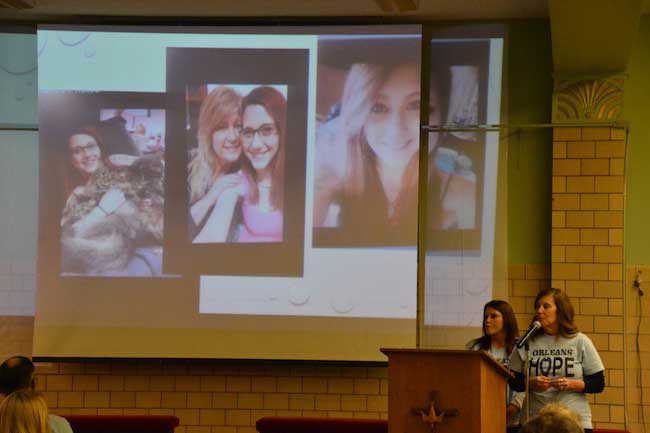
Photos by Tom Rivers: Kim Lockwood, left, of Medina and Kathy Hodgins, director of treatment services for GCASA in Orleans County, address 100 people during a community forum on Thursday night about the opioid crisis. Several people in the county have lost their lives to fatal drug overdoses recently, including Courtney Kenward, 27, of Medina, who died on Nov. 12. She is pictured in the on the screen. The event was held at the Calvary Tabernacle Church, the former Medina High School.
By Tom Rivers, Editor Posted 1 December 2017 at 9:50 am
‘We are bleeding and we are dying. We have to stop these drugs from coming into our community.’ – District Attorney Joe Cardone
Tami Ashton speaks about her daughter’s addiction which ultimately claimed her life on June 27, 2016 at age 34.
MEDINA – There was anger, despair, frustration and hope – all expressed on Thursday night during a community forum about the opioid crisis in the community, which has caused several recent deaths and devastated many families.
“We’re done burying our kids,” said Tami Ashton. “We need to come together as a community and do something and the time is now.”
Her daughter, Christina Ashton, died from a drug overdose on June 27, 2016. Christina had been clean for 19 days. Her mother left the house for a 40-minute errand. When she came back, she found her daughter slumped over and not breathing in the backyard. Someone dropped off heroin and her daughter took all of it. Christina was 34.
“It’s killing our children and destroying our families,” said Ashton, who has become an addiction recovery coach with GCASA.
Thursday’s forum was attended by about 100 people and lasted more than 2 hours. Three people shared how their drug addictions escalated, nearly killing them.
Tiffany Neroni shared how drugs nearly killed her when she was a teen-ager. She has been sober now for a decade.
Tiffany Neroni was only 11 when she started smoking marijuana and taking pills with an older boyfriend. Drugs took over her life as a teen-ager. Her family had to send her away to get the treatment she needed, and not to be a danger to her siblings.
Neroni once was so high she didn’t come home for several days. A missing persons report was filed and she was found in Rochester.
She has been sober now for 10 years and wants to help others as a peer advocate, helping to ensure there is support after an addict completes treatment. Families of addicts also need services, Neroni said.
The addicts “have strengths and skill sets,” Neroni said. “They are valuable to the community.”
With treatment and support, they can be dedicated employees, business owners and other community assets.
A husband and wife from Niagara County shared their story of drug abuse that nearly claimed their lives. The husband needed to be revived with Narcan after a heroin overdose.
The husband was working in construction and injured his back. He took prescribed painkillers. When the prescription expired, he continued to use painkillers and turned to more hardcore drugs, including heroin, which were cheaper to buy than painkillers.
He committed crimes to pay for drugs, and was jailed for burglary and grand larceny. A drug diversion program through Niagara County, which required treatment, helped him to stop the cycle of drug use and crime.
District Attorney Joe Cardone said there is an epidemic of drug addiction in the community and country. “I’m angry about what’s happening in our society.”
His wife also had been using drugs for many years. She credited Vivitrol for helping her to stay clean. Vivitrol is a treatment that blocks the effects of opioid addiction. She hasn’t felt the triggers or pull to use drugs for more than a year.
District Attorney Joe Cardone has been the county’s top prosecutor for about 26 years. The drug crimes when he started tended to be misdemeanors with marijuana and recreational drugs.
Now, the county is facing an “epidemic” with heroin laced with fentanyl which is proving deadly, Cardone said.
“We are bleeding and we are dying,” the DA told the crowd. “We have to stop these drugs from coming into our community.”
He said the best way to fight the drug problem in the county is keep people from using it. He urged residents to let law enforcement know if people are selling drugs in the community. Cardone said he is frustrated with residents who blame others for “snitching” to law enforcement. Cardone said those tips to law enforcement can save lives and prevent misery in the community.
Doctors overprescribed painkillers for years which he said has fueled the national drug problem.
“Every small town in the United States has drugs,” he said. “We have to stop the flow of drugs into our country.”
Her praised the effort by GCASA and the Sheriff’s Office to have more treatment and services for residents battling drug addiction.
“Thank God for GCASA. Thank God for the sheriff and what he is doing,” Cardone said. “But it’s only a Band Aid.”
Kathy Hodgins, the director of treatment services for GCASA in Orleans County, said there are many services available in the county to assist people fighting addictions. She urged people to stop by GCASA in Albion, 249 East Ave., or call at (585) 589-0055.
Don Snyder, a chaplain for the Orleans County Sheriff’s Office, wants the community to lift the stigma for people suffering from drug addictions.
The Sheriff’s Office has started a new CARES program that links people leaving the jail or treatment programs with volunteer mentors.
Don Snyder, a retired chaplain who worked in state prisons, is volunteering as a chaplain for the Sheriff’s Office and helping people go through the training to become a mentor or recovery coach.
Addicts recover “in different ways and at different speeds,” Snyder said. He urged the community to not attach a stigma to people fighting addictions.
Many have been pulled into drug abuse through painkillers, or from using drugs to mask other pain or childhood trauma.
Scott Wilson, the county’s jail superintendent, said the jail has stepped up its services for addicts connecting them to treatment programs, health insurance and Vivitrol. The county pushes to have a transition from the jail to GCASA or another treatment program.
Sheriff Randy Bower said Narcan has proven a life-saver in the county with 26 people saved from a fatal overdose this year in Orleans County. Those are just the calls to the 9-1-1 center. Bower said more Narcan doses may have been administered without a 9-1-1 call.
GCASA has been offering Narcan training and giving away the doses. On Thursday, there was a training at the end of the meeting and people were given Narcan nasal sprays.
“Narcan continues to make a difference in saving someone’s life,” said Diana Fulcomer, a prevention educator with GCASA.
ALBION – Hospice of Orleans is pleased to announce that it has received a generous grant for furniture upgrades to the Martin-Linsin Residence which opened in 2012. A check in the amount of $10,000 was received through the Orleans County Foundation, Inc.
“The Martin-Linsin Residence has served nearly 200 patients and their families since opening its doors in 2012,” said Brittany Dix, Development Manager. “Our staff has discovered some typical wear and tear on some of the well-used furniture.”
The grant will allow Hospice to purchase furniture in each of the patient rooms as well as in the communal area, and also will allow for the purchase of larger televisions for each of the patient rooms.
“This is especially significant as some patients spend a good deal of their time in their rooms, and watching television is something they can initiate independently,” Dix said. “This furniture upgrade and purchase of larger televisions will undoubtedly have a positive impact on the quality of life for our patients and the family members that visit.”
Hospice of Orleans extends sincere gratitude to the Elizabeth Dye Curtis Trust and the Orleans County Foundation for this very generous grant and helping Hospice of Orleans to provide care that is about living.
For more information on Hospice of Orleans, Inc. services and supports, call the office at 585-589-0809 or visit the website at www.hospiceoforleans.org.