

















Green Orleans hosts discussion on AI, data center project proposed for STAMP
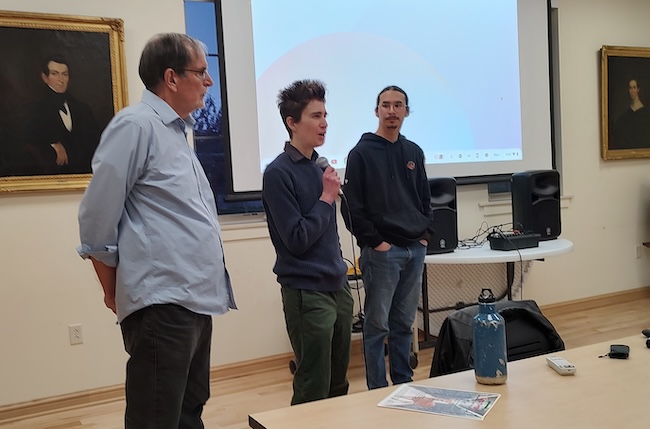
Photo by Kim Remley: Green Orleans sponsored a discussion last week at Hoag Library about a proposed data center at the STAMP site in Alabama, NY. From left to right, David Giacherio (Green Orleans and Oak Orchard Neighborhood Association), Sarah Howard (Allies of the Tonawanda Seneca Nation), and Grandell “Bird” Logan (Tonawanda Seneca Nation).
Press Release, Green Orleans
ALBION – Approximately 50 Orleans County residents recently gathered at the Hoag Library for a Green Orleans sponsored presentation on the mega data center proposed for the STAMP site in Alabama, NY.
The evening was kicked-off by Dave Giacherio, a retired scientist and professor, representing Green Orleans and the Oak Orchard Neighborhood Association. Giacherio posted a quote that set the tone for the evening’s presentation. It read: “Nothing that is vast enters the life of mortals without a curse” (Sophocles, circa 480 BCE).
Giacherio gave a broad-brush overview of artificial intelligence (AI), because the rush to build data centers around the nation is closely linked to AI. Data centers function as the “brains” for AI, carrying out the incredibly large number of calculations needed to answer AI queries.
He noted AI offers both great promise and great risks. The promise includes massive increases in efficiency and productivity across all of society, a revolution in healthcare, and large advances in science and technology. He gave an example where AI readily solved the extraordinarily difficult bio-science problem of protein folding.
The risks of AI include massive economic and social disruption (including huge job losses), societal risks from people using AI for criminal purposes, and the risks from AI itself acting against the best interests of humanity.
Giacherio gave examples where AI urged a young man to commit suicide, where AI provided instructions for preparation and dispersal of toxic pathogens, and where AI helped plan a school shooting.
The current rush to develop AI and build data centers does not include appropriate measures to ensure human safety. Giacherio claimed that what is needed is a pause in the manic rush to develop AI and data centers, and a reimagining and redirection of AI so that humans and their concerns are “in the loop.”
Sarah Howard of the Allies of the Tonawanda Seneca Nation focused on health and environmental concerns. Low-frequency noise, which is emitted by such hyperscale data centers can travel several miles and would be heard by some Orleans County residents.
Persistent exposure to noise, especially low frequency noise, causes physical health problems such as hearing loss and tinnitus, as well as emotional distress. This noise will also impact wildlife in the surrounding public-protected areas. Also, the 24/7 lighting will affect birds, including migratory birds (light pollution affects migratory fly-path navigation).
Wastewater discharge from the proposed data center will flow into a tributary of the Oak Orchard Creek via the Village of Oakfield wastewater treatment facility – inevitably impacting the $28 million/year sportfishing industry. The Orleans County coordinator of Sportfishing and the Seth Green Chapter of Trout Unlimited have expressed opposition and concerns.
Next up was Grandell “Bird” Logan of the Tonawanda Seneca Nation (TSN). Logan did a short review of the history of the Tonawanda Seneca people, noting that their territory has shrunk dramatically over the last centuries. He talked about the “Big Woods”, a section of old-growth forest on the reservation that is rich in plant and animal life, and which is culturally central both to the TSN and to other tribes around the country.
The STAMP site is adjacent to the TSN and the Iroquois National Wildlife Refuge. Logan explained that there is only a 400-foot buffer between it and the Tonawanda Seneca Nation’s federally recognized reservation territory.
He noted the risks of noise pollution, air pollution, and groundwater pollution from a gigantic data center so close to their homeland. Logan stressed that humans are not the only creatures that can be affected – the rich animal and plant life of the reservation could also be at risk.
The evening’s presentation ended with a vigorous discussion with the audience.
Green Orleans is a small grassroots organization committed to the preservation of our environment. The organization holds its meetings on the third Thursday of every month at 11:30 a.m. at the Hoag Library. All are welcome.