



















From Lyndonville High to the College Soccer Field: Austin Fonda
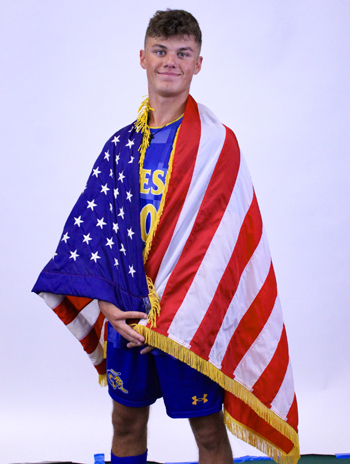
Photo by Ethan Heim – Austin Fonda posing with an American flag.
Press release from the Lyndonville School District
For more than 8 million high school students across the country, sports are a part of the high school experience. But for a much smaller percentage, those athletic careers continue beyond graduation.
For Austin Fonda, a 2026 graduate of Lyndonville Central School District, the final whistle of his high school career was not the end of his athletic journey. Instead, it marked the beginning of something new.
Fonda is now playing soccer at Genesee Community College (GCC), becoming just the second Lndonville student in a very long time to continue competing at the college level.
Although Fonda always hoped to play college sports, he originally imagined a different path. He planned to pursue baseball, but when that opportunity did not work out as expected, Fonda took a chance and tried out for the soccer team.
“I’ve had a lot of people, even opposing coaches, tell me that I could go further in soccer if I wanted to,” he said.
That chance changed the direction of his athletic career.
For Fonda, becoming a college athlete is an accomplishment he once thought might be shared by more of his teammates.
“It felt surreal,” he said. “I didn’t realize I would be one of the few teammates to choose this route of college athletics.”
His path ultimately led him to Genesee Community College, but he is quick to point out that he did not get there alone.
Fonda said there are far too many special people to name when discussing those who have helped him reach this point, but his family is at the center of that support system.
“My family is my cornerstone,” he said.
His father encouraged him for years to get into the gym, work in the field and continue developing himself as an athlete day by day.Fonda also pointed to former Lyndonville coach Joe Smith as an important influence. Fonda played under Smith for three years and has continued to stay in touch with him. Smith also served as a reference when Fonda was pursuing college soccer.
“He was such a bright, good person,” Fonda said. “Talking to him will make you smile no matter what. It’s not a trait a lot of people have.”
Another coach left an especially lasting impression on Fonda: Wes Bradley.
Bradley was an important coach during Fonda’s junior year, and Fonda remembers attending Bradley’s wake during the season.
“He was someone I looked forward to seeing at practice every day,” Fonda said.
Bradley’s approach to coaching went beyond what happened during games. After every away game, Fonda recalled, Bradley would sit down with every player on the bus. He would shake each player’s hand and talk with them about what they had done well and what they could improve, often with his notepad in hand.Bradley remembered what players had worked on in practice and what they had learned from the people around them.
“He was very impactful on me,” Fonda said.
Those lessons continued through Fonda’s relationships with his teammates. He credits them with helping shape him into a better player and person, teaching him about patience, kindness, honesty, communication and taking responsibility for mistakes.
He also learned how important it is to control his emotions.
“You need to keep your emotions in at times,” Fonda said. “If it comes out on the field, you will pay for it. Your emotions have to be left on the bench so you don’t end up sitting with them on the bench.”
Instead of allowing frustration to spill over onto teammates, Fonda learned to step back and reflect, asking himself what he could do differently the next day, whether that meant improving hver time, those lessons in communication and leadership helped turn a group of teammates into something more.
“It’s family,” Fonda said. “A team doesn’t go to a wake. A family does. A group of brothers does. It’s not a group of people you see for two hours a day. It’s family.”
College soccer has brought a completely new experience, with higher expectations and more commitment.“It is fast-paced,” Fonda said. “Practices are quick and difficult.”
Fonda said the players often walk back to the dorms together after practice, laughing and spending time together.
“I love these guys,” he said. “I love being on the same pitch as them.”
One of the most unique aspects of playing at GCC is the international makeup of the team. Fonda is one of only three Americans on the roster, with players representing 12 countries.
Being one of the few Americans has put Fonda in the position of being the “odd one out,” something that is new for him. He has even been trying to learn different accents to communicate more effectively with his teammates on the field.
“It is such an enriching experience because there are so many different languages,” he said. “It is a whole new world to experience. And I am loving every second of it.”
While soccer has opened the door to college for Fonda, he already has his sights set on what comes next. After completing approximately 40 GCC credits while still in high school, he hopes to graduate this spring with his associate degree in Teaching Sciences.
He plans to take college tours in the fall as he searches for a school where he can continue his education, with the goal of eventually earning a degree in elementary education.
And while soccer has helped take him to college, Fonda believes its impact on his life goes far beyond athletics.
“Without soccer, I would be nowhere close to the person I am today,” he said. “The people you meet, the coaches, the teammates, even the opponents.”
That perspective is also at the heart of the advice he would give to younger athletes hoping to compete at the college level.
Fonda emphasizes commitment. His advice is simple: keep your head down, work hard and stay focused.
He remembers receiving an email while on vacation informing him that practice would begin at 5 p.m. Monday.
His response was simple: “Yes, Coach.”
Rather than treating vacation as an excuse to take time off, Fonda spent several days preparing himself.“I would run on the beach,” he said.
But commitment, he said, is only part of the equation. Athletes also need resilience.
“You have to want nothing more than to be on that field,” Fonda said. “You exercise and gain strength. Athleticism can come through genetics, but you still have to work for it.”
He learned the same lesson through injury. After taking a hard fall while playing basketball,
Fonda dealt with pain for weeks. Rather than stop exercising altogether, he found ways to continue training.
“If my lower body hurt, I would exercise my upper,” he said.
For Fonda, resilience is as much mental as it is physical.
“Your brain can be your strongest muscle if you use it right.”
Now, as he continues his college soccer career and looks ahead to a future in education, Fonda is carrying the lessons he learned in Lyndonville with him, including the importance of hard work, resilience, leadership and the people who make the journey worthwhile.
“I’m very grateful for this opportunity,” Fonda said. “I am proud of myself for the accomplishment, and I am thankful to everyone who has helped me along the way.”