



















During winter’s deep freeze, trees find ways to protect themselves from cold
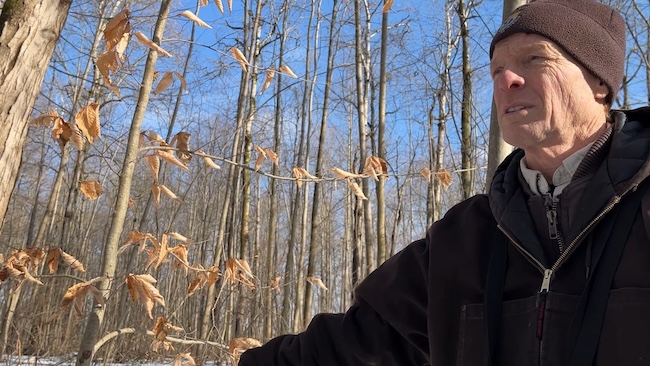
Photos courtesy of Patti Singer: Paul Hess, a wildlife biologist with the Iroquois National Wildlife Refuge, points out the leaves still on a beech tree. Beeches and some oaks hold their leaves all winter, until new growth pushes them off in the spring.
Courtesy of Patti Singer, contributor to Friends of the Iroquois National Wildlife Refuge
BASOM – The sun was out and the temperature on this early January day was in the 40s. Along the Kanyoo Trail at Iroquois National Wildlife Refuge, a light breeze stirred branches of trees that were waiting for a few more months to pass.
James Ianni examines a black cherry tree.
“They’re just trying to survive and protect themselves,” says James Ianni, a biological science technician. “They already have their buds ready for spring. Their job right now is to stay alive so those buds are usable as rapidly as possible in the spring.”
Trees spend the end of one summer preparing for the next, and they need to protect that work.
“They do a lot of things in the fall to get ready for winter,” says Paul Hess, wildlife biologist. “They’ve got a lot of mechanics to prepare themselves for a New York winter.”
Deciduous trees drop their leaves so they don’t lose water and dehydrate. Hess said the trees also increase their sugar content, which acts like antifreeze for their cells. Beeches and some oaks keep their leaves through winter, a protective mechanism for those species.
“All the active growth in a tree is around the outside, near the bark,” he said. “What they try to do is keep those cells alive.”
Paul Hess shows a swollen area on an ash tree where emerald ash borers may have gotten into the trunk.
Trees enter a dormant phase the way some animals hibernate, is how Dave Shepherd, a volunteer at the refuge and a member of Friends of Iroquois National Wildlife Refuge, explains the process on his Walks in the Woods programs. He give talks on identifying trees and the forest ecosystem. When he leads a walk in the fall, he talks about what trees do so they don’t freeze over the next few months.
“I ask people to think about a bear hibernating and what you know about how that works,” says Shepherd, who is certified as a New York State master naturalist through a program administered by Cornell University. “They bulk up in the summertime so they live off their fat reserves. The heart rate goes down.”
Trees break down chlorophyll and also store their energy, so “in a very broad sense, they are analogous,” Shepherd said.
Once temperatures get consistently warmer in March, the tree’s energy comes back through the trunk to the branches and into the buds.
Even though this January day seemed to catch the trees in a slumber, they offered plenty to Hess and Ianni as the two walked the Kanyoo Trail.
“There’s a bunch of stories to trees,” said Ianni, whose interest in photographing birds led him to appreciate trees.
“I thought they were cool because they’re weird and they don’t talk, and how do you understand things that don’t make sounds or talk. … They don’t move, so they’re easy to look for. You can walk right up to a tree … and stare at it and study it for a long time.”
He can tell by looking whether a tree is stressed, such as a cherry tree with tattered and broken limbs. Trees with wide, umbrella-shaped canopies grew when there was little competition for sunlight, unlike a tall, narrow tree.
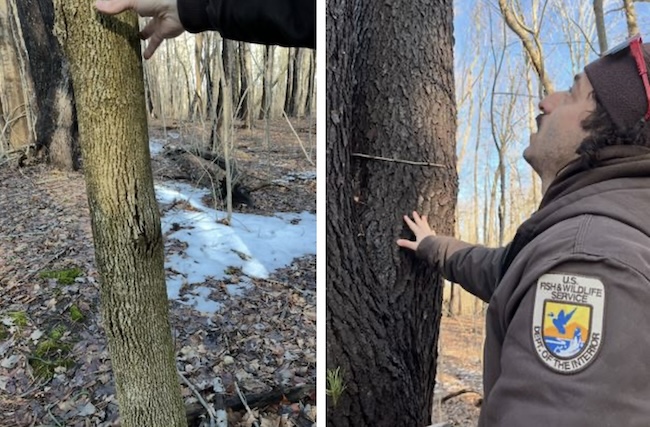
(Right) James Ianni, biological services tech, describes the curled cups on the bark of a black cherry as looking like black potato chips. (Left) James Ianni points out larvae tracks near sapsucker holes on a dead tree.
Bark, besides being used to identify the species, can tell about the health of the tree.
Hess pointed out an ash tree that looked swollen in one spot where the bark was split and said that the invasive emerald ash borer might be killing the tree. He pointed out another tree with a gaping hole, which he said could be housing wildlife either in the cavity or elsewhere in the trunk.
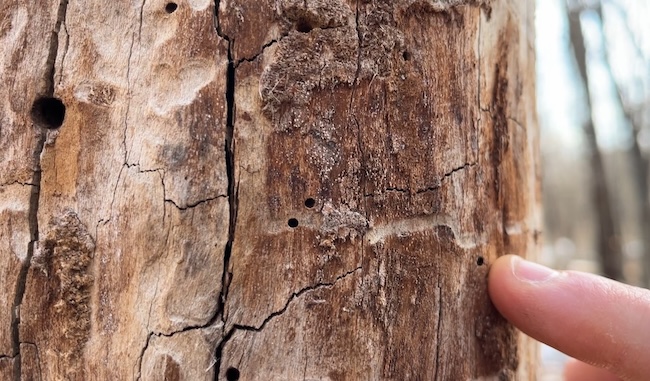
Ianni walked up to a trunk stripped of its bark and studied insect holes. “You’ve got some sapsucker holes, probably from when it was alive.” Sapsuckers pop holes into a living tree to allow the sap to flow, which attracts insects, and come back to eat the insects and sap.
The direction of downed trees can indicate prevailing winds or a storm.
“If you’re out in the woods and wondering where the really strong winds come from, just look at the direction that the trees are lying down,” Ianni said. “And the growth habit of the branches. If you’re up hiking in the Adirondacks and you look at the trees and the right side of the tree doesn’t look as happy as the left side of the tree, then the right side of the tree probably gets more wind.”
The clues from individual trees tell the bigger story of the forest.
“They make the forest what it is and provide habitat and food for all kinds of other creatures that wouldn’t be here if it wasn’t for them,” says Hess, a birder who had his ear out for nuthatches and his eye on old nests. “You can look at individual trees as you’re walking around and see what you need about that individual tree. … But then also it’s kind of forest-for-the-tree sort of thing. You step back and you look at it as part of a whole system. There’s a whole lot more going on when you look at it that way.”
Patti Singer is a freelance writer and a retired reporter from the Rochester Democrat and Chronicle.