
















Local officials wrestle with how to best provide EMS in era of rising costs
Shortage of ambulances, EMTs result in slower responses, dropped calls; Countywide model could be in the future
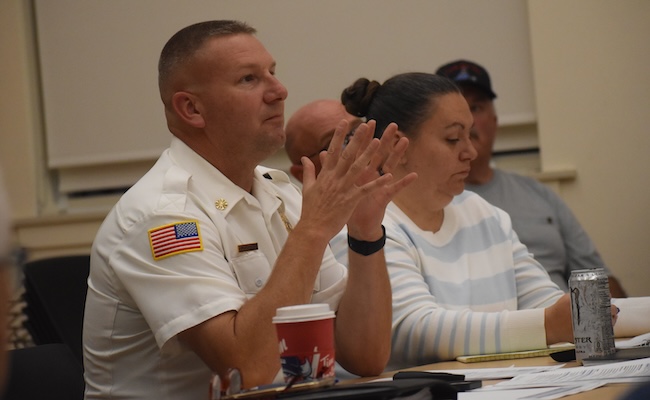
Photos by Tom Rivers: Justin Niederhofer, the Orleans County emergency management director, speaks during an Orleans County Shared Services meeting last Thursday at Hoag Library in Albion. Next to him is Audra Fisher, a secretary in the Emergency Management Office.
ALBION – Municipal leaders in Orleans County are trying to stabilize the EMS system in the county and develop a long-term plan for a rising demand for EMS and ambulance responses.
EMS/ambulance calls went up 11.2 percent or by 556 calls from 4,965 in 2024 to 5,521 in 2025. The response calls for 11 fire departments in the county increased 12.4 percent or by 464 calls from 2024 to 2025 – from 3,755 calls to 4,219.
The total call volume is up 11.5 percent or by 1,046 from 9,105 in 2024 to 10,151 in 2025.
A report looking at the EMS and fire resources and response in the county finds a shortage of firefighters, EMTs and other first responders despite the rising calls.
Local leaders are taking a staggered approach to address issues outlined in the study, with EMS the first priority due to shortages in EMS personnel, rising response times and increasing costs.
There is also a shortage of firefighters in the county, putting more demand on mutual aid, especially during weekday peak call hours, the typical workday when many volunteers are at their regular jobs.
“We’re getting close to the stage of system failure,” Justin Niederhofer, the county’s emergency management director, said about the demand on the volunteer fire departments. “Mutual aid is at an all-time high.”
About 30 officials from local municipalities, fire departments and districts, and the county met last Thursday at shared services meeting at Hoag Library to establish working groups on the issues. Niederhofer will lead the EMS group, which needs to have a report to the state by Dec. 19.
The report needs to assess EMS coverage in each area of the county, identify gaps and how they will be filled, designate the provider and organizational structure for each area, estimate costs and how those costs are assigned, and identify any intermunicipal agreements or special districts needed.
The state is requiring all counties to submit a County EMS System Plan by Dec. 19. The Orleans County plan will be submitted to the state Department of Health, Big Lakes Regional EMS Council, and the State EMS Council.
Much of the local data already available from the EMS and fire service study completed in June .
The study shows call volume, response times, dropped calls, GIS coverage mapping, provider costs. the remaining work centers on the service model, provider designations, cost estimates and cost assignment.
Much of the local data already available from the EMS and fire service study by the Municipal Resources Inc. Its final report included 59 recommendations, with eight identified as highest priority.
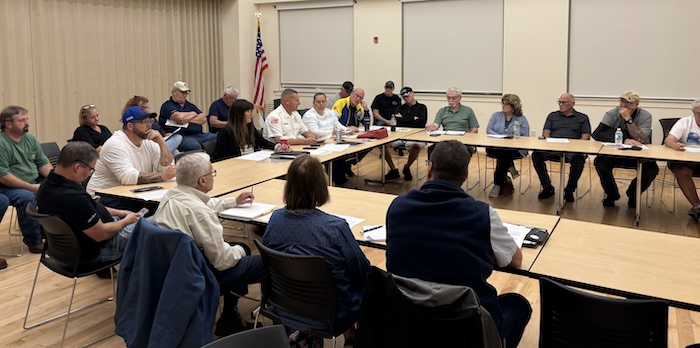
County Legislature Chairwoman Lynne Johnson, in black next to Niederhofer, speaks at the beginning of last week’s shared services meeting with a focus on EMS services. “Our challenge is taking a hard look at the information in front of us, hearing different perspectives, and identifying solutions that are effective,” she said.
Lynne Johnson, Orleans County Legislature chairwoman, said the leaders of the county, towns, villages and emergency service providers all face their own challenges every day, and have their own perspectives.
“But despite these potential differences, we share the same fundamental goal: keeping our residents safe and making sure they have access to high-quality emergency services when they need it,” she said. “there are no easy fixes but we can have an open discussion, listen to each other, and start to develop a path forward to best serve Orleans County residents.”
Right now the Medina Fire Department is the primary ambulance provider for western Orleans for the towns of Shelby, Ridgeway and Yates. Mercy EMS serves the seven other towns in central and eastern Orleans – Albion, Barre, Carlton, Clarendon, Gaines, Kendall and Murray.
Medina village officials say the ambulance service costs the village about $1.3 million a year. It wants the three towns to increase its contribution for the service from $35,000 annually to $135,000.
Yates Town Supervisor Jim Simon said that is a big increase for the town. He has reached out to Mercy EMS about serving Yates.
“We’re concerned about the town of Yates being treated fairly,” Simon said about the contract with Medina.
The seven towns in 2027 will pay Mercy $300,000, with each town paying based on its share of call volume. The towns have asked for an more ambulances which would increase the total amount to $500,000 in a new contract for eight towns with Yates included. Yates would only have to pay $11,000 because of its low call volume.
That agreement is yet to be settled, and it impacts how the other towns will pay and receive coverage. The towns are all working on their budgets for 2027 with the budgets typically voted on in November.
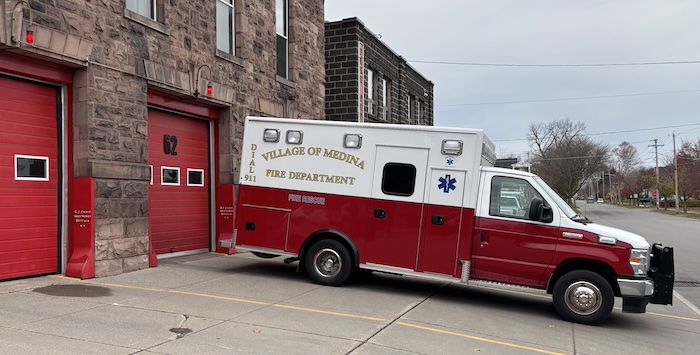
An ambulance at the Medina Fire Department is parked outside the fire station. Medina handles the majority of EMS calls on the western end of the county but village officials say too much of the cost of the service is paid by village taxpayers.
Simon, during last week’s meeting, said there is no uniformity on how the towns pay, with Medina charging a set amount regardless of call volume while the Mercy EMS contract has varying amounts for the towns based on the number of calls.
Mercy EMS keeps ambulances in Albion at the former COVA headquarters and also is partially based out of the Fancher-Hulberton-Murray fire hall in Murray. With the expanded $500,000 contract, Mercy would add an ambulance in Carlton.
Mercy EMS’s contract currently calls for two 24/7 basic life support ambulances and one 24/7 advanced life support fly car. Steve Coville, the Barre town supervisor, said the towns would like more coverage, including an advanced life support ambulance for 12 hours.
“We want to save people’s lives but we don’t want the townspeople to go broke either,” he said during the meeting last week.
In the study by Municipal Resources Inc., three options were identified to stabilize EMS service in the short-term and long-term.
Option 1. County-operated EMS – A county-run EMS system for the entire county, which would require a staff of about 60, Niederhofer. It would take major capital and workforce requirements, and a long-term step toward fire services augmentation.
Option 2. Enhanced contract with Mercy EMS – Mercy EMS is the primary ambulance provider for seven towns in the county. The contract could be renegotiated for enhanced, performance-based service with additional units, strategic posting of ambulances, response and quality of care standards, and corrective-action triggers.
Option 3. County Peak-Hour Unit – A county-staffed Advanced Life Support ambulance as a backup and gap-filler to Mercy EMS and Medina Fire Department during weekday peak hours. It could be a step toward an eventual county ambulance and volunteer fire service augmentation.
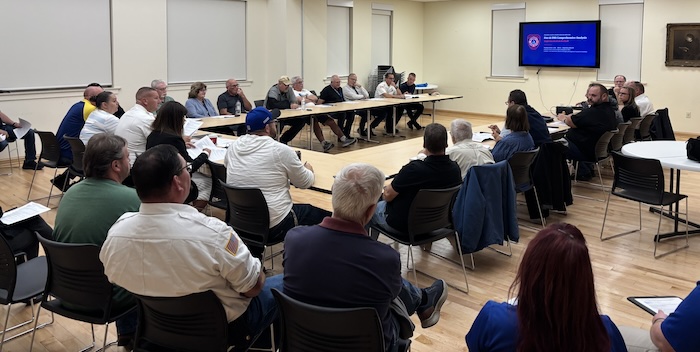
Local officials discuss the EMS service in Orleans County during a meeting last Thursday at Hoag Library.