
















Public asked to assist in tracking double-crested cormorants
These birds viewed as threat to recreational fishing industry
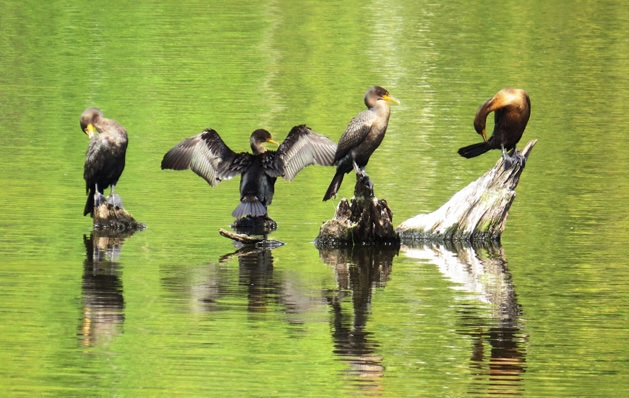
Photo of double-crested cormorants by Donna Stanley/U.S. Fish and Wildlife Service.
Press Release, New York Sea Grant
OSWEGO – New York Sea Grant, a collaborative program of Cornell University and the State University of New York, is inviting the public to document the presence, activities and impacts of double-crested cormorants.
Double-crested cormorants are a native, fish-eating, federally protected migratory bird species. New York Sea Grant partnered with Wayne County GIS to develop an online reporting tool at https://nyseagrant.org/cormorant for the public to upload photos and report observations of double-crested cormorant numbers, nesting, and feeding activities.
The survey includes options for logging the birds’ impact to natural habitat, water quality, infrastructure, and recreational usage. The survey developers strongly encourage users to submit photos to show the birds’ activity and impact.
Although originating in Wayne County, the nyseagrant.org/cormorant survey is designed for use by the public across New York’s Great Lakes region and statewide. The site includes a link to an observation viewer to see updates in real-time and as a resource for New York State, American, Canadian, and other environmental, wildlife and fisheries resource managers.
“This new reporting tool responds to local leaders’ interests in having a way for community members to report, track, and share with resource managers information about double-crested cormorant activity statewide,” said New York Sea Grant Associate Director Katherine Bunting-Howarth.
Double-crested cormorants utilize the Great Lakes region for breeding, with nesting colonies of a few dozen birds to more than a thousand pairs. Their droppings can destroy the trees and vegetation below their nests.
The birds’ wide-ranging diet of fish is a cause of concern for the recreational fishing industry. Double-crested cormorants were identified as a serious issue by New York’s charter fishing industry during industry meetings held by New York Sea Grant along New York’s Great Lakes-St. Lawrence River shoreline.
“In meetings in Oak Orchard, Irondequoit, Oswego, Henderson, and Alexandria Bay, charter captains expressed concerns about increasing populations of double-crested cormorants and interest in seeing more research on the birds and their predation of fish, particular after stocking,” said New York Sea Grant Great Lakes Fisheries and Ecosystem Health Specialist Stacy Furgal.
Double-crested cormorants, their nests, and eggs are all federally protected under the Migratory Bird Treaty Act updated by the U.S. Congress in 1972.
New York Sea Grant is one of 34 university-based programs under the National Sea Grant College Program of the National Oceanic and Atmospheric Administration. New York Sea Grant’s statewide network integrates research, education, and extension services focused on coastal community economic vitality, environmental sustainability, and citizen awareness and understanding about New York’s Great Lakes and marine resources.