

















In 1890s, new Oak Orchard-on-the-Lake community touted for ‘pure air and cool breezes’
Early appeal of site: ‘No beer or liquors may be sold on any part of this property’
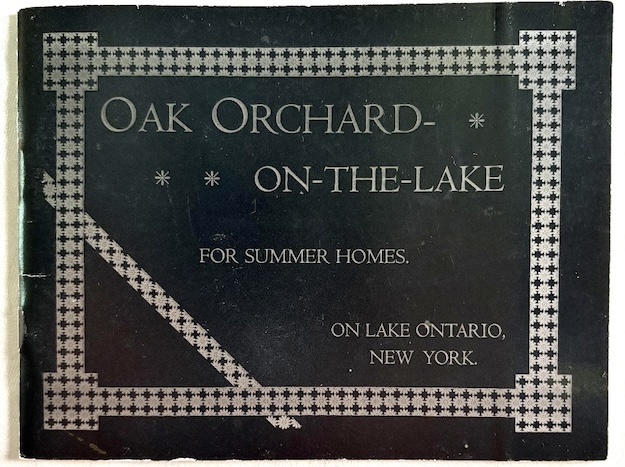
In 2004, the Oak Orchard Harbor Light Committee reprinted the marketing booklet originally produced by the Oak Orchard-on-the-Lake Committee.
By Catherine Cooper, Orleans County Historian
“Illuminating Orleans” – Volume 6, No. 17
 CARLTON – “Here we escape the Summer’s heat
And gain new life and strength”
Around the turn of the last century, the lucrative potential of Orleans County’s assets attracted a variety of speculators. In 1911, a group of New York city investors who had incorporated as the Western New York Farm Company, acquired a large swath of swamp land in the southern end of the county and developed it for agricultural purposes.
Prior to that, in 1891, a group of Buffalo area businessmen incorporated as the Oak Orchard-on -the-Lake Company and purchased four hundred acres of land located on the west bank of Oak Orchard Harbor and along the south shore of Lake Ontario.
With a General Office at 39 Chapin Block in Buffalo, the Officers and Directors of the company were: Edwards D. Emerson, President; George T. Wardwell, Vice-President; Frank E. Sickels, Secretary and Charles H. Robinson, Treasurer. Emerson was a Standard Oil manager in Buffalo, Wardwell and Sickels were Buffalo attorneys, while Robinson was chairman of the J.L. Hudson Company, Buffalo clothiers.
As they described it “the land gently slopes toward the lake and for nearly a mile is bounded by a beautiful unbroken sandy beach that allows unobstructed access to the water of the lake.” The property also included water frontage of three quarters of a mile on Oak Orchard Creek “one of the most picturesque streams in Western New York.”
“The lake and creek fronts of this property will be offered for summer homes, while the remaining land will be so worked as to be a never-failing source from which cottagers can draw those necessities which are required for the refreshing of ‘the inner man.’”
The promotional booklet’s flowery prose extols the joys of cottage life, “the unexcelled advantages which it offers for sports, boating and bathing; of the pure air and cool breezes which it furnishes its cottagers; of its healthfulness, freedom from dangers for children; of the social life, refined and yet jolly, which characterizes the place…”
The company had a local office at 2 Swan’s Block in Albion. Dwight C. Beckwith, a wholesale apple shipper and lumber merchant was the local General Manger.
The lake and creek frontage was subdivided into building lots, each with a minimum of fifty feet of frontage. Lot prices ranged from $100 upwards. Generous terms were offered: “We shall be content with a small cash payment and the balance in small weekly or monthly installments.”
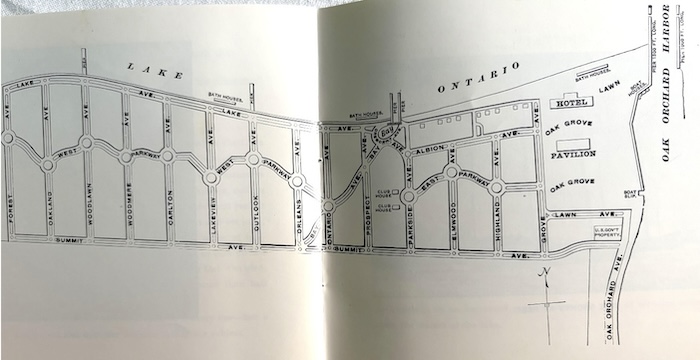
Recognizing the desirability of a water view, the company produced a layout which set the streets at right angles from the shoreline. This, combined with a gradual rise from the water’s edge, assured each cottage an unobstructed view.
A promotional article in the Times-Union, May 23, 1892, claimed that “the special feature which will render this a most desirable summer resort is that no beer or liquors may be sold on any part of this property.” In the summer of 1897, the Buffalo News reported that the cottages at Oak Orchard-on-the-Lake are filled to overflowing.”